A1 · Beginner
Oman National Day: Lights, Flags, and Celebrations
Every November, people across Oman celebrate National Day. Cities shine with bright lights, families gather together, and dancers perform in historic forts.
The story of National Day
Oman National Day is officially observed on 18 November to commemorate national sovereignty and statehood. The date marks the historic expulsion of Portuguese forces in 1650 under Imam Sultan bin Saif of the Ya'aruba dynasty. This military victory established Oman as the oldest continuously independent sovereign state in the Arab world.
The holiday also commemorates the 18 November 1940 birth of late Sultan Qaboos bin Said, architect of the modern Renaissance. The modern era of development began in 1970, transforming national education, healthcare, and road infrastructure. His Majesty Sultan Haitham bin Tarik continues this sovereign legacy under a renewed framework of national modernization.
The official holiday and time with family
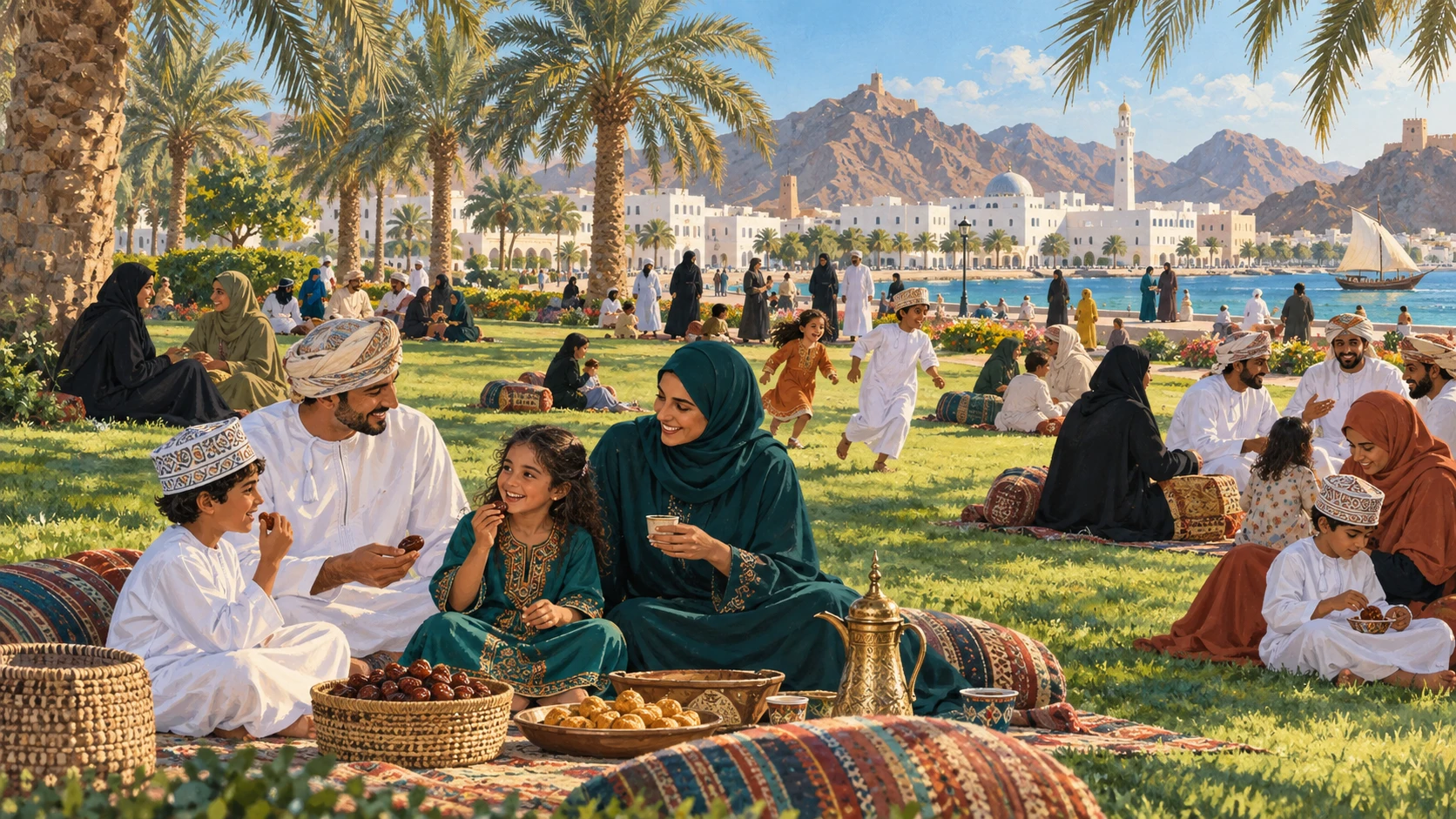
The Ministry of Labour issues official ministerial decrees designating the specific dates for the public holiday. The holiday typically spans two consecutive paid days off for employees across both public and private sectors. When 18 and 19 November fall on weekends, statutory decrees designate substitute weekdays to preserve the full rest period.
Essential service personnel who work during the holiday receive compensatory rest days or statutory overtime compensation. Commercial banks, government offices, and academic institutions close during the officially proclaimed holiday period. The extended holiday creates an annual peak in domestic travel and family gatherings across regional governorates.
Royal speeches and military parades
The head of state delivers an annual Royal National Day address reviewing strategic achievements and national priorities. A grand military parade features synchronized ceremonial drills by the Sultan's Armed Forces and Royal Guard of Oman.
Royal Oman Police bands perform bagpipe processions and ceremonial equestrian demonstrations during civic ceremonies. Distinguished citizens, public servants, and military officers receive national medals and honorary civil orders. Public buildings across Muscat display large royal portraits and ornamental crests featuring the national emblem, while official diplomatic receptions host foreign dignitaries and ambassadors to reaffirm international partnerships.
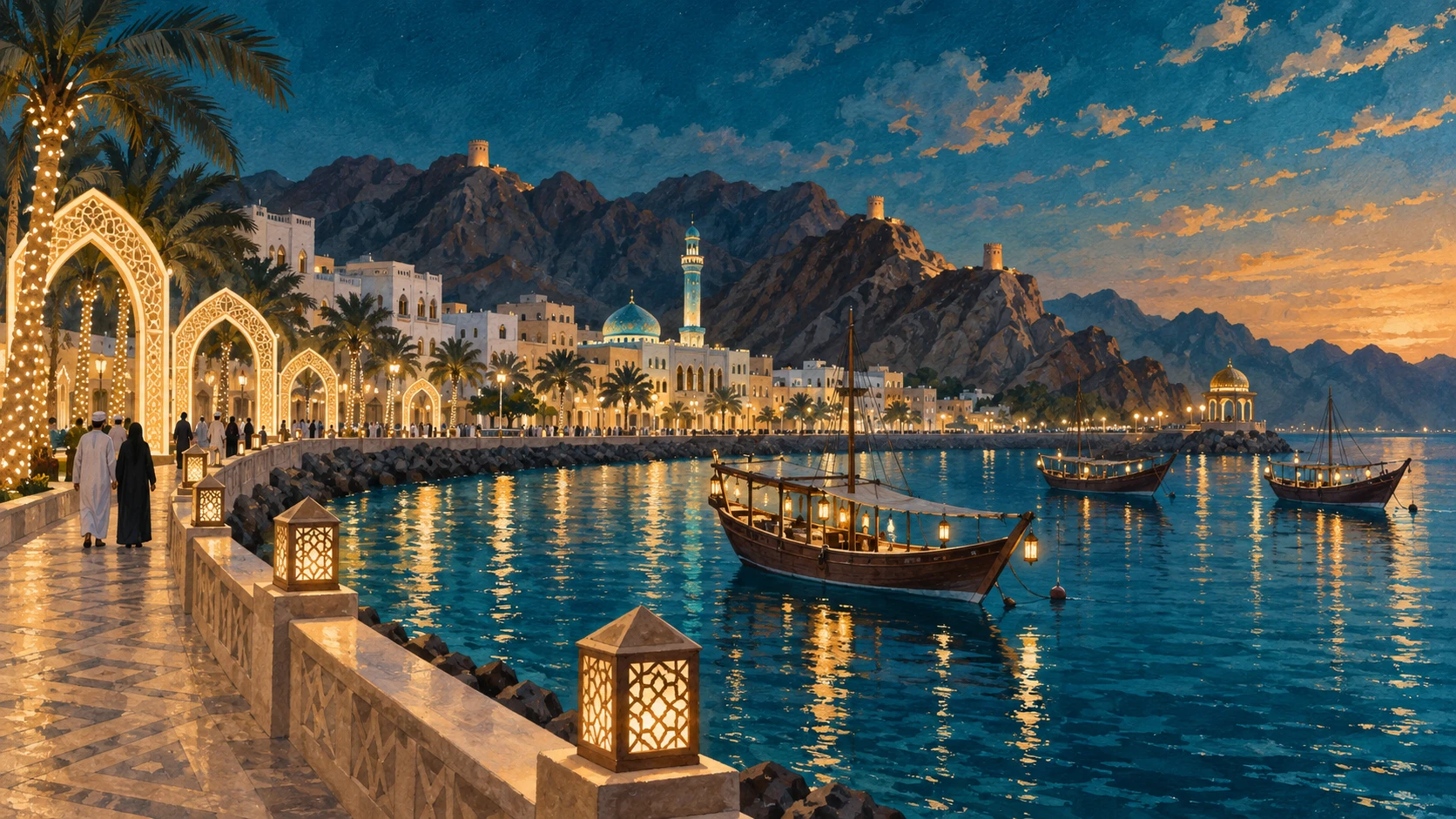
Bright lights and colorful street illuminations
Municipal authorities install thousands of colorful light arches and geometric LED motifs across major boulevards. Prominent architectural landmarks including the Sultan Qaboos Grand Mosque highway and Matrah Corniche glow with evening lights.
The national colors of white, red, and green dominate civic decorations, public plazas, and ornamental roundabouts. Dazzling public fireworks displays light up the evening skies above Muscat, Salalah, and interior provincial capitals. Motorists decorate private vehicles with national flags and decals following strict Royal Oman Police safety rules, while waterfront promenades fill with pedestrians strolling among glowing palm trees and temporary decorative water fountains.
Music, dances, and sweet halwa
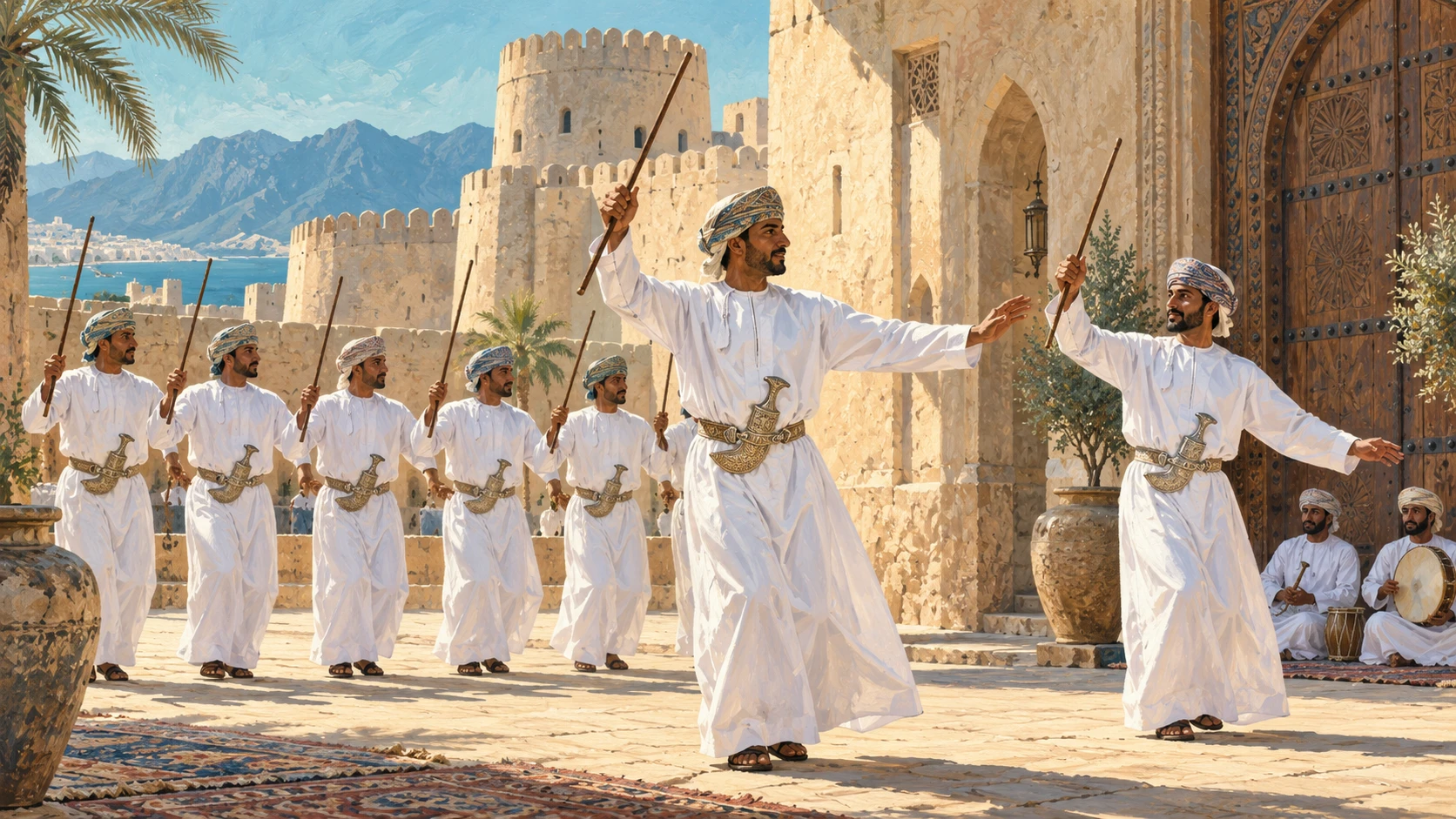
Historic forts and village squares host traditional folk arts including the ceremonial Razha sword dance. Performers wear formal white dishdashas, embroidered massar turbans, and silver khanjar curved daggers. Traditional poets recite celebratory qasidas praising Omani heritage, bravery, and geographic beauty.
Musical ensembles perform ancient maritime sea chanteys and rhythmic Bedouin al-Ayyala group dances. Communities prepare large copper cauldrons of celebratory Omani halwa and distribute spiced cardamon coffee. School children across every wilayat participate in patriotic musical pageants and traditional folklore exhibitions.
Holiday travel and future goals
Families take advantage of the long weekend to visit ancestral villages, desert camps, and mountain resorts. Hotels and heritage inns in Nizwa, Jebel Akhdar, and the Wahiba Sands report maximum holiday occupancy rates.
Civic volunteer groups organize public park clean-ups and community tree-planting activities over the holiday. The holiday reinforces social solidarity among diverse governorates from Musandam in the north to Dhofar in the south. Youth organizations host sports tournaments, cultural exhibitions, and entrepreneurship showcases during the festival week, as national celebrations reaffirm public commitment to the social, economic, and cultural goals of Oman Vision 2040.
A2 · Elementary
Oman National Day: Sovereignty, Heritage, and Public Celebrations
Every November, Oman honors centuries of sovereignty and five decades of modern renaissance. Citizens and visitors enjoy colorful illuminated boulevards, military parades, and traditional music.
Historical origins and the modern Renaissance
Oman National Day is officially observed on 18 November to commemorate national sovereignty and statehood. The holiday marks the historic expulsion of Portuguese forces in 1650 under Imam Sultan bin Saif of the Ya'aruba dynasty. This military victory established Oman as the oldest continuously independent sovereign state in the Arab world.
The holiday also commemorates the 18 November 1940 birth of late Sultan Qaboos bin Said, architect of the modern Renaissance. The modern era of development began in 1970, transforming national education, healthcare, and road infrastructure. His Majesty Sultan Haitham bin Tarik continues this sovereign legacy under a renewed framework of national modernization.
Statutory holiday decree and workforce regulations
The Ministry of Labour issues official ministerial decrees designating the specific dates for the public holiday. The holiday typically spans two consecutive paid days off for employees across both public and private sectors. When 18 and 19 November fall on weekends, statutory decrees designate substitute weekdays to preserve the full rest period.
Essential service personnel who work during the holiday receive compensatory rest days or statutory overtime compensation. Commercial banks, government offices, and academic institutions close during the officially proclaimed holiday period. The extended holiday creates an annual peak in domestic travel and family gatherings across regional governorates.
Royal addresses, military drills, and civic honors
The head of state delivers an annual Royal National Day address reviewing strategic achievements and national priorities. A grand military parade features synchronized ceremonial drills by the Sultan's Armed Forces and Royal Guard of Oman.
Royal Oman Police bands perform bagpipe processions and ceremonial equestrian demonstrations during civic ceremonies. Distinguished citizens, public servants, and military officers receive national medals and honorary civil orders. Public buildings across Muscat display large royal portraits and ornamental crests featuring the national emblem, while official diplomatic receptions host foreign dignitaries and ambassadors to reaffirm international partnerships.
Civic illuminations, fireworks, and public displays
Municipal authorities install thousands of colorful light arches and geometric LED motifs across major boulevards. Prominent architectural landmarks including the Sultan Qaboos Grand Mosque highway and Matrah Corniche glow with evening lights.
The national colors of white, red, and green dominate civic decorations, public plazas, and ornamental roundabouts. Dazzling public fireworks displays light up the evening skies above Muscat, Salalah, and interior provincial capitals. Motorists decorate private vehicles with national flags and decals following strict Royal Oman Police safety rules, while waterfront promenades fill with pedestrians strolling among glowing palm trees and temporary decorative water fountains.
Traditional folk arts, poetry, and culinary heritage
Historic forts and village squares host traditional folk arts including the ceremonial Razha sword dance. Performers wear formal white dishdashas, embroidered massar turbans, and silver khanjar curved daggers. Traditional poets recite celebratory qasidas praising Omani heritage, bravery, and geographic beauty.
Musical ensembles perform ancient maritime sea chanteys and rhythmic Bedouin al-Ayyala group dances. Communities prepare large copper cauldrons of celebratory Omani halwa and distribute spiced cardamon coffee. School children across every wilayat participate in patriotic musical pageants and traditional folklore exhibitions.
Holiday mobility, civic solidarity, and future vision
Families take advantage of the long weekend to visit ancestral villages, desert camps, and mountain resorts. Hotels and heritage inns in Nizwa, Jebel Akhdar, and the Wahiba Sands report maximum holiday occupancy rates.
Civic volunteer groups organize public park clean-ups and community tree-planting activities over the holiday. The holiday reinforces social solidarity among diverse governorates from Musandam in the north to Dhofar in the south. Youth organizations host sports tournaments, cultural exhibitions, and entrepreneurship showcases during the festival week, as national celebrations reaffirm public commitment to the social, economic, and cultural goals of Oman Vision 2040.
B1 · Intermediate
National Day in Oman: Celebrating Sovereignty, Renaissance, and Civic Unity
Every November, the Sultanate of Oman marks National Day with nationwide pride. Across coastal cities and mountain towns, citizens celebrate historical self-determination, modern achievements, and traditional heritage.
Historical foundations of independence and the modern Renaissance
Oman National Day is officially observed on 18 November to commemorate national sovereignty and statehood. The historical milestone honors the expulsion of Portuguese forces in 1650 under Imam Sultan bin Saif of the Ya'aruba dynasty. This military victory established Oman as the oldest continuously independent sovereign state in the Arab world.
The holiday also commemorates the 18 November 1940 birth of late Sultan Qaboos bin Said, architect of the modern Renaissance. The modern era of development began in 1970, transforming national education, healthcare, and road infrastructure. His Majesty Sultan Haitham bin Tarik continues this sovereign legacy under a renewed framework of national modernization.
Statutory holiday decrees and workforce provisions
The Ministry of Labour issues official ministerial decrees designating the specific dates for the public holiday. The holiday typically spans two consecutive paid days off for employees across both public and private sectors. When 18 and 19 November fall on weekends, statutory decrees designate substitute weekdays to preserve the full rest period.
Essential service personnel who work during the holiday receive compensatory rest days or statutory overtime compensation. Commercial banks, government offices, and academic institutions close during the officially proclaimed holiday period. The extended holiday creates an annual peak in domestic travel and family gatherings across regional governorates.
State pageantry, military parades, and civic honors
The head of state delivers an annual Royal National Day address reviewing strategic achievements and national priorities. A grand military parade features synchronized ceremonial drills by the Sultan's Armed Forces and Royal Guard of Oman.
Royal Oman Police bands perform bagpipe processions and ceremonial equestrian demonstrations during civic ceremonies. Distinguished citizens, public servants, and military officers receive national medals and honorary civil orders. Public buildings across Muscat display large royal portraits and ornamental crests featuring the national emblem, while official diplomatic receptions host foreign dignitaries and ambassadors to reaffirm international partnerships.
Urban illuminations, architectural lighting, and public festivities
Municipal authorities install thousands of colorful light arches and geometric LED motifs across major boulevards. Prominent architectural landmarks including the Sultan Qaboos Grand Mosque highway and Matrah Corniche glow with evening lights.
The national colors of white, red, and green dominate civic decorations, public plazas, and ornamental roundabouts. Dazzling public fireworks displays light up the evening skies above Muscat, Salalah, and interior provincial capitals. Motorists decorate private vehicles with national flags and decals following strict Royal Oman Police safety rules, while waterfront promenades fill with pedestrians strolling among glowing palm trees and temporary decorative water fountains.
Traditional performing arts, poetry, and shared hospitality
Historic forts and village squares host traditional folk arts including the ceremonial Razha sword dance. Performers wear formal white dishdashas, embroidered massar turbans, and silver khanjar curved daggers. Traditional poets recite celebratory qasidas praising Omani heritage, bravery, and geographic beauty.
Musical ensembles perform ancient maritime sea chanteys and rhythmic Bedouin al-Ayyala group dances. Communities prepare large copper cauldrons of celebratory Omani halwa and distribute spiced cardamon coffee. School children across every wilayat participate in patriotic musical pageants and traditional folklore exhibitions.
Regional holiday travel, civic engagement, and Vision 2040
Families take advantage of the long weekend to visit ancestral villages, desert camps, and mountain resorts. Hotels and heritage inns in Nizwa, Jebel Akhdar, and the Wahiba Sands report maximum holiday occupancy rates.
Civic volunteer groups organize public park clean-ups and community tree-planting activities over the holiday. The holiday reinforces social solidarity among diverse governorates from Musandam in the north to Dhofar in the south. Youth organizations host sports tournaments, cultural exhibitions, and entrepreneurship showcases during the festival week, as national celebrations reaffirm public commitment to the social, economic, and cultural goals of Oman Vision 2040.
B2 · Upper Intermediate
Oman National Day: Historical Sovereignty, Civic Pageantry, and Modern Renaissance
Every November, the Sultanate of Oman commemorates historic self-determination and over five decades of national modernization. Across all governorates, public assemblies, grand military parades, and cultural pageantry unite communities in shared pride.
Sovereign foundations, Portuguese expulsion, and modern renaissance
Oman National Day is officially observed on 18 November to commemorate national sovereignty and statehood. The historical milestone honors the expulsion of Portuguese forces in 1650 under Imam Sultan bin Saif of the Ya'aruba dynasty. This military victory established Oman as the oldest continuously independent sovereign state in the Arab world.
The holiday also commemorates the 18 November 1940 birth of late Sultan Qaboos bin Said, architect of the modern Renaissance. The modern era of development began in 1970, transforming national education, healthcare, and road infrastructure. His Majesty Sultan Haitham bin Tarik continues this sovereign legacy under a renewed framework of national modernization.
Statutory holiday decree, labor regulations, and domestic mobility
The Ministry of Labour issues official ministerial decrees designating the specific dates for the public holiday. The holiday typically spans two consecutive paid days off for employees across both public and private sectors. When 18 and 19 November fall on weekends, statutory decrees designate substitute weekdays to preserve the full rest period.
Essential service personnel who work during the holiday receive compensatory rest days or statutory overtime compensation. Commercial banks, government offices, and academic institutions close during the officially proclaimed holiday period. The extended holiday creates an annual peak in domestic travel and family gatherings across regional governorates.
State ceremonial pageantry, royal address, and military parades
The head of state delivers an annual Royal National Day address reviewing strategic achievements and national priorities. A grand military parade features synchronized ceremonial drills by the Sultan's Armed Forces and Royal Guard of Oman.
Royal Oman Police bands perform bagpipe processions and ceremonial equestrian demonstrations during civic ceremonies. Distinguished citizens, public servants, and military officers receive national medals and honorary civil orders. Public buildings across Muscat display large royal portraits and ornamental crests featuring the national emblem, while official diplomatic receptions host foreign dignitaries and ambassadors to reaffirm international partnerships.
Civic illuminations, landmark lighting, and public fireworks
Municipal authorities install thousands of colorful light arches and geometric LED motifs across major boulevards. Prominent architectural landmarks including the Sultan Qaboos Grand Mosque highway and Matrah Corniche glow with evening lights.
The national colors of white, red, and green dominate civic decorations, public plazas, and ornamental roundabouts. Dazzling public fireworks displays light up the evening skies above Muscat, Salalah, and interior provincial capitals. Motorists decorate private vehicles with national flags and decals following strict Royal Oman Police safety rules, while waterfront promenades fill with pedestrians strolling among glowing palm trees and temporary decorative water fountains.
Traditional performing arts, heritage crafts, and communal banquets
Historic forts and village squares host traditional folk arts including the ceremonial Razha sword dance. Performers wear formal white dishdashas, embroidered massar turbans, and silver khanjar curved daggers. Traditional poets recite celebratory qasidas praising Omani heritage, bravery, and geographic beauty.
Musical ensembles perform ancient maritime sea chanteys and rhythmic Bedouin al-Ayyala group dances. Communities prepare large copper cauldrons of celebratory Omani halwa and distribute spiced cardamon coffee. School children across every wilayat participate in patriotic musical pageants and traditional folklore exhibitions.
Holiday domestic travel, civic solidarity, and Vision 2040 commitments
Families take advantage of the long weekend to visit ancestral villages, desert camps, and mountain resorts. Hotels and heritage inns in Nizwa, Jebel Akhdar, and the Wahiba Sands report maximum holiday occupancy rates.
Civic volunteer groups organize public park clean-ups and community tree-planting activities over the holiday. The holiday reinforces social solidarity among diverse governorates from Musandam in the north to Dhofar in the south. Youth organizations host sports tournaments, cultural exhibitions, and entrepreneurship showcases during the festival week, as national celebrations reaffirm public commitment to the social, economic, and cultural goals of Oman Vision 2040.
C1 · Advanced
Oman National Day: Sovereignty, Cultural Heritage, and the Long Weekend
Every November, Oman marks over three centuries of independent statehood with military drills, illuminated corniche boulevards, and countryside travels. From the Ya'aruba victory of 1650 to modern Vision 2040 ambitions, the holiday unites history with family celebrations.
Sovereign origins, the Ya'aruba victory, and the modern Renaissance
Every year on 18 November, citizens across Oman gather to commemorate national sovereignty and statehood, marking a lineage of political independence unique in the region. The date commemorates the historic expulsion of Portuguese forces from Muscat in 1650 under the leadership of Imam Sultan bin Saif of the Ya'aruba dynasty. That decisive military campaign liberated strategic coastal ports and established Oman as the oldest continuously independent sovereign state in the Arab world.
The November holiday also honors the 18 November 1940 birth of the late Sultan Qaboos bin Said, remembered across the country as the architect of the modern Renaissance. When his reign commenced in 1970, the Sultanate embarked on rapid modernization that built schools, hospitals, and modern road infrastructure connecting rugged mountain villages to coastal towns. Today, His Majesty Sultan Haitham bin Tarik continues this sovereign legacy under a renewed framework of national modernization, guiding the nation into a fresh era of economic and institutional maturity.
Official holiday decrees and the nationwide pause from work
Ahead of the celebrations, the Ministry of Labour issues official ministerial decrees designating the specific dates for the public holiday. The official observance typically spans two consecutive paid days off for employees across both public and private sectors, allowing the entire workforce to take part in festivities. Whenever 18 and 19 November fall on weekends, statutory decrees designate substitute weekdays to preserve the full rest period for workers.
Commercial banks, government offices, and academic institutions close during the officially proclaimed holiday period as daily commerce gives way to national celebrations. Essential service personnel who work during the holiday receive compensatory rest days or statutory overtime compensation under national labor regulations. This extended holiday creates an annual peak in domestic travel and family gatherings across regional governorates, filling highways with families traveling home.
Royal addresses, armed forces pageantry, and diplomatic honors
The formal morning begins as the head of state delivers an annual Royal National Day address reviewing strategic achievements and national priorities before the country. In the capital, a grand military parade features synchronized ceremonial drills by the Sultan's Armed Forces and Royal Guard of Oman, displaying military precision before the monarch. Royal Oman Police bands perform bagpipe processions and ceremonial equestrian demonstrations during civic ceremonies, blending traditional desert horsemanship with brass and pipes.
Civic recognition forms an important part of the state celebrations, as distinguished citizens, public servants, and military officers receive national medals and honorary civil orders for their service to the nation. Across the capital, public buildings across Muscat display large royal portraits and ornamental crests featuring the national emblem of crossed swords and the curved khanjar. In the evening, official diplomatic receptions host foreign dignitaries and ambassadors to reaffirm international partnerships and cordial ties.
Boulevard illuminations, fireworks, and seafront festivities
As evening falls across the Sultanate, municipal authorities install thousands of colorful light arches and geometric LED motifs across major boulevards, bathing cities in radiant light. Prominent architectural landmarks including the Sultan Qaboos Grand Mosque highway and Matrah Corniche glow with evening lights, while the national colors of white, red, and green dominate civic decorations, public plazas, and ornamental roundabouts. Dazzling public fireworks displays light up the evening skies above Muscat, Salalah, and interior provincial capitals, drawing enthusiastic crowds into the night air.
Civic participation is visible on every thoroughfare as motorists decorate private vehicles with national flags and decals following strict Royal Oman Police safety rules. Meanwhile, bustling waterfront promenades fill with pedestrians strolling among glowing palm trees and temporary decorative water fountains, enjoying the mild November sea breeze. Families admire the creative festive illuminations, transforming public urban spaces into open-air festival grounds.
Sword dances, classical poetry, and communal feasts
Deep in the interior, historic forts and village squares host traditional folk arts including the ceremonial Razha sword dance, where lines of men rhythmically toss heavy steel blades into the air. Performers wear formal white dishdashas, embroidered massar turbans, and silver khanjar curved daggers strapped across their waists, keeping ancestral attire alive. Traditional poets recite celebratory qasidas praising Omani heritage, bravery, and geographic beauty, captivating listeners gathered in ancient courtyards.
Music echoes through coastal and desert settlements as musical ensembles perform ancient maritime sea chanteys and rhythmic Bedouin al-Ayyala group dances to the beat of wooden drums. Hospitality flourishes in every neighborhood, where communities prepare large copper cauldrons of celebratory Omani halwa and distribute spiced cardamon coffee to guests and passersby. In classrooms and town squares, school children across every wilayat participate in patriotic musical pageants and traditional folklore exhibitions, ensuring ancient folklore endures for the next generation.
Holiday travel, community service, and the Vision 2040 horizon
The autumn holiday weather encourages widespread travel as families take advantage of the long weekend to visit ancestral villages, desert camps, and mountain resorts across the country. Tourism surges inland, where hotels and heritage inns in Nizwa, Jebel Akhdar, and the Wahiba Sands report maximum holiday occupancy rates weeks in advance. Beyond leisure, civic volunteer groups organize public park clean-ups and community tree-planting activities over the holiday, demonstrating widespread dedication to environmental stewardship.
Ultimately, the holiday reinforces social solidarity among diverse governorates from Musandam in the north to Dhofar in the south, uniting urban dwellers with mountain and desert communities. Across towns and campuses, youth organizations host sports tournaments, cultural exhibitions, and entrepreneurship showcases during the festival week. Through this spirited participation, national celebrations reaffirm public commitment to the social, economic, and cultural goals of Oman Vision 2040, linking proud historical memory with future national development.
C2 · Mastery
Oman National Day: Sovereign Lineage, Civic Pageantry, and the Modern State
Commemorating the 1650 expulsion of the Portuguese alongside the modern Renaissance, Oman National Day brings together solemn state protocol, nocturnal illuminations, and vibrant folk traditions. Across governorates from Musandam to Dhofar, the festival highlights three centuries of unbroken sovereignty and civic continuity.
Maritime expulsion of the Portuguese and the Ya'aruba sovereign legacy
On 18 November, the Sultanate pauses to commemorate national sovereignty and statehood, grounding modern civic identity in more than three centuries of unbroken self-rule. The national observance traces its lineage to the expulsion of Portuguese garrisons in 1650 under Imam Sultan bin Saif, the second ruler of the Ya'aruba dynasty. By driving colonial fleets from Muscat harbor, the Ya'aruba triumph established Oman as the oldest continuously independent sovereign state in the Arab world, inaugurating an expansive seafaring empire across the western Indian Ocean.
The mid-November date carries dual resonance, coinciding with the 18 November 1940 birth of the late Sultan Qaboos bin Said, recognized internationally as the architect of the modern Renaissance. Following his accession in 1970, sweeping oil-funded public programs transformed national education, specialized healthcare networks, and paved road infrastructure across formidable desert expanses. In the contemporary era, His Majesty Sultan Haitham bin Tarik continues this sovereign legacy under a renewed framework of national modernization, calibrating historical statecraft with forward-looking administrative governance.
Labor decrees, statutory rest periods, and the civic holiday rhythm
The institutional mechanics of the celebration begin when the Ministry of Labour issues official ministerial decrees designating the specific dates for the public holiday. The holiday typically spans two consecutive paid days off for employees across both public and private sectors, unifying public administration and private enterprise in a synchronized civic pause. When 18 and 19 November fall on weekends, statutory decrees designate substitute weekdays to preserve the full rest period without diminishing worker entitlements.
During the shutdown, commercial banks, government offices, and academic institutions close during the officially proclaimed holiday period, bringing routine administrative operations to a complete standstill. To ensure civic continuity, essential service personnel who work during the holiday receive compensatory rest days or statutory overtime compensation guaranteed by executive decree. The extended holiday creates an annual peak in domestic travel and family gatherings across regional governorates, prompting widespread journeys between urban capitals and interior settlements.
Military ceremonies, royal addresses, and diplomatic receptions
State protocol reaches its zenith when the head of state delivers an annual Royal National Day address reviewing strategic achievements and national priorities, offering an authoritative assessment of national progress. The sovereign address precedes a grand military parade features synchronized ceremonial drills by the Sultan's Armed Forces and Royal Guard of Oman, staged with immaculate choreography. Complementing the military formations, Royal Oman Police bands perform bagpipe processions and ceremonial equestrian demonstrations during civic ceremonies, showcasing mounted cavalry traditions alongside military music.
The ceremonies also serve as a forum for state patronage, wherein distinguished citizens, public servants, and military officers receive national medals and honorary civil orders in recognition of merit. Facades of ministerial headquarters and public buildings across Muscat display large royal portraits and ornamental crests featuring the national emblem of the crossed blades and ceremonial dagger. Concurrently, official diplomatic receptions host foreign dignitaries and ambassadors to reaffirm international partnerships, underlining Oman's enduring foreign policy of quiet diplomacy and non-alignment.
Nocturnal illuminations, public spectacle, and civic assembly
At nightfall, urban centers undergo a vibrant transformation as municipal authorities install thousands of colorful light arches and geometric LED motifs across major boulevards. Prominent architectural landmarks including the Sultan Qaboos Grand Mosque highway and Matrah Corniche glow with evening lights that trace their historic contours against the rocky coastline. Across civic squares, the national colors of white, red, and green dominate civic decorations, public plazas, and ornamental roundabouts, while dazzling public fireworks displays light up the evening skies above Muscat, Salalah, and interior provincial capitals.
Everyday citizens express civic pride through participatory displays, as motorists decorate private vehicles with national flags and decals following strict Royal Oman Police safety rules that prohibit obstructed vision. Along coastal harbors, waterfront promenades fill with pedestrians strolling among glowing palm trees and temporary decorative water fountains, bringing intergenerational crowds together in relaxed camaraderie. These dazzling light displays and nocturnal illuminations reflect an energetic civic celebration that bridges urban centers with regional communities.
The Razha sword dance, Bedouin heritage, and living folk traditions
Beyond the official pageantry of the capital, historic forts and village squares host traditional folk arts including the ceremonial Razha sword dance, an athletic folk tradition celebrating valor and communal unity. In these performances, elder men and youth wear formal white dishdashas, embroidered massar turbans, and silver khanjar curved daggers wrought by silversmiths. Between dance movements, traditional poets recite celebratory qasidas praising Omani heritage, bravery, and geographic beauty, employing classical Arabic meters to articulate cultural memory.
Regional diversity emerges through varied artistic idioms, as musical ensembles perform ancient maritime sea chanteys and rhythmic Bedouin al-Ayyala group dances that recall centuries of dhow trading and desert navigation. Communal feasts accompany every gathering, where communities prepare large copper cauldrons of celebratory Omani halwa and distribute spiced cardamon coffee from ornamental dallah pots. Cultivating this heritage early, school children across every wilayat participate in patriotic musical pageants and traditional folklore exhibitions, reaffirming ancestral identities within contemporary schooling.
Domestic travel, civic volunteering, and the trajectory toward Vision 2040
The extended holiday acts as an economic catalyst for internal travel as families take advantage of the long weekend to visit ancestral villages, desert camps, and mountain resorts across the interior. Rural hospitality operators thrive during this period, with hotels and heritage inns in Nizwa, Jebel Akhdar, and the Wahiba Sands report maximum holiday occupancy rates as travelers seek cooler mountain climates and desert skies. Concurrently, civic volunteer groups organize public park clean-ups and community tree-planting activities over the holiday, manifesting civic responsibility through grassroots environmental action.
At its core, the holiday reinforces social solidarity among diverse governorates from Musandam in the north to Dhofar in the south, weaving varied provincial identities into a unified national collective. In regional centers, youth organizations host sports tournaments, cultural exhibitions, and entrepreneurship showcases during the festival week, demonstrating youthful commercial enterprise alongside cultural pride. In doing so, national celebrations reaffirm public commitment to the social, economic, and cultural goals of Oman Vision 2040, transforming commemorative reflection into collective ambition for national prosperity.
Check your understanding
Choose how closely you want to revisit the article. You can refer back while answering, and review explanations when you finish.
Quick Quiz A1
Try one question, then create a free account for the full Quick Quiz. Sign Up Free
Answer every question before checking. There is no time limit.
Your results
/ 1 correct (%)
Read the explanations to see how each answer connects to the article.
-
When is Oman National Day officially observed each year?
1. Answer:
Quick Quiz A2
Try one question, then create a free account for the full Quick Quiz. Sign Up Free
Answer every question before checking. There is no time limit.
Your results
/ 1 correct (%)
Read the explanations to see how each answer connects to the article.
-
Which historic victory established Oman as the oldest continuously independent sovereign state in the Arab world?
1. Answer:
Quick Quiz B1
Try one question, then create a free account for the full Quick Quiz. Sign Up Free
Answer every question before checking. There is no time limit.
Your results
/ 1 correct (%)
Read the explanations to see how each answer connects to the article.
-
What military event in 1650 established Oman as the oldest continuously independent sovereign state in the Arab world?
1. Answer:
Quick Quiz B2
Try one question, then create a free account for the full Quick Quiz. Sign Up Free
Answer every question before checking. There is no time limit.
Your results
/ 1 correct (%)
Read the explanations to see how each answer connects to the article.
-
What military achievement in 1650 established Oman as the oldest continuously independent sovereign state in the Arab world?
1. Answer:
Quick Quiz C1
Try one question, then create a free account for the full Quick Quiz. Sign Up Free
Answer every question before checking. There is no time limit.
Your results
/ 1 correct (%)
Read the explanations to see how each answer connects to the article.
-
Why do citizens across Oman gather every year on 18 November?
1. Answer:
Quick Quiz C2
Try one question, then create a free account for the full Quick Quiz. Sign Up Free
Answer every question before checking. There is no time limit.
Your results
/ 1 correct (%)
Read the explanations to see how each answer connects to the article.
-
What foundational milestone does Oman National Day commemorate on 18 November?
1. Answer:
