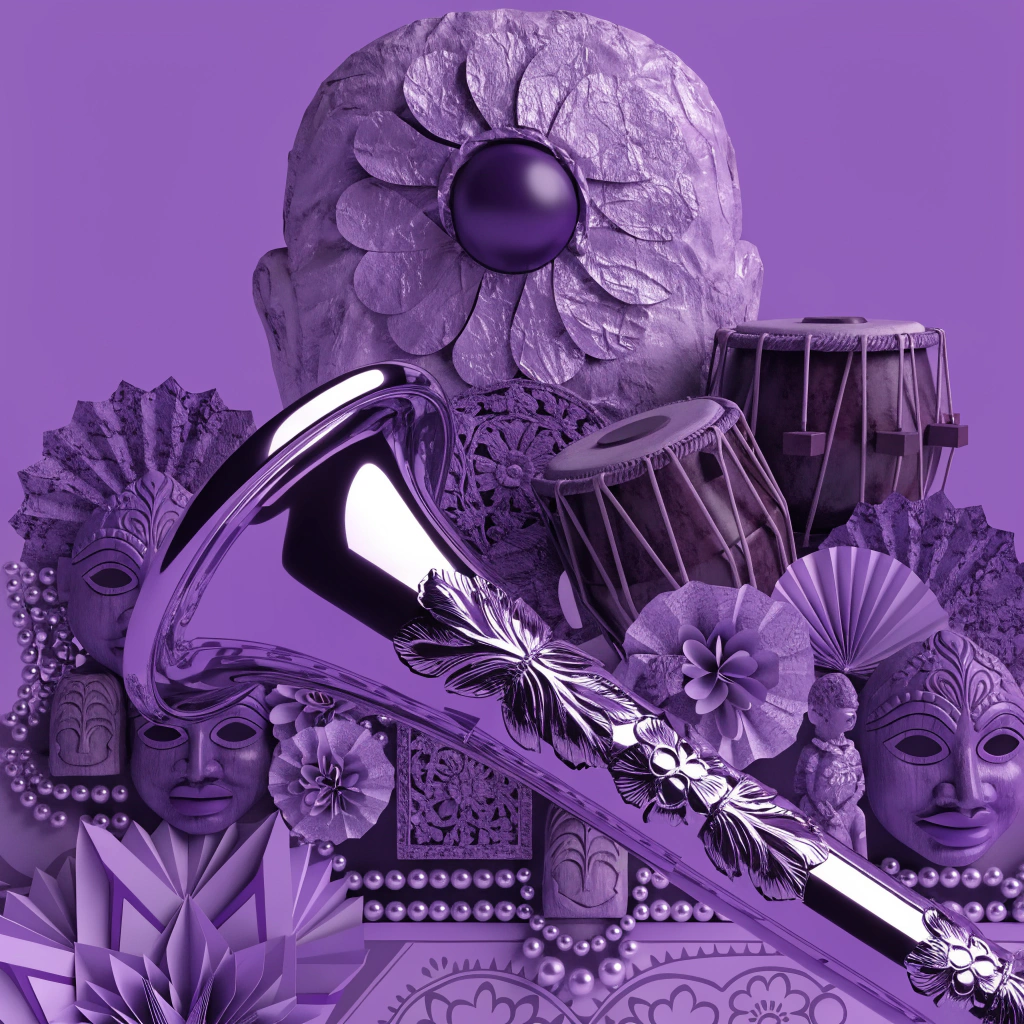
Madhubani: Beautiful Art from India
Madhubani painting is a famous art from India. It comes from the Mithila region. Long ago, women painted on the walls of their homes. Today, artists paint on paper and cloth too.
The paintings use bright colors. They have many shapes and patterns. People paint pictures of nature, like flowers and birds. They also paint weddings and festivals.
Every part of the painting is full. There is no empty space. This art is very beautiful and old. People in India love these colorful pictures.
Grammar Spotlight
Pattern: Present Simple (to be)
"Madhubani painting is a famous art from India."
We use 'is' with singular subjects like 'painting' to describe facts or permanent states.
Pattern: Present Simple (Action Verbs)
"The paintings use bright colors."
We use the base form of the verb (use) for plural subjects (paintings) to talk about habits or general truths.
Test Your Understanding
10 questions · A1 Beginner · 1 free preview
Test what you learned from this article. Answer all questions to earn XP!
Where does Madhubani art come from?
Want to finish the quiz?
9 more questions are waiting for you. Sign up free to unlock the full quiz and earn XP!
Sign Up FreeAlready have an account? Sign In
Question Breakdown
Where does Madhubani art come from?
Your answer:
Correct answer: India
There is a lot of empty space in Madhubani paintings.
Your answer:
Correct answer: False
What is 'nature'?
Your answer:
Correct answer: Flowers and birds
Madhubani painting is a _____ art from India.
Your answer:
Correct answer: famous
The Beautiful Art of Madhubani
Madhubani painting is a very old and beautiful folk art from India. It started in a place called Mithila in Bihar. Long ago, women painted the mud walls and floors of their homes. They did this because they wanted to celebrate special occasions like weddings and religious festivals. These paintings are famous for their bright colors and patterns. Artists use natural materials to make the colors. For example, they use plants and flowers to get green and yellow. The paintings show many things like nature, animals, and people. A unique thing about this art is that the artists fill every inch of the surface. They do not like empty spaces. Today, Madhubani art is more popular than it was in the past. Artists now paint on paper, cloth, and even bags. People from all over the world buy these paintings because they are very colorful. This traditional art helps us understand the history and culture of India.
Grammar Spotlight
Pattern: Past Simple
"Long ago, women painted the mud walls and floors of their homes."
We use the past simple to talk about completed actions in the past. To form it for regular verbs, we usually add '-ed' to the base verb.
Pattern: Comparatives
"Today, Madhubani art is more popular than it was in the past."
We use comparatives to compare two things. For long adjectives like 'popular', we use 'more' + adjective + 'than'.
Test Your Understanding
11 questions · A2 Elementary · 1 free preview
Test what you learned from this article. Answer all questions to earn XP!
Where did Madhubani art start?
Want to finish the quiz?
10 more questions are waiting for you. Sign up free to unlock the full quiz and earn XP!
Sign Up FreeAlready have an account? Sign In
Question Breakdown
Where did Madhubani art start?
Your answer:
Correct answer: In Mithila, Bihar
Madhubani artists like to leave empty spaces in their paintings.
Your answer:
Correct answer: False
What are 'patterns'?
Your answer:
Correct answer: Shapes or lines that are repeated
Artists use _____ materials like plants to make the colors.
Your answer:
Correct answer: natural
What do artists paint on today?
Your answer:
Correct answer: Paper and cloth
The Colorful World of Madhubani Painting
Madhubani painting, which is also called Mithila art, has become one of the most famous folk traditions in India. It originated in the Mithila region of Bihar and parts of Nepal. For centuries, this unique art form has been practiced by local women to decorate the mud walls and floors of their homes. They usually painted these beautiful, intricate patterns during important celebrations, such as weddings, births, and religious festivals.
These paintings are characterized by their bright colors and complex geometric designs. Interestingly, almost no space is left empty in a traditional Madhubani painting. Every single corner of the surface is typically filled with patterns of flowers, animals, birds, or symbolic shapes. In the past, only natural materials were used to create the vibrant colors. For example, black was made from coal or soot, and yellow was taken from turmeric or flowers. Today, although modern paints are sometimes used for convenience, many professional artists still prefer these traditional methods because they produce a unique look.
In recent years, Madhubani art has gained significant international recognition. It is no longer just found on the walls of rural houses; now, it is painted on handmade paper, cloth, and even large canvases. Many talented women have been recognized for their incredible skills, and their work is now sold in expensive galleries around the world. This transition from domestic walls to international markets has helped many families earn a better living and has helped preserve the culture of the Mithila people.
If you visit a small village in Bihar today, you will see that this ancient tradition is still very much alive and respected. It remains a beautiful way for people to share their history, religious stories, and daily lives through art. It is a style that has been passed down through generations, connecting the past with the modern world.
Grammar Spotlight
Pattern: Passive Voice
"These paintings are characterized by their bright colors and complex geometric designs."
The passive voice is used when the focus is on the action or the object rather than the person performing it. It is formed using the verb 'to be' followed by the past participle.
Pattern: Present Perfect
"In recent years, Madhubani art has gained significant international recognition."
The present perfect describes an action that happened at an unspecified time in the past and has an effect on the present. It is formed using 'has/have' plus the past participle.
Test Your Understanding
11 questions · B1 Intermediate · 1 free preview
Test what you learned from this article. Answer all questions to earn XP!
Where did Madhubani painting originally come from?
Want to finish the quiz?
10 more questions are waiting for you. Sign up free to unlock the full quiz and earn XP!
Sign Up FreeAlready have an account? Sign In
Question Breakdown
Where did Madhubani painting originally come from?
Your answer:
Correct answer: The Mithila region of Bihar and Nepal
Traditional Madhubani paintings usually leave a lot of empty space on the canvas.
Your answer:
Correct answer: False
What does 'intricate' mean in the context of the article?
Your answer:
Correct answer: Extremely detailed and complex
Madhubani art is also known by the name _____ art.
Your answer:
Correct answer: Mithila
What natural material was traditionally used to create the color yellow?
Your answer:
Correct answer: Turmeric
Madhubani Painting: A Vibrant Legacy of Mithila Art
Originating from the Mithila region of Bihar and neighboring Nepal, Madhubani painting—also referred to as Mithila art—represents one of the most ancient and captivating folk traditions in the world. Traditionally, this intricate art form was practiced exclusively by women, who would decorate the mud walls and floors of their dwellings to commemorate significant life events such as weddings, births, and religious festivals. While these ephemeral creations were once susceptible to the elements, the transition to paper and canvas in the mid-20th century allowed the art to be preserved and shared globally.
The aesthetic of Madhubani painting is distinctive, characterized by its bold use of color and complex geometrical patterns. Artists typically use natural pigments derived from plants and minerals, such as turmeric for yellow and indigo for blue. Furthermore, the tools employed are often rudimentary, including twigs, matchsticks, and even fingers, rather than traditional brushes. A unique feature of this style is that every inch of the surface is typically filled with motifs; if a gap remains, it is often occupied by floral or animal designs, leaving no empty space behind.
Beyond its visual appeal, Madhubani art is rich in symbolism. Many paintings depict scenes from ancient epics, Hindu deities, and celestial bodies like the sun and moon. However, social themes and the natural world are also frequently represented, reflecting the community's deep connection to their environment. This artistic manifestation serves as a visual narrative of the region’s history and spiritual beliefs, which has been passed down through generations from mothers to daughters.
In recent decades, the commercialization of Mithila art has led to significant socio-economic changes. What was once a domestic ritual has evolved into a professional pursuit, providing a vital source of income for rural families. Consequently, this shift has contributed to the empowerment of women in the region, granting them financial independence and a public voice. Despite the modernization of materials, the core techniques and cultural essence remain largely unchanged. Today, Madhubani painting is not only celebrated in local galleries but also recognized on international platforms, ensuring that this ancient heritage continues to flourish in the contemporary world.
Grammar Spotlight
Pattern: Passive Infinitive
"the transition to paper and canvas in the mid-20th century allowed the art to be preserved"
The passive infinitive (to be + past participle) is used here because the 'art' is the receiver of the action 'preserve', focusing on the result rather than the agent.
Pattern: Past Habit with 'Would'
"women, who would decorate the mud walls and floors of their dwellings"
'Would' is used to describe repeated actions or habits in the past. It is often used in formal or narrative writing to create a nostalgic or descriptive tone.
Pattern: Non-defining Relative Clause
"spiritual beliefs, which has been passed down through generations"
This clause adds extra information about the 'spiritual beliefs'. It is separated by a comma and uses 'which' to provide context that is not essential to the sentence's basic meaning.
Test Your Understanding
11 questions · B2 Upper Intermediate · 1 free preview
Test what you learned from this article. Answer all questions to earn XP!
What was the original purpose of Madhubani painting?
Want to finish the quiz?
10 more questions are waiting for you. Sign up free to unlock the full quiz and earn XP!
Sign Up FreeAlready have an account? Sign In
Question Breakdown
What was the original purpose of Madhubani painting?
Your answer:
Correct answer: To decorate homes for domestic rituals and festivals
Madhubani artists traditionally use expensive synthetic brushes imported from abroad.
Your answer:
Correct answer: False
Which word describes something that lasts for a very short time?
Your answer:
Correct answer: Ephemeral
The aesthetic of Madhubani painting is characterized by its bold use of color and complex _____ patterns.
Your answer:
Correct answer: geometrical
How has the commercialization of the art affected local women?
Your answer:
Correct answer: It has provided financial independence and empowerment.
The Chromatic Legacy of Mithila: A Critical Appraisal of Madhubani Art
Rarely has a regional folk tradition managed to transcend its humble domestic origins with such profound aesthetic impact as Madhubani painting. Originating in the Mithila region of Bihar, this vibrant art form, characterized by its intricate geometrical patterns and vivid palette, serves as a testament to the cultural resilience of the rural women who have nurtured it for centuries. What began as an ephemeral ritual—decorating mud walls and floors to commemorate matrimonial unions and celestial festivals—has evolved into a globally recognized genre of fine art. The iconography of Madhubani art is deeply rooted in the primordial connection between humanity and the divine. Traditional motifs often include depictions of deities such as Krishna and Shiva, alongside flora and fauna that hold symbolic significance. It is through the meticulous application of natural pigments, derived from crushed flowers and minerals, that the artists imbue their work with a sense of vitality. A defining characteristic of the style is the 'horror vacui'—a Latin term describing the aversion to empty spaces. In Mithila art, every square inch of the canvas is occupied by delicate line work or vibrant hues, ensuring a visual density that is both overwhelming and mesmerizing. Historically, the provenance of these paintings was strictly confined to the domestic sphere, serving as a non-verbal medium for women to express their spiritual aspirations and social narratives. However, the transmutation of this art form from wall murals to handmade paper occurred during the 1960s, a shift precipitated by a severe drought in the region. To provide an alternative source of income, the government encouraged local women to transfer their traditional designs onto portable media. This transition not only facilitated the survival of the community during a period of economic hardship but also catalyzed the institutionalization of the craft. While the commercialization of Madhubani painting has provided economic empowerment to thousands of women, it has also sparked a nuanced debate regarding the preservation of its ritualistic essence. Critics argue that the shift toward the global market has led to the commodification of sacred symbols, potentially diluting the profound spiritual meaning they once held. Furthermore, the juxtaposition of traditional techniques with contemporary themes—such as environmental conservation or feminist narratives—reflects the art form's capacity for adaptation. No longer is Madhubani painting merely a relic of the past; it has become a dynamic vehicle for social commentary. The democratization of the art form has also challenged longstanding social hierarchies. Once divided strictly by caste-based styles—with the upper-class Brahmin and Kayastha women focusing on religious themes while lower castes utilized more secular motifs—the contemporary scene is increasingly egalitarian. The recognition of individual artists on the international stage has dismantled some of the anonymity historically associated with folk traditions. Ultimately, the enduring legacy of Madhubani art lies in its ability to balance the weight of tradition with the exigencies of the modern world, proving that even the most localized practices can resonate with universal significance.
Grammar Spotlight
Pattern: Negative Inversion
"Rarely has a regional folk tradition managed to transcend its humble domestic origins with such profound aesthetic impact as Madhubani painting."
Inversion is used for emphasis by placing a negative or restrictive adverb at the start of the sentence, followed by the auxiliary verb and then the subject.
Pattern: Cleft Sentences
"It is through the meticulous application of natural pigments that the artists imbue their work with a sense of vitality."
Cleft sentences focus on specific information by dividing the sentence into two parts, usually starting with 'It is' or 'It was' to highlight the agency or method.
Pattern: Nominalisation
"The transmutation of this art form from wall murals to handmade paper occurred during the 1960s."
Nominalisation involves turning verbs or adjectives into nouns. This creates a more formal, academic tone suitable for complex analysis at the C1 level.
Test Your Understanding
12 questions · C1 Advanced · 1 free preview
Test what you learned from this article. Answer all questions to earn XP!
What was the primary catalyst for Madhubani art transitioning from walls to paper?
Want to finish the quiz?
11 more questions are waiting for you. Sign up free to unlock the full quiz and earn XP!
Sign Up FreeAlready have an account? Sign In
Question Breakdown
What was the primary catalyst for Madhubani art transitioning from walls to paper?
Your answer:
Correct answer: Economic necessity during a drought
Madhubani art historically allowed for significant empty space on the canvas.
Your answer:
Correct answer: False
What does 'provenance' refer to in the context of the article?
Your answer:
Correct answer: The origin and history of the art
The shift from caste-based styles to a more shared practice indicates that the contemporary scene is increasingly _____.
Your answer:
Correct answer: egalitarian
Which term describes the artistic aversion to leaving empty space?
Your answer:
Correct answer: Horror vacui
The article suggests that commercialization has had both positive and negative impacts.
Your answer:
Correct answer: True
The Epistemological and Aesthetic Evolution of Mithila Art: Beyond the Vernacular
Were one to traverse the fertile, sun-drenched plains of the Mithila region, spanning the borderlands of Bihar and Nepal, one would encounter a visual lexicon so profound that it transcends mere decoration. Madhubani painting, or Mithila art as it is traditionally designated, represents a quintessential manifestation of communal identity and domestic ritual. Historically circumscribed within the feminine sphere, this art form was an ephemeral endeavor, where women would meticulously adorn the mud-plastered walls and floors of their dwellings to commemorate rites of passage, nuptial ceremonies, and celestial festivals. It is arguably not merely a matter of aesthetic pursuit but an ontological expression of the relationship between the human and the divine.
The iconography of Madhubani is characterized by its dense, vibrantly saturated compositions and a horror vacui that leaves no interstice unoccupied. Utilizing pigments derived from primordial sources—lampblack, ochre, and botanical extracts—the artists weave a tapestry of mythological narratives, often centering on the Krishna-Leela or the Ramayana. However, it is the stylistic nuance that distinguishes the various sub-genres, such as Bharni, Katchni, and Tantric styles. These were historically demarcated by caste lines, though such rigid stratifications have increasingly blurred in the contemporary era. The juxtaposition of bold, geometric patterns with fluid, organic forms creates a visual tension that is both jarring and harmonious, demanding a sophisticated level of visual literacy from the observer.
It was the catastrophic drought of the mid-1960s that catalyzed a seismic paradigm shift in the medium's history. To mitigate the economic hardship of the agrarian crisis, the All India Handicrafts Board encouraged the women of Mithila to transpose their wall paintings onto handmade paper for commercial distribution. This transition from the fixed, architectural surface to the portable, commodified sheet fundamentally altered the nature of the craft. While critics might argue that such commercialization risks diluting the esoteric sanctity of the ritual, it has simultaneously empowered the practitioners, providing a platform for socio-political commentary. Modern Madhubani artists frequently engage with contemporary exigencies, addressing themes of environmental degradation, gender inequality, and global health crises, thereby ensuring the art form's continued relevance.
Furthermore, it is imperative that the observer recognize the technical rigor inherent in the process. The absence of preliminary sketching necessitates an unerring precision, as each stroke of the bamboo twig or nib is definitive. This immediacy reflects a mastery of form that is often underestimated by those who categorize it under the reductive label of 'folk art.' In reality, the complexity of its symbolic language and the sophisticated use of negative space suggest a theoretical depth comparable to any canonized Western art movement. As Mithila art continues to flourish on the global stage, it serves as a testament to the resilience of vernacular traditions in the face of modernity, proving that the ancient and the avant-garde are not mutually exclusive but are, instead, inextricably linked in a perpetual dialogue of cultural evolution.
Grammar Spotlight
Pattern: Inverted Conditionals (Were + Subject)
"Were one to traverse the fertile, sun-drenched plains of the Mithila region... one would encounter a visual lexicon so profound..."
This is a formal alternative to 'If' clauses (If one were to traverse). It is used in C2 level writing to create a more scholarly or hypothetical tone.
Pattern: Subjunctive Mood (It is imperative that...)
"Furthermore, it is imperative that the observer recognize the technical rigor inherent in the process."
The subjunctive 'recognize' (rather than 'recognizes') follows an adjective of importance or necessity. It is used to express urgency or a strong recommendation.
Pattern: Cleft Sentences for Emphasis
"It was the catastrophic drought of the mid-1960s that catalyzed a seismic paradigm shift in the medium's history."
Cleft sentences (It + be + subject + relative clause) are used to focus on a specific piece of information, highlighting the cause of the shift rather than just stating the fact.
Test Your Understanding
12 questions · C2 Mastery · 1 free preview
Test what you learned from this article. Answer all questions to earn XP!
What primary factor triggered the transition of Mithila art from walls to paper?
Want to finish the quiz?
11 more questions are waiting for you. Sign up free to unlock the full quiz and earn XP!
Sign Up FreeAlready have an account? Sign In
Question Breakdown
What primary factor triggered the transition of Mithila art from walls to paper?
Your answer:
Correct answer: An economic intervention during a period of severe drought.
Madhubani painting was traditionally practiced exclusively by men for religious ceremonies.
Your answer:
Correct answer: False
Which word describes the 'horror vacui' style mentioned in the text?
Your answer:
Correct answer: Interstice
The absence of preliminary sketching in Mithila art necessitates an unerring _____ during the execution.
Your answer:
Correct answer: precision
How has commercialization affected the thematic scope of Madhubani painting?
Your answer:
Correct answer: It has enabled artists to address modern socio-political issues.
Caste-based stylistic distinctions in Mithila art have become less rigid in modern times.
Your answer:
Correct answer: True
