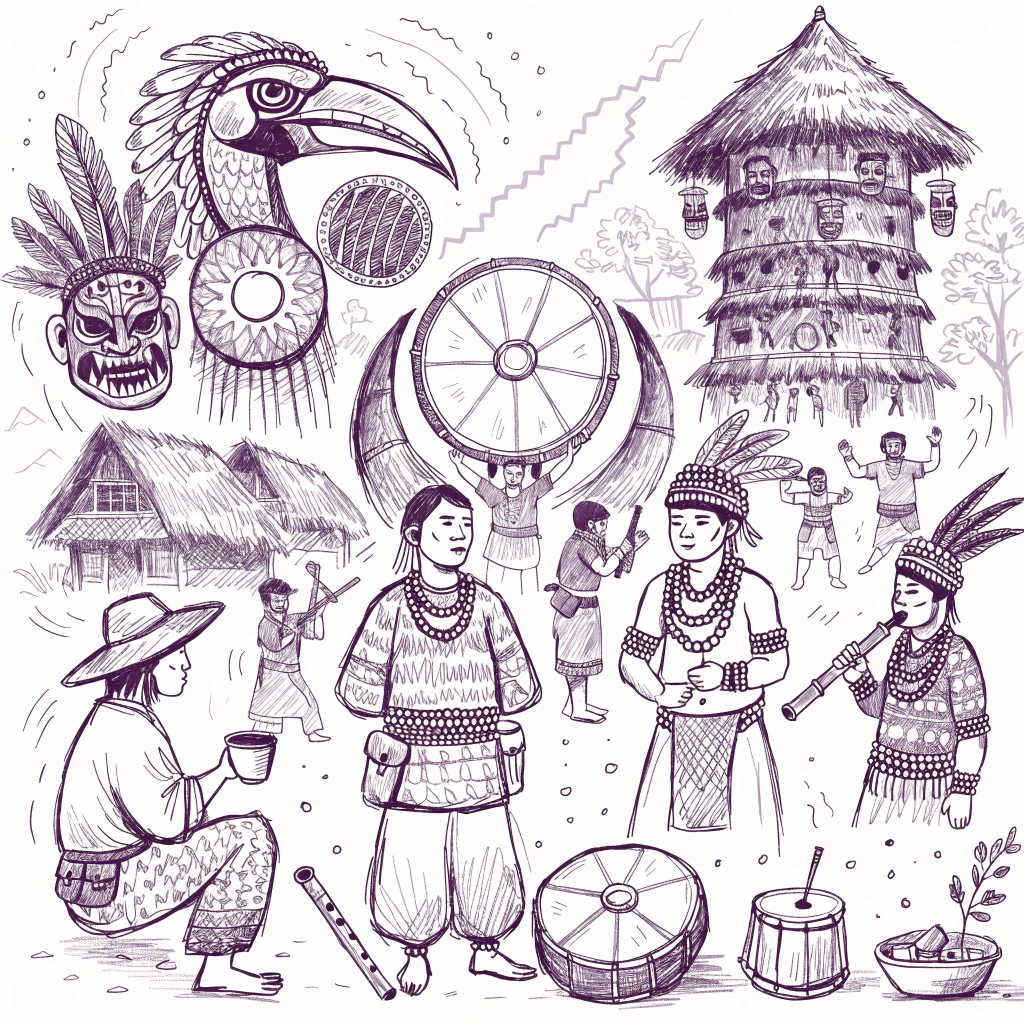
The Great Hornbill Festival
The Hornbill Festival is in India. It is in Nagaland. Many people visit this place in December. It is a very big party.
There are sixteen tribes in Nagaland. They wear colorful clothes. They dance and sing traditional songs. They also play music.
People eat local food. They see beautiful birds. The festival has a name from a bird. It is the hornbill bird. It is a special time for everyone.
Grammar Spotlight
Pattern: Present Simple of 'To Be'
"The Hornbill Festival is in India."
We use 'is' with singular subjects like 'the festival'. It describes a fact or location.
Pattern: Present Simple for Regular Actions
"They wear colorful clothes."
We use the base verb 'wear' with 'they'. It describes what the people do every year at the festival.
Test Your Understanding
10 questions · A1 Beginner · 1 free preview
Test what you learned from this article. Answer all questions to earn XP!
Where is the Hornbill Festival?
Want to finish the quiz?
9 more questions are waiting for you. Sign up free to unlock the full quiz and earn XP!
Sign Up FreeAlready have an account? Sign In
Question Breakdown
Where is the Hornbill Festival?
Your answer:
Correct answer: Nagaland
The festival happens in December.
Your answer:
Correct answer: True
What does 'clothes' mean?
Your answer:
Correct answer: Things you wear
They sing traditional _____.
Your answer:
Correct answer: songs
The Hornbill Festival: A Great Celebration in India
The Hornbill Festival is a famous event in Nagaland, India. People call it the 'Festival of Festivals' because it is very big. It happens every December at Kisama Heritage Village. This festival is important because it protects the traditions of the Naga people. There are sixteen major tribes in Nagaland. During the festival, they all come together to dance, sing, and eat special food.
The festival is named after the Hornbill bird. This bird is very special in many local stories. Visitors can see beautiful traditional clothes during the event. The colors are brighter than everyday clothes. Last year, many tourists went to Kisama. They saw traditional houses and listened to loud drums. The food was delicious, but some dishes were very spicy. The festival is better than a museum because the culture is alive there. It is a great place to learn about history and make new friends from different tribes.
Grammar Spotlight
Pattern: Comparatives (Adjective + -er + than)
"The colors are brighter than everyday clothes."
We use comparatives to compare two things. For short adjectives like 'bright', we add '-er' and then use the word 'than'.
Pattern: Past Simple (Irregular Verbs)
"Last year, many tourists went to Kisama."
The past simple is used to talk about finished actions in the past. 'Went' is the irregular past form of the verb 'go'.
Test Your Understanding
11 questions · A2 Elementary · 1 free preview
Test what you learned from this article. Answer all questions to earn XP!
Where does the Hornbill Festival take place?
Want to finish the quiz?
10 more questions are waiting for you. Sign up free to unlock the full quiz and earn XP!
Sign Up FreeAlready have an account? Sign In
Question Breakdown
Where does the Hornbill Festival take place?
Your answer:
Correct answer: Nagaland
The festival is named after a type of fish.
Your answer:
Correct answer: False
What does 'tradition' mean?
Your answer:
Correct answer: A way of doing things for a long time
It happens every _____ at Kisama Heritage Village.
Your answer:
Correct answer: December
How many major tribes are there in Nagaland?
Your answer:
Correct answer: Sixteen
The Hornbill Festival: A Celebration of Naga Heritage
The Hornbill Festival is a famous event that takes place every December in Nagaland, a beautiful state in Northeast India. It has been called the 'Festival of Festivals' because it brings together many different groups of people. The festival is named after the Indian hornbill, which is a bird that appears prominently in many local stories and songs.
Since the festival started in 2000, it has become very popular with tourists from all over the world. The main events are held at the Kisama Heritage Village, which is located near the capital city, Kohima. During the ten-day celebration, sixteen major tribes show their unique traditions. Visitors can see traditional dances that are performed by dancers in colorful clothes.
In the village, traditional houses have been built to show how the Naga people lived in the past. These structures are made of wood and straw, representing the architecture of each tribe. You can try local food, listen to folk music, and watch exciting competitions. One of the most famous events is the Naga chili-eating competition, which is known for being very difficult for participants! There are also craft markets where local artists sell handmade jewelry and clothes.
The Hornbill Festival is not just about fun; it is an important way to protect the heritage of the Naga people. It encourages young people to learn about their history and helps different tribes to interact with each other. For travelers who want to experience a unique culture, this festival is an unforgettable experience.
Grammar Spotlight
Pattern: Present Perfect
"Since the festival started in 2000, it has become very popular with tourists from all over the world."
The present perfect (have/has + past participle) is used here to describe an action that started in the past and continues to have an effect or remain true in the present.
Pattern: Passive Voice
"The main events are held at the Kisama Heritage Village, which is located near the capital city, Kohima."
The passive voice (is/are + past participle) is used when the focus is on the action or the location rather than who is performing the action.
Test Your Understanding
11 questions · B1 Intermediate · 1 free preview
Test what you learned from this article. Answer all questions to earn XP!
Where does the Hornbill Festival take place?
Want to finish the quiz?
10 more questions are waiting for you. Sign up free to unlock the full quiz and earn XP!
Sign Up FreeAlready have an account? Sign In
Question Breakdown
Where does the Hornbill Festival take place?
Your answer:
Correct answer: Northeast India
The festival is named after a type of local mountain.
Your answer:
Correct answer: False
What does 'heritage' mean?
Your answer:
Correct answer: Cultural history and traditions
The festival is _____ after the Indian hornbill.
Your answer:
Correct answer: named
How many major tribes participate in the celebration?
Your answer:
Correct answer: 16
The Hornbill Festival: A Resilient Celebration of Naga Heritage
The Hornbill Festival, frequently referred to as the 'Festival of Festivals,' serves as a pivotal cultural cornerstone for the state of Nagaland in Northeast India. Celebrated annually during the first week of December, this grand event is not merely a display of traditional dances; rather, it is a strategic initiative aimed at fostering inter-tribal interaction and preserving the rich heritage of the Naga people. By centralizing the diverse traditions of sixteen major tribes at the Kisama Heritage Village, the festival provides a platform where ancient customs can be observed and appreciated by a global audience.
Named after the Indian Hornbill, a bird that features prominently in the folklore and songs of almost all Naga tribes, the festival symbolizes collective identity. Historically, the bird’s feathers were used to adorn the headgear of warriors, signifying bravery and status. Consequently, the festival serves as a bridge between the historical past and the contemporary present. Visitors are often captivated by the vibrant displays of traditional attire, which are meticulously crafted to reflect the unique history of each individual tribe.
Moreover, the festival facilitates a complex socio-economic exchange that extends beyond simple tourism. While the influx of international visitors provides a necessary boost to the local economy through hospitality and handicraft sales, the event also serves a deeper purpose by encouraging the younger generation to engage with their ancestral roots. In an age dominated by digital entertainment, the festival acts as a living museum. If the festival had not been established by the state government in 2000, many traditional crafts, intricate weaving techniques, and oral histories might have faded into obscurity.
However, the increasing commercialization of such events often sparks rigorous debate among cultural scholars regarding the authenticity of the performances. Some critics argue that the theatrical nature of the festivities might inadvertently dilute the sacredness of certain rituals, yet many others contend that such adaptation is an essential strategy for cultural survival in an increasingly globalized era. Throughout the ten-day duration of the event, the atmosphere is electric, filled with the rhythmic resonance of log drums. Each tribe resides in its own 'morung'—a traditional communal hut—which is reconstructed at the site to showcase specific architectural styles. Ultimately, the Hornbill Festival stands as a powerful testament to the resilience of Naga culture, illustrating how traditional societies can navigate modernity while maintaining a profound sense of pride in their distinctive heritage.
Grammar Spotlight
Pattern: Passive Voice
"The Hornbill Festival, frequently referred to as the 'Festival of Festivals,' serves as a pivotal cultural cornerstone."
The passive voice is used here to focus on the festival itself rather than the people who refer to it. It is formed using a form of 'to be' plus the past participle.
Pattern: Third Conditional
"If the festival had not been established by the state government in 2000, many traditional crafts [...] might have faded into obscurity."
This pattern is used to talk about hypothetical situations in the past. It uses 'if + past perfect' and 'might/would have + past participle' to describe an alternative past outcome.
Pattern: Contrastive Conjunctions
"While the influx of international visitors provides a necessary boost to the local economy, the event also serves a deeper purpose."
The word 'while' is used as a discourse marker to show contrast between two ideas within the same sentence, common in academic B2 writing.
Test Your Understanding
11 questions · B2 Upper Intermediate · 1 free preview
Test what you learned from this article. Answer all questions to earn XP!
What is the primary strategic goal of the Hornbill Festival mentioned in the text?
Want to finish the quiz?
10 more questions are waiting for you. Sign up free to unlock the full quiz and earn XP!
Sign Up FreeAlready have an account? Sign In
Question Breakdown
What is the primary strategic goal of the Hornbill Festival mentioned in the text?
Your answer:
Correct answer: To foster inter-tribal interaction and preserve heritage
The Hornbill bird is significant to only one specific tribe in Nagaland.
Your answer:
Correct answer: False
What is the meaning of 'authenticity' as used in the article?
Your answer:
Correct answer: The quality of being real or true to origins
The festival provides a _____ where ancient customs can be observed by a global audience.
Your answer:
Correct answer: platform
What does the text identify as a point of debate among scholars?
Your answer:
Correct answer: The potential dilution of sacred rituals due to commercialization
Echoes of the Naga Hills: A Critical Appraisal of the Hornbill Festival
Nestled within the undulating topography of Nagaland lies the Kisama Heritage Village, the epicenter of a cultural phenomenon known as the Hornbill Festival. Seldom has an event managed to encapsulate such a profound sense of tribal identity while simultaneously navigating the precarious waters of modern globalization. Often termed the ‘Festival of Festivals’, this ten-day extravaganza is far more than a mere display of ethnographic curiosity; it is a vital mechanism for inter-tribal cohesion and the systematic preservation of ancestral customs. In an era where cultural homogenization poses a significant threat to indigenous identities, the festival stands as a monumental testament to the resilience of the Naga people.
It is the majestic hornbill that serves as the unifying emblem across the disparate folklore of the sixteen major Naga tribes. This avian symbol, revered for its perceived qualities of alertness and grandeur, transcends individual tribal boundaries, offering a shared narrative in a region historically defined by its fragmentation. Through the rhythmic thumping of feet and the resonant chants that echo across the valley, the festival facilitates a kaleidoscopic reimagining of Naga heritage. Not only does the festival serve as a bridge between generations, but it also acts as a bulwark against the erosion of oral histories. The intentionality behind this gathering reflects a broader desire to project a unified Naga identity to the external world.
The architectural layout of the Kisama village further reinforces this unity. Each tribe maintains a ‘morung’—a traditional communal dormitory—constructed with meticulous attention to detail, showcasing unique woodcarvings and structural designs. The juxtaposition of these distinct styles within a single heritage complex allows for a quintessential exploration of regional diversity. However, the commercialization of such sacred spaces often sparks a complex dichotomy. While the influx of international tourists provides a necessary economic stimulus, critics argue that the performative nature of the festival might inadvertently lead to the commodification of culture, where rituals are stripped of their spiritual depth to satisfy the tourist gaze.
Furthermore, the Hornbill Festival is not a static relic of the past; it is a dynamic space where tradition meets modernity. This is perhaps most evident in the Hornbill Rock Contest, where the raw energy of contemporary music meets the ancient echoes of the log drum. Such a fusion illustrates the adaptability of Naga youth, who refuse to be confined by a binary choice between their roots and global trends. The resilience of their cultural fabric is found in this very ability to synthesize the old with the new. Should the festival continue to evolve with such sensitivity, it will remain a cornerstone of Indian cultural diplomacy.
Ultimately, the Hornbill Festival represents a sophisticated exercise in cultural reclamation. The systematic documentation and presentation of dance, cuisine, and craft ensure that these ephemeral traditions are solidified into an enduring legacy. It is through this collective effort that the tribes of Nagaland navigate their historical trauma and celebrate their contemporary vitality. The festival is, in essence, a living archive—a place where the past is not merely remembered, but vibrantly performed for the future.
Grammar Spotlight
Pattern: Negative Inversion
"Seldom has an event managed to encapsulate such a profound sense of tribal identity while simultaneously navigating the precarious waters of modern globalization."
Inversion is used after restrictive adverbs like 'seldom' to add emphasis and formal weight. The auxiliary verb 'has' comes before the subject 'an event'.
Pattern: It-Cleft Sentences
"It is the majestic hornbill that serves as the unifying emblem across the disparate folklore of the sixteen major Naga tribes."
Cleft sentences are used to focus on a specific part of the information. Here, 'It is [subject] that...' emphasizes the bird as the primary symbol.
Pattern: Nominalization
"The commercialization of such sacred spaces often sparks a complex dichotomy."
Nominalization turns verbs (commercialize) into nouns (commercialization). This is a hallmark of C1 writing, making the text more abstract and academic.
Test Your Understanding
12 questions · C1 Advanced · 1 free preview
Test what you learned from this article. Answer all questions to earn XP!
What is the primary purpose of the Hornbill Festival according to the text?
Want to finish the quiz?
11 more questions are waiting for you. Sign up free to unlock the full quiz and earn XP!
Sign Up FreeAlready have an account? Sign In
Question Breakdown
What is the primary purpose of the Hornbill Festival according to the text?
Your answer:
Correct answer: To foster inter-tribal cohesion and preserve heritage
The text suggests that the festival is entirely immune to the effects of globalization.
Your answer:
Correct answer: False
Which word describes the division between 'authentic tradition' and 'commodification'?
Your answer:
Correct answer: Dichotomy
The festival acts as a _____ against the erosion of oral histories.
Your answer:
Correct answer: bulwark
What does the 'morung' represent in the Kisama Heritage Village?
Your answer:
Correct answer: A traditional communal dormitory for each tribe
The Hornbill Rock Contest is mentioned as an example of how tradition and modernity can coexist.
Your answer:
Correct answer: True
The Hornbill Festival: A Socio-Anthropological Prism of Naga Cultural Reclamation
In the verdant, mist-shrouded hills of Nagaland, the Hornbill Festival emerges not merely as an annual congregation but as a profound socio-anthropological prism through which the Naga identity is both preserved and reconstructed. Often referred to as the 'Festival of Festivals,' this event is a state-sponsored initiative aimed at fostering inter-tribal interaction and safeguarding the vestigial elements of a heritage that faced the risk of erosion under the weight of modernity. The festival is named after the Indian Hornbill, a bird that occupies a central role in the folklore of nearly all sixteen major Naga tribes. It is through the lens of the Hornbill that the Naga tribes articulate their shared heritage, utilizing the bird as a potent synecdoche for the collective spirit of the people.
Located at the Kisama Heritage Village, a site designed to function as a microcosm of the diverse Naga landscape, the festival provides a platform where the traditional and the contemporary engage in a complex dialogue. Seldom has a cultural manifestation so effectively bridged the chasm between ancestral customs and the aspirations of a modernizing state. Here, the juxtaposition of ancient warrior dances with contemporary rock music contests creates a multifaceted experience that challenges the simplistic dichotomy of 'tradition versus progress.' Critics might argue that such an event risks the commodification of culture, transforming sacred rituals into a spectacle for the global gaze. However, one might equally contend that this very visibility is what ensures the survival of these practices in an increasingly homogenized world.
It is imperative that the festival serve as more than a mere aesthetic display; it must act as a crucible for genuine cultural transmission. The ephemeral nature of the performances—the fleeting rhythm of the log drums and the transient beauty of the ceremonial attire—belies the deep-seated historical narratives they represent. While the festival undeniably bolsters the local economy through tourism, its primary utility lies in its ability to resist cultural hegemony. By providing a space where each tribe can assert its unique linguistic and social markers, the festival mitigates the risk of a singular, flattened Naga identity.
Furthermore, the plethora of activities, ranging from indigenous games to culinary exhibitions, serves to reinforce the social fabric of the region. The inclusion of traditional morungs—communal dormitories that historically served as centers of learning—allows younger generations to witness the architectural and social structures of their forebears. Notwithstanding the commercial veneer that inevitably accompanies such large-scale events, the Hornbill Festival remains a vital exercise in cultural agency. It provides a scholarly insight into how a post-colonial society navigates the intricacies of self-representation.
Ultimately, the festival is a testament to the resilience of the Naga people. Should the festival continue to evolve with the same sensitivity to its roots, it will remain an essential bulwark against the loss of indigenous knowledge. The Hornbill Festival is not just a celebration; it is a sophisticated negotiation with history, ensuring that the echoes of the past are not silenced by the clamor of the future. In this sense, it is a living archive, a dynamic space where the past is not merely remembered, but actively lived and reimagined for the twenty-first century.
Grammar Spotlight
Pattern: Inversion after negative or restrictive adverbials
"Seldom has a cultural manifestation so effectively bridged the chasm between ancestral customs and the aspirations of a modernizing state."
This structure is used for rhetorical emphasis. When 'seldom' starts a sentence, the auxiliary verb 'has' precedes the subject 'a cultural manifestation'.
Pattern: The Subjunctive Mood
"It is imperative that the festival serve as more than a mere aesthetic display."
The subjunctive 'serve' (instead of 'serves') is used after adjectives of urgency or importance like 'imperative' to express a requirement or desire.
Pattern: Cleft Sentences for emphasis
"It is through the lens of the Hornbill that the Naga tribes articulate their shared heritage."
This 'It is... that...' structure focuses the reader's attention on the specific means (the lens of the Hornbill) by which the action occurs.
Test Your Understanding
12 questions · C2 Mastery · 1 free preview
Test what you learned from this article. Answer all questions to earn XP!
What is the primary function of the Hornbill Festival according to the text?
Want to finish the quiz?
11 more questions are waiting for you. Sign up free to unlock the full quiz and earn XP!
Sign Up FreeAlready have an account? Sign In
Question Breakdown
What is the primary function of the Hornbill Festival according to the text?
Your answer:
Correct answer: To act as a tool for cultural reclamation and inter-tribal unity
The author suggests that the commercial aspects of the festival completely undermine its cultural value.
Your answer:
Correct answer: False
What does 'ephemeral' mean in the context of the festival's performances?
Your answer:
Correct answer: Fading and short-lived
Kisama Heritage Village is described as a _____ of the diverse Naga landscape.
Your answer:
Correct answer: microcosm
How does the author view the 'tradition versus progress' debate regarding the festival?
Your answer:
Correct answer: As a complex dialogue that challenges simplistic views
The Hornbill bird is used as a synecdoche to represent the collective spirit of the Naga tribes.
Your answer:
Correct answer: True
