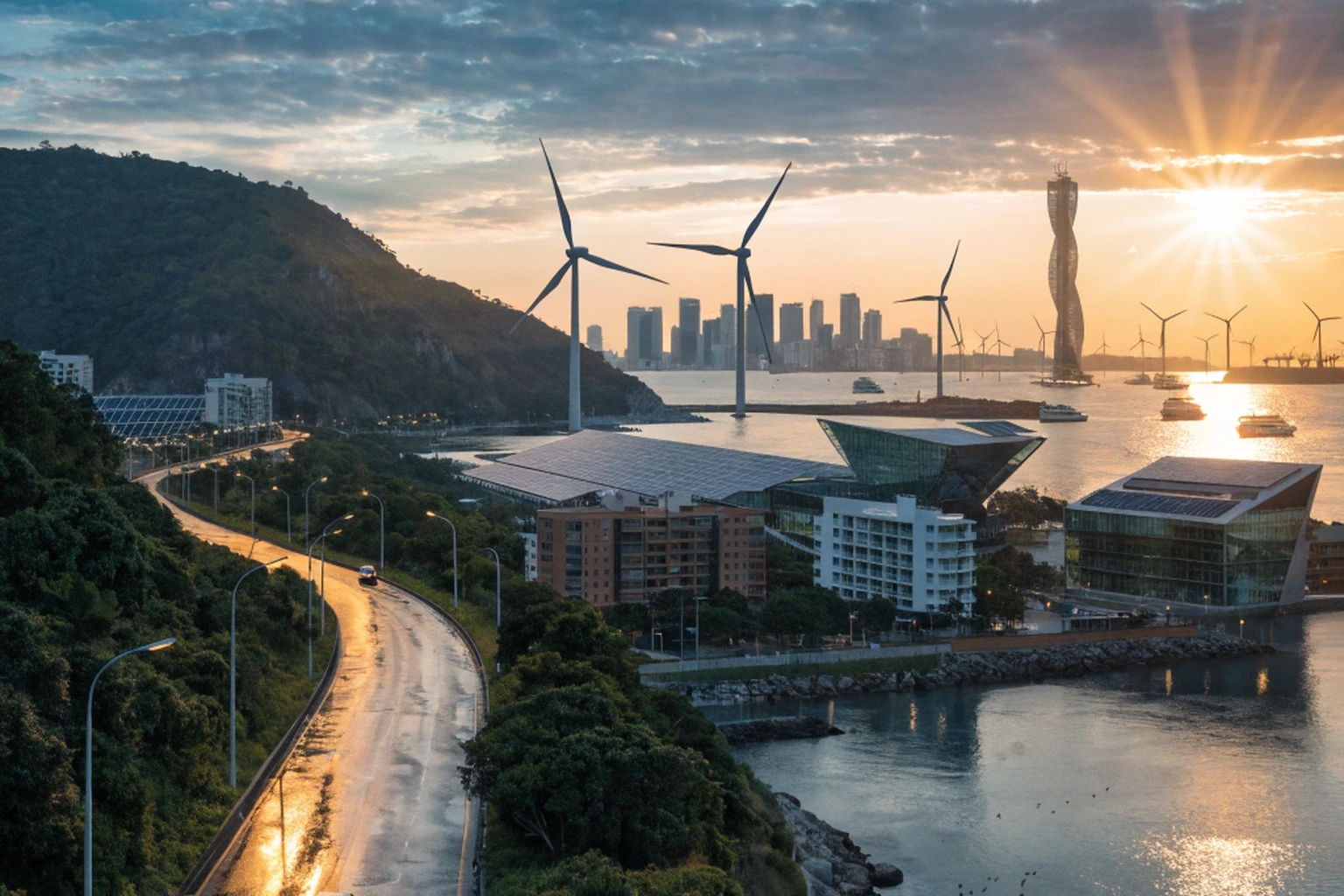
A Green Plan for Thailand
Thailand has a new plan. It is the BCG Economy. This plan helps the country and the environment. Thailand has many plants and animals. People use these to make food and medicine.
The plan also helps with waste. People reuse old things. This is good for nature. The plan follows a special way of living. It is about balance and being careful.
Farmers like this plan. They grow healthy food. Businesses use green energy. Everyone works together for a better future. Thailand is a green country.
Grammar Spotlight
Pattern: Present Simple (to be)
"Thailand is a green country."
We use 'is' with singular nouns like Thailand to describe a state or fact. It is the most common verb in English.
Pattern: Present Simple (regular verbs)
"Farmers like this plan."
We use the base form of the verb (like) for plural subjects (farmers) to talk about facts or general feelings.
Test Your Understanding
10 questions · A1 Beginner · 1 free preview
Test what you learned from this article. Answer all questions to earn XP!
What is the name of Thailand's new plan?
Want to finish the quiz?
9 more questions are waiting for you. Sign up free to unlock the full quiz and earn XP!
Sign Up FreeAlready have an account? Sign In
Question Breakdown
What is the name of Thailand's new plan?
Your answer:
Correct answer: The BCG Economy
Thailand has many plants and animals.
Your answer:
Correct answer: True
What does 'waste' mean?
Your answer:
Correct answer: Things people throw away
Thailand has a new _____.
Your answer:
Correct answer: plan
Thailand’s New Green Plan: The BCG Economy
Thailand is starting a new plan for the future. People call it the BCG Economy. This plan helps the country grow while protecting nature. BCG stands for Bio, Circular, and Green. It is very important for Thai people because it uses science to solve environmental problems.
In the past, many businesses created a lot of waste. Now, things are different. For example, farmers use old plants to make clean energy. This is better for the Earth than using old methods. The government started this national plan in 2021. They want to protect the beautiful forests and oceans of Thailand.
The BCG model also helps local communities. Small businesses are now more successful because they use natural resources carefully. This plan follows the ideas of the late King Bhumibol Adulyadej. He taught people to live with moderation and respect for nature. Today, Thailand is greener and stronger than before. Everyone is working hard to build a sustainable and healthy country for the next generation.
Grammar Spotlight
Pattern: Comparatives
"Today, Thailand is greener and stronger than before."
We use comparatives to compare two things. For short adjectives like 'green', we add '-er' and use the word 'than'.
Pattern: Past Simple
"The government started this national plan in 2021."
We use the Past Simple to talk about finished actions at a specific time. For regular verbs, we add '-ed' to the base verb.
Test Your Understanding
11 questions · A2 Elementary · 1 free preview
Test what you learned from this article. Answer all questions to earn XP!
What does the BCG plan help Thailand do?
Want to finish the quiz?
10 more questions are waiting for you. Sign up free to unlock the full quiz and earn XP!
Sign Up FreeAlready have an account? Sign In
Question Breakdown
What does the BCG plan help Thailand do?
Your answer:
Correct answer: Grow while protecting nature
The BCG plan started in the year 2021.
Your answer:
Correct answer: True
What is the meaning of 'waste'?
Your answer:
Correct answer: Things thrown away
Farmers use old plants to make clean _____.
Your answer:
Correct answer: energy
Whose ideas does the BCG plan follow?
Your answer:
Correct answer: The late King Bhumibol
The BCG Economy: Thailand’s Sustainable Transformation
Thailand has introduced an ambitious new plan called the Bio-Circular-Green (BCG) Economy. This model is designed to help the country grow while protecting its beautiful environment. Since 2021, it has been a national priority for the government. The BCG model is deeply rooted in the 'Sufficiency Economy Philosophy,' which was created by the late King Bhumibol Adulyadej. This philosophy emphasizes moderation and reasonableness, teaching people to live within their means.
Thailand is a country that is rich in biological diversity and natural resources. The BCG model uses these strengths to create a more resilient future. For instance, in the agricultural sector, new technology is used to turn waste into valuable products. Instead of burning old plants, they are transformed into clean energy or eco-friendly materials. This is the 'circular' part of the plan, where nothing is thrown away.
Many projects have been started to support this transformation. These initiatives help local farmers and small businesses use modern science to improve their products. By focusing on green growth, Thailand wants to reduce pollution and protect its forests. This sustainable approach is expected to create many new jobs for the next generation. Today, Thailand is becoming a regional leader in environmental protection, showing that economic success can go hand in hand with nature.
Grammar Spotlight
Pattern: Passive Voice
"This model is designed to help the country grow while protecting its beautiful environment."
The passive voice is used when the focus is on the action or the object rather than the person doing it. It is formed using 'to be' + past participle.
Pattern: Present Perfect
"Thailand has introduced an ambitious new plan called the Bio-Circular-Green (BCG) Economy."
We use the present perfect to talk about an action that happened at an unspecified time in the past or started in the past and continues now. It is formed with 'have/has' + past participle.
Test Your Understanding
11 questions · B1 Intermediate · 1 free preview
Test what you learned from this article. Answer all questions to earn XP!
What is the main goal of the BCG Economy model?
Want to finish the quiz?
10 more questions are waiting for you. Sign up free to unlock the full quiz and earn XP!
Sign Up FreeAlready have an account? Sign In
Question Breakdown
What is the main goal of the BCG Economy model?
Your answer:
Correct answer: To grow the economy while protecting the environment
The BCG model is based on a philosophy created by a former King.
Your answer:
Correct answer: True
What does 'agricultural' mean?
Your answer:
Correct answer: Related to farming
Thailand has _____ an ambitious new plan.
Your answer:
Correct answer: introduced
What happens to agricultural waste in the circular economy?
Your answer:
Correct answer: It is turned into energy or materials.
The BCG Economy: Thailand’s Sustainable Transformation
Thailand has recently embarked on a transformative journey by adopting the Bio-Circular-Green (BCG) Economy model. This strategic framework, which was officially declared a national agenda in 2021, aims to revitalize the country’s economy while simultaneously safeguarding its rich natural heritage. By integrating three distinct economic approaches, the Thai government intends to foster a more resilient and sustainable society in the post-pandemic era. This transition is not merely an economic shift but a comprehensive strategy to utilize the nation's biological and cultural assets more effectively.
The first pillar, the Bio-Economy, focuses on the production of renewable biological resources and their conversion into value-added products. Given Thailand’s immense biodiversity, this sector is particularly promising for the development of high-value agricultural and medicinal innovations. Furthermore, the Circular Economy component emphasizes a 'closed-loop' system where waste is minimized and resources are reused. This shift is crucial for addressing the growing concerns regarding environmental degradation and resource scarcity that have plagued the region in recent decades.
Crucially, the BCG model is deeply rooted in the 'Sufficiency Economy Philosophy' (SEP). This philosophy, developed by the late King Bhumibol Adulyadej, advocates for moderation, reasonableness, and self-immunity. It serves as a moral compass, ensuring that economic growth does not occur at the expense of social equity or environmental stability. Consequently, the Green Economy aspect seeks to balance economic activities with the preservation of ecosystems, thereby promoting long-term sustainability across four main sectors: agriculture, medicine, energy, and tourism.
However, the transition to a BCG-based economy is not without its challenges. It requires significant investment in research and development, as well as the active participation of various stakeholders, including the private sector and local communities. For the model to be successful, the government must ensure that technological advancements are accessible to small-scale farmers and entrepreneurs. In conclusion, while the implementation of the BCG model requires a fundamental shift in traditional economic practices, it represents a visionary approach to modern development. If Thailand manages to effectively navigate these complexities, it could serve as a global blueprint for sustainable growth in the 21st century.
Grammar Spotlight
Pattern: Passive Voice
"This strategic framework, which was officially declared a national agenda in 2021..."
The passive voice is used here to focus on the action (the declaration) and the framework rather than who declared it. It is common in formal and academic writing to maintain an objective tone.
Pattern: Discourse Markers for Consequence
"Consequently, the Green Economy aspect seeks to balance economic activities..."
'Consequently' is a formal transition word used to show a logical result or effect of the previous statement. It helps create a cohesive argument in B2-level writing.
Pattern: First Conditional with Modals
"If Thailand manages to effectively navigate these complexities, it could serve as a global blueprint..."
This structure uses 'if' + present simple followed by 'could' + infinitive to discuss a possible future outcome based on a specific condition. Using 'could' instead of 'will' expresses a degree of possibility or potential.
Test Your Understanding
11 questions · B2 Upper Intermediate · 1 free preview
Test what you learned from this article. Answer all questions to earn XP!
What is the primary objective of Thailand's BCG model?
Want to finish the quiz?
10 more questions are waiting for you. Sign up free to unlock the full quiz and earn XP!
Sign Up FreeAlready have an account? Sign In
Question Breakdown
What is the primary objective of Thailand's BCG model?
Your answer:
Correct answer: To revitalize the economy while protecting natural heritage
The BCG model was introduced as a national agenda in 2021.
Your answer:
Correct answer: True
What does 'scarcity' mean in the context of the article?
Your answer:
Correct answer: A lack of available resources
The Circular Economy emphasizes a _____ -loop system to minimize waste.
Your answer:
Correct answer: closed
Which philosophy provides the moral foundation for the BCG model?
Your answer:
Correct answer: The Sufficiency Economy Philosophy
The BCG Model: A Paradigm Shift in Thailand’s Economic Sovereignty
Seldom has a nation embarked on such a radical restructuring of its economic DNA as Thailand has with its Bio-Circular-Green (BCG) model. Introduced as a national agenda in 2021, this strategy represents a departure from traditional, resource-extractive growth toward a more resilient, value-based framework. At its core, the BCG model seeks to leverage Thailand's biological diversity and cultural richness, transforming these assets into competitive advantages through innovation and sustainable practices.
It is through the lens of the Sufficiency Economy Philosophy (SEP) that this multifaceted strategy must be understood. Rooted in the wisdom of the late King Bhumibol Adulyadej, SEP emphasizes moderation, reasonableness, and self-immunity. By integrating these principles, the BCG model aims to shield the Thai economy from external shocks while ensuring that development does not come at the expense of ecological integrity. This ideological foundation distinguishes Thailand’s approach from purely market-driven sustainability models found elsewhere.
The 'Bio' component focuses on the utilization of renewable biological resources to produce value-added products. This involves the application of biotechnology to enhance the productivity of the agricultural, food, and medical sectors. Meanwhile, the 'Circular' aspect targets the optimization of resource use, advocating for a 'closed-loop' system where waste is minimized and materials are perpetually recycled. Lastly, the 'Green' pillar emphasizes the mitigation of environmental impacts, promoting a balance between economic expansion and nature conservation.
The proliferation of circular practices necessitates a fundamental reimagining of supply chains. However, the transition is not without its hurdles. While large conglomerates may possess the capital to invest in green technologies, small and medium-sized enterprises (SMEs) often struggle with the initial costs of adoption. Furthermore, the dissemination of technical expertise across rural provinces remains a significant challenge. For the BCG model to achieve its full potential, the government must ensure that the benefits of this transformation are inclusive, reaching the grassroots level of Thai society.
Moreover, the synergy between the public and private sectors is paramount. Policy incentives, such as tax breaks for eco-friendly investments and grants for research and development, are essential catalysts for change. Critics argue that without stringent enforcement of environmental regulations, the BCG model risks becoming a mere rhetorical device rather than a transformative force. Nevertheless, the inherent potential for Thailand to lead as a regional hub for bio-innovation is undeniable.
In conclusion, Thailand’s commitment to the BCG economy reflects a sophisticated understanding of the interconnectedness of ecology and economics. By pivoting toward a model that prizes sustainability over short-term gain, Thailand is not only safeguarding its natural heritage but also carving out a unique niche in the global market. Whether this ambitious vision can be fully realized will depend on the sustained political will and the collective participation of all sectors of society.
Grammar Spotlight
Pattern: Negative Inversion
"Seldom has a nation embarked on such a radical restructuring of its economic DNA as Thailand has with its Bio-Circular-Green (BCG) model."
When a sentence starts with a negative or restrictive adverb like 'seldom', the auxiliary verb comes before the subject. This is used in formal writing to add emphasis.
Pattern: Cleft Sentences
"It is through the lens of the Sufficiency Economy Philosophy (SEP) that this multifaceted strategy must be understood."
An 'It is... that' structure is used to focus on a specific part of the sentence (the SEP lens). It highlights the most important piece of information.
Pattern: Nominalisation
"The proliferation of circular practices necessitates a fundamental reimagining of supply chains."
This involves turning verbs (proliferate, reimagine) into nouns (proliferation, reimagining). It makes the text more academic and concise by focusing on concepts rather than actions.
Test Your Understanding
12 questions · C1 Advanced · 1 free preview
Test what you learned from this article. Answer all questions to earn XP!
What is the primary objective of the BCG model in Thailand?
Want to finish the quiz?
11 more questions are waiting for you. Sign up free to unlock the full quiz and earn XP!
Sign Up FreeAlready have an account? Sign In
Question Breakdown
What is the primary objective of the BCG model in Thailand?
Your answer:
Correct answer: To shift toward a resilient, value-based economic framework
The BCG model is entirely separate from the Sufficiency Economy Philosophy (SEP).
Your answer:
Correct answer: False
Which word describes having many different aspects or features?
Your answer:
Correct answer: Multifaceted
The BCG model seeks to create a _____ economy that can withstand external shocks.
Your answer:
Correct answer: resilient
Which group is mentioned as facing significant hurdles in adopting green technologies?
Your answer:
Correct answer: Small and medium-sized enterprises (SMEs)
The 'Green' pillar focuses on balancing economic expansion with nature conservation.
Your answer:
Correct answer: True
The Paradigmatic Pivot: Thailand’s BCG Model as a Vanguard for Sustainable Prosperity
In the contemporary era of ecological precariousness and rapid climate oscillation, Thailand has emerged as a vanguard for sustainable development through its Bio-Circular-Green (BCG) Economy model. This strategic framework, institutionalized as a national agenda in 2021, represents a paradigmatic shift from traditional extractive growth towards a more holistic, value-based economic structure. It is not merely a policy adjustment but a profound ontological shift in how a nation perceives the relationship between capital and nature. At its core, the BCG model is inextricably linked to the 'Sufficiency Economy Philosophy' (SEP), a doctrine pioneered by the late King Bhumibol Adulyadej, which advocates for moderation, reasonableness, and self-immunity in the face of global volatility.
The 'Bio' component of the model seeks to capitalize on Thailand’s status as a biodiversity hotspot, leveraging its vast natural wealth to drive innovation. By integrating cutting-edge biotechnology with centuries-old indigenous wisdom, the nation aims to enhance the value of its biological resources. This is particularly evident in the agricultural and food sectors, where precision farming and bio-prospecting are utilized to mitigate the risks of climate fluctuations while ensuring global food security. Should the international community fail to recognize the intrinsic value of such biological stewardship, the global genetic heritage may be permanently diminished. Furthermore, the development of high-value bio-based products, such as functional foods and biopharmaceuticals, positions Thailand as a potential 'Medical Hub' of Asia.
Concomitantly, the 'Circular' economy emphasizes a regenerative, closed-loop system where waste is minimized and resources are continuously repurposed. It is imperative that the state facilitate a regulatory environment conducive to circularity, encouraging industries to adopt 'cradle-to-cradle' production cycles rather than the obsolete 'take-make-dispose' linear model. This transition requires a significant proliferation of green technologies and a sophisticated, interdisciplinary approach to supply chain management. Not only does the BCG model address the pressing issue of environmental degradation, but it also fortifies economic resilience by reducing dependency on imported raw materials and fossil fuels. The synergy between industrial output and waste management becomes a cornerstone of national stability.
The 'Green' pillar focuses on maintaining a delicate equilibrium between economic expansion and environmental preservation. It envisions a future characterized by carbon neutrality and an egalitarian distribution of wealth, ensuring that the benefits of growth are not concentrated within urban centers. This necessitates a synergy between the public and private sectors to reduce greenhouse gas emissions and promote renewable energy sources. Notwithstanding the inherent complexities of such a systemic transition, the initial outcomes remain promising, particularly in the realms of eco-tourism and the creative economy. The ubiquity of digital transformation further accelerates this process, enabling small-scale enterprises to participate in global value chains while maintaining their local ecological footprint.
The efficacy of the BCG model ultimately rests upon its ability to foster innovation across four strategic sectors: agriculture and food, medical and wellness, bioenergy and biochemicals, and tourism. Leveraging its biological diversity, Thailand aims to transcend the middle-income trap by moving toward high-value services and products. It is paramount that the government foster a climate of innovation where researchers and entrepreneurs can collaborate effectively. By prioritizing research and development, the nation can transform its traditional role as a commodity exporter into a leader in bio-innovation.
In conclusion, the BCG Economy model is not merely a localized strategy but a sophisticated blueprint for the Global South. It demonstrates that economic prosperity and ecological integrity are not mutually exclusive but are, in fact, mutually reinforcing. As the world grapples with the multifaceted fallout of the Anthropocene, Thailand’s commitment to a sustainable transformation serves as a beacon of hope. It suggests that through stewardship, innovation, and the application of the Sufficiency Economy Philosophy, a more resilient and equitable future is within reach. The success of this model will likely depend on the continued integration of technological prowess and ethical governance, ensuring that the legacy of the BCG economy is one of enduring prosperity for generations to come.
Grammar Spotlight
Pattern: Conditional Inversion
"Should the international community fail to recognize the intrinsic value of such biological stewardship, the global genetic heritage may be permanently diminished."
In formal English, the conjunction 'if' can be omitted and the auxiliary 'should' moved before the subject. This structure is used to express a hypothetical condition with a more academic or literary tone.
Pattern: Mandative Subjunctive
"It is imperative that the state facilitate a regulatory environment conducive to circularity."
The subjunctive mood is used after adjectives of necessity (like imperative, essential, paramount). The verb remains in its base form (facilitate) regardless of the subject's person or number.
Pattern: Negative Inversion
"Not only does the BCG model address the pressing issue of environmental degradation, but it also fortifies economic resilience."
When a sentence begins with a negative or restrictive phrase like 'not only', the subject and auxiliary verb are inverted. This is a common rhetorical device used for emphasis in advanced writing.
Test Your Understanding
12 questions · C2 Mastery · 1 free preview
Test what you learned from this article. Answer all questions to earn XP!
What is the foundational philosophy behind Thailand's BCG model?
Want to finish the quiz?
11 more questions are waiting for you. Sign up free to unlock the full quiz and earn XP!
Sign Up FreeAlready have an account? Sign In
Question Breakdown
What is the foundational philosophy behind Thailand's BCG model?
Your answer:
Correct answer: The Sufficiency Economy Philosophy (SEP)
The 'Circular' economy component advocates for the traditional 'take-make-dispose' linear model.
Your answer:
Correct answer: False
What does 'ubiquity' mean in the context of the article?
Your answer:
Correct answer: The state of being everywhere
The BCG model is _____ linked to the Sufficiency Economy Philosophy.
Your answer:
Correct answer: inextricably
Which sector is NOT listed as one of the four strategic sectors for the BCG model?
Your answer:
Correct answer: Heavy Steel Manufacturing
What does the 'Bio' component aim to integrate with indigenous wisdom?
Your answer:
Correct answer: Cutting-edge biotechnology
