A1 · Beginner
Xhubleta Craftsmanship: Ancient Highland Garments
Traditional bell dress tailoring, wool fulling, and urgent safeguarding in Northern Albania.
Ancient Bell Dresses in the Northern Highlands
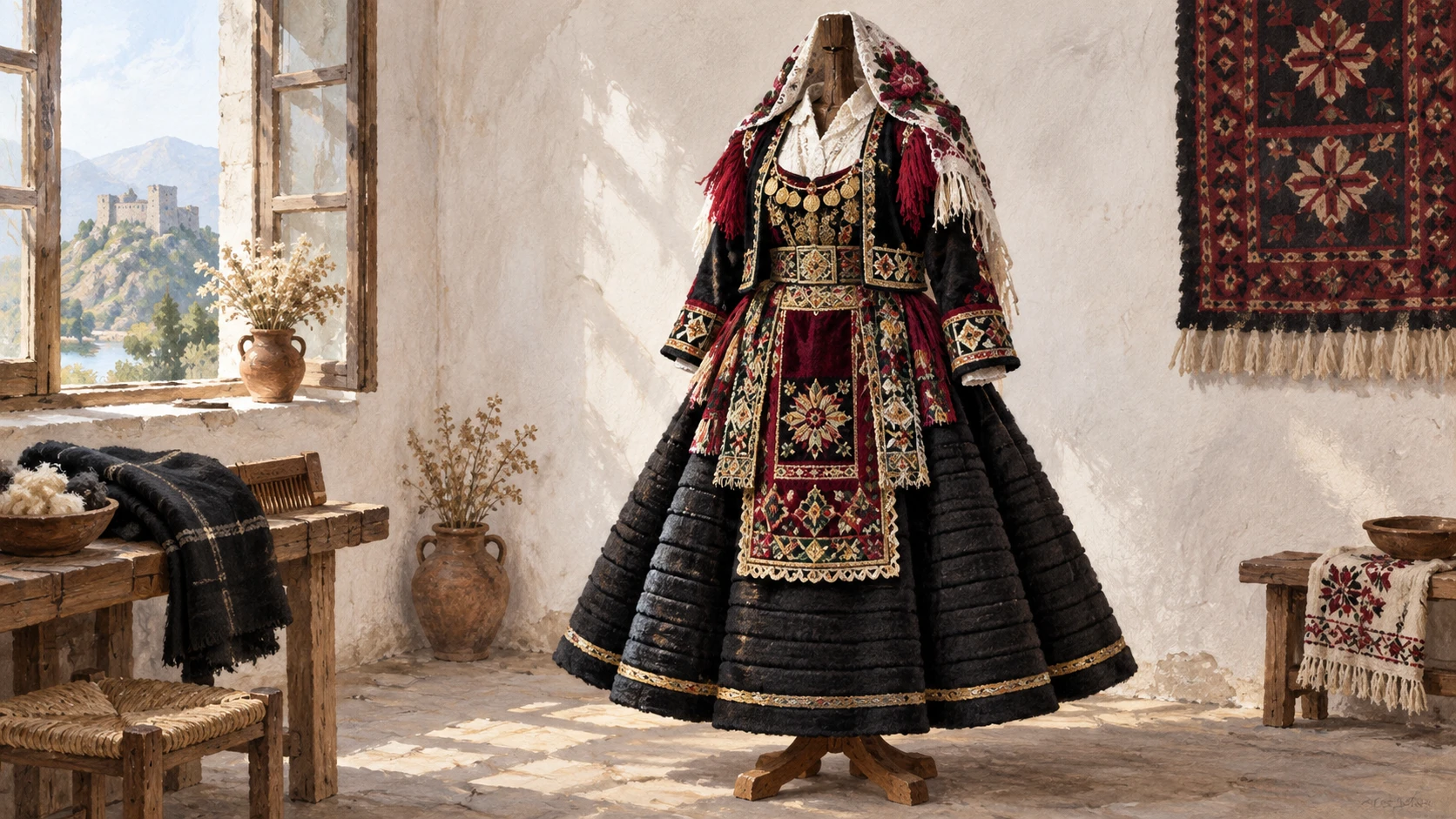
In November 2022, UNESCO inscribed Xhubleta craftsmanship on the Urgent Safeguarding List. Women historically handcraft and wear this bell-shaped garment across Northern Albania, notably within Malesia e Madhe and Dukagjin.
The undulating silhouette represents one of Europe's oldest continuous dress designs, dating back four millennia. Ancient Bronze Age terracotta figurines depict bell-skirted garments closely resembling the modern xhubleta.
Statutory decrees establish legal protective mechanisms and financial safeguarding subsidies for master artisans. A complete assembled xhubleta comprises between 25 and 30 individual horizontal strips of thick black wool felt.
Highland Wool and Water Fulling Mills
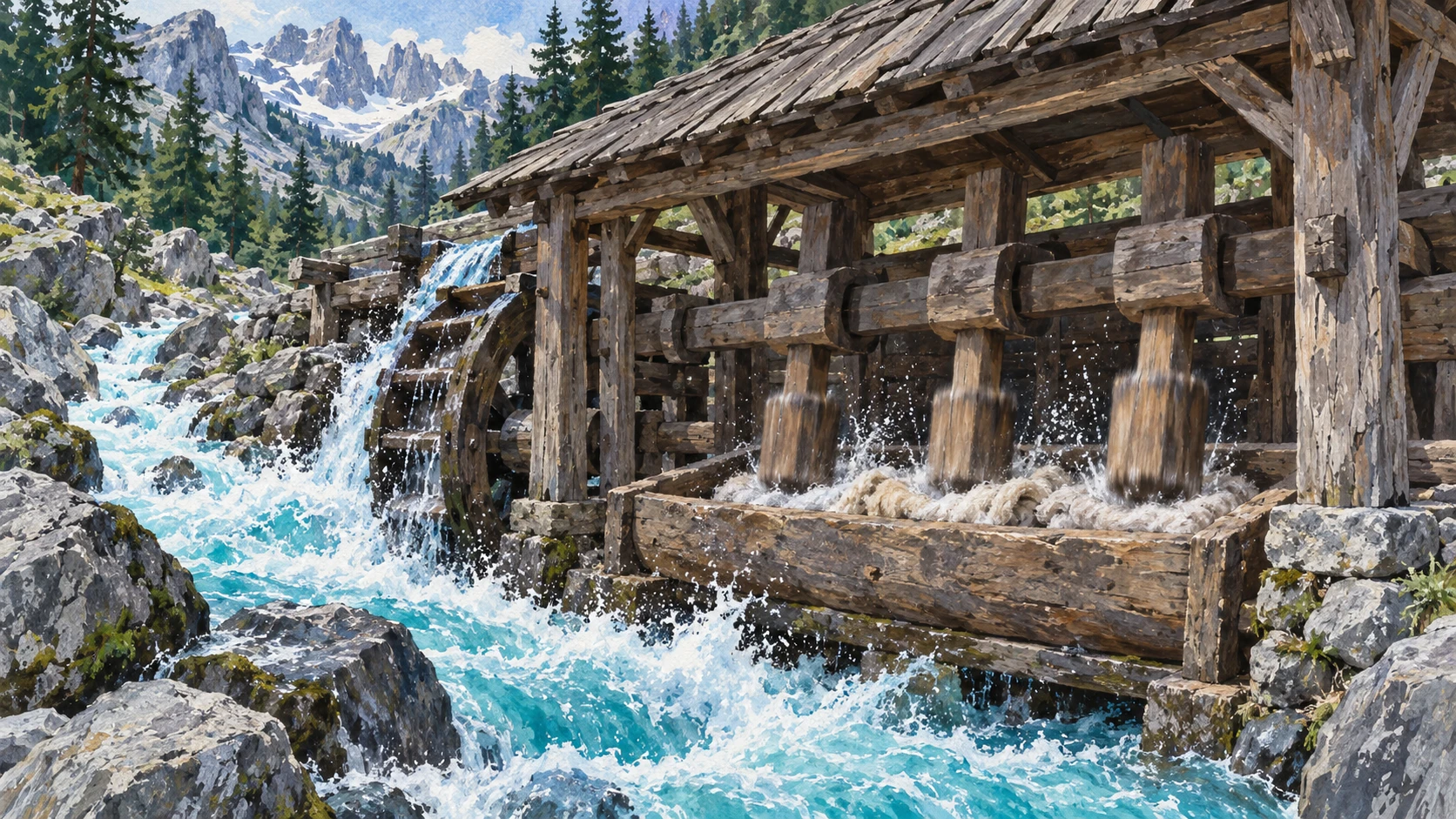
Construction begins with shearing native coarse highland sheep wool and hand-spinning heavy yarns. Woven fabrics undergo intensive water fulling in mountain wooden mills called valanica to produce dense felt known as shajak.
Highland water-powered mills employ reciprocating oak pestles driven by alpine torrents to shrink cloth. Artisans achieve deep black color using mineral mordaunts and boiled walnut husk dyes.
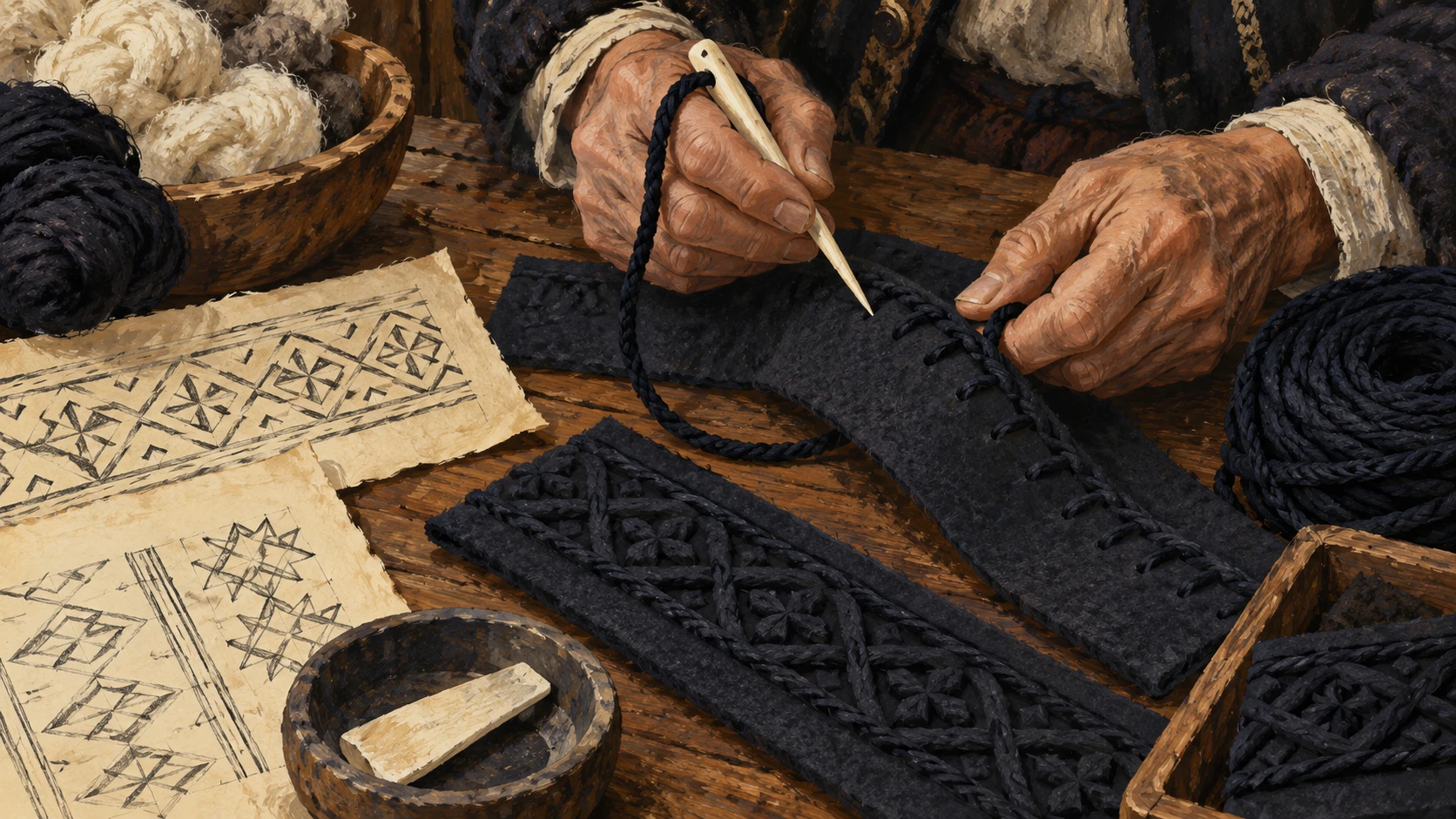
Master craftswomen hand-twist black wool cords called gajtana to reinforce edges and form borders. Scarcity of highland wool and decay of alpine fulling mills present bottlenecks for contemporary makers.
Cutting and Stitching the Heavy Felt Bands
Tailoring requires cutting felt into curved trapezoidal segments that create the stepped bell flare. Individual strips are joined horizontally using dense zigzag hand-stitching with bone needles and waxed hemp threads.
The undulating wave structure is reinforced by inserting stiffened gajtan cord welts along seams. An authentic finished xhubleta weighs between 10 and 15 kilograms due to dense wool.
Complete tailoring and assembly of a single xhubleta demands six to eight months of manual labor. The rigid bell structure flexes and sways dynamically with the wearer's gait without wire hoops.
Archaic Solar Symbols and Clan Embroidery
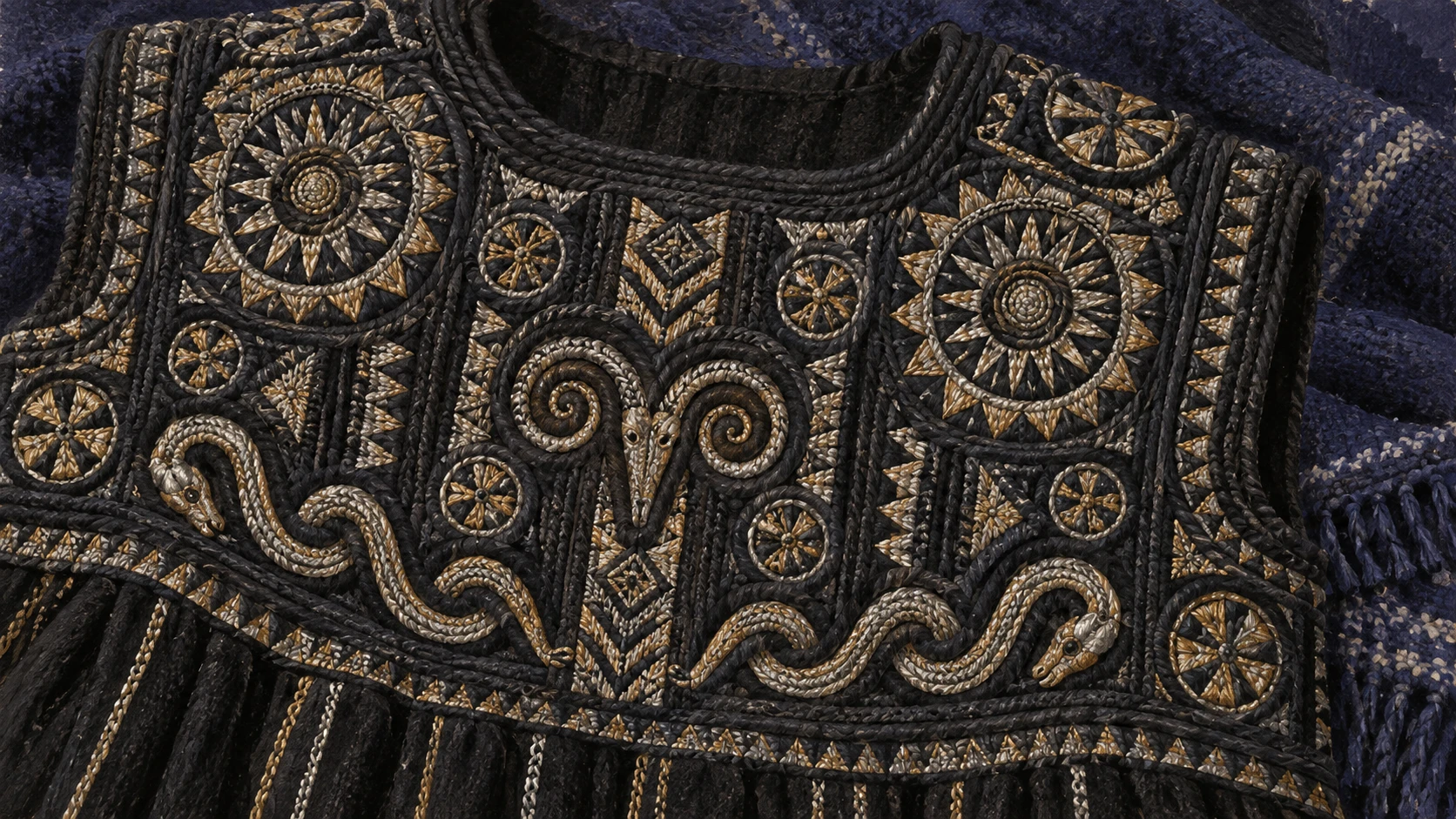
The decorative front apron called the parrallëza and bodice called the grykëza feature archaic geometric embroidery. Prominent embroidered motifs depict pagan solar disks and celestial rosettes symbolizing cosmic light.
Coiled serpent and horned ram emblems represent ancestral fertility cults and pastoral guardian spirits. Embroiderers apply raised wool cord braiding, silver filigree threads, and glass beads to sacred patterns.
Archaic geometric swastika and cross motifs represent ancient solar rotations documented in Illyrian artifacts. Each highland clan valley preserved distinctive color accents and embroidery variations to signal village lineage.
Weddings, Ceremonies, and Mourning Ensembles
The xhubleta historically served as the focal garment in young women's wedding dowries, termed the paja. Unmarried maidens wore lighter garments with alternating white and red felt bands before marriage.
Married women wore solemn black felt dresses decorated with vibrant red velvet aprons. Elderly women and widows wore strictly unornamented all-black ensembles devoid of metallic threads or colorful fabrics.
Traditional mortuary rites required deceased matriarchs to be buried in their finest handcrafted bridal xhubleta. Community festive dances and seasonal Catholic feast days featured collective processions of women wearing ancestral garments.
Artisan Workshops and Highland Revival
In the early twenty-first century, fewer than five master artisans possessed complete fabrication knowledge. The Ministry of Culture established dedicated apprenticeship workshops in Shkodra and Koplik to train young women.
Cultural Heritage without Borders established community wool cooperatives to supply authentic materials. National museum curators conduct systematic high-resolution digital documentation of antique xhubleta specimens across regional archives.
Contemporary fashion exhibitions and cultural festivals present reconstructed xhubleta garments to foster national pride. International safeguarding grants finance the restoration of historic water-powered valanica mills in alpine gorges.
A2 · Elementary
Xhubleta Craftsmanship: Ancient Highland Garments
Traditional bell dress tailoring, wool fulling, and urgent safeguarding in Northern Albania.
Urgent Safeguarding and Ancient Bell-Shaped Lineage
In November 2022, UNESCO inscribed Xhubleta craftsmanship on the List of Intangible Cultural Heritage in Need of Urgent Safeguarding, recognizing its profound cultural significance and extreme vulnerability.
The garment is historically handcrafted and worn by women across Northern Albania, notably within the mountainous highlands of Malesia e Madhe and Dukagjin. The undulating bell-shaped silhouette represents one of Europe's oldest continuous dress designs, dating back approximately four millennia to prehistoric Mediterranean civilizations.
Archaeological discoveries of Bronze Age Adriatic and Illyrian terracotta figurines depict bell-skirted garments closely resembling the modern xhubleta, confirming its ancient origin. Statutory cultural heritage decrees establish legal protective mechanisms and financial safeguarding subsidies for master artisans. A complete assembled xhubleta comprises between 25 and 30 individual horizontal strips of thick black wool felt.
Highland Wool, Water Fulling Mills, and Mineral Dyes
Construction begins with shearing native coarse highland sheep wool and hand-spinning heavy yarns using carved wooden spindles. Woven wool fabrics undergo intensive water fulling in mountain wooden mills called valanica to produce dense weatherproof felt known as shajak.
Highland water-powered mills employ heavy reciprocating oak pestles driven by alpine torrents to felt and shrink raw wool cloth through hours of continuous mechanical pounding. Artisans achieve the characteristic lustrous deep black hue using traditional mineral mordaunts and boiled walnut husk dyes.
Master craftswomen hand-twist black wool cords called gajtana to reinforce edges and form decorative relief borders. However, the scarcity of locally harvested highland wool and the decay of alpine fulling mills present severe supply chain bottlenecks for contemporary makers.
Complex Wave Geometry, Stitching, and Structural Dynamics
Tailoring requires cutting felt into precise curved trapezoidal segments that create the garment's distinctive stepped bell flare. Individual strips are joined horizontally using dense zigzag hand-stitching with bone needles and waxed hemp threads.
The undulating wave structure is reinforced by inserting stiffened gajtan cord welts along horizontal seams to maintain rigid horizontal pleats. An authentic finished xhubleta garment weighs between 10 and 15 kilograms due to the density of fulled wool and cords.
Complete tailoring and assembly of a single xhubleta demands between six and eight months of intensive skilled manual labor. The rigid bell structure flexes and sways dynamically with the wearer's gait while standing upright without internal wire hoops.
Archaic Solar Iconography and Clan Valley Variations
The decorative front apron called the parrallëza and bodice called the grykëza feature intricate archaic geometric embroidery. Prominent embroidered motifs depict pagan solar disks and celestial rosettes symbolizing cosmic vitality and light.
Coiled serpent and horned ram emblems represent ancestral fertility cults and pastoral guardian spirits. Embroiderers apply raised wool cord braiding, antique silver filigree threads, and polished glass beads to highlight sacred patterns.
Archaic geometric swastika and cross motifs represent ancient solar rotations documented in Illyrian archaeological artifacts. Each highland clan valley preserved distinctive color accents and embroidery variations to signal lineage and village identity.
Life-Cycle Rites, Bridal Dowries, and Mourning Protocols
The xhubleta historically served as the focal garment in young women's wedding dowries, termed the paja. Unmarried maidens wore lighter garments with alternating white and red felt bands before transitioning to dark bridal attire.
Married women wore solemn black felt dresses decorated with vibrant red velvet aprons and silver filigree ornaments. In contrast, elderly women and widows wore strictly unornamented all-black ensembles devoid of metallic threads or colorful fabrics.
Traditional mortuary rites required deceased matriarchs to be buried in their finest handcrafted bridal xhubleta. Community festive dances and seasonal Catholic patron saint feast days featured collective processions of women wearing ancestral garments.
Institutional Safeguarding, Apprenticeship, and Revival
In the early twenty-first century, fewer than five master artisans possessed comprehensive knowledge of the complete fabrication cycle. The Ministry of Culture established dedicated apprenticeship workshops in Shkodra and Koplik to train younger women artisans.
Cultural Heritage without Borders established community wool cooperatives to supply authentic materials to apprentice makers. National museum curators conduct systematic high-resolution digital documentation of antique xhubleta specimens across regional archives.
Contemporary fashion exhibitions and cultural festivals present reconstructed xhubleta garments to foster national cultural pride. International safeguarding grants finance the restoration of historic water-powered valanica mills in alpine highland gorges.
B1 · Intermediate
Xhubleta Craftsmanship: Ancient Highland Garments
Traditional bell dress tailoring, wool fulling, and urgent safeguarding in Northern Albania.
Urgent Safeguarding and Ancient Bell-Shaped Lineage
In November 2022, UNESCO inscribed Xhubleta craftsmanship on the List of Intangible Cultural Heritage in Need of Urgent Safeguarding, recognizing its profound cultural significance and extreme vulnerability.
The garment is historically handcrafted and worn by women across Northern Albania, notably within the mountainous highlands of Malesia e Madhe and Dukagjin. The undulating bell-shaped silhouette represents one of Europe's oldest continuous dress designs, dating back approximately four millennia to prehistoric Mediterranean civilizations.
Archaeological discoveries of Bronze Age Adriatic and Illyrian terracotta figurines depict bell-skirted garments closely resembling the modern xhubleta, confirming its ancient origin. Statutory cultural heritage decrees establish legal protective mechanisms and financial safeguarding subsidies for master artisans. A complete assembled xhubleta comprises between 25 and 30 individual horizontal strips of thick black wool felt.
Highland Wool, Water Fulling Mills, and Mineral Dyes
Construction begins with shearing native coarse highland sheep wool and hand-spinning heavy yarns using carved wooden spindles. Woven wool fabrics undergo intensive water fulling in mountain wooden mills called valanica to produce dense weatherproof felt known as shajak.
Highland water-powered mills employ heavy reciprocating oak pestles driven by alpine torrents to felt and shrink raw wool cloth through hours of continuous mechanical pounding. Artisans achieve the characteristic lustrous deep black hue using traditional mineral mordaunts and boiled walnut husk dyes.
Master craftswomen hand-twist black wool cords called gajtana to reinforce edges and form decorative relief borders. However, the scarcity of locally harvested highland wool and the decay of alpine fulling mills present severe supply chain bottlenecks for contemporary makers.
Complex Wave Geometry, Stitching, and Structural Dynamics
Tailoring requires cutting felt into precise curved trapezoidal segments that create the garment's distinctive stepped bell flare. Individual strips are joined horizontally using dense zigzag hand-stitching with bone needles and waxed hemp threads.
The undulating wave structure is reinforced by inserting stiffened gajtan cord welts along horizontal seams to maintain rigid horizontal pleats. An authentic finished xhubleta garment weighs between 10 and 15 kilograms due to the density of fulled wool and cords.
Complete tailoring and assembly of a single xhubleta demands between six and eight months of intensive skilled manual labor. The rigid bell structure flexes and sways dynamically with the wearer's gait while standing upright without internal wire hoops.
Archaic Solar Iconography and Clan Valley Variations
The decorative front apron called the parrallëza and bodice called the grykëza feature intricate archaic geometric embroidery. Prominent embroidered motifs depict pagan solar disks and celestial rosettes symbolizing cosmic vitality and light.
Coiled serpent and horned ram emblems represent ancestral fertility cults and pastoral guardian spirits. Embroiderers apply raised wool cord braiding, antique silver filigree threads, and polished glass beads to highlight sacred patterns.
Archaic geometric swastika and cross motifs represent ancient solar rotations documented in Illyrian archaeological artifacts. Each highland clan valley preserved distinctive color accents and embroidery variations to signal lineage and village identity.
Life-Cycle Rites, Bridal Dowries, and Mourning Protocols
The xhubleta historically served as the focal garment in young women's wedding dowries, termed the paja. Unmarried maidens wore lighter garments with alternating white and red felt bands before transitioning to dark bridal attire.
Married women wore solemn black felt dresses decorated with vibrant red velvet aprons and silver filigree ornaments. In contrast, elderly women and widows wore strictly unornamented all-black ensembles devoid of metallic threads or colorful fabrics.
Traditional mortuary rites required deceased matriarchs to be buried in their finest handcrafted bridal xhubleta. Community festive dances and seasonal Catholic patron saint feast days featured collective processions of women wearing ancestral garments.
Institutional Safeguarding, Apprenticeship, and Revival
In the early twenty-first century, fewer than five master artisans possessed comprehensive knowledge of the complete fabrication cycle. The Ministry of Culture established dedicated apprenticeship workshops in Shkodra and Koplik to train younger women artisans.
Cultural Heritage without Borders established community wool cooperatives to supply authentic materials to apprentice makers. National museum curators conduct systematic high-resolution digital documentation of antique xhubleta specimens across regional archives.
Contemporary fashion exhibitions and cultural festivals present reconstructed xhubleta garments to foster national cultural pride. International safeguarding grants finance the restoration of historic water-powered valanica mills in alpine highland gorges.
B2 · Upper Intermediate
Xhubleta Craftsmanship: Ancient Highland Garments
Traditional bell dress tailoring, wool fulling, and urgent safeguarding in Northern Albania.
Urgent Safeguarding and Ancient Bell-Shaped Lineage
In November 2022, UNESCO inscribed Xhubleta craftsmanship on the List of Intangible Cultural Heritage in Need of Urgent Safeguarding, recognizing its profound cultural significance and extreme vulnerability.
The garment is historically handcrafted and worn by women across Northern Albania, notably within the mountainous highlands of Malesia e Madhe and Dukagjin. The undulating bell-shaped silhouette represents one of Europe's oldest continuous dress designs, dating back approximately four millennia to prehistoric Mediterranean civilizations.
Archaeological discoveries of Bronze Age Adriatic and Illyrian terracotta figurines depict bell-skirted garments closely resembling the modern xhubleta, confirming its ancient origin. Statutory cultural heritage decrees establish legal protective mechanisms and financial safeguarding subsidies for master artisans. A complete assembled xhubleta comprises between 25 and 30 individual horizontal strips of thick black wool felt.
Highland Wool, Water Fulling Mills, and Mineral Dyes
Construction begins with shearing native coarse highland sheep wool and hand-spinning heavy yarns using carved wooden spindles. Woven wool fabrics undergo intensive water fulling in mountain wooden mills called valanica to produce dense weatherproof felt known as shajak.
Highland water-powered mills employ heavy reciprocating oak pestles driven by alpine torrents to felt and shrink raw wool cloth through hours of continuous mechanical pounding. Artisans achieve the characteristic lustrous deep black hue using traditional mineral mordaunts and boiled walnut husk dyes.
Master craftswomen hand-twist black wool cords called gajtana to reinforce edges and form decorative relief borders. However, the scarcity of locally harvested highland wool and the decay of alpine fulling mills present severe supply chain bottlenecks for contemporary makers.
Complex Wave Geometry, Stitching, and Structural Dynamics
Tailoring requires cutting felt into precise curved trapezoidal segments that create the garment's distinctive stepped bell flare. Individual strips are joined horizontally using dense zigzag hand-stitching with bone needles and waxed hemp threads.
The undulating wave structure is reinforced by inserting stiffened gajtan cord welts along horizontal seams to maintain rigid horizontal pleats. An authentic finished xhubleta garment weighs between 10 and 15 kilograms due to the density of fulled wool and cords.
Complete tailoring and assembly of a single xhubleta demands between six and eight months of intensive skilled manual labor. The rigid bell structure flexes and sways dynamically with the wearer's gait while standing upright without internal wire hoops.
Archaic Solar Iconography and Clan Valley Variations
The decorative front apron called the parrallëza and bodice called the grykëza feature intricate archaic geometric embroidery. Prominent embroidered motifs depict pagan solar disks and celestial rosettes symbolizing cosmic vitality and light.
Coiled serpent and horned ram emblems represent ancestral fertility cults and pastoral guardian spirits. Embroiderers apply raised wool cord braiding, antique silver filigree threads, and polished glass beads to highlight sacred patterns.
Archaic geometric swastika and cross motifs represent ancient solar rotations documented in Illyrian archaeological artifacts. Each highland clan valley preserved distinctive color accents and embroidery variations to signal lineage and village identity.
Life-Cycle Rites, Bridal Dowries, and Mourning Protocols
The xhubleta historically served as the focal garment in young women's wedding dowries, termed the paja. Unmarried maidens wore lighter garments with alternating white and red felt bands before transitioning to dark bridal attire.
Married women wore solemn black felt dresses decorated with vibrant red velvet aprons and silver filigree ornaments. In contrast, elderly women and widows wore strictly unornamented all-black ensembles devoid of metallic threads or colorful fabrics.
Traditional mortuary rites required deceased matriarchs to be buried in their finest handcrafted bridal xhubleta. Community festive dances and seasonal Catholic patron saint feast days featured collective processions of women wearing ancestral garments.
Institutional Safeguarding, Apprenticeship, and Revival
In the early twenty-first century, fewer than five master artisans possessed comprehensive knowledge of the complete fabrication cycle. The Ministry of Culture established dedicated apprenticeship workshops in Shkodra and Koplik to train younger women artisans.
Cultural Heritage without Borders established community wool cooperatives to supply authentic materials to apprentice makers. National museum curators conduct systematic high-resolution digital documentation of antique xhubleta specimens across regional archives.
Contemporary fashion exhibitions and cultural festivals present reconstructed xhubleta garments to foster national cultural pride. International safeguarding grants finance the restoration of historic water-powered valanica mills in alpine highland gorges.
C1 · Advanced
Xhubleta Craftsmanship: Ancient Highland Garments
Traditional bell dress tailoring, wool fulling, and urgent safeguarding in Northern Albania.
Urgent Safeguarding and Ancient Bell-Shaped Lineage
In November 2022, UNESCO inscribed Xhubleta craftsmanship on the List of Intangible Cultural Heritage in Need of Urgent Safeguarding, recognizing its profound cultural significance and extreme vulnerability.
The garment is historically handcrafted and worn by women across Northern Albania, notably within the mountainous highlands of Malesia e Madhe and Dukagjin. The undulating bell-shaped silhouette represents one of Europe's oldest continuous dress designs, dating back approximately four millennia to prehistoric Mediterranean civilizations.
Archaeological discoveries of Bronze Age Adriatic and Illyrian terracotta figurines depict bell-skirted garments closely resembling the modern xhubleta, confirming its ancient origin. Statutory cultural heritage decrees establish legal protective mechanisms and financial safeguarding subsidies for master artisans. A complete assembled xhubleta comprises between 25 and 30 individual horizontal strips of thick black wool felt.
Highland Wool, Water Fulling Mills, and Mineral Dyes
Construction begins with shearing native coarse highland sheep wool and hand-spinning heavy yarns using carved wooden spindles. Woven wool fabrics undergo intensive water fulling in mountain wooden mills called valanica to produce dense weatherproof felt known as shajak.
Highland water-powered mills employ heavy reciprocating oak pestles driven by alpine torrents to felt and shrink raw wool cloth through hours of continuous mechanical pounding. Artisans achieve the characteristic lustrous deep black hue using traditional mineral mordaunts and boiled walnut husk dyes.
Master craftswomen hand-twist black wool cords called gajtana to reinforce edges and form decorative relief borders. However, the scarcity of locally harvested highland wool and the decay of alpine fulling mills present severe supply chain bottlenecks for contemporary makers.
Complex Wave Geometry, Stitching, and Structural Dynamics
Tailoring requires cutting felt into precise curved trapezoidal segments that create the garment's distinctive stepped bell flare. Individual strips are joined horizontally using dense zigzag hand-stitching with bone needles and waxed hemp threads.
The undulating wave structure is reinforced by inserting stiffened gajtan cord welts along horizontal seams to maintain rigid horizontal pleats. An authentic finished xhubleta garment weighs between 10 and 15 kilograms due to the density of fulled wool and cords.
Complete tailoring and assembly of a single xhubleta demands between six and eight months of intensive skilled manual labor. The rigid bell structure flexes and sways dynamically with the wearer's gait while standing upright without internal wire hoops.
Archaic Solar Iconography and Clan Valley Variations
The decorative front apron called the parrallëza and bodice called the grykëza feature intricate archaic geometric embroidery. Prominent embroidered motifs depict pagan solar disks and celestial rosettes symbolizing cosmic vitality and light.
Coiled serpent and horned ram emblems represent ancestral fertility cults and pastoral guardian spirits. Embroiderers apply raised wool cord braiding, antique silver filigree threads, and polished glass beads to highlight sacred patterns.
Archaic geometric swastika and cross motifs represent ancient solar rotations documented in Illyrian archaeological artifacts. Each highland clan valley preserved distinctive color accents and embroidery variations to signal lineage and village identity.
Life-Cycle Rites, Bridal Dowries, and Mourning Protocols
The xhubleta historically served as the focal garment in young women's wedding dowries, termed the paja. Unmarried maidens wore lighter garments with alternating white and red felt bands before transitioning to dark bridal attire.
Married women wore solemn black felt dresses decorated with vibrant red velvet aprons and silver filigree ornaments. In contrast, elderly women and widows wore strictly unornamented all-black ensembles devoid of metallic threads or colorful fabrics.
Traditional mortuary rites required deceased matriarchs to be buried in their finest handcrafted bridal xhubleta. Community festive dances and seasonal Catholic patron saint feast days featured collective processions of women wearing ancestral garments.
Institutional Safeguarding, Apprenticeship, and Revival
In the early twenty-first century, fewer than five master artisans possessed comprehensive knowledge of the complete fabrication cycle. The Ministry of Culture established dedicated apprenticeship workshops in Shkodra and Koplik to train younger women artisans.
Cultural Heritage without Borders established community wool cooperatives to supply authentic materials to apprentice makers. National museum curators conduct systematic high-resolution digital documentation of antique xhubleta specimens across regional archives.
Contemporary fashion exhibitions and cultural festivals present reconstructed xhubleta garments to foster national cultural pride. International safeguarding grants finance the restoration of historic water-powered valanica mills in alpine highland gorges.
C2 · Mastery
Xhubleta Craftsmanship: Ancient Highland Garments
Traditional bell dress tailoring, wool fulling, and urgent safeguarding in Northern Albania.
Urgent Safeguarding and Ancient Bell-Shaped Lineage
In November 2022, UNESCO inscribed Xhubleta craftsmanship on the List of Intangible Cultural Heritage in Need of Urgent Safeguarding, recognizing its profound cultural significance and extreme vulnerability.
The garment is historically handcrafted and worn by women across Northern Albania, notably within the mountainous highlands of Malesia e Madhe and Dukagjin. The undulating bell-shaped silhouette represents one of Europe's oldest continuous dress designs, dating back approximately four millennia to prehistoric Mediterranean civilizations.
Archaeological discoveries of Bronze Age Adriatic and Illyrian terracotta figurines depict bell-skirted garments closely resembling the modern xhubleta, confirming its ancient origin. Statutory cultural heritage decrees establish legal protective mechanisms and financial safeguarding subsidies for master artisans. A complete assembled xhubleta comprises between 25 and 30 individual horizontal strips of thick black wool felt.
Highland Wool, Water Fulling Mills, and Mineral Dyes
Construction begins with shearing native coarse highland sheep wool and hand-spinning heavy yarns using carved wooden spindles. Woven wool fabrics undergo intensive water fulling in mountain wooden mills called valanica to produce dense weatherproof felt known as shajak.
Highland water-powered mills employ heavy reciprocating oak pestles driven by alpine torrents to felt and shrink raw wool cloth through hours of continuous mechanical pounding. Artisans achieve the characteristic lustrous deep black hue using traditional mineral mordaunts and boiled walnut husk dyes.
Master craftswomen hand-twist black wool cords called gajtana to reinforce edges and form decorative relief borders. However, the scarcity of locally harvested highland wool and the decay of alpine fulling mills present severe supply chain bottlenecks for contemporary makers.
Complex Wave Geometry, Stitching, and Structural Dynamics
Tailoring requires cutting felt into precise curved trapezoidal segments that create the garment's distinctive stepped bell flare. Individual strips are joined horizontally using dense zigzag hand-stitching with bone needles and waxed hemp threads.
The undulating wave structure is reinforced by inserting stiffened gajtan cord welts along horizontal seams to maintain rigid horizontal pleats. An authentic finished xhubleta garment weighs between 10 and 15 kilograms due to the density of fulled wool and cords.
Complete tailoring and assembly of a single xhubleta demands between six and eight months of intensive skilled manual labor. The rigid bell structure flexes and sways dynamically with the wearer's gait while standing upright without internal wire hoops.
Archaic Solar Iconography and Clan Valley Variations
The decorative front apron called the parrallëza and bodice called the grykëza feature intricate archaic geometric embroidery. Prominent embroidered motifs depict pagan solar disks and celestial rosettes symbolizing cosmic vitality and light.
Coiled serpent and horned ram emblems represent ancestral fertility cults and pastoral guardian spirits. Embroiderers apply raised wool cord braiding, antique silver filigree threads, and polished glass beads to highlight sacred patterns.
Archaic geometric swastika and cross motifs represent ancient solar rotations documented in Illyrian archaeological artifacts. Each highland clan valley preserved distinctive color accents and embroidery variations to signal lineage and village identity.
Life-Cycle Rites, Bridal Dowries, and Mourning Protocols
The xhubleta historically served as the focal garment in young women's wedding dowries, termed the paja. Unmarried maidens wore lighter garments with alternating white and red felt bands before transitioning to dark bridal attire.
Married women wore solemn black felt dresses decorated with vibrant red velvet aprons and silver filigree ornaments. In contrast, elderly women and widows wore strictly unornamented all-black ensembles devoid of metallic threads or colorful fabrics.
Traditional mortuary rites required deceased matriarchs to be buried in their finest handcrafted bridal xhubleta. Community festive dances and seasonal Catholic patron saint feast days featured collective processions of women wearing ancestral garments.
Institutional Safeguarding, Apprenticeship, and Revival
In the early twenty-first century, fewer than five master artisans possessed comprehensive knowledge of the complete fabrication cycle. The Ministry of Culture established dedicated apprenticeship workshops in Shkodra and Koplik to train younger women artisans.
Cultural Heritage without Borders established community wool cooperatives to supply authentic materials to apprentice makers. National museum curators conduct systematic high-resolution digital documentation of antique xhubleta specimens across regional archives.
Contemporary fashion exhibitions and cultural festivals present reconstructed xhubleta garments to foster national cultural pride. International safeguarding grants finance the restoration of historic water-powered valanica mills in alpine highland gorges.
Check your understanding
Choose how closely you want to revisit the article. You can refer back while answering, and review explanations when you finish.
Quick Quiz A1
Try one question, then create a free account for the full Quick Quiz. Sign Up Free
Answer every question before checking. There is no time limit.
Your results
/ 1 correct (%)
Read the explanations to see how each answer connects to the article.
-
In what year and month did UNESCO inscribe Xhubleta craftsmanship on the Urgent Safeguarding List?
1. Answer:
Quick Quiz A2
Try one question, then create a free account for the full Quick Quiz. Sign Up Free
Answer every question before checking. There is no time limit.
Your results
/ 1 correct (%)
Read the explanations to see how each answer connects to the article.
-
Under what international convention was Xhubleta craftsmanship inscribed in November 2022?
1. Answer:
Quick Quiz B1
Try one question, then create a free account for the full Quick Quiz. Sign Up Free
Answer every question before checking. There is no time limit.
Your results
/ 1 correct (%)
Read the explanations to see how each answer connects to the article.
-
Under what international convention was Xhubleta craftsmanship inscribed in November 2022?
1. Answer:
Quick Quiz B2
Try one question, then create a free account for the full Quick Quiz. Sign Up Free
Answer every question before checking. There is no time limit.
Your results
/ 1 correct (%)
Read the explanations to see how each answer connects to the article.
-
Under what international convention was Xhubleta craftsmanship inscribed in November 2022?
1. Answer:
Quick Quiz C1
Try one question, then create a free account for the full Quick Quiz. Sign Up Free
Answer every question before checking. There is no time limit.
Your results
/ 1 correct (%)
Read the explanations to see how each answer connects to the article.
-
Under what international convention was Xhubleta craftsmanship inscribed in November 2022?
1. Answer:
Quick Quiz C2
Try one question, then create a free account for the full Quick Quiz. Sign Up Free
Answer every question before checking. There is no time limit.
Your results
/ 1 correct (%)
Read the explanations to see how each answer connects to the article.
-
Under what international convention was Xhubleta craftsmanship inscribed in November 2022?
1. Answer:
