A1 · Beginner
The Lahuta Safeguarding Project: Preserving Northern Albania's Epic Lute Tradition
An international safeguarding project revitalizes the carved single-stringed lute and living Homeric songs of the Accursed Mountains.
International Assistance for an Ancient Mountain Instrument
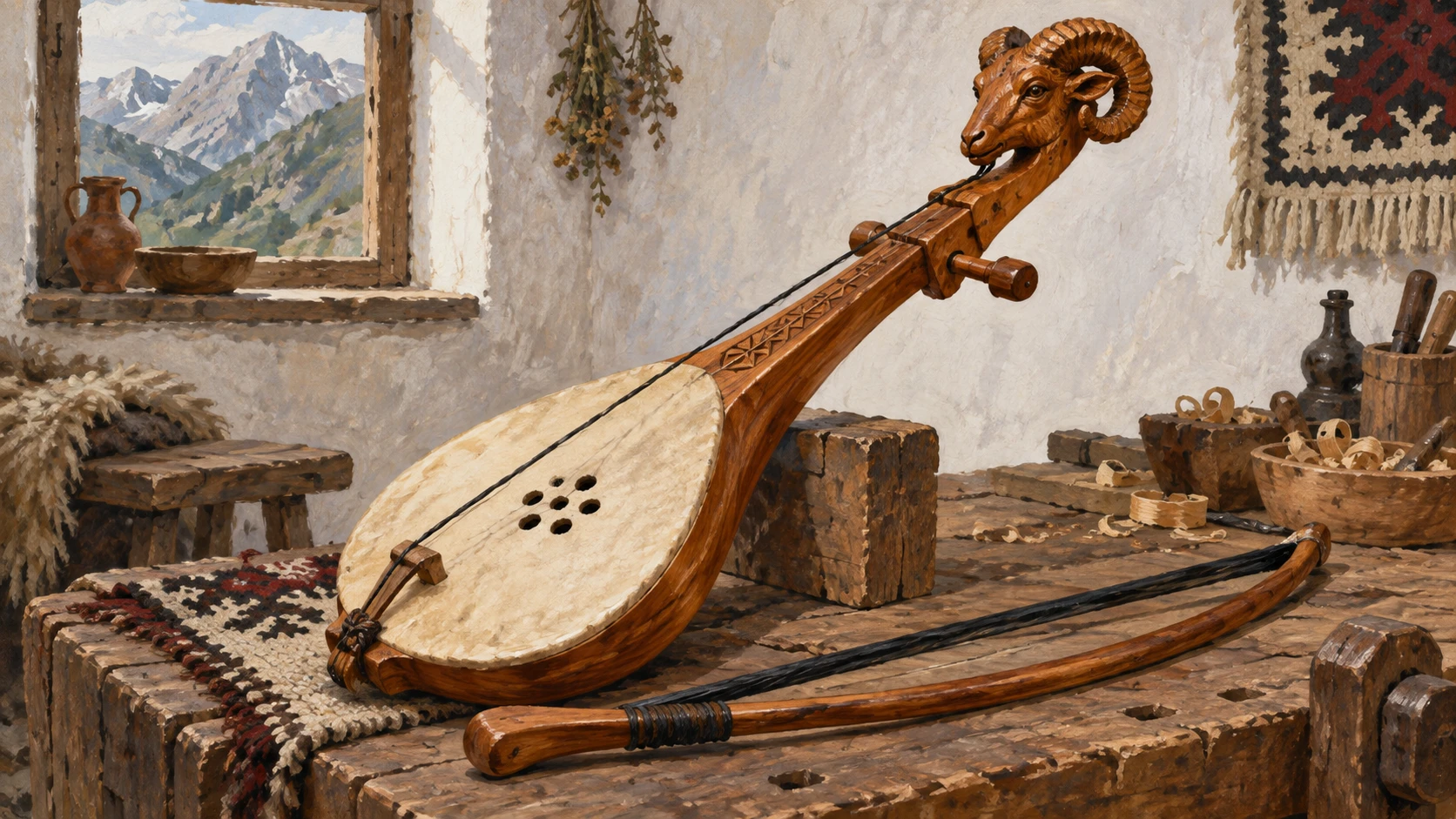
UNESCO registered international assistance project 02311 to build sustainable national capacities for safeguarding the art of singing, playing, and making the lahuta. The lahuta is an archaic single-stringed bowed musical lute played across northern Albania, particularly in Malesia e Madhe, Dukagjin, and Tropoja.
The instrument accompanies traditional oral recitations of the Kange Kreshnikesh, an ancient heroic cycle preserved in the Accursed Mountains. Safeguarding assistance focuses on documenting elder rhapsodists, revitalizing artisan workshops, and transmitting vocal chanting styles to younger apprentices.
Highland epic singing traditions represent a living oral tradition comparable in archaic poetic structure to ancient classical epics. The Ministry of Culture established official heritage inventories to protect regional dialects, instrument craft, and oral recitation styles.
Carving the Resonant Body from Mountain Timber
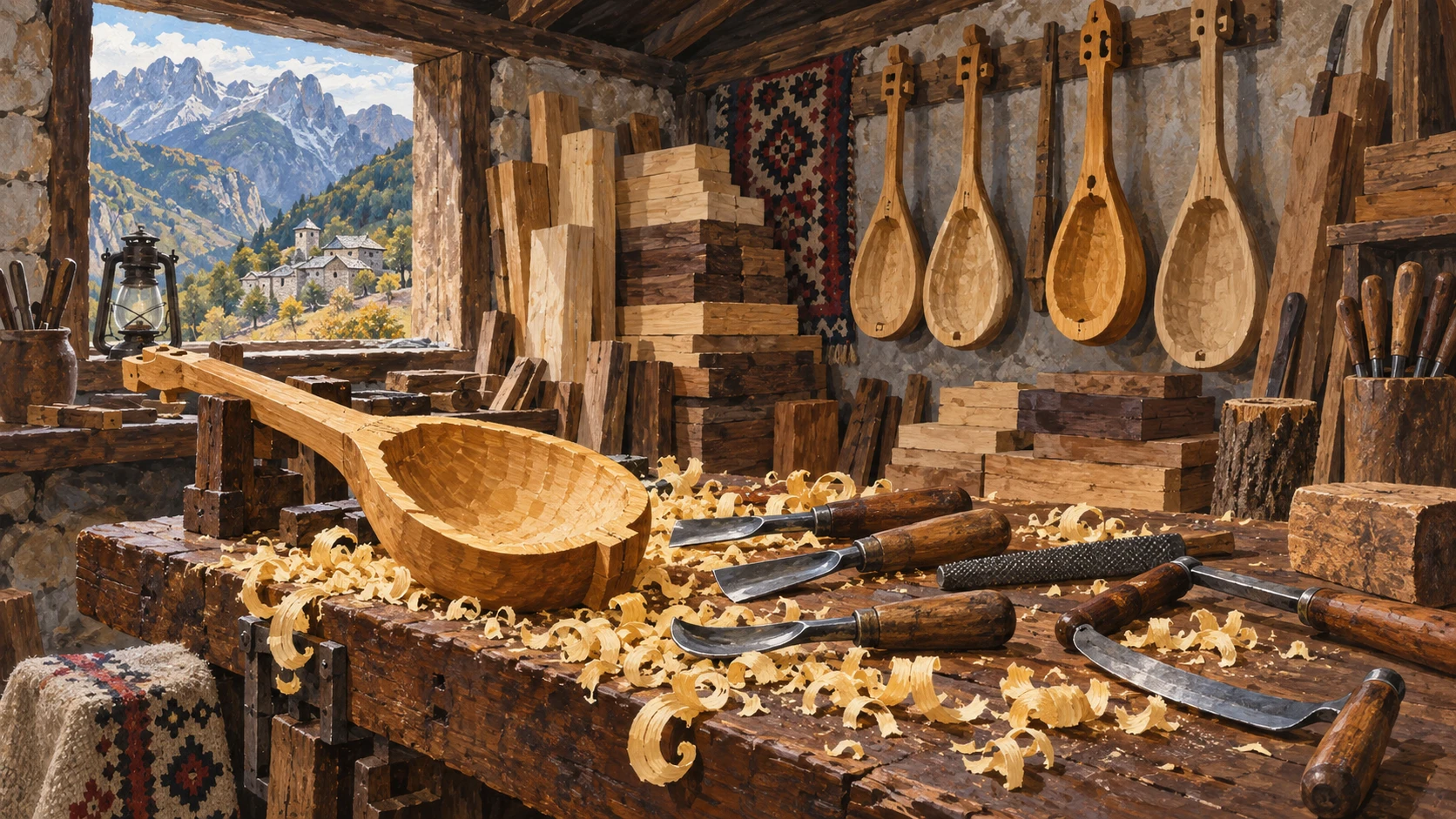
Master luthiers carve the entire body and neck of the lahuta from a single block of seasoned maple, walnut, or plum wood. Artisans hollow out the soundbox with hand gouges and drawknives, maintaining precise timber thickness for optimal acoustic resonance.
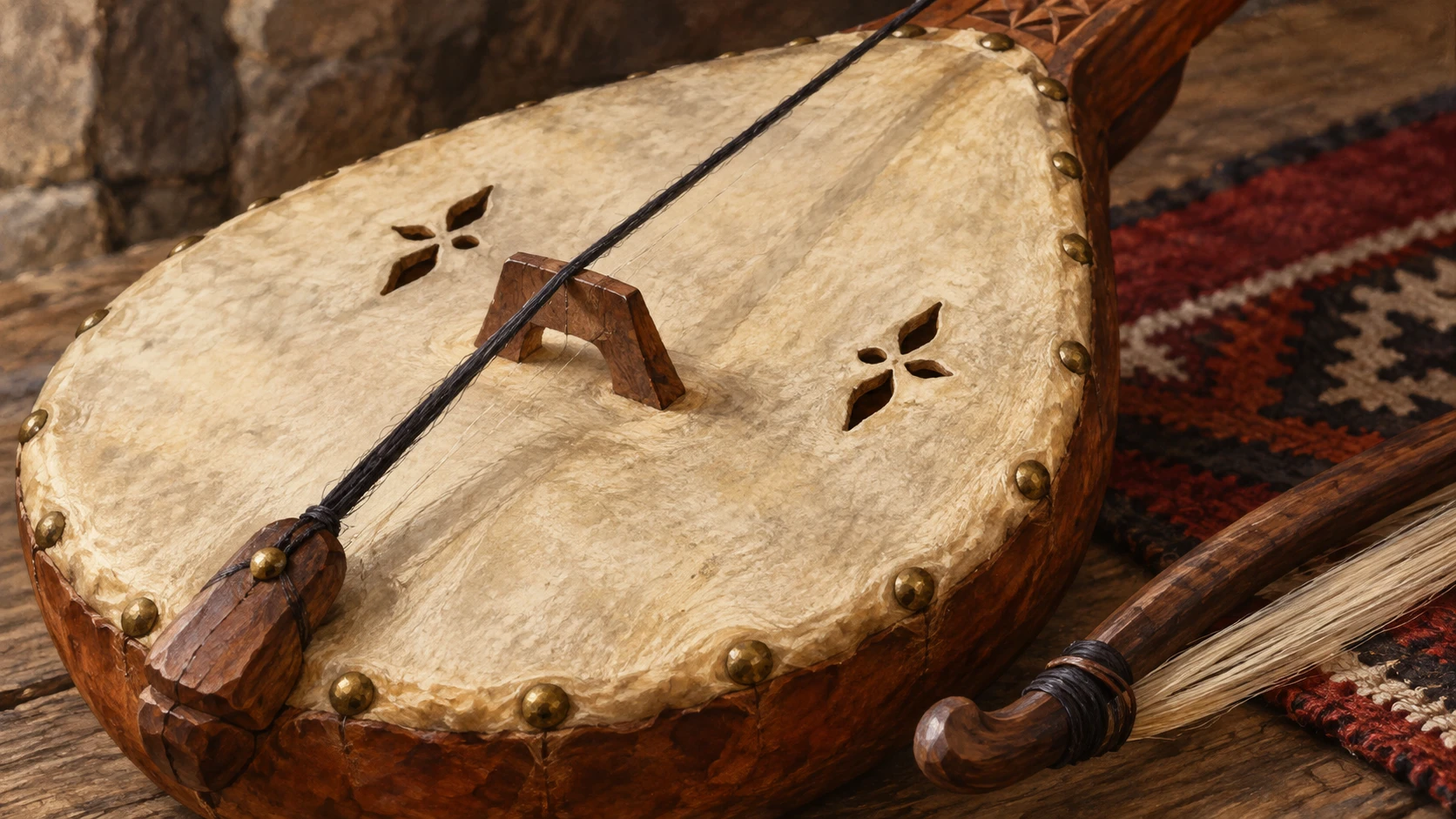
The peghead of the lahuta is traditionally sculpted with decorative animal motifs, most commonly a mountain goat, wild ram, or serpentine head. The instrument soundboard consists of dried goatskin or sheepskin stretched taut over the hollowed belly and fastened with metal nails or brass tacks.
A single thick string composed of dozens of twisted black stallion horsehairs is strung across a low wooden bridge to the tuning peg. The curved wooden bow is fitted with coarse horsehair, rubbed with pine rosin to grip the string firmly during highland performance.
Epic Poetry and Highland Gathering Halls
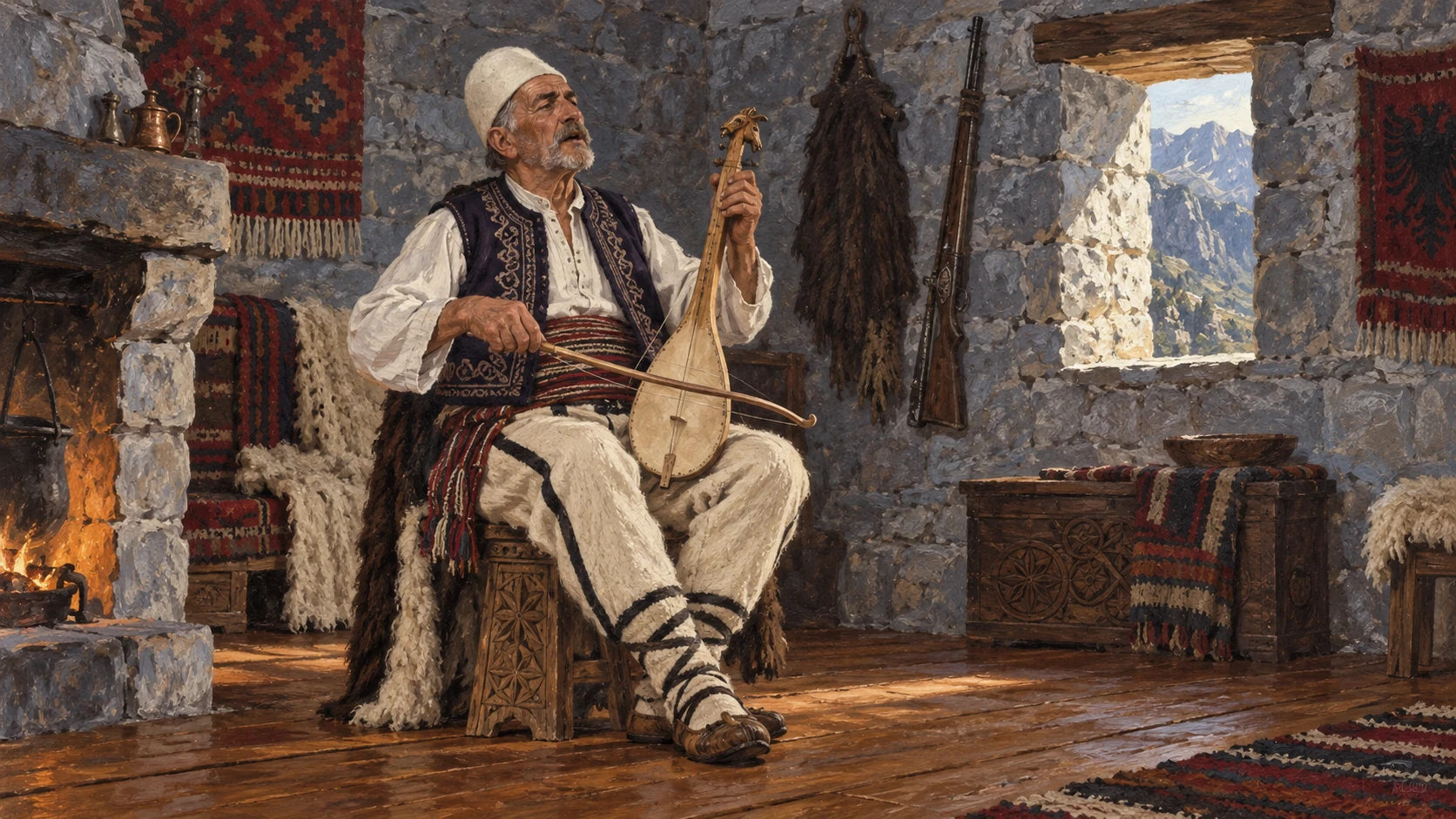
Highland singers, known as lahutars, perform epic songs containing thousands of unrhymed decasyllabic poetic verses. The epic cycle narrates legendary battles, code of honor, and mythological confrontations involving highland warriors such as Muji and Halili.
Performances traditionally took place during winter evening gatherings in fortified stone tower houses called kullas. The rhythmic vocal delivery combines recitative speech chanting with guttural pitch inflections, anchored by droning lute resonance.
Ethnomusicological field recordings demonstrate that master lahutars rely on dynamic oral formulae rather than memorized static texts. Epic poetry assemblies served historically as civic forums that transmitted ethical customs, customary law, and ancestral communal memory.
Rural Emigration and Generational Disruption
Rural demographic flight from northern mountain villages during recent decades disrupted traditional generational transmission channels. The number of active elder lahutars possessing extensive repertoires declined significantly by the early twenty-first century.
Traditional woodcarvers faced shortages of seasoned native tone woods and shrinking local economic demand for handmade folk instruments. Urban media shifts and modern digital entertainment reduced youth exposure to hours-long communal epic poetry recitals.
Ethnographers documented that fewer than twenty master rhapsodists maintained active command of complete epic song cycles in remote valleys. Preserving the tradition requires systemic institutional backing rather than relying entirely on informal family apprenticeships.
Artisan Workshops and Digital Audio Archives
Community cultural centers in Shkodra and highland towns established dedicated instrument-making workshops for young woodworking apprentices. Master artisans teach students the manual techniques of timber selection, skin curing, string braiding, and decorative headstock carving.
Regional secondary schools and folklore ensembles incorporated epic lute music and singing classes into specialized cultural curricula. Audiovisual documentation teams recorded dozens of elderly lahutars, creating open digital audio archives for musical researchers.
Financial micro-grants and artisan stipends provide economic incentives for luthiers to maintain continuous workshop production. Public masterclasses allow veteran performers to teach youth the precise bowing angles, left-hand touch, and breathing intervals required for performance.
Folklore Festivals and Contemporary Stages
Annual folklore festivals in Shkodra, Lezha, and Tropoja feature dedicated performance stages for emerging and veteran epic singers. Contemporary Albanian composers and world music groups integrate the acoustic timbres of the lahuta into modern orchestral arrangements.
Highland cultural tourism creates new sustainable markets where visitors observe authentic instrument craft and hear live performances. Cross-border cooperation among Balkan cultural heritage institutions supports comparative research into shared regional oral epics.
Highland communities take pride in the lahuta as a symbol of identity, resilient resistance, and northern hospitality. Ongoing safeguarding initiatives demonstrate that the ancient epic tradition can thrive when supported by living community institutions.
A2 · Elementary
The Lahuta Safeguarding Project: Preserving Northern Albania's Epic Lute Tradition
An international safeguarding project revitalizes the carved single-stringed lute and living Homeric songs of the Accursed Mountains.
International Assistance and Highland Heritage Registers
UNESCO registered international assistance project 02311 to build sustainable national capacities for safeguarding the art of singing, playing, and making the lahuta. The lahuta is an archaic single-stringed bowed musical lute played across northern Albania, particularly within the mountainous highlands of Malesia e Madhe, Dukagjin, and Tropoja.
The instrument accompanies traditional oral recitations of the Kange Kreshnikesh, an ancient heroic epic cycle preserved in the Accursed Mountains. Safeguarding assistance focuses on documenting elder rhapsodists, revitalizing artisan workshops, and transmitting vocal chanting styles to younger apprentices.
Highland epic singing traditions represent a living oral tradition comparable in archaic poetic structure to ancient classical epics. The Ministry of Culture established official heritage inventories to protect regional dialects, instrument craft, and oral recitation styles.
Organology, Resonant Timber, and Soundboard Assembly
Master luthiers carve the entire body and neck of the lahuta from a single block of seasoned maple, walnut, or plum wood. Artisans hollow out the soundbox with hand gouges and drawknives, maintaining precise timber thickness for optimal acoustic resonance.
The peghead of the lahuta is traditionally sculpted with decorative animal motifs, most commonly a mountain goat, wild ram, or serpentine head. The instrument soundboard consists of dried goatskin or sheepskin stretched taut over the hollowed belly and fastened with metal nails or brass tacks.
A single thick string composed of dozens of twisted black stallion horsehairs is strung across a low wooden bridge to the tuning peg. The curved wooden bow is fitted with coarse horsehair, rubbed with pine rosin to grip the string firmly during highland performance.
The Kange Kreshnikesh Cycle and Highland Assemblies
Highland singers, known as lahutars, perform epic songs containing thousands of unrhymed decasyllabic poetic verses. The epic cycle narrates legendary battles, code of honor, and mythological confrontations involving highland warriors such as Muji and Halili.
Performances traditionally took place during winter evening gatherings in fortified stone tower houses called kullas. The rhythmic vocal delivery combines recitative speech chanting with guttural pitch inflections, anchored by droning lute resonance.
Ethnomusicological field recordings demonstrate that master lahutars rely on dynamic oral formulae rather than memorized static texts. Epic poetry assemblies served historically as civic forums that transmitted ethical customs, customary law, and ancestral communal memory.
Demographic Shifts and Vulnerability of Oral Transmission
Rural demographic flight from northern mountain villages during recent decades disrupted traditional generational transmission channels. The number of active elder lahutars possessing extensive repertoires declined significantly by the early twenty-first century.
Traditional woodcarvers faced shortages of seasoned native tone woods and shrinking local economic demand for handmade folk instruments. Urban media shifts and modern digital entertainment reduced youth exposure to hours-long communal epic poetry recitals.
Ethnographers documented that fewer than twenty master rhapsodists maintained active command of complete epic song cycles in remote valleys. Preserving the tradition requires systemic institutional backing rather than relying entirely on informal family apprenticeships.
Artisan Apprenticeships and Audio Documentation
Community cultural centers in Shkodra and highland towns established dedicated instrument-making workshops for young woodworking apprentices. Master artisans teach students the manual techniques of timber selection, skin curing, string braiding, and decorative headstock carving.
Regional secondary schools and folklore ensembles incorporated epic lute music and singing classes into specialized cultural curricula. Audiovisual documentation teams recorded dozens of elderly lahutars, creating open digital audio archives for musical researchers.
Financial micro-grants and artisan stipends provide economic incentives for luthiers to maintain continuous workshop production. Public masterclasses allow veteran performers to teach youth the precise bowing angles, left-hand touch, and breathing intervals required for performance.
Contemporary Orchestras, Festivals, and Living Heritage
Annual folklore festivals in Shkodra, Lezha, and Tropoja feature dedicated performance stages for emerging and veteran epic singers. Contemporary Albanian composers and world music groups integrate the acoustic timbres of the lahuta into modern orchestral arrangements.
Highland cultural tourism creates new sustainable markets where visitors observe authentic instrument craft and hear live performances. Cross-border cooperation among Balkan cultural heritage institutions supports comparative research into shared regional oral epics.
Highland communities take pride in the lahuta as a symbol of identity, resilient resistance, and northern hospitality. Ongoing safeguarding initiatives demonstrate that the ancient epic tradition can thrive when supported by living community institutions.
B1 · Intermediate
The Lahuta Safeguarding Project: Preserving Northern Albania's Epic Lute Tradition
An international safeguarding project revitalizes the carved single-stringed lute and living Homeric songs of the Accursed Mountains.
International Assistance and Highland Heritage Registers
UNESCO registered international assistance project 02311 to build sustainable national capacities for safeguarding the art of singing, playing, and making the lahuta. The lahuta is an archaic single-stringed bowed musical lute played across northern Albania, particularly within the mountainous highlands of Malesia e Madhe, Dukagjin, and Tropoja.
The instrument accompanies traditional oral recitations of the Kange Kreshnikesh, an ancient heroic epic cycle preserved in the Accursed Mountains. Safeguarding assistance focuses on documenting elder rhapsodists, revitalizing artisan workshops, and transmitting vocal chanting styles to younger apprentices.
Highland epic singing traditions represent a living oral tradition comparable in archaic poetic structure to ancient classical epics. The Ministry of Culture established official heritage inventories to protect regional dialects, instrument craft, and oral recitation styles.
Organology, Resonant Timber, and Soundboard Assembly
Master luthiers carve the entire body and neck of the lahuta from a single block of seasoned maple, walnut, or plum wood. Artisans hollow out the soundbox with hand gouges and drawknives, maintaining precise timber thickness for optimal acoustic resonance.
The peghead of the lahuta is traditionally sculpted with decorative animal motifs, most commonly a mountain goat, wild ram, or serpentine head. The instrument soundboard consists of dried goatskin or sheepskin stretched taut over the hollowed belly and fastened with metal nails or brass tacks.
A single thick string composed of dozens of twisted black stallion horsehairs is strung across a low wooden bridge to the tuning peg. The curved wooden bow is fitted with coarse horsehair, rubbed with pine rosin to grip the string firmly during highland performance.
The Kange Kreshnikesh Cycle and Highland Assemblies
Highland singers, known as lahutars, perform epic songs containing thousands of unrhymed decasyllabic poetic verses. The epic cycle narrates legendary battles, code of honor, and mythological confrontations involving highland warriors such as Muji and Halili.
Performances traditionally took place during winter evening gatherings in fortified stone tower houses called kullas. The rhythmic vocal delivery combines recitative speech chanting with guttural pitch inflections, anchored by droning lute resonance.
Ethnomusicological field recordings demonstrate that master lahutars rely on dynamic oral formulae rather than memorized static texts. Epic poetry assemblies served historically as civic forums that transmitted ethical customs, customary law, and ancestral communal memory.
Demographic Shifts and Vulnerability of Oral Transmission
Rural demographic flight from northern mountain villages during recent decades disrupted traditional generational transmission channels. The number of active elder lahutars possessing extensive repertoires declined significantly by the early twenty-first century.
Traditional woodcarvers faced shortages of seasoned native tone woods and shrinking local economic demand for handmade folk instruments. Urban media shifts and modern digital entertainment reduced youth exposure to hours-long communal epic poetry recitals.
Ethnographers documented that fewer than twenty master rhapsodists maintained active command of complete epic song cycles in remote valleys. Preserving the tradition requires systemic institutional backing rather than relying entirely on informal family apprenticeships.
Artisan Apprenticeships and Audio Documentation
Community cultural centers in Shkodra and highland towns established dedicated instrument-making workshops for young woodworking apprentices. Master artisans teach students the manual techniques of timber selection, skin curing, string braiding, and decorative headstock carving.
Regional secondary schools and folklore ensembles incorporated epic lute music and singing classes into specialized cultural curricula. Audiovisual documentation teams recorded dozens of elderly lahutars, creating open digital audio archives for musical researchers.
Financial micro-grants and artisan stipends provide economic incentives for luthiers to maintain continuous workshop production. Public masterclasses allow veteran performers to teach youth the precise bowing angles, left-hand touch, and breathing intervals required for performance.
Contemporary Orchestras, Festivals, and Living Heritage
Annual folklore festivals in Shkodra, Lezha, and Tropoja feature dedicated performance stages for emerging and veteran epic singers. Contemporary Albanian composers and world music groups integrate the acoustic timbres of the lahuta into modern orchestral arrangements.
Highland cultural tourism creates new sustainable markets where visitors observe authentic instrument craft and hear live performances. Cross-border cooperation among Balkan cultural heritage institutions supports comparative research into shared regional oral epics.
Highland communities take pride in the lahuta as a symbol of identity, resilient resistance, and northern hospitality. Ongoing safeguarding initiatives demonstrate that the ancient epic tradition can thrive when supported by living community institutions.
B2 · Upper Intermediate
The Lahuta Safeguarding Project: Preserving Northern Albania's Epic Lute Tradition
An international safeguarding project revitalizes the carved single-stringed lute and living Homeric songs of the Accursed Mountains.
International Assistance and Highland Heritage Registers
UNESCO registered international assistance project 02311 to build sustainable national capacities for safeguarding the art of singing, playing, and making the lahuta. The lahuta is an archaic single-stringed bowed musical lute played across northern Albania, particularly within the mountainous highlands of Malesia e Madhe, Dukagjin, and Tropoja.
The instrument accompanies traditional oral recitations of the Kange Kreshnikesh, an ancient heroic epic cycle preserved in the Accursed Mountains. Safeguarding assistance focuses on documenting elder rhapsodists, revitalizing artisan workshops, and transmitting vocal chanting styles to younger apprentices.
Highland epic singing traditions represent a living oral tradition comparable in archaic poetic structure to ancient classical epics. The Ministry of Culture established official heritage inventories to protect regional dialects, instrument craft, and oral recitation styles.
Organology, Resonant Timber, and Soundboard Assembly
Master luthiers carve the entire body and neck of the lahuta from a single block of seasoned maple, walnut, or plum wood. Artisans hollow out the soundbox with hand gouges and drawknives, maintaining precise timber thickness for optimal acoustic resonance.
The peghead of the lahuta is traditionally sculpted with decorative animal motifs, most commonly a mountain goat, wild ram, or serpentine head. The instrument soundboard consists of dried goatskin or sheepskin stretched taut over the hollowed belly and fastened with metal nails or brass tacks.
A single thick string composed of dozens of twisted black stallion horsehairs is strung across a low wooden bridge to the tuning peg. The curved wooden bow is fitted with coarse horsehair, rubbed with pine rosin to grip the string firmly during highland performance.
The Kange Kreshnikesh Cycle and Highland Assemblies
Highland singers, known as lahutars, perform epic songs containing thousands of unrhymed decasyllabic poetic verses. The epic cycle narrates legendary battles, code of honor, and mythological confrontations involving highland warriors such as Muji and Halili.
Performances traditionally took place during winter evening gatherings in fortified stone tower houses called kullas. The rhythmic vocal delivery combines recitative speech chanting with guttural pitch inflections, anchored by droning lute resonance.
Ethnomusicological field recordings demonstrate that master lahutars rely on dynamic oral formulae rather than memorized static texts. Epic poetry assemblies served historically as civic forums that transmitted ethical customs, customary law, and ancestral communal memory.
Demographic Shifts and Vulnerability of Oral Transmission
Rural demographic flight from northern mountain villages during recent decades disrupted traditional generational transmission channels. The number of active elder lahutars possessing extensive repertoires declined significantly by the early twenty-first century.
Traditional woodcarvers faced shortages of seasoned native tone woods and shrinking local economic demand for handmade folk instruments. Urban media shifts and modern digital entertainment reduced youth exposure to hours-long communal epic poetry recitals.
Ethnographers documented that fewer than twenty master rhapsodists maintained active command of complete epic song cycles in remote valleys. Preserving the tradition requires systemic institutional backing rather than relying entirely on informal family apprenticeships.
Artisan Apprenticeships and Audio Documentation
Community cultural centers in Shkodra and highland towns established dedicated instrument-making workshops for young woodworking apprentices. Master artisans teach students the manual techniques of timber selection, skin curing, string braiding, and decorative headstock carving.
Regional secondary schools and folklore ensembles incorporated epic lute music and singing classes into specialized cultural curricula. Audiovisual documentation teams recorded dozens of elderly lahutars, creating open digital audio archives for musical researchers.
Financial micro-grants and artisan stipends provide economic incentives for luthiers to maintain continuous workshop production. Public masterclasses allow veteran performers to teach youth the precise bowing angles, left-hand touch, and breathing intervals required for performance.
Contemporary Orchestras, Festivals, and Living Heritage
Annual folklore festivals in Shkodra, Lezha, and Tropoja feature dedicated performance stages for emerging and veteran epic singers. Contemporary Albanian composers and world music groups integrate the acoustic timbres of the lahuta into modern orchestral arrangements.
Highland cultural tourism creates new sustainable markets where visitors observe authentic instrument craft and hear live performances. Cross-border cooperation among Balkan cultural heritage institutions supports comparative research into shared regional oral epics.
Highland communities take pride in the lahuta as a symbol of identity, resilient resistance, and northern hospitality. Ongoing safeguarding initiatives demonstrate that the ancient epic tradition can thrive when supported by living community institutions.
C1 · Advanced
The Lahuta Safeguarding Project: Preserving Northern Albania's Epic Lute Tradition
An international safeguarding project revitalizes the carved single-stringed lute and living Homeric songs of the Accursed Mountains.
International Assistance and Highland Heritage Registers
UNESCO registered international assistance project 02311 to build sustainable national capacities for safeguarding the art of singing, playing, and making the lahuta. The lahuta is an archaic single-stringed bowed musical lute played across northern Albania, particularly within the mountainous highlands of Malesia e Madhe, Dukagjin, and Tropoja.
The instrument accompanies traditional oral recitations of the Kange Kreshnikesh, an ancient heroic epic cycle preserved in the Accursed Mountains. Safeguarding assistance focuses on documenting elder rhapsodists, revitalizing artisan workshops, and transmitting vocal chanting styles to younger apprentices.
Highland epic singing traditions represent a living oral tradition comparable in archaic poetic structure to ancient classical epics. The Ministry of Culture established official heritage inventories to protect regional dialects, instrument craft, and oral recitation styles.
Organology, Resonant Timber, and Soundboard Assembly
Master luthiers carve the entire body and neck of the lahuta from a single block of seasoned maple, walnut, or plum wood. Artisans hollow out the soundbox with hand gouges and drawknives, maintaining precise timber thickness for optimal acoustic resonance.
The peghead of the lahuta is traditionally sculpted with decorative animal motifs, most commonly a mountain goat, wild ram, or serpentine head. The instrument soundboard consists of dried goatskin or sheepskin stretched taut over the hollowed belly and fastened with metal nails or brass tacks.
A single thick string composed of dozens of twisted black stallion horsehairs is strung across a low wooden bridge to the tuning peg. The curved wooden bow is fitted with coarse horsehair, rubbed with pine rosin to grip the string firmly during highland performance.
The Kange Kreshnikesh Cycle and Highland Assemblies
Highland singers, known as lahutars, perform epic songs containing thousands of unrhymed decasyllabic poetic verses. The epic cycle narrates legendary battles, code of honor, and mythological confrontations involving highland warriors such as Muji and Halili.
Performances traditionally took place during winter evening gatherings in fortified stone tower houses called kullas. The rhythmic vocal delivery combines recitative speech chanting with guttural pitch inflections, anchored by droning lute resonance.
Ethnomusicological field recordings demonstrate that master lahutars rely on dynamic oral formulae rather than memorized static texts. Epic poetry assemblies served historically as civic forums that transmitted ethical customs, customary law, and ancestral communal memory.
Demographic Shifts and Vulnerability of Oral Transmission
Rural demographic flight from northern mountain villages during recent decades disrupted traditional generational transmission channels. The number of active elder lahutars possessing extensive repertoires declined significantly by the early twenty-first century.
Traditional woodcarvers faced shortages of seasoned native tone woods and shrinking local economic demand for handmade folk instruments. Urban media shifts and modern digital entertainment reduced youth exposure to hours-long communal epic poetry recitals.
Ethnographers documented that fewer than twenty master rhapsodists maintained active command of complete epic song cycles in remote valleys. Preserving the tradition requires systemic institutional backing rather than relying entirely on informal family apprenticeships.
Artisan Apprenticeships and Audio Documentation
Community cultural centers in Shkodra and highland towns established dedicated instrument-making workshops for young woodworking apprentices. Master artisans teach students the manual techniques of timber selection, skin curing, string braiding, and decorative headstock carving.
Regional secondary schools and folklore ensembles incorporated epic lute music and singing classes into specialized cultural curricula. Audiovisual documentation teams recorded dozens of elderly lahutars, creating open digital audio archives for musical researchers.
Financial micro-grants and artisan stipends provide economic incentives for luthiers to maintain continuous workshop production. Public masterclasses allow veteran performers to teach youth the precise bowing angles, left-hand touch, and breathing intervals required for performance.
Contemporary Orchestras, Festivals, and Living Heritage
Annual folklore festivals in Shkodra, Lezha, and Tropoja feature dedicated performance stages for emerging and veteran epic singers. Contemporary Albanian composers and world music groups integrate the acoustic timbres of the lahuta into modern orchestral arrangements.
Highland cultural tourism creates new sustainable markets where visitors observe authentic instrument craft and hear live performances. Cross-border cooperation among Balkan cultural heritage institutions supports comparative research into shared regional oral epics.
Highland communities take pride in the lahuta as a symbol of identity, resilient resistance, and northern hospitality. Ongoing safeguarding initiatives demonstrate that the ancient epic tradition can thrive when supported by living community institutions.
C2 · Mastery
The Lahuta Safeguarding Project: Preserving Northern Albania's Epic Lute Tradition
An international safeguarding project revitalizes the carved single-stringed lute and living Homeric songs of the Accursed Mountains.
International Assistance and Highland Heritage Registers
UNESCO registered international assistance project 02311 to build sustainable national capacities for safeguarding the art of singing, playing, and making the lahuta. The lahuta is an archaic single-stringed bowed musical lute played across northern Albania, particularly within the mountainous highlands of Malesia e Madhe, Dukagjin, and Tropoja.
The instrument accompanies traditional oral recitations of the Kange Kreshnikesh, an ancient heroic epic cycle preserved in the Accursed Mountains. Safeguarding assistance focuses on documenting elder rhapsodists, revitalizing artisan workshops, and transmitting vocal chanting styles to younger apprentices.
Highland epic singing traditions represent a living oral tradition comparable in archaic poetic structure to ancient classical epics. The Ministry of Culture established official heritage inventories to protect regional dialects, instrument craft, and oral recitation styles.
Organology, Resonant Timber, and Soundboard Assembly
Master luthiers carve the entire body and neck of the lahuta from a single block of seasoned maple, walnut, or plum wood. Artisans hollow out the soundbox with hand gouges and drawknives, maintaining precise timber thickness for optimal acoustic resonance.
The peghead of the lahuta is traditionally sculpted with decorative animal motifs, most commonly a mountain goat, wild ram, or serpentine head. The instrument soundboard consists of dried goatskin or sheepskin stretched taut over the hollowed belly and fastened with metal nails or brass tacks.
A single thick string composed of dozens of twisted black stallion horsehairs is strung across a low wooden bridge to the tuning peg. The curved wooden bow is fitted with coarse horsehair, rubbed with pine rosin to grip the string firmly during highland performance.
The Kange Kreshnikesh Cycle and Highland Assemblies
Highland singers, known as lahutars, perform epic songs containing thousands of unrhymed decasyllabic poetic verses. The epic cycle narrates legendary battles, code of honor, and mythological confrontations involving highland warriors such as Muji and Halili.
Performances traditionally took place during winter evening gatherings in fortified stone tower houses called kullas. The rhythmic vocal delivery combines recitative speech chanting with guttural pitch inflections, anchored by droning lute resonance.
Ethnomusicological field recordings demonstrate that master lahutars rely on dynamic oral formulae rather than memorized static texts. Epic poetry assemblies served historically as civic forums that transmitted ethical customs, customary law, and ancestral communal memory.
Demographic Shifts and Vulnerability of Oral Transmission
Rural demographic flight from northern mountain villages during recent decades disrupted traditional generational transmission channels. The number of active elder lahutars possessing extensive repertoires declined significantly by the early twenty-first century.
Traditional woodcarvers faced shortages of seasoned native tone woods and shrinking local economic demand for handmade folk instruments. Urban media shifts and modern digital entertainment reduced youth exposure to hours-long communal epic poetry recitals.
Ethnographers documented that fewer than twenty master rhapsodists maintained active command of complete epic song cycles in remote valleys. Preserving the tradition requires systemic institutional backing rather than relying entirely on informal family apprenticeships.
Artisan Apprenticeships and Audio Documentation
Community cultural centers in Shkodra and highland towns established dedicated instrument-making workshops for young woodworking apprentices. Master artisans teach students the manual techniques of timber selection, skin curing, string braiding, and decorative headstock carving.
Regional secondary schools and folklore ensembles incorporated epic lute music and singing classes into specialized cultural curricula. Audiovisual documentation teams recorded dozens of elderly lahutars, creating open digital audio archives for musical researchers.
Financial micro-grants and artisan stipends provide economic incentives for luthiers to maintain continuous workshop production. Public masterclasses allow veteran performers to teach youth the precise bowing angles, left-hand touch, and breathing intervals required for performance.
Contemporary Orchestras, Festivals, and Living Heritage
Annual folklore festivals in Shkodra, Lezha, and Tropoja feature dedicated performance stages for emerging and veteran epic singers. Contemporary Albanian composers and world music groups integrate the acoustic timbres of the lahuta into modern orchestral arrangements.
Highland cultural tourism creates new sustainable markets where visitors observe authentic instrument craft and hear live performances. Cross-border cooperation among Balkan cultural heritage institutions supports comparative research into shared regional oral epics.
Highland communities take pride in the lahuta as a symbol of identity, resilient resistance, and northern hospitality. Ongoing safeguarding initiatives demonstrate that the ancient epic tradition can thrive when supported by living community institutions.
Check your understanding
Choose how closely you want to revisit the article. You can refer back while answering, and review explanations when you finish.
Quick Quiz A1
Try one question, then create a free account for the full Quick Quiz. Sign Up Free
Answer every question before checking. There is no time limit.
Your results
/ 1 correct (%)
Read the explanations to see how each answer connects to the article.
-
Which organization registered international assistance project 02311 for the lahuta?
1. Answer:
Quick Quiz A2
Try one question, then create a free account for the full Quick Quiz. Sign Up Free
Answer every question before checking. There is no time limit.
Your results
/ 1 correct (%)
Read the explanations to see how each answer connects to the article.
-
Which body registered international assistance project 02311 for safeguarding the lahuta?
1. Answer:
Quick Quiz B1
Try one question, then create a free account for the full Quick Quiz. Sign Up Free
Answer every question before checking. There is no time limit.
Your results
/ 1 correct (%)
Read the explanations to see how each answer connects to the article.
-
Which body registered international assistance project 02311 for safeguarding the lahuta?
1. Answer:
Quick Quiz B2
Try one question, then create a free account for the full Quick Quiz. Sign Up Free
Answer every question before checking. There is no time limit.
Your results
/ 1 correct (%)
Read the explanations to see how each answer connects to the article.
-
Which body registered international assistance project 02311 for safeguarding the lahuta?
1. Answer:
Quick Quiz C1
Try one question, then create a free account for the full Quick Quiz. Sign Up Free
Answer every question before checking. There is no time limit.
Your results
/ 1 correct (%)
Read the explanations to see how each answer connects to the article.
-
Which body registered international assistance project 02311 for safeguarding the lahuta?
1. Answer:
Quick Quiz C2
Try one question, then create a free account for the full Quick Quiz. Sign Up Free
Answer every question before checking. There is no time limit.
Your results
/ 1 correct (%)
Read the explanations to see how each answer connects to the article.
-
Which body registered international assistance project 02311 for safeguarding the lahuta?
1. Answer:
