A1 · Beginner
Pilbara Iron Ore Mining and Long Heavy Trains
Red rock mountains, giant desert mines, long freight trains, and ships carrying metal to world ports.
Ancient Red Rocks and Big Metal Hills
Vast red rocks formed deep under ancient oceans over two billion years ago in Western Australia.
Tiny sea plants made layers of iron and silica across the water floor.
A pilot named Lang Hancock saw tall red cliffs while flying through rain in 1952.
Geological surveys found rich hematite with sixty percent pure iron.
Workers opened the large Mount Whaleback mine in 1969 to dig up heavy metal.
The Commonwealth export embargo ended in 1960 so Asian mills could buy ore.
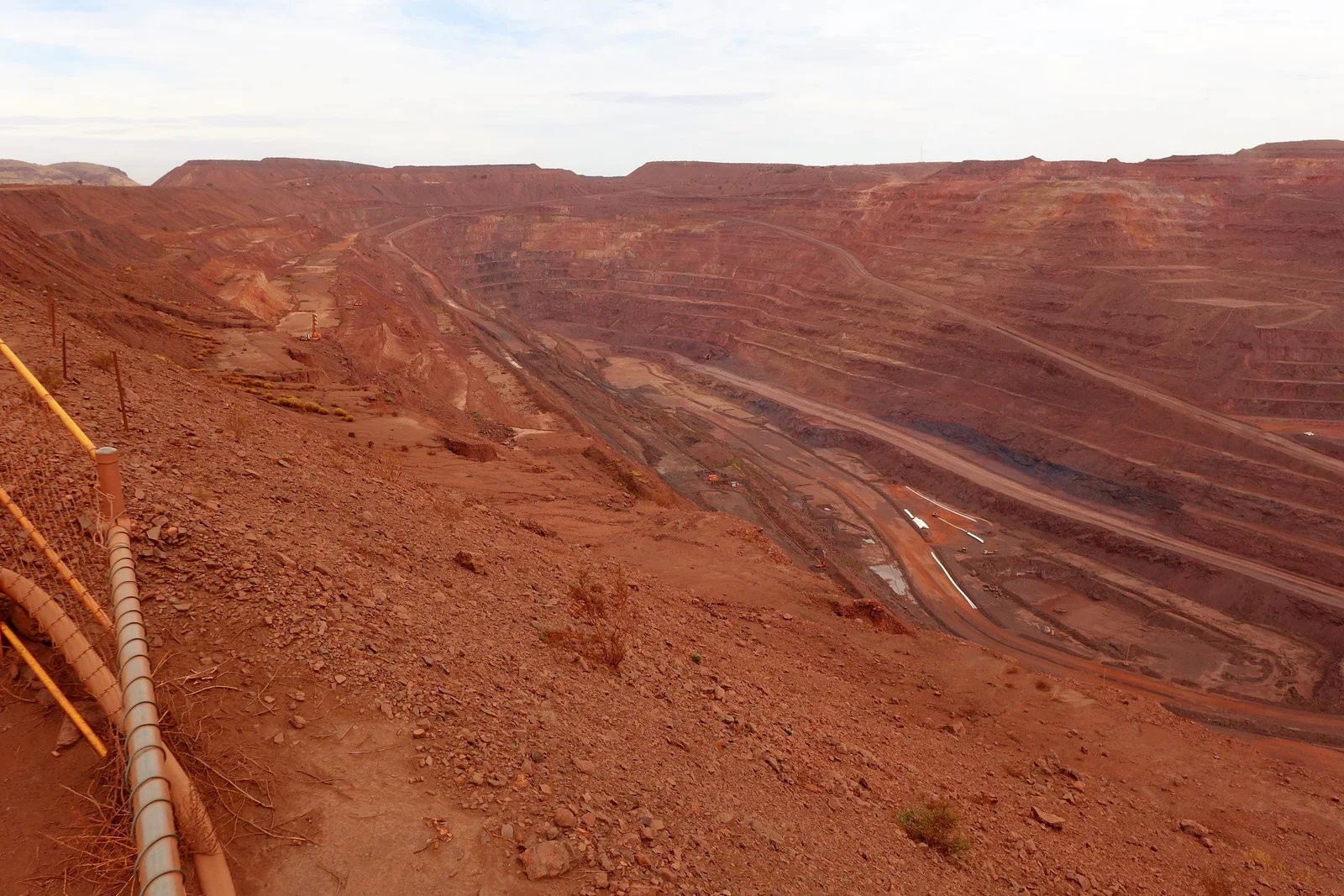
Giant Diggers and Smart Robot Trucks
Big drill machines make deep holes in the rock before workers blast the hard ground.
Huge power shovels lift one hundred tonnes of red stone into tall mine trucks.
Smart trucks drive along dirt roads without human drivers by using radios and computers.
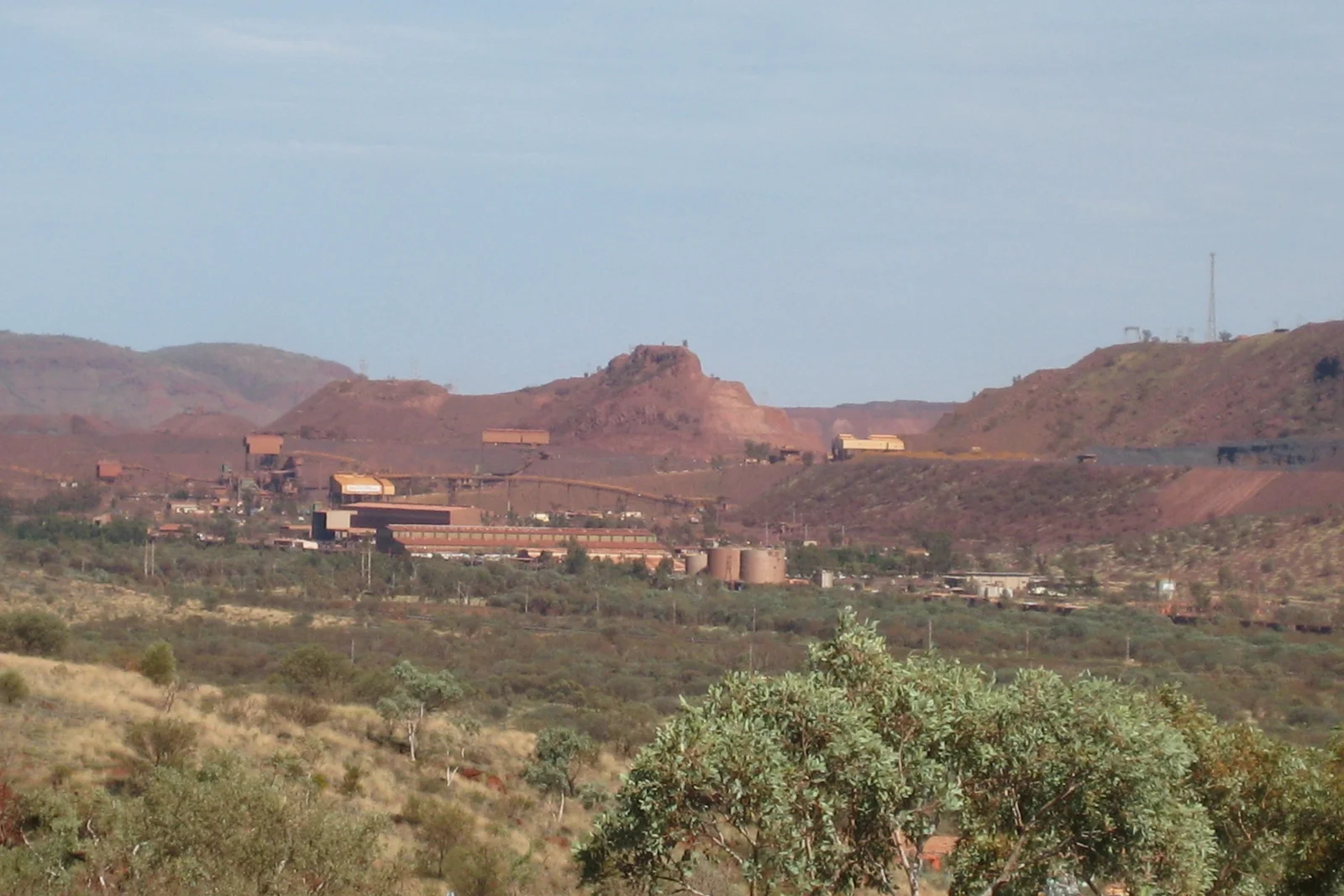
Large rock crushers break big stones into small pebbles before belts move the ore.
Engineers sit in an office in Perth and guide remote trucks across the desert.
Sprays of clean water wet the dry red dirt so dust does not blow away.
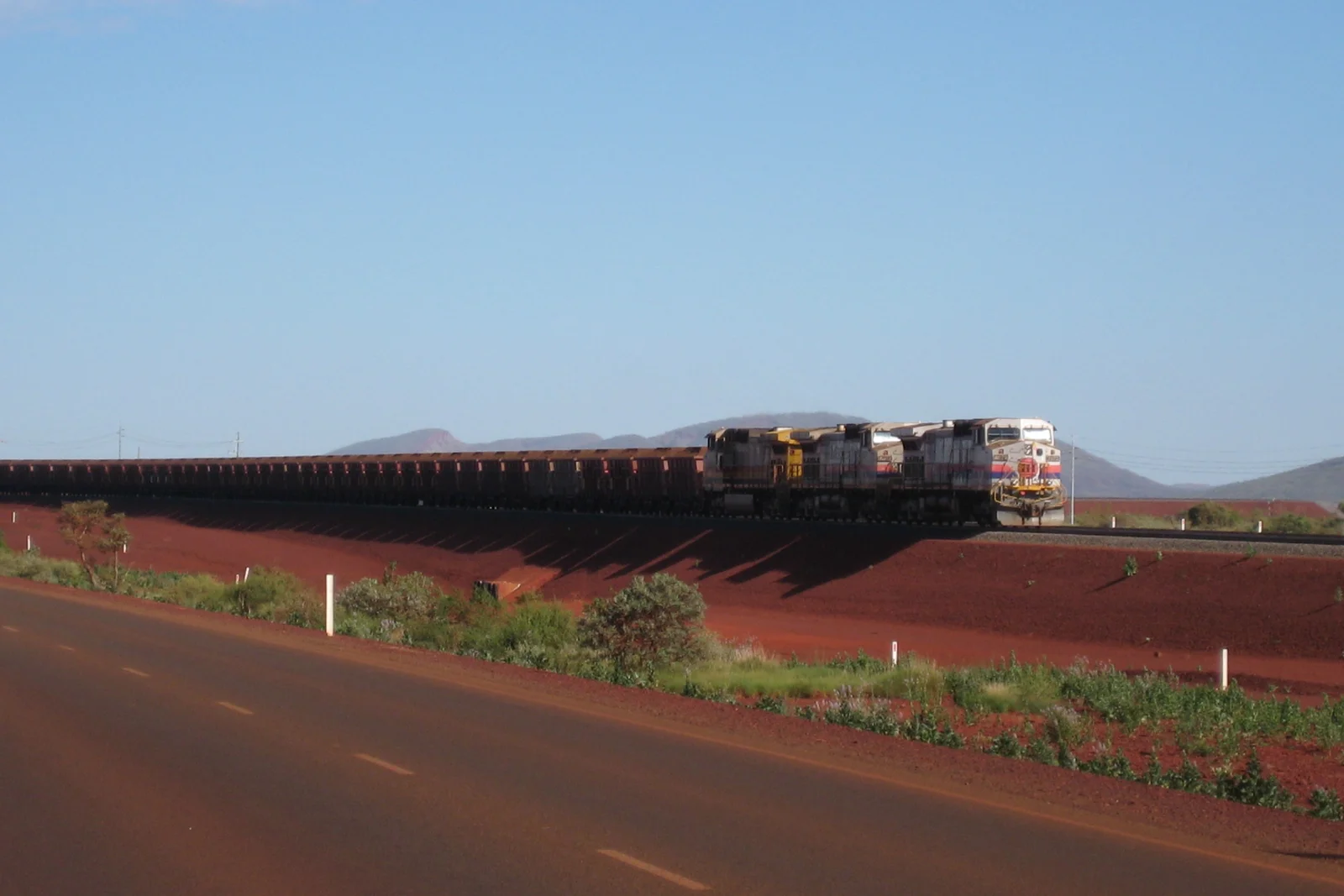
Very Long Trains Crossing the Hot Desert
Long steel railway tracks run hundreds of kilometers across the flat red desert.
Powerful diesel engines pull more than two hundred and forty loaded metal wagons.
These giant freight trains weigh more than thirty-five thousand tonnes on the track.
In 2018 mining teams started automated AutoHaul trains that travel without onboard drivers.
Rail repair crews use laser tools and grinding machines to keep the tracks smooth.
Large turning machines flip rail wagons upside down to empty ore in minutes.
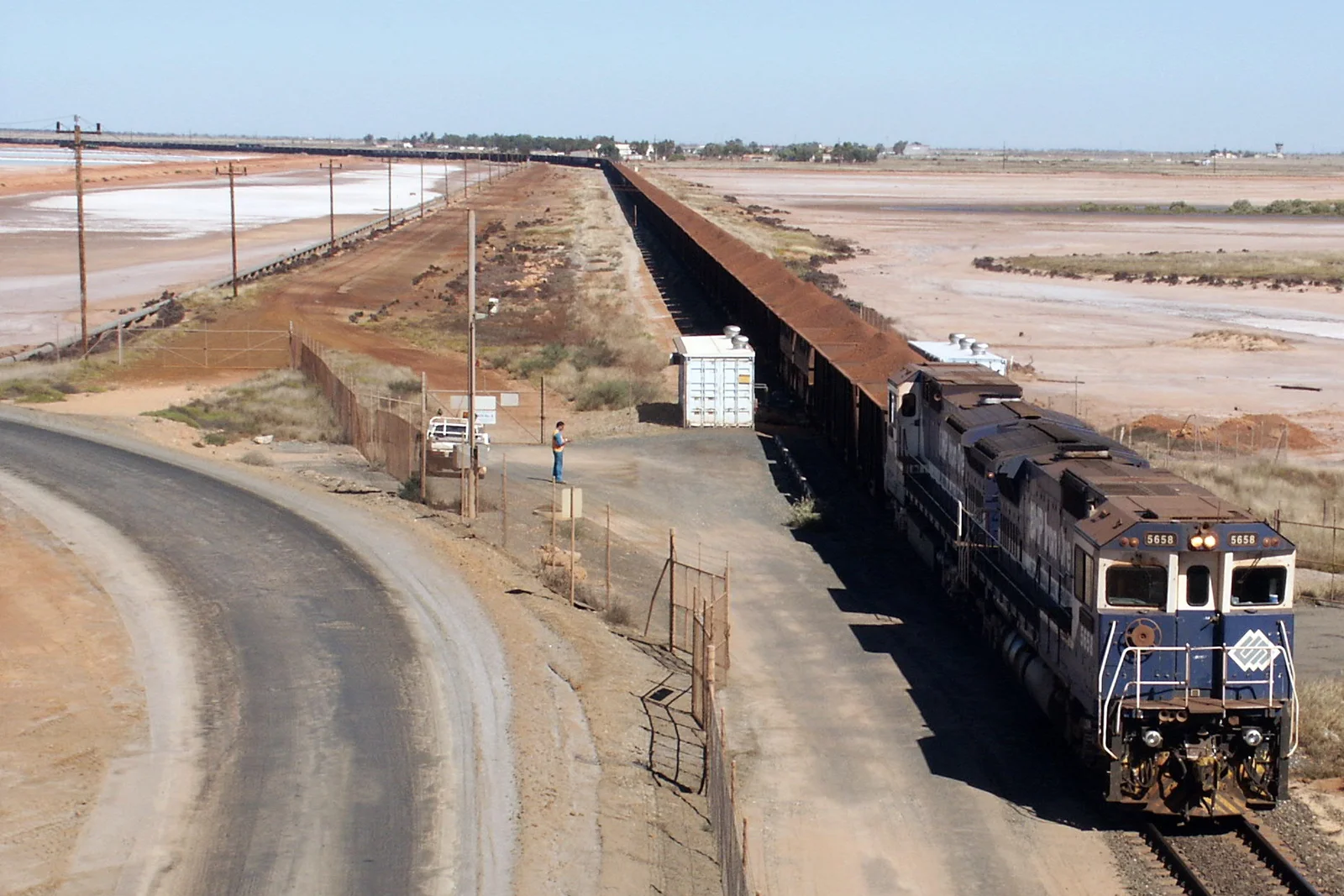
Busy Sea Ports, World Steel, and Sacred Land
Huge cargo ships stop at Port Hedland to load red iron ore for Asia.
Australia sends millions of tonnes of iron every year to make strong steel.
Iron sales bring more than one hundred billion dollars to the Australian economy.
Aboriginal groups like the Banjima and Nyiyaparli have cared for this land for generations.
After damage at Juukan Gorge, mining companies must protect ancient rock shelters on traditional country.
Solar panels and electric train engines help cut pollution across the desert mines.
A2 · Elementary
Pilbara Iron Ore Mines and Heavy-Haul Freight Railways
Vast hematite deposits, massive open-pit excavation, automated freight trains, and global steel trade.
Ancient Marine Geology and the 1952 Hancock Discovery
More than two billion years ago, prehistoric shallow seas deposited thick layers of iron across the Pilbara region.
Primitive cyanobacteria released oxygen, causing iron minerals and silica to settle into alternating red rock bands.
Prospector Lang Hancock identified immense iron ore cliffs in November 1952 while navigating low through a stormy gorge.
Subsequent geological surveys proved these hematite deposits contained more than sixty percent pure iron content.
Industrial mining commenced at Mount Whaleback in 1969, creating one of the largest open-pit hematite operations.
The lifting of the federal export ban in 1960 allowed miners to supply iron to expanding industrial mills in Japan.
Open-Cut Excavation and Autonomous Heavy Equipment
Rotary drill rigs bore deep patterns into rock benches before ammonium nitrate explosives fracture the ironstone strata.
Colossal electric rope shovels scoop up to one hundred tonnes of broken ore in single passes to fill haul trucks.
Driverless autonomous trucks navigate open-pit access ramps using satellite guidance, radar sensors, and onboard computers.
Gyratory crushing stations reduce massive boulders into manageable sizes before conveyor systems transport the ore.
Technicians at remote operations centers in Perth monitor equipment diagnostics and dispatch vehicle fleets in real time.
Recycled water misting cannons spray haul roads continuously to suppress fine red dust across dry extraction benches.
Heavy-Haul Rail Operations and Autonomous Trains
Private heavy-haul railway networks stretch across hundreds of kilometers of desert between interior mines and northern shipping terminals.
Standard iron ore freight trains measure almost three kilometers long, linking three locomotives with two hundred and forty wagons.
Total train weights exceed thirty-five thousand tonnes, making them some of the heaviest freight convoys in the world.
Rio Tinto introduced the driverless AutoHaul rail system in 2018, operating fully automated heavy freight trains across the desert.
Specialized maintenance crews deploy robotic rail grinders and laser geometry cars to preserve continuous welded steel track.
Rotary car dumpers tip loaded wagons upside down without uncoupling them, unloading thousands of tonnes of ore in minutes.
Deepwater Export Terminals, Global Markets, and Traditional Land
Deepwater ports at Port Hedland and Dampier berth giant Capesize carrier vessels to load bulk hematite for overseas ports.
Australia ships hundreds of millions of tonnes of iron ore annually, supplying blast furnaces across Asian steel centers.
Export revenues exceed one hundred billion dollars each year, generating substantial company taxes and public royalties.
Aboriginal Traditional Owners including the Banjima and Yinhawangka peoples maintain enduring cultural custody over their ancestral country.
Following damage at Juukan Gorge, recent reforms enforce rigorous protection standards to safeguard ancient rock shelters.
Pilbara mining companies invest in utility solar farms and battery locomotives to reduce industrial emissions.
B1 · Intermediate
Pilbara Iron Ore Mining and Autonomous Heavy-Haul Railways
Ancient banded formations, open-cut terracing, world-leading heavy rail automation, and global industrial supply.
Paleoproterozoic Basin Sedimentation and Hancock's 1952 Flight
Over two billion years ago, sedimentary marine basins in Western Australia accumulated extensive banded iron formations containing rich metallic oxides.
Seasonal blooms of early photosynthetic cyanobacteria produced oxygen that precipitated alternating layers of iron oxide and chert upon the seafloor.
Western Australian prospector Lang Hancock recognized valuable iron outcrops in November 1952 while flying his light aircraft through Turner River gorges during rain.
Detailed geological field assays confirmed high-grade hematite deposits exceeding sixty percent iron concentration across the remote Hamersley Range.
Commercial extraction began at Mount Whaleback near Newman in 1969, establishing what became the world's most expansive single-pit hematite mine.
The Commonwealth government repealed its longstanding export embargo on iron ore in 1960, initiating vital supply agreements with Japanese industrial steelmakers.
Bench Extraction Dynamics and Autonomous Haulage Engineering
Industrial blast hole drill rigs penetrate hard banded ironstone benches before precision ammonium nitrate blasting shatters the ore body.
Enormous electric rope shovels load up to one hundred tonnes of fragmented hematite per bucket pass into heavy-duty haul trucks.
Fleets of autonomous haulage trucks traverse unpaved pit ramps using satellite positioning, lidar scanners, and collision avoidance software.
Primary gyratory crushers pulverize oversized run-of-mine boulders into uniform cobbles before high-speed conveyor belts route the rock to stockyards.
Engineers stationed at integrated remote control facilities in Perth oversee automated vehicle movement and production scheduling across distant mine pits.
Closed-loop industrial water recycling systems feed automated roadside mist sprayers to mitigate airborne red dust across working benches.
Heavy-Haul Rail Corridors and Driverless Freight Operations
Dedicated standard-gauge railway lines span hundreds of kilometers across the harsh desert interior to connect remote mines with coastal export ports.
Each standard freight convoy measures nearly three kilometers in length, coupling three powerful diesel-electric locomotives to two hundred and forty ore wagons.
Gross train weights consistently exceed thirty-five thousand tonnes, placing Pilbara heavy-haul operations among the most massive freight systems globally.
In 2018 Rio Tinto inaugurated AutoHaul, establishing the world's first fully autonomous, driverless heavy-haul freight railway network across desert terrain.
Track maintenance teams deploy laser track inspection wagons, dynamic ballast stabilizers, and robotic rail grinders to maintain heavy steel rails.
Tandem rotary car dumpers clamp and invert loaded wagons without disconnecting couplers, discharging thousands of tonnes of iron ore within minutes.
Deepwater Export Hubs, East Asian Demand, and Cultural Heritage
Massive bulk shipping ports at Port Hedland and Dampier berth deep-draft Capesize vessels to transport graded lump and fines overseas.
Australian producers ship hundreds of millions of tonnes of processed hematite annually, supplying commercial steel blast furnaces in China, Japan, and South Korea.
Annual iron ore export shipments generate more than one hundred billion dollars, delivering essential corporate taxes and national current account surpluses.
Indigenous Traditional Owners, including the Banjima, Yinhawangka, and Nyiyaparli nations, hold thousands of years of unbroken spiritual connection to the land.
The 2020 destruction of ancient rock shelters at Juukan Gorge spurred legislative overhauls and binding heritage co-management accords across the mining sector.
Resource corporations are piloting green hydrogen production, battery-electric locomotives, and utility solar microgrids to decarbonize heavy extraction operations.
B2 · Upper Intermediate
Pilbara Iron Ore Mining, Heavy-Haul Rail, and Global Trade
Ancient banded iron stratigraphy, autonomous mining technology, heavy rail logistics, and trans-Pacific commodity flows.
Archean Oceanic Stratigraphy and the 1952 Aerial Discovery
Deep marine basins of the Pilbara craton accumulated massive banded iron formations over two billion years ago through complex geochemical precipitation.
Primitive photosynthetic cyanobacteria pulsed oxygen into Archean oceans, depositing alternating laminar bands of hematite, magnetite, and silica chert.
Pioneering aviator Lang Hancock discovered immense ferruginous canyon walls in November 1952 while flying low through Turner River gorges to evade severe weather.
Systematic geological surveys confirmed vast high-grade hematite deposits exceeding sixty percent iron content throughout the rugged Hamersley Range.
Industrial development culminated in the 1969 opening of Mount Whaleback near Newman, creating the planet's premier open-cut hematite mining complex.
The Commonwealth government rescinded its national iron ore export embargo in 1960, unlocking commercial export contracts for post-war Japanese industrial reconstruction.
Open-Cut Mining Architecture and Autonomous Fleet Coordination
Heavy rotary blasthole drill rigs establish precise blast grids before commercial ammonium nitrate detonations fragment high-grade hematite benches.
Ultra-class electric rope shovels transfer up to one hundred tonnes of blasted ironstone in single bucket passes into four-hundred-tonne dump trucks.
Autonomous haulage systems guide driverless heavy haul trucks across pit benches using differential satellite positioning, obstacle radar, and onboard algorithms.
Gyratory primary crushing plants break run-of-mine ore into calibrated fragments before overland conveyor networks transfer materials to processing stockpiles.
Integrated remote operations centers in Perth utilize advanced telemetry to coordinate mining extraction, rail dispatch, and equipment maintenance in real time.
Engineered dust mitigation networks and recycled process water sprays operate across haulage corridors to curb airborne particulate emissions.
Heavy-Haul Rail Engineering and the AutoHaul Autonomous Network
Privately operated heavy-haul railway networks traverse hundreds of kilometers of desert scrub, connecting inland mining centers to coastal deepwater terminals.
Standard iron ore freight configurations span up to three kilometers in length, assembling multiple high-horsepower diesel locomotives and over two hundred and forty ore cars.
Loaded train convoys achieve gross weights exceeding thirty-five thousand tonnes, demanding reinforced rail infrastructure and heavy axle-load standards.
In 2018 Rio Tinto commissioned AutoHaul, delivering the world's first fully automated, driverless heavy-haul freight rail network across remote outback conditions.
Automated track inspection cars, ultrasonic rail flaw detectors, and computerized rail grinding machines preserve track geometry under relentless axle loading.
High-capacity rotary car dumpers invert paired wagons on continuous swivel couplers, discharging thousands of tonnes of iron ore into underground hoppers within minutes.
Maritime Bulk Logistics, Commodity Revenue, and Indigenous Governance
Export harbors at Port Hedland and Cape Lambert accommodate Capesize bulk carriers, loading high-grade lump and fine ore for international sea routes.
Australia exports hundreds of millions of tonnes of iron ore annually, providing the principal feedstock for primary steel manufacturing throughout industrial Asia.
Commodity export sales routinely surpass one hundred billion Australian dollars annually, delivering vital fiscal dividends, mining royalties, and trade surpluses.
Traditional Custodians, including the Banjima, Yinhawangka, and Nyiyaparli language groups, maintain ancient spiritual obligations and native title interests across the Pilbara.
The catastrophic destruction of rock shelters at Juukan Gorge in 2020 triggered sweeping statutory reviews and restructured heritage co-management frameworks.
Mining operators are investing in utility-scale solar farms, green hydrogen trials, and battery-electric heavy locomotives to decarbonize Pilbara supply chains.
C1 · Advanced
Pilbara Iron Ore Extraction, Autonomous Heavy Rail, and Global Supply
An authoritative industrial and geochemical analysis of Western Australia's iron ore province, autonomous logistics, and resource diplomacy.
Proterozoic Oceanic Sedimentation and Hancock's Discovery
Over two billion years ago, marine sedimentation basins across Western Australia laid down enormous banded iron formations rich in hematite and magnetite.
Photosynthetic cyanobacteria pulsed free oxygen into ancient ferruginous seas, precipitating alternating microbands of iron oxides and siliceous chert.
Aviator Lang Hancock identified vast rust-red canyon exposures in November 1952 while flying low through Turner River gorges to escape severe turbulence.
Subsequent geochemical exploration confirmed massive hematite deposits possessing over sixty percent elemental iron concentration across the Hamersley province.
Large-scale commercial exploitation commenced in 1969 at Mount Whaleback, constructing the world's most productive open-cut hematite mining operation.
The Commonwealth government dismantled its iron ore export embargo in 1960, establishing indispensable raw material supply lines for East Asian steelworks.
Open-Pit Geomechanics, Autonomous Fleet Logistics, and Telemetry
Rotary blasthole drills penetrate stepped benches before calibrated emulsion explosives shatter the dense banded ironstone formation.
High-capacity electric rope shovels load up to one hundred tonnes of fractured hematite in a single bucket swing into ultra-class haul trucks.
Autonomous haulage fleets navigate rugged open-cut haul roads utilizing satellite guidance, radar obstacle detection, and computer vision without human operators.
Primary gyratory crushers reduce massive run-of-mine boulders to calibrated cobbles before covered conveyor arteries transfer ore to automated stockyards.
Centralized operations centers in Perth analyze live telemetry from thousands of sensors, optimizing fleet dispatch across remote inland operations.
Engineered dust suppression loops utilize recycled hypersaline process water to abate fugitive mineral particulates across active haulage benches.
Heavy-Haul Rail Mechanics, AutoHaul Automation, and Rotary Dumpers
Heavy-haul freight railways traverse hundreds of kilometers across the Pilbara desert, linking remote inland extraction complexes to coastal export ports.
Unit freight trains measure nearly three kilometers long, coupling multiple heavy-haul diesel-electric locomotives to two hundred and forty specialized ore cars.
Trailing loads regularly exceed thirty-five thousand tonnes, requiring specialized continuous welded rail and premium concrete sleepers to withstand heavy axle stress.
Rio Tinto commissioned AutoHaul in 2018, inaugurating the world's first fully autonomous, driverless heavy-haul freight railway system across desert terrain.
Robotic track maintenance systems and ultrasonic flaw detection vehicles inspect the permanent way continuously to preempt mechanical fatigue and track buckling.
Twin rotary car dumpers rotate coupled wagons around their longitudinal axis without uncoupling, discharging thousands of tonnes of iron ore within minutes.
Deepwater Harbor Logistics, Commodity Revenues, and Indigenous Custody
Tidal export berths at Port Hedland and Dampier accommodate giant Capesize bulk carriers, loading high-density lump and fine iron ore for international trade.
Australia supplies hundreds of millions of tonnes of premium iron ore annually as essential feedstock for steel blast furnaces across China, Japan, and South Korea.
Annual commodity export earnings exceed one hundred billion Australian dollars, underpinning sovereign fiscal balances, trade surpluses, and corporate tax receipts.
Traditional Custodians, including the Banjima, Yinhawangka, and Nyiyaparli nations, preserve deep cultural kinship and ancestral heritage across the Pilbara landscape.
The 2020 demolition of sacred 46,000-year-old rock shelters at Juukan Gorge precipitated national legislative reforms and mandatory heritage co-management agreements.
Mining conglomerates are deploying utility-scale solar generation, battery-electric locomotives, and hydrogen pilot facilities to transition away from fossil fuels.
C2 · Mastery
Pilbara Iron Ore Extraction, Autonomous Heavy Rail, and Global Supply Chains
A comprehensive geological, technological, and economic examination of Australia's iron ore province, autonomous logistics, and commodity trade.
Archean Oceanography, Banded Iron Genesis, and the 1952 Discovery
Over two billion years ago, sedimentary basins in Western Australia laid down massive banded iron formations within an anoxic marine environment.
Metabolic activity from photosynthetic cyanobacteria precipitated alternating laminar strata of crystalline hematite, magnetite, and silica chert.
Aviator Lang Hancock detected vast ferruginous cliffs in November 1952 while navigating low through Turner River gorges to evade severe atmospheric turbulence.
Subsequent geological core sampling confirmed extensive hematite ore bodies exceeding sixty percent iron content throughout the Hamersley Range.
Mount Whaleback commenced industrial production in 1969, creating an immense open-cut mining operation that became a cornerstone of modern mineral extraction.
The Commonwealth government dismantled its iron ore export embargo in 1960, unleashing commercial commodity flows that powered post-war Japanese industrial reconstruction.
Open-Cut Geomechanics, Autonomous Fleet Logistics, and Control Telemetry
Rigorous open-cut geomechanics informs high-torque rotary blasthole drilling before ammonium nitrate emulsion detonations fracture dense banded ironstone strata.
Electric rope shovels transfer up to one hundred tonnes of shattered hematite in single bucket passes into ultra-class haulage vehicles.
Autonomous haulage fleets traverse active open-cut pit roads using differential satellite navigation, radar obstacle detection, and algorithmic collision avoidance.
Gyratory crushers pulverize oversized run-of-mine boulders into uniform cobbles before high-capacity overland conveyor arteries transfer crushed material to blending yards.
Centralized remote operations centers in Perth harness real-time telemetry from thousands of field sensors, coordinating vehicle dispatch across distant mine sites.
Engineered dust suppression loops utilize recycled process water to mitigate fugitive mineral particulates across high-traffic haulage corridors.
Heavy-Haul Rail Logistics, AutoHaul Automation, and Rotary Inversion
Standard-gauge heavy-haul railways traverse hundreds of kilometers across the Pilbara desert, linking inland mining hubs to coastal deepwater export ports.
Freight train configurations extend nearly three kilometers in length, assembling multiple diesel-electric locomotives and over two hundred and forty ore wagons.
Gross train weights exceed thirty-five thousand tonnes, demanding specialized continuous welded steel rails and heavy concrete sleepers to absorb extreme axle loads.
In 2018 Rio Tinto commissioned AutoHaul, delivering the world's first fully autonomous, driverless heavy-haul freight railway system across remote desert topography.
Automated ultrasonic flaw detection vehicles and robotic rail grinding machines patrol the permanent way continuously to prevent rail fatigue and surface corrugation.
Twin rotary car dumpers complete continuous wagon inversion on specialized swivel couplers, discharging thousands of tonnes of iron ore into subterranean hoppers within minutes.
Deepwater Port Logistics, Sovereign Economics, and Indigenous Custody
Tidal export berths at Port Hedland and Dampier service Capesize bulk carriers, loading high-density lump and fine iron ore for international maritime transit.
Australia exports hundreds of millions of tonnes of processed hematite annually as primary feedstock for steel blast furnaces across East Asian manufacturing hubs.
Annual commodity export earnings exceed one hundred billion Australian dollars, underpinning sovereign fiscal balances, trade surpluses, and corporate tax receipts.
Traditional Custodians, including the Banjima, Yinhawangka, and Nyiyaparli peoples, preserve profound spiritual lineage and ancestral custody across the Pilbara plateau.
The tragic demolition of 46,000-year-old rock shelters at Juukan Gorge in 2020 triggered national legislative inquiries and binding heritage co-management compacts.
Major mining conglomerates are deploying utility-scale solar generation, battery-electric locomotives, and hydrogen pilot facilities to decarbonize mineral extraction operations.
Check your understanding
Choose how closely you want to revisit the article. You can refer back while answering, and review explanations when you finish.
Quick Quiz A1
Try one question, then create a free account for the full Quick Quiz. Sign Up Free
Answer every question before checking. There is no time limit.
Your results
/ 1 correct (%)
Read the explanations to see how each answer connects to the article.
-
How long ago did vast banded iron formations begin forming under ancient oceans in Western Australia?
1. Answer:
Quick Quiz A2
Try one question, then create a free account for the full Quick Quiz. Sign Up Free
Answer every question before checking. There is no time limit.
Your results
/ 1 correct (%)
Read the explanations to see how each answer connects to the article.
-
How long ago did vast banded iron formations begin forming under ancient oceans in Western Australia?
1. Answer:
Quick Quiz B1
Try one question, then create a free account for the full Quick Quiz. Sign Up Free
Answer every question before checking. There is no time limit.
Your results
/ 1 correct (%)
Read the explanations to see how each answer connects to the article.
-
How long ago did vast banded iron formations begin forming under ancient oceans in Western Australia?
1. Answer:
Quick Quiz B2
Try one question, then create a free account for the full Quick Quiz. Sign Up Free
Answer every question before checking. There is no time limit.
Your results
/ 1 correct (%)
Read the explanations to see how each answer connects to the article.
-
How long ago did vast banded iron formations begin forming under ancient oceans in Western Australia?
1. Answer:
Quick Quiz C1
Try one question, then create a free account for the full Quick Quiz. Sign Up Free
Answer every question before checking. There is no time limit.
Your results
/ 1 correct (%)
Read the explanations to see how each answer connects to the article.
-
How long ago did vast banded iron formations begin forming under ancient oceans in Western Australia?
1. Answer:
Quick Quiz C2
Try one question, then create a free account for the full Quick Quiz. Sign Up Free
Answer every question before checking. There is no time limit.
Your results
/ 1 correct (%)
Read the explanations to see how each answer connects to the article.
-
How long ago did vast banded iron formations begin forming under ancient oceans in Western Australia?
1. Answer:
