A1 · Beginner
The San Fermin Festival in Pamplona
Every July, the Spanish city of Pamplona hosts a world-famous festival featuring the morning running of the bulls.
Origins and Civic Calendar of San Fermín
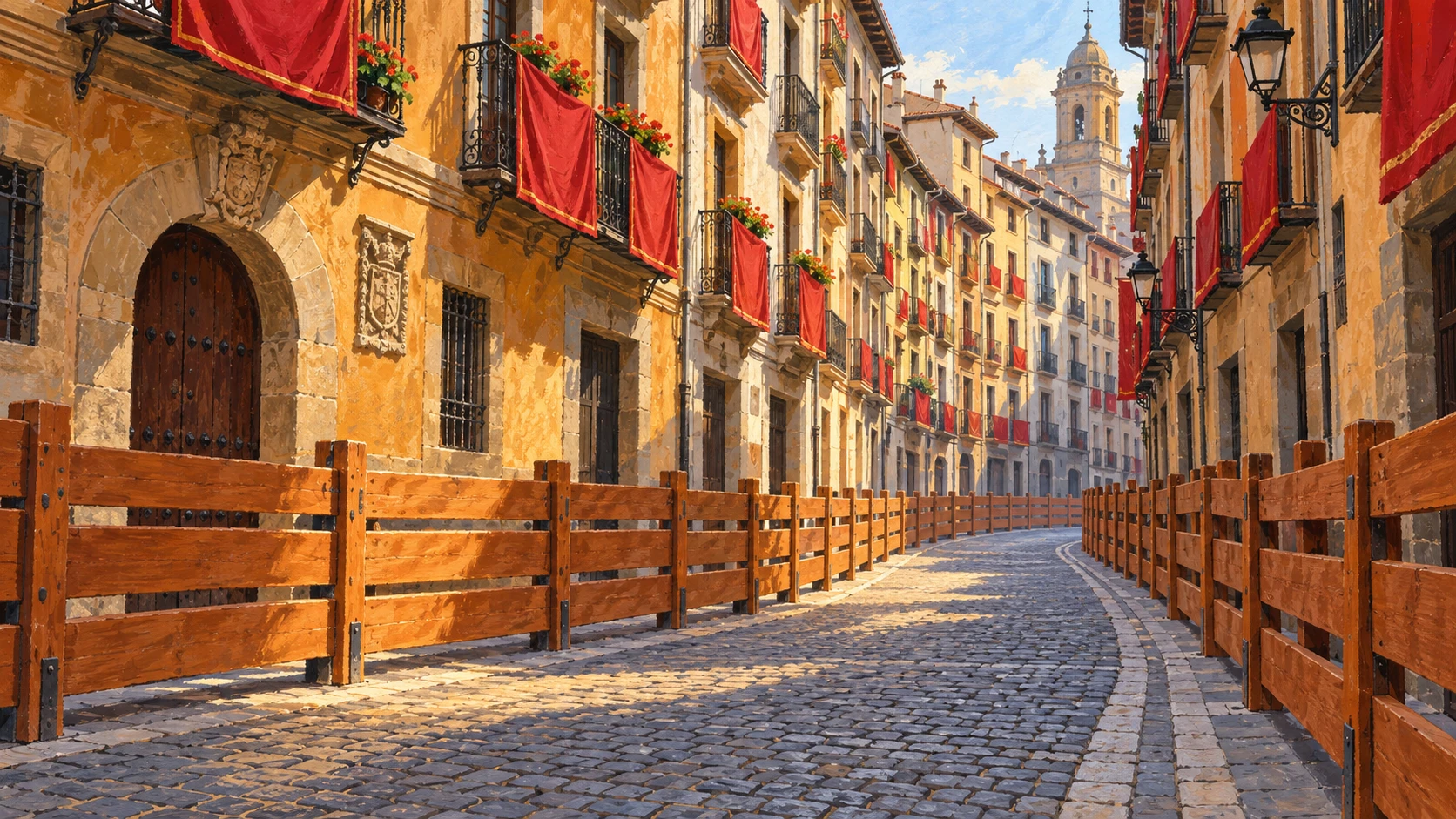
Pamplona is the regional capital of Navarre. The famous festival begins at noon on July 6 and ends at midnight on July 14. Long ago, three different traditions created this festival. People joined religious events, cattle trade fairs, and summer bull exhibitions together into one big celebration.
In 1591, city leaders moved the festival from wet autumn weather in October to sunny July 7 to enjoy warm summer weather. The festival opens when a loud Chupinazo pyrotechnic rocket flies from the town hall balcony. People wear white clothing and red neckerchiefs in the plaza. In 1980, the tourism secretariat named the celebration an official Fiesta of International Tourist Interest. At midnight on July 14, people sing the mournful anthem Pobre de Mí and untie their red neckerchiefs to end the festival.
The Encierro Course and Double Wooden Barriers
The encierro bull run happens daily from July 7 to July 14 at 08:00. Two warning pyrotechnic rocket discharges tell runners the bulls are running. The race route measures 875 meters through old streets. Bulls run from Corrales de Santo Domingo through Calle Mercaderes and Calle Estafeta to the arena.
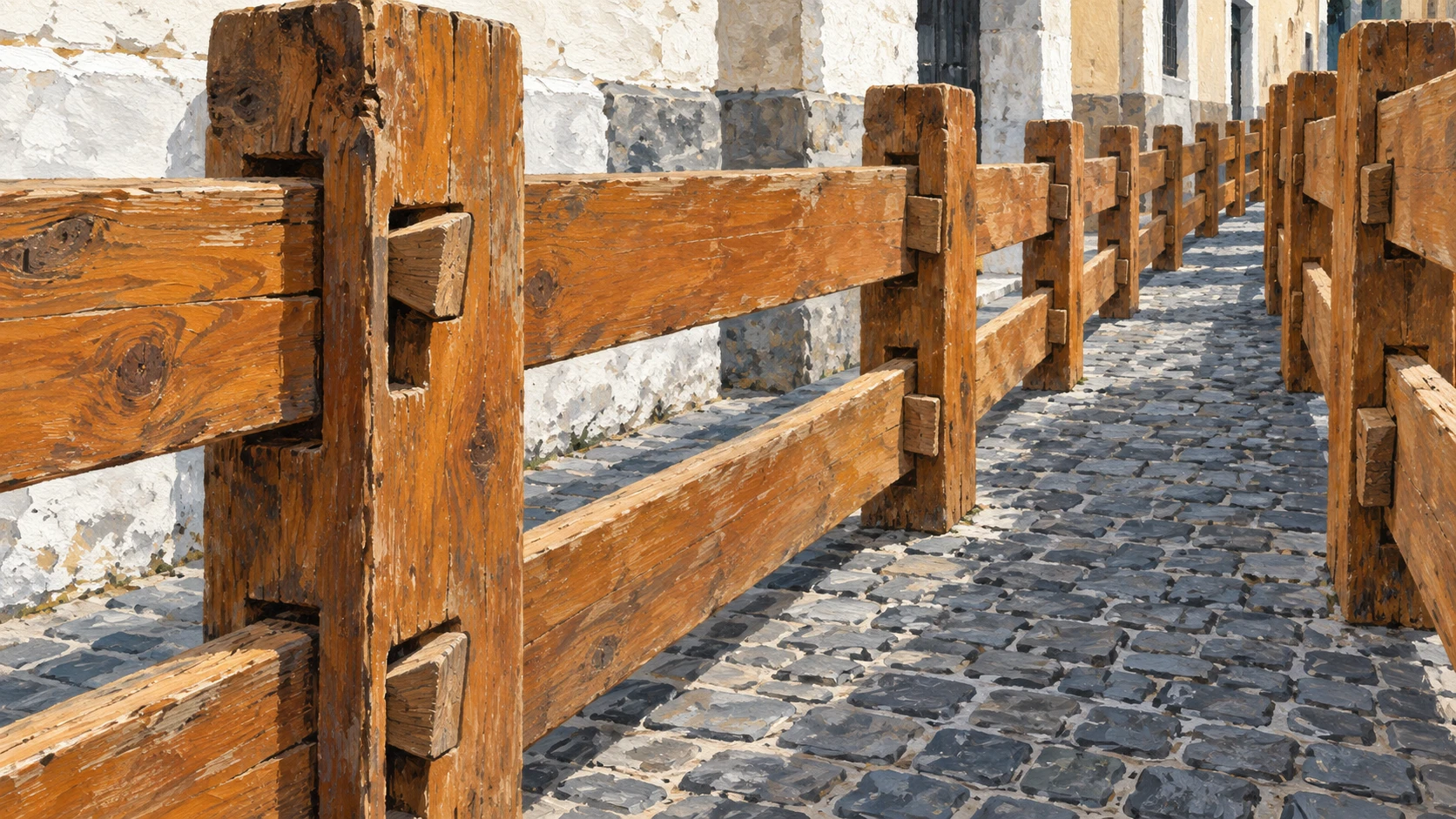
Town carpenters build a strong double barrier along the course. They assemble 900 vertical timber posts and 2,700 horizontal pine planks. The gap between the barriers is a quiet evacuation corridor. Only doctors, nurses, police officers, and accredited media photographers may stand in this space. Crews spray an anti-slip resin solution on the sharp ninety-degree right turn into Calle Estafeta to stop running bulls from sliding on stones. Carpenters lock each timber fence with wooden wedge keys. Workers take down small gate sections each morning so delivery vehicle transit can pass.
Pastoral Handling and Six Fighting Bulls
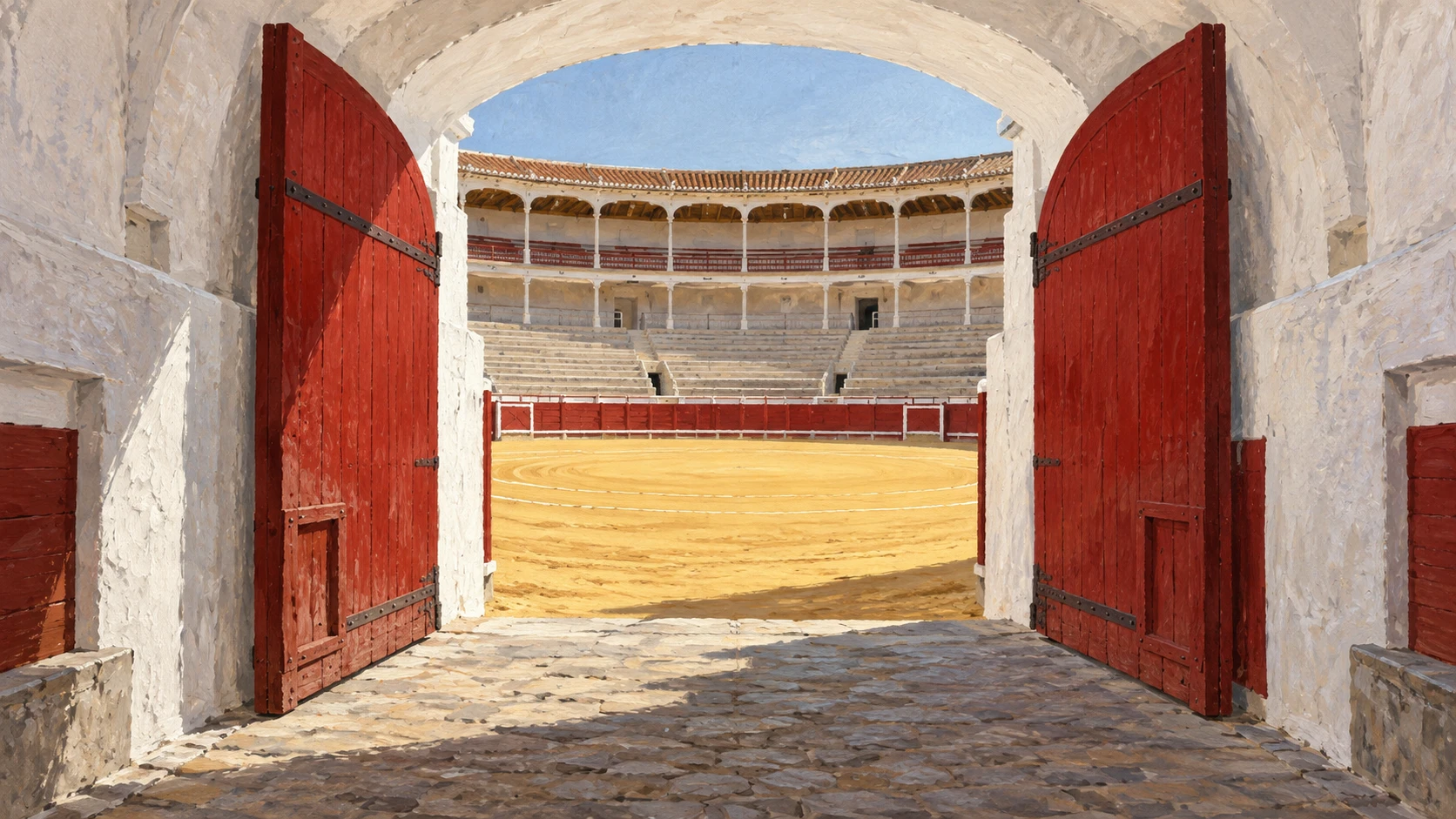
Six mature fighting bulls from an accredited livestock estate run each morning. Six trained guide steers called cabestros run with them to maintain herd cohesion. Two minutes later, workers release a sweeping sweep team of three additional bullocks to collect any separated or disoriented animals along the route.
Trained pastores herders run beside the pack holding long hazel wood rods. They stop runners from touching, inciting, or turning the bulls around. Before the morning run, runners stand before a wall shrine niche on Cuesta de Santo Domingo. They sing a traditional chant three times asking for divine protection. When no bulls fall, the herd traverses the 875-meter course in about two minutes and thirty seconds. City rules state that runners cannot be intoxicated or carry filming equipment or backpacks. Nobody may touch the animals or follow them into the arena tunnel.

Municipal Healthcare and Crowd Safety Logistics
More than three hundred healthcare personnel work along the race course. Trauma physicians, hospital nurses, and Red Cross volunteers stand ready to help injured runners. Teams operate sixteen medical intervention posts along the course. These emergency stations sit roughly fifty meters apart to provide quick roadside stabilization.
More than twenty emergency ambulances wait on side streets. Mobile intensive care ambulances have clear routes to the Hospital Universitario de Navarra. Small contusions and skin scrapes make up 85 percent of all treated injuries. Surgeons also treat deep horn puncture wounds known as cornadas. City police work with the Policía Foral and the Guardia Civil. Officers set up sobriety checkpoints to keep dangerous or unauthorized people out of the course precinct. Since records began in 1910, officials have recorded sixteen participant fatalities, spurring strict modern safety rules and careful medical drills.
A2 · Elementary
San Fermín in Pamplona: Civic Architecture, Pastoral Corridors, and Urban Safety
From the morning Chupinazo rocket to the daily encierro along Calle Estafeta, Pamplona transforms during nine days of intense civic festival.
Origins and Civic Calendar of San Fermín
The Fiestas de San Fermín take place annually in Pamplona, the regional capital of Navarre, commencing at twelve o'clock noon on July 6 and concluding at midnight on July 14. The modern celebration originated from a historical merger of three medieval traditions: liturgical observances honoring saint patron figures, regional agricultural cattle trade fairs, and seasonal bullfighting exhibitions. In 1591, municipal councilors and diocesan authorities permanently transferred the patron saint feast day from its damp autumn date on October 10 to July 7 to secure drier summer weather for public festivities.
The festival officially opens with the Chupinazo pyrotechnic rocket launched from the town hall balcony in Plaza Consistorial before crowds dressed in traditional white clothing with red neckerchiefs. In January 1980, Spain Secretariat of Tourism formally designated the Fiestas de San Fermín as an official Fiesta of International Tourist Interest. The festival officially draws to a close at midnight on July 14 in Plaza Consistorial as assembly participants sing the mournful anthem Pobre de Mí and untie their festive red neckerchiefs.
The Encierro Course and Double Wooden Barriers
The morning encierro bull run is conducted daily from July 7 through July 14, commencing at precisely 08:00 following two warning pyrotechnic rocket discharges. The designated encierro route spans 875 meters across narrow urban streets from the Corrales de Santo Domingo through Plaza Consistorial, Calle Mercaderes, and Calle Estafeta before entering the arena. Municipal carpenters construct a heavy double wooden barrier along the 875-meter route using approximately 900 vertical timber posts and 2,700 horizontal pine planks.
The intermediate security space between the inner and outer timber fences functions as an exclusive evacuation corridor restricted to medical personnel, police officers, and accredited media photographers. Municipal sanitation teams treat the ninety-degree right turn from Calle Mercaderes into Calle Estafeta with a specialized anti-slip resin solution to reduce bull sliding on cobblestones. Municipal carpentered timber barriers are inspected and secured with timber wedge keys each morning, with selected gate sections temporarily disassembled daily to enable urban delivery vehicle transit.
Pastoral Handling and Six Fighting Bulls
Each morning running features six mature fighting bulls from an accredited livestock estate accompanied by six castrated steer guides, known as cabestros, that maintain herd cohesion. A sweeping sweep team of three additional bullocks is released two minutes after the main herd to gather any disoriented or isolated animals remaining along the course. Professional pastoral herders known as pastores run behind and beside the animals carrying flexible hazel wood rods to prevent human runners from touching, inciting, or turning the bulls.
Minutes before the 08:00 rocket launch, runners assemble before a wall shrine niche in Cuesta de Santo Domingo to sing a traditional chant to Saint Fermín three times requesting divine protection. Without isolated or fallen animals, the collective herd traverses the 875-meter cobblestone course in an average duration of approximately two minutes and thirty seconds. Municipal ordinances strictly prohibit runners from participating while intoxicated, carrying filming equipment or backpacks, touching animals, or running behind the pack into the arena tunnel.
Municipal Healthcare and Crowd Safety Logistics
The specialized emergency medical operation stationed along the 875-meter encierro course deploys over three hundred healthcare personnel, including trauma physicians, nurses, and Red Cross volunteers. Emergency authorities station sixteen medical intervention posts along the course, distributing trauma response stations at intervals of roughly fifty meters to guarantee immediate roadside stabilization. A dedicated fleet of more than twenty emergency ambulances, including mobile intensive care ambulances, occupies preassigned egress streets with clearance corridors directly to the Hospital Universitario de Navarra.
While superficial contusions and abrasions represent more than 85 percent of all injuries treated, specialized surgical teams remain on alert to manage severe horn puncture wounds, known as cornadas. The municipal police force collaborates with the Policía Foral and the Guardia Civil to enforce mandatory perimeter sobriety checkpoints and filter unauthorized spectators out of the race precinct. Since systematic municipal injury keeping commenced in 1910, sixteen participant fatalities have been documented in the Pamplona encierro, spurring modern protective barricades and medical protocols.
B1 · Intermediate
San Fermín in Pamplona: Civic Calendar, Timber Corridors, and Pastoral Herding
From the morning Chupinazo rocket to the daily encierro along Calle Estafeta, Pamplona transforms during nine days of intense civic festival.
Origins and Civic Calendar of San Fermín
The Fiestas de San Fermín take place annually in Pamplona, the regional capital of Navarre, commencing at twelve o'clock noon on July 6 and concluding at midnight on July 14. The modern celebration originated from a historical merger of three medieval traditions: liturgical observances honoring saint patron figures, regional agricultural cattle trade fairs, and seasonal bullfighting exhibitions. In 1591, municipal councilors and diocesan authorities permanently transferred the patron saint feast day from its damp autumn date on October 10 to July 7 to secure drier summer weather for public festivities.
The festival officially opens with the Chupinazo pyrotechnic rocket launched from the town hall balcony in Plaza Consistorial before crowds dressed in traditional white clothing with red neckerchiefs. In January 1980, Spain Secretariat of Tourism formally designated the Fiestas de San Fermín as an official Fiesta of International Tourist Interest. The festival officially draws to a close at midnight on July 14 in Plaza Consistorial as assembly participants sing the mournful anthem Pobre de Mí and untie their festive red neckerchiefs.
The Encierro Course and Double Wooden Barriers
The morning encierro bull run is conducted daily from July 7 through July 14, commencing at precisely 08:00 following two warning pyrotechnic rocket discharges. The designated encierro route spans 875 meters across narrow urban streets from the Corrales de Santo Domingo through Plaza Consistorial, Calle Mercaderes, and Calle Estafeta before entering the arena. Municipal carpenters construct a heavy double wooden barrier along the 875-meter route using approximately 900 vertical timber posts and 2,700 horizontal pine planks.
The intermediate security space between the inner and outer timber fences functions as an exclusive evacuation corridor restricted to medical personnel, police officers, and accredited media photographers. Municipal sanitation teams treat the ninety-degree right turn from Calle Mercaderes into Calle Estafeta with a specialized anti-slip resin solution to reduce bull sliding on cobblestones. Municipal carpentered timber barriers are inspected and secured with timber wedge keys each morning, with selected gate sections temporarily disassembled daily to enable urban delivery vehicle transit.
Pastoral Handling and Six Fighting Bulls
Each morning running features six mature fighting bulls from an accredited livestock estate accompanied by six castrated steer guides, known as cabestros, that maintain herd cohesion. A sweeping sweep team of three additional bullocks is released two minutes after the main herd to gather any disoriented or isolated animals remaining along the course. Professional pastoral herders known as pastores run behind and beside the animals carrying flexible hazel wood rods to prevent human runners from touching, inciting, or turning the bulls.
Minutes before the 08:00 rocket launch, runners assemble before a wall shrine niche in Cuesta de Santo Domingo to sing a traditional chant to Saint Fermín three times requesting divine protection. Without isolated or fallen animals, the collective herd traverses the 875-meter cobblestone course in an average duration of approximately two minutes and thirty seconds. Municipal ordinances strictly prohibit runners from participating while intoxicated, carrying filming equipment or backpacks, touching animals, or running behind the pack into the arena tunnel.
Municipal Healthcare and Crowd Safety Logistics
The specialized emergency medical operation stationed along the 875-meter encierro course deploys over three hundred healthcare personnel, including trauma physicians, nurses, and Red Cross volunteers. Emergency authorities station sixteen medical intervention posts along the course, distributing trauma response stations at intervals of roughly fifty meters to guarantee immediate roadside stabilization. A dedicated fleet of more than twenty emergency ambulances, including mobile intensive care ambulances, occupies preassigned egress streets with clearance corridors directly to the Hospital Universitario de Navarra.
While superficial contusions and abrasions represent more than 85 percent of all injuries treated, specialized surgical teams remain on alert to manage severe horn puncture wounds, known as cornadas. The municipal police force collaborates with the Policía Foral and the Guardia Civil to enforce mandatory perimeter sobriety checkpoints and filter unauthorized spectators out of the race precinct. Since systematic municipal injury keeping commenced in 1910, sixteen participant fatalities have been documented in the Pamplona encierro, spurring modern protective barricades and medical protocols.
B2 · Upper Intermediate
San Fermín in Pamplona: Urban Logistics, Pastoral Herding, and Emergency Medicine
From the morning Chupinazo rocket to the daily encierro along Calle Estafeta, Pamplona transforms during nine days of intense civic festival.
Origins and Civic Calendar of San Fermín
The Fiestas de San Fermín take place annually in Pamplona, the regional capital of Navarre, commencing at twelve o'clock noon on July 6 and concluding at midnight on July 14. The modern celebration originated from a historical merger of three medieval traditions: liturgical observances honoring saint patron figures, regional agricultural cattle trade fairs, and seasonal bullfighting exhibitions. In 1591, municipal councilors and diocesan authorities permanently transferred the patron saint feast day from its damp autumn date on October 10 to July 7 to secure drier summer weather for public festivities.
The festival officially opens with the Chupinazo pyrotechnic rocket launched from the town hall balcony in Plaza Consistorial before crowds dressed in traditional white clothing with red neckerchiefs. In January 1980, Spain Secretariat of Tourism formally designated the Fiestas de San Fermín as an official Fiesta of International Tourist Interest. The festival officially draws to a close at midnight on July 14 in Plaza Consistorial as assembly participants sing the mournful anthem Pobre de Mí and untie their festive red neckerchiefs.
The Encierro Course and Double Wooden Barriers
The morning encierro bull run is conducted daily from July 7 through July 14, commencing at precisely 08:00 following two warning pyrotechnic rocket discharges. The designated encierro route spans 875 meters across narrow urban streets from the Corrales de Santo Domingo through Plaza Consistorial, Calle Mercaderes, and Calle Estafeta before entering the arena. Municipal carpenters construct a heavy double wooden barrier along the 875-meter route using approximately 900 vertical timber posts and 2,700 horizontal pine planks.
The intermediate security space between the inner and outer timber fences functions as an exclusive evacuation corridor restricted to medical personnel, police officers, and accredited media photographers. Municipal sanitation teams treat the ninety-degree right turn from Calle Mercaderes into Calle Estafeta with a specialized anti-slip resin solution to reduce bull sliding on cobblestones. Municipal carpentered timber barriers are inspected and secured with timber wedge keys each morning, with selected gate sections temporarily disassembled daily to enable urban delivery vehicle transit.
Pastoral Handling and Six Fighting Bulls
Each morning running features six mature fighting bulls from an accredited livestock estate accompanied by six castrated steer guides, known as cabestros, that maintain herd cohesion. A sweeping sweep team of three additional bullocks is released two minutes after the main herd to gather any disoriented or isolated animals remaining along the course. Professional pastoral herders known as pastores run behind and beside the animals carrying flexible hazel wood rods to prevent human runners from touching, inciting, or turning the bulls.
Minutes before the 08:00 rocket launch, runners assemble before a wall shrine niche in Cuesta de Santo Domingo to sing a traditional chant to Saint Fermín three times requesting divine protection. Without isolated or fallen animals, the collective herd traverses the 875-meter cobblestone course in an average duration of approximately two minutes and thirty seconds. Municipal ordinances strictly prohibit runners from participating while intoxicated, carrying filming equipment or backpacks, touching animals, or running behind the pack into the arena tunnel.
Municipal Healthcare and Crowd Safety Logistics
The specialized emergency medical operation stationed along the 875-meter encierro course deploys over three hundred healthcare personnel, including trauma physicians, nurses, and Red Cross volunteers. Emergency authorities station sixteen medical intervention posts along the course, distributing trauma response stations at intervals of roughly fifty meters to guarantee immediate roadside stabilization. A dedicated fleet of more than twenty emergency ambulances, including mobile intensive care ambulances, occupies preassigned egress streets with clearance corridors directly to the Hospital Universitario de Navarra.
While superficial contusions and abrasions represent more than 85 percent of all injuries treated, specialized surgical teams remain on alert to manage severe horn puncture wounds, known as cornadas. The municipal police force collaborates with the Policía Foral and the Guardia Civil to enforce mandatory perimeter sobriety checkpoints and filter unauthorized spectators out of the race precinct. Since systematic municipal injury keeping commenced in 1910, sixteen participant fatalities have been documented in the Pamplona encierro, spurring modern protective barricades and medical protocols.
C1 · Advanced
San Fermín in Pamplona: Pastoral Corridors, Timber Engineering, and Trauma Protocols
From the morning Chupinazo rocket to the daily encierro along Calle Estafeta, Pamplona transforms during nine days of intense civic festival.
Origins and Civic Calendar of San Fermín
The Fiestas de San Fermín take place annually in Pamplona, the regional capital of Navarre, commencing at twelve o'clock noon on July 6 and concluding at midnight on July 14. The modern celebration originated from a historical merger of three medieval traditions: liturgical observances honoring saint patron figures, regional agricultural cattle trade fairs, and seasonal bullfighting exhibitions. In 1591, municipal councilors and diocesan authorities permanently transferred the patron saint feast day from its damp autumn date on October 10 to July 7 to secure drier summer weather for public festivities.
The festival officially opens with the Chupinazo pyrotechnic rocket launched from the town hall balcony in Plaza Consistorial before crowds dressed in traditional white clothing with red neckerchiefs. In January 1980, Spain Secretariat of Tourism formally designated the Fiestas de San Fermín as an official Fiesta of International Tourist Interest. The festival officially draws to a close at midnight on July 14 in Plaza Consistorial as assembly participants sing the mournful anthem Pobre de Mí and untie their festive red neckerchiefs.
The Encierro Course and Double Wooden Barriers
The morning encierro bull run is conducted daily from July 7 through July 14, commencing at precisely 08:00 following two warning pyrotechnic rocket discharges. The designated encierro route spans 875 meters across narrow urban streets from the Corrales de Santo Domingo through Plaza Consistorial, Calle Mercaderes, and Calle Estafeta before entering the arena. Municipal carpenters construct a heavy double wooden barrier along the 875-meter route using approximately 900 vertical timber posts and 2,700 horizontal pine planks.
The intermediate security space between the inner and outer timber fences functions as an exclusive evacuation corridor restricted to medical personnel, police officers, and accredited media photographers. Municipal sanitation teams treat the ninety-degree right turn from Calle Mercaderes into Calle Estafeta with a specialized anti-slip resin solution to reduce bull sliding on cobblestones. Municipal carpentered timber barriers are inspected and secured with timber wedge keys each morning, with selected gate sections temporarily disassembled daily to enable urban delivery vehicle transit.
Pastoral Handling and Six Fighting Bulls
Each morning running features six mature fighting bulls from an accredited livestock estate accompanied by six castrated steer guides, known as cabestros, that maintain herd cohesion. A sweeping sweep team of three additional bullocks is released two minutes after the main herd to gather any disoriented or isolated animals remaining along the course. Professional pastoral herders known as pastores run behind and beside the animals carrying flexible hazel wood rods to prevent human runners from touching, inciting, or turning the bulls.
Minutes before the 08:00 rocket launch, runners assemble before a wall shrine niche in Cuesta de Santo Domingo to sing a traditional chant to Saint Fermín three times requesting divine protection. Without isolated or fallen animals, the collective herd traverses the 875-meter cobblestone course in an average duration of approximately two minutes and thirty seconds. Municipal ordinances strictly prohibit runners from participating while intoxicated, carrying filming equipment or backpacks, touching animals, or running behind the pack into the arena tunnel.
Municipal Healthcare and Crowd Safety Logistics
The specialized emergency medical operation stationed along the 875-meter encierro course deploys over three hundred healthcare personnel, including trauma physicians, nurses, and Red Cross volunteers. Emergency authorities station sixteen medical intervention posts along the course, distributing trauma response stations at intervals of roughly fifty meters to guarantee immediate roadside stabilization. A dedicated fleet of more than twenty emergency ambulances, including mobile intensive care ambulances, occupies preassigned egress streets with clearance corridors directly to the Hospital Universitario de Navarra.
While superficial contusions and abrasions represent more than 85 percent of all injuries treated, specialized surgical teams remain on alert to manage severe horn puncture wounds, known as cornadas. The municipal police force collaborates with the Policía Foral and the Guardia Civil to enforce mandatory perimeter sobriety checkpoints and filter unauthorized spectators out of the race precinct. Since systematic municipal injury keeping commenced in 1910, sixteen participant fatalities have been documented in the Pamplona encierro, spurring modern protective barricades and medical protocols.
C2 · Mastery
San Fermín in Pamplona: Civic Topography, Pastoral Coordination, and Emergency Response
From the morning Chupinazo rocket to the daily encierro along Calle Estafeta, Pamplona transforms during nine days of intense civic festival.
Origins and Civic Calendar of San Fermín
The Fiestas de San Fermín take place annually in Pamplona, the regional capital of Navarre, commencing at twelve o'clock noon on July 6 and concluding at midnight on July 14. The modern celebration originated from a historical merger of three medieval traditions: liturgical observances honoring saint patron figures, regional agricultural cattle trade fairs, and seasonal bullfighting exhibitions. In 1591, municipal councilors and diocesan authorities permanently transferred the patron saint feast day from its damp autumn date on October 10 to July 7 to secure drier summer weather for public festivities.
The festival officially opens with the Chupinazo pyrotechnic rocket launched from the town hall balcony in Plaza Consistorial before crowds dressed in traditional white clothing with red neckerchiefs. In January 1980, Spain Secretariat of Tourism formally designated the Fiestas de San Fermín as an official Fiesta of International Tourist Interest. The festival officially draws to a close at midnight on July 14 in Plaza Consistorial as assembly participants sing the mournful anthem Pobre de Mí and untie their festive red neckerchiefs.
The Encierro Course and Double Wooden Barriers
The morning encierro bull run is conducted daily from July 7 through July 14, commencing at precisely 08:00 following two warning pyrotechnic rocket discharges. The designated encierro route spans 875 meters across narrow urban streets from the Corrales de Santo Domingo through Plaza Consistorial, Calle Mercaderes, and Calle Estafeta before entering the arena. Municipal carpenters construct a heavy double wooden barrier along the 875-meter route using approximately 900 vertical timber posts and 2,700 horizontal pine planks.
The intermediate security space between the inner and outer timber fences functions as an exclusive evacuation corridor restricted to medical personnel, police officers, and accredited media photographers. Municipal sanitation teams treat the ninety-degree right turn from Calle Mercaderes into Calle Estafeta with a specialized anti-slip resin solution to reduce bull sliding on cobblestones. Municipal carpentered timber barriers are inspected and secured with timber wedge keys each morning, with selected gate sections temporarily disassembled daily to enable urban delivery vehicle transit.
Pastoral Handling and Six Fighting Bulls
Each morning running features six mature fighting bulls from an accredited livestock estate accompanied by six castrated steer guides, known as cabestros, that maintain herd cohesion. A sweeping sweep team of three additional bullocks is released two minutes after the main herd to gather any disoriented or isolated animals remaining along the course. Professional pastoral herders known as pastores run behind and beside the animals carrying flexible hazel wood rods to prevent human runners from touching, inciting, or turning the bulls.
Minutes before the 08:00 rocket launch, runners assemble before a wall shrine niche in Cuesta de Santo Domingo to sing a traditional chant to Saint Fermín three times requesting divine protection. Without isolated or fallen animals, the collective herd traverses the 875-meter cobblestone course in an average duration of approximately two minutes and thirty seconds. Municipal ordinances strictly prohibit runners from participating while intoxicated, carrying filming equipment or backpacks, touching animals, or running behind the pack into the arena tunnel.
Municipal Healthcare and Crowd Safety Logistics
The specialized emergency medical operation stationed along the 875-meter encierro course deploys over three hundred healthcare personnel, including trauma physicians, nurses, and Red Cross volunteers. Emergency authorities station sixteen medical intervention posts along the course, distributing trauma response stations at intervals of roughly fifty meters to guarantee immediate roadside stabilization. A dedicated fleet of more than twenty emergency ambulances, including mobile intensive care ambulances, occupies preassigned egress streets with clearance corridors directly to the Hospital Universitario de Navarra.
While superficial contusions and abrasions represent more than 85 percent of all injuries treated, specialized surgical teams remain on alert to manage severe horn puncture wounds, known as cornadas. The municipal police force collaborates with the Policía Foral and the Guardia Civil to enforce mandatory perimeter sobriety checkpoints and filter unauthorized spectators out of the race precinct. Since systematic municipal injury keeping commenced in 1910, sixteen participant fatalities have been documented in the Pamplona encierro, spurring modern protective barricades and medical protocols.
Check your understanding
Choose how closely you want to revisit the article. You can refer back while answering, and review explanations when you finish.
Quick Quiz A1
Try one question, then create a free account for the full Quick Quiz. Sign Up Free
Answer every question before checking. There is no time limit.
Your results
/ 1 correct (%)
Read the explanations to see how each answer connects to the article.
-
When does the famous festival begin and end in Pamplona?
1. Answer:
Quick Quiz A2
Try one question, then create a free account for the full Quick Quiz. Sign Up Free
Answer every question before checking. There is no time limit.
Your results
/ 1 correct (%)
Read the explanations to see how each answer connects to the article.
-
When does the festival of San Fermín in Pamplona commence and conclude?
1. Answer:
Quick Quiz B1
Try one question, then create a free account for the full Quick Quiz. Sign Up Free
Answer every question before checking. There is no time limit.
Your results
/ 1 correct (%)
Read the explanations to see how each answer connects to the article.
-
When does the festival of San Fermín in Pamplona commence and conclude?
1. Answer:
Quick Quiz B2
Try one question, then create a free account for the full Quick Quiz. Sign Up Free
Answer every question before checking. There is no time limit.
Your results
/ 1 correct (%)
Read the explanations to see how each answer connects to the article.
-
When does the festival of San Fermín in Pamplona commence and conclude?
1. Answer:
Quick Quiz C1
Try one question, then create a free account for the full Quick Quiz. Sign Up Free
Answer every question before checking. There is no time limit.
Your results
/ 1 correct (%)
Read the explanations to see how each answer connects to the article.
-
When does the festival of San Fermín in Pamplona commence and conclude?
1. Answer:
Quick Quiz C2
Try one question, then create a free account for the full Quick Quiz. Sign Up Free
Answer every question before checking. There is no time limit.
Your results
/ 1 correct (%)
Read the explanations to see how each answer connects to the article.
-
When does the festival of San Fermín in Pamplona commence and conclude?
1. Answer:
