A1 · Beginner
Alhambra Conservation Workshops in Granada
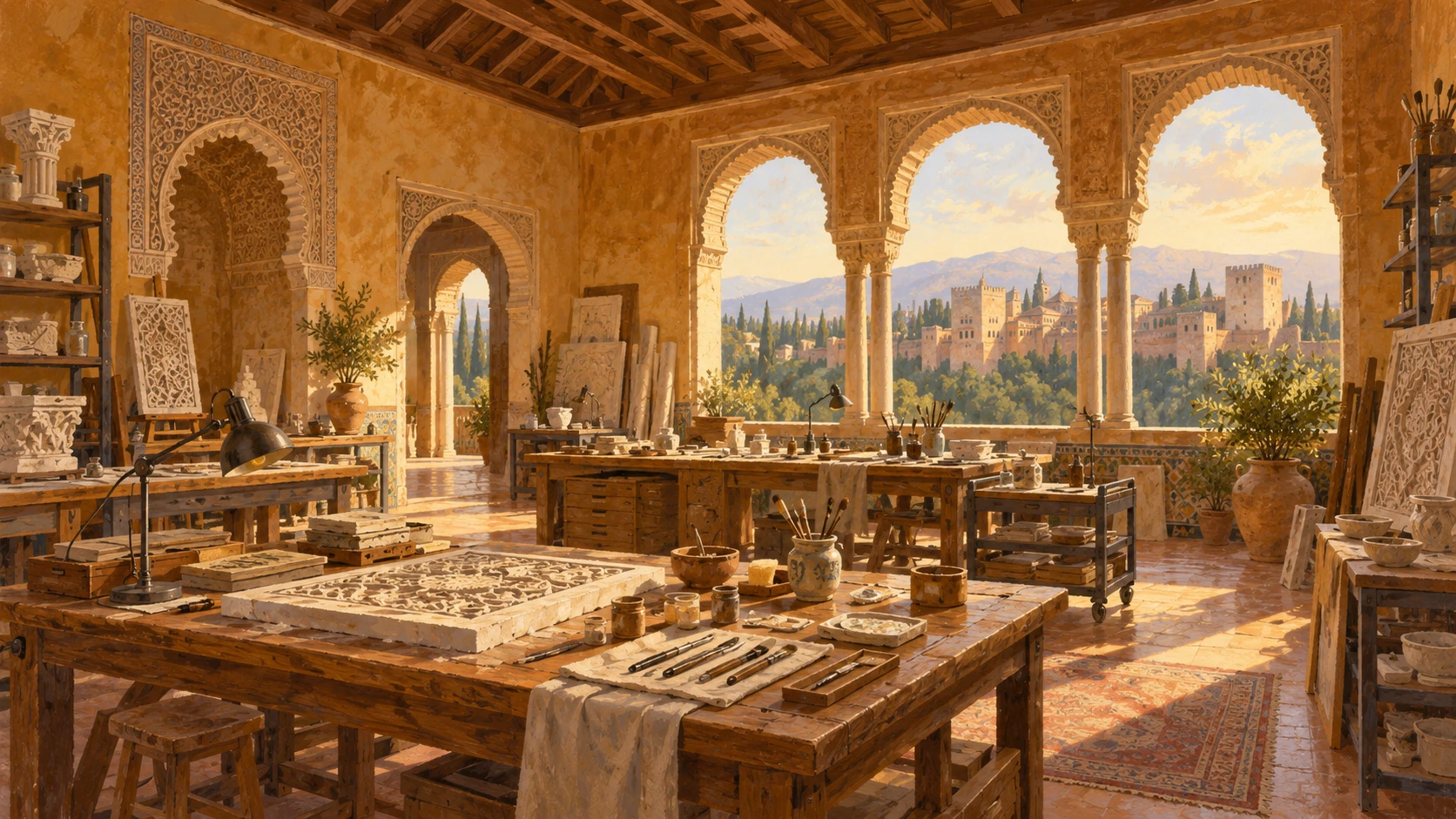
Dedicated craft studios inside the hilltop fortress complex repair ancient stuccowork, cedar roofs, and marble columns.
The Patronato Restoration Studios and Institutional Mandate
The Patronato de la Alhambra operates dedicated conservation workshops on the hill. Expert restorers, chemists, and craftspeople work together in these heritage studios. The agency preserves ancient palace walls, timber ceilings, and garden stone masonry. Strict international rules require all restoration work to be completely reversible.
Specialists create detailed digital photographs of every treated palace surface. A scientific laboratory tests tiny material samples from historic walls. Scientists identify original mineral pigments, lime binders, and damaging salt deposits. The department collaborates with university scholars to protect the monument without causing harm.
Plasterwork, Muqarnas, and Ceramic Tile Preservation
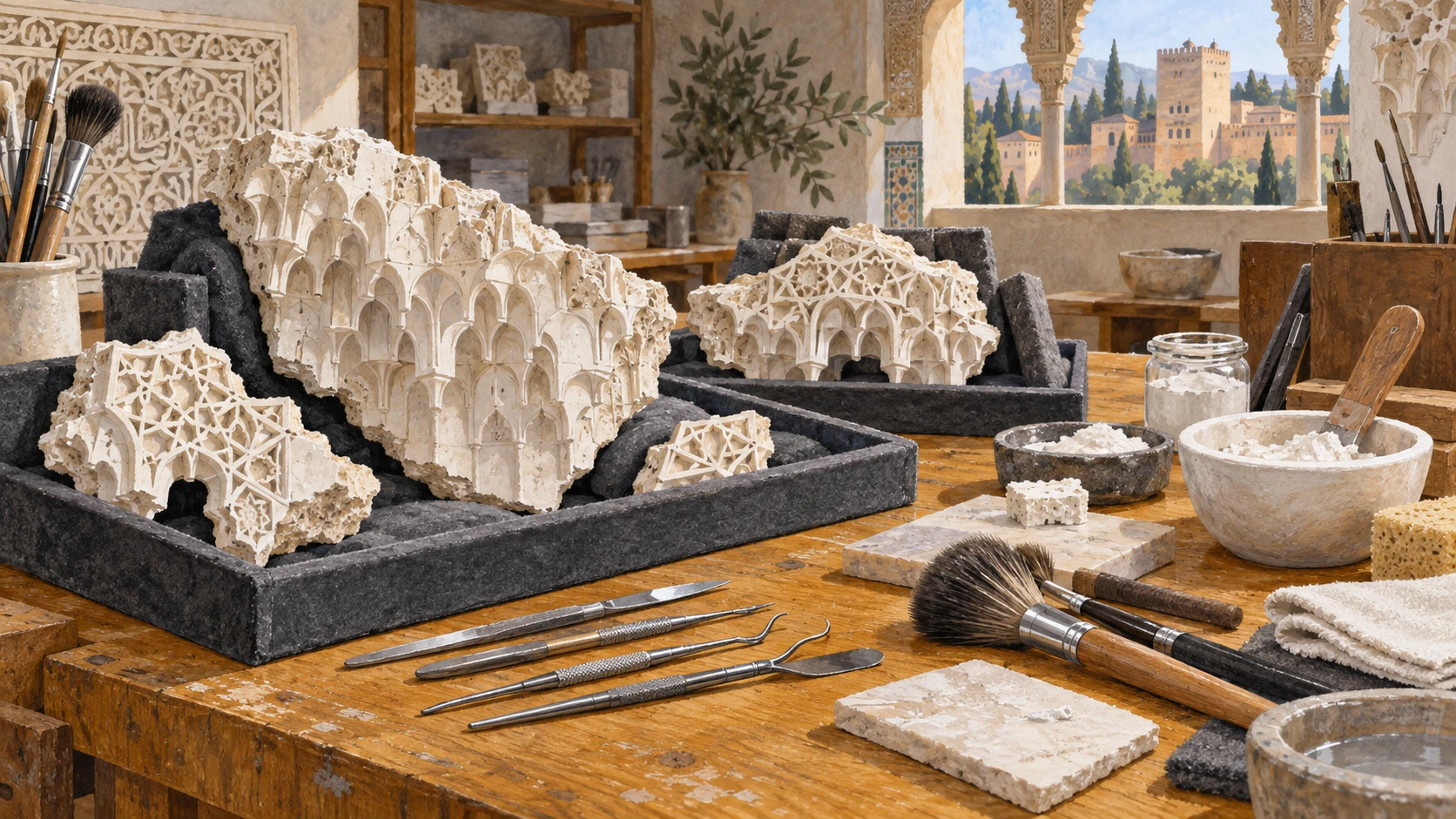
The plaster workshop conserves delicate Nasrid stuccowork and muqarnas arches. Skilled artisans use fine vegetable powders to remove surface soot and dust. They clean fragile gypsum carvings without harming original wall surfaces. Conservators secure loose plaster panels using compatible lime grouts and fiberglass pins.
Microscopic tests detect traces of ancient gold leaf and blue lapis lazuli paint. The ceramic studio restores glazed mosaic tile dados along palace corridors. Broken tiles receive tinted mortar infills to keep repairs clearly visible. Conservators avoid installing false modern tiles across historic palace rooms.
Cedar Ceilings, Joinery, and Stone Masonry Care
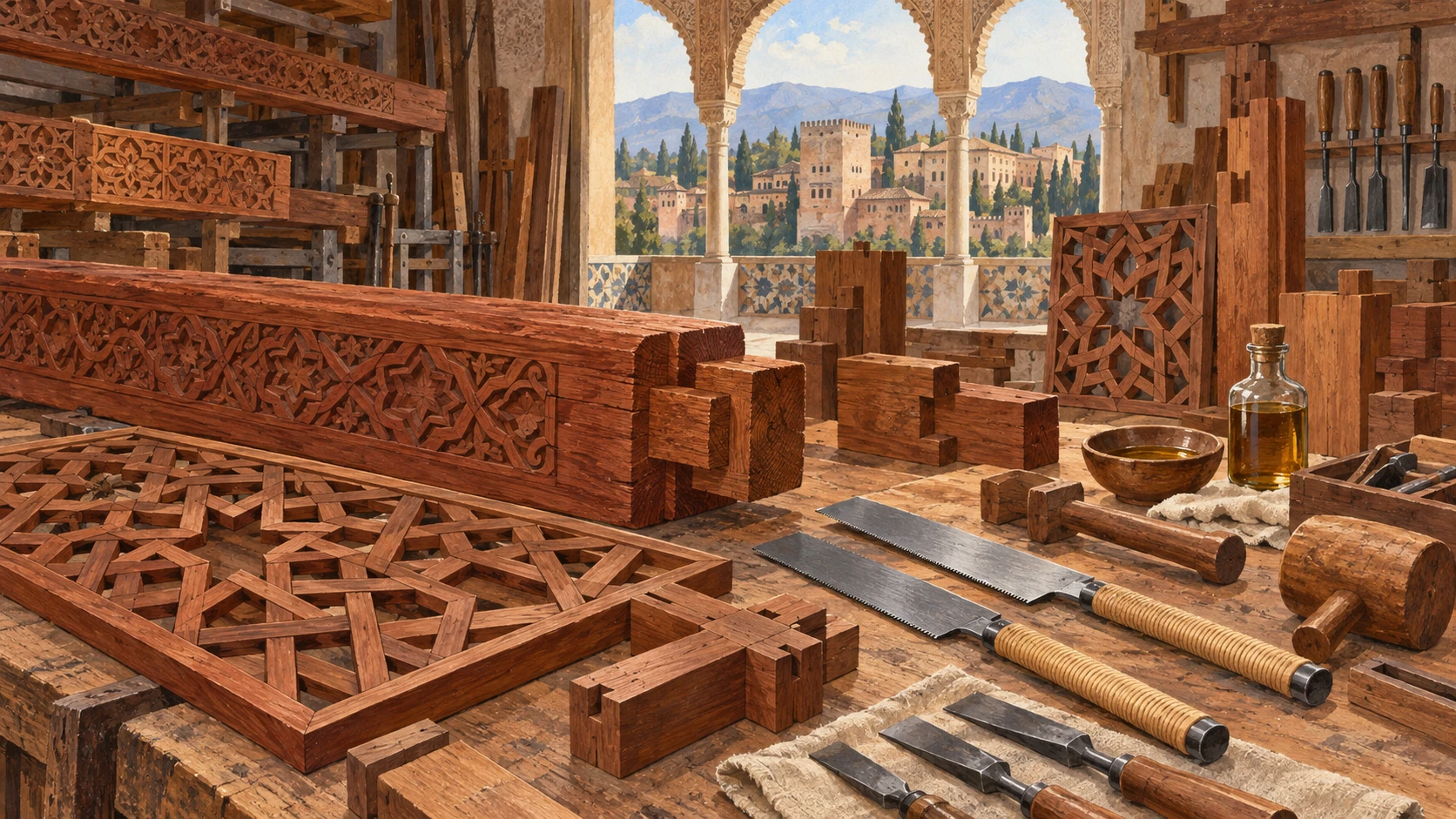
Woodwork artisans preserve geometric cedar ceilings across the royal palaces. Master carpenters repair ancient roof armatures using traditional wooden interlocking joints. They apply natural tree resins instead of metal nails and screws. The grand ceiling of the Ambassadors Hall contains eight thousand cedar pieces.
Stone conservators care for white marble columns and sandstone fortress towers. Natural plant oils remove lichens and green moss without damaging old stonework. Builders protect rammed earth walls with authentic red clay lime plasters. Regular maintenance protects the fortress battlements against winter rain and summer sun.
Microclimatic Monitoring and Preventive Conservation
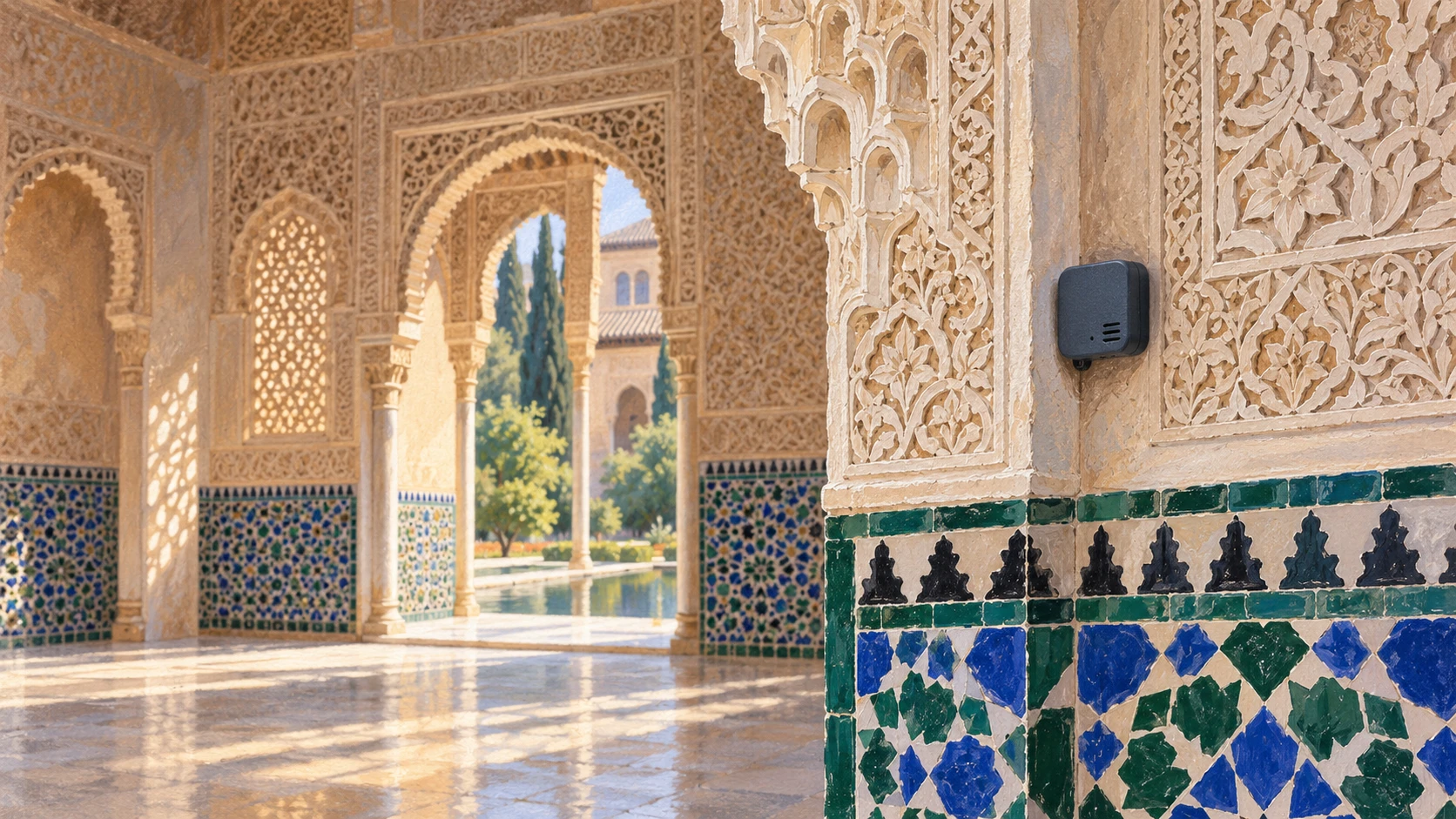
Wireless environmental sensors record room temperature and air humidity day and night. The electronic network tracks moisture levels inside delicate palace chambers. Managers use sensor readings to regulate visitor lines and prevent indoor heat spikes. Ultrasonic tools detect building vibrations caused by city traffic and ground tremors.
Palace windows open automatically to let cool mountain breezes circulate inside. Emergency teams store protective wooden braces in secure underground storage rooms. Yearly surveys track building decay and guide conservation budgets. The staff prioritizes steady preventive care over sudden emergency repairs.
A2 · Elementary
Alhambra Conservation Workshops: Preserving Palatine Architecture
Within the palatine city of Granada, multidisciplinary restoration ateliers safeguard medieval stuccowork, timber lacería, and marble colonnades.
The Patronato Restoration Studios and Institutional Mandate
Inside the monumental perimeter of the Alhambra and Generalife, the Patronato operates dedicated in-house conservation workshops charged with the physical survival of medieval palatine architecture. Functioning as an autonomous public heritage agency under the Regional Government of Andalusia, the institution employs multidisciplinary teams comprising conservators, materials scientists, structural engineers, and master craftspeople. Interventions adhere strictly to the Venice Charter and subsequent international conservation doctrines, enforcing the core tenets of reversibility, minimal physical intrusion, and strict compatibility with original fourteenth-century building fabrics.
Diagnostic imaging protocols establish rigorous baseline documentation before any physical intervention begins, utilizing high-density photogrammetry and multispectral stratigraphic analysis to map past alterations. An on-site conservation science laboratory conducts chemical profiling on micro-samples, identifying historical binding media, organic varnishes, and destructive sub-surface efflorescent salts. In collaboration with the Institute of Cultural Heritage of Spain and university research centers, the department pioneers non-destructive ultrasonic and spectroscopic techniques to evaluate structural integrity without compromising historical surfaces.
Plasterwork, Muqarnas, and Ceramic Tile Preservation
The plaster and stucco atelier focuses on the consolidation of intricate Nasrid yeserías and suspended three-dimensional muqarnas vaulting throughout the Comares and Lions palaces. To eliminate centuries of candle soot, accumulated atmospheric dust, and incompatible twentieth-century coatings, conservators employ controlled micro-sandblasting with powdered walnut shells alongside tailored absorbent chemical poultices. Structural reattachment of detached decorative stucco reliefs avoids synthetic epoxy polymers, relying instead on injectable hydraulic lime grouts reinforced with inert fiberglass micro-pins.
Micro-stratigraphic investigations across sheltered friezes have uncovered intact polychrome layers, including precious lapis lazuli pigments, cinnabar reds, and beaten gold leaf. Concurrently, the ceramic conservation studio treats medieval zellij mosaic tile dados lining palace wall bases. Fragmented or missing ceramic tesserae are stabilized using chromatic lime mortar infills rather than deceptive modern replicas, ensuring that modern interventions remain discernible upon close examination while preserving overall architectural harmony.
Cedar Ceilings, Joinery, and Stone Masonry Care
The carpentry and joinery atelier preserves expansive Islamic woodwork ceilings, known as lacería or armaduras apeinazadas, crafted primarily from Spanish cedar and Scots pine. Master wood restorers consolidate weakened structural armatures using natural resin impregnations and traditional interlocking joinery, entirely omitting modern metallic fixings that could induce differential stress or rust. The crowning achievement of this woodworking tradition, the domical ceiling of the Hall of the Ambassadors, incorporates more than eight thousand individual geometric timber elements forming symbolic concentric celestial spheres.
Simultaneously, stone conservators manage exterior Macael marble colonnades, royal fountains, and perimeter ramparts constructed from porous calcarenite sandstone. To combat biological colonization without acidic damage, technicians apply eco-friendly biocidal washes derived from natural essential oils to eradicate lichens and mosses. Monumental defensive perimeter walls built of rammed-earth tapial undergo cyclic stabilization using slaked lime mortars and local red clays formulated to replicate the exact aggregate ratios of medieval Moorish masons.
Microclimatic Monitoring and Preventive Conservation
Preventive conservation operates as the institutional cornerstone of Alhambra preservation, anchored by a continuous network of wireless microclimatic sensors deployed across royal palace chambers. High-precision telemetry monitors ambient temperature, relative humidity fluctuations, and carbon dioxide concentrations in real time, alerting conservators to microclimatic instability caused by external weather swings or concentrated visitor presence. Environmental data directly informs visitor flow management protocols, preventing destructive condensation cycles, salt dissolution, and thermal shocks inside fragile spaces.
Structural health monitoring incorporates laser interferometry and acoustic emission sensors that detect microscopic vibrations induced by foot traffic, regional seismic tremors, and urban transit in the valley below. The institution supplements passive environmental controls, such as automated clerestory ventilation shutters and fountain evaporation, with comprehensive disaster preparedness frameworks. Subterranean depots hold modular earthquake shoring systems and emergency dehumidification arrays, ensuring that multi-year condition assessments prioritize proactive preventive stabilization over disruptive corrective interventions.
B1 · Intermediate
Alhambra Conservation Workshops: Heritage Science and Traditional Crafts
Within the palatine city of Granada, multidisciplinary restoration ateliers safeguard medieval stuccowork, timber lacería, and marble colonnades.
The Patronato Restoration Studios and Institutional Mandate
Inside the monumental perimeter of the Alhambra and Generalife, the Patronato operates dedicated in-house conservation workshops charged with the physical survival of medieval palatine architecture. Functioning as an autonomous public heritage agency under the Regional Government of Andalusia, the institution employs multidisciplinary teams comprising conservators, materials scientists, structural engineers, and master craftspeople. Interventions adhere strictly to the Venice Charter and subsequent international conservation doctrines, enforcing the core tenets of reversibility, minimal physical intrusion, and strict compatibility with original fourteenth-century building fabrics.
Diagnostic imaging protocols establish rigorous baseline documentation before any physical intervention begins, utilizing high-density photogrammetry and multispectral stratigraphic analysis to map past alterations. An on-site conservation science laboratory conducts chemical profiling on micro-samples, identifying historical binding media, organic varnishes, and destructive sub-surface efflorescent salts. In collaboration with the Institute of Cultural Heritage of Spain and university research centers, the department pioneers non-destructive ultrasonic and spectroscopic techniques to evaluate structural integrity without compromising historical surfaces.
Plasterwork, Muqarnas, and Ceramic Tile Preservation
The plaster and stucco atelier focuses on the consolidation of intricate Nasrid yeserías and suspended three-dimensional muqarnas vaulting throughout the Comares and Lions palaces. To eliminate centuries of candle soot, accumulated atmospheric dust, and incompatible twentieth-century coatings, conservators employ controlled micro-sandblasting with powdered walnut shells alongside tailored absorbent chemical poultices. Structural reattachment of detached decorative stucco reliefs avoids synthetic epoxy polymers, relying instead on injectable hydraulic lime grouts reinforced with inert fiberglass micro-pins.
Micro-stratigraphic investigations across sheltered friezes have uncovered intact polychrome layers, including precious lapis lazuli pigments, cinnabar reds, and beaten gold leaf. Concurrently, the ceramic conservation studio treats medieval zellij mosaic tile dados lining palace wall bases. Fragmented or missing ceramic tesserae are stabilized using chromatic lime mortar infills rather than deceptive modern replicas, ensuring that modern interventions remain discernible upon close examination while preserving overall architectural harmony.
Cedar Ceilings, Joinery, and Stone Masonry Care
The carpentry and joinery atelier preserves expansive Islamic woodwork ceilings, known as lacería or armaduras apeinazadas, crafted primarily from Spanish cedar and Scots pine. Master wood restorers consolidate weakened structural armatures using natural resin impregnations and traditional interlocking joinery, entirely omitting modern metallic fixings that could induce differential stress or rust. The crowning achievement of this woodworking tradition, the domical ceiling of the Hall of the Ambassadors, incorporates more than eight thousand individual geometric timber elements forming symbolic concentric celestial spheres.
Simultaneously, stone conservators manage exterior Macael marble colonnades, royal fountains, and perimeter ramparts constructed from porous calcarenite sandstone. To combat biological colonization without acidic damage, technicians apply eco-friendly biocidal washes derived from natural essential oils to eradicate lichens and mosses. Monumental defensive perimeter walls built of rammed-earth tapial undergo cyclic stabilization using slaked lime mortars and local red clays formulated to replicate the exact aggregate ratios of medieval Moorish masons.
Microclimatic Monitoring and Preventive Conservation
Preventive conservation operates as the institutional cornerstone of Alhambra preservation, anchored by a continuous network of wireless microclimatic sensors deployed across royal palace chambers. High-precision telemetry monitors ambient temperature, relative humidity fluctuations, and carbon dioxide concentrations in real time, alerting conservators to microclimatic instability caused by external weather swings or concentrated visitor presence. Environmental data directly informs visitor flow management protocols, preventing destructive condensation cycles, salt dissolution, and thermal shocks inside fragile spaces.
Structural health monitoring incorporates laser interferometry and acoustic emission sensors that detect microscopic vibrations induced by foot traffic, regional seismic tremors, and urban transit in the valley below. The institution supplements passive environmental controls, such as automated clerestory ventilation shutters and fountain evaporation, with comprehensive disaster preparedness frameworks. Subterranean depots hold modular earthquake shoring systems and emergency dehumidification arrays, ensuring that multi-year condition assessments prioritize proactive preventive stabilization over disruptive corrective interventions.
B2 · Upper Intermediate
Alhambra Conservation Workshops: Multidisciplinary Restoration in Granada
Within the palatine city of Granada, multidisciplinary restoration ateliers safeguard medieval stuccowork, timber lacería, and marble colonnades.
The Patronato Restoration Studios and Institutional Mandate
Inside the monumental perimeter of the Alhambra and Generalife, the Patronato operates dedicated in-house conservation workshops charged with the physical survival of medieval palatine architecture. Functioning as an autonomous public heritage agency under the Regional Government of Andalusia, the institution employs multidisciplinary teams comprising conservators, materials scientists, structural engineers, and master craftspeople. Interventions adhere strictly to the Venice Charter and subsequent international conservation doctrines, enforcing the core tenets of reversibility, minimal physical intrusion, and strict compatibility with original fourteenth-century building fabrics.
Diagnostic imaging protocols establish rigorous baseline documentation before any physical intervention begins, utilizing high-density photogrammetry and multispectral stratigraphic analysis to map past alterations. An on-site conservation science laboratory conducts chemical profiling on micro-samples, identifying historical binding media, organic varnishes, and destructive sub-surface efflorescent salts. In collaboration with the Institute of Cultural Heritage of Spain and university research centers, the department pioneers non-destructive ultrasonic and spectroscopic techniques to evaluate structural integrity without compromising historical surfaces.
Plasterwork, Muqarnas, and Ceramic Tile Preservation
The plaster and stucco atelier focuses on the consolidation of intricate Nasrid yeserías and suspended three-dimensional muqarnas vaulting throughout the Comares and Lions palaces. To eliminate centuries of candle soot, accumulated atmospheric dust, and incompatible twentieth-century coatings, conservators employ controlled micro-sandblasting with powdered walnut shells alongside tailored absorbent chemical poultices. Structural reattachment of detached decorative stucco reliefs avoids synthetic epoxy polymers, relying instead on injectable hydraulic lime grouts reinforced with inert fiberglass micro-pins.
Micro-stratigraphic investigations across sheltered friezes have uncovered intact polychrome layers, including precious lapis lazuli pigments, cinnabar reds, and beaten gold leaf. Concurrently, the ceramic conservation studio treats medieval zellij mosaic tile dados lining palace wall bases. Fragmented or missing ceramic tesserae are stabilized using chromatic lime mortar infills rather than deceptive modern replicas, ensuring that modern interventions remain discernible upon close examination while preserving overall architectural harmony.
Cedar Ceilings, Joinery, and Stone Masonry Care
The carpentry and joinery atelier preserves expansive Islamic woodwork ceilings, known as lacería or armaduras apeinazadas, crafted primarily from Spanish cedar and Scots pine. Master wood restorers consolidate weakened structural armatures using natural resin impregnations and traditional interlocking joinery, entirely omitting modern metallic fixings that could induce differential stress or rust. The crowning achievement of this woodworking tradition, the domical ceiling of the Hall of the Ambassadors, incorporates more than eight thousand individual geometric timber elements forming symbolic concentric celestial spheres.
Simultaneously, stone conservators manage exterior Macael marble colonnades, royal fountains, and perimeter ramparts constructed from porous calcarenite sandstone. To combat biological colonization without acidic damage, technicians apply eco-friendly biocidal washes derived from natural essential oils to eradicate lichens and mosses. Monumental defensive perimeter walls built of rammed-earth tapial undergo cyclic stabilization using slaked lime mortars and local red clays formulated to replicate the exact aggregate ratios of medieval Moorish masons.
Microclimatic Monitoring and Preventive Conservation
Preventive conservation operates as the institutional cornerstone of Alhambra preservation, anchored by a continuous network of wireless microclimatic sensors deployed across royal palace chambers. High-precision telemetry monitors ambient temperature, relative humidity fluctuations, and carbon dioxide concentrations in real time, alerting conservators to microclimatic instability caused by external weather swings or concentrated visitor presence. Environmental data directly informs visitor flow management protocols, preventing destructive condensation cycles, salt dissolution, and thermal shocks inside fragile spaces.
Structural health monitoring incorporates laser interferometry and acoustic emission sensors that detect microscopic vibrations induced by foot traffic, regional seismic tremors, and urban transit in the valley below. The institution supplements passive environmental controls, such as automated clerestory ventilation shutters and fountain evaporation, with comprehensive disaster preparedness frameworks. Subterranean depots hold modular earthquake shoring systems and emergency dehumidification arrays, ensuring that multi-year condition assessments prioritize proactive preventive stabilization over disruptive corrective interventions.
C1 · Advanced
Alhambra Conservation Workshops: Material Science, Traditional Joinery, and Preventive Care
Within the palatine city of Granada, multidisciplinary restoration ateliers safeguard medieval stuccowork, timber lacería, and marble colonnades.
The Patronato Restoration Studios and Institutional Mandate
Inside the monumental perimeter of the Alhambra and Generalife, the Patronato operates dedicated in-house conservation workshops charged with the physical survival of medieval palatine architecture. Functioning as an autonomous public heritage agency under the Regional Government of Andalusia, the institution employs multidisciplinary teams comprising conservators, materials scientists, structural engineers, and master craftspeople. Interventions adhere strictly to the Venice Charter and subsequent international conservation doctrines, enforcing the core tenets of reversibility, minimal physical intrusion, and strict compatibility with original fourteenth-century building fabrics.
Diagnostic imaging protocols establish rigorous baseline documentation before any physical intervention begins, utilizing high-density photogrammetry and multispectral stratigraphic analysis to map past alterations. An on-site conservation science laboratory conducts chemical profiling on micro-samples, identifying historical binding media, organic varnishes, and destructive sub-surface efflorescent salts. In collaboration with the Institute of Cultural Heritage of Spain and university research centers, the department pioneers non-destructive ultrasonic and spectroscopic techniques to evaluate structural integrity without compromising historical surfaces.
Plasterwork, Muqarnas, and Ceramic Tile Preservation
The plaster and stucco atelier focuses on the consolidation of intricate Nasrid yeserías and suspended three-dimensional muqarnas vaulting throughout the Comares and Lions palaces. To eliminate centuries of candle soot, accumulated atmospheric dust, and incompatible twentieth-century coatings, conservators employ controlled micro-sandblasting with powdered walnut shells alongside tailored absorbent chemical poultices. Structural reattachment of detached decorative stucco reliefs avoids synthetic epoxy polymers, relying instead on injectable hydraulic lime grouts reinforced with inert fiberglass micro-pins.
Micro-stratigraphic investigations across sheltered friezes have uncovered intact polychrome layers, including precious lapis lazuli pigments, cinnabar reds, and beaten gold leaf. Concurrently, the ceramic conservation studio treats medieval zellij mosaic tile dados lining palace wall bases. Fragmented or missing ceramic tesserae are stabilized using chromatic lime mortar infills rather than deceptive modern replicas, ensuring that modern interventions remain discernible upon close examination while preserving overall architectural harmony.
Cedar Ceilings, Joinery, and Stone Masonry Care
The carpentry and joinery atelier preserves expansive Islamic woodwork ceilings, known as lacería or armaduras apeinazadas, crafted primarily from Spanish cedar and Scots pine. Master wood restorers consolidate weakened structural armatures using natural resin impregnations and traditional interlocking joinery, entirely omitting modern metallic fixings that could induce differential stress or rust. The crowning achievement of this woodworking tradition, the domical ceiling of the Hall of the Ambassadors, incorporates more than eight thousand individual geometric timber elements forming symbolic concentric celestial spheres.
Simultaneously, stone conservators manage exterior Macael marble colonnades, royal fountains, and perimeter ramparts constructed from porous calcarenite sandstone. To combat biological colonization without acidic damage, technicians apply eco-friendly biocidal washes derived from natural essential oils to eradicate lichens and mosses. Monumental defensive perimeter walls built of rammed-earth tapial undergo cyclic stabilization using slaked lime mortars and local red clays formulated to replicate the exact aggregate ratios of medieval Moorish masons.
Microclimatic Monitoring and Preventive Conservation
Preventive conservation operates as the institutional cornerstone of Alhambra preservation, anchored by a continuous network of wireless microclimatic sensors deployed across royal palace chambers. High-precision telemetry monitors ambient temperature, relative humidity fluctuations, and carbon dioxide concentrations in real time, alerting conservators to microclimatic instability caused by external weather swings or concentrated visitor presence. Environmental data directly informs visitor flow management protocols, preventing destructive condensation cycles, salt dissolution, and thermal shocks inside fragile spaces.
Structural health monitoring incorporates laser interferometry and acoustic emission sensors that detect microscopic vibrations induced by foot traffic, regional seismic tremors, and urban transit in the valley below. The institution supplements passive environmental controls, such as automated clerestory ventilation shutters and fountain evaporation, with comprehensive disaster preparedness frameworks. Subterranean depots hold modular earthquake shoring systems and emergency dehumidification arrays, ensuring that multi-year condition assessments prioritize proactive preventive stabilization over disruptive corrective interventions.
C2 · Mastery
Alhambra Conservation Workshops: Structural Integrity, Microclimates, and Heritage Stewardship
Within the palatine city of Granada, multidisciplinary restoration ateliers safeguard medieval stuccowork, timber lacería, and marble colonnades.
The Patronato Restoration Studios and Institutional Mandate
Inside the monumental perimeter of the Alhambra and Generalife, the Patronato operates dedicated in-house conservation workshops charged with the physical survival of medieval palatine architecture. Functioning as an autonomous public heritage agency under the Regional Government of Andalusia, the institution employs multidisciplinary teams comprising conservators, materials scientists, structural engineers, and master craftspeople. Interventions adhere strictly to the Venice Charter and subsequent international conservation doctrines, enforcing the core tenets of reversibility, minimal physical intrusion, and strict compatibility with original fourteenth-century building fabrics.
Diagnostic imaging protocols establish rigorous baseline documentation before any physical intervention begins, utilizing high-density photogrammetry and multispectral stratigraphic analysis to map past alterations. An on-site conservation science laboratory conducts chemical profiling on micro-samples, identifying historical binding media, organic varnishes, and destructive sub-surface efflorescent salts. In collaboration with the Institute of Cultural Heritage of Spain and university research centers, the department pioneers non-destructive ultrasonic and spectroscopic techniques to evaluate structural integrity without compromising historical surfaces.
Plasterwork, Muqarnas, and Ceramic Tile Preservation
The plaster and stucco atelier focuses on the consolidation of intricate Nasrid yeserías and suspended three-dimensional muqarnas vaulting throughout the Comares and Lions palaces. To eliminate centuries of candle soot, accumulated atmospheric dust, and incompatible twentieth-century coatings, conservators employ controlled micro-sandblasting with powdered walnut shells alongside tailored absorbent chemical poultices. Structural reattachment of detached decorative stucco reliefs avoids synthetic epoxy polymers, relying instead on injectable hydraulic lime grouts reinforced with inert fiberglass micro-pins.
Micro-stratigraphic investigations across sheltered friezes have uncovered intact polychrome layers, including precious lapis lazuli pigments, cinnabar reds, and beaten gold leaf. Concurrently, the ceramic conservation studio treats medieval zellij mosaic tile dados lining palace wall bases. Fragmented or missing ceramic tesserae are stabilized using chromatic lime mortar infills rather than deceptive modern replicas, ensuring that modern interventions remain discernible upon close examination while preserving overall architectural harmony.
Cedar Ceilings, Joinery, and Stone Masonry Care
The carpentry and joinery atelier preserves expansive Islamic woodwork ceilings, known as lacería or armaduras apeinazadas, crafted primarily from Spanish cedar and Scots pine. Master wood restorers consolidate weakened structural armatures using natural resin impregnations and traditional interlocking joinery, entirely omitting modern metallic fixings that could induce differential stress or rust. The crowning achievement of this woodworking tradition, the domical ceiling of the Hall of the Ambassadors, incorporates more than eight thousand individual geometric timber elements forming symbolic concentric celestial spheres.
Simultaneously, stone conservators manage exterior Macael marble colonnades, royal fountains, and perimeter ramparts constructed from porous calcarenite sandstone. To combat biological colonization without acidic damage, technicians apply eco-friendly biocidal washes derived from natural essential oils to eradicate lichens and mosses. Monumental defensive perimeter walls built of rammed-earth tapial undergo cyclic stabilization using slaked lime mortars and local red clays formulated to replicate the exact aggregate ratios of medieval Moorish masons.
Microclimatic Monitoring and Preventive Conservation
Preventive conservation operates as the institutional cornerstone of Alhambra preservation, anchored by a continuous network of wireless microclimatic sensors deployed across royal palace chambers. High-precision telemetry monitors ambient temperature, relative humidity fluctuations, and carbon dioxide concentrations in real time, alerting conservators to microclimatic instability caused by external weather swings or concentrated visitor presence. Environmental data directly informs visitor flow management protocols, preventing destructive condensation cycles, salt dissolution, and thermal shocks inside fragile spaces.
Structural health monitoring incorporates laser interferometry and acoustic emission sensors that detect microscopic vibrations induced by foot traffic, regional seismic tremors, and urban transit in the valley below. The institution supplements passive environmental controls, such as automated clerestory ventilation shutters and fountain evaporation, with comprehensive disaster preparedness frameworks. Subterranean depots hold modular earthquake shoring systems and emergency dehumidification arrays, ensuring that multi-year condition assessments prioritize proactive preventive stabilization over disruptive corrective interventions.
Check your understanding
Choose how closely you want to revisit the article. You can refer back while answering, and review explanations when you finish.
Quick Quiz A1
Try one question, then create a free account for the full Quick Quiz. Sign Up Free
Answer every question before checking. There is no time limit.
Your results
/ 1 correct (%)
Read the explanations to see how each answer connects to the article.
-
What does the agency preserve across the hill complex?
1. Answer:
Quick Quiz A2
Try one question, then create a free account for the full Quick Quiz. Sign Up Free
Answer every question before checking. There is no time limit.
Your results
/ 1 correct (%)
Read the explanations to see how each answer connects to the article.
-
What institution operates dedicated in-house conservation workshops inside the Alhambra?
1. Answer:
Quick Quiz B1
Try one question, then create a free account for the full Quick Quiz. Sign Up Free
Answer every question before checking. There is no time limit.
Your results
/ 1 correct (%)
Read the explanations to see how each answer connects to the article.
-
What institution operates dedicated in-house conservation workshops inside the Alhambra?
1. Answer:
Quick Quiz B2
Try one question, then create a free account for the full Quick Quiz. Sign Up Free
Answer every question before checking. There is no time limit.
Your results
/ 1 correct (%)
Read the explanations to see how each answer connects to the article.
-
What institution operates dedicated in-house conservation workshops inside the Alhambra?
1. Answer:
Quick Quiz C1
Try one question, then create a free account for the full Quick Quiz. Sign Up Free
Answer every question before checking. There is no time limit.
Your results
/ 1 correct (%)
Read the explanations to see how each answer connects to the article.
-
What institution operates dedicated in-house conservation workshops inside the Alhambra?
1. Answer:
Quick Quiz C2
Try one question, then create a free account for the full Quick Quiz. Sign Up Free
Answer every question before checking. There is no time limit.
Your results
/ 1 correct (%)
Read the explanations to see how each answer connects to the article.
-
What institution operates dedicated in-house conservation workshops inside the Alhambra?
1. Answer:
