A1 · Beginner
Kandy Esala Perahera: Elephants, Fire Dancers, and River Waters
The city of Kandy fills with bright lights, decorated tuskers, and great crowds during Sri Lanka biggest festival.
Ritual Inauguration and the Devale Sanctuaries
The great Kandy festival begins by planting young jackfruit tree branches at four holy shrines.
These four historic shrines honor the guardian protectors named Natha, Vishnu, Kataragama, and Pattini.
Priests hold quiet evening walks inside temple gardens for five nights before crowds gather.
The festival has two main parts called the Kumbal Perahera and the grand Randoli Perahera.
During the second week, golden carriage boxes carry holy symbols through crowded streets.
Wise star watchers choose the exact lucky second to start each night parade.
Processional Order and the Sacred Relic Casket
Loud whip crackers walk in front, snapping long ropes to clear the city roads.
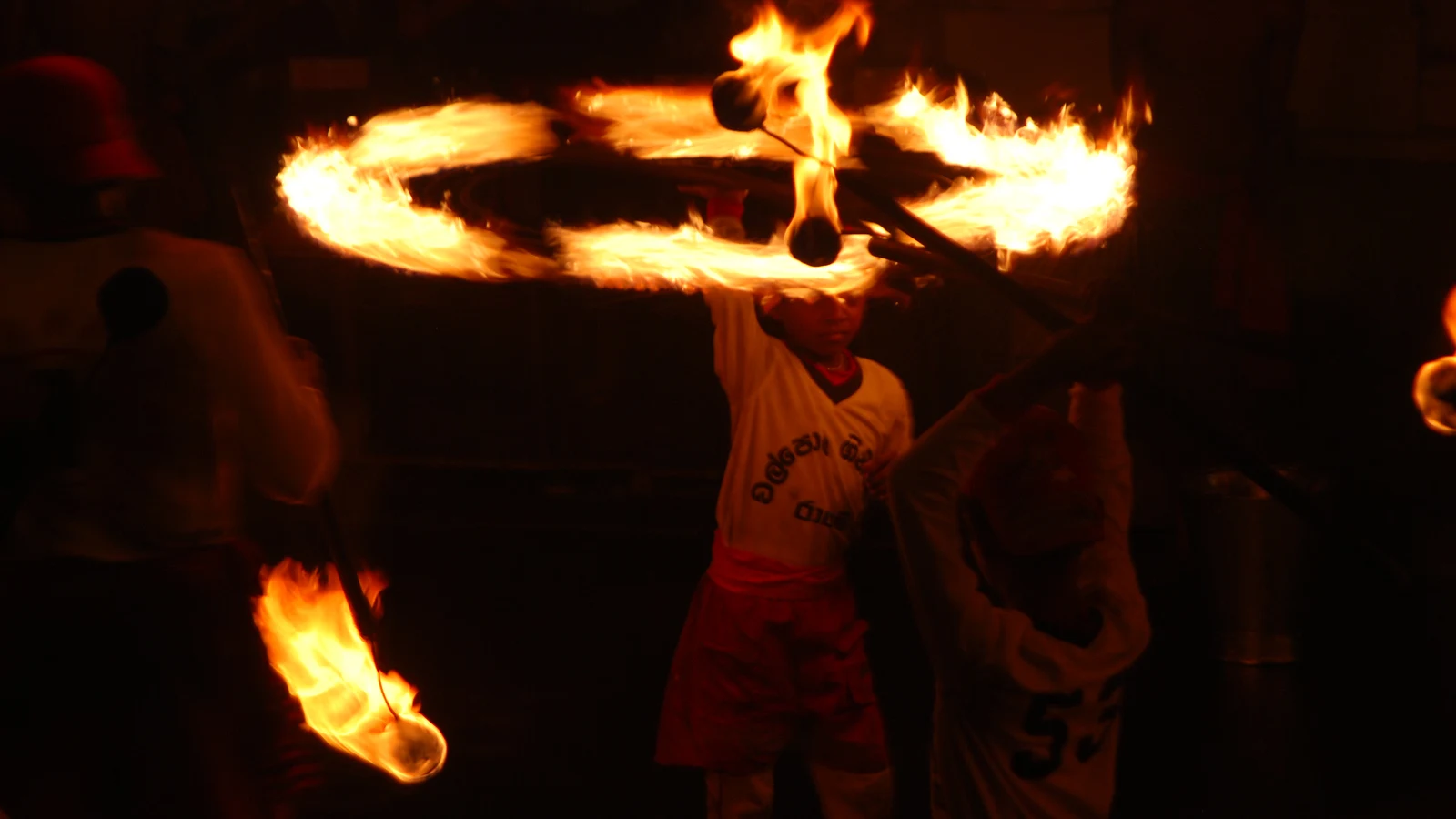
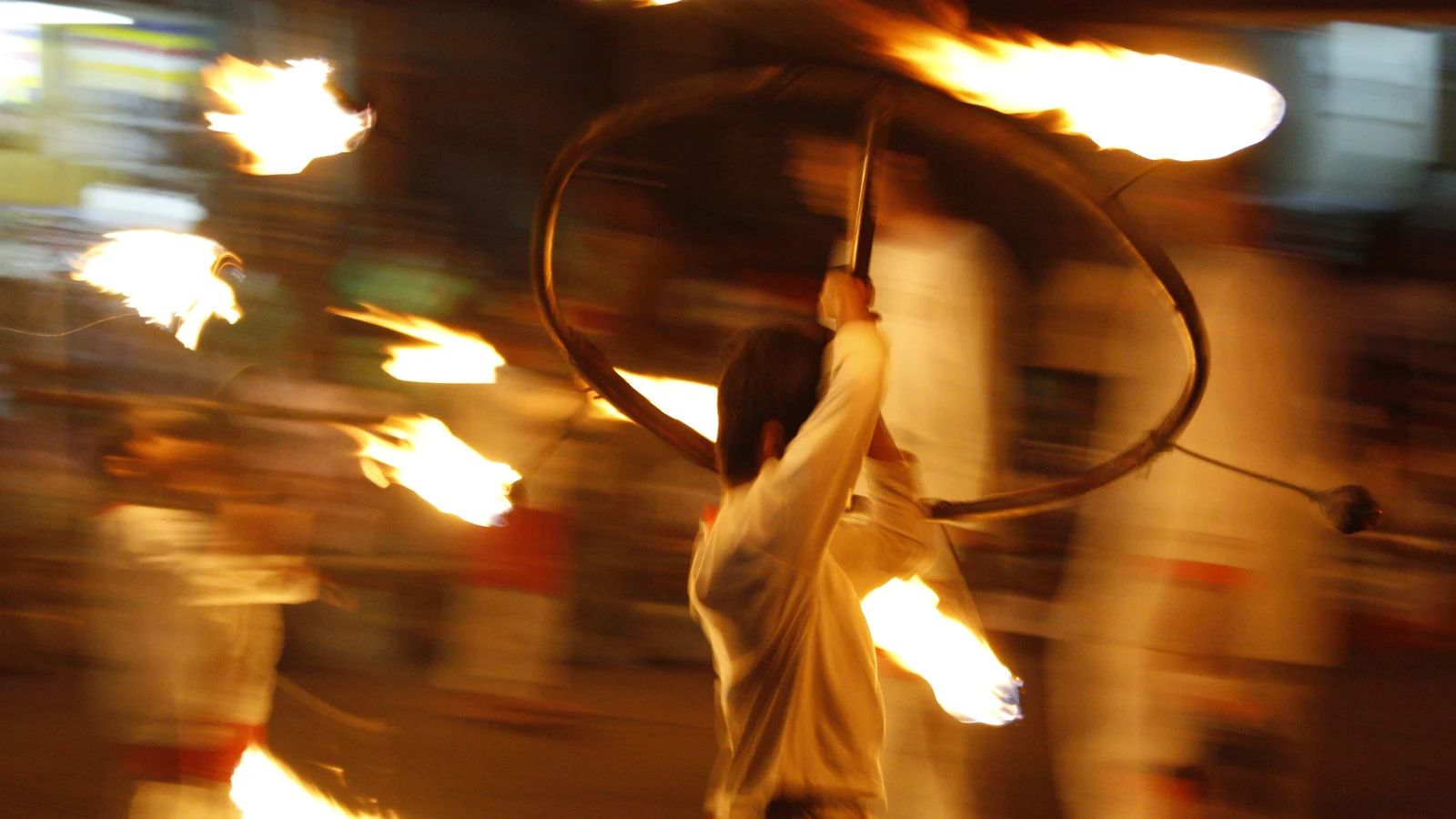
Brave fire dancers spin flaming coconut husk wheels to light the dark road.
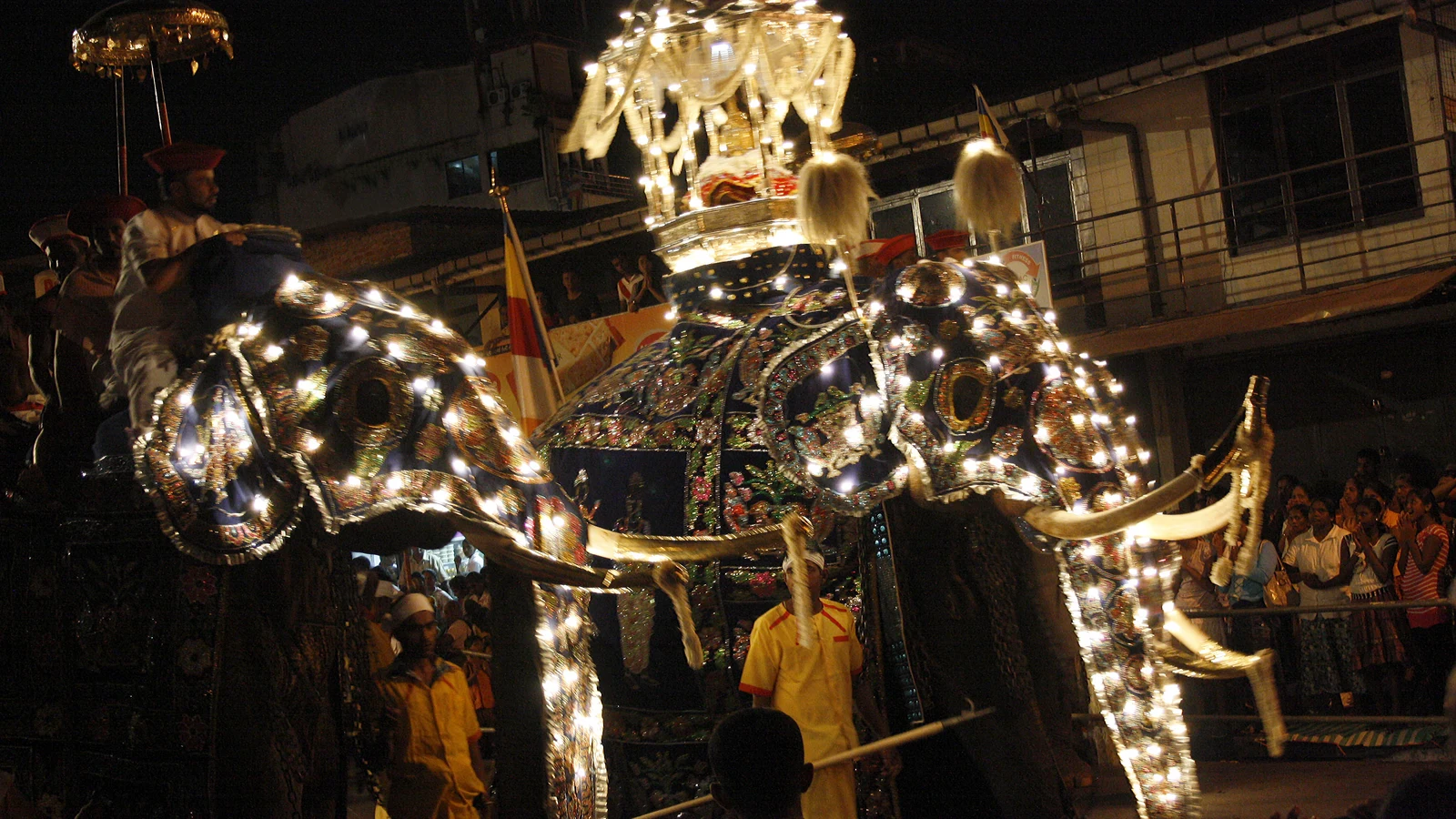
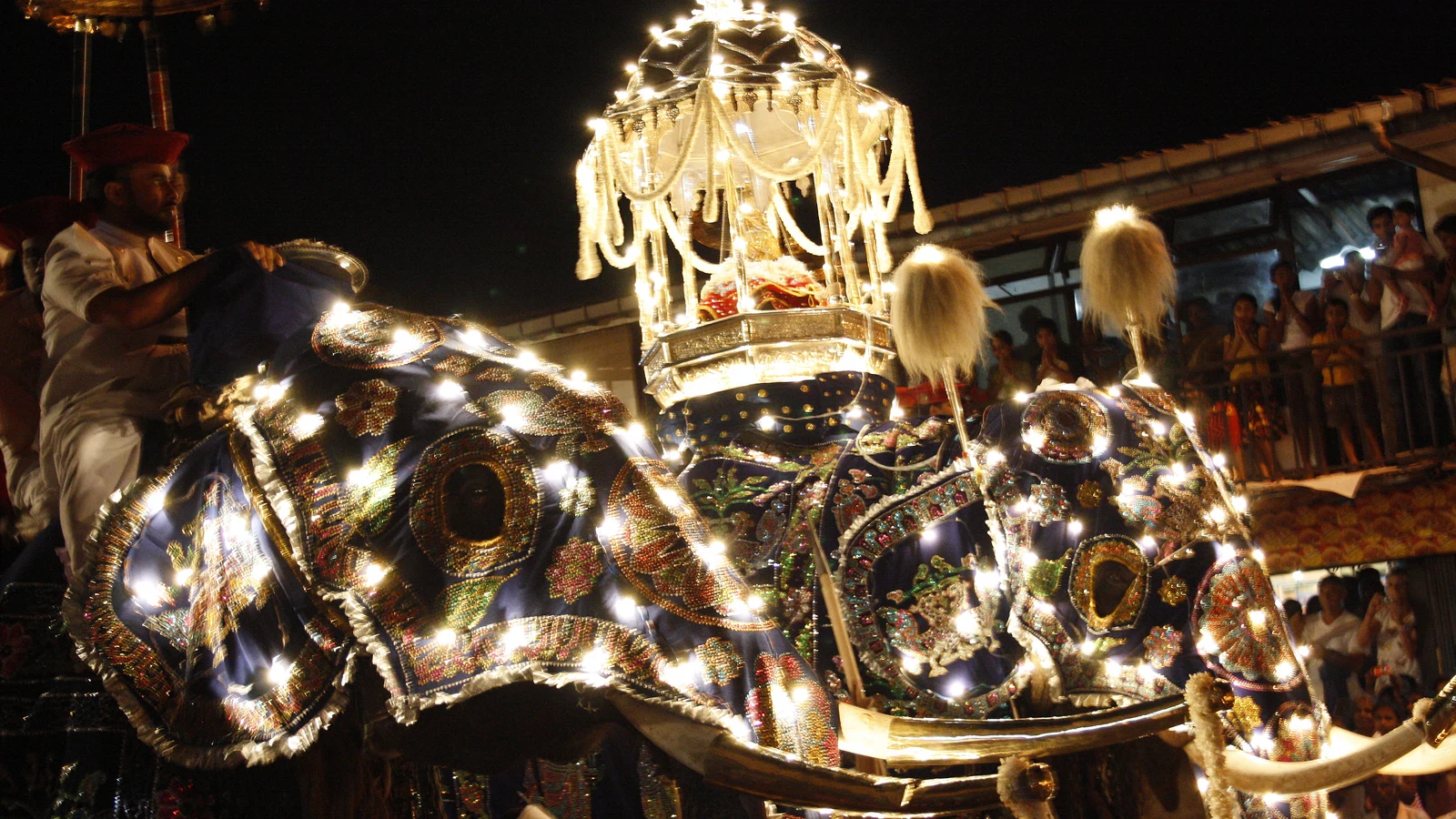
A majestic elephant with long white tusks wears a shining gold cloth coat.
The tall tusker carries the sacred golden casket of the Buddha beneath a bright roof.
The chief temple leader walks behind the elephant on clean white ground cloths.
Four shrine groups follow in order behind the great temple elephant team.
Urban Logistics, Municipal Transformation, and Crowd Dynamics
The festival changes Kandy into a giant walking city filled with bright lights.
City workers put up wooden seats, safety fences, and first aid tents along roads.
Police officers guide cars away to outside ring roads to keep walkers safe.
Engineers set up big electric generators to light thousands of colorful light bulbs.
Trained elephant keepers feed and wash more than seventy big elephants in quiet yards.
Thousands of happy families sit on sidewalks all day to watch the evening parade.
The Water Cutting Rite and the Diya Kepeema at Getambe
On the final morning, priests travel to the Mahaweli River for the water cutting ritual.
Priests ride in pretty decorated river boats to the Getambe ferry water crossing.
The head priest hits the river water with a golden sword at sunrise.
Priests fill sacred clay pots with fresh river water to keep until next year.
A daytime parade walks back to Kandy to tell temple leaders the festival finished well.
A loud cannon shoots from the palace, and city roads open again for normal cars.
A2 · Elementary
Kandy Esala Perahera: Ancient Shrines, Relic Tuskers, and City Lights
The Kap Situveema planting, Kumbal and Randoli night processions, and Getambe water cutting shape Kandy grandest annual festival.
Ritual Inauguration and the Devale Sanctuaries
The Kandy Esala Perahera begins with the Kap Situveema, an ancient ritual planting of a sanctified jackfruit tree cutting at the four guardian devales of Kandy. The four historic devale sanctuaries dedicated to Natha, Vishnu, Kataragama, and Pattini form the sacred fourfold pantheon surrounding the Temple of the Tooth. Following the planting of the Kap, internal devale processions occur for five nights before the public festival emerges onto the city streets.
The festival unfolds across two successive five-night phases known respectively as the Kumbal Perahera and the more elaborate Randoli Perahera. The transition from Kumbal to Randoli marks an escalation in pageantry, introducing golden palanquins containing the sacred insignia of the devale consorts. Astrological calculations conducted by royal temple astrologers establish the precise auspicious seconds for every ceremonial stage and departure cue.
Processional Order and the Sacred Relic Casket
The processional order is led by whip crackers known as kasakkarayo whose synchronized snapping clears crowds and announces the arrival of the pageant. Following the whip crackers, energetic fireball acrobats spin flaming coconut husk wheels along Dalada Veediya to purify the street corridor. The climax of the procession is anchored by the Maligawa Tusker, a majestic elephant with curved tusks draped in gold-embroidered velvet vestments.
The Maligawa Tusker carries the sacred golden casket known as the Karanduwa containing replica relics of the Buddha beneath a gilded canopy. Walking behind the tusker on white cloth runners known as pavada, the Diyawadana Nilame wears traditional Kandyan aristocratic regalia as chief lay custodian. The four devale processions follow behind the main Maligawa contingent in strict hierarchical sequence: Natha first, Vishnu second, Kataragama third, and Pattini fourth.
Urban Logistics, Municipal Transformation, and Crowd Dynamics
The festival temporarily transforms the physical geography of Kandy, converting core streets into an exclusive illuminated pedestrian amphitheatre. Kandy Municipal Council erects temporary barricades, tiered wooden grandstands, and emergency aid stations along the circular parade route. Thousands of provincial police officers enforce specialized traffic zones, diverting commercial vehicles to perimeter ring roads outside the valley.
Municipal engineers deploy supplementary electrical transformers and diesel generators to power thousands of incandescent lights illuminating elephants and temple facades. Dedicated temple mahouts manage more than seventy trained elephants, coordinating feeding depots and freshwater drinking baths in holding yards. An estimated five hundred thousand spectators from across Sri Lanka camp along sidewalks and shop verandas hours before nightfall to secure front-row sightlines.
The Water Cutting Rite and the Diya Kepeema at Getambe
Following the final Randoli night procession, the festival concludes the next morning with the sacred Water Cutting ritual known as Diya Kepeema. Devale priests travel in decorated river palanquins to the Getambe ferry point on the Mahaweli River southwest of the historic city centre. The chief priest enters the river in a traditional outrigger canoe and strikes the water with a golden sword, cleaving the current at an auspicious astrological dawn.
Priests draw fresh river water into consecrated clay vessels known as kendiya to be preserved within the devales until the following year festival. The daytime concluding procession returns to Kandy where temple officials report the successful completion of the festival to the Diyawadana Nilame. With the final cannon fire from the palace grounds, municipal barriers are dismantled and normal commercial traffic returns to the streets of Kandy.
B1 · Intermediate
Sacred Pantheons, Processional Hierarchies, and Municipal Logistics in the Esala Perahera
An analytical study of the four guardian devales, the Maligawa Tusker reliquary procession, and urban crowd management in the Kandy basin.
Ritual Inauguration and the Devale Sanctuaries
The Kandy Esala Perahera begins with the Kap Situveema, an ancient ritual planting of a sanctified jackfruit tree cutting at the four guardian devales of Kandy. The four historic devale sanctuaries dedicated to Natha, Vishnu, Kataragama, and Pattini form the sacred fourfold pantheon surrounding the Temple of the Tooth. Following the planting of the Kap, internal devale processions occur for five nights before the public festival emerges onto the city streets.
The festival unfolds across two successive five-night phases known respectively as the Kumbal Perahera and the more elaborate Randoli Perahera. The transition from Kumbal to Randoli marks an escalation in pageantry, introducing golden palanquins containing the sacred insignia of the devale consorts. Astrological calculations conducted by royal temple astrologers establish the precise auspicious seconds for every ceremonial stage and departure cue.
Processional Order and the Sacred Relic Casket
The processional order is led by whip crackers known as kasakkarayo whose synchronized snapping clears crowds and announces the arrival of the pageant. Following the whip crackers, energetic fireball acrobats spin flaming coconut husk wheels along Dalada Veediya to purify the street corridor. The climax of the procession is anchored by the Maligawa Tusker, a majestic elephant with curved tusks draped in gold-embroidered velvet vestments.
The Maligawa Tusker carries the sacred golden casket known as the Karanduwa containing replica relics of the Buddha beneath a gilded canopy. Walking behind the tusker on white cloth runners known as pavada, the Diyawadana Nilame wears traditional Kandyan aristocratic regalia as chief lay custodian. The four devale processions follow behind the main Maligawa contingent in strict hierarchical sequence: Natha first, Vishnu second, Kataragama third, and Pattini fourth.
Urban Logistics, Municipal Transformation, and Crowd Dynamics
The festival temporarily transforms the physical geography of Kandy, converting core streets into an exclusive illuminated pedestrian amphitheatre. Kandy Municipal Council erects temporary barricades, tiered wooden grandstands, and emergency aid stations along the circular parade route. Thousands of provincial police officers enforce specialized traffic zones, diverting commercial vehicles to perimeter ring roads outside the valley.
Municipal engineers deploy supplementary electrical transformers and diesel generators to power thousands of incandescent lights illuminating elephants and temple facades. Dedicated temple mahouts manage more than seventy trained elephants, coordinating feeding depots and freshwater drinking baths in holding yards. An estimated five hundred thousand spectators from across Sri Lanka camp along sidewalks and shop verandas hours before nightfall to secure front-row sightlines.
The Water Cutting Rite and the Diya Kepeema at Getambe
Following the final Randoli night procession, the festival concludes the next morning with the sacred Water Cutting ritual known as Diya Kepeema. Devale priests travel in decorated river palanquins to the Getambe ferry point on the Mahaweli River southwest of the historic city centre. The chief priest enters the river in a traditional outrigger canoe and strikes the water with a golden sword, cleaving the current at an auspicious astrological dawn.
Priests draw fresh river water into consecrated clay vessels known as kendiya to be preserved within the devales until the following year festival. The daytime concluding procession returns to Kandy where temple officials report the successful completion of the festival to the Diyawadana Nilame. With the final cannon fire from the palace grounds, municipal barriers are dismantled and normal commercial traffic returns to the streets of Kandy.
B2 · Upper Intermediate
Liturgical Temporal Systems, Processional Morphology, and Civic Reordering in Kandy
Examining royal astrological timings, devale consort insignia palanquins, emergency electrical grids, and the Mahaweli water cutting rite.
Ritual Inauguration and the Devale Sanctuaries
The Kandy Esala Perahera begins with the Kap Situveema, an ancient ritual planting of a sanctified jackfruit tree cutting at the four guardian devales of Kandy. The four historic devale sanctuaries dedicated to Natha, Vishnu, Kataragama, and Pattini form the sacred fourfold pantheon surrounding the Temple of the Tooth. Following the planting of the Kap, internal devale processions occur for five nights before the public festival emerges onto the city streets.
The festival unfolds across two successive five-night phases known respectively as the Kumbal Perahera and the more elaborate Randoli Perahera. The transition from Kumbal to Randoli marks an escalation in pageantry, introducing golden palanquins containing the sacred insignia of the devale consorts. Astrological calculations conducted by royal temple astrologers establish the precise auspicious seconds for every ceremonial stage and departure cue.
Processional Order and the Sacred Relic Casket
The processional order is led by whip crackers known as kasakkarayo whose synchronized snapping clears crowds and announces the arrival of the pageant. Following the whip crackers, energetic fireball acrobats spin flaming coconut husk wheels along Dalada Veediya to purify the street corridor. The climax of the procession is anchored by the Maligawa Tusker, a majestic elephant with curved tusks draped in gold-embroidered velvet vestments.
The Maligawa Tusker carries the sacred golden casket known as the Karanduwa containing replica relics of the Buddha beneath a gilded canopy. Walking behind the tusker on white cloth runners known as pavada, the Diyawadana Nilame wears traditional Kandyan aristocratic regalia as chief lay custodian. The four devale processions follow behind the main Maligawa contingent in strict hierarchical sequence: Natha first, Vishnu second, Kataragama third, and Pattini fourth.
Urban Logistics, Municipal Transformation, and Crowd Dynamics
The festival temporarily transforms the physical geography of Kandy, converting core streets into an exclusive illuminated pedestrian amphitheatre. Kandy Municipal Council erects temporary barricades, tiered wooden grandstands, and emergency aid stations along the circular parade route. Thousands of provincial police officers enforce specialized traffic zones, diverting commercial vehicles to perimeter ring roads outside the valley.
Municipal engineers deploy supplementary electrical transformers and diesel generators to power thousands of incandescent lights illuminating elephants and temple facades. Dedicated temple mahouts manage more than seventy trained elephants, coordinating feeding depots and freshwater drinking baths in holding yards. An estimated five hundred thousand spectators from across Sri Lanka camp along sidewalks and shop verandas hours before nightfall to secure front-row sightlines.
The Water Cutting Rite and the Diya Kepeema at Getambe
Following the final Randoli night procession, the festival concludes the next morning with the sacred Water Cutting ritual known as Diya Kepeema. Devale priests travel in decorated river palanquins to the Getambe ferry point on the Mahaweli River southwest of the historic city centre. The chief priest enters the river in a traditional outrigger canoe and strikes the water with a golden sword, cleaving the current at an auspicious astrological dawn.
Priests draw fresh river water into consecrated clay vessels known as kendiya to be preserved within the devales until the following year festival. The daytime concluding procession returns to Kandy where temple officials report the successful completion of the festival to the Diyawadana Nilame. With the final cannon fire from the palace grounds, municipal barriers are dismantled and normal commercial traffic returns to the streets of Kandy.
C1 · Advanced
Ritual Geographies, Feudal Devale Networks, and Spatial Hegemony in the Kandy Esala Perahera
A critical investigation of the Kap Situveema consecration, Karanduwa reliquary transit, municipal pedestrian conversion, and Getambe hydrological rites.
Ritual Inauguration and the Devale Sanctuaries
The Kandy Esala Perahera begins with the Kap Situveema, an ancient ritual planting of a sanctified jackfruit tree cutting at the four guardian devales of Kandy. The four historic devale sanctuaries dedicated to Natha, Vishnu, Kataragama, and Pattini form the sacred fourfold pantheon surrounding the Temple of the Tooth. Following the planting of the Kap, internal devale processions occur for five nights before the public festival emerges onto the city streets.
The festival unfolds across two successive five-night phases known respectively as the Kumbal Perahera and the more elaborate Randoli Perahera. The transition from Kumbal to Randoli marks an escalation in pageantry, introducing golden palanquins containing the sacred insignia of the devale consorts. Astrological calculations conducted by royal temple astrologers establish the precise auspicious seconds for every ceremonial stage and departure cue.
Processional Order and the Sacred Relic Casket
The processional order is led by whip crackers known as kasakkarayo whose synchronized snapping clears crowds and announces the arrival of the pageant. Following the whip crackers, energetic fireball acrobats spin flaming coconut husk wheels along Dalada Veediya to purify the street corridor. The climax of the procession is anchored by the Maligawa Tusker, a majestic elephant with curved tusks draped in gold-embroidered velvet vestments.
The Maligawa Tusker carries the sacred golden casket known as the Karanduwa containing replica relics of the Buddha beneath a gilded canopy. Walking behind the tusker on white cloth runners known as pavada, the Diyawadana Nilame wears traditional Kandyan aristocratic regalia as chief lay custodian. The four devale processions follow behind the main Maligawa contingent in strict hierarchical sequence: Natha first, Vishnu second, Kataragama third, and Pattini fourth.
Urban Logistics, Municipal Transformation, and Crowd Dynamics
The festival temporarily transforms the physical geography of Kandy, converting core streets into an exclusive illuminated pedestrian amphitheatre. Kandy Municipal Council erects temporary barricades, tiered wooden grandstands, and emergency aid stations along the circular parade route. Thousands of provincial police officers enforce specialized traffic zones, diverting commercial vehicles to perimeter ring roads outside the valley.
Municipal engineers deploy supplementary electrical transformers and diesel generators to power thousands of incandescent lights illuminating elephants and temple facades. Dedicated temple mahouts manage more than seventy trained elephants, coordinating feeding depots and freshwater drinking baths in holding yards. An estimated five hundred thousand spectators from across Sri Lanka camp along sidewalks and shop verandas hours before nightfall to secure front-row sightlines.
The Water Cutting Rite and the Diya Kepeema at Getambe
Following the final Randoli night procession, the festival concludes the next morning with the sacred Water Cutting ritual known as Diya Kepeema. Devale priests travel in decorated river palanquins to the Getambe ferry point on the Mahaweli River southwest of the historic city centre. The chief priest enters the river in a traditional outrigger canoe and strikes the water with a golden sword, cleaving the current at an auspicious astrological dawn.
Priests draw fresh river water into consecrated clay vessels known as kendiya to be preserved within the devales until the following year festival. The daytime concluding procession returns to Kandy where temple officials report the successful completion of the festival to the Diyawadana Nilame. With the final cannon fire from the palace grounds, municipal barriers are dismantled and normal commercial traffic returns to the streets of Kandy.
C2 · Mastery
Sacred Sovereignty, Spatial Palimpsests, and Municipal Reordering during the Kandy Esala Perahera
A rigorous analytical treatise on fourfold devale cosmology, aristocratic custodial protocols, large-scale urban crowd logistics, and riparian water cleaving rites.
Ritual Inauguration and the Devale Sanctuaries
The Kandy Esala Perahera begins with the Kap Situveema, an ancient ritual planting of a sanctified jackfruit tree cutting at the four guardian devales of Kandy. The four historic devale sanctuaries dedicated to Natha, Vishnu, Kataragama, and Pattini form the sacred fourfold pantheon surrounding the Temple of the Tooth. Following the planting of the Kap, internal devale processions occur for five nights before the public festival emerges onto the city streets.
The festival unfolds across two successive five-night phases known respectively as the Kumbal Perahera and the more elaborate Randoli Perahera. The transition from Kumbal to Randoli marks an escalation in pageantry, introducing golden palanquins containing the sacred insignia of the devale consorts. Astrological calculations conducted by royal temple astrologers establish the precise auspicious seconds for every ceremonial stage and departure cue.
Processional Order and the Sacred Relic Casket
The processional order is led by whip crackers known as kasakkarayo whose synchronized snapping clears crowds and announces the arrival of the pageant. Following the whip crackers, energetic fireball acrobats spin flaming coconut husk wheels along Dalada Veediya to purify the street corridor. The climax of the procession is anchored by the Maligawa Tusker, a majestic elephant with curved tusks draped in gold-embroidered velvet vestments.
The Maligawa Tusker carries the sacred golden casket known as the Karanduwa containing replica relics of the Buddha beneath a gilded canopy. Walking behind the tusker on white cloth runners known as pavada, the Diyawadana Nilame wears traditional Kandyan aristocratic regalia as chief lay custodian. The four devale processions follow behind the main Maligawa contingent in strict hierarchical sequence: Natha first, Vishnu second, Kataragama third, and Pattini fourth.
Urban Logistics, Municipal Transformation, and Crowd Dynamics
The festival temporarily transforms the physical geography of Kandy, converting core streets into an exclusive illuminated pedestrian amphitheatre. Kandy Municipal Council erects temporary barricades, tiered wooden grandstands, and emergency aid stations along the circular parade route. Thousands of provincial police officers enforce specialized traffic zones, diverting commercial vehicles to perimeter ring roads outside the valley.
Municipal engineers deploy supplementary electrical transformers and diesel generators to power thousands of incandescent lights illuminating elephants and temple facades. Dedicated temple mahouts manage more than seventy trained elephants, coordinating feeding depots and freshwater drinking baths in holding yards. An estimated five hundred thousand spectators from across Sri Lanka camp along sidewalks and shop verandas hours before nightfall to secure front-row sightlines.
The Water Cutting Rite and the Diya Kepeema at Getambe
Following the final Randoli night procession, the festival concludes the next morning with the sacred Water Cutting ritual known as Diya Kepeema. Devale priests travel in decorated river palanquins to the Getambe ferry point on the Mahaweli River southwest of the historic city centre. The chief priest enters the river in a traditional outrigger canoe and strikes the water with a golden sword, cleaving the current at an auspicious astrological dawn.
Priests draw fresh river water into consecrated clay vessels known as kendiya to be preserved within the devales until the following year festival. The daytime concluding procession returns to Kandy where temple officials report the successful completion of the festival to the Diyawadana Nilame. With the final cannon fire from the palace grounds, municipal barriers are dismantled and normal commercial traffic returns to the streets of Kandy.
Check your understanding
Choose how closely you want to revisit the article. You can refer back while answering, and review explanations when you finish.
Quick Quiz A1
Try one question, then create a free account for the full Quick Quiz. Sign Up Free
Answer every question before checking. There is no time limit.
Your results
/ 1 correct (%)
Read the explanations to see how each answer connects to the article.
-
How does the great Kandy festival begin at four holy shrines?
1. Answer:
Quick Quiz A2
Try one question, then create a free account for the full Quick Quiz. Sign Up Free
Answer every question before checking. There is no time limit.
Your results
/ 1 correct (%)
Read the explanations to see how each answer connects to the article.
-
What sacred rite inaugurates the Kandy Esala Perahera festival at the four guardian devales?
1. Answer:
Quick Quiz B1
Try one question, then create a free account for the full Quick Quiz. Sign Up Free
Answer every question before checking. There is no time limit.
Your results
/ 1 correct (%)
Read the explanations to see how each answer connects to the article.
-
What sacred rite inaugurates the Kandy Esala Perahera festival at the four guardian devales?
1. Answer:
Quick Quiz B2
Try one question, then create a free account for the full Quick Quiz. Sign Up Free
Answer every question before checking. There is no time limit.
Your results
/ 1 correct (%)
Read the explanations to see how each answer connects to the article.
-
What sacred rite inaugurates the Kandy Esala Perahera festival at the four guardian devales?
1. Answer:
Quick Quiz C1
Try one question, then create a free account for the full Quick Quiz. Sign Up Free
Answer every question before checking. There is no time limit.
Your results
/ 1 correct (%)
Read the explanations to see how each answer connects to the article.
-
What sacred rite inaugurates the Kandy Esala Perahera festival at the four guardian devales?
1. Answer:
Quick Quiz C2
Try one question, then create a free account for the full Quick Quiz. Sign Up Free
Answer every question before checking. There is no time limit.
Your results
/ 1 correct (%)
Read the explanations to see how each answer connects to the article.
-
What sacred rite inaugurates the Kandy Esala Perahera festival at the four guardian devales?
1. Answer:
