A1 · Beginner
Sudanese Basket Weaving: Palm Fronds and Beautiful Trays
Village women weave strong coiled baskets from wild dom palm and date leaves to protect daily food and earn useful income.
Botanical Raw Materials and Fiber Preparation
Sudanese weavers make strong baskets from wild dom palm and date leaves.
Women harvest soft green palm leaves in early spring for smooth weaving.
Makers use sharp metal tools called mikhraz to cut thin leaf strips.
Artisans boil pomegranate rinds and tree pods to make bright red dyes.
A thick bundle of wild grass forms the inner core of each basket.
Weavers wet the dry palm fibers with water to keep them flexible.
Close-Coiled Stitching and Apprenticeship
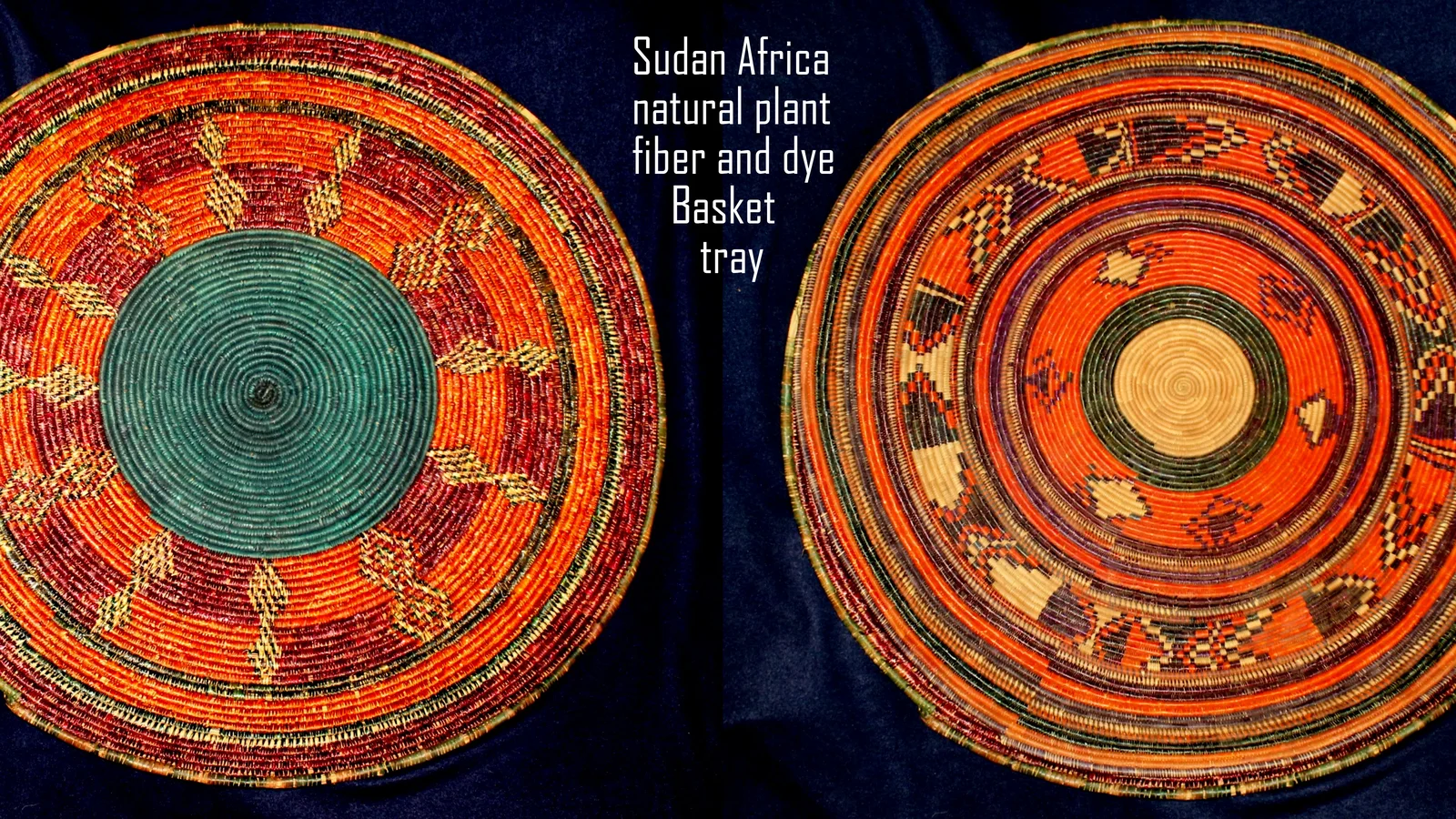
Craftswomen wrap colored palm fibers tightly around the grass core.
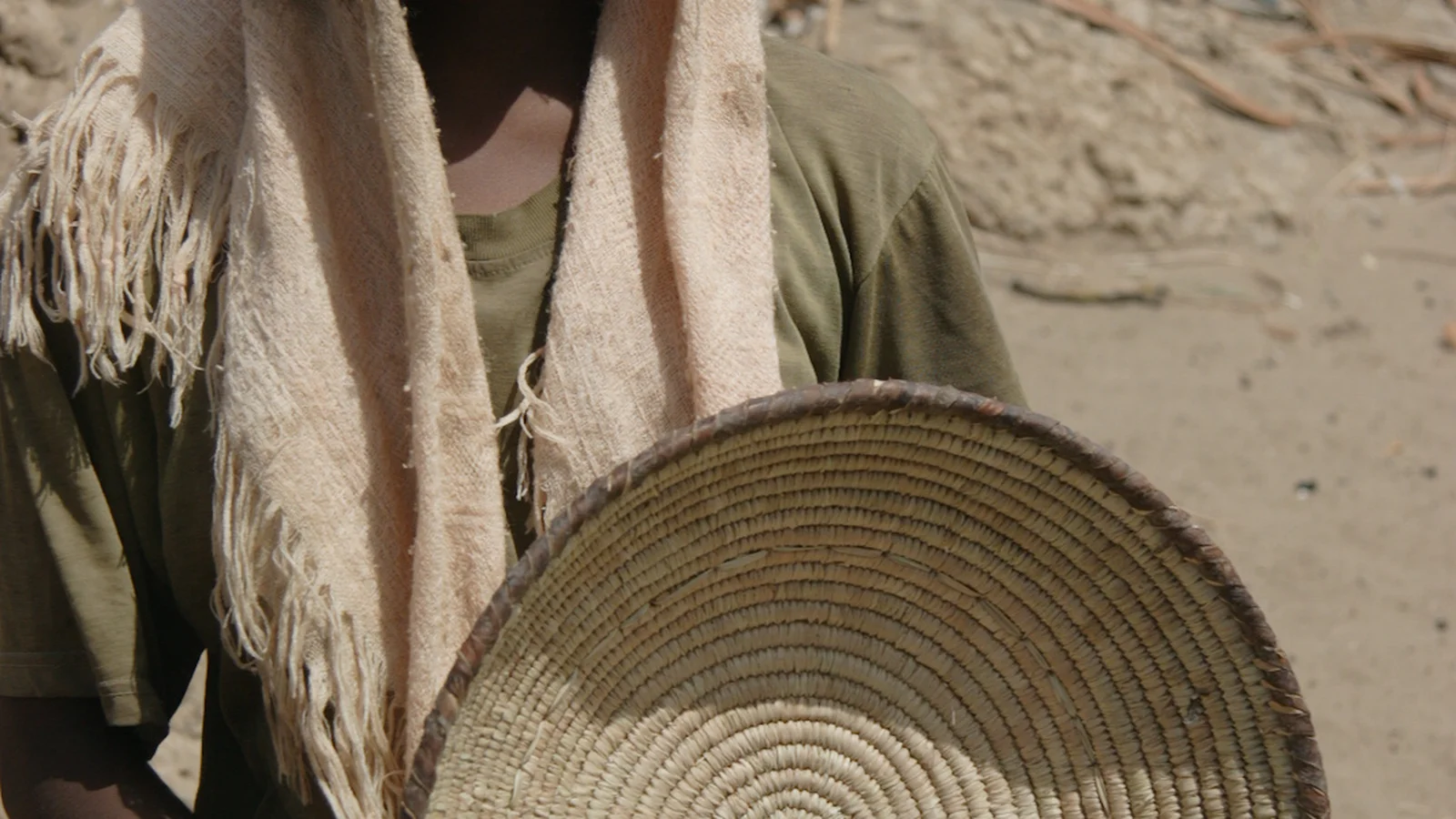
The round tabaq basket is a famous food cover used in homes.
Beautiful patterns show star shapes and triangles on the woven trays.
Tight stitching makes strong baskets that last for many years.
Weavers finish the outer edge with a braided rim called dhafirah.
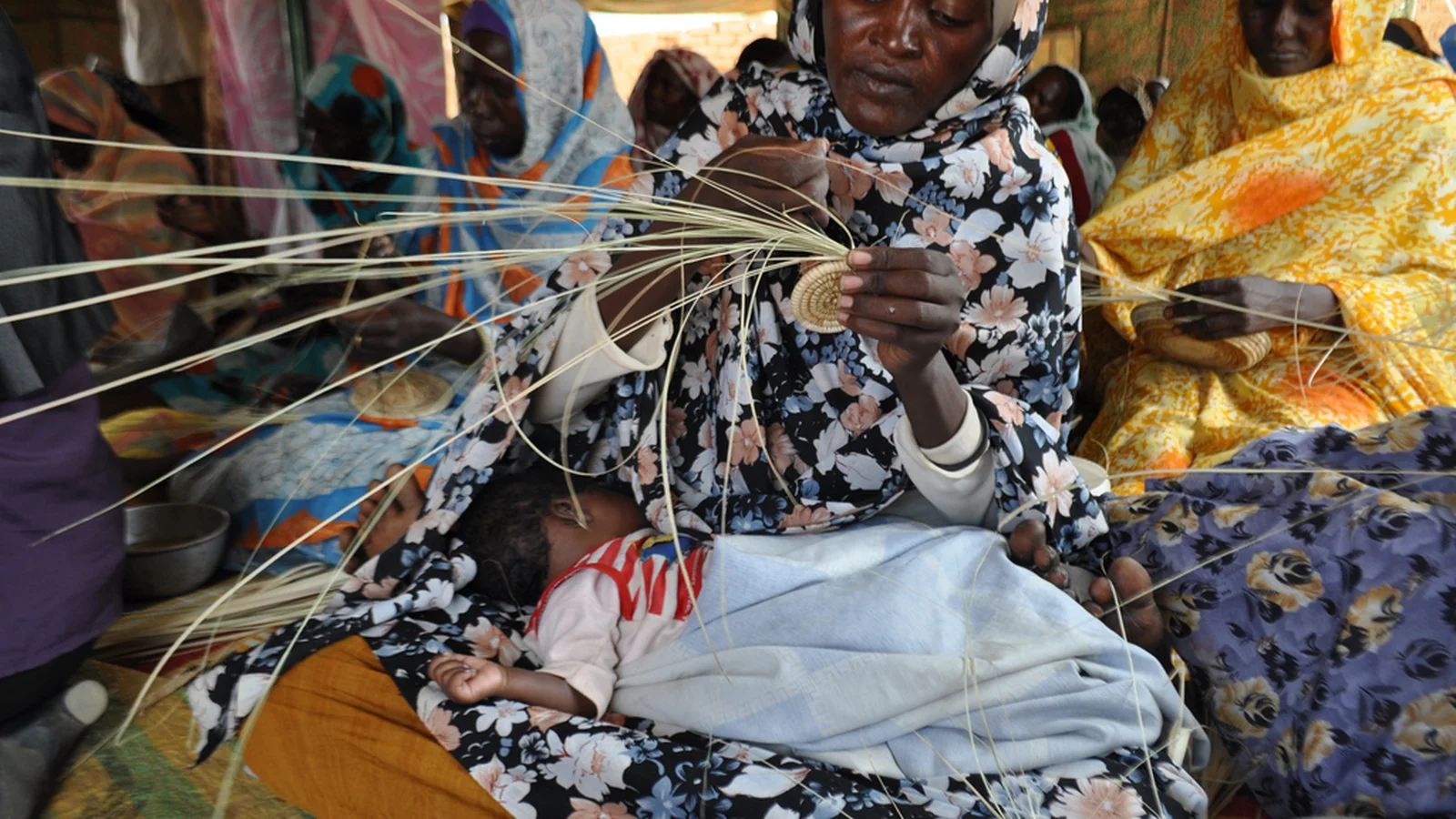
Young girls learn weaving skills from mothers and grandmothers at home.
Domestic Food Protection and Wedding Rituals
Selling handwoven baskets gives rural women useful money for daily life.
Village women sit in shaded home courtyards to weave together.
A round tabaq covers kisra bread and porridge to keep off dust.
Red and green tabaq trays carry sweet dates during wedding jertig rituals.
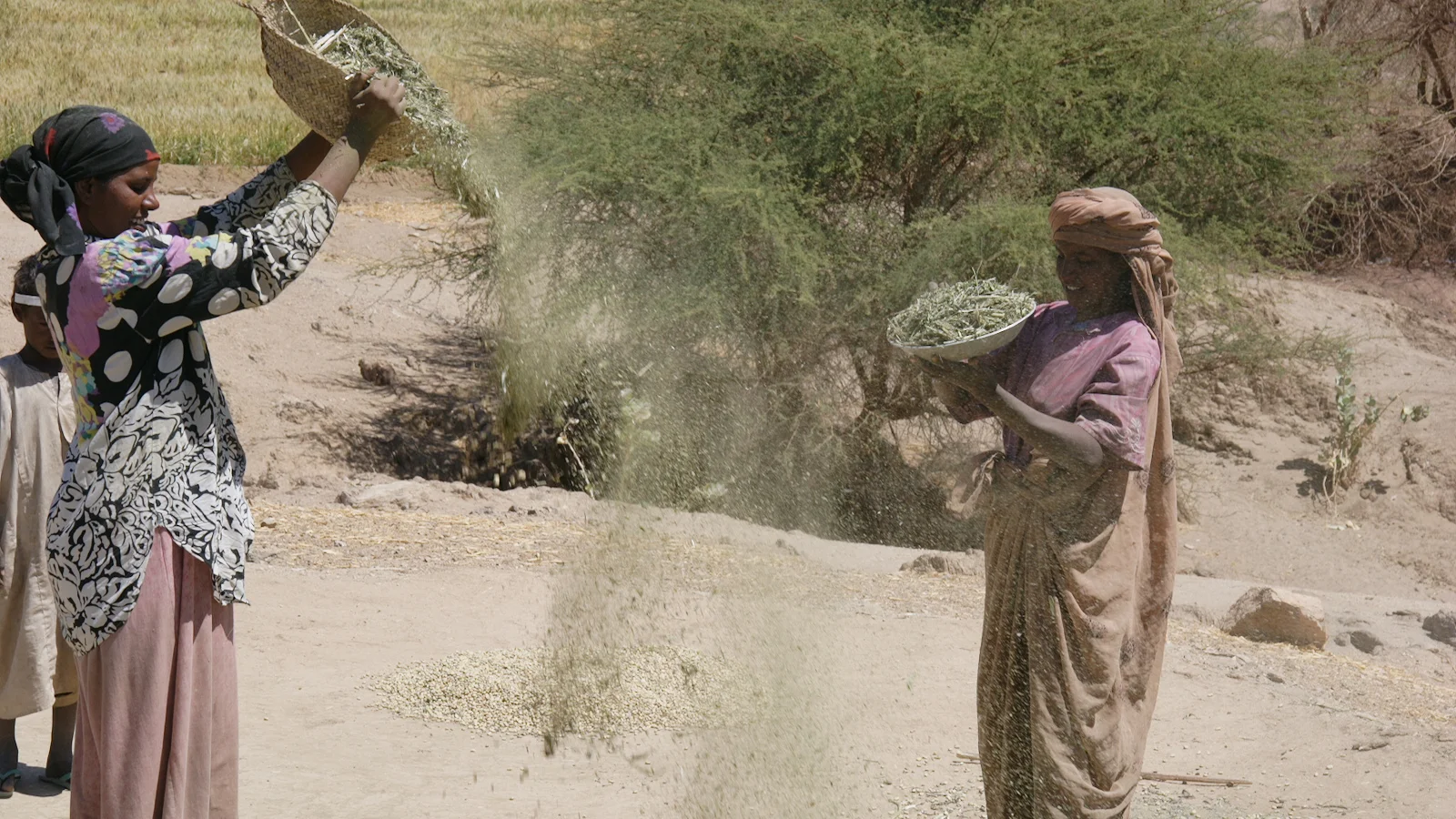
Farmers use flat baskets called reika to clean harvested grain crops.
Different weave patterns show the heritage of Nubian and Beja communities.
Urban Wholesale Trade and Fair-Trade Markets
Trucks carry finished baskets to big markets in Souq Omdurman and Kassala.
Traders price each basket by its stitch tightness, colors, and size.
Cheap plastic bowls from foreign factories create tough market competition for weavers.
Village craft groups and small loans help women buy palm leaves.
Museum collections preserve old handwoven baskets to protect traditional art patterns.
Global fair-trade shops sell Sudanese palm baskets as natural decorative art.
A2 · Elementary
Sudanese Basket Weaving: Palm Fronds, Coiled Craftsmanship, and Living Household Economy
Across rural riverine villages, women weave dyed palm leaves into insulating tabaq food covers, wedding heirlooms, and trade containers.
Botanical Raw Materials and Fiber Preparation
Traditional Sudanese basket weaving relies on harvested leaves and fronds from wild dom palms and cultivated date palms across northern and western Sudan. Artisans selectively harvest tender unexpanded central fronds during early spring to obtain supple, flexible fibers suitable for tight coiled stitching. Weavers use pointed steel awls, known locally as mikhraz, or sharpened bone tools to split palm leaves into uniform, hair-thin weaving splints.
Palm strands are colored using boiled botanical dyes from pomegranate rinds and acacia pods alongside mineral pigments to produce bold red, black, and purple hues. The coiled foundation core is assembled from dense bundles of wild halfawi savannah grass or stripped date palm midribs that provide tensile structure. Throughout the work, artisans continually moisten palm fibers in bowls of clean water during fabrication to maintain pliability and prevent brittle splitting under tension.
Close-Coiled Stitching and Apprenticeship
Sudanese basketry is constructed primarily through a close-coiled stitching technique where dyed palm splints wrap tightly around the foundation bundle. The most iconic Sudanese basketry form is the conical or flat circular tabaq, engineered as an insulating and insect-proof food cover. Intricate surface patterns incorporate contrasting geometric motifs, including chevrons, stepped diamonds, and radial stars rooted in ancient regional symbolism.
Dense manual stitching produces rigid containers that resist insect boring and can endure decades of daily domestic use without unraveling. Weavers finish outer basket borders with reinforced braided rims, known as dhafirah, to withstand repeated manual handling and transport friction. This basket-weaving expertise is transmitted without written guides through matrilineal apprenticeship, as young girls observe and emulate elder female artisans.
Domestic Food Protection and Wedding Rituals
Basketry operates as a crucial decentralized craft industry providing rural women with autonomous cash earnings to support household livelihoods. Village women assemble in shaded residential courtyards during afternoon hours to weave collaboratively, sharing dye vats, tools, and oral poetry. In daily domestic service, tabaq covers are placed over communal platters of kisra bread and porridge to protect prepared meals from airborne desert dust.
Specially crafted tabaq trays dyed in celebratory red and green hold ceremonial dates, sandalwood incense, and perfumes during traditional wedding jertig rituals. Large flat reika baskets and quffa containers serve essential agricultural functions, allowing farmers to winnow cereal grains and store harvested pulses. Distinct weave styles identify specific ethnic and geographic traditions, preserving historical Nubian, Beja, and Darfuri cultural heritage.
Urban Wholesale Trade and Fair-Trade Markets
Finished baskets move through rural transport networks to wholesale craft markets in major urban centers, including Souq Omdurman, Kassala, and El Fasher. Urban merchants price traditional baskets based on stitch density, geometric complexity, dye quality, and structural symmetry. The influx of cheap imported plastic food covers and metal bowls poses a direct commercial challenge to traditional handwoven palm products.
Community development agencies establish women's craft cooperatives and microfinance initiatives to supply raw materials and stabilize market prices for weavers. The Sudan Ethnographic Museum and national heritage bodies maintain curated collections of antique baskets to document endangered weaving patterns. Fair-trade cultural enterprises market Sudanese coiled basketry internationally as eco-friendly, biodegradable decorative craft art.
B1 · Intermediate
Palm Fiber Organology, Coiled Basketry Mechanics, and Rural Women's Cooperatives in Sudan
An analytical study of dom and date palm harvesting, vegetable dye chemistry, courtyard apprenticeship, and domestic food protection.
Botanical Raw Materials and Fiber Preparation
Traditional Sudanese basket weaving relies on harvested leaves and fronds from wild dom palms and cultivated date palms across northern and western Sudan. Artisans selectively harvest tender unexpanded central fronds during early spring to obtain supple, flexible fibers suitable for tight coiled stitching. Weavers use pointed steel awls, known locally as mikhraz, or sharpened bone tools to split palm leaves into uniform, hair-thin weaving splints.
Palm strands are colored using boiled botanical dyes from pomegranate rinds and acacia pods alongside mineral pigments to produce bold red, black, and purple hues. The coiled foundation core is assembled from dense bundles of wild halfawi savannah grass or stripped date palm midribs that provide tensile structure. Throughout the work, artisans continually moisten palm fibers in bowls of clean water during fabrication to maintain pliability and prevent brittle splitting under tension.
Close-Coiled Stitching and Apprenticeship
Sudanese basketry is constructed primarily through a close-coiled stitching technique where dyed palm splints wrap tightly around the foundation bundle. The most iconic Sudanese basketry form is the conical or flat circular tabaq, engineered as an insulating and insect-proof food cover. Intricate surface patterns incorporate contrasting geometric motifs, including chevrons, stepped diamonds, and radial stars rooted in ancient regional symbolism.
Dense manual stitching produces rigid containers that resist insect boring and can endure decades of daily domestic use without unraveling. Weavers finish outer basket borders with reinforced braided rims, known as dhafirah, to withstand repeated manual handling and transport friction. This basket-weaving expertise is transmitted without written guides through matrilineal apprenticeship, as young girls observe and emulate elder female artisans.
Domestic Food Protection and Wedding Rituals
Basketry operates as a crucial decentralized craft industry providing rural women with autonomous cash earnings to support household livelihoods. Village women assemble in shaded residential courtyards during afternoon hours to weave collaboratively, sharing dye vats, tools, and oral poetry. In daily domestic service, tabaq covers are placed over communal platters of kisra bread and porridge to protect prepared meals from airborne desert dust.
Specially crafted tabaq trays dyed in celebratory red and green hold ceremonial dates, sandalwood incense, and perfumes during traditional wedding jertig rituals. Large flat reika baskets and quffa containers serve essential agricultural functions, allowing farmers to winnow cereal grains and store harvested pulses. Distinct weave styles identify specific ethnic and geographic traditions, preserving historical Nubian, Beja, and Darfuri cultural heritage.
Urban Wholesale Trade and Fair-Trade Markets
Finished baskets move through rural transport networks to wholesale craft markets in major urban centers, including Souq Omdurman, Kassala, and El Fasher. Urban merchants price traditional baskets based on stitch density, geometric complexity, dye quality, and structural symmetry. The influx of cheap imported plastic food covers and metal bowls poses a direct commercial challenge to traditional handwoven palm products.
Community development agencies establish women's craft cooperatives and microfinance initiatives to supply raw materials and stabilize market prices for weavers. The Sudan Ethnographic Museum and national heritage bodies maintain curated collections of antique baskets to document endangered weaving patterns. Fair-trade cultural enterprises market Sudanese coiled basketry internationally as eco-friendly, biodegradable decorative craft art.
B2 · Upper Intermediate
Material Culture, Coiled Structural Engineering, and Decentralized Craft Enterprise in Northern Sudan
Investigating savannah grass tensile cores, geometric chevron motifs, wedding jertig traditions, and urban wholesale distribution.
Botanical Raw Materials and Fiber Preparation
Traditional Sudanese basket weaving relies on harvested leaves and fronds from wild dom palms and cultivated date palms across northern and western Sudan. Artisans selectively harvest tender unexpanded central fronds during early spring to obtain supple, flexible fibers suitable for tight coiled stitching. Weavers use pointed steel awls, known locally as mikhraz, or sharpened bone tools to split palm leaves into uniform, hair-thin weaving splints.
Palm strands are colored using boiled botanical dyes from pomegranate rinds and acacia pods alongside mineral pigments to produce bold red, black, and purple hues. The coiled foundation core is assembled from dense bundles of wild halfawi savannah grass or stripped date palm midribs that provide tensile structure. Throughout the work, artisans continually moisten palm fibers in bowls of clean water during fabrication to maintain pliability and prevent brittle splitting under tension.
Close-Coiled Stitching and Apprenticeship
Sudanese basketry is constructed primarily through a close-coiled stitching technique where dyed palm splints wrap tightly around the foundation bundle. The most iconic Sudanese basketry form is the conical or flat circular tabaq, engineered as an insulating and insect-proof food cover. Intricate surface patterns incorporate contrasting geometric motifs, including chevrons, stepped diamonds, and radial stars rooted in ancient regional symbolism.
Dense manual stitching produces rigid containers that resist insect boring and can endure decades of daily domestic use without unraveling. Weavers finish outer basket borders with reinforced braided rims, known as dhafirah, to withstand repeated manual handling and transport friction. This basket-weaving expertise is transmitted without written guides through matrilineal apprenticeship, as young girls observe and emulate elder female artisans.
Domestic Food Protection and Wedding Rituals
Basketry operates as a crucial decentralized craft industry providing rural women with autonomous cash earnings to support household livelihoods. Village women assemble in shaded residential courtyards during afternoon hours to weave collaboratively, sharing dye vats, tools, and oral poetry. In daily domestic service, tabaq covers are placed over communal platters of kisra bread and porridge to protect prepared meals from airborne desert dust.
Specially crafted tabaq trays dyed in celebratory red and green hold ceremonial dates, sandalwood incense, and perfumes during traditional wedding jertig rituals. Large flat reika baskets and quffa containers serve essential agricultural functions, allowing farmers to winnow cereal grains and store harvested pulses. Distinct weave styles identify specific ethnic and geographic traditions, preserving historical Nubian, Beja, and Darfuri cultural heritage.
Urban Wholesale Trade and Fair-Trade Markets
Finished baskets move through rural transport networks to wholesale craft markets in major urban centers, including Souq Omdurman, Kassala, and El Fasher. Urban merchants price traditional baskets based on stitch density, geometric complexity, dye quality, and structural symmetry. The influx of cheap imported plastic food covers and metal bowls poses a direct commercial challenge to traditional handwoven palm products.
Community development agencies establish women's craft cooperatives and microfinance initiatives to supply raw materials and stabilize market prices for weavers. The Sudan Ethnographic Museum and national heritage bodies maintain curated collections of antique baskets to document endangered weaving patterns. Fair-trade cultural enterprises market Sudanese coiled basketry internationally as eco-friendly, biodegradable decorative craft art.
C1 · Advanced
Ethnoarchaeological Morphology, Coiled Fiber Dynamics, and Matrilineal Artisanal Transmission in Sudanese Basketry
A critical examination of mikhraz awl slitting, dhafirah braided borders, agricultural winnowing reika trays, and fair-trade cooperatives.
Botanical Raw Materials and Fiber Preparation
Traditional Sudanese basket weaving relies on harvested leaves and fronds from wild dom palms and cultivated date palms across northern and western Sudan. Artisans selectively harvest tender unexpanded central fronds during early spring to obtain supple, flexible fibers suitable for tight coiled stitching. Weavers use pointed steel awls, known locally as mikhraz, or sharpened bone tools to split palm leaves into uniform, hair-thin weaving splints.
Palm strands are colored using boiled botanical dyes from pomegranate rinds and acacia pods alongside mineral pigments to produce bold red, black, and purple hues. The coiled foundation core is assembled from dense bundles of wild halfawi savannah grass or stripped date palm midribs that provide tensile structure. Throughout the work, artisans continually moisten palm fibers in bowls of clean water during fabrication to maintain pliability and prevent brittle splitting under tension.
Close-Coiled Stitching and Apprenticeship
Sudanese basketry is constructed primarily through a close-coiled stitching technique where dyed palm splints wrap tightly around the foundation bundle. The most iconic Sudanese basketry form is the conical or flat circular tabaq, engineered as an insulating and insect-proof food cover. Intricate surface patterns incorporate contrasting geometric motifs, including chevrons, stepped diamonds, and radial stars rooted in ancient regional symbolism.
Dense manual stitching produces rigid containers that resist insect boring and can endure decades of daily domestic use without unraveling. Weavers finish outer basket borders with reinforced braided rims, known as dhafirah, to withstand repeated manual handling and transport friction. This basket-weaving expertise is transmitted without written guides through matrilineal apprenticeship, as young girls observe and emulate elder female artisans.
Domestic Food Protection and Wedding Rituals
Basketry operates as a crucial decentralized craft industry providing rural women with autonomous cash earnings to support household livelihoods. Village women assemble in shaded residential courtyards during afternoon hours to weave collaboratively, sharing dye vats, tools, and oral poetry. In daily domestic service, tabaq covers are placed over communal platters of kisra bread and porridge to protect prepared meals from airborne desert dust.
Specially crafted tabaq trays dyed in celebratory red and green hold ceremonial dates, sandalwood incense, and perfumes during traditional wedding jertig rituals. Large flat reika baskets and quffa containers serve essential agricultural functions, allowing farmers to winnow cereal grains and store harvested pulses. Distinct weave styles identify specific ethnic and geographic traditions, preserving historical Nubian, Beja, and Darfuri cultural heritage.
Urban Wholesale Trade and Fair-Trade Markets
Finished baskets move through rural transport networks to wholesale craft markets in major urban centers, including Souq Omdurman, Kassala, and El Fasher. Urban merchants price traditional baskets based on stitch density, geometric complexity, dye quality, and structural symmetry. The influx of cheap imported plastic food covers and metal bowls poses a direct commercial challenge to traditional handwoven palm products.
Community development agencies establish women's craft cooperatives and microfinance initiatives to supply raw materials and stabilize market prices for weavers. The Sudan Ethnographic Museum and national heritage bodies maintain curated collections of antique baskets to document endangered weaving patterns. Fair-trade cultural enterprises market Sudanese coiled basketry internationally as eco-friendly, biodegradable decorative craft art.
C2 · Mastery
Middle Nile Material Culture, Botanical Fiber Technology, and Intangible Artisanal Economy of Sudanese Basketry
A comprehensive analytical monograph detailing wild dom palm harvesting, close-coiled stitching kinetics, ritual jertig tabaq trays, and fair-trade global export.
Botanical Raw Materials and Fiber Preparation
Traditional Sudanese basket weaving relies on harvested leaves and fronds from wild dom palms and cultivated date palms across northern and western Sudan. Artisans selectively harvest tender unexpanded central fronds during early spring to obtain supple, flexible fibers suitable for tight coiled stitching. Weavers use pointed steel awls, known locally as mikhraz, or sharpened bone tools to split palm leaves into uniform, hair-thin weaving splints.
Palm strands are colored using boiled botanical dyes from pomegranate rinds and acacia pods alongside mineral pigments to produce bold red, black, and purple hues. The coiled foundation core is assembled from dense bundles of wild halfawi savannah grass or stripped date palm midribs that provide tensile structure. Throughout the work, artisans continually moisten palm fibers in bowls of clean water during fabrication to maintain pliability and prevent brittle splitting under tension.
Close-Coiled Stitching and Apprenticeship
Sudanese basketry is constructed primarily through a close-coiled stitching technique where dyed palm splints wrap tightly around the foundation bundle. The most iconic Sudanese basketry form is the conical or flat circular tabaq, engineered as an insulating and insect-proof food cover. Intricate surface patterns incorporate contrasting geometric motifs, including chevrons, stepped diamonds, and radial stars rooted in ancient regional symbolism.
Dense manual stitching produces rigid containers that resist insect boring and can endure decades of daily domestic use without unraveling. Weavers finish outer basket borders with reinforced braided rims, known as dhafirah, to withstand repeated manual handling and transport friction. This basket-weaving expertise is transmitted without written guides through matrilineal apprenticeship, as young girls observe and emulate elder female artisans.
Domestic Food Protection and Wedding Rituals
Basketry operates as a crucial decentralized craft industry providing rural women with autonomous cash earnings to support household livelihoods. Village women assemble in shaded residential courtyards during afternoon hours to weave collaboratively, sharing dye vats, tools, and oral poetry. In daily domestic service, tabaq covers are placed over communal platters of kisra bread and porridge to protect prepared meals from airborne desert dust.
Specially crafted tabaq trays dyed in celebratory red and green hold ceremonial dates, sandalwood incense, and perfumes during traditional wedding jertig rituals. Large flat reika baskets and quffa containers serve essential agricultural functions, allowing farmers to winnow cereal grains and store harvested pulses. Distinct weave styles identify specific ethnic and geographic traditions, preserving historical Nubian, Beja, and Darfuri cultural heritage.
Urban Wholesale Trade and Fair-Trade Markets
Finished baskets move through rural transport networks to wholesale craft markets in major urban centers, including Souq Omdurman, Kassala, and El Fasher. Urban merchants price traditional baskets based on stitch density, geometric complexity, dye quality, and structural symmetry. The influx of cheap imported plastic food covers and metal bowls poses a direct commercial challenge to traditional handwoven palm products.
Community development agencies establish women's craft cooperatives and microfinance initiatives to supply raw materials and stabilize market prices for weavers. The Sudan Ethnographic Museum and national heritage bodies maintain curated collections of antique baskets to document endangered weaving patterns. Fair-trade cultural enterprises market Sudanese coiled basketry internationally as eco-friendly, biodegradable decorative craft art.
Check your understanding
Choose how closely you want to revisit the article. You can refer back while answering, and review explanations when you finish.
Quick Quiz A1
Try one question, then create a free account for the full Quick Quiz. Sign Up Free
Answer every question before checking. There is no time limit.
Your results
/ 1 correct (%)
Read the explanations to see how each answer connects to the article.
-
What trees do Sudanese weavers use to make strong baskets?
1. Answer:
Quick Quiz A2
Try one question, then create a free account for the full Quick Quiz. Sign Up Free
Answer every question before checking. There is no time limit.
Your results
/ 1 correct (%)
Read the explanations to see how each answer connects to the article.
-
What botanical palms provide raw materials for traditional Sudanese basketry?
1. Answer:
Quick Quiz B1
Try one question, then create a free account for the full Quick Quiz. Sign Up Free
Answer every question before checking. There is no time limit.
Your results
/ 1 correct (%)
Read the explanations to see how each answer connects to the article.
-
What botanical palms provide raw materials for traditional Sudanese basketry?
1. Answer:
Quick Quiz B2
Try one question, then create a free account for the full Quick Quiz. Sign Up Free
Answer every question before checking. There is no time limit.
Your results
/ 1 correct (%)
Read the explanations to see how each answer connects to the article.
-
What botanical palms provide raw materials for traditional Sudanese basketry?
1. Answer:
Quick Quiz C1
Try one question, then create a free account for the full Quick Quiz. Sign Up Free
Answer every question before checking. There is no time limit.
Your results
/ 1 correct (%)
Read the explanations to see how each answer connects to the article.
-
What botanical palms provide raw materials for traditional Sudanese basketry?
1. Answer:
Quick Quiz C2
Try one question, then create a free account for the full Quick Quiz. Sign Up Free
Answer every question before checking. There is no time limit.
Your results
/ 1 correct (%)
Read the explanations to see how each answer connects to the article.
-
What botanical palms provide raw materials for traditional Sudanese basketry?
1. Answer:
