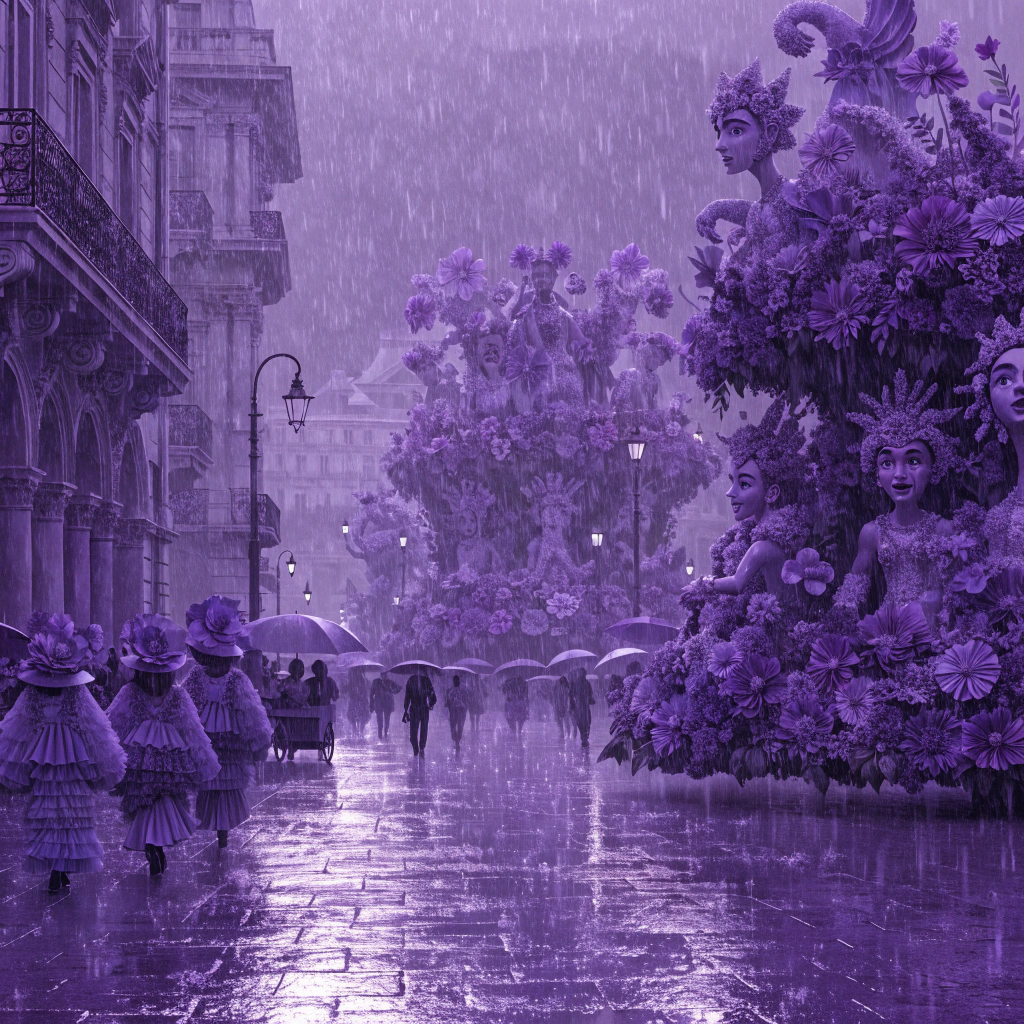
The Big Party in Nice
Nice is a beautiful city in France. Every February, there is a big party. It is the Carnival of Nice. Many people visit this city. It is very famous.
The carnival has big floats. The floats are colorful. People wear beautiful costumes. They dance in the streets. There is loud music. It is very fun.
There is also a special flower parade. People on the floats throw flowers to the crowd. You can see many roses and lilies. The city is full of color and joy. It is a great time to visit Nice.
Grammar Spotlight
Pattern: Present Simple: To Be
"Nice is a beautiful city in France."
We use 'is' with singular subjects (he, she, it) to describe facts or states. In this sentence, it describes the location and quality of the city.
Pattern: Present Simple: Action Verbs
"They dance in the streets."
We use the base form of the verb for 'I', 'you', 'we', and 'they' to talk about regular actions. There is no 's' at the end of the verb 'dance' because the subject is 'they'.
Test Your Understanding
10 questions · A1 Beginner · 1 free preview
Test what you learned from this article. Answer all questions to earn XP!
Where is the Carnival of Nice?
Want to finish the quiz?
9 more questions are waiting for you. Sign up free to unlock the full quiz and earn XP!
Sign Up FreeAlready have an account? Sign In
Question Breakdown
Where is the Carnival of Nice?
Your answer:
Correct answer: France
The carnival takes place every August.
Your answer:
Correct answer: False
What are 'costumes'?
Your answer:
Correct answer: Special clothes
They _____ in the streets.
Your answer:
Correct answer: dance
The Bright Colors of the Carnaval de Nice
The Carnaval de Nice is a famous festival in France. It happens every February in the beautiful city of Nice. This festival is very old. The first carnival was in 1294, so it is one of the oldest in the world.
During the carnival, there are many big parades. People build giant statues from paper. These statues move through the streets, and they are very colorful. One special event is the "Flower Parade." During this parade, people throw thousands of fresh flowers into the crowd. It is more beautiful than a normal parade because of all the colors and smells.
More than one million people visit Nice for this event. They come because the atmosphere is exciting and the weather is usually nice. Families love the carnival because there is music and dancing everywhere. It is a great way to see French culture and have fun at the same time.
Grammar Spotlight
Pattern: Past Simple (Be)
"The first carnival was in 1294."
We use 'was' to talk about a single event or situation in the past. It is the past form of the verb 'to be' for singular subjects.
Pattern: Comparatives
"It is more beautiful than a normal parade."
We use 'more + adjective + than' to compare two things. We use 'more' because 'beautiful' is a long adjective with three syllables.
Test Your Understanding
11 questions · A2 Elementary · 1 free preview
Test what you learned from this article. Answer all questions to earn XP!
When does the Carnaval de Nice take place?
Want to finish the quiz?
10 more questions are waiting for you. Sign up free to unlock the full quiz and earn XP!
Sign Up FreeAlready have an account? Sign In
Question Breakdown
When does the Carnaval de Nice take place?
Your answer:
Correct answer: Every February
The Carnaval de Nice is a very new festival.
Your answer:
Correct answer: False
What does 'famous' mean?
Your answer:
Correct answer: Known by many people
The statues in the parades are made of _____.
Your answer:
Correct answer: paper
What do people throw during the special parade?
Your answer:
Correct answer: Flowers
The Magic of the Nice Carnival: France's Winter Festival
Every February, the beautiful city of Nice transforms into a spectacular world of color, music, and joy. The "Carnaval de Nice" is recognized as the most important winter event on the French Riviera. It has been celebrated for centuries, with the first historical records dating back to 1294. Since those early days, the festival has grown into one of the most prestigious carnivals in the world, attracting more than a million international visitors every year.
The celebration is primarily divided into two main parades. First, there is the "Carnival Parade," which features giant floats that are decorated with incredible, colorful sculptures. These floats, which are often taller than local buildings, move slowly through the streets while professional dancers and talented musicians perform. The second event is the famous "Flower Parade," or Bataille de Fleurs. During this parade, thousands of fresh, locally grown flowers are thrown from the floats into the excited crowd. This tradition, which started in 1876, originally began as a way to celebrate the local floral industry and the arrival of spring.
In recent years, the carnival has embraced modern technology and creative themes. Each year, a new theme is chosen, such as "King of Cinema" or "King of the Oceans." Professional artists spend many months preparing the magnificent costumes and the complex moving parts for the floats. Visitors have often described the atmosphere as electric because the energy of the performers is truly contagious. If you have never visited Nice during the winter season, you should definitely experience this incredible explosion of creativity. It is a magical time when the whole city comes together to celebrate life, art, and the unique history of the Mediterranean.
Grammar Spotlight
Pattern: Passive Voice
"During this parade, thousands of fresh, locally grown flowers are thrown from the floats into the excited crowd."
The passive voice is used when the action itself is more important than who is doing it. It is formed with the verb 'to be' (are) and the past participle of the main verb (thrown).
Pattern: Relative Clauses
"First, there is the 'Carnival Parade,' which features giant floats that are decorated with incredible, colorful sculptures."
Relative clauses provide extra information about a noun without starting a new sentence. 'Which' is used for things and 'that' can be used for both things and people to add detail.
Test Your Understanding
11 questions · B1 Intermediate · 1 free preview
Test what you learned from this article. Answer all questions to earn XP!
When were the first historical records of the Nice Carnival written?
Want to finish the quiz?
10 more questions are waiting for you. Sign up free to unlock the full quiz and earn XP!
Sign Up FreeAlready have an account? Sign In
Question Breakdown
When were the first historical records of the Nice Carnival written?
Your answer:
Correct answer: 1294
The Flower Parade was originally created to celebrate the local floral industry.
Your answer:
Correct answer: True
What does the word 'spectacular' mean in the article?
Your answer:
Correct answer: Very impressive and beautiful
The festival attracts more than a _____ international visitors every year.
Your answer:
Correct answer: million
Which parade features giant sculptures taller than local buildings?
Your answer:
Correct answer: The Carnival Parade
The Splendor of the French Riviera: Exploring the Carnaval de Nice
The Carnaval de Nice stands as a cornerstone of French cultural heritage, representing an unparalleled spectacle of creativity on the shores of the Mediterranean. Although its origins can be traced back to 1294, when Count Charles d'Anjou mentioned the 'joyous days of Carnival,' the event underwent a significant transformation in 1873. It was during this period that a dedicated committee was established to organize the festivities, ensuring that the carnival evolved from a spontaneous street celebration into the sophisticated international attraction it is today.
One of the most distinctive features of the Nice Carnival is the 'Corso Carnavalesque' or the Carnival Parade. Each year, a unique theme is chosen—usually centered around a 'King'—which serves as the creative foundation for the massive, intricately designed floats. These structures, often reaching several meters in height, are accompanied by street performers and musicians from across the globe. Furthermore, the political and social satire embedded within the designs allows the event to remain relevant, offering a witty commentary on contemporary global issues while maintaining a festive atmosphere.
Equally mesmerizing are the 'Batailles de Fleurs' (Flower Battles), a tradition that originated in 1876 to entertain the first tourists. During these parades, elegantly dressed models seated on floral floats throw thousands of locally grown flowers—such as mimosas, lilies, and roses—into the cheering crowds. This specific event highlights the botanical richness of the French Riviera and reinforces the city's historical connection to the floral industry. It is estimated that approximately 90% of the flowers used are produced within the region, emphasizing a commitment to local heritage.
Nevertheless, the preparation for such an immense undertaking requires months of meticulous planning. Artisans, known as 'Ymagiers,' work tirelessly to sculpt the floats using traditional techniques combined with modern technology. Consequently, the carnival not only provides entertainment but also serves as a vital economic engine for the region, attracting over a million visitors annually.
In conclusion, the Carnaval de Nice is far more than a simple party; it is a sophisticated blend of history, art, and community spirit. For those seeking to immerse themselves in French culture, witnessing the 'King' being burned at sea on the final night—a symbolic gesture of renewal—is an experience that should not be missed.
Grammar Spotlight
Pattern: Passive Voice
"A dedicated committee was established to organize the festivities."
The passive voice is formed with the verb 'to be' followed by the past participle. It is used here to focus on the action (establishing the committee) rather than who specifically did it.
Pattern: Participle Clauses
"Representing an unparalleled spectacle of creativity on the shores of the Mediterranean."
Present participle clauses (verb + -ing) can be used to provide additional information about the subject of the main clause. They help make writing more concise and sophisticated at the B2 level.
Pattern: Passive Modals
"Its origins can be traced back to 1294."
Passive modals are formed using 'modal + be + past participle'. They are commonly used in academic and formal English to express possibility or necessity regarding a specific subject.
Test Your Understanding
11 questions · B2 Upper Intermediate · 1 free preview
Test what you learned from this article. Answer all questions to earn XP!
What was the significance of the year 1873 for the Carnaval de Nice?
Want to finish the quiz?
10 more questions are waiting for you. Sign up free to unlock the full quiz and earn XP!
Sign Up FreeAlready have an account? Sign In
Question Breakdown
What was the significance of the year 1873 for the Carnaval de Nice?
Your answer:
Correct answer: A formal committee was created to organize and professionalize the event.
The 'Batailles de Fleurs' were originally designed as a way to entertain the earliest tourists in Nice.
Your answer:
Correct answer: True
What does 'meticulous' mean?
Your answer:
Correct answer: Very careful and precise with great attention to detail.
On the final night of the festival, the 'King' is symbolically burned at _____.
Your answer:
Correct answer: sea
What percentage of the flowers used in the Flower Battles are produced locally?
Your answer:
Correct answer: Approximately 90%
The Ephemeral Grandeur of the Carnaval de Nice: A Bastion of Provençal Tradition
Set against the azure backdrop of the Mediterranean, the Carnaval de Nice stands as a testament to the enduring power of public spectacle. Seldom does one encounter such a harmonious blend of historical reverence and contemporary irreverence. Since its inception in the late 13th century—specifically mentioned in records dating back to 1294—the event has undergone a profound metamorphosis, evolving from a medieval frolic into a global powerhouse of cultural tourism. It is the meticulous craftsmanship of the 'Ymagiers' that breathes life into the towering papier-mâché leviathans that traverse the Promenade des Anglais each February.
Central to the festivities is the 'Bataille de Fleurs' (Battle of Flowers). What defines this event is the juxtaposition of horticultural elegance and competitive spirit. Not until the first flower is hurled do the spectators truly grasp the vibrancy of the local flora. This tradition, inaugurated in 1876, serves as a poignant reminder of the region’s agricultural heritage, where mimosa, lilies, and daisies take center stage. The sheer scale of the production requires months of preparation, reflecting a level of dedication that borders on the obsessive.
Furthermore, the satirical edge of the main parade offers a biting critique of global politics, proving that beneath the layers of glitter and paint lies a sophisticated commentary on the human condition. Each year, 'Sa Majesté Carnaval' presides over the city, embodying a specific theme that often lampoons current events or societal trends. Critics might argue that the commercialization of the carnival has diluted its authenticity. However, the preservation of the 'Carnavalier' craft suggests otherwise. This hereditary vocation requires a synthesis of engineering and artistry that remains unparalleled in the modern age.
The economic windfall for the Côte d'Azur is undeniable, yet the true value lies in the collective effervescence that permeates the streets. In an increasingly digital world, the visceral impact of thousands of performers and the heady scent of fresh blossoms provide a grounding experience. Moreover, the integration of sustainable practices in recent years demonstrates an awareness of the ecological footprint of such grand-scale events. From the recycling of float materials to the widespread use of biodegradable confetti, the carnival is reinventing itself for the 21st century.
The culmination of the event occurs on the final night, when the King is traditionally burned on a pyre at sea. This ritualistic ending symbolizes renewal and the casting away of winter's hardships. Ultimately, the Carnaval de Nice is more than a mere parade; it is a kaleidoscopic celebration of resilience and creativity, ensuring that the spirit of Nice continues to shine through the winter gloom, attracting millions who seek a brief, ephemeral escape from the mundane.
Grammar Spotlight
Pattern: Negative Inversion
"Seldom does one encounter such a harmonious blend of historical reverence and contemporary irreverence."
Inversion is used after negative or restrictive adverbs (like 'seldom', 'never', 'hardly') at the start of a sentence for emphasis. The auxiliary verb ('does') precedes the subject ('one').
Pattern: Cleft Sentences
"It is the meticulous craftsmanship of the 'Ymagiers' that breathes life into the towering papier-mâché leviathans."
Cleft sentences (It + be + subject + that/who) are used to focus on a specific part of the information. Here, it emphasizes the craftsmen as the primary cause of the spectacle.
Pattern: Nominalization
"The integration of sustainable practices in recent years demonstrates an awareness of the ecological footprint."
Nominalization involves turning verbs (integrate) into nouns (integration). This is a hallmark of C1/C2 writing, making the text more formal, concise, and academically sophisticated.
Test Your Understanding
12 questions · C1 Advanced · 1 free preview
Test what you learned from this article. Answer all questions to earn XP!
When was the first recorded mention of a 'joyous carnival' in Nice?
Want to finish the quiz?
11 more questions are waiting for you. Sign up free to unlock the full quiz and earn XP!
Sign Up FreeAlready have an account? Sign In
Question Breakdown
When was the first recorded mention of a 'joyous carnival' in Nice?
Your answer:
Correct answer: 1294
The Battle of Flowers was introduced in the late 13th century.
Your answer:
Correct answer: False
What does the word 'Juxtaposition' mean in the context of the article?
Your answer:
Correct answer: Placing contrasting elements together
The event known as the _____ de Fleurs involves hurling local flora at the crowd.
Your answer:
Correct answer: Bataille
How does the carnival traditionally conclude on the final night?
Your answer:
Correct answer: By burning the King on a pyre
The article suggests that commercialization has completely destroyed the authenticity of the carnival.
Your answer:
Correct answer: False
The Niçois Palimpsest: Allegory, Subversion, and Spectacle in the Carnaval de Nice
The Carnaval de Nice, a kaleidoscopic manifestation of exuberant pageantry, stands as a sophisticated nexus where historical continuity and contemporary artistic expression converge. Far from being a mere parochial indulgence, this Mediterranean festivities' trajectory—from its 1294 inception under Charles d'Anjou to its current iteration—mirrors the profound socio-political metamorphosis of the region. In the Middle Ages, the carnival was characterized by unbridled, often chaotic bacchanalia, providing a temporary suspension of social hierarchies and a vital vent for communal irreverence. However, the late 19th-century systematic institutionalization of the event transformed it into a meticulously choreographed municipal spectacle, designed primarily to entice the European aristocracy during the burgeoning winter resort era. This shift necessitated a transition from spontaneous revelry to a structured display of civic pride and artistic artifice.
Central to this grand artifice is the 'Ymagier'—the master craftsman whose creative ingenuity dictates the aesthetic and allegorical direction of the floats. These artisans utilize the grotesque and the parodic to construct towering structures that are as much a medium for caustic social commentary as they are a testament to technical virtuosity. They employ materials ranging from traditional papier-mâché to advanced composite resins, ensuring that each figure possesses a lifelike, albeit exaggerated, quality. Were one to scrutinize the thematic choices of the 'King of the Carnival' across recent decades, one would discern a sharp reflection of the global zeitgeist. Each year, the chosen theme serves as a thematic lens through which the year’s political triumphs and follies are refracted. The King’s effigy, far from being a static monument, acts as a vessel for the collective anxieties and aspirations of the populace, allowing for a public, ritualized grappling with the complexities of the modern world.
The festival's structure is defined by a compelling duality: the 'Corso Carnavalesque' and the 'Bataille des Fleurs'. While the former is steeped in the subversive tradition of political satire and caricature, the latter—held along the iconic Promenade des Anglais—offers an ethereal contrast. This floral pageant, where thousands of locally grown lilies, mimosas, and carnations are showered upon the spectators, pays homage to the floricultural heritage of the Côte d'Azur. It is this tension between the rugged irreverence of the satirical floats and the refined ostentation of the floral processions that best encapsulates the Niçois identity. The juxtaposition of the two events suggests a city that is simultaneously comfortable with its rough, plebeian roots and its later role as a sanctuary for the elite.
Critics of the modern carnival frequently lament the perceived dilution of its authentic spirit, suggesting that the pressures of globalization have rendered it a homogenized product of the tourism industry. They argue that the bacchanalian vestiges of the past, once visceral and unpredictable, have been sanitized for mass consumption and the safety requirements of a global audience. Yet, such a reductionist view ignores the resilience of the local community’s engagement and the artistic subversion that still simmers beneath the surface. The festival remains a living organism, a ritualistic space where the ephemeral nature of power is celebrated through the climactic burning of the King. This symbolic immolation on the final night serves a dual purpose: it marks the ritualistic cleansing of the city and the inevitable conclusion of a period of sanctioned lawlessness before the austerity of Lent begins to exert its influence.
Moreover, the logistical complexity of the Carnaval de Nice is staggering, involving thousands of participants and a synchronization that rivals theatrical productions of the highest order. The integration of modern technology—including sophisticated lighting systems and soundscapes—has bolstered the sensory impact of the parades, yet the core remains tethered to traditional craftsmanship. It is imperative that the artistic integrity of the 'Ymagiers' be preserved, lest the event lose the distinctiveness that separates it from other global festivals. In conclusion, the Carnaval de Nice is not merely a transient burst of color but a profound cultural inquiry into the human need for spectacle, satire, and renewal. It manages to balance the weight of its medieval vestiges with the demands of a modern audience without succumbing entirely to commercial vacuity. Whether viewed through the lens of political subversion or as an exercise in sheer aesthetic ostentation, the carnival continues to be a vital cornerstone of French cultural life, reminding us that even in an increasingly digital age, the visceral power of the physical pageant remains unparalleled.
Grammar Spotlight
Pattern: Inverted Conditionals
"Were one to scrutinize the thematic choices of the 'King of the Carnival' across recent decades, one would discern a sharp reflection of the global zeitgeist."
This formal structure replaces the 'if' clause ('If one were to...'). It is used in academic or literary contexts to hypothesize about a situation with a sophisticated tone.
Pattern: Subjunctive Mood
"It is imperative that the artistic integrity of the 'Ymagiers' be preserved, lest the event lose the distinctiveness that separates it from other global festivals."
Used after expressions of necessity (imperative, essential), the base form of the verb ('be') is used regardless of the subject. It expresses a requirement or strong recommendation.
Pattern: Nominalization for Academic Register
"However, the late 19th-century systematic institutionalization of the event transformed it into a meticulously choreographed municipal spectacle."
By turning verbs into nouns (institutionalize -> institutionalization), the writer creates a more abstract, analytical tone typical of C2 level proficiency.
Test Your Understanding
12 questions · C2 Mastery · 1 free preview
Test what you learned from this article. Answer all questions to earn XP!
What was the primary driver for the formal institutionalization of the carnival in the late 19th century?
Want to finish the quiz?
11 more questions are waiting for you. Sign up free to unlock the full quiz and earn XP!
Sign Up FreeAlready have an account? Sign In
Question Breakdown
What was the primary driver for the formal institutionalization of the carnival in the late 19th century?
Your answer:
Correct answer: The aim to attract wealthy European aristocrats to the winter resort
The 'Ymagier' is a role focused solely on the physical construction of floats, avoiding any socio-political commentary.
Your answer:
Correct answer: False
Which word best describes something that is extremely delicate and seems too perfect for the physical world?
Your answer:
Correct answer: Ethereal
The ritualistic _____ of the King on the final night symbolizes a cleansing of the city.
Your answer:
Correct answer: burning
What does the 'Bataille des Fleurs' specifically pay homage to?
Your answer:
Correct answer: The region's rich floricultural heritage
The annual theme of the King of the Carnival is used as a lens to reflect the current global zeitgeist.
Your answer:
Correct answer: True
