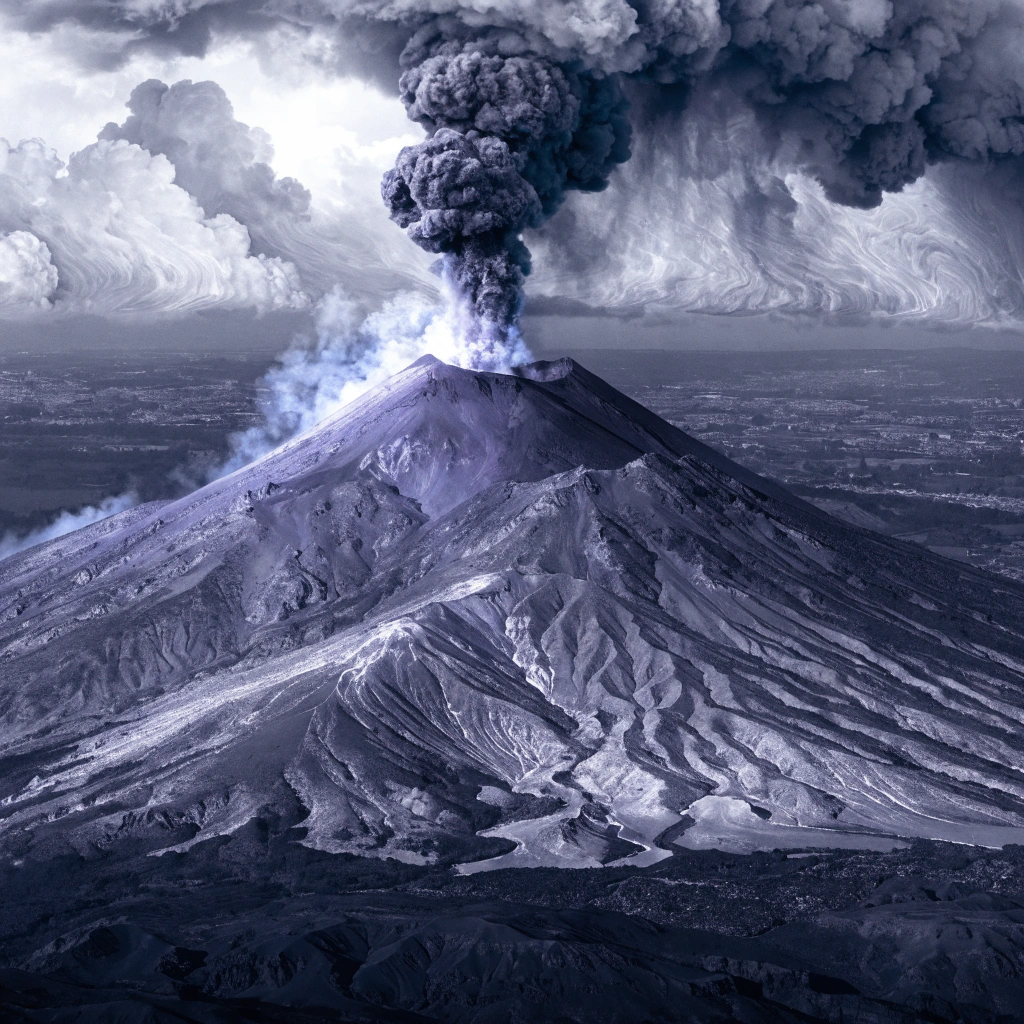
The Big Volcano in Italy
Mount Etna is a very big mountain in Italy. It is on the island of Sicily. Etna is a volcano. It is the highest active volcano in Europe. It is very beautiful and famous.
Many people visit Mount Etna every year. They walk on the mountain and see the smoke. The smoke comes from the top of the volcano. Sometimes, the volcano is hot and has red lava.
In the winter, there is white snow on the mountain. People can ski there. The weather is cold at the top but warm at the bottom. It is a special place in Italy.
Grammar Spotlight
Pattern: The Verb 'To Be'
"Mount Etna is a very big mountain in Italy."
We use 'is' with singular nouns or names like 'Mount Etna'. It is used here to describe a fact or a state.
Pattern: Present Simple for Regular Actions
"Many people visit Mount Etna every year."
We use the base form of the verb when the subject is plural like 'people'. This pattern describes things that happen often.
Test Your Understanding
10 questions · A1 Beginner · 1 free preview
Test what you learned from this article. Answer all questions to earn XP!
Where is Mount Etna?
Want to finish the quiz?
9 more questions are waiting for you. Sign up free to unlock the full quiz and earn XP!
Sign Up FreeAlready have an account? Sign In
Question Breakdown
Where is Mount Etna?
Your answer:
Correct answer: Italy
Mount Etna is the highest active volcano in Europe.
Your answer:
Correct answer: True
What does 'famous' mean?
Your answer:
Correct answer: Known by many people
The volcano is the _____ active volcano in Europe.
Your answer:
Correct answer: highest
Mount Etna: The Famous Volcano of Sicily
Mount Etna is a very famous mountain on the island of Sicily in Italy. It is the highest active volcano in Europe. It is about 3,357 meters tall, but the height changes when it erupts. Many people visit Sicily because they want to see this amazing place.
In the past, people told many stories about Etna. The ancient Greeks believed that a giant lived under the mountain. They thought the volcano erupted because the giant was angry or moving. Today, scientists study the mountain carefully. They want to understand the volcano better because it is still very active.
Visiting Mount Etna is an exciting adventure. You can hike on the mountain or take a special bus to the top. The views from the volcano are better than other places in Italy. It is more dangerous than a normal mountain, but many tourists go there every year. It is a special place for both history and nature.
Grammar Spotlight
Pattern: Comparatives
"The views from the volcano are better than other places in Italy."
We use comparatives to compare two things. For short words, we add '-er', but for 'good', the comparative form is 'better'.
Pattern: Past Simple
"In the past, people told many stories about Etna."
We use the past simple to talk about finished actions in the past. 'Told' is the irregular past form of the verb 'tell'.
Test Your Understanding
11 questions · A2 Elementary · 1 free preview
Test what you learned from this article. Answer all questions to earn XP!
Where is Mount Etna located?
Want to finish the quiz?
10 more questions are waiting for you. Sign up free to unlock the full quiz and earn XP!
Sign Up FreeAlready have an account? Sign In
Question Breakdown
Where is Mount Etna located?
Your answer:
Correct answer: On the island of Sicily
Mount Etna is the highest active volcano in Europe.
Your answer:
Correct answer: True
What does 'active' mean in this article?
Your answer:
Correct answer: A volcano that can erupt
Mount Etna is a very famous _____ in Italy.
Your answer:
Correct answer: volcano
Who did the ancient Greeks think lived under the mountain?
Your answer:
Correct answer: A giant
Mount Etna: Europe's Famous Giant
Mount Etna, which is located on the eastern coast of Sicily, is Europe's highest and most active volcano. It has reached a height of about 3,357 meters, although this altitude changes every time there is a new eruption. For thousands of years, people have lived in its shadow, even though the mountain is often dangerous. Because of its unique geological features, it has been named a UNESCO World Heritage site.
In ancient Greek mythology, Mount Etna was seen as a very special place. It was believed to be the forge of Hephaestus, the god of fire. Some stories also say that a giant named Typhon was trapped under the mountain. According to these legends, the smoke and fire are caused by his restless movements. Today, however, the volcano is studied by scientists who use modern technology to predict when it might erupt again.
Over the years, hundreds of eruptions have been documented by historians and scientists. These natural events have changed the landscape significantly, creating dark, volcanic fields. Despite the risks, the soil around the volcano is very fertile. Consequently, farmers have grown grapes, olives, and citrus fruits there for many generations. The wine from this region is famous all over the world.
The area has also become a popular destination for tourists who want to hike on the volcanic trails. While some parts of the mountain are safe to visit, the volcano is monitored 24 hours a day by experts. This monitoring is done to ensure that the local towns are protected from any sudden activity. Mount Etna is not just a natural wonder; it is a vital part of the daily life and history of the people in Sicily.
Grammar Spotlight
Pattern: Relative Clauses with 'which' or 'who'
"Mount Etna, which is located on the eastern coast of Sicily, is Europe's highest and most active volcano."
Relative clauses give more information about a noun. 'Which' is used for things or places, and 'who' is used for people.
Pattern: Present Perfect Tense
"For thousands of years, people have lived in its shadow."
The present perfect (have/has + past participle) is used for actions that started in the past and continue to the present or have an effect on now.
Test Your Understanding
11 questions · B1 Intermediate · 1 free preview
Test what you learned from this article. Answer all questions to earn XP!
Why does the height of Mount Etna change?
Want to finish the quiz?
10 more questions are waiting for you. Sign up free to unlock the full quiz and earn XP!
Sign Up FreeAlready have an account? Sign In
Question Breakdown
Why does the height of Mount Etna change?
Your answer:
Correct answer: Because of new eruptions
Mount Etna is a UNESCO World Heritage site.
Your answer:
Correct answer: True
What does 'fertile' mean?
Your answer:
Correct answer: Good for growing plants
The volcano is _____ 24 hours a day by experts.
Your answer:
Correct answer: monitored
According to Greek mythology, who was trapped under the mountain?
Your answer:
Correct answer: Typhon
Mount Etna: A Living Laboratory of Geological Evolution
Rising majestically on the eastern coast of Sicily, Mount Etna is far more than just a scenic backdrop for tourists. As Europe’s highest and most active volcano, it stands as a testament to the Earth's dynamic nature. Reaching an elevation of approximately 3,357 meters—though this figure frequently fluctuates due to summit eruptions—Etna has a documented history of activity spanning over half a million years. For the people of Sicily, the mountain is a constant presence that shapes both the physical landscape and the cultural identity of the region.
In ancient times, the volcano was shrouded in mythology. The Greeks believed it was the forge of Hephaestus, the god of fire, and the prison of the giant Typhon. Today, however, the focus has shifted from myth to rigorous scientific observation. Because of its frequent activity, Etna has become one of the most studied geological features on the planet. Researchers from around the world flock to its slopes to utilize advanced monitoring systems, seeking to understand the complex mechanisms of volcanic eruptions.
Despite the inherent risks associated with living in the shadow of such a powerful force, the local population has flourished. This is largely due to the exceptionally fertile soil produced by volcanic ash, which supports thriving vineyards and citrus groves. The relationship between the mountain and the inhabitants is a delicate balance of respect and exploitation of natural resources. While eruptions can cause significant disruption to transport and local infrastructure, they also draw thousands of tourists, contributing significantly to the regional economy.
Furthermore, Mount Etna was designated a UNESCO World Heritage site in 2013, recognizing its geological importance and cultural impact. It is widely believed that the mountain provides a unique natural laboratory for volcanologists. By studying the chemical composition of its lava and the frequency of its tremors, scientists can better predict volcanic behavior elsewhere.
In conclusion, Mount Etna remains a symbol of both destruction and creation. It continues to evolve, reminding us of the immense power beneath the Earth's crust. Whether viewed through the lens of ancient legend or modern science, Etna remains an awe-inspiring giant that continues to captivate the human imagination while providing essential insights into our planet's fiery heart.
Grammar Spotlight
Pattern: Present Participle Clauses
"Rising majestically on the eastern coast of Sicily, Mount Etna is far more than just a scenic backdrop for tourists."
The present participle (-ing) is used here to provide additional information about the subject in the main clause. It functions like a relative clause, shortening the sentence while maintaining a formal, academic tone.
Pattern: Passive Voice for Reporting
"It is widely believed that the mountain provides a unique natural laboratory for volcanologists."
This structure is used to express a general opinion or belief without attributing it to a specific person. It is commonly used in B2 level academic writing to sound objective and authoritative.
Pattern: Concession Clauses with 'Despite'
"Despite the inherent risks associated with living in the shadow of such a powerful force, the local population has flourished."
'Despite' is followed by a noun phrase to show contrast. It indicates that the second part of the sentence happened even though the first part might have prevented it.
Test Your Understanding
11 questions · B2 Upper Intermediate · 1 free preview
Test what you learned from this article. Answer all questions to earn XP!
What is unique about Mount Etna's height?
Want to finish the quiz?
10 more questions are waiting for you. Sign up free to unlock the full quiz and earn XP!
Sign Up FreeAlready have an account? Sign In
Question Breakdown
What is unique about Mount Etna's height?
Your answer:
Correct answer: It changes frequently due to volcanic eruptions.
The Greeks believed that Mount Etna was used as a prison for a giant.
Your answer:
Correct answer: True
What does the word 'inherent' mean in the context of the article?
Your answer:
Correct answer: An essential or permanent part of something
The local agriculture thrives because the volcanic ash makes the soil very _____.
Your answer:
Correct answer: fertile
Why was Mount Etna designated a UNESCO World Heritage site?
Your answer:
Correct answer: Because of its geological importance and cultural impact.
The Restless Sentinel: Decoding the Enigma of Mount Etna
Dominating the eastern skyline of Sicily, Mount Etna stands as a testament to the Earth’s volatile inner workings. Seldom has a geological entity commanded such profound reverence and scientific scrutiny simultaneously. At an elevation that fluctuates around 3,357 meters, Etna is not merely a mountain; it is a living, breathing laboratory. Its history, spanning over half a million years, is characterized by a preponderance of eruptive events that have reshaped the landscape with capricious frequency. It is this very unpredictability that necessitates the sophisticated monitoring systems currently employed by volcanologists. The mountain’s physical stature is in a state of constant flux, with its summit height being recalibrated following every significant thermal paroxysm.
Beyond the sheer physical magnitude, the mountain occupies a central position in the Mediterranean psyche. In antiquity, the smoke and fire emanating from its craters were perceived as the vestiges of divine labor. It was believed that the forge of Hephaestus resided within its depths, and the tremors were the restless movements of the giant Typhon. Such mythological frameworks provided a narrative for the cataclysmic events that the ancient world could not otherwise rationalize. Today, however, the focus has shifted from myth to the dichotomy of Etna’s impact on human settlement. The transition from superstitious dread to empirical observation marks a significant evolution in our relationship with the natural world, though the mountain still inspires a sense of the sublime.
What makes Etna particularly fascinating is the burgeoning agricultural industry that thrives in its shadow. The volcanic ash, while destructive during an eruption, bestows the soil with an unparalleled richness. This fertility has encouraged a multifaceted economy based on viticulture and citrus production. Yet, the proximity of these settlements to an active vent presents a quintessential dilemma: the acceptance of inherent risk for the sake of prosperity. The nominalization of danger has become a psychological necessity for the local populace, who view the volcano as a benevolent, albeit temperamental, provider.
Furthermore, the constant recalibration of the mountain’s height serves as a reminder of its dynamic nature. Each eruption deposits new layers of tephra, while others are eroded or collapsed. It is through the meticulous study of these strata that scientists gain insights into the Earth’s crust and the tectonic shifts occurring beneath the Mediterranean. The integration of satellite imagery and ground-based sensors has revolutionized our understanding, yet Etna remains somewhat enigmatic. The sheer volume of data collected has allowed for more accurate predictions, yet the mountain still possesses the capacity for sudden, unexpected shifts in behavior.
In conclusion, Mount Etna represents a complex interplay between geological force and human resilience. Whether viewed as a destructive titan or a provider of life-giving soil, its status as Europe’s highest active volcano remains undisputed. As we move forward, the challenge lies in balancing the burgeoning tourism industry with the imperative of safety, ensuring that this restless sentinel continues to be a source of wonder rather than tragedy. The preservation of this UNESCO World Heritage site is not merely a matter of environmental concern, but a commitment to understanding the quintessential forces that shape our planet.
Grammar Spotlight
Pattern: Inversion
"Seldom has a geological entity commanded such profound reverence and scientific scrutiny simultaneously."
Inversion is used here by placing the adverbial 'Seldom' at the beginning of the sentence followed by the auxiliary verb 'has'. This emphasizes the rarity and magnitude of the situation, a common feature in formal C1-level writing.
Pattern: Cleft Sentence
"It is this very unpredictability that necessitates the sophisticated monitoring systems currently employed by volcanologists."
A cleft sentence (It + is + subject + that/who) is used to focus on a specific part of the sentence. Here, it highlights 'unpredictability' as the primary reason for the monitoring systems.
Pattern: Nominalisation
"The constant recalibration of the mountain’s height serves as a reminder of its dynamic nature."
Nominalisation involves turning verbs or adjectives into nouns (e.g., 'recalibration' instead of 'recalibrating'). This creates a more formal, academic tone and allows for more complex ideas to be expressed concisely.
Test Your Understanding
12 questions · C1 Advanced · 1 free preview
Test what you learned from this article. Answer all questions to earn XP!
What primary factor causes the height of Mount Etna to fluctuate?
Want to finish the quiz?
11 more questions are waiting for you. Sign up free to unlock the full quiz and earn XP!
Sign Up FreeAlready have an account? Sign In
Question Breakdown
What primary factor causes the height of Mount Etna to fluctuate?
Your answer:
Correct answer: Eruptive events and the deposition of tephra
The local population generally views the volcano with pure dread and avoids living near it.
Your answer:
Correct answer: False
What does the word 'capricious' imply about Mount Etna?
Your answer:
Correct answer: It is unpredictable and changes suddenly
The volcanic ash bestows the soil with an unparalleled _____, which supports the local economy.
Your answer:
Correct answer: richness
In Greek mythology, what was believed to be located inside Mount Etna?
Your answer:
Correct answer: The forge of Hephaestus
Modern technology has made Mount Etna's behavior completely predictable to scientists.
Your answer:
Correct answer: False
The Chthonic Sovereign: A Scholarly Inquiry into the Ontological and Geological Magnitude of Mount Etna
Dominating the eastern littoral of Sicily, Mount Etna stands not merely as a terrestrial landmark but as a pulsating testament to the primordial forces that sculpted our planet. This stratovolcano, reaching an elevation of approximately 3,357 meters—though such a metric is subject to the ephemeral whims of basaltic accumulation—represents one of the most rigorously documented geological entities in the annals of vulcanology. To contemplate Etna is to engage with a dichotomy of existence: it is simultaneously a harbinger of cataclysmic destruction and a progenitor of profound fertility. Seldom has a geological feature so thoroughly permeated the cultural consciousness of a civilization, weaving itself into the very fabric of Mediterranean identity.
From a geological perspective, Etna’s provenance is rooted in the complex tectonic subduction of the African plate beneath the Eurasian plate. This subterranean friction generates the magma that eventually finds its inexorable path to the surface. However, the mountain’s significance transcends mere lithospheric movement. In the realms of antiquity, the Greeks perceived the mountain as a confluence of the divine and the monstrous. It was the forge of Hephaestus, where the thunderbolts of Zeus were tempered, and concurrently the prison of the giant Typhon. Were the mountain to unleash its full fury, the ancients believed it was but the restless shifting of a shackled titan. Such mythological frameworks provided a narrative structure for the inherent unpredictability of the volcano’s temperament.
In contemporary discourse, the relationship between the local populace and the volcano is characterized by a nuanced symbiosis. While the threat of an eruption remains an ever-present reality, the volcanic soil—enriched by minerals such as phosphorus and potassium—yields a bounty of viticulture and agriculture that is unparalleled in the region. One might posit that the inhabitants of the Sicilian slopes live in a state of 'tragic optimism,' acknowledging the inevitability of geological upheaval while simultaneously reaping the rewards of the mountain’s bounty. It is this very tension that defines the regional character: a resilience forged in the shadow of a smoke-wreathed sovereign.
Furthermore, the academic scrutiny applied to Etna has yielded invaluable insights into the mechanics of volcanic plumbing and gas emissions. Scientists utilize the mountain as a natural laboratory, where the monitoring of seismic tremors and sulfur dioxide levels provides a blueprint for global disaster mitigation. The mountain’s sovereignty over the landscape is not merely physical but intellectual, as it continues to challenge our understanding of the Earth’s internal thermodynamics. Should researchers fail to account for the minute fluctuations in Etna's behavior, they would overlook critical indicators of broader crustal shifts.
Ultimately, Mount Etna remains an enigma of the natural world. It is a site where the temporal nature of human endeavor meets the deep time of geological processes. As we move further into an era of climate uncertainty, the study of such enduring natural monuments becomes increasingly pertinent. Etna serves as a reminder that despite our technological advancements, we remain beholden to the chthonic powers that reside beneath our feet. The mountain does not merely exist; it persists, a silent witness to the rise and fall of empires, demanding a reverence that is as ancient as the basalt of which it is composed.
Grammar Spotlight
Pattern: Negative Inversion
"Seldom has a geological feature so thoroughly permeated the cultural consciousness of a civilization."
Inversion is used here for rhetorical emphasis. When a sentence begins with a negative or restrictive adverb like 'seldom', the auxiliary verb is placed before the subject.
Pattern: The Subjunctive Mood
"Were the mountain to unleash its full fury, the ancients believed it was but the restless shifting of a shackled titan."
This is an inverted conditional using the subjunctive 'were'. It expresses a hypothetical or counterfactual situation in a highly formal, academic style.
Pattern: Academic Hedging with Modals
"One might posit that the inhabitants of the Sicilian slopes live in a state of 'tragic optimism'."
The use of 'might posit' is a common academic hedging device. It softens the claim, acknowledging that the statement is an interpretation rather than an absolute fact.
Test Your Understanding
12 questions · C2 Mastery · 1 free preview
Test what you learned from this article. Answer all questions to earn XP!
According to the text, why is the height of Mount Etna described as subject to 'ephemeral whims'?
Want to finish the quiz?
11 more questions are waiting for you. Sign up free to unlock the full quiz and earn XP!
Sign Up FreeAlready have an account? Sign In
Question Breakdown
According to the text, why is the height of Mount Etna described as subject to 'ephemeral whims'?
Your answer:
Correct answer: Because the accumulation of basaltic material changes with eruptions.
The text suggests that the relationship between Sicilians and the volcano is purely one of fear and avoidance.
Your answer:
Correct answer: False
What does the word 'inexorable' imply in the context of the magma's path?
Your answer:
Correct answer: That the movement is inevitable and cannot be stopped.
What is the 'dichotomy of existence' mentioned in the first paragraph?
Your answer:
Correct answer: Its role as both a destructive force and a source of fertility.
The text posits that Mount Etna serves as a natural laboratory for global disaster mitigation.
Your answer:
Correct answer: True
The author uses the term _____ to describe the forces residing beneath our feet that we remain beholden to.
Your answer:
Correct answer: chthonic
