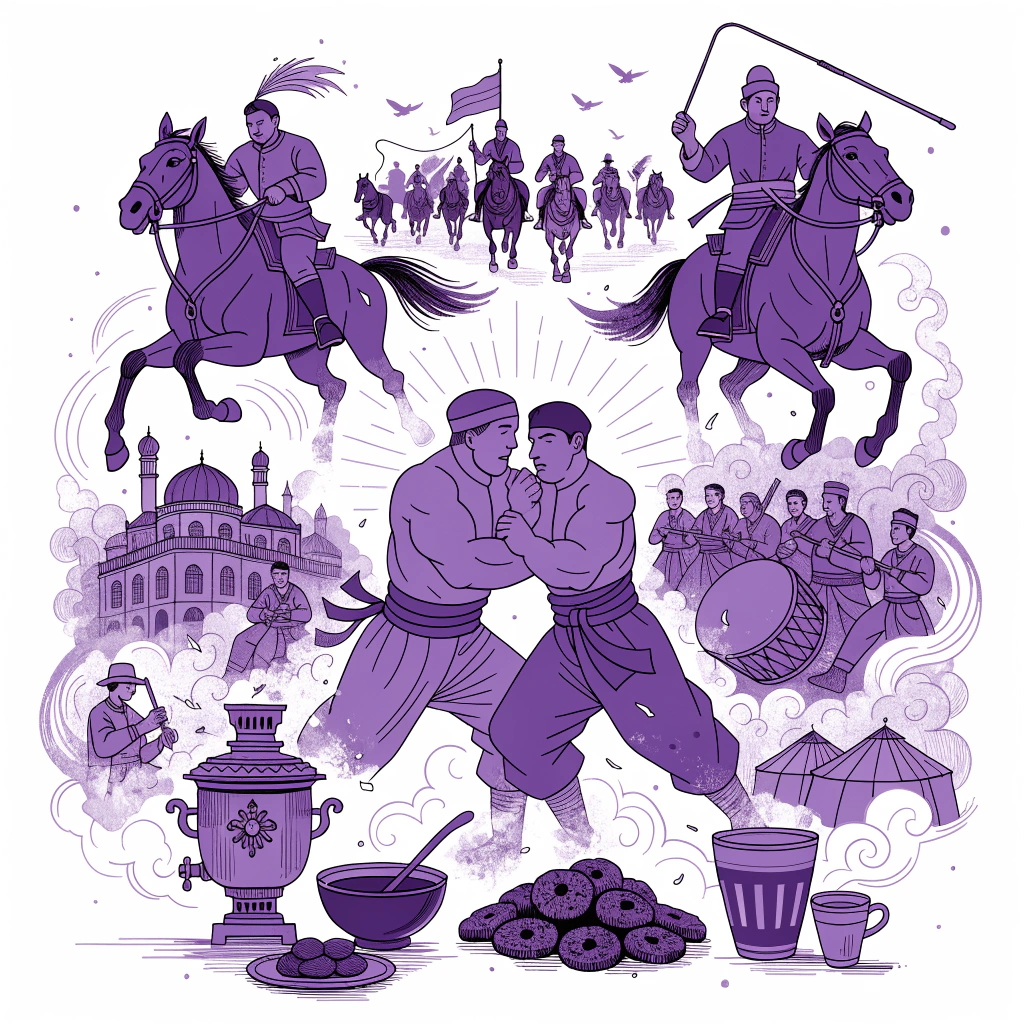
Sabantuy: A Big Festival in Russia
Sabantuy is a very big festival in Russia. It is also called the 'Festival of the Plow'. Tatar and Bashkir people celebrate it every year. It is a very old tradition.
The festival is in the spring. People go to a large park or a green field. They wear beautiful clothes. Families eat traditional food and drink hot tea together.
There are many fun games at the festival. Men wrestle on the grass. Children run fast races. People sing songs and dance. It is a very happy day for everyone in the community.
Grammar Spotlight
Pattern: Present Simple (Plural)
"People wear beautiful clothes."
We use the present simple for facts and habits. With plural subjects like 'people', we use the base form of the verb.
Pattern: There are
"There are many fun games at the festival."
We use 'there are' to show that something exists. We use it when the noun that follows is plural.
Test Your Understanding
10 questions · A1 Beginner · 1 free preview
Test what you learned from this article. Answer all questions to earn XP!
Where is the Sabantuy festival?
Want to finish the quiz?
9 more questions are waiting for you. Sign up free to unlock the full quiz and earn XP!
Sign Up FreeAlready have an account? Sign In
Question Breakdown
Where is the Sabantuy festival?
Your answer:
Correct answer: In Russia
The festival is in the winter.
Your answer:
Correct answer: False
What does 'field' mean?
Your answer:
Correct answer: A large area of grass
Families eat traditional _____ and drink tea.
Your answer:
Correct answer: food
Sabantuy: The Festival of the Plow
Sabantuy is a very important festival for the Tatar and Bashkir people in Russia. Its name means 'Festival of the Plow.' In the past, people celebrated it because they wanted the earth to be healthy before they planted seeds. Today, it is a big celebration of culture and sports.
The festival usually happens in June. People travel to beautiful fields outside the villages. There are many fun competitions. The most famous sport is a special type of wrestling called Kuresh. The winner often gets a big prize, like a sheep! There are also horse races and climbing games.
Families eat traditional food and listen to folk music. Children play games and adults talk with old friends. Sabantuy is now bigger and more exciting than it was many years ago. It happens in small villages and also in big cities like Kazan. Everyone is welcome to join the party.
Grammar Spotlight
Pattern: Past Simple
"In the past, people celebrated it because they wanted the earth to be healthy."
We use the past simple to talk about things that happened and finished in the past. For regular verbs, we usually add '-ed' to the end.
Pattern: Comparatives
"Sabantuy is now bigger and more exciting than it was many years ago."
We use comparatives to compare two things. For short adjectives, we add '-er' (bigger), and for long adjectives, we use 'more' (more exciting).
Test Your Understanding
11 questions · A2 Elementary · 1 free preview
Test what you learned from this article. Answer all questions to earn XP!
What does the name 'Sabantuy' mean?
Want to finish the quiz?
10 more questions are waiting for you. Sign up free to unlock the full quiz and earn XP!
Sign Up FreeAlready have an account? Sign In
Question Breakdown
What does the name 'Sabantuy' mean?
Your answer:
Correct answer: Festival of the Plow
Sabantuy only happens in small villages.
Your answer:
Correct answer: False
What is a 'prize'?
Your answer:
Correct answer: Something you win
The winner of the wrestling often gets a _____, like a sheep.
Your answer:
Correct answer: prize
When does the festival usually happen?
Your answer:
Correct answer: June
Sabantuy: The Ancient Festival of the Plow
Sabantuy, which is often called the 'Festival of the Plow', is the most important cultural event for the Tatar and Bashkir people in Russia. For centuries, this ancient celebration has marked the end of spring sowing. Although it started as a ritual to please the spirits of the earth, it has evolved into a massive festival of sports, music, and community spirit.
The festival is celebrated in both small rural villages and large cities like Kazan. During the event, many traditional competitions are organized. The most famous sport is 'Kuresh', a type of wrestling where opponents use towels to throw each other to the ground. Winners are often rewarded with valuable prizes, such as a sheep or even a car in modern times. Horse racing is another popular activity that has been part of the tradition for a long time.
In addition to sports, people enjoy folk music and traditional food. Families gather to eat 'chak-chak', a sweet honey dessert that is loved by everyone. Children participate in fun games, such as racing while carrying an egg on a spoon or climbing a tall wooden pole to reach a prize at the top.
Sabantuy is not just a holiday; it is a symbol of ethnic identity. It is a time when people who have moved away return to their home villages to meet their relatives. Today, the festival is recognized as a significant part of Russia's cultural heritage. It shows how ancient traditions can survive and bring people together in the modern world.
Grammar Spotlight
Pattern: Present Perfect
"For centuries, this ancient celebration has marked the end of spring sowing."
The present perfect (have/has + past participle) is used here to describe an action that started in the past and continues to have relevance or repeat up to the present.
Pattern: Passive Voice
"The festival is celebrated in both small rural villages and large cities like Kazan."
The passive voice (be + past participle) is used when the focus is on the event (the festival) rather than who is performing the action.
Test Your Understanding
11 questions · B1 Intermediate · 1 free preview
Test what you learned from this article. Answer all questions to earn XP!
What is the main modern focus of Sabantuy?
Want to finish the quiz?
10 more questions are waiting for you. Sign up free to unlock the full quiz and earn XP!
Sign Up FreeAlready have an account? Sign In
Question Breakdown
What is the main modern focus of Sabantuy?
Your answer:
Correct answer: Sports, music, and community
Sabantuy is celebrated only in rural areas and not in big cities.
Your answer:
Correct answer: False
What does the word 'ancient' mean?
Your answer:
Correct answer: Very old
The most famous sport at the festival is _____, which uses towels.
Your answer:
Correct answer: Kuresh
What is 'chak-chak'?
Your answer:
Correct answer: A sweet honey dessert
Sabantuy: A Tapestry of Tradition and Unity in Modern Russia
Sabantuy, commonly referred to as the 'Festival of the Plow,' stands as a monumental cultural cornerstone for the Tatar and Bashkir peoples, the two largest Turkic ethnic groups in Russia. This vibrant celebration, which takes place annually following the completion of spring sowing, is far more than a mere agricultural event; it is a profound expression of ethnic identity, communal resilience, and historical continuity. Having originated as a pagan ritual to appease the spirits of the earth, Sabantuy has undergone a remarkable transformation over the centuries. Historically, the festival was intended to ensure a bountiful harvest and prosperity for the village. However, over the years, the religious undertones have gradually receded, allowing Sabantuy to evolve into a secular folk festival that unites people across different backgrounds. Despite these changes, the core values of honoring the land and fostering social harmony remain remarkably intact.
Central to the festivities are the traditional sporting competitions, which draw massive crowds and showcase the physical prowess of the participants. The most prestigious event is undoubtedly 'Kuresh,' a form of belt wrestling where competitors attempt to throw their opponents over their backs using only their sashes. Winning the title of 'Batyr' (hero) is considered a supreme honor, and the champion is traditionally awarded a live ram, symbolizing strength and vitality. Other activities, such as horse racing and humorous contests like sack racing, further contribute to the festive atmosphere. Beyond the athletic displays, Sabantuy serves as a vital platform for the preservation of culinary and musical heritage. Visitors are often treated to a spectacular array of traditional dishes, most notably 'Chak-chak,' a honey-drenched pastry that epitomizes Tatar hospitality. Folk music and dance performances also play a crucial role, with performers dressed in intricate traditional costumes that reflect the artistic legacy of the region.
In the contemporary era, Sabantuy has transcended its rural beginnings to become a major urban phenomenon. From the bustling streets of Kazan to the parks of Moscow, the festival provides an opportunity for urban dwellers to reconnect with their ancestral roots. Should one visit a major city during the festivities, the scale of the event is truly impressive. By balancing tradition with modernity, Sabantuy ensures that the rich cultural fabric of the Turkic peoples continues to thrive in an increasingly globalized world. It is widely acknowledged that such festivals are essential for maintaining a sense of belonging and cultural pride.
Grammar Spotlight
Pattern: Perfect Participle Clause
"Having originated as a pagan ritual to appease the spirits of the earth, Sabantuy has undergone a remarkable transformation over the centuries."
This structure is used to show that one action happened before another. It consists of 'Having' + past participle, and it helps to provide background information in a concise, formal way.
Pattern: Passive Reporting Verbs
"It is widely acknowledged that such festivals are essential for maintaining a sense of belonging and cultural pride."
This formal structure is used to report general opinions or facts without mentioning the specific people who hold them. It uses 'It is' + past participle of a reporting verb (like acknowledge, believe, or say) + that-clause.
Pattern: Inverted First Conditional
"Should one visit a major city during the festivities, the scale of the event is truly impressive."
In formal English, 'should' can replace 'if' in a first conditional sentence. When this happens, the subject and 'should' are inverted, making the tone more academic or literary.
Test Your Understanding
11 questions · B2 Upper Intermediate · 1 free preview
Test what you learned from this article. Answer all questions to earn XP!
What was the original pagan purpose of Sabantuy?
Want to finish the quiz?
10 more questions are waiting for you. Sign up free to unlock the full quiz and earn XP!
Sign Up FreeAlready have an account? Sign In
Question Breakdown
What was the original pagan purpose of Sabantuy?
Your answer:
Correct answer: To satisfy earth spirits for a good harvest
The religious aspects of Sabantuy have become more important in modern times.
Your answer:
Correct answer: False
What does the word 'prestigious' mean in the context of the article?
Your answer:
Correct answer: Highly respected and admired
The winner of the Kuresh wrestling competition is traditionally given a _____.
Your answer:
Correct answer: ram
What does the honey-drenched pastry 'Chak-chak' represent?
Your answer:
Correct answer: Tatar hospitality
Sabantuy: The Cultural Synthesis of the Plow and the Modern Tatar Identity
Seldom has a tradition navigated the tumultuous waters of history with such grace as Sabantuy, the 'Festival of the Plow.' Deeply rooted in the ancient agrarian cycles of the Tatar and Bashkir peoples, this celebration serves as a profound testament to cultural resilience and the syncretism of pagan origins with modern ethnic identity. While its etymological roots trace back to the Turkic words for 'plow' and 'wedding' or 'celebration,' the festival’s contemporary manifestation is a multifaceted spectacle that transcends mere seasonal marking. It is through the meticulous orchestration of these festivities that the community reaffirms its collective heritage in a rapidly globalizing world.
Historically, Sabantuy was a pagan rite intended to appease the spirits of the earth before the spring sowing. It was believed that through specific rituals, the fertility of the land could be secured. However, as the centuries unfolded, the festival underwent a significant transformation. What was once a localized, spiritual necessity evolved into a national holiday, celebrated with equal fervor in rural hamlets and burgeoning metropolises like Kazan. The transformation of a pagan rite into a secular symbol of national unity highlights the adaptability of Turkic culture within the broader Russian landscape. Rarely do we witness such a seamless integration of ancient vestiges into a modern socio-political framework.
At the heart of Sabantuy lies the demonstration of physical prowess and communal spirit. The most venerated event is undoubtedly 'Koresh,' a traditional form of belt wrestling. It is the victory in this arena that grants the winner the title of 'batyr' (hero), a status that carries immense social prestige. Beyond wrestling, the festival features horse racing, sack races, and the climbing of greased poles—activities that might appear whimsical to the casual observer but are steeped in historical significance. These games are not merely for entertainment; they are a quintessential expression of the competitive yet cohesive nature of the community.
Critically speaking, the survival of Sabantuy is not merely a matter of nostalgia. In an era where minority languages and traditions often face the threat of dilution, Sabantuy acts as a bulwark against cultural erosion. The burgeoning interest in the festival among the youth suggests that it has successfully pivoted from being a relic of the past to a vibrant component of modern life. Furthermore, the festival provides a unique space for inter-ethnic dialogue, as people of various backgrounds participate in the jubilation. Ultimately, Sabantuy remains a powerful narrative of how a people can honor their ancestral spirits while firmly planting their feet in the twenty-first century.
Grammar Spotlight
Pattern: Negative Inversion
"Seldom has a tradition navigated the tumultuous waters of history with such grace as Sabantuy..."
When we start a sentence with a negative or restrictive adverb like 'seldom', the auxiliary verb comes before the subject. This is used in formal writing to add emphasis or a dramatic tone.
Pattern: It-Cleft Sentence
"It is through the lens of athletic prowess that the community reaffirms its collective heritage..."
Cleft sentences use 'It is/was' to focus on a specific part of the sentence (the 'focus'). This structure highlights the importance of the 'lens of athletic prowess' over other factors.
Pattern: Nominalisation
"The transformation of a pagan rite into a secular symbol of national unity highlights the adaptability of Turkic culture."
Using a noun phrase (The transformation...) instead of a verb (The rite transformed...) makes the writing more academic and dense, focusing on the concept rather than the action.
Test Your Understanding
12 questions · C1 Advanced · 1 free preview
Test what you learned from this article. Answer all questions to earn XP!
What was the original primary objective of Sabantuy in ancient times?
Want to finish the quiz?
11 more questions are waiting for you. Sign up free to unlock the full quiz and earn XP!
Sign Up FreeAlready have an account? Sign In
Question Breakdown
What was the original primary objective of Sabantuy in ancient times?
Your answer:
Correct answer: To appease spirits for a successful harvest
Sabantuy is exclusively celebrated in small rural villages.
Your answer:
Correct answer: False
Which word is synonymous with 'the perfect example' of something?
Your answer:
Correct answer: Quintessential
The wrestling event known as 'Koresh' is the most _____ part of the festival.
Your answer:
Correct answer: venerated
According to the article, why is the festival significant for the youth?
Your answer:
Correct answer: It has evolved into a vibrant part of modern identity rather than just a relic.
The term 'batyr' refers to the winner of the wrestling competition.
Your answer:
Correct answer: True
The Vernal Synthesis: Sabantuy and the Dialectics of Tatar Identity
Were one to scrutinize the vestigial remnants of the pre-Islamic era within the Russian Federation, the pagan underpinnings of Sabantuy would become incontrovertibly apparent. Known colloquially as the 'Festival of the Plow,' Sabantuy represents a profound syncretism of ancient agrarian ritual and contemporary ethnic assertion. Originally conceived as a means to propitiate the spirits of the earth before the spring sowing, the festival has transcended its archaic origins to become the quintessence of Tatar and Bashkir cultural hegemony. It is arguably the most significant folk celebration for these Turkic peoples, serving as a temporal bridge between a nomadic past and a sophisticated, multi-ethnic present.
At the heart of Sabantuy lies the koresh, a traditional form of belt-wrestling that demands not only physical prowess but also a stoic adherence to ancestral codes of honor. The spectacle of the koresh is not merely an athletic contest; it is a symbolic reaffirmation of communal strength. Winners are often awarded a ram, a prize that harks back to the pastoralist foundations of the Volga-Ural region. Furthermore, horse racing—a hallmark of Turkic heritage—underscores the historical reliance on equestrian mastery. These activities are not performed in isolation but are woven into a tapestry of song, dance, and culinary indulgence, creating an atmosphere that is simultaneously egalitarian and fiercely competitive.
Notwithstanding its rural roots, Sabantuy has undergone a remarkable metamorphosis in the urban landscape. In cities such as Kazan, the festival is orchestrated with a level of grandiosity that rivals national holidays. It is imperative that the communal spirit be maintained, lest the festival devolve into a mere commercial enterprise. Critics might suggest that the institutionalization of Sabantuy risks diluting its raw, visceral energy; however, the sheer scale of participation suggests otherwise. Families traverse vast distances to reunite, ensuring that the ephemeral nature of the celebration is countered by the enduring bonds of kinship. This migration pattern highlights the festival's role as a centrifuge of identity, drawing the diaspora back to their cultural locus.
From an analytical perspective, Sabantuy functions as a vital mechanism for cultural preservation in an increasingly globalized world. It is a space where the Tatar language is not merely spoken but celebrated through poetry and song. The festival provides a rare opportunity for the manifestation of ethnic pride within a broader federal framework, illustrating a delicate balance between regional autonomy and national integration. Seldom has a cultural phenomenon so effectively bridged the chasm between archaic agrarian ritual and contemporary ethnic assertion. It is through these rhythmic cycles of sowing and celebration that the Turkic peoples of Russia continue to negotiate their place in history, ensuring that the plow remains a symbol of both labor and liberation.
Grammar Spotlight
Pattern: Inversion for Emphasis
"Seldom has a cultural phenomenon so effectively bridged the chasm between archaic agrarian ritual and contemporary ethnic assertion."
Inversion occurs when the auxiliary verb comes before the subject, often used after negative or restrictive adverbs like 'seldom' to add rhetorical weight or formality.
Pattern: Subjunctive Mood in Conditionals
"Were one to scrutinize the vestigial remnants of the pre-Islamic era, the pagan underpinnings of Sabantuy would become incontrovertibly apparent."
This 'were' subjunctive is used in formal English to express a hypothetical or unlikely condition in the present or future, replacing 'If one were to...'
Pattern: Subjunctive with 'Lest'
"It is imperative that the communal spirit be maintained, lest the festival devolve into a mere commercial enterprise."
The word 'lest' is followed by the base form of the verb (subjunctive) to indicate a negative purpose or to express fear that something might happen.
Test Your Understanding
12 questions · C2 Mastery · 1 free preview
Test what you learned from this article. Answer all questions to earn XP!
According to the text, what was the primary original purpose of Sabantuy?
Want to finish the quiz?
11 more questions are waiting for you. Sign up free to unlock the full quiz and earn XP!
Sign Up FreeAlready have an account? Sign In
Question Breakdown
According to the text, what was the primary original purpose of Sabantuy?
Your answer:
Correct answer: To appease spirits before the spring planting
The author suggests that the urban version of Sabantuy has lost its popularity due to commercialization.
Your answer:
Correct answer: False
Which word describes a state where different cultures or beliefs are blended together?
Your answer:
Correct answer: Syncretism
The winning prize of a ram in the koresh competition is a tradition that _____ back to the region's pastoralist history.
Your answer:
Correct answer: harks
What is the 'koresh' mentioned in the second paragraph?
Your answer:
Correct answer: A form of wrestling involving belts
The text claims that Sabantuy helps maintain the Tatar language through artistic expression.
Your answer:
Correct answer: True
