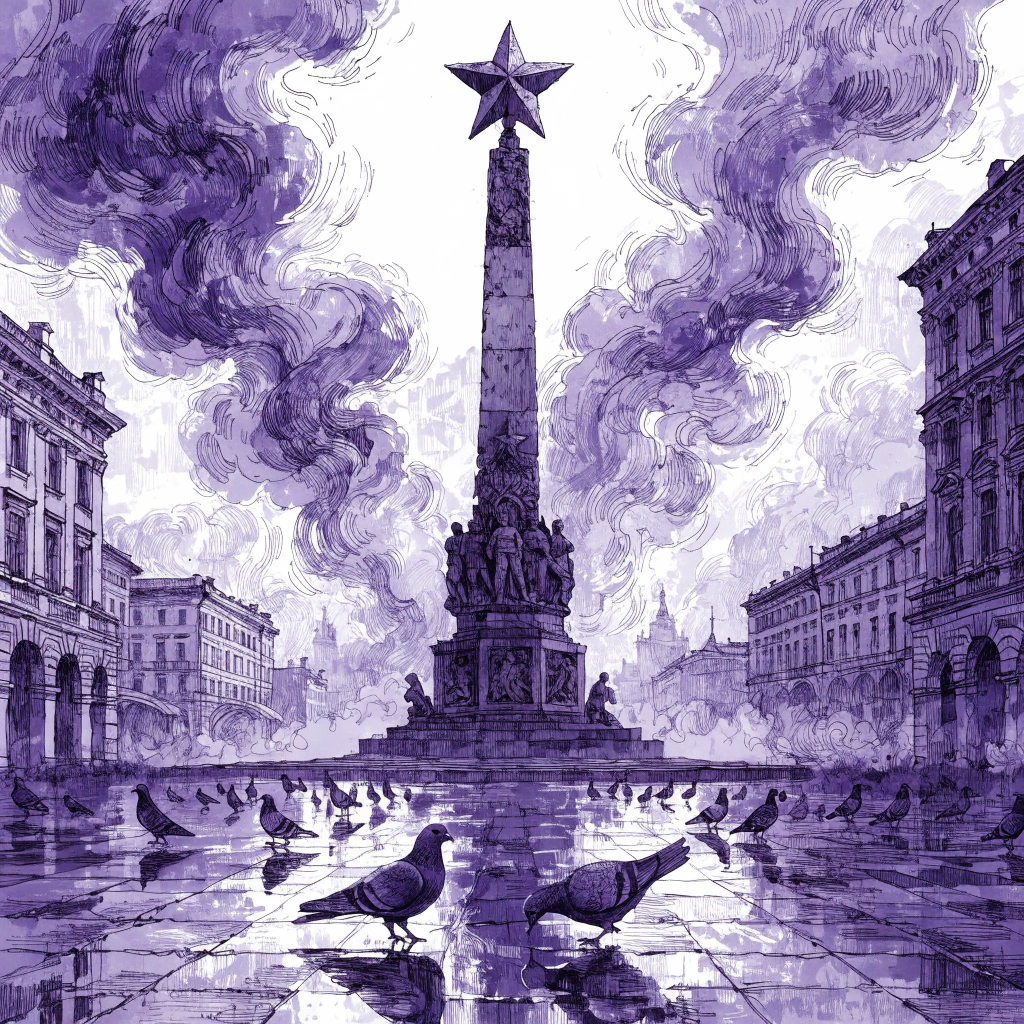
Victory Day in Russia
May 9th is a very important day in Russia. It is Victory Day. People remember the end of the Great Patriotic War in 1945. It is a big holiday for every family.
In the morning, there is a big parade in Moscow. Soldiers march and tanks move through the streets. People watch the parade on television or outside. They wear orange and black ribbons.
Many people carry photos of their grandfathers. This is called the Immortal Regiment. People say 'thank you' to veterans. In the evening, there are beautiful fireworks in the sky. It is a day of memory and peace.
Grammar Spotlight
Pattern: Present Simple 'To Be'
"May 9th is a very important day in Russia."
We use 'is' for singular subjects like dates and holidays. It describes a fact or a permanent state.
Pattern: Present Simple Plural
"Soldiers march and tanks move through the streets."
For plural subjects like 'soldiers' and 'tanks', we use the base form of the verb without an 's'.
Test Your Understanding
10 questions · A1 Beginner · 1 free preview
Test what you learned from this article. Answer all questions to earn XP!
When is Victory Day in Russia?
Want to finish the quiz?
9 more questions are waiting for you. Sign up free to unlock the full quiz and earn XP!
Sign Up FreeAlready have an account? Sign In
Question Breakdown
When is Victory Day in Russia?
Your answer:
Correct answer: May 9th
There is a big parade in Moscow in the morning.
Your answer:
Correct answer: True
What does 'peace' mean?
Your answer:
Correct answer: A time with no war
In the evening, there are beautiful _____ in the sky.
Your answer:
Correct answer: fireworks
Victory Day: A Special Holiday in Russia
Victory Day is the most important holiday in Russia. Every year on May 9th, people celebrate the end of a big war from 1945. For many Russians, this is a very special day because almost every family lost a relative in the past.
In the morning, there is a famous parade in Moscow’s Red Square. Thousands of soldiers march, and people watch big tanks and planes. It is louder and bigger than other parades. Many people also walk in the streets with photos of their family members. They want to remember the brave men and women who fought many years ago.
The atmosphere is both happy and sad. People wear orange and black ribbons on their clothes. They give flowers, like red carnations, to older people and veterans. In the evening, the sky becomes bright with colorful fireworks. Families sit together and share stories about their history. It is a day to remember peace and feel proud of their country.
Grammar Spotlight
Pattern: Past Simple
"Every family lost a relative in the past."
We use the past simple to talk about finished actions in the past. For the irregular verb 'lose', the past form is 'lost'.
Pattern: Comparatives
"It is louder and bigger than other parades."
To compare two things, we add '-er' to short adjectives followed by 'than'. If the adjective ends in a consonant-vowel-consonant, we double the last letter, like 'bigger'.
Test Your Understanding
11 questions · A2 Elementary · 1 free preview
Test what you learned from this article. Answer all questions to earn XP!
When do Russians celebrate Victory Day?
Want to finish the quiz?
10 more questions are waiting for you. Sign up free to unlock the full quiz and earn XP!
Sign Up FreeAlready have an account? Sign In
Question Breakdown
When do Russians celebrate Victory Day?
Your answer:
Correct answer: May 9th
There is a famous parade in Moscow's Red Square.
Your answer:
Correct answer: True
What does 'brave' mean?
Your answer:
Correct answer: Not afraid of danger
The sky becomes _____ with colorful fireworks.
Your answer:
Correct answer: bright
Why is this day sad for some people?
Your answer:
Correct answer: Because many families lost relatives in the war
A Day of Remembrance and Pride: Victory Day in Russia
Victory Day, which is celebrated on May 9th, is the most important secular holiday in Russia. This date marks the end of the Great Patriotic War, a conflict that has changed the lives of millions. For many Russians, this is not just a historical event but a deeply personal day. Almost every family has lost a relative during the war, and these sacrifices are never forgotten. In the Soviet Union, there were an estimated 27 million casualties, which is why the atmosphere is often somber.
The celebrations start with a huge military parade in Moscow’s Red Square. Modern tanks and soldiers are seen by the whole country on television. However, the most touching part of the day is the 'Immortal Regiment' march. During this event, thousands of people walk through the streets carrying portraits of their ancestors who fought or died. It is a powerful way to commemorate those who served.
Veterans are also a central part of the holiday. They are given flowers and thanked by strangers in the streets. People often wear the Ribbon of Saint George, which is a symbol of military honor. While the morning is filled with loud music and parades, the evening is usually quieter. Families gather together to share stories and remember their loved ones.
In conclusion, Victory Day is a complex blend of mourning and pride. It is a day when the past is brought into the present. By remembering the horrors of the past, Russians hope to value the peace they have today. It remains a tradition that unites different generations across the country.
Grammar Spotlight
Pattern: Passive Voice
"Modern tanks and soldiers are seen by the whole country on television."
The passive voice is used when the action is more important than the person doing it. It is formed using 'be' + the past participle.
Pattern: Relative Clauses
"Victory Day, which is celebrated on May 9th, is the most important secular holiday in Russia."
Relative clauses give more information about a noun. We use 'which' for things and 'who' for people.
Test Your Understanding
11 questions · B1 Intermediate · 1 free preview
Test what you learned from this article. Answer all questions to earn XP!
Why is Victory Day considered a personal holiday for many Russians?
Want to finish the quiz?
10 more questions are waiting for you. Sign up free to unlock the full quiz and earn XP!
Sign Up FreeAlready have an account? Sign In
Question Breakdown
Why is Victory Day considered a personal holiday for many Russians?
Your answer:
Correct answer: Because almost every family lost a relative in the war.
The 'Immortal Regiment' involves people carrying pictures of their ancestors.
Your answer:
Correct answer: True
What does 'somber' mean in the context of the article?
Your answer:
Correct answer: Serious and sad.
The atmosphere is often _____ because of the millions of casualties.
Your answer:
Correct answer: somber
What do strangers often give to veterans on the street?
Your answer:
Correct answer: Flowers
Victory Day: A Tapestry of Triumph and Remembrance in Modern Russia
Every year on May 9th, Russia pauses to commemorate Victory Day, a date that marks the formal signing of the German Instrument of Surrender in 1945. Known domestically as the Great Patriotic War, the conflict has left an indelible mark on the nation's psyche. While the day is celebrated with grand military parades, it is fundamentally a period of profound reflection on the resilience of the human spirit and the immense costs of war.
The sheer scale of the conflict is difficult to comprehend. It is estimated that approximately 27 million Soviet citizens became a casualty of the war, a statistic that translates into a personal tragedy for nearly every Russian family. Consequently, the holiday serves as a vital bridge between generations. Grandparents share stories of hardship and bravery, ensuring that the sacrifices made by their ancestors are never forgotten. This oral history is vital for maintaining the collective memory of the nation, especially as the number of living veterans continues to dwindle.
In Moscow, the festivities are characterized by a massive display of military hardware in Red Square. However, the most moving aspect of the day is often the 'Immortal Regiment' march. During this event, millions of people walk through the streets holding portraits of relatives who fought or died. This act of collective memory transforms a state-sanctioned event into a deeply personal tribute. The atmosphere is notably solemn, yet it remains a source of national pride.
Despite the passage of time, the importance of Victory Day has not diminished. On the contrary, it has become a cornerstone of national identity. The government utilizes the occasion to emphasize national unity and strength. Furthermore, the day is marked by a unique emotional atmosphere where veterans are treated with the utmost respect, often receiving flowers from strangers. The contrast between the loud roar of tanks and the quiet, tearful moments at memorials illustrates the multifaceted nature of the occasion.
In conclusion, Victory Day is a complex phenomenon. It is a day where the somber atmosphere of mourning meets the jubilant spirit of triumph. Russia not only honors its past but also seeks to define its legacy through the lens of historical perseverance. By remembering the fallen, the nation reinforces its cultural narrative of survival and strength.
Grammar Spotlight
Pattern: Passive Voice
"the festivities are characterized by a massive display of military hardware"
The passive voice is used here to focus on the celebrations themselves rather than the people organizing them. It is formed using the verb 'to be' plus the past participle.
Pattern: Present Perfect Simple
"the conflict has left an indelible mark on the nation's psyche"
This tense is used to describe a past action that has a strong result or relevance in the present. It emphasizes the ongoing impact of the war.
Pattern: Correlative Conjunctions
"Russia not only honors its past but also seeks to define its legacy"
The 'not only... but also' structure is used to join two related ideas, giving extra emphasis to the second point. It is common in formal B2 level writing.
Test Your Understanding
11 questions · B2 Upper Intermediate · 1 free preview
Test what you learned from this article. Answer all questions to earn XP!
What is the primary historical event celebrated on Victory Day?
Want to finish the quiz?
10 more questions are waiting for you. Sign up free to unlock the full quiz and earn XP!
Sign Up FreeAlready have an account? Sign In
Question Breakdown
What is the primary historical event celebrated on Victory Day?
Your answer:
Correct answer: The surrender of Nazi Germany in 1945
Victory Day is considered a purely political event with no personal connection for Russian families.
Your answer:
Correct answer: False
Which word describes the capacity to recover quickly from extreme hardship?
Your answer:
Correct answer: Resilience
The 'Immortal Regiment' march is described as an act of _____ memory.
Your answer:
Correct answer: collective
What does the term 'Great Patriotic War' specifically refer to in Russia?
Your answer:
Correct answer: The Eastern Front of World War II
Echoes of the Great Victory: The Socio-Political Tapestry of May 9th
Seldom has a national holiday resonated with such profound emotional intensity as Victory Day does in Russia. Commemorated annually on May 9th, the date marks the formal signing of the German Instrument of Surrender in 1945, an event that effectively terminated the Great Patriotic War. For the Russian populace, this is not merely a historical milestone but a deeply ingrained facet of national identity, rooted in the visceral reality of loss. With an estimated 27 million Soviet casualties, the conflict left no family untouched, transforming the day into a complex synthesis of exuberant celebration and somber mourning.
The magnitude of the sacrifice is central to the day’s significance. The Soviet contribution to the defeat of Nazi Germany remains a cornerstone of Russian historical consciousness. What defines the modern observance, however, is the state’s sophisticated instrumentalization of this history to foster national cohesion. The Red Square parade, characterized by its display of military grandeur and technological prowess, serves as a potent symbol of renewed sovereignty and geopolitical influence. Yet, beneath the veneer of state-sponsored spectacle lies a more intimate dimension of remembrance.
It is the juxtaposition of the personal and the political that grants the holiday its unique character. This is perhaps most visible in the 'Immortal Regiment' march, where millions of citizens carry portraits of relatives who fought or perished. This grassroots movement, which began as a spontaneous act of commemoration, has since been integrated into the official program, illustrating the delicate balance between private grief and public patriotism. The sheer scale of these processions underscores the enduring relevance of the war’s legacy in the contemporary Russian psyche.
Critical analysis of Victory Day often focuses on how historical narratives are curated to suit modern agendas. The resurgence of traditionalist rhetoric and the emphasis on historical continuity are designed to project a sense of stability and strength. Critics argue that the relentless focus on the 1945 triumph may sometimes overshadow the more nuanced, and often tragic, complexities of the Soviet era. Nevertheless, for the average citizen, the day remains a non-negotiable pillar of their heritage.
Furthermore, the solemnity of the occasion is underscored by a minute of silence, a poignant pause that cuts through the festive atmosphere. This moment of reflection acknowledges the unprecedented devastation wrought by the conflict. While the geopolitical landscape has shifted dramatically since the mid-twentieth century, the collective memory of the 'Great Victory' persists as a unifying force. It is a day where the echoes of the past are purposefully amplified to resonate with the challenges of the present.
In conclusion, Victory Day is far more than a simple anniversary. It is a multifaceted phenomenon where historical fact, personal memory, and state ideology converge. As the generation that witnessed the horrors of the war fades, the responsibility of preservation falls to their descendants. Whether through the thunderous roar of tanks or the silent tears of a grandchild holding a photograph, the legacy of May 9th continues to shape the trajectory of a nation still grappling with the shadows of its monumental past.
Grammar Spotlight
Pattern: Negative Inversion
"Seldom has a national holiday resonated with such profound emotional intensity as Victory Day does in Russia."
When starting a sentence with a negative or restrictive adverb like 'seldom', the auxiliary verb comes before the subject. This structure is used for emphasis and is typical of formal, advanced writing.
Pattern: Cleft Sentences
"It is the juxtaposition of the personal and the political that grants the holiday its unique character."
Cleft sentences use the structure 'It + is/was + [emphasized part] + that/who' to focus the reader's attention on a specific element of the sentence.
Pattern: Nominalization
"The magnitude of the sacrifice is central to the day’s significance."
Nominalization involves turning verbs or adjectives into nouns (e.g., 'instrumentalization' from 'instrumentalize'). This makes the writing more abstract, dense, and formal, which is expected at the C1 level.
Test Your Understanding
12 questions · C1 Advanced · 1 free preview
Test what you learned from this article. Answer all questions to earn XP!
According to the article, what defines the modern observance of Victory Day beyond historical remembrance?
Want to finish the quiz?
11 more questions are waiting for you. Sign up free to unlock the full quiz and earn XP!
Sign Up FreeAlready have an account? Sign In
Question Breakdown
According to the article, what defines the modern observance of Victory Day beyond historical remembrance?
Your answer:
Correct answer: The state's strategic use of history to encourage national unity
The 'Immortal Regiment' was originally a state-mandated event before becoming a grassroots movement.
Your answer:
Correct answer: False
What does the word 'instrumentalization' refer to in the context of the text?
Your answer:
Correct answer: The use of historical narrative as a tool for political or social ends
The conflict left no family untouched, transforming the day into a complex _____ of exuberant celebration and somber mourning.
Your answer:
Correct answer: synthesis
What is the primary function of the Red Square parade as described in the text?
Your answer:
Correct answer: To symbolize sovereignty and geopolitical influence
The article suggests that critics believe the focus on 1945 might hide more complex and tragic aspects of Soviet history.
Your answer:
Correct answer: True
The Dialectics of Remembrance: Victory Day and the Architecture of Russian National Identity
To the uninitiated observer, the annual iteration of Victory Day in Russia, observed on the ninth of May, might appear as a mere display of militaristic bravado. However, to frame it thus would be to overlook the profound ontological significance this date holds for the Russian populace. Commemorating the signing of the German Instrument of Surrender in 1945, which effectively terminated the Great Patriotic War, the holiday serves as the quintessential cornerstone of contemporary Russian identity. It is a day where the hagiography of the Soviet state and the visceral bereavement of the individual family converge into a singular, epochal narrative of survival and sacrifice. Were one to traverse the vast expanse of the Russian Federation on this day, one would find that the scars of the mid-twentieth century remain remarkably fresh, etched into the collective consciousness of a nation that lost an estimated twenty-seven million lives.
The juxtaposition of the grand military parade on Red Square with the silent, mournful rituals of private remembrance creates a complex semiotic landscape. For decades, the holiday's prominence ebbed and flowed; Stalin initially feared the prestige of victorious generals might eclipse his own authority, leading to a period where the day was not even a public holiday. It was only under Brezhnev that the celebration assumed its current form of state-sponsored solemnity. Today, the parade is not merely a retrospective look at past glories but a potent tool for geopolitical signaling. The display of sophisticated weaponry serves as a reminder of an indomitable spirit, intended as much for foreign chancelleries as for the domestic electorate. Lest the magnitude of the sacrifice be forgotten, the state employs these displays to reinforce a sense of historical continuity and national resilience.
Perhaps the most poignant development in recent years has been the 'Immortal Regiment' movement. What began as a grassroots initiative in Tomsk, where citizens marched with portraits of their veteran ancestors, has since undergone significant state appropriation. This phenomenon illustrates the tension between genuine, bottom-up memorialization and the top-down curation of history. Nevertheless, for the participants, the act remains deeply personal. Each portrait represents a narrative of hardship, a life interrupted by the machinery of total war. It is this interweaving of the personal and the political that ensures the holiday’s enduring relevance. One might argue that the holiday functions as a secular religion, providing a unifying mythos in a post-Soviet era often characterized by ideological fragmentation.
Furthermore, the discourse surrounding Victory Day often involves a rigorous defense of the Soviet role in the defeat of Nazism, a stance frequently at odds with Western historiography. Russian officials and scholars alike emphasize that the Eastern Front was the primary theater of operations, where the Wehrmacht’s backbone was shattered. In this context, any perceived revisionism from abroad is met with fierce academic and diplomatic resistance. The holiday thus becomes a site of contestation, where the past is actively utilized to justify current policy and to assert a specific moral standing on the global stage. Ultimately, Victory Day is less about the finality of 1945 and more about the ongoing construction of a national self-image that prizes sovereignty and the capacity to endure unimaginable hardship. It remains a day of 'tears in the eyes,' a phrase from a popular Soviet song that encapsulates the duality of triumph and tragedy, a sentiment that continues to resonate with indomitable force across the generations.
Grammar Spotlight
Pattern: Inverted Conditional (Were...)
"Were one to traverse the vast expanse of the Russian Federation on this day, one would find that the scars of the mid-twentieth century remain remarkably fresh."
This structure replaces 'if' with an inverted word order (verb-subject) to express a hypothetical or formal conditional. It is common in C2 academic prose to add a layer of sophistication and distance.
Pattern: Negative Purpose Clause with 'Lest'
"Lest the magnitude of the sacrifice be forgotten, the state employs these displays to reinforce a sense of historical continuity."
'Lest' is used to express the intention of preventing something undesirable. It is followed by the subjunctive mood ('be forgotten'), which is a hallmark of formal and scholarly English.
Pattern: Hedging with Modal Verbs and Passive Voice
"One might argue that the holiday functions as a secular religion, providing a unifying mythos."
C2 writing utilizes 'hedging' to avoid over-generalization. Using 'One might argue' softens the claim, acknowledging it as a perspective rather than an absolute fact, which is essential in analytical discourse.
Test Your Understanding
12 questions · C2 Mastery · 1 free preview
Test what you learned from this article. Answer all questions to earn XP!
What does the author suggest about the 'Immortal Regiment' movement?
Want to finish the quiz?
11 more questions are waiting for you. Sign up free to unlock the full quiz and earn XP!
Sign Up FreeAlready have an account? Sign In
Question Breakdown
What does the author suggest about the 'Immortal Regiment' movement?
Your answer:
Correct answer: It represents a tension between personal memory and state narrative.
Victory Day has been a major public holiday consistently since 1945.
Your answer:
Correct answer: False
What is the meaning of 'hagiography' in the context of the article?
Your answer:
Correct answer: An idealized or overly heroic biographical account.
The author describes the Russian national spirit as _____, meaning it is impossible to defeat.
Your answer:
Correct answer: indomitable
According to the article, how does the Russian view of WWII history differ from Western historiography?
Your answer:
Correct answer: Russians emphasize the Eastern Front as the primary theater of operations.
The military parade serves a dual purpose: honoring the past and signaling strength to foreign nations.
Your answer:
Correct answer: True
