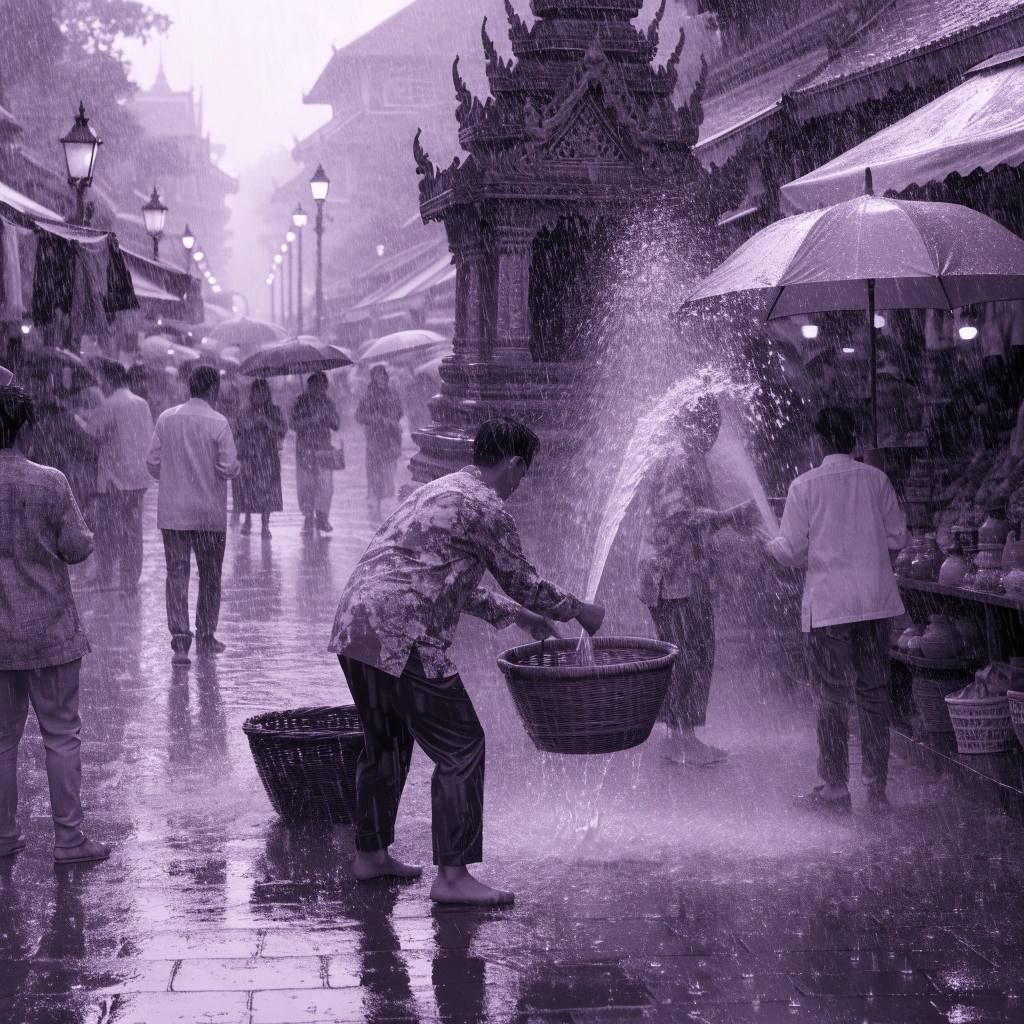
Songkran: A Happy Water Festival
Songkran is the Thai New Year. It is in April. This festival is very important for Thai people. Families come together. They visit old people and talk.
People use water to wash statues of Buddha. They also put water on their hands. This means good luck and clean. It is a spiritual time.
But Songkran is also fun. Young people play with water in the streets. They use buckets and water guns. Everyone is wet and happy. It is a big party for everyone.
Grammar Spotlight
Pattern: Present Simple (to be)
"Songkran is the Thai New Year."
We use 'is' for singular subjects like Songkran or 'it'. It describes facts or states that are always true.
Pattern: Present Simple (Action Verbs)
"Families come together."
We use the base form of the verb for plural subjects like 'families'. This pattern describes regular habits or general truths.
Test Your Understanding
10 questions · A1 Beginner · 1 free preview
Test what you learned from this article. Answer all questions to earn XP!
When is Songkran?
Want to finish the quiz?
9 more questions are waiting for you. Sign up free to unlock the full quiz and earn XP!
Sign Up FreeAlready have an account? Sign In
Question Breakdown
When is Songkran?
Your answer:
Correct answer: In April
Songkran is a sad time for Thai people.
Your answer:
Correct answer: False
What does 'family' mean?
Your answer:
Correct answer: A group of related people
People use _____ to wash statues of Buddha.
Your answer:
Correct answer: water
Songkran: The Spiritual and Playful Water Festival
Songkran is the traditional New Year in Thailand. It happens every year from April 13th to 15th. For many people, Songkran is the most famous festival in the country. It is a time for family, cleaning, and fun. In the past, the festival was smaller and quieter. Now, it is bigger and more exciting.
During the festival, Thai people visit temples. They pour water on statues of Buddha because they want to start the year clean. They also visit their parents and grandparents. They pour a little water on the hands of older people to show respect. This is a very spiritual part of the festival.
However, Songkran is also famous for water fights! In the streets, people use buckets and water guns to splash each other. April is the hottest month in Thailand, so the cold water feels better than a fan. People are friendlier during this time and everyone smiles. It is a wonderful celebration for everyone.
Grammar Spotlight
Pattern: Comparatives and Superlatives
"April is the hottest month in Thailand, so the cold water feels better than a fan."
We use 'the hottest' to compare one month to all others. We use 'better than' to compare the feeling of water to the feeling of a fan.
Pattern: Past Simple with 'to be'
"In the past, the festival was smaller and quieter."
We use 'was' to talk about a state or situation in the past. It shows how things were different from the present.
Test Your Understanding
11 questions · A2 Elementary · 1 free preview
Test what you learned from this article. Answer all questions to earn XP!
When is the Songkran festival celebrated?
Want to finish the quiz?
10 more questions are waiting for you. Sign up free to unlock the full quiz and earn XP!
Sign Up FreeAlready have an account? Sign In
Question Breakdown
When is the Songkran festival celebrated?
Your answer:
Correct answer: From April 13th to 15th
People splash water because April is the coldest month in Thailand.
Your answer:
Correct answer: False
What does 'respect' mean?
Your answer:
Correct answer: A feeling of admiration for someone
Thai people visit _____ to pour water on statues of Buddha.
Your answer:
Correct answer: temples
Why do people pour water on statues of Buddha?
Your answer:
Correct answer: To start the new year clean
Songkran: The Spiritual and Playful Water Festival
Songkran is the traditional Thai New Year which is celebrated every year from April 13th to 15th. Although many international tourists visit Thailand for the famous water fights, the festival has a much deeper spiritual meaning for local people. For Thais, it is a significant time for renewal, cleansing, and family reunions.
The word 'Songkran' comes from an ancient language and refers to the sun’s movement into a new zodiac sign. During the three-day holiday, many traditions are followed. For example, Buddha statues are carefully washed with scented water in local temples. This ritual, which is performed by thousands of people, is believed to bring good luck and prosperity for the coming year. Furthermore, younger family members often pour water over the palms of their elders. This act is a beautiful sign of respect and has been practiced for many centuries to seek blessings.
Of course, the modern celebration is also famous for its playful side. In major cities like Bangkok, many streets are closed so that people can participate in massive, friendly water fights. People of all ages use buckets and water guns to soak each other. However, even this fun activity has a symbolic purpose. The water is used to represent the washing away of the previous year's misfortunes.
In conclusion, Songkran is a unique festival that combines ancient spiritual customs with modern joy. It has become one of the most popular events in the world because it promotes unity and happiness. Whether you are visiting a quiet village temple or joining a crowded street party, you will certainly experience the incredible warmth of Thai culture during this special time.
Grammar Spotlight
Pattern: Passive Voice
"Buddha statues are carefully washed with scented water in local temples."
We use the passive voice (am/is/are + past participle) when the action is more important than the person doing it. It is common in descriptions of traditions and processes.
Pattern: Present Perfect
"This act is a beautiful sign of respect and has been practiced for many centuries."
The present perfect (have/has + past participle) is used here to describe an action that started in the past and continues to be relevant today.
Test Your Understanding
11 questions · B1 Intermediate · 1 free preview
Test what you learned from this article. Answer all questions to earn XP!
What is the primary spiritual focus of Songkran for Thai people?
Want to finish the quiz?
10 more questions are waiting for you. Sign up free to unlock the full quiz and earn XP!
Sign Up FreeAlready have an account? Sign In
Question Breakdown
What is the primary spiritual focus of Songkran for Thai people?
Your answer:
Correct answer: Renewal, cleansing, and family reunions
The water fights in Songkran are purely for fun and have no symbolic meaning.
Your answer:
Correct answer: False
Which word means 'the state of being successful'?
Your answer:
Correct answer: Prosperity
The word Songkran refers to the _____’s movement into a new zodiac sign.
Your answer:
Correct answer: sun
Why are streets in cities like Bangkok closed during the festival?
Your answer:
Correct answer: To allow people to participate in water fights
Songkran: Beyond the Water Fights – A Deep Dive into Thailand's Spiritual New Year
Songkran is widely acknowledged as one of the most vibrant and culturally significant festivals globally. Celebrated annually from April 13th to 15th, it marks the traditional Thai New Year. While international media often portrays the event as a massive, country-wide water fight, for the local population, it is a deeply spiritual period of renewal and family reunion. Consequently, understanding the nuanced layers of this festival is essential for any traveler wishing to experience Thai culture authentically.
The term 'Songkran' is derived from the Sanskrit word 'Sankranti,' which literally translates to 'astrological passage.' This signifies the sun's entry into the constellation of Aries, marking the end of the dry season and the beginning of a new lunar cycle. Historically, this transition has been celebrated with rituals that symbolize the washing away of the previous year's misfortunes to make way for future prosperity.
Central to the spiritual aspect of Songkran is the practice of merit-making. Thais visit local temples to offer food to monks and perform the ritual of 'Song Nam Phra.' This involves pouring scented water over Buddha statues, a gesture intended to represent purification and good fortune. Furthermore, the festival serves as a crucial time for family gatherings. Younger generations perform 'Rod Nam Dum Hua,' a ceremony where they pour water into the palms of their elders as a sign of respect and to receive blessings. This emphasis on filial piety ensures that the social fabric of the community remains strong despite the rapid modernization of Thai society.
Inevitably, the playful side of Songkran cannot be ignored. The streets transform into arenas of joy where people of all ages splash water on one another. This evolution from a gentle sprinkling of water into a high-energy celebration has been criticized by some traditionalists; however, many argue that it reflects the Thai spirit of 'Sanuk'—the pursuit of pleasure and fun in everyday life. While many tourists might have expected only the chaotic water battles, they often find themselves moved by the quiet moments of devotion found in neighborhood temples.
In conclusion, Songkran is a multifaceted celebration that successfully bridges the gap between ancient tradition and modern festivity. Although the water fights provide an exhilarating experience, the underlying values of gratitude, cleansing, and respect are what truly define the festival's enduring legacy.
Grammar Spotlight
Pattern: Passive Voice for Formal Statements
"Songkran is widely acknowledged as one of the most vibrant and culturally significant festivals globally."
The passive voice is used here to create a formal tone and focus on the festival itself rather than who acknowledges it. It is formed using the verb 'to be' and the past participle.
Pattern: Present Participle Clauses
"This signifies the sun's entry into the constellation of Aries, marking the end of the dry season."
The participle 'marking' introduces a result or a simultaneous action. This structure is common in B2 writing to combine ideas and improve flow.
Pattern: Modal Verbs of Deduction (Past)
"While many tourists might have expected only the chaotic water battles, they often find themselves moved."
'Might have expected' is used to express a possibility about a past state or expectation that has since been corrected or contrasted with reality.
Test Your Understanding
11 questions · B2 Upper Intermediate · 1 free preview
Test what you learned from this article. Answer all questions to earn XP!
What is the primary linguistic origin of the word 'Songkran'?
Want to finish the quiz?
10 more questions are waiting for you. Sign up free to unlock the full quiz and earn XP!
Sign Up FreeAlready have an account? Sign In
Question Breakdown
What is the primary linguistic origin of the word 'Songkran'?
Your answer:
Correct answer: Ancient Sanskrit
The text suggests that Songkran is only about water fights and has no spiritual meaning.
Your answer:
Correct answer: False
What does 'renewal' mean in the context of the article?
Your answer:
Correct answer: A process of making something new again
The ritual of pouring water over the palms of elders is a sign of _____.
Your answer:
Correct answer: respect
What does the concept of 'Sanuk' represent in Thai culture?
Your answer:
Correct answer: The pursuit of pleasure and fun
Songkran: The Dichotomy of Devotion and Deluge
To the uninitiated observer, Songkran presents itself as a chaotic, country-wide aquatic skirmish, characterized by high-powered water cannons and exuberant revelry. However, it is the profound spiritual undercurrent of Songkran that remains largely invisible to the casual observer. Known as the Thai New Year, the festival is a complex tapestry of ancient Sanskrit traditions and modern social dynamics. The term 'Songkran' is derived from the Sanskrit 'Sankranti,' denoting an astrological passage—specifically, the sun’s transition into the constellation of Aries. Historically, this celestial event signaled the end of the dry season and the promise of life-giving rains for the agrarian society.
Rarely do the raucous water fights of Bangkok’s Khao San Road reflect the somber merit-making occurring in rural temples. For the Thai populace, the essence of the festival lies in the concept of purification. Water is not merely a tool for play; it is a sanctified medium used to wash away the misfortunes of the previous year. This is most poignantly observed in the ritual of 'Rod Nam Dum Hua,' where the younger generation pours scented water over the palms of their elders as a gesture of veneration and a request for blessings. Such acts of filial piety underscore the festival’s role as a catalyst for family reunions, as millions migrate from urban centers back to their ancestral provinces.
The commercialization of this ancient rite has prompted a national discourse on the preservation of cultural integrity. Critics argue that the metamorphosis of Songkran into a global tourist attraction has led to a transgression of its original sanctity. What was once a gentle sprinkling of water has evolved into a deluge, sometimes obscuring the auspicious nature of the season. Nevertheless, proponents of the modern celebration suggest that the festival’s adaptability is precisely what ensures its longevity. The dichotomy between the ephemeral joy of the water fights and the enduring depth of the spiritual rituals creates a unique cultural phenomenon that defies simple categorization.
Ultimately, Songkran serves as a temporal bridge, connecting Thailand’s animist and Buddhist past with its hyper-modernized present. While the headlines may focus on the statistics of water consumption and tourism revenue, the heart of the festival remains rooted in the quiet aspiration for renewal. It is through the synthesis of the playful and the prayerful that Songkran maintains its status as the most significant event in the Thai calendar, offering a moment of collective catharsis and the hopeful anticipation of a prosperous year ahead.
Grammar Spotlight
Pattern: Cleft Sentences
"It is the profound spiritual undercurrent of Songkran that remains largely invisible to the casual observer."
Cleft sentences are used to focus on a specific part of the sentence. They often start with 'It is/was' followed by the noun phrase being emphasized and a 'that' or 'who' clause.
Pattern: Negative Inversion
"Rarely do the raucous water fights of Bangkok’s Khao San Road reflect the somber merit-making occurring in rural temples."
When a sentence starts with a negative or restrictive adverb (like 'rarely'), the auxiliary verb and subject are inverted. This is used for rhetorical effect or emphasis in formal writing.
Pattern: Nominalization
"The commercialization of this ancient rite has prompted a national discourse on the preservation of cultural integrity."
Nominalization involves turning verbs or adjectives into nouns (e.g., 'commercialize' to 'commercialization'). This is a hallmark of C1 academic writing to create a more objective and concise tone.
Test Your Understanding
12 questions · C1 Advanced · 1 free preview
Test what you learned from this article. Answer all questions to earn XP!
What does the author suggest is the primary misunderstanding of Songkran by outsiders?
Want to finish the quiz?
11 more questions are waiting for you. Sign up free to unlock the full quiz and earn XP!
Sign Up FreeAlready have an account? Sign In
Question Breakdown
What does the author suggest is the primary misunderstanding of Songkran by outsiders?
Your answer:
Correct answer: That it is merely a large-scale water fight without spiritual depth.
The word 'Songkran' is derived from an ancient Thai word meaning 'water splash'.
Your answer:
Correct answer: False
Which word is a synonym for 'veneration' as used in the text?
Your answer:
Correct answer: Reverence
The _____ of the festival into a major tourist attraction has caused concerns about its original meaning.
Your answer:
Correct answer: metamorphosis
According to the article, what does the 'Rod Nam Dum Hua' ritual symbolize?
Your answer:
Correct answer: Respect for elders and a request for blessings.
The author believes that the festival's ability to adapt may be the reason it has lasted so long.
Your answer:
Correct answer: True
Songkran: A Sociocultural Analysis of Spiritual Renewal and Communal Catharsis
Songkran, the traditional Thai New Year, stands as a formidable testament to the intricate synthesis of Brahmanical tradition and Buddhist philosophy. To the uninitiated observer, the festival may appear to be little more than an exuberant, country-wide water fight—a hedonistic reprieve from the sweltering heat of the dry season. However, such a reductionist view elides the profound spiritual undercurrents that define this vernal equinox celebration. Derived from the Sanskrit 'Sankranti,' the term denotes an astrological passage, specifically the sun’s ingress into the constellation of Aries. This transition is not merely chronological; it is a symbolic threshold, a period of collective purgation and communal renewal.
Central to the Songkran ethos is the concept of merit-making, or 'Tham Bun.' Devotees frequent temples to offer alms and partake in the lustral bathing of Buddha images, a practice known as 'Song Nam Phra.' This act is imbued with the belief that water serves as a purifying agent, washing away the misfortunes of the previous year and ushering in auspiciousness for the next. Furthermore, the practice of 'Rod Nam Dum Hua'—wherein the youth pour scented water over the palms of their elders—epitomizes the filial piety and reverence for ancestral wisdom that remains a cornerstone of Thai social fabric. Were one to scrutinize the evolution of Songkran, one might observe a palpable tension between tradition and modernity.
The commercialized spectacle of 'water wars' in urban centers like Bangkok often overshadows the quietude of rural observances. Yet, it would be a mistake to view these manifestations as mutually exclusive. The playful element, though seemingly chaotic, serves as a vital release valve for social tensions, fostering a sense of egalitarianism as participants of all strata are doused indiscriminately. The water, far from being a mere propellant for play, acts as a metaphorical conduit for blessings. As the sun culminates its celestial journey, the Thai people engage in a temporal hiatus, reflecting on the impermanence of life while simultaneously celebrating its continuity.
One might posit that the festival’s enduring appeal lies in its ability to bridge the sacred and the profane. While the youth engage in spirited aquatic skirmishes, the underlying motive remains rooted in the desire for rejuvenation. The efficacy of Songkran as a cultural mechanism for maintaining social cohesion cannot be overstated. It provides a structured environment for the expression of joy, the reinforcement of familial bonds, and the public affirmation of spiritual values. In an era of rapid globalization, Songkran remains a resilient marker of Thai identity, adapting to the contemporary world while preserving the ancient rhythms of the cosmos. The festival, therefore, is not merely a holiday but a sophisticated psychological and spiritual reset, ensuring that the collective consciousness is cleansed and prepared for the challenges of the coming year.
Grammar Spotlight
Pattern: Second Conditional with 'Were' (Subjunctive)
"Were one to scrutinize the evolution of Songkran, one might observe a palpable tension between tradition and modernity."
This formal structure uses 'were' instead of 'if... was' to express a hypothetical condition. It is common in academic and C2-level writing to convey a scholarly tone.
Pattern: Participial Phrases for Sentence Variation
"Derived from the Sanskrit 'Sankranti,' the term denotes an astrological passage."
Starting a sentence with a past participle ('Derived') allows for more sophisticated sentence structures, linking the origin of a concept directly to its definition.
Pattern: Hedging and Academic Modality
"One might posit that the festival’s enduring appeal lies in its ability to bridge the sacred and the profane."
Using 'one might posit' is a classic C2 academic hedging technique. It avoids making an overly blunt claim, instead presenting an argument as a possibility for consideration.
Test Your Understanding
12 questions · C2 Mastery · 1 free preview
Test what you learned from this article. Answer all questions to earn XP!
According to the article, what is the 'reductionist view' of Songkran?
Want to finish the quiz?
11 more questions are waiting for you. Sign up free to unlock the full quiz and earn XP!
Sign Up FreeAlready have an account? Sign In
Question Breakdown
According to the article, what is the 'reductionist view' of Songkran?
Your answer:
Correct answer: A country-wide water fight for fun
The term 'Songkran' is derived from a Sanskrit word meaning 'astrological passage'.
Your answer:
Correct answer: True
What does 'filial' mean in the context of the article?
Your answer:
Correct answer: Related to the duty of children to parents
The water in Songkran acts as a metaphorical _____ for blessings.
Your answer:
Correct answer: conduit
What social function does the 'playful element' of Songkran serve?
Your answer:
Correct answer: It acts as a release valve for social tensions
The article suggests that the commercialized 'water wars' and traditional observances cannot coexist.
Your answer:
Correct answer: False
