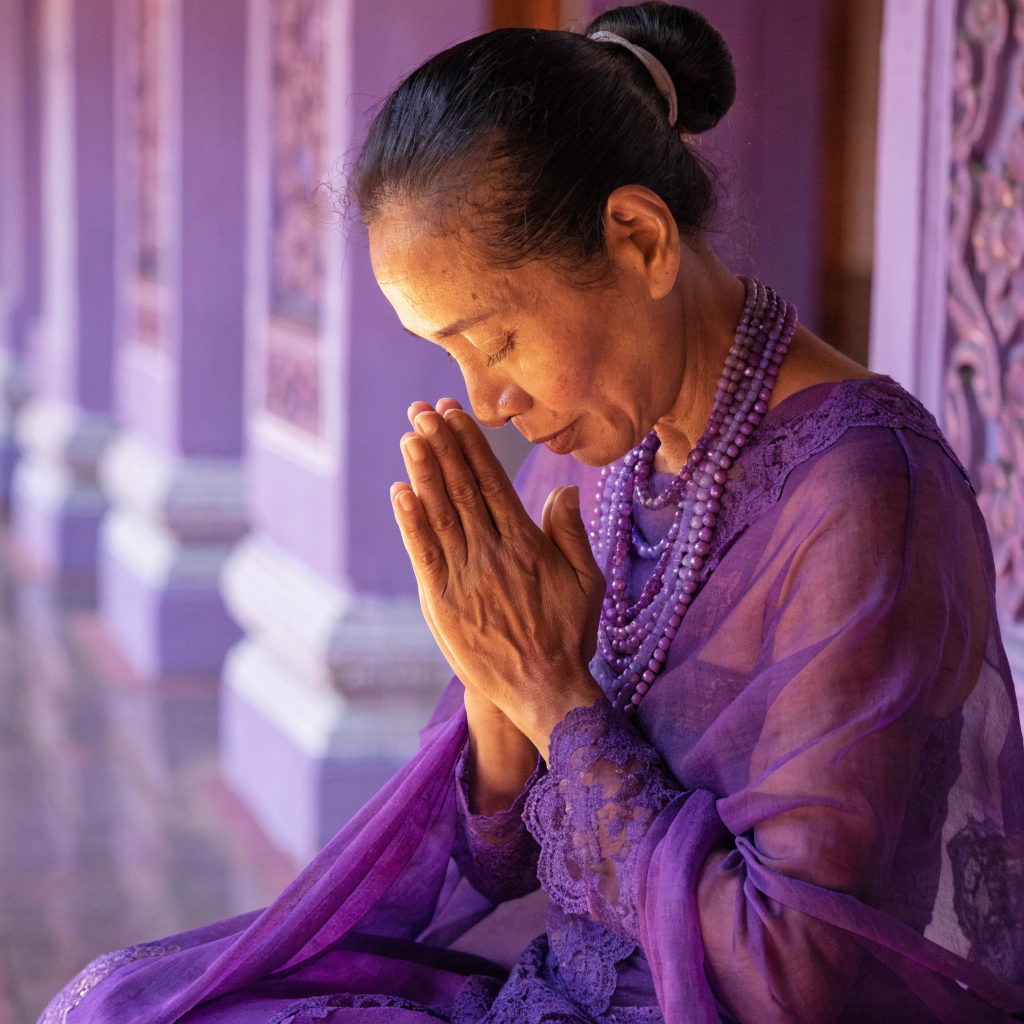
The Wai: A Special Greeting
People in Thailand have a special greeting. It is called the 'Wai'. You put your hands together. It looks like a prayer. You bow your head a little.
Thai people use the Wai to say hello and goodbye. They also use it to say thank you or sorry. It shows great respect. It is a beautiful part of Thai culture.
Young people Wai to older people first. It is very polite. Everyone in Thailand knows this sign. It is a friendly way to meet people.
Grammar Spotlight
Pattern: Present Simple (to be)
"It is a beautiful part of Thai culture."
We use 'am', 'is', or 'are' to describe things or people. In this sentence, 'is' links the subject 'it' to the description.
Pattern: Present Simple (plural subjects)
"Thai people use the Wai to say hello."
We use the present simple for habits and general facts. For plural subjects like 'Thai people', we use the base form of the verb without adding 's'.
Test Your Understanding
10 questions · A1 Beginner · 1 free preview
Test what you learned from this article. Answer all questions to earn XP!
What is the Wai?
Want to finish the quiz?
9 more questions are waiting for you. Sign up free to unlock the full quiz and earn XP!
Sign Up FreeAlready have an account? Sign In
Question Breakdown
What is the Wai?
Your answer:
Correct answer: A special greeting
You put your hands together for a Wai.
Your answer:
Correct answer: True
What does 'respect' mean?
Your answer:
Correct answer: To feel someone is important
Young people _____ to older people first.
Your answer:
Correct answer: Wai
The Wai: Thailand’s Special Greeting
When you visit Thailand, you will see a beautiful greeting called the Wai. It is a very important symbol of Thai culture. To do a Wai, you must press your palms together in front of your chest or face. Then, you bow your head slightly. This gesture is more graceful than a simple handshake, and it shows deep respect.
Younger people always Wai older people first because it is polite. It is also used to say goodbye or to say sorry. In the past, people used the Wai to show they had no weapons in their hands. Today, it is a sign of kindness and peace.
The Wai is more than just a movement. It is a way to show consideration for other people's feelings. If you go to a shop or a temple, you will see many people doing this. Even though it looks easy, there are different ways to do it. For example, your hands are higher when you meet a monk. Learning the Wai is a great way to show respect to Thai people.
Grammar Spotlight
Pattern: Comparatives
"This gesture is more graceful than a simple handshake, and it shows deep respect."
We use 'more + adjective + than' to compare two things. 'Graceful' is a long adjective, so we use 'more' before it.
Pattern: Past Simple
"In the past, people used the Wai to show they had no weapons in their hands."
The past simple is used for finished actions in the past. We add '-ed' to the regular verb 'use' to make 'used'.
Test Your Understanding
11 questions · A2 Elementary · 1 free preview
Test what you learned from this article. Answer all questions to earn XP!
Where do you put your hands when you do a Wai?
Want to finish the quiz?
10 more questions are waiting for you. Sign up free to unlock the full quiz and earn XP!
Sign Up FreeAlready have an account? Sign In
Question Breakdown
Where do you put your hands when you do a Wai?
Your answer:
Correct answer: In front of your chest or face
Younger people should Wai older people first.
Your answer:
Correct answer: True
What does 'symbol' mean?
Your answer:
Correct answer: A sign that represents something
To do a Wai, you must press your _____ together.
Your answer:
Correct answer: palms
Why did people use the Wai in the past?
Your answer:
Correct answer: To show they had no weapons
The Wai: More Than Just a Greeting in Thailand
When you visit Thailand, you will see people pressing their palms together in a graceful gesture. This is called the 'Wai', which is the most famous symbol of Thai identity. It is used as a greeting, a farewell, and even a sincere apology. To perform a Wai, you must press your palms together in front of your chest or face and bow your head slightly.
The Wai is a sophisticated social tool that is rooted in the concept of 'Kreng Jai'. This term, which is often difficult to translate, refers to the deep consideration for other people’s feelings and a desire not to disturb them. In Thai society, the Wai has been practiced for centuries to show respect and kindness. It is not just a simple physical movement; it is a way to acknowledge the social status of others in a polite manner.
Usually, the person who is younger or has a lower social status should initiate the Wai first. The height of the hands also depends on who you are greeting. For example, if you are greeting an older person, your fingertips should reach your nose. However, if you are greeting a monk, your head should bow much lower so your thumbs touch your forehead. This shows that the monk holds a very high position in society.
Although visitors are not expected to master every detail of this complex tradition, the effort is always highly appreciated by locals. The Wai has been recognized globally as a beautiful sign of Thai politeness and culture. By learning about this tradition, travelers can better understand the deep values that have shaped Thailand for generations.
Grammar Spotlight
Pattern: Passive Voice
"It is used as a greeting, a farewell, and even a sincere apology."
The passive voice is formed with the verb 'to be' and the past participle. We use it when the action is more important than the person performing it.
Pattern: Present Perfect
"In Thai society, the Wai has been practiced for centuries to show respect."
This pattern uses 'has/have' plus the past participle. It describes an action that started in the past and continues to the present time.
Test Your Understanding
11 questions · B1 Intermediate · 1 free preview
Test what you learned from this article. Answer all questions to earn XP!
What is the primary purpose of the Wai in Thailand?
Want to finish the quiz?
10 more questions are waiting for you. Sign up free to unlock the full quiz and earn XP!
Sign Up FreeAlready have an account? Sign In
Question Breakdown
What is the primary purpose of the Wai in Thailand?
Your answer:
Correct answer: To serve as a greeting and mark of respect
The position of the hands stays the same regardless of who you are greeting.
Your answer:
Correct answer: False
What does 'sophisticated' mean in the context of the article?
Your answer:
Correct answer: Complex and socially advanced
To perform a Wai, you must _____ your palms together in front of your chest.
Your answer:
Correct answer: press
Who should usually initiate the Wai first?
Your answer:
Correct answer: The person who is younger or has lower status
The Nuances of the Wai: More Than Just a Greeting
In the heart of Southeast Asia, Thailand stands out not only for its stunning landscapes but also for its profound cultural traditions. Among these, the ‘Wai’—the act of pressing one’s palms together in a prayer-like fashion—serves as the most recognizable emblem of Thai identity. Although it might appear to be a simple greeting to an untrained observer, the Wai is, in fact, a sophisticated social mechanism rooted in centuries of tradition. It is a gesture that transcends mere politeness, functioning as a marker of respect, an apology, and a tool for maintaining social harmony.
The execution of the Wai is intrinsically hierarchical. Unlike a Western handshake, which generally implies equality, the Wai reflects the relative status of the individuals involved. Generally, there are three distinct levels of the Wai. When greeting peers or those of similar status, the thumbs usually touch the chin. However, when showing respect to elders or superiors, the hands are raised higher, with the thumbs touching the nose. The highest level, reserved for Buddhist monks and royalty, requires the thumbs to touch the forehead, often accompanied by a deeper bow. This physical nuance allows participants to acknowledge social standing without a single word being spoken.
Central to this practice is the concept of ‘Kreng Jai’, a uniquely Thai cultural trait. Kreng Jai involves a deep consideration for others' feelings and a desire to avoid causing discomfort or 'losing face.' The Wai acts as a physical manifestation of this philosophy. By performing the gesture correctly, individuals demonstrate that they adhere to the values of humility and mutual respect. This practice, which is deeply rooted in Buddhist traditions, remains a cornerstone of Thai social life, ensuring that interactions remain smooth and respectful.
Despite the rapid modernization of cities like Bangkok, the Wai remains indispensable. In corporate boardrooms and street markets alike, the gesture is used to initiate and conclude interactions. For foreigners, understanding these customs is vital. While locals do not expect visitors to master every nuance, making an effort to perform a reciprocal Wai is highly appreciated. Tourists might find the various levels of the Wai confusing at first, but observing how locals interact can provide valuable insights into the social fabric of the country.
In conclusion, the Wai is much more than a graceful movement; it is a vital component of the Thai identity. It fosters a culture of respect and serves as a constant reminder of the importance of social hierarchy and consideration. As Thailand continues to evolve in a globalized world, this elegant gesture remains a powerful symbol of a society that deeply values its heritage and the harmony of its people.
Grammar Spotlight
Pattern: Present Simple Passive
"The Wai is performed by pressing the palms together in a prayer-like fashion."
The passive voice is used here because the action (the gesture) is more important than who specifically is doing it. It is formed using 'is/are' + the past participle.
Pattern: Non-defining Relative Clauses
"This practice, which is deeply rooted in Buddhist traditions, remains a cornerstone of Thai social life."
This pattern provides extra information about the 'practice'. It is separated by commas and uses the relative pronoun 'which'.
Pattern: Modal Verbs of Possibility
"Tourists might find the various levels of the Wai confusing at first."
The modal 'might' is used to express a logical possibility or a tentative prediction about someone's experience.
Test Your Understanding
11 questions · B2 Upper Intermediate · 1 free preview
Test what you learned from this article. Answer all questions to earn XP!
What is the primary function of the Wai according to the article?
Want to finish the quiz?
10 more questions are waiting for you. Sign up free to unlock the full quiz and earn XP!
Sign Up FreeAlready have an account? Sign In
Question Breakdown
What is the primary function of the Wai according to the article?
Your answer:
Correct answer: A multi-purpose gesture of respect, greeting, and apology
The Wai is only used as a greeting when people first meet.
Your answer:
Correct answer: False
What does the word 'nuance' refer to in the text?
Your answer:
Correct answer: A subtle difference in social rank or gesture
The Wai is a ______ gesture that serves multiple social functions.
Your answer:
Correct answer: sophisticated
What does the concept of 'Kreng Jai' involve?
Your answer:
Correct answer: Consideration for others' feelings and avoiding discomfort
Beyond the Bow: Deciphering the Socio-Cultural Nuances of the Thai Wai
Seldom does a single gesture encapsulate the ethos of a nation as profoundly as the Wai does for Thailand. To the uninitiated observer, it may appear as a simple, prayer-like pressing of the palms; however, its cultural implications are far more multifaceted. What distinguishes the Wai from a mere formality is its intrinsic connection to the Thai social hierarchy and the philosophical underpinnings of 'Kreng Jai'. This concept, which involves a deep consideration for the feelings of others and a desire to avoid causing discomfort, is the bedrock upon which the Wai is built.
The physical execution of the Wai is dictated by strict social protocols. The position of the hands and the depth of the bow are indicative of the level of deference being shown. For instance, when addressing a monk or a member of the royal family, the thumbs should reach the forehead, accompanied by a deep bow. Conversely, a greeting between peers involves the hands resting at chest level. The perpetuation of these distinctions ensures that the social order is maintained and respected. It is not merely a greeting but a sophisticated manifestation of one’s awareness of their place within the social fabric.
The historical lineage of the Wai can be traced back to ancient India, sharing roots with the 'Namaste', yet it has evolved into a uniquely Thai phenomenon. The integration of Buddhist principles has infused the gesture with a sense of sanctity. The act of bowing the head, the most vulnerable part of the body, signifies a total lack of hostility and a profound acknowledgement of the other person's humanity. This spiritual dimension elevates the Wai from a social obligation to a moment of shared reverence.
Furthermore, the Wai serves as a critical tool for social cohesion. It is employed not only in greetings but also as a profound expression of gratitude or a sincere apology. In instances of conflict, the offering of a Wai can act as a powerful de-escalation tactic, signaling a willingness to restore harmony. The nuance involved in these interactions is immense; a misplaced Wai or the failure to return one can lead to social friction or a perceived lack of 'Galatesa'—the sense of time and place.
Critics might argue that such a rigid system of etiquette is incompatible with the egalitarian values of the modern, globalized world. However, the Wai has proven remarkably resilient. Even in the bustle of contemporary Bangkok, amidst the rapid influx of Western influence, the gesture remains ubiquitous. It has adapted to the digital age, appearing in emojis and being practiced by international corporations operating within the kingdom to demonstrate local sensitivity.
Ultimately, the Wai is more than a relic of the past; it is a living, breathing component of Thai identity. It bridges the gap between tradition and modernity, providing a sense of continuity in an ever-changing landscape. By mastering the intricacies of the Wai, one gains a deeper understanding of the Thai psyche—a world where respect, hierarchy, and social harmony are paramount. The ambiguity often felt by foreigners regarding when and how to Wai highlights the complexity of this silent language, yet its enduring presence confirms its status as the heartbeat of Thai social interaction.
Grammar Spotlight
Pattern: Inversion with Negative Adverbials
"Seldom does a single gesture encapsulate the ethos of a nation as profoundly as the Wai does for Thailand."
Inversion is used here by placing the auxiliary verb 'does' before the subject 'a single gesture' after the negative adverb 'Seldom'. This structure is used in formal English to add rhetorical emphasis.
Pattern: Cleft Sentences
"What distinguishes the Wai from a mere formality is its intrinsic connection to the Thai social hierarchy..."
A pseudo-cleft sentence starting with 'What' is used to focus on the specific reason why the Wai is unique. It emphasizes the 'intrinsic connection' as the most important piece of information.
Pattern: Nominalisation
"The perpetuation of these distinctions ensures that the social order is maintained and respected."
The verb 'perpetuate' is turned into the noun 'perpetuation' to make the sentence more formal and concise. This is a hallmark of C1 academic and professional writing.
Test Your Understanding
12 questions · C1 Advanced · 1 free preview
Test what you learned from this article. Answer all questions to earn XP!
What is the primary function of the Wai according to the article?
Want to finish the quiz?
11 more questions are waiting for you. Sign up free to unlock the full quiz and earn XP!
Sign Up FreeAlready have an account? Sign In
Question Breakdown
What is the primary function of the Wai according to the article?
Your answer:
Correct answer: To signify social status and maintain order
The physical form of the Wai remains identical regardless of who is being greeted.
Your answer:
Correct answer: False
What does 'deference' mean?
Your answer:
Correct answer: Polite submission and respect
The _____ of these distinctions ensures that the social order is maintained.
Your answer:
Correct answer: perpetuation
Which Thai concept is described as the 'bedrock' of the Wai?
Your answer:
Correct answer: Kreng Jai
The Wai is used as a tool for de-escalating conflicts.
Your answer:
Correct answer: True
The Semiotic Tapestry of the Wai: An Analytical Inquiry into Thai Social Deference
To perceive the Thai 'Wai' merely as a superficial salutation is to overlook the profound semiotic tapestry it weaves within the kingdom's social fabric. This graceful gesture, characterized by the pressing of palms together in a prayer-like fashion, serves as a quintessential manifestation of the nation's ontological commitment to hierarchy and social harmony. While the uninitiated observer might interpret the motion as a singular act of greeting, it is, in fact, a highly nuanced protocol that communicates status, gratitude, and apology with surgical precision. At the heart of this practice lies the concept of 'Kreng Jai'—a psychological state involving the desire to avoid causing discomfort or burden to others. Seldom does a simple physical movement encapsulate such a complex web of interpersonal dynamics.
The mechanics of the Wai are dictated by an intricate set of rules that reflect the relative social standing of the participants. Were one to disregard these subtleties, the result would be a significant breach of cultural etiquette. Generally, the position of the hands relative to the face indicates the level of deference being paid. For instance, when addressing an equal, the thumbs typically touch the chin. However, should an individual encounter a social superior or an elder, the hands are elevated so that the thumbs touch the nose. The most profound manifestation of respect is reserved for the clergy and the monarchy, where the thumbs reach the forehead, accompanied by a deep, reverent bow. This hierarchical stratification ensures that every interaction is grounded in a mutual understanding of one's place within the societal structure.
Historically, the Wai finds its roots in the ancient Indian 'Anjali Mudra,' yet it has evolved into a uniquely Thai expression of identity. It might be posited that the gesture's endurance in the modern era is a testament to its cultural resilience. In an increasingly globalized world where Western egalitarian ideals often clash with traditional Eastern structures, the Wai remains an immovable pillar of Thai life. It functions as a non-verbal buffer that mitigates potential conflict, fostering an environment of 'sanuk' (playfulness) and 'sabai' (comfort) even within formal constraints. Even in the high-stakes environments of contemporary corporate Bangkok, the gesture persists, bridging the gap between historical tradition and the demands of modern capitalism.
Furthermore, the Wai is not merely a unidirectional offering of respect; it is a reciprocal engagement. While a subordinate must initiate the gesture, the superior often returns it with a 'Wai Rap,' or a receiving Wai, held at a lower level to acknowledge the greeting without relinquishing their status. This cyclical exchange reinforces the social bond and validates the identities of both parties. It is through these micro-interactions that the collective identity of the Thai people is continuously negotiated and reaffirmed. Notwithstanding the pressures of rapid urbanization and digital transformation, the Wai continues to serve as a vital communicative tool, proving that some traditions are too deeply embedded in the national psyche to be eroded by the tides of change.
Grammar Spotlight
Pattern: Negative Inversion
"Seldom does a simple physical movement encapsulate such a complex web of interpersonal dynamics."
When negative or restrictive adverbs like 'seldom' or 'rarely' start a sentence, the auxiliary verb and subject are inverted for rhetorical emphasis.
Pattern: Inverted Conditional (Subjunctive)
"Were one to disregard these subtleties, the result would be a significant breach of cultural etiquette."
This structure replaces 'If one were to...' and is used in formal writing to express a hypothetical situation with a high degree of formality.
Pattern: Epistemic Modality (Academic Hedging)
"It might be posited that the gesture's endurance in the modern era is a testament to its cultural resilience."
Using 'It might be posited that' allows the writer to suggest a theory without stating it as an absolute fact, which is a hallmark of scholarly prose.
Test Your Understanding
12 questions · C2 Mastery · 1 free preview
Test what you learned from this article. Answer all questions to earn XP!
What is the primary psychological driver of the Wai according to the text?
Want to finish the quiz?
11 more questions are waiting for you. Sign up free to unlock the full quiz and earn XP!
Sign Up FreeAlready have an account? Sign In
Question Breakdown
What is the primary psychological driver of the Wai according to the text?
Your answer:
Correct answer: The concept of Kreng Jai
The height of the hands in a Wai is irrelevant to the social status of the recipient.
Your answer:
Correct answer: False
Which word best describes a system that treats all individuals as equal?
Your answer:
Correct answer: Egalitarian
The Wai is described as a _____ manifestation of Thai commitment to hierarchy.
Your answer:
Correct answer: quintessential
Where should the thumbs touch when performing a Wai for the clergy?
Your answer:
Correct answer: The forehead
The 'Wai Rap' is typically performed by the person of lower status.
Your answer:
Correct answer: False
