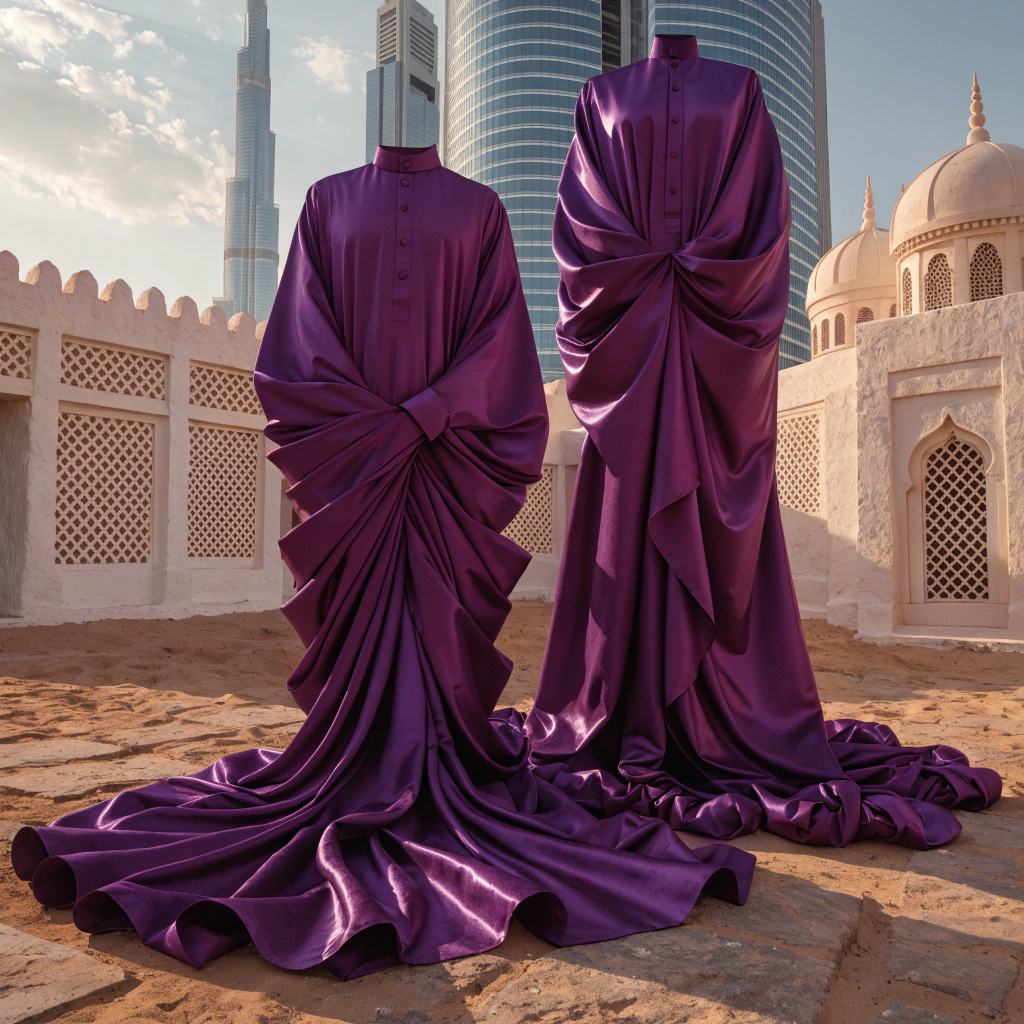
Traditional Clothes in the UAE
In the United Arab Emirates, people wear traditional clothes. Men wear the kandura. It is a long white dress. The white color is good for the sun. It keeps men cool in the desert. The kandura has no collar. It has a long tassel.
Women wear the abaya. It is a long black robe. Women wear it over their clothes. It is very elegant. These clothes are important. They show the history of the UAE. People are proud of their clothes. They wear them every day.
Grammar Spotlight
Pattern: Present Simple (to be)
"It is a long white dress."
We use 'is' with singular subjects like 'it' or 'the kandura'. This pattern helps us describe things and give facts.
Pattern: Present Simple (Action Verbs)
"People wear traditional clothes."
We use the base form of the verb 'wear' for plural subjects like 'people'. This describes a habit or a general truth.
Test Your Understanding
10 questions · A1 Beginner · 1 free preview
Test what you learned from this article. Answer all questions to earn XP!
What color is the kandura?
Want to finish the quiz?
9 more questions are waiting for you. Sign up free to unlock the full quiz and earn XP!
Sign Up FreeAlready have an account? Sign In
Question Breakdown
What color is the kandura?
Your answer:
Correct answer: White
Women wear the abaya over their clothes.
Your answer:
Correct answer: True
What does 'cool' mean?
Your answer:
Correct answer: Not hot
The kandura has a long _____.
Your answer:
Correct answer: tassel
Traditional Clothes in the UAE
In the United Arab Emirates, people are very proud of their traditional clothes. These clothes show the history and culture of the country. For men, the national dress is the Kandura. It is a long, white robe. Men usually wear white because it is cooler than other colors in the hot desert sun. The Emirati Kandura is special because it does not have a collar. It also has a long tassel called a tarboosh.
Women wear a beautiful black robe called an Abaya. It is very elegant and covers the clothes underneath. Some Abayas are simple, but others have pretty designs with gold or silver thread. In the past, these clothes were very basic, but now they are more modern. However, they are still important because they connect people to their history. Emiratis wear these clothes for work, weddings, and daily life. They are a symbol of identity and respect for everyone in the UAE.
Grammar Spotlight
Pattern: Comparatives
"Men usually wear white because it is cooler than other colors in the hot desert sun."
We use the comparative form to compare two things. For short adjectives like 'cool', we add '-er' and use the word 'than'.
Pattern: Connectors (Because)
"The Emirati Kandura is special because it does not have a collar."
We use the word 'because' to give a reason for something. It connects a result with the cause.
Test Your Understanding
11 questions · A2 Elementary · 1 free preview
Test what you learned from this article. Answer all questions to earn XP!
What is a Kandura?
Want to finish the quiz?
10 more questions are waiting for you. Sign up free to unlock the full quiz and earn XP!
Sign Up FreeAlready have an account? Sign In
Question Breakdown
What is a Kandura?
Your answer:
Correct answer: A long white robe
The Emirati Kandura has a high collar.
Your answer:
Correct answer: False
What does 'elegant' mean?
Your answer:
Correct answer: Graceful and attractive
Men wear white because it is _____ than other colors.
Your answer:
Correct answer: cooler
Why are these clothes still important today?
Your answer:
Correct answer: Because they connect people to their history
Symbols of Identity: The Kandura and Abaya
In the United Arab Emirates, traditional clothing is worn with great pride by almost everyone. These garments are not just clothes; they are symbols that represent the nation's history and Islamic values. For many years, these styles have remained popular because they are perfectly suited to the local climate and culture.
For men, the national dress is called the Kandura. It is a floor-length tunic which is usually white. This color is preferred because it reflects the hot desert sun, keeping the wearer cool during the day. Emirati Kanduras are unique because they do not have a collar. Instead, they feature a long tassel known as a tarboosh, which hangs from the neck.
Women in the UAE typically wear the Abaya, which is a long, flowing black cloak. It is worn over regular clothes to provide modesty and elegance. Although many Abayas are simple, some have been decorated with beautiful embroidery or beads. Women also wear a headscarf called a Shayla to complete the look.
In recent years, modern fashion has influenced these traditional styles, but the core design remains the same. The Kandura and Abaya have been preserved as essential parts of Emirati identity. When people wear these clothes, they show respect for their ancestors while staying comfortable in the modern world. This balance between the past and the present is what makes UAE fashion so special.
Grammar Spotlight
Pattern: Passive Voice
"In the United Arab Emirates, traditional clothing is worn with great pride by almost everyone."
The passive voice is used when the focus is on the action or the object rather than the person performing the action. It is formed using 'to be' + the past participle of the verb.
Pattern: Relative Clauses with 'Which'
"It is a floor-length tunic which is usually white."
Relative clauses provide extra information about a noun. 'Which' is used to introduce information about objects or things, helping to combine two thoughts into one sentence.
Test Your Understanding
11 questions · B1 Intermediate · 1 free preview
Test what you learned from this article. Answer all questions to earn XP!
Why is the Kandura usually white?
Want to finish the quiz?
10 more questions are waiting for you. Sign up free to unlock the full quiz and earn XP!
Sign Up FreeAlready have an account? Sign In
Question Breakdown
Why is the Kandura usually white?
Your answer:
Correct answer: To reflect the sun and keep the wearer cool.
Emirati Kanduras are different from others because they have high collars.
Your answer:
Correct answer: False
What does 'embroidery' mean?
Your answer:
Correct answer: Decorative patterns sewn onto cloth.
The long tassel that hangs from the neck of a Kandura is called a _____.
Your answer:
Correct answer: tarboosh
What is the purpose of the Abaya according to the text?
Your answer:
Correct answer: To provide modesty and elegance.
Symbols of Identity: The Kandura and Abaya in Modern Emirati Society
In the United Arab Emirates, traditional attire represents far more than a simple choice of clothing; it serves as a profound statement of cultural heritage and national identity. While many nations have transitioned entirely to Western-style garments in professional settings, the Emirati people have consciously maintained their traditional dress—the Kandura and the Abaya—as symbols of their enduring history and Islamic values. This adherence to tradition is not merely a matter of habit but a deliberate act of cultural preservation in an increasingly globalized world.
For men, the Kandura is the quintessential garment. This floor-length, typically white tunic is meticulously designed to suit the harsh desert environment. The preference for white is not merely aesthetic; it is a vital functional adaptation to the climate, as the light color reflects the intense sunlight, effectively keeping the wearer cool. Emirati Kanduras are specifically distinguished from those of neighboring Gulf countries by their lack of a collar and the presence of a long, decorative tassel known as the 'tarboosh' or 'karkusha'. This tassel, which was historically used to dip into perfume, now serves as a unique cultural marker that identifies the wearer's nationality.
Similarly, the Abaya is the traditional overgarment worn by Emirati women. Historically, it was a simple, functional black cloak designed to ensure modesty, in accordance with religious principles. However, in contemporary society, the Abaya has undergone a remarkable transformation. While it still fulfills its original purpose, it has also become a sophisticated fashion statement. Modern designers have introduced intricate embroidery, diverse textures, and even different color palettes, allowing women to express their individuality. Consequently, the Abaya has evolved into a sophisticated blend of tradition and high fashion, reflecting the UAE's position as a global luxury hub.
Despite the rapid globalization that has characterized the region's development, these garments have not been relegated to the past. On the contrary, they have been embraced by the younger generation as a form of cultural resilience. By choosing to wear these symbols, Emiratis demonstrate a commitment to their roots amidst a rapidly changing world. Furthermore, this attire fosters a sense of social cohesion, bridging the gap between the nomadic history of the Bedouin and the urbanized, high-tech future of the nation. Ultimately, the Kandura and Abaya are not merely items of clothing; they are living expressions of a culture that honors its past while confidently navigating the modern world.
Grammar Spotlight
Pattern: Contrast Markers (While / On the contrary)
"While many nations have transitioned entirely to Western-style garments, the Emirati people have maintained their traditional dress."
These markers are used to highlight differences between two ideas. 'While' introduces a concession clause, whereas 'on the contrary' emphasizes a complete opposite.
Pattern: Present Perfect Passive
"These garments have not been relegated to the past."
Formed using 'have/has + been + past participle'. It focuses on the status of the object resulting from past actions up to the present.
Pattern: Non-defining Relative Clauses
"This tassel, which was historically used to dip into perfume, now serves as a unique cultural marker."
Used to add extra information about a noun. It is separated by commas and uses 'which' for objects or 'who' for people.
Test Your Understanding
11 questions · B2 Upper Intermediate · 1 free preview
Test what you learned from this article. Answer all questions to earn XP!
Why is the Kandura typically white?
Want to finish the quiz?
10 more questions are waiting for you. Sign up free to unlock the full quiz and earn XP!
Sign Up FreeAlready have an account? Sign In
Question Breakdown
Why is the Kandura typically white?
Your answer:
Correct answer: To reflect sunlight and keep the wearer cool.
The Emirati Kandura is identical to those worn in all other Gulf countries.
Your answer:
Correct answer: False
What does the word 'contemporary' mean in the context of the article?
Your answer:
Correct answer: Modern and present-day
The long, decorative tassel on a Kandura is known as the _____.
Your answer:
Correct answer: tarboosh
According to the article, how has the Abaya changed in modern times?
Your answer:
Correct answer: It has evolved into a blend of tradition and high fashion.
Sartorial Sovereignty: The Kandura and Abaya as Bastions of Emirati Identity
In the rapidly evolving landscape of the United Arab Emirates, where glass-and-steel monoliths pierce the clouds, one might expect the erosion of traditional customs in favor of globalized norms. However, rarely does one encounter a society so steadfast in its sartorial heritage. The Kandura and the Abaya are not merely vestigial remnants of a bygone era; they are quintessential symbols of a living, breathing identity that navigates the tension between modernity and tradition. The preservation of these garments is a testament to the UAE’s unique trajectory.
The Kandura, a floor-length tunic predominantly worn by Emirati men, is a masterclass in understated elegance. While its pristine white hue serves the pragmatic purpose of reflecting the blistering desert sun, its design is steeped in subtle cultural signifiers. Unlike the collared variants found in neighboring Gulf states, the Emirati Kandura is distinguished by its collarless neckline and the karkusha—a long, hand-braided tassel. It is through the subtle nuances of the karkusha’s length and style that an individual’s specific lineage or personal preference is often conveyed. This meticulous attention to detail transforms a seemingly simple garment into a sophisticated narrative of belonging.
Parallel to this is the Abaya, the traditional overgarment for women. Traditionally obsidian in color to ensure modesty, the contemporary Abaya has undergone a profound metamorphosis. What was once a simple cloak has evolved into a canvas for haute couture, featuring intricate embroidery and luxurious fabrics. Yet, despite these aesthetic flourishes, the core ethos remains unchanged: a commitment to Islamic values of modesty. The juxtaposition of high-fashion elements with traditional silhouettes reflects a nuanced negotiation of identity, where Emirati women project both their cultural roots and their participation in the modern global economy.
Furthermore, the continued adherence to national dress serves as a bulwark against the homogenization of global culture. In an age where Western fashion often dictates global trends, the resilience of the Kandura and Abaya is striking. It fosters an egalitarian sense of community; within the mosque or the majlis, the billionaire and the clerk are visually unified, their shared heritage transcending socioeconomic disparities. This visual cohesion reinforces a collective consciousness that is vital for national stability in a multicultural hub.
The manufacturing of these garments also reflects a sophisticated economic ecosystem. Tailoring shops across the Emirates are bustling hubs where precision is paramount. Every stitch in a Kandura is placed meticulously, ensuring a bespoke fit that maintains the garment's fluid silhouette. This artisanal dedication highlights the value placed on presentation in Emirati culture. Moreover, in diplomatic circles, the national dress acts as a powerful statement of sovereignty. When Emirati officials engage in international summits, their choice of attire serves as a non-verbal assertion of cultural pride, demanding respect for a tradition that refuses to be sidelined by the 'suit-and-tie' hegemony of the West. Ultimately, the Kandura and Abaya are not just clothes; they are an enduring dialogue between the past and the future.
Grammar Spotlight
Pattern: Negative Inversion
"However, rarely does one encounter a society so steadfast in its sartorial heritage."
This is used for emphasis by placing a negative or restrictive adverb at the start. The auxiliary verb 'does' is placed before the subject 'one'.
Pattern: Cleft Sentences
"It is through the subtle nuances of the karkusha’s length and style that an individual’s specific lineage or personal preference is often conveyed."
Cleft sentences (It + be + focus + relative clause) are used to emphasize a specific part of the information. Here, the focus is on the specific method of communication.
Pattern: Nominalization
"The preservation of these garments is a testament to the UAE’s unique trajectory."
Nominalization involves turning verbs (preserve) into nouns (preservation). This creates a more formal, academic tone typical of C1 level writing.
Test Your Understanding
12 questions · C1 Advanced · 1 free preview
Test what you learned from this article. Answer all questions to earn XP!
What distinguishes the Emirati Kandura from those in other Gulf countries?
Want to finish the quiz?
11 more questions are waiting for you. Sign up free to unlock the full quiz and earn XP!
Sign Up FreeAlready have an account? Sign In
Question Breakdown
What distinguishes the Emirati Kandura from those in other Gulf countries?
Your answer:
Correct answer: The lack of a collar and the presence of a karkusha
The article suggests that the Abaya has remained completely unchanged in its aesthetic design over time.
Your answer:
Correct answer: False
What does 'sartorial' refer to in the context of the article?
Your answer:
Correct answer: Clothing and style
The continued use of national dress serves as a _____ against the homogenization of global culture.
Your answer:
Correct answer: bulwark
According to the text, how does the national dress affect socioeconomic perception?
Your answer:
Correct answer: It fosters an egalitarian sense of community
The author argues that progress in the UAE has necessitated the abandonment of cultural essence.
Your answer:
Correct answer: False
Sartorial Sovereignty: The Semiotics of the Kandura and Abaya in the Emirati Cultural Landscape
In the contemporary landscape of the United Arab Emirates, the vestiary choices of its citizenry serve as a profound ontological statement, transcending the mere pragmatism of desert survival. Seldom do garments carry such a heavy semiotic burden as the Kandura and the Abaya. These articles of clothing are not merely fabrics stitched to cover the human form; rather, they are the manifestation of a cultural paradigm that seeks to harmonize the relentless onslaught of globalization with a steadfast adherence to Islamic values and ancestral heritage. To the uninitiated observer, the ubiquity of the white Kandura might suggest a monolithic uniformity; however, a more nuanced analysis reveals a complex language of identity and distinction.
The Kandura, often termed a thobe or dishdasha in neighboring regions, is a floor-length tunic that defines the Emirati male silhouette. Its primary color, a crisp and luminous white, is a strategic response to the thermal exigencies of the Arabian Peninsula, reflecting the solar radiation that would otherwise prove debilitating. Yet, the Emirati Kandura is distinguished from its regional counterparts by subtle sartorial flourishes. The absence of a collar and the presence of the 'tarboosh'—a long, woven tassel descending from the neckline—serve as conspicuous markers of national belonging. One might tentatively suggest that the tarboosh is not merely decorative but functions as a vestigial element of historical utility, now repurposed as a badge of cultural pride.
Parallel to the Kandura, the Abaya represents the feminine articulation of this cultural narrative. While traditionally a black, flowing cloak designed to preserve modesty, the modern Abaya has undergone a significant aesthetic evolution. It has become a canvas for individual expression, incorporating intricate embroidery, diverse textiles, and avant-garde silhouettes. It is imperative that one recognize the Abaya not as a static relic of the past, but as a dynamic medium through which Emirati women navigate the intersection of religious obligation and high-fashion sensibility. The persistence of the Abaya, even amidst the hegemony of Western fashion trends, underscores a collective refusal to allow cultural identity to be subsumed by a generic global aesthetic.
Furthermore, the sociological implications of these garments are profound. In an era where cultural homogenization is often viewed as an inevitable byproduct of modernization, the UAE’s commitment to its national dress is a remarkable act of cultural resistance. Had the Emirati populace abandoned these sartorial traditions, the nation’s visual identity would have been significantly diluted. Instead, the Kandura and Abaya function as anchors, providing a modicum of stability in a rapidly transforming society. The ambivalence some feel toward modern rapid change is often mitigated by the comforting continuity of traditional attire.
Ultimately, the continued relevance of the Kandura and Abaya reflects a sophisticated synthesis of tradition and modernity. They are not merely costumes worn for the sake of nostalgia; they are living symbols of a nation that remains fiercely protective of its roots while simultaneously engaging with the global community. Whether in the boardroom of a multinational corporation or the quiet halls of a family majlis, these garments command respect and signal a deep-seated allegiance to a heritage that predates the discovery of oil. As the UAE continues to ascend on the global stage, its national dress remains a paradigmatic example of how a society can embrace the future without forfeiting its soul.
Grammar Spotlight
Pattern: Negative Inversion
"Seldom do garments carry such a heavy semiotic burden as the Kandura and the Abaya."
This pattern places a negative or restrictive adverb at the beginning of the sentence for emphasis, requiring the subject and auxiliary verb to invert (do garments carry). It is common in formal and academic English to create a more dramatic or authoritative tone.
Pattern: Subjunctive Mood
"It is imperative that one recognize the Abaya not as a static relic of the past..."
The subjunctive is used here after an adjective of importance (imperative). The base form of the verb (recognize) is used regardless of the subject, indicating that the action is a necessary or desired requirement rather than a simple statement of fact.
Pattern: Mixed/Third Conditional (Counter-factual)
"Had the Emirati populace abandoned these sartorial traditions, the nation’s visual identity would have been significantly diluted."
This structure uses 'Had' + subject + past participle to replace 'If the Emirati populace had abandoned'. It discusses a hypothetical past situation and its hypothetical past result, emphasizing the causal link between tradition and identity preservation.
Test Your Understanding
12 questions · C2 Mastery · 1 free preview
Test what you learned from this article. Answer all questions to earn XP!
According to the text, what is the primary function of the Kandura's white color?
Want to finish the quiz?
11 more questions are waiting for you. Sign up free to unlock the full quiz and earn XP!
Sign Up FreeAlready have an account? Sign In
Question Breakdown
According to the text, what is the primary function of the Kandura's white color?
Your answer:
Correct answer: To reflect solar radiation and manage heat
The author suggests that the Abaya has remained completely unchanged over time to preserve its historical value.
Your answer:
Correct answer: False
What does 'sartorial' mean in the context of the article?
Your answer:
Correct answer: Relating to clothing and style
The author argues that a more _____ analysis reveals that the clothing is not as uniform as it first appears.
Your answer:
Correct answer: nuanced
What does the 'tarboosh' represent in the context of the Kandura?
Your answer:
Correct answer: A conspicuous marker of national belonging
The text posits that the UAE's national dress is an act of cultural resistance against homogenization.
Your answer:
Correct answer: True
