A1 · Beginner
The Afghan Rubab and Musical Traditions
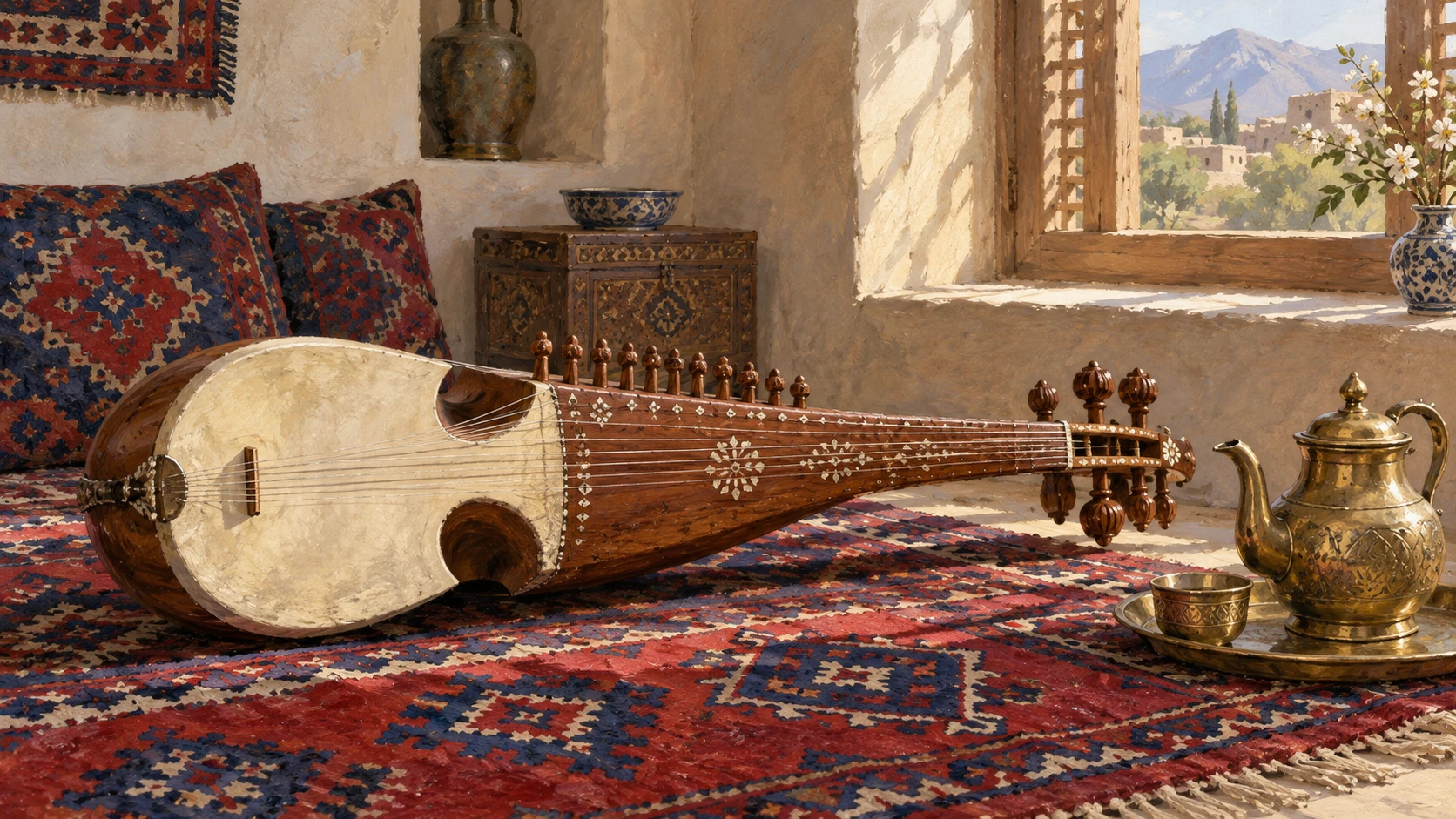
The rubab is a famous musical instrument in Afghanistan played with strings and carved from mulberry wood.
UNESCO Intangible Cultural Heritage Inscription and Safeguarding
UNESCO listed the art of making and playing the rubab as protected cultural heritage in December 2024.
This multinational listing shows that the rubab is a famous musical instrument across Central and South Asia.
Official documents give international recognition to the instrument without listing public concert schedules in Afghanistan.
Protection rules check how local communities play music instead of assuming people play in open public halls.
Modern cultural surveys focus on real oral teaching between master players and apprentices rather than guessing institutional plans.
Nomination papers explain that musicians historically played the instrument in royal courts, Sufi gatherings, and family celebrations.
Organology, Mulberry Lutherie, and Acoustic Construction
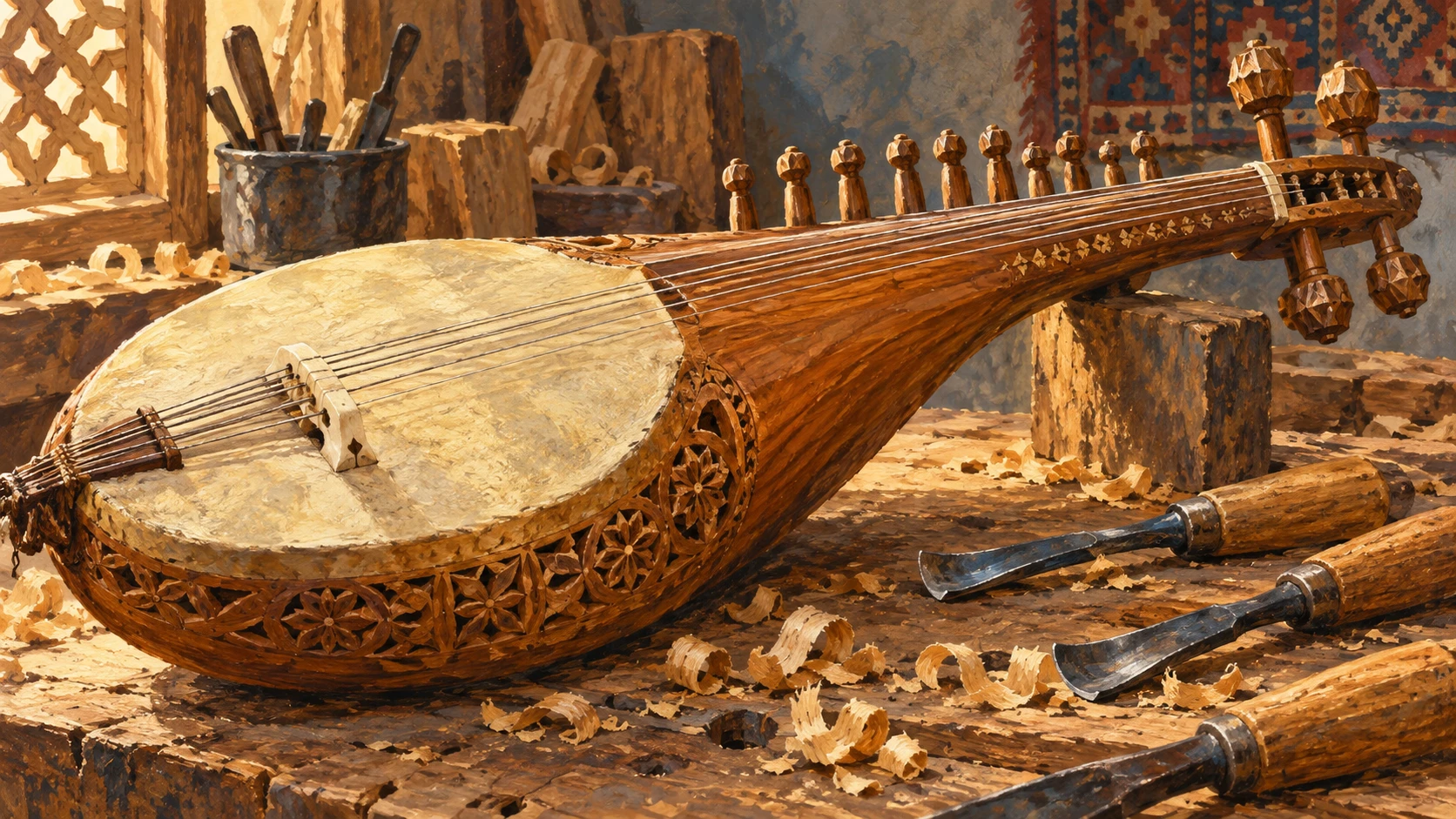
Skilled woodworkers carve the whole soundbox, neck, and pegbox from a single block of dry mulberry wood cut from a mature tree.
The wooden body has a narrow waist with a skin belly below and a hollow chest above.
Makers stretch clean goat skin over the lower bowl to make a vibrating soundboard that makes loud tones.
A small bridge made of animal bone stands on the skin to send vibrations inside the hollow chamber.
A player tunes each main melody string, three drone strings, and fifteen sympathetic strings underneath.
Craft workshops use well-aged timber so the wood will not bend or crack in dry winter air.
Modal Systems, Naghma Instrumental Forms, and Classical Ragas
Afghan players perform classical naghma songs that follow traditional modal music rules from regional raga systems.
A traditional song begins with a slow quiet intro called shakl and continues into fast rhythm with a drum.
Musicians count rhythm cycles called tal and often play fast meters like tintal and dadra.
The right hand holds a small triangular bone pick called a shahbaz to pluck the strings clearly.
Thin metal strings vibrate together in resonance to create a sweet humming sound inside the wooden body.
Players improvise melodies by strictly following traditional steps going up and down the musical scale.
Oral Transmission and the Ustad-Shagird Pedagogical Lineage
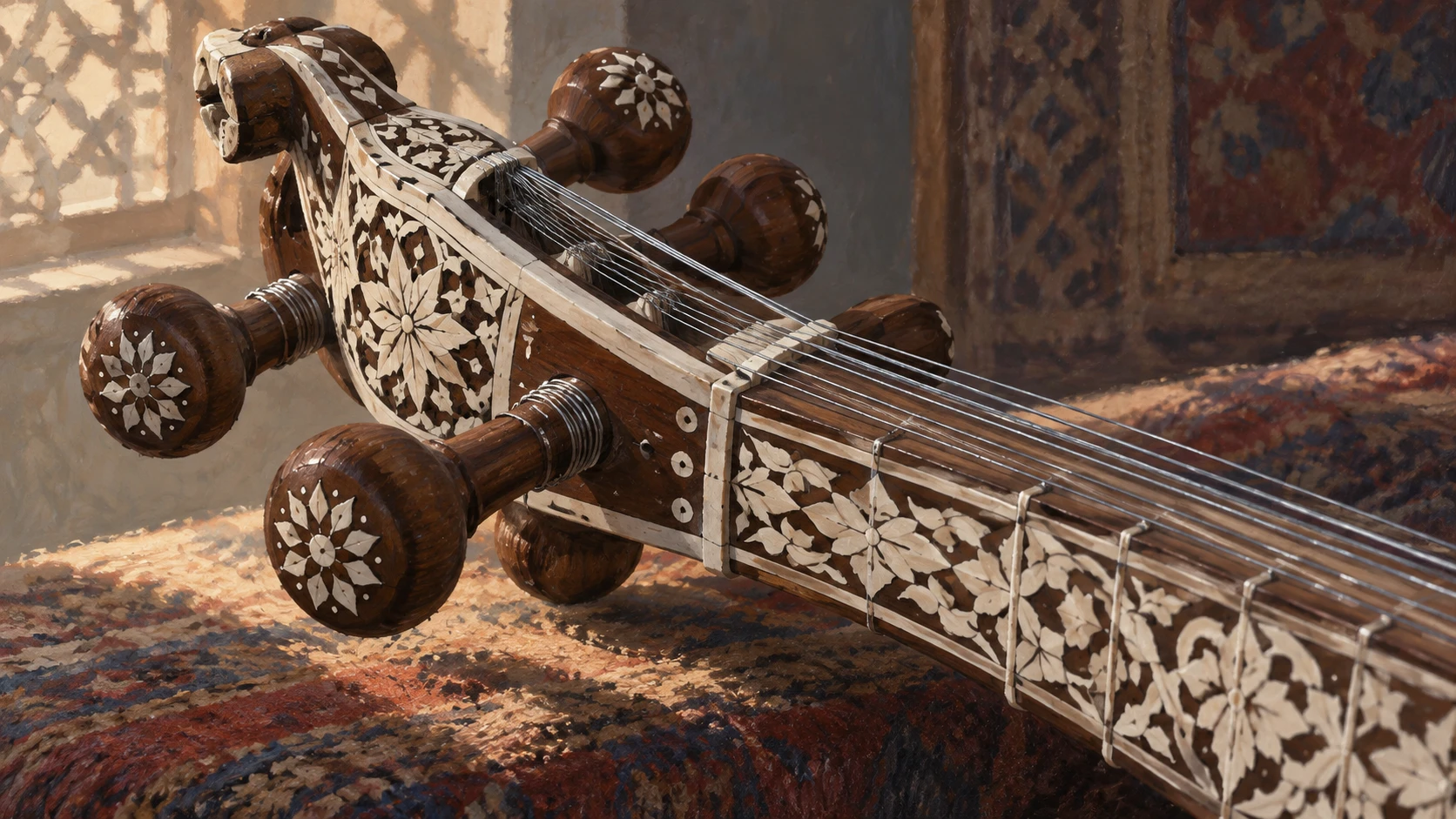
Musical knowledge passes from an experienced ustad master to a young shagird student across family generations.
Young students learn songs by listening and copying an instructor without reading written musical notes on paper.
In traditional initiation ceremonies, a master tied a sacred cord around the student wrist as a blessing.
Masters show students small ornaments, sliding notes, and gentle rhythms during daily practice sessions at home.
Recent social displacement has broken many traditional family lineages in historic musical neighborhoods of big cities.
Private lessons still take place inside quiet family homes because public music schools are not operating today.
Artisan Workshops and Urban Lutherie Clusters
Historic lutherie workshops still sit close together in old artisan quarters like the Kharabat street of Kabul.
Master luthiers use curved chisels and scrapers to carve thin wooden walls inside the mulberry body.
Craft surveys show that finding good dry mulberry logs and strong metal wire is difficult in local markets.
Recent census reports show that fewer master makers run an active woodworking shop in each historic town.
Fewer young people enter craft guilds because economic troubles push youth to seek fast daily wage labour.
Strict rules require direct consent from adult craftspeople before writers publish reports about active workshops.
Safeguarding Realities, Digital Archives, and Living Continuities
International audio archives save historical recordings of twentieth-century masters to keep classic models of playing safe.
Independent music projects record elderly players in quiet private spaces to protect rare regional musical styles.
Online sound libraries let Afghan youth in the diaspora hear ancient songs and learn traditional melodies today.
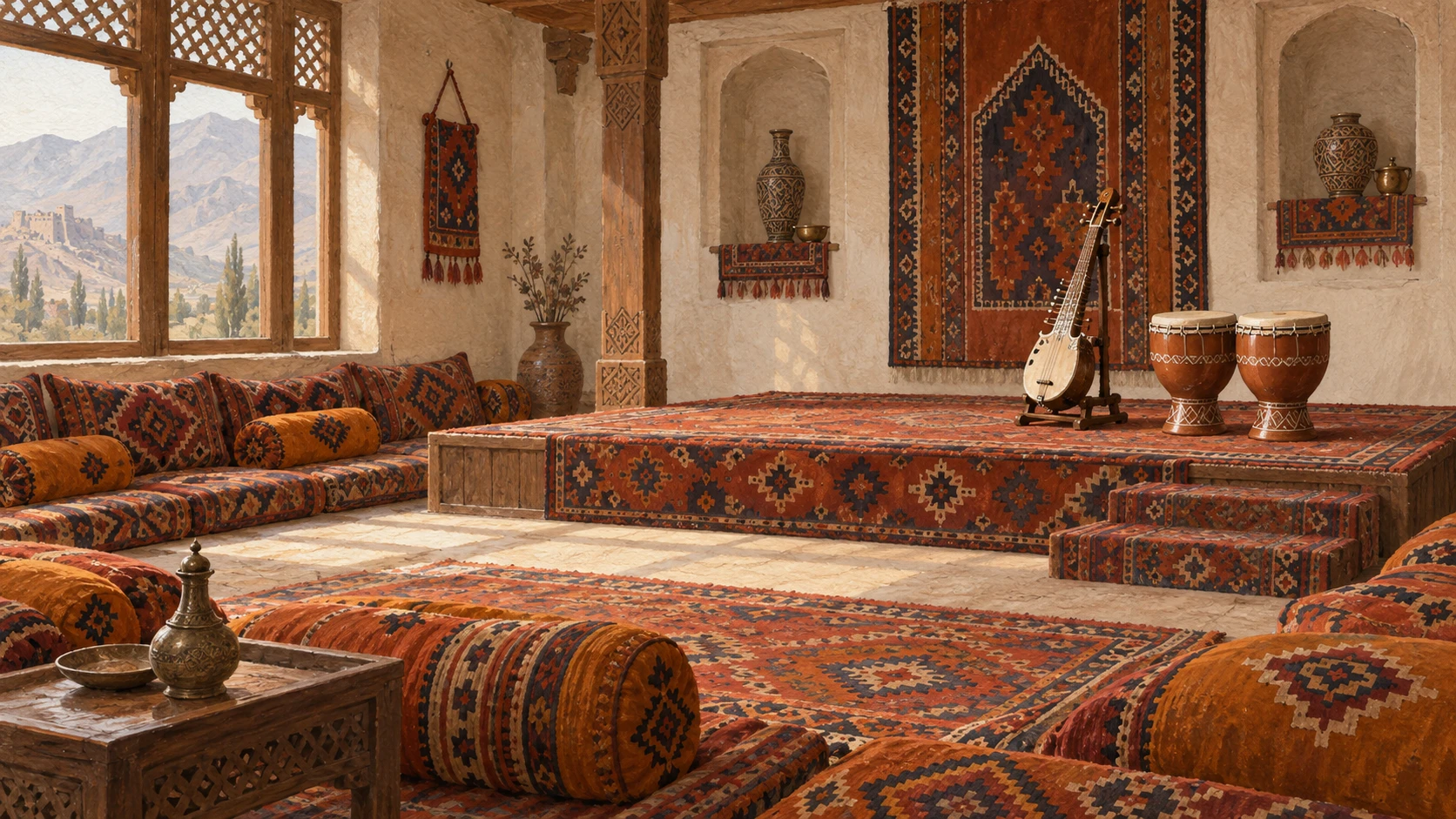
Great cultural love for the rubab keeps music alive in private homes despite restrictions on public concerts.
Foreign cultural grants support skilled luthiers and old teachers to help save endangered traditional craft methods.
Research teams follow strict ethical guidelines to protect the safety and private lives of living artists.
A2 · Elementary
Playing and Crafting the Afghan Rubab
Musicians and craftspeople keep the national rubab alive by learning songs by ear and shaping wooden soundboxes in local workshops.
UNESCO Intangible Cultural Heritage Inscription and Safeguarding
In December 2024, UNESCO placed the art of making and playing the Afghan rubab on its intangible cultural heritage list.
This multinational recognition celebrates the instrument as a central cultural treasure and living culture shared across neighboring Central and South Asian countries.
Official registration records establish international status for the tradition, but they do not describe public concert events within Afghan cities.
International preservation groups inspect community learning habits directly instead of assuming that musicians can perform in open concert halls.
Modern cultural monitoring examines authentic master-apprentice connections in neighborhoods rather than trusting institutional claims.
Historical application files show that people traditionally played the rubab in royal courts, Sufi prayer rooms, and rural wedding parties.
Organology, Mulberry Lutherie, and Acoustic Construction
Experienced artisans complete the carving of the soundbox, neck, and pegbox out of a single block of aged mulberry wood.
The instrument body has a narrow curved waist that separates a lower skin belly from a hollow wooden upper chamber.
Instrument makers pull clean goat skin tightly across the lower resonator bowl, and this membrane acts as the main vibrating soundboard.
A carved bridge made from animal bone sits right upon the tight skin to transfer string vibrations into the inner cavity.
Players adjust string tension across three primary melody strings, two drone strings, and up to fifteen thin sympathetic strings along the neck.
Carpentry workshops must dry their mulberry timber for years so that summer humidity will not warp the delicate wooden frame.
Modal Systems, Naghma Instrumental Forms, and Classical Ragas
Classical Afghan instrumental pieces follow the naghma structure, which connects directly to traditional North Indian classical raga rules.
A typical performance begins with a slow unmetered introduction called a shakl and then moves into a fast rhythm with the tabla drum.
Master musicians verify accurate tuning before counting complex rhythmic beat patterns known as tal in meters like tintal or dadra.
The musician holds a small triangular pick called a shahbaz in the right hand to strike strings with clear rhythmic power.
Steel sympathetic strings vibrate on their own when melody notes sound, creating a bright sustained echo inside the wooden chamber.
Skilled players create new variations during performance, but they must follow strict rules for ascending and descending notes in each mode.
Oral Transmission and the Ustad-Shagird Pedagogical Lineage
Teaching musical skill in Afghanistan has long relied on the personal ustad-shagird bond between an expert master and an apprentice student.
Disciples master difficult finger movements and modal grammar through patient listening and daily imitation without written sheet music.
In traditional initiation rites, an older master tied a protective cotton cord on the student wrist to welcome the youth into the lineage.
Respected masters show disciples how to slide between notes, shape ornaments, and control rhythm through daily supervised practice at home.
Recent economic troubles and population movements have broken many old family lineages in historic musical quarters of major cities.
Dedicated musicians offer each private lesson inside family rooms because formal institutional music academies cannot operate freely today.
Artisan Workshops and Urban Lutherie Clusters
Traditional woodworking artisans operate in each private workshop in old city quarters, including the historic Kharabat musical neighborhood of Kabul.
Experienced luthiers use a sharp steel chisel and flat scrapers to adjust the exact thickness of the mulberry wood shell.
Field reports indicate that craftsmen face severe shortages when searching for well-seasoned mulberry logs in the local market.
Trade records reveal that the total number of full-time independent master instrument builders has declined over recent decades.
Few young apprentices enter carpentry workshops today because urgent family financial needs force youths into simple wage labour.
Reliable editorial standards require signed permission and verified workshop interviews before researchers publish stories about working artisans.
Safeguarding Realities, Digital Archives, and Living Continuities
Scholars store valuable audio files in an overseas sound archive to maintain historic playing standards for Afghan masters.
Independent field researchers record older musicians in safe home environments to document endangered provincial melodies before they disappear.
Modern digital collections allow young Afghans living abroad to study modal grammar and listen to classic rubab recordings on personal computers.
Broad community respect for the instrument keeps domestic playing alive inside private living rooms despite public concert prohibitions.
International heritage programs provide targeted grants to elder luthiers and teachers to help sustain endangered craft methods.
Responsible field researchers follow strict privacy rules to protect the physical security and domestic privacy of living musicians.
B1 · Intermediate
Musical Heritage and Rubab Performance in Afghanistan
From mulberry woodworking to master-apprentice instruction, Afghan musicians preserve ancient modal melodies and family traditions.
UNESCO Intangible Cultural Heritage Inscription and Safeguarding
In December 2024, UNESCO officially inscribed the art of crafting and playing the rubab on the Representative List of the Intangible Cultural Heritage of Humanity.
The multilateral nomination dossier recognized the instrument as an emblem of cultural identity uniting diverse communities across Central and South Asia.
While this statutory safeguarding action confers high international visibility, official documents do not schedule or guarantee public concerts in Afghan cities.
Cultural observers emphasize verifying living domestic transmission channels directly rather than assuming that public performance stages operate without hindrance.
Modern heritage documentation prioritizes recording authentic oral teaching relationships between masters and apprentices rather than celebrating speculative institutional reforms.
Historical nomination records emphasize that the instrument enriched diverse civic settings, including royal court ensembles, Sufi devotional sessions, and festive provincial weddings.
Organology, Mulberry Lutherie, and Acoustic Construction
Skilled artisans carve the entire soundbox, neck, and lower pegbox from a single dense block of seasoned white mulberry wood.
The instrument features a distinctive waisted silhouette that divides the body into a lower leather-covered bowl and an upper hollow wooden chamber.
Craftspeople stretch treated goat parchment tightly across the lower resonator bowl, turning the dried skin into the primary acoustic soundboard.
A hand-carved bridge fashioned from mountain goat bone rests directly on the taut skin membrane, transferring string vibrations into the resonant interior.
The completed instrument carries three heavy gut or nylon melody strings, several drone strings, and up to fifteen steel sympathetic strings.
Traditional lutherie workshops require timber cured for several seasons to prevent wooden parts from warping under sharp changes in provincial humidity.
Modal Systems, Naghma Instrumental Forms, and Classical Ragas
Afghan classical rubab repertoire centers on the naghma instrumental genre, which traces its modal foundations to North Indian classical raga traditions.
A full performance opens with an unmetered melodic introduction called a shakl before transitioning into a structured metric composition with tabla accompaniment.
Instrumentalists coordinate their playing around traditional rhythmic cycles known as tal, executing compositions set in popular meters like tintal and dadra.
Plucking technique depends upon a small triangular wooden or bone plectrum called a shahbaz, which produces sharp rhythmic attacks across the strings.
Steel sympathetic strings respond in sympathetic resonance whenever corresponding melody pitches sound, creating an ethereal halo of sound inside the wooden chamber.
Instrumental improvisation demands rigorous technical discipline, requiring the performer to honor ascending and descending rules characteristic of each traditional mode.
Oral Transmission and the Ustad-Shagird Pedagogical Lineage
The transmission of instrumental knowledge in Afghanistan historically relies on the hereditary ustad-shagird tradition connecting lineage masters with committed disciples.
Apprentices absorb complex modal grammar through direct oral demonstration and constant melodic repetition without depending on printed western musical notation.
Formal initiation into a musical guild historically involved a solemn ritual where the master tied a symbolic cord around the disciple wrist.
Lineage teachers instruct young players in expressive microtonal slides, rapid plectrum variations, and subtle melodic ornaments during daily household lessons.
Widespread demographic migration and economic hardship have disrupted traditional family musical dynasties that once anchored historic urban craft quarters.
Dedicated practitioners maintain quiet private household lessons for promising youth while formal institutional music academies face extensive administrative prohibitions.
Artisan Workshops and Urban Lutherie Clusters
Historic instrument manufacturing workshops remain clustered in long-established artisanal quarters, such as the famous Kharabat neighborhood in old Kabul.
Master luthiers rely on specialized curved gouges, hand chisels, and metal scrapers to calibrate the delicate wall thickness of the mulberry body.
Field interviews report persistent supply shortages in obtaining well-aged mulberry logs, fine bone blanks, and imported musical wire from provincial bazaars.
Craft surveys record a steady contraction in the total number of full-time master artisans operating independent lutherie businesses in Afghan towns.
Urban woodworking guilds struggle to recruit apprentices because pressing family survival needs push young people into immediate daily wage labour.
Modern publishing ethics require verified artisan testimonies and signed consent before researchers document active workshop operations or identify individual craftspeople.
Safeguarding Realities, Digital Archives, and Living Continuities
International cultural sound archives safeguard historic twentieth-century field recordings of veteran rubab masters to maintain canonical performance benchmarks for future study.
Independent ethnomusicologists document senior instrumentalists in secure private settings, preserving endangered regional melodic styles that lack formal civic patronage.
A modern digital repository provides accessible learning resources for Afghan diaspora students seeking to reconnect with their ancestral musical heritage.
Strong domestic reverence for the national instrument sustains informal domestic playing among family gatherings despite widespread civic restrictions on public concerts.
International cultural preservation networks offer targeted financial assistance to elder instrument makers and teachers to sustain vulnerable craft traditions.
Systematic ethnographic fieldwork enforces strict ethical safeguards to protect the personal security, dignity, and domestic privacy of Afghan musicians.
B2 · Upper Intermediate
Modal Artistry and Organological Craft of the Afghan Rubab
Classical naghma structures, mulberry lutherie acoustics, and oral ustad-shagird lineages navigate modern social disruptions in Afghan musical life.
UNESCO Intangible Cultural Heritage Inscription and Safeguarding
In December 2024, UNESCO formally ratified the inscription of rubab craftsmanship and performance onto the Representative List of Intangible Cultural Heritage.
This multinational treaty recognizes the instrument as a quintessential cultural symbol connecting musical communities throughout Central and South Asia.
While statutory safeguarding documentation establishes multilateral recognition, treaty texts deliberately avoid guaranteeing civic authorization for public performance inside Afghanistan.
Analytical safeguarding evaluations require empirical verification of community-level transmission rather than assuming that civic cultural spaces remain accessible to musicians.
Modern cultural monitoring frameworks focus on empirical evidence from private master-disciple relationships rather than accepting speculative projections from state cultural departments.
Historical nomination dossiers substantiate that the instrument fulfilled critical functions in courtly aesthetic salons, Sufi spiritual ceremonies, and communal domestic celebrations.
Organology, Mulberry Lutherie, and Acoustic Construction
Master instrument builders hollow the integrated soundbox, neck, and lower pegbox from a single monoxyle block of mature white mulberry wood.
The acoustic chassis features a distinctive bilateral waisted contour separating the lower parchment soundboard from a hollow wooden upper chest.
Taut parchment harvested from cured goat hide forms the primary vibrating soundboard across the deep lower resonator cavity.
An intricately carved bone bridge rests directly upon the flexible skin membrane, efficiently transferring mechanical string vibrations into the resonant body.
The acoustic system accommodates three principal gut or steel melody strings, several rhythmic drone strings, and up to fifteen steel sympathetic strings.
Lutherie workshops must obtain thoroughly seasoned timber to prevent structural warping and acoustic dampening under severe seasonal humidity fluctuations.
Modal Systems, Naghma Instrumental Forms, and Classical Ragas
Classical Afghan instrumental performance revolves around the naghma structure, a sophisticated genre derived from North Indian raga modal systems.
A typical performance advances from an unmetered introductory shakl into a fixed metric composition supported by intricate accompaniment from the tabla.
Performers navigate complex rhythmic cycles known as tal, demonstrating rhythmic mastery within classical metric meters such as tintal and dadra.
Right-hand plectrum articulation utilizes a stiff triangular bone pick known as a shahbaz to execute rapid tremolos and syncopated accents.
Steel sympathetic strings vibrate in acoustic resonance with corresponding melody pitches, generating a continuous shimmering reverberation within the hollow body.
Instrumental improvisation demands rigorous technical discipline, compelling the soloist to observe strict ascending and descending modal grammar throughout each performance.
Oral Transmission and the Ustad-Shagird Pedagogical Lineage
Pedagogical transmission in Afghan musical culture historically operates through the hereditary ustad-shagird lineage, an intimate apprentice system rooted in master lineages.
Disciples acquire instrumental technique and complex modal grammar through intensive oral imitation, memorizing extensive melodic repertoires without written notation.
Formal guild initiation historically bound disciples to lineage masters through a ceremonial rite involving the ritual tying of a sacred cord.
Experienced ustads impart delicate microtones, expressive ornamentation, and precise rhythmic phrasing through intensive daily household tutorials.
Contemporary demographic dislocation, urban conflict, and social changes have severely fractured historical family dynasties in traditional musical quarters.
Field research confirms that dedicated masters maintain private instruction within domestic settings while formal music academies endure total institutional closure.
Artisan Workshops and Urban Lutherie Clusters
Historic instrument manufacturing remains geographically concentrated in traditional artisan districts such as the renowned Kharabat quarter of Kabul.
Master luthiers utilize a specialized hand gouge, curved rasps, and scrapers to calibrate the delicate wall thickness of the hollow mulberry shell.
Market surveys reveal severe supply bottlenecks in procuring properly aged mulberry logs, quality bone blanks, and imported steel musical wire.
Longitudinal artisan census data indicates a sharp numerical decline among full-time master craftsmen operating independent commercial lutherie workshops.
Apprenticeship intake within urban woodworking guilds has contracted sharply as economic pressures force younger family members into immediate manual wage labour.
Rigorous professional research standards mandate verifiable workshop documentation and informed adult consent before researchers publish field data on active instrument makers.
Safeguarding Realities, Digital Archives, and Living Continuities
International cultural sound archives preserve rare twentieth-century field recordings of master instrumentalists, establishing canonical performance baselines for ethnomusicologists.
Independent musicological documentation projects record senior virtuosos in secure private domestic settings, rescuing endangered regional modal dialects from oblivion.
Transnational digital repositories ensure that complex modal knowledge remains accessible to diaspora learners and cultural scholars across global networks.
Deep-seated cultural prestige protects the instrument from disappearance, sustaining vibrant informal domestic playing despite civic bans on public concerts.
International philanthropic foundations provide targeted safeguarding grants to elder master luthiers and teachers, preserving vulnerable manual and acoustic knowledge.
Systematic ethnographic monitoring adheres to rigorous ethical protocols to safeguard the personal security, financial stability, and privacy of living practitioners.
C1 · Advanced
The Afghan Rubab: Intangible Heritage Safeguarding, Modal Performance, and Oral Transmission
An analytical study of the 2024 UNESCO intangible heritage inscription of the rubab, classical naghma instrumental forms, mulberry wood acoustic resonance, and verified pedagogical transmission boundaries.
UNESCO Intangible Cultural Heritage Inscription and Safeguarding
In December 2024, UNESCO approved the multinational inscription of the art of crafting and playing the rubab on the Representative List of the Intangible Cultural Heritage of Humanity.
The multinational dossier formalizes international recognition of the plucked lute as a pivotal cultural asset shared across Central and South Asian traditions.
While statutory safeguarding documentation establishes multilateral recognition, the convention provides no enforceable legal mechanism to restore public concert schedules within Afghan municipal borders.
Rigorous international monitoring protocols mandate empirical verification of domestic transmission channels rather than relying on diplomatic assumptions regarding public artistic expression.
Modern cultural observation frameworks prioritize documenting verified master-apprentice lineages over speculative institutional assessments issued by administrative ministries.
Historical nomination filings underscore the instrument's enduring significance across princely court ensembles, mystical Sufi gatherings, and regional communal ceremonies.
Organology, Mulberry Lutherie, and Acoustic Construction
Traditional lutherie masters hollow the entire acoustic soundbox, structural neck, and lower pegbox from a solitary block of mature white mulberry wood.
The instrument displays a distinctive bilateral waisted morphology, demarcating a parchment-covered lower belly from an integrated upper wooden acoustic chamber.
Cured goat parchment is stretched tightly across the lower resonator bowl, functioning as an extraordinarily responsive acoustic soundboard.
An intricately carved bone bridge sits directly upon the taut skin membrane, efficiently transferring mechanical string oscillations into the resonant internal cavity.
The organological layout accommodates three principal gut melody strings, several rhythmic drone courses, and eleven to fifteen sympathetic steel strings.
Commercial lutherie operations depend upon cured mulberry timber, as inadequately aged wood inevitably warps under arid continental humidity extremes.
Modal Systems, Naghma Instrumental Forms, and Classical Ragas
Classical Afghan instrumental performance centers upon the naghma instrumental genre, an art music tradition derived from North Indian classical raga frameworks.
A canonical naghma performance unfolds from an unmetered introductory shakl before accelerating into a structured rhythmic theme accompanied by the tabla drum.
Master instrumentalists navigate intricate metric cycles known as tal, demonstrating rhythmic virtuosity across compositions set in tintal or dadra meters.
Right-hand plectrum technique relies upon a triangular bone or horn pick termed a shahbaz to execute rapid dynamic phrasing and syncopation.
Steel sympathetic strings vibrate in acoustic resonance with primary melody notes, generating a luminous harmonic reverberation throughout the hollow wooden body.
Instrumental improvisation demands rigorous technical discipline, compelling the soloist to adhere strictly to ascending and descending modal rules governing specific melodic modes.
Oral Transmission and the Ustad-Shagird Pedagogical Lineage
Pedagogical transmission in Afghan art music historically depends on the hereditary ustad-shagird instructional relationship, which preserves oral tradition across generations.
Disciples acquire instrumental virtuosity and complex modal grammar through intensive oral imitation and repetition, bypassing written western musical notation entirely.
Formal guild initiation historically bound apprentice disciples to lineage masters through a ceremonial rite centered on the tying of a protective cord.
Respected masters transmit nuanced ornamentation, subtle microtonal inflections, and sophisticated rhythmic phrasing through continuous supervised domestic practice.
Contemporary demographic dislocation and urban conflict have severely fractured traditional family dynasties within historic musical enclaves.
Pedagogical documentation confirms that private household instruction persists among dedicated masters, even as institutional academy training remains entirely paralyzed.
Artisan Workshops and Urban Lutherie Clusters
Historic instrument manufacturing remains concentrated in long-standing artisanal enclaves, most notably the storied Kharabat quarter of old Kabul.
Master luthiers utilize specialized curved gouges, hand chisels, and iron scrapers to calibrate the critical wall thickness of the mulberry body.
Field surveys record severe procurement bottlenecks in acquiring well-seasoned mulberry logs and imported German musical wire in provincial bazaars.
Artisan census records document a steep decline in the number of full-time master craftsmen operating dedicated independent lutherie workshops.
Apprenticeship intake within urban woodworking guilds has contracted sharply, as acute economic hardship drives young family members into immediate wage labour.
Rigorous professional research standards mandate verifiable workshop documentation and adult artisan consent before publishing data on active instrument makers.
Safeguarding Realities, Digital Archives, and Living Continuities
International cultural sound archives preserve canonical twentieth-century recordings of Afghan rubab masters, maintaining historical baselines for contemporary ethnomusicologists.
Independent musicological initiatives record veteran instrumentalists in secure domestic environments, documenting endangered provincial modal traditions before they vanish.
Transnational digital repositories ensure that sophisticated modal knowledge remains accessible to diaspora learners and academic researchers worldwide.
The enduring cultural prestige of the national instrument sustains private domestic playing within household gatherings despite sweeping civic prohibitions on public music.
International cultural foundations provide targeted financial grants to elder master luthiers and teachers, preserving vulnerable manual and acoustic knowledge.
Systematic ethnographic monitoring adheres to rigorous ethical protocols to safeguard the personal security, financial stability, and privacy of living practitioners.
C2 · Mastery
Organological Taxonomy, Modal Grammar, and Dispersed Lineages of the Afghan Rubab
A critical ethnomusicological inquiry into mulberry acoustics, ustad-shagird pedagogical transmission, and statutory UNESCO safeguarding amid institutional contraction in Afghanistan.
UNESCO Intangible Cultural Heritage Inscription and Safeguarding
In December 2024, UNESCO consummated the multilateral inscription of rubab craftsmanship and performance onto the Representative List of Intangible Cultural Heritage.
The inscription codifies the chordophone as an ontological cultural signifier shared across Central and South Asian civilizational spheres.
While statutory safeguarding documentation establishes multilateral recognition, the convention provides no enforceable administrative instruments to revive public performance within Afghanistan.
Rigorous safeguarding protocols necessitate the independent empirical verification of communal transmission networks rather than relying on diplomatic assumptions of civic accessibility.
Modern cultural monitoring frameworks prioritize documenting verified master-apprentice lineages over speculative institutional assessments issued by provincial ministries.
Historical nomination dossiers substantiate that the instrument fulfilled vital expressive roles within aristocratic court chambers, Sufi khanaqahs, and regional communal rituals.
Organology, Mulberry Lutherie, and Acoustic Construction
Traditional lutherie masters sculpt the integrated soundbox, structural neck, and lower pegbox from an unjoined block of mature Morus alba timber.
The instrument displays an organological taxonomy featuring a bilateral waisted profile that separates a membrane-covered lower belly from a hollow wooden upper resonator.
Taut parchment derived from cured caprine skin is affixed across the lower bowl, functioning as an extraordinarily responsive acoustic soundboard.
An intricately sculpted bone bridge rests directly upon the flexible skin membrane, transferring mechanical string vibrations into the resonant interior.
The structural taxonomy integrates three gut melody strings, several rhythmic drone strings, and eleven to fifteen sympathetic resonance strings.
Lutherie workshops depend upon thoroughly cured timber, as unseasoned wood exhibits catastrophic hygroscopic warping and acoustic damping under arid continental conditions.
Modal Systems, Naghma Instrumental Forms, and Classical Ragas
Ethnomusicological inquiry situates Afghan instrumental rubab performance within the classical naghma genre, whose scalar architecture derives from North Indian raga systems.
The tripartite performance architecture unfolds from an unmetered introductory shakl exposition into a cyclical metric composition anchored by the tabla drum.
Virtuosos articulate intricate metric cycles known as tal, executing sophisticated rhythmic cadences within standard meters such as tintal or dadra.
Manual attack relies upon a specialized bone plectrum known as a shahbaz, which delivers high-velocity percussive strikes across the melodic strings.
Auxiliary sympathetic strings resonate in acoustical sympathy with primary modal intervals, enveloping the melody in a rich shimmering sonority.
Disciplined modal improvisation demands rigorous adherence to strict ascending and descending scalar pathways defining each melodic mode.
Oral Transmission and the Ustad-Shagird Pedagogical Lineage
Pedagogical transmission historically functions through the hereditary ustad-shagird guild system, sustaining musical memory across generations.
Disciples assimilate intricate modal structures through unmediated oral imitation and rigorous melodic repetition, bypassing written western notation entirely.
Formal guild initiation historically bonded apprentice disciples to lineage masters through the symbolic investiture of a sacred tied cord.
Authoritative masters transmit subtle microtonal pitch inflections, ornate embellishments, and dynamic cadence nuances through daily supervised household tutorials.
Contemporary demographic dislocation and socioacoustic fragmentation have dismantled hereditary family dynasties in historic urban artisan quarters.
Ethnographic evidence confirms that private domestic instruction continues within secluded household settings while state music academies face structural extinction.
Artisan Workshops and Urban Lutherie Clusters
Historic artisanal woodworking workshops remain concentrated within traditional guild enclaves, most notably the historic Kharabat district of Kabul.
Master luthiers deploy specialized hand gouges, curved rasps, and scrapers to perform precision calibration of soundbox wall thickness.
Commercial field surveys document chronic supply bottlenecks in procuring properly seasoned mulberry logs and high-tensile wire in regional bazaars.
Craft census data reflects a precipitous numerical contraction among full-time independent master instrument builders operating urban workshops.
Guild apprenticeship has contracted under severe economic pressures that divert adolescent artisans away from lutherie into immediate wage labour.
Strict ethnographic research ethics require verified artisan testimonies and signed consent prior to publishing detailed accounts of active workshop operations.
Safeguarding Realities, Digital Archives, and Living Continuities
Archival cultural institutions safeguard historical twentieth-century recordings of legendary Afghan masters to establish canonical performance baselines for modern musicology.
Independent musicological initiatives record elder master instrumentalists in secure domestic environments, documenting endangered regional modal styles before they disappear.
Transnational digital repositories enable diaspora youth and global scholars to access complex oral modal knowledge across international networks.
The profound cultural prestige of the rubab sustains informal domestic playing among private family circles despite severe municipal bans on public concerts.
International cultural heritage foundations deliver documented financial grants to veteran luthiers and teachers, safeguarding endangered manual techniques.
Systematic ethnography adheres to rigorous hermeneutic protocols to preserve the physical security, professional integrity, and personal privacy of living practitioners.
Check your understanding
Choose how closely you want to revisit the article. You can refer back while answering, and review explanations when you finish.
Quick Quiz A1
Try one question, then create a free account for the full Quick Quiz. Sign Up Free
Answer every question before checking. There is no time limit.
Your results
/ 1 correct (%)
Read the explanations to see how each answer connects to the article.
-
According to the section on UNESCO Intangible Cultural Heritage Inscription and Safeguarding, what does the text identify regarding listed?
1. Answer:
Quick Quiz A2
Try one question, then create a free account for the full Quick Quiz. Sign Up Free
Answer every question before checking. There is no time limit.
Your results
/ 1 correct (%)
Read the explanations to see how each answer connects to the article.
-
According to the section on UNESCO Intangible Cultural Heritage Inscription and Safeguarding, what does the text identify regarding unesco?
1. Answer:
Quick Quiz B1
Try one question, then create a free account for the full Quick Quiz. Sign Up Free
Answer every question before checking. There is no time limit.
Your results
/ 1 correct (%)
Read the explanations to see how each answer connects to the article.
-
According to the section on UNESCO Intangible Cultural Heritage Inscription and Safeguarding, what does the text identify regarding unesco?
1. Answer:
Quick Quiz B2
Try one question, then create a free account for the full Quick Quiz. Sign Up Free
Answer every question before checking. There is no time limit.
Your results
/ 1 correct (%)
Read the explanations to see how each answer connects to the article.
-
According to the section on UNESCO Intangible Cultural Heritage Inscription and Safeguarding, what does the text identify regarding unesco?
1. Answer:
Quick Quiz C1
Try one question, then create a free account for the full Quick Quiz. Sign Up Free
Answer every question before checking. There is no time limit.
Your results
/ 1 correct (%)
Read the explanations to see how each answer connects to the article.
-
According to the section on UNESCO Intangible Cultural Heritage Inscription and Safeguarding, what does the text identify regarding unesco?
1. Answer:
Quick Quiz C2
Try one question, then create a free account for the full Quick Quiz. Sign Up Free
Answer every question before checking. There is no time limit.
Your results
/ 1 correct (%)
Read the explanations to see how each answer connects to the article.
-
According to the section on UNESCO Intangible Cultural Heritage Inscription and Safeguarding, what does the text identify regarding unesco?
1. Answer:
