A1 · Beginner
Coal Mines and Talc Rocks of Afghanistan
A basic guide to how workers dig coal and talc rocks in mountain mines.
Counting Mineral Exports
Every month, officers count the heavy stones and black rocks leaving the country. The World Bank Afghanistan Economic Monitor reports that mineral products form a leading component of official recorded merchandise exports. In summer, the July 2026 monitor records monthly mineral product export values between twenty and thirty-five million dollars. Many foreign traders pay good money for these hard mountain rocks.
These solid mineral shipments generate vital foreign currency inflows for commercial banking settlement across national banks. Government workers write down each load in big official trade registries under external tariff schedules. In small mountain towns, people wake up early to see big trucks drive down dusty dirt roads.
However, aggregate trade values summarize port invoices but do not reveal pithead extraction costs or mine site capital expenditure. Buying shovels, iron carts, and big steel tools takes a lot of money. Also, headline export sums obscure the narrow geographic origin of bulk mineral consignments across specific mountain provinces. Only a few high mountain valleys produce these heavy rocks.

Coal and Talc Custom Rules
At the border post, guards check paper books for each truck. Customs officers record bituminous and sub-bituminous coal under code 2701. This black rock is the biggest solid mineral export item sent to foreign neighbors. Customs authorities establish administrative baseline values per metric ton of raw lump coal to compute export tariffs and cess.
Drivers also carry soft white stones in open wooden crates. Inspectors classify industrial talc and steatite under code 2526. Traders sell this soft stone in crude boulders or sawn rectangular slabs to clean factories abroad. Price differentials between customs declarations and destination market deliveries reflect high freight and insurance margins charged by drivers.
Other trucks carry beautiful green and white rocks from dry riverbeds. Miners cut onyx marble and serpentinite blocks under Chapter 68 with minimal domestic processing before export. Fixed customs valuation tables buffer fiscal receipts against short-term commodity price swings in regional spot markets.
Northern Coal and Eastern Stone Pits
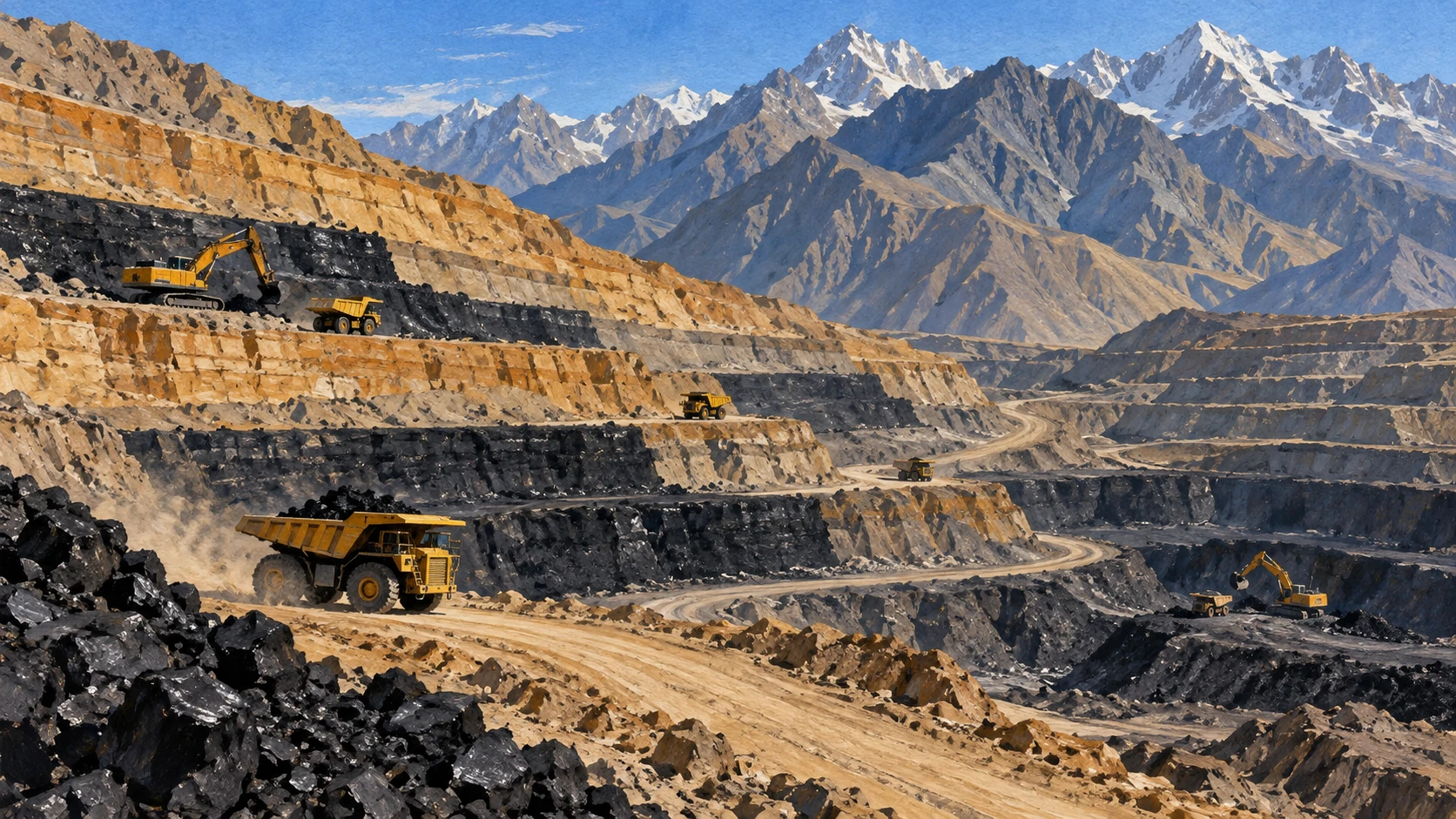
Men dig black coal in northern mountain valleys where cold winds blow. Major coal production is concentrated in northern deposits, including the Dara-i-Suf basin in Samangan and Karkar pits in Baghlan. In the Dara-i-Suf basin, steep geological inclinations require room-and-pillar tunneling alongside open benches. Miners dig deep shafts into dark stone walls.
Far to the east, industrial talc extraction is concentrated in the Spinghar mountain belt of Sherzad and Khogyani districts in Nangarhar Province. High in these green hills, talc quarries operate through terraced bench excavations using steel diamond wire saws and diesel hydraulic excavators. Men cut giant white blocks under the bright morning sun.
Life in the high mountains is very cold and quiet. Winter snowfalls and freezing temperatures routinely suspend open-pit coal extraction in high-elevation northern valleys. Deep snow blocks dirt tracks for weeks. Because remote quarry pits lack grid electricity, teams need regular diesel fuel deliveries to power drainage pumps and sorting screens.

Trucks on Mountain Highways
Early in the morning, drivers start noisy engines and drink warm green tea with flat bread. Heavy freight trucks carry coal southward across the high Salang corridor to fuel brick kilns and regional industrial consumers near city markets. Other drivers carry coal eastward through Torkham, Ghulam Khan, and Dand-e-Patan border crossing posts into neighboring cities.
The long roads have deep holes and sharp turns along steep mountain cliffs. Provincial weighbridge stations monitor truck axle loads to prevent pavement destruction on mountain asphalt highways. High trucking tariffs and fuel costs absorb more than half of the delivered market value of raw mineral commodities. Drivers spend days sleeping in their truck cabs.
Long lines form near border gates as guards inspect papers. Lengthy inspection queues and weighbridge bottlenecks at border terminals create demurrage charges for mineral haulers waiting in the heat. In the north, mineral flows to Central Asian markets transit through Hairatan dry port using broad-gauge railway flatcars.
Mining Rules and the Environment
Government leaders make rules to protect mountain land and collect money. The Ministry of Mines and Petroleum tenders extraction rights through five-year and ten-year exploration and exploitation contracts to private companies. These concession contracts mandate production royalties calculated as a percentage of assessed pithead commodity tonnage.
These mineral royalties and transit cess represent vital domestic revenue streams allocated to the central state budget. The state uses this money for public administration. Concession rules also require operators to construct settled tailings dams and implement basic erosion control earthworks to stop mud from sliding down hills.
Clear mountain water is very precious for farming families. Environmental regulations prohibit discharging untreated acidic mine drainage into seasonal irrigation canals and river channels where children play and sheep drink. However, limited field inspectorate capacity at remote extraction sites creates enforcement gaps in environmental oversight in lonely valleys.

Miners and Mountain Towns
Village men walk up steep dirt trails each morning carrying metal lunch tins. Underground coal extraction relies heavily on manual labour with pickaxes, handheld pneumatic drills, and timber props to keep rocks from falling. Day labourers earn piece-rate wages tied directly to the volume of extracted mineral tonnage hauled to pithead collection yards.
Working inside dark tunnels is dangerous and dusty. Many artisanal coal pits operate with minimal safety gear, exposing workers to roof-fall hazards and fine coal dust inhalation during long shifts. Yet these busy pits stimulate secondary rural markets for diesel supply, vehicle tire repair, and roadside tea houses where villagers sell hot soup and bread.
Most money from mineral trucks goes to big banks in large cities. Macroeconomic mineral export revenues remain concentrated among central fiscal accounts rather than local community public works in poor mining villages. Policy analysts emphasize that sustainable resource development requires formalizing worker safety standards and local processing facilities.
A2 · Elementary
Mountain Pits and Mineral Convoys: Practical Realities of Afghan Mining
An elementary overview of daily routines for coal haulers, quarry workers, weighbridge inspectors, and local traders.
Tracking Mineral Output in National Registers
Official updates from the World Bank Afghanistan Economic Monitor show that mineral products represent a leading component of official recorded merchandise exports. The July 2026 monitor records monthly mineral product export values fluctuating between twenty and thirty-five million dollars. Across regional provinces, these solid mineral shipments generate essential foreign currency inflows for commercial banking settlement across national banking networks.
Customs officers record these mineral export goods under external tariff schedules at border stations. However, aggregate trade values summarize port invoices but do not reveal pithead extraction costs or mine site capital expenditure. Purchasing heavy metal shovels, replacement drill bits, and hydraulic hoses requires steady private capital from small enterprise owners.
In addition, headline export sums obscure the narrow geographic origin of bulk mineral consignments across specific mountain provinces. Most bulk mineral shipments originate from only a handful of remote mountain districts where families have lived for generations.
Customs Codes and Official Benchmark Pricing
Border agencies classify bituminous and sub-bituminous coal under HS code 2701, which represents the single largest solid mineral export category. Customs authorities establish administrative baseline values per metric ton of raw lump coal to compute export tariffs and cess. These official benchmarks ensure consistent revenue collection regardless of invoice fluctuations.
Officers classify shipments of industrial talc and steatite under HS code 2526, shipped predominantly in crude boulders or sawn rectangular slabs. Cross-border price differentials between customs declarations and destination market deliveries reflect high freight and insurance margins charged by regional trucking syndicates navigating rough unpaved mountain roads.
Furthermore, quarry operators ship onyx marble and serpentinite blocks classified under Chapter 68 with minimal domestic processing prior to export. Fixed customs valuation tables buffer fiscal receipts against short-term commodity price swings in regional spot markets.
Northern Coal Seams and Eastern Mountain Quarries
Major commercial coal production is concentrated in northern deposits, including the Dara-i-Suf basin in Samangan and Karkar pits in Baghlan. In the Dara-i-Suf valley, coal seams feature steep geological inclinations that require artisanal room-and-pillar tunneling alongside open benches. Work underground proceeds slowly through thick mountain rock as miners carry pickaxes through narrow chambers.
To the east, industrial talc extraction is concentrated in the Spinghar mountain belt of Sherzad and Khogyani districts in Nangarhar Province. These commercial talc quarries operate through terraced bench excavations using steel diamond wire saws and diesel hydraulic excavators to slice white stone blocks from cliffs. Quarry crews stack the blocks neatly on flat timber skids.
Severe winter snowfalls and freezing temperatures routinely suspend open-pit coal extraction in high-elevation northern valleys. Because remote quarry pits lack grid electricity, operators require continuous diesel fuel deliveries to power drainage pumps and sorting screens throughout the mining season, keeping deep shafts free of icy water.
Hauling Heavy Rock Across Mountain Corridors
Heavy freight trucks carry coal southward across the steep Salang corridor to fuel brick kilns and regional industrial consumers near urban centers. At the same time, a substantial portion of extracted coal moves eastward through Torkham, Ghulam Khan, and Dand-e-Patan border crossing posts destined for foreign power stations.
Provincial weighbridge stations monitor truck axle loads to prevent pavement destruction on mountainous asphalt highways. Operating these convoys remains expensive, as high trucking tariffs and fuel costs absorb more than half of the delivered market value of raw mineral commodities. Drivers sleep in their truck cabs and buy hot flatbread at roadside teahouses.
Lengthy inspection queues and weighbridge bottlenecks at border terminals create demurrage charges for mineral haulers waiting in line. In the north, mineral flows to Central Asian markets transit through Hairatan dry port using broad-gauge railway flatcars loaded with heavy cargo.
Mining Contracts and Environmental Rules
The Ministry of Mines and Petroleum tenders extraction rights through five-year and ten-year exploration and exploitation contracts to formal commercial enterprises. Concession agreements mandate production royalties calculated as a percentage of assessed pithead commodity tonnage.
These mineral royalties and transit cess represent vital domestic revenue streams allocated to the central state budget. Formal agreements also require operators to construct settled tailings dams and implement basic erosion control earthworks on surrounding slopes to stop seasonal mudslides from destroying mountain terraces.
National environmental regulations explicitly prohibit discharging untreated acidic mine drainage into seasonal irrigation canals and river channels used by downstream villages. However, limited field inspectorate capacity at remote extraction sites creates enforcement gaps in environmental oversight across isolated mountain ravines.
Miners, Daily Wages, and Local Businesses
Underground coal extraction relies heavily on manual labour with pickaxes, handheld pneumatic drills, and timber props. Day labourers earn piece-rate wages tied directly to the volume of extracted mineral tonnage hauled to pithead collection yards each afternoon, walking home with soot on their hands and faces.
Most artisanal coal pits operate with minimal safety gear, exposing workers to roof-fall hazards and fine coal dust inhalation during long shifts. Despite difficult working conditions, mining operations stimulate secondary rural markets for diesel supply, vehicle tire repair, and roadside tea houses where drivers and villagers gather to drink tea.
Nevertheless, macroeconomic mineral export revenues remain concentrated among central fiscal accounts rather than local community public works. Policy analysts emphasize that sustainable resource development requires formalizing worker safety standards and local processing facilities.
B1 · Intermediate
Veins of the Hindu Kush: Extraction, Transport, and Livelihoods in Afghan Mining
An intermediate study of northern coal basins, eastern talc hills, highway trucking logistics, and mining community life.
Mineral Output and National Trade Ledgers
Across the rugged mountain provinces of the Hindu Kush, the extraction of solid minerals has emerged as a central pillar of the national economy. Regular assessments published in the World Bank Afghanistan Economic Monitor confirm that mineral products constitute a leading component of official recorded merchandise exports. The July 2026 monitor records monthly mineral product export values fluctuating between twenty and thirty-five million dollars, providing hard currency that stabilizes broader commercial commerce.
These consistent solid mineral shipments generate essential foreign currency inflows for commercial banking settlement, enabling import merchants to clear foreign trade contracts. Border posts record every outgoing consignment under external tariff schedules designed to standardize export taxes. Yet economic observers note that aggregate trade values summarize port invoices but do not reveal pithead extraction costs or mine site capital expenditure required to establish working shafts.
Furthermore, headline export sums obscure the narrow geographic origin of bulk mineral consignments across specific mountain provinces. While export statistics appear on national balance sheets, the actual physical wealth emerges from deep ravines where mountain communities navigate difficult topography and limited modern machinery.
Customs Classifications and Benchmark Valuation
When mineral convoys arrive at frontier gates, customs officers verify classifications using international trade codes. Bituminous and sub-bituminous coal is recorded under HS code 2701, representing the single largest solid mineral export category by both weight and monetary value. To maintain administrative uniformity, customs authorities establish administrative baseline values per metric ton of raw lump coal to compute export tariffs and cess.
In the eastern borderlands, shipments of industrial talc and steatite are classified under HS code 2526, shipped predominantly in crude boulders or sawn rectangular slabs bound for processing mills abroad. Market analysts observe that cross-border price differentials between customs declarations and destination market deliveries reflect high freight and insurance margins charged by long-haul trucking companies operating across mountain terrain.
Similarly, prized architectural stones like onyx marble and serpentinite blocks classified under Chapter 68 undergo minimal domestic processing prior to export. To insulate the treasury from volatile world markets, fixed customs valuation tables buffer fiscal receipts against short-term commodity price swings in regional spot markets.
The Geography of Coal Seams and Eastern Talc Quarries
The physical landscape of Afghan mining is distinctly clustered. Major coal production is concentrated in northern deposits, including the Dara-i-Suf basin in Samangan and Karkar pits in Baghlan. Within the rugged Dara-i-Suf basin, thick coal seams feature steep geological inclinations that require artisanal room-and-pillar tunneling alongside open benches, forcing miners to carve narrow chambers deep beneath sandstone layers.
Hundreds of kilometers to the east, industrial talc extraction is concentrated in the Spinghar mountain belt of Sherzad and Khogyani districts in Nangarhar Province. Here, open-air talc quarries operate through terraced bench excavations using steel diamond wire saws and diesel hydraulic excavators, carefully slicing huge white mineral blocks from the mountainside.
Both mining regions struggle against environmental isolation. Severe winter snowfalls and freezing temperatures routinely suspend open-pit coal extraction in high-elevation northern valleys, trapping equipment under heavy snow. Compounding these seasonal disruptions, remote quarry pits lack grid electricity, requiring continuous diesel fuel deliveries to power drainage pumps and sorting screens in order to prevent flooded shafts.
Highway Transit Across Mountain Passes
Transporting bulk rock across Afghanistan requires navigating formidable geographical obstacles. Heavy freight trucks carry coal southward across the Salang corridor to fuel brick kilns and regional industrial consumers in Kabul and eastern provinces. Simultaneously, a substantial portion of extracted coal moves eastward through Torkham, Ghulam Khan, and Dand-e-Patan border crossing posts bound for cross-border industrial furnaces.
To protect vulnerable infrastructure, provincial weighbridge stations monitor truck axle loads to prevent pavement destruction on mountainous asphalt highways. The economics of road transport remain punishing, as high trucking tariffs and fuel costs absorb more than half of the delivered market value of raw mineral commodities.
Logistical friction at the border also cuts into profits. Lengthy inspection queues and weighbridge bottlenecks at border terminals create demurrage charges for mineral haulers stranded along the highway. In contrast, northern mineral flows to Central Asian markets transit through Hairatan dry port using broad-gauge railway flatcars, offering a more efficient rail route for bulk freight.
Concession Contracts and Environmental Safeguards
The formal exploitation of Afghan resources operates under strict legal frameworks. The Ministry of Mines and Petroleum tenders extraction rights through five-year and ten-year exploration and exploitation contracts to qualified domestic and regional firms. These extraction concessions mandate production royalties calculated as a percentage of assessed pithead commodity tonnage.
Revenues collected from mineral royalties and transit cess represent vital domestic revenue streams allocated to the central state budget, underwriting vital government operations. In exchange for extraction licenses, concession agreements require operators to construct settled tailings dams and implement basic erosion control earthworks across excavated hillsides.
Environmental protection forms another essential statutory requirement. National environmental regulations prohibit discharging untreated acidic mine drainage into seasonal irrigation canals and river channels that downstream farmers depend upon for agriculture. However, limited field inspectorate capacity at remote extraction sites creates enforcement gaps in environmental oversight, allowing ecological damage to persist in isolated canyons.
Labour Conditions and Mining Town Economies
Beyond high-level trade statistics lies the daily physical struggle of extraction. Underground coal extraction relies heavily on manual labour with pickaxes, handheld pneumatic drills, and timber props, requiring exceptional physical endurance from local diggers. Day labourers earn piece-rate wages tied directly to the volume of extracted mineral tonnage hauled to pithead collection yards.
Safety standards remain rudimentary across the sector. Artisanal coal pits operate with minimal safety gear, exposing workers to roof-fall hazards and fine coal dust inhalation during long subterranean shifts. Yet the presence of mining operations stimulates secondary rural markets for diesel supply, vehicle tire repair, and roadside tea houses, infusing remote valleys with commercial cash.
A persistent imbalance remains in how mining wealth is distributed. Macroeconomic mineral export revenues remain concentrated among central fiscal accounts rather than local community public works, leaving mining villages with unimproved roads and basic clinics. Consequently, policy analysts emphasize that sustainable resource development requires formalizing worker safety standards and local processing facilities.
B2 · Upper Intermediate
Solid Minerals Beyond the Ledger: Economic Mechanics and Extraction Realities in Afghanistan
An analytical investigation of recorded mineral trade data, northern coal seams, eastern talc quarries, transport cost structures, and mining community impacts.
Macroeconomic Trade Metrics and Fiscal Significance
In the contemporary Afghan economy, the primary extractive sector plays a decisive role in sustaining balance of payments equilibrium. Official assessments compiled in the World Bank Afghanistan Economic Monitor confirm that mineral products constitute a leading component of official recorded merchandise exports, anchoring total export value amidst contractions in other commercial sectors. The July 2026 monitor records monthly mineral product export values fluctuating between twenty and thirty-five million dollars, providing an essential foundation for the formal external accounts.
These consistent solid mineral shipments generate essential foreign currency inflows for commercial banking settlement, which commercial financial institutions utilize to facilitate essential consumer goods imports. At border terminals, customs officials record mineral export goods under external tariff schedules that establish formal fiscal liabilities. However, development economists caution that aggregate trade values summarize port invoices but do not reveal pithead extraction costs or mine site capital expenditure required to maintain operational shafts.
Consequently, headline export sums obscure the narrow geographic origin of bulk mineral consignments across specific mountain provinces. Rather than reflecting widespread national industrialization, recorded mineral revenues derive from concentrated geographic nodes where mineral deposits intersect with accessible road corridors.
Tariff Classification and Administrative Price Valuation
Regulating cross-border mineral flows requires precise administrative instruments to balance fiscal extraction against trade facilitation. Customs registries record bituminous and sub-bituminous coal under HS code 2701, representing the single largest solid mineral export category by both physical volume and statutory customs yield. To prevent arbitrary local assessment, customs authorities establish administrative baseline values per metric ton of raw lump coal to compute export tariffs and cess.
In parallel, industrial talc and steatite are classified under HS code 2526, shipped predominantly in crude boulders or sawn rectangular slabs to foreign processing hubs. Empirical market studies demonstrate that cross-border price differentials between customs declarations and destination market deliveries reflect high freight and insurance margins imposed by mountain transit risks and transport bottlenecks.
Furthermore, ornamental stone shipments, including onyx marble and serpentinite blocks classified under Chapter 68, undergo minimal domestic processing prior to export, depriving the domestic economy of downstream value addition. To stabilize state income against global volatility, fixed customs valuation tables buffer fiscal receipts against short-term commodity price swings in regional spot markets.
Geological Formations and Extraction Constraints
The extraction architecture of Afghanistan is sharply defined by its complex geology. Major coal production is concentrated in northern deposits, including the Dara-i-Suf basin in Samangan and Karkar pits in Baghlan. Within the Dara-i-Suf deposits, coal seams feature steep geological inclinations that require artisanal room-and-pillar tunneling alongside open benches, creating severe structural stability challenges for underground workings.
In contrast, industrial talc extraction is concentrated in the Spinghar mountain belt of Sherzad and Khogyani districts in Nangarhar Province, where massive hydrothermal deposits lie near the surface. These talc quarries operate through terraced bench excavations using steel diamond wire saws and diesel hydraulic excavators to quarry large dimensional blocks without shattering internal crystalline structures.
Operational continuity across both extractive sectors is heavily constrained by climate and infrastructure deficits. Winter snowfalls and freezing temperatures routinely suspend open-pit coal extraction in high-elevation northern valleys, halting surface haulage for months. Moreover, remote quarry pits lack grid electricity, requiring continuous diesel fuel deliveries to power drainage pumps and sorting screens in isolated mountain valleys.
Mountain Highway Logistics and Weighbridge Enforcement
Moving dense mineral commodities from pitheads to international markets involves traversing difficult mountain routes. Heavy freight trucks carry coal southward across the Salang corridor to fuel brick kilns and regional industrial consumers in the Kabul basin. Simultaneously, a substantial portion of extracted coal moves eastward through Torkham, Ghulam Khan, and Dand-e-Patan border crossing posts toward regional manufacturing centers.
To mitigate accelerated road wear, provincial weighbridge stations monitor truck axle loads to prevent pavement destruction on mountainous asphalt highways. The financial overhead of this transport network is formidable, as high trucking tariffs and fuel costs absorb more than half of the delivered market value of raw mineral commodities, constraining mine site margins.
Logistical inefficiencies at frontier terminals further amplify overhead costs. Lengthy inspection queues and weighbridge bottlenecks at border terminals create demurrage charges for mineral haulers stranded along the highway. In contrast, northern mineral flows to Central Asian markets transit through Hairatan dry port using broad-gauge railway flatcars, providing a more capital-efficient bulk logistics mechanism.
Concession Architecture and Environmental Compliance
State administration of mineral wealth relies on formalized contractual instruments. The Ministry of Mines and Petroleum tenders extraction rights through five-year and ten-year exploration and exploitation contracts designed to attract private investment into formal extraction zones. These extraction concessions mandate production royalties calculated as a percentage of assessed pithead commodity tonnage.
Revenues generated through mineral royalties and transit cess represent vital domestic revenue streams allocated to the central state budget, providing critical non-aid fiscal resources for central administration. Contract terms legally require operators to construct settled tailings dams and implement basic erosion control earthworks across steep excavation cuts.
From an ecological perspective, national environmental regulations explicitly prohibit discharging untreated acidic mine drainage into seasonal irrigation canals and river channels that sustain downstream agrarian communities. Nevertheless, limited field inspectorate capacity at remote extraction sites creates enforcement gaps in environmental oversight, allowing unregulated runoff to compromise local watersheds.
Labour Economics and Mining Community Realities
At the base of the extractive hierarchy sits an intensive manual labour system. Underground coal extraction relies heavily on manual labour with pickaxes, handheld pneumatic drills, and timber props, operating with minimal mechanical assistance. Day labourers earn piece-rate wages tied directly to the volume of extracted mineral tonnage hauled to pithead collection yards, linking individual income directly to physical output.
Occupational safety conditions remain precarious throughout the sector. Artisanal coal pits operate with minimal safety gear, exposing workers to roof-fall hazards and fine coal dust inhalation over extended underground shifts. However, mining operations stimulate secondary rural markets for diesel supply, vehicle tire repair, and roadside tea houses, creating crucial non-farm livelihood opportunities in remote mountain districts.
Despite localized economic dynamism, structural fiscal disparities persist across the extractive landscape. Macroeconomic mineral export revenues remain concentrated among central fiscal accounts rather than local community public works, leaving host communities with limited institutional benefits. Policy analysts emphasize that sustainable resource development requires formalizing worker safety standards and local processing facilities.
C1 · Advanced
Coal Seams and Talc Quarries: Afghanistan's Mineral Records Beyond Headline Values
An empirical investigation into recorded mineral export classifications, northern coal extraction sites, eastern talc quarries, transport cost structures, and mining town economies.
Trade Data and Mineral Shipments
In an economy characterized by severe trade deficits and constrained industrial output, the extractive sector provides an indispensable source of foreign exchange. The World Bank Afghanistan Economic Monitor reports that mineral products constitute a leading component of official recorded merchandise exports, demonstrating the sector's pivotal macroeconomic weight. The July 2026 monitor records monthly mineral product export values fluctuating between twenty and thirty-five million dollars, offering vital fiscal and external liquidity amid broader economic contraction.
Macroeconomic updates note that solid mineral shipments generate essential foreign currency inflows for commercial banking settlement, supporting commercial letters of credit for staple food and fuel imports. At national frontier posts, official trade registries record mineral export goods under external tariff schedules that establish formal fiscal obligations. Nevertheless, aggregate trade values summarize port invoices but do not reveal pithead extraction costs or mine site capital expenditure required to develop geological reserves.
Crucially, headline export sums obscure the narrow geographic origin of bulk mineral consignments across specific mountain provinces. While macroeconomic balance sheets register consolidated monetary values, the physical extraction occurs within isolated mountain valleys, where logistical bottlenecks and geological complexity govern actual output capacity.
Customs Codes and Fixed Valuation
Regulating the cross-border flow of bulk minerals demands standardized administrative instruments that insulate public revenue from market fluctuations. Bituminous and sub-bituminous coal is recorded under HS code 2701, representing the single largest solid mineral export category by physical volume and aggregate customs value. To standardize fiscal capture, customs authorities establish administrative baseline values per metric ton of raw lump coal to compute export tariffs and cess.
A parallel dynamic characterizes the trade in soft industrial minerals, where industrial talc and steatite are classified under HS code 2526, shipped predominantly in crude boulders or sawn rectangular slabs to regional grinding mills. Significant cross-border price differentials between customs declarations and destination market deliveries reflect high freight and insurance margins imposed by hazardous highway corridors and regional transit risk.
Similarly, high-grade ornamental stone, such as onyx marble and serpentinite blocks classified under Chapter 68, undergo minimal domestic processing prior to export, depriving domestic artisans of value-added fabrication margins. To ensure predictability in fiscal planning, fixed customs valuation tables buffer fiscal receipts against short-term commodity price swings in regional spot markets.
Northern Coalfields and Eastern Talc Sites
The geography of extraction in Afghanistan reflects complex tectonic belts that dictate physical mining methods. Major coal production is concentrated in northern deposits, including the Dara-i-Suf basin in Samangan and Karkar pits in Baghlan. In the Dara-i-Suf basin, thick coal seams feature steep geological inclinations that require artisanal room-and-pillar tunneling alongside open benches, requiring miners to negotiate hazardous structural roof pressures beneath towering mountain ridges.
In the eastern mountain ranges, industrial talc extraction is concentrated in the Spinghar mountain belt of Sherzad and Khogyani districts in Nangarhar Province. These high-purity deposits are exploited through terraced bench excavations using steel diamond wire saws and diesel hydraulic excavators to cut massive geometric blocks directly from marbleized limestone hillsides.
Both northern and eastern mining districts operate under acute environmental constraints. Severe winter snowfalls and freezing temperatures routinely suspend open-pit coal extraction in high-elevation northern valleys, cutting access routes for months. Furthermore, remote quarry pits lack grid electricity, requiring continuous diesel fuel deliveries to power drainage pumps and sorting screens in order to maintain continuous operations.
Mountain Highways and Weighbridge Scales
Transporting dense mineral wealth from remote extraction nodes to international borders entails formidable logistics challenges. Heavy freight trucks carry coal southward across the Salang corridor to fuel brick kilns and regional industrial consumers across the Kabul plateau. Concurrently, a substantial portion of extracted coal moves eastward through Torkham, Ghulam Khan, and Dand-e-Patan border crossing posts bound for cross-border industrial complexes.
To curb catastrophic damage to national road networks, provincial weighbridge stations monitor truck axle loads to prevent pavement destruction on mountainous asphalt highways. However, the economics of road haulage remain punishing, as high trucking tariffs and fuel costs absorb more than half of the delivered market value of raw mineral commodities, compressing producer profit margins.
Border infrastructure constraints further complicate transport schedules. Lengthy inspection queues and weighbridge bottlenecks at border terminals create demurrage charges for mineral haulers immobilized along highway shoulders. In contrast, northern mineral flows to Central Asian markets transit through Hairatan dry port using broad-gauge railway flatcars, offering a more efficient rail transshipment alternative for bulk freight.
Mining Contracts and Environmental Rules
State governance of the extractive sector relies on formal contractual licensing to secure public revenue and enforce statutory standards. The Ministry of Mines and Petroleum tenders extraction rights through five-year and ten-year exploration and exploitation contracts to private commercial entities. These extraction concessions mandate production royalties calculated as a percentage of assessed pithead commodity tonnage.
Revenues derived from mineral royalties and transit cess represent vital domestic revenue streams allocated to the central state budget, providing essential non-tax fiscal income for the national administration. Concession contracts stipulate specific environmental safeguards, requiring operators to construct settled tailings dams and implement basic erosion control earthworks on surrounding slopes.
Statutory frameworks also seek to preserve agricultural resources. Environmental regulations prohibit discharging untreated acidic mine drainage into seasonal irrigation canals and river channels that sustain downstream farming villages. However, limited field inspectorate capacity at remote extraction sites creates enforcement gaps in environmental oversight, allowing ecological damage to persist in isolated river basins.
Mining Labour and Community Life
Beneath the formal institutional framework lies an arduous manual labour regime. Underground coal extraction relies heavily on manual labour with pickaxes, handheld pneumatic drills, and timber props, demanding relentless physical toil from rural workforces. Day labourers earn piece-rate wages tied directly to the volume of extracted mineral tonnage hauled to pithead collection yards each day.
Workplace safety conditions remain profoundly deficient throughout the artisanal sector. Artisanal coal pits operate with minimal safety gear, exposing workers to roof-fall hazards and fine coal dust inhalation during long subterranean shifts. Yet the sector remains an indispensable economic lifeline, as mining operations stimulate secondary rural markets for diesel supply, vehicle tire repair, and roadside tea houses across isolated districts.
A glaring divergence persists between national fiscal accounting and local development outcomes. Macroeconomic mineral export revenues remain concentrated among central fiscal accounts rather than local community public works, leaving extraction regions with minimal social infrastructure. Consequently, policy analysts emphasize that sustainable resource development requires formalizing worker safety standards and local processing facilities.
C2 · Mastery
The Political Ecology of Afghan Extractivism: Spatial Fractures, Fiscality, and Commodity Frontiers
A scholarly treatise examining the institutional political economy of solid mineral extraction, customs classification mechanisms, transport friction, and mountain labor regimes.
Epistemologies of Mineral Accounting and Macroeconomic Extraction
The structural insertion of the Afghan economy into regional accumulation regimes is fundamentally mediated by raw material extractivism. Empirical tabulations within the World Bank Afghanistan Economic Monitor confirm that mineral products constitute a leading component of official recorded merchandise exports, serving as the paramount macroeconomic pillar in the formal trade ledger. Specifically, the July 2026 monitor records monthly mineral product export values fluctuating between twenty and thirty-five million dollars, providing the primary ballast for sovereign balance-of-payments accounting amidst broad-based industrial stagnation.
Sustained solid mineral shipments generate essential foreign currency inflows for commercial banking settlement, endowing the central financial system with critical liquidity to finance foreign import transactions. At national frontier posts, state customs registries classify mineral export goods under external tariff schedules that formalize fiscal extraction. However, rigorous macroeconomic critique demonstrates that aggregate trade values summarize port invoices but do not reveal pithead extraction costs or mine site capital expenditure required to establish working subterranean shafts.
Infrastructurally, headline export sums obscure the narrow geographic origin of bulk mineral consignments across specific mountain provinces. This statistical abstraction masks the extreme spatial concentration of primary extraction within isolated mountain pockets, where geological rent extraction operates largely disconnected from diversified territorial development.
Taxonomic Regimes and Fiscal Valuation Mechanisms
The bureaucratic rationalization of primary mineral trade requires codified customs nomenclatures that establish administrative certainty over fiscal transfers. Customs authorities systematically record bituminous and sub-bituminous coal under HS code 2701, representing the single largest solid mineral export category by physical mass and statutory fiscal yield. To preempt commercial under-invoicing, customs authorities establish administrative baseline values per metric ton of raw lump coal to compute export tariffs and cess.
Concurrently, the extraction of soft industrial minerals is codified under international trade frameworks, where industrial talc and steatite are classified under HS code 2526, shipped predominantly in crude boulders or sawn rectangular slabs to foreign processing hubs. Empirical trade studies reveal that cross-border price differentials between customs declarations and destination market deliveries reflect high freight and insurance margins imposed by the perilous transit topography of Afghan mountain highways.
Furthermore, high-grade ornamental metamorphic deposits, including onyx marble and serpentinite blocks classified under Chapter 68, undergo minimal domestic processing prior to export, reflecting a classic peripheral pattern of raw commodity export without domestic industrial transformation. To mitigate sovereign revenue volatility, fixed customs valuation tables buffer fiscal receipts against short-term commodity price swings in regional spot markets.
Tectonic Asymmetries and the Material Spatiality of Extraction
The territorialization of mining capital in Afghanistan is rigidly demarcated by lithological formations. Major coal production is concentrated in northern deposits, including the Dara-i-Suf basin in Samangan and Karkar pits in Baghlan. In the Dara-i-Suf basin, thick coal seams feature steep geological inclinations that require artisanal room-and-pillar tunneling alongside open benches, compelling local diggers to adapt manual methods to severe tectonic deformations.
Along the eastern crystalline belt, industrial talc extraction is concentrated in the Spinghar mountain belt of Sherzad and Khogyani districts in Nangarhar Province. These high-purity deposits are quarried through terraced bench excavations using steel diamond wire saws and diesel hydraulic excavators to dislodge immense mineral monoliths from steep metamorphic hillsides.
The spatial continuity of extraction across these mountain zones is perpetually undermined by extreme environmental precarity. Severe winter snowfalls and freezing temperatures routinely suspend open-pit coal extraction in high-elevation northern valleys, paralyzing road haulage for extended intervals. Simultaneously, remote quarry pits lack grid electricity, requiring continuous diesel fuel deliveries to power drainage pumps and sorting screens to prevent the hydraulic flooding of working shafts.
Infrastructural Friction, Highway Tolls, and Transshipment Bottlenecks
Translating extracted geological matter into liquid fiscal revenue requires overcoming formidable friction across arterial mountain corridors. Heavy freight trucks carry coal southward across the Salang corridor to fuel brick kilns and regional industrial consumers across the Kabul plateau. Concurrently, a substantial portion of extracted coal moves eastward through Torkham, Ghulam Khan, and Dand-e-Patan border crossing posts bound for cross-border thermal power complexes.
To preserve fragile transportation infrastructure from irreversible physical degradation, provincial weighbridge stations monitor truck axle loads to prevent pavement destruction on mountainous asphalt highways. Yet transport costs remain economically suffocating, as high trucking tariffs and fuel costs absorb more than half of the delivered market value of raw mineral commodities, depressing net producer returns.
Terminal border logistics introduce further operational friction. Lengthy inspection queues and weighbridge bottlenecks at border terminals create demurrage charges for mineral haulers immobilized along highway shoulders for days. In contrast, northern mineral flows to Central Asian markets transit through Hairatan dry port using broad-gauge railway flatcars, highlighting the efficiency differentials between road haulage and rail networks.
Concessionary Statecraft and Institutional Regulatory Gaps
State sovereignty over subterranean assets is institutionalized through formal contractual concession architecture. The Ministry of Mines and Petroleum tenders extraction rights through five-year and ten-year exploration and exploitation contracts that govern private corporate access to mineralized territory. These extraction concessions mandate production royalties calculated as a percentage of assessed pithead commodity tonnage, anchoring public claims on subterranean wealth.
These mineral royalties and transit cess represent vital domestic revenue streams allocated to the central state budget, providing the sovereign administration with non-aid fiscal capacity. Statutory agreements formally mandate environmental mitigation, requiring operators to construct settled tailings dams and implement basic erosion control earthworks across degraded watersheds.
From an ecological governance perspective, statutory environmental regulations prohibit discharging untreated acidic mine drainage into seasonal irrigation canals and river channels utilized by agrarian communities. Nonetheless, limited field inspectorate capacity at remote extraction sites creates enforcement gaps in environmental oversight, institutionalizing systemic regulatory forbearance across peripheral mountain basins.
Labour Subsumption, Bodily Precarity, and Enclave Economics
At the sharp end of extractive accumulation, the production process is characterized by manual labour exploitation. Underground coal extraction relies heavily on manual labour with pickaxes, handheld pneumatic drills, and timber props, operating under minimal mechanization. Day labourers earn piece-rate wages tied directly to the volume of extracted mineral tonnage hauled to pithead collection yards, transferring geological risk directly onto the physical bodies of miners.
Occupational protections remain nonexistent across the artisanal perimeter. Artisanal coal pits operate with minimal safety gear, exposing workers to roof-fall hazards and fine coal dust inhalation over arduous working lives. Paradoxically, mining operations stimulate secondary rural markets for diesel supply, vehicle tire repair, and roadside tea houses, creating volatile commercial hubs in otherwise impoverished agrarian hinterlands.
This extractive dynamic epitomizes classic enclave economics. Macroeconomic mineral export revenues remain concentrated among central fiscal accounts rather than local community public works, leaving extraction regions bereft of durable public goods. Consequently, critical policy analysts emphasize that sustainable resource development requires formalizing worker safety standards and local processing facilities.
Check your understanding
Choose how closely you want to revisit the article. You can refer back while answering, and review explanations when you finish.
Quick Quiz A1
Try one question, then create a free account for the full Quick Quiz. Sign Up Free
Answer every question before checking. There is no time limit.
Your results
/ 1 correct (%)
Read the explanations to see how each answer connects to the article.
-
According to the section on Counting Mineral Exports, what does the text identify regarding month?
1. Answer:
Quick Quiz A2
Try one question, then create a free account for the full Quick Quiz. Sign Up Free
Answer every question before checking. There is no time limit.
Your results
/ 1 correct (%)
Read the explanations to see how each answer connects to the article.
-
According to the section on Tracking Mineral Output in National Registers, what does the text identify regarding updates?
1. Answer:
Quick Quiz B1
Try one question, then create a free account for the full Quick Quiz. Sign Up Free
Answer every question before checking. There is no time limit.
Your results
/ 1 correct (%)
Read the explanations to see how each answer connects to the article.
-
According to the section on Mineral Output and National Trade Ledgers, what does the text identify regarding mountain?
1. Answer:
Quick Quiz B2
Try one question, then create a free account for the full Quick Quiz. Sign Up Free
Answer every question before checking. There is no time limit.
Your results
/ 1 correct (%)
Read the explanations to see how each answer connects to the article.
-
According to the section on Macroeconomic Trade Metrics and Fiscal Significance, what does the text identify regarding afghan?
1. Answer:
Quick Quiz C1
Try one question, then create a free account for the full Quick Quiz. Sign Up Free
Answer every question before checking. There is no time limit.
Your results
/ 1 correct (%)
Read the explanations to see how each answer connects to the article.
-
According to the section on Trade Data and Mineral Shipments, what does the text identify regarding characterized?
1. Answer:
Quick Quiz C2
Try one question, then create a free account for the full Quick Quiz. Sign Up Free
Answer every question before checking. There is no time limit.
Your results
/ 1 correct (%)
Read the explanations to see how each answer connects to the article.
-
According to the section on Epistemologies of Mineral Accounting and Macroeconomic Extraction, what does the text identify regarding insertion?
1. Answer:
