
A1 · Beginner
Reading Reports in Dari and Pashto in Kabul
Offices in Kabul write reports in two languages. People read public news and complete forms in Dari and Pashto.
Bilingual State Mandates and Orthographic Coordination
On August 23, 2026 Pajhwok reported on a technical workshop in Kabul. The five-day meeting focused on writing rules for Pashto and Dari.
National administrative statutes make Dari and Pashto the official state languages of the country. Both languages have equal standing in public governance.
Linguists and ministerial editors met to fix spelling problems with loanwords, compound words, and affix spacing. People came from state ministries, university language faculties, and textbook publishing departments. Analysts note that conferences differ from everyday talking. A single workshop does not show all reading practices across Kabul.
Official Economic Reports and Statistical Releases
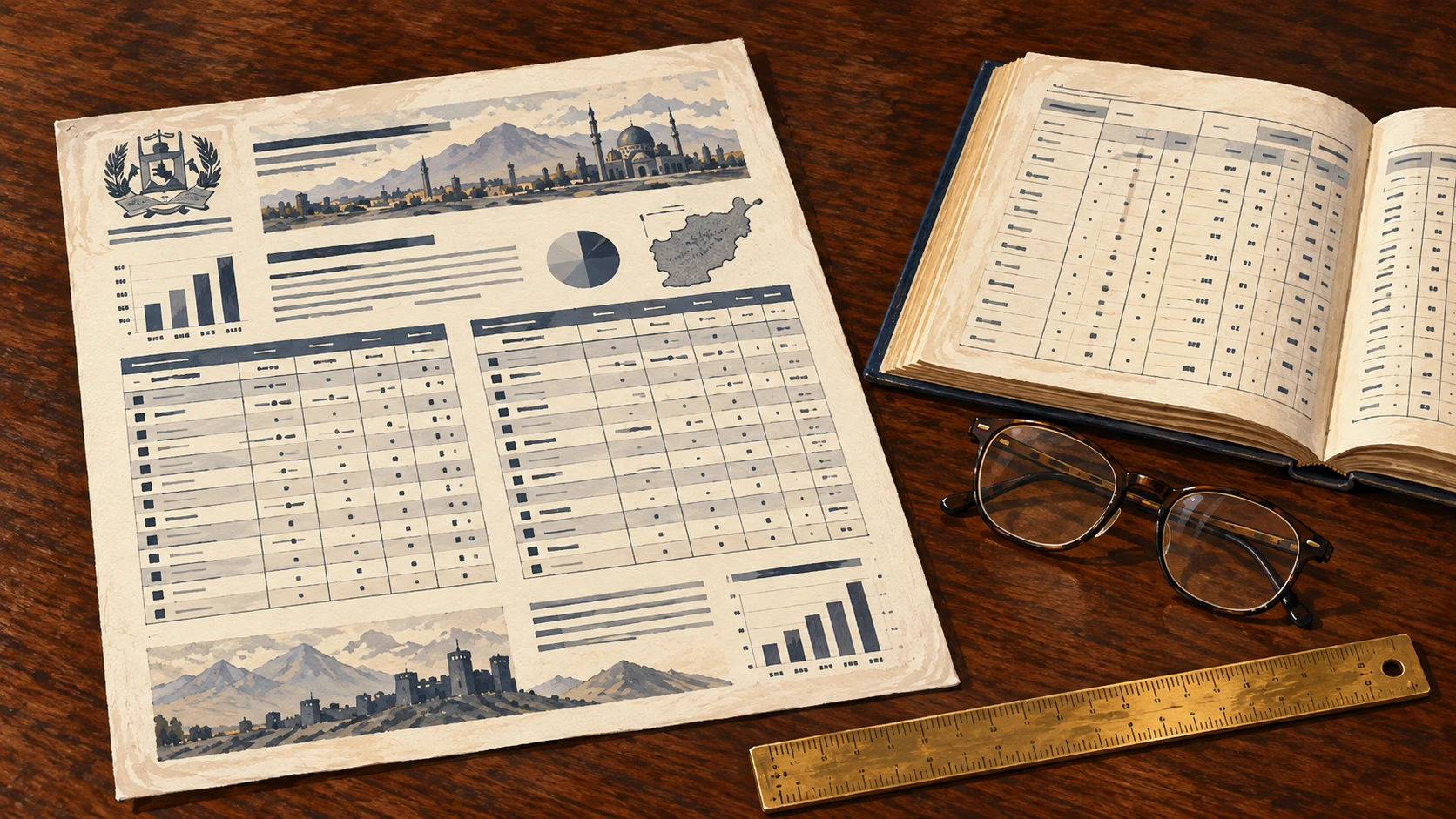
The National Statistics and Information Authority publishes price indices, national accounts, and trade reports in both languages. The Ministry of Economy prints monthly economic bulletins about consumer price trends, currency movements, and trade flows.
Statistical tables show dual-language column headers, numerical data labels, and explanatory footnotes. But release schedules show delays of many weeks between Dari drafts and published Pashto editions.
Difficult economic words and formal phrasing make reports hard for regular readers. Public data audits find that some provincial breakdowns appear only in single-language annexes.
Public Signage, Administrative Forms, and Municipal Interfaces
Kabul municipal offices and public service counters display departmental signage and posters in both national languages. Standard application forms for civil registry papers, business licenses, and tax filings have parallel Dari and Pashto text.
In busy commercial markets, buyers and sellers talk easily in both languages without reading text. Outside government offices, informal street scribes and public petition writers help people complete official paperwork.
Distant urban neighborhoods have fewer bilingual signs than central ministry buildings. Researchers say that good public service depends on municipal clerks who speak both languages well.
Lexical Standardization and Technical Terminology
The Academy of Sciences writes technical glossaries to replace English and Russian technical loanwords. Special terminology committees choose clear Dari and Pashto words for terms like inflation, liquidity, and deficit.
Newspapers and independent economic analysts often use different words for the same money ideas. Small mistakes with the zero-width non-joiner and special Pashto letters cause computer printing errors in digital documents.
Statistical publishing teams face shortages of certified bilingual terminologists and professional copy editors. Official guidelines ask government printing houses to use unified terminology lists in all published economic gazettes.
Publishing Formats, Digital Portals, and Paper Distribution
Official economic publications have small print runs that go mostly to central government ministries. State agencies put downloadable electronic reports in portable document format on digital web portals.
High mobile data costs and power cuts stop rural citizens and small business owners from reading online. Kabul public libraries and university reference collections keep paper copies of national gazettes for student researchers.
Import tariffs on paper and printing machine parts make printed gazettes expensive. Radio news bulletins and audio broadcasts give economic news to people who cannot read paper reports.

Reader Accessibility, Visual Communication, and Information Metrics
Civil society researchers want simple summaries to go with hard bilingual publications. Educational surveys show that economic reports in a person primary language build understanding and civic trust.
Information agencies use visual data charts and infographics to help people in city markets. Statistical authorities set fixed publication calendars with clear release dates for monthly price indices.
Media monitors ask government publishers to check reader numbers in universities and businesses. Tracking digital downloads and paper distribution gives clear metrics for managing public information.
A2 · Elementary
Government Reports in Dari and Pashto: Daily Reading and Public Information in Kabul
Offices in Kabul print official reports and signs in both Dari and Pashto so citizens can read economic news and complete public forms.
Bilingual State Mandates and Orthographic Coordination
On August 23, 2026 Pajhwok reported that Afghan officials held a five-day technical workshop in Kabul. Language experts worked together to harmonize spelling rules across the Pashto and Dari writing systems.
National administrative statutes establish that Dari and Pashto are the official state languages of Afghanistan. Both languages possess equal standing in public governance, so government documents must respect both equally.
Linguists and ministerial editors met to resolve orthographic inconsistencies in spelling foreign loanwords, compounds, and affix spacing. Participants included delegates from state ministries, university language faculties, and textbook publishing departments. Analysts emphasize that formal conferences do not reflect everyday city speech, and a single workshop cannot document literacy across all of Kabul.
Official Economic Reports and Statistical Releases
The National Statistics and Information Authority publishes official price indices, national accounts, and trade reports in Dari and Pashto. In addition, the Ministry of Economy disseminates monthly economic bulletins that examine consumer price trends, currency movements, and trade flows.
Official statistical tables feature dual-language column headers, clear numerical data labels, and technical explanatory footnotes. However, release schedules frequently show multi-week delays between initial Dari statistical drafts and published Pashto editions.
Dense macroeconomic vocabulary and formal administrative phrasing often confuse non-specialist readers who want simple facts. Independent audits also reveal gaps where detailed provincial breakdowns appear only in single-language annexes.
Public Signage, Administrative Forms, and Municipal Interfaces
Kabul municipal offices and public service counters display departmental signage and instructional posters in both national languages. Standard application forms for civil registry papers, business licenses, and tax filings provide parallel Dari and Pashto text side by side.
In central commercial districts, oral market negotiations and retail transactions function fluidly across both languages without formal written text. Outside public buildings, informal street scribes and public petition writers help illiterate residents complete official paperwork.
Peripheral urban neighborhoods display lower rates of standardized bilingual signage than central ministry complexes. Linguistic researchers point out that real civic access depends on frontline municipal clerks who are proficient in both languages.
Lexical Standardization and Technical Terminology
The Academy of Sciences develops standardized technical glossaries to replace informal English and Russian technical loanwords. Dedicated terminology committees establish paired Dari and Pashto equivalents for complex financial concepts like inflation, liquidity, and deficit.
At the same time, commercial newspapers and independent economic analysts often use competing terms for identical fiscal ideas. Small discrepancies in zero-width non-joiner usage and modified Pashto characters create annoying formatting errors in digital documents.
Statistical publishing units face serious shortages of certified bilingual terminologists and professional copy editors. Official guidelines urge government printing houses to adopt unified terminology lists in all published economic gazettes.
Publishing Formats, Digital Portals, and Paper Distribution
Official economic publications have limited physical print runs and circulate primarily within central government ministries. As a result, state agencies rely on digital web portals to host downloadable electronic reports in portable document format.
Unfortunately, high mobile data costs and frequent electrical power outages restrict digital access for rural citizens and small business owners. Kabul public libraries and university reference collections maintain physical copies of national gazettes for student researchers.
High import tariffs on commercial paper and printing machinery parts drive up the manufacturing costs of printed economic gazettes. For millions of citizens without print access, daily radio news bulletins and audio broadcasts provide essential economic news.
Reader Accessibility, Visual Communication, and Information Metrics
Civil society researchers advocate for clear plain-language executive summaries to accompany dense bilingual publications. Educational surveys show that reading official economic data in a primary language improves policy comprehension and builds civic trust.
Public information agencies design visual data charts and infographics to communicate market prices clearly to shoppers and traders. Statistical authorities also establish fixed publication calendars to give predictable release dates for monthly price indices.
Media monitors recommend that government publishers carry out regular readership audits across university departments and business associations. Tracking digital downloads and print distribution provides empirical metrics for managing public information systems.
B1 · Intermediate
Reading the Economy in Two Languages: Dari and Pashto Reports in Kabul
A look at how government offices in Kabul share economic news, publish statistical reports, and help citizens understand official documents in Dari and Pashto.
Bilingual State Mandates and Orthographic Coordination
On August 23, 2026 Pajhwok reported that scholars and government delegates assembled in Kabul for a five-day technical workshop dedicated to harmonizing Pashto and Dari writing systems. The initiative reflected longstanding administrative goals to coordinate written communication across public institutions.
National administrative statutes explicitly designate Dari and Pashto as official state languages, granting them equal formal standing in public governance. In practical terms, this constitutional equality requires state agencies to produce administrative records and public statements in both tongues.
Linguists and ministerial editors convened to reconcile orthographic inconsistencies in spelling international loanwords, grammatical compounds, and affix spacing. Participants included official representatives from state ministries, university language faculties, and textbook publishing departments. However, administrative analysts observe that academic conventions often diverge from colloquial city speech, and one workshop does not reflect literacy practices across Kabul.
Official Economic Reports and Statistical Releases
The National Statistics and Information Authority regularly publishes official price indices, national accounts, and foreign trade reports in paired Dari and Pashto editions. Similarly, the Ministry of Economy disseminates monthly economic bulletins that summarize consumer price trends, currency movements, and trade flows for public scrutiny.
Standard statistical tables incorporate dual-language column headers, numerical data labels, and technical explanatory footnotes. Despite these editorial efforts, official release schedules frequently record multi-week delays between initial Dari statistical drafts and published Pashto editions.
Dense macroeconomic vocabulary and stiff administrative phrasing impede comprehension among non-specialist readers who rely on public information to manage household decisions. Furthermore, public data audits reveal gaps where specific provincial breakdowns appear only in single-language annexes.
Public Signage, Administrative Forms, and Municipal Interfaces
Throughout the capital, Kabul municipal offices and public service counters display departmental signage and instructional posters in both national languages. Standard application forms for civil registry documents, business licenses, and tax filings routinely provide parallel Dari and Pashto text to serve diverse citizens.
In central commercial districts like Mandawi, oral market negotiations and retail transactions function fluidly across both languages without reliance on formal text. Outside major government offices, informal street scribes and public petition writers assist illiterate applicants in completing required official paperwork.
Conversely, peripheral urban neighborhoods exhibit notably lower rates of standardized bilingual signage compared to central ministry complexes. Linguistic researchers emphasize that authentic civic access depends upon frontline municipal clerks who remain thoroughly proficient in both national languages.
Lexical Standardization and Technical Terminology
To modernize bureaucratic communication, the Academy of Sciences develops standardized technical glossaries designed to replace informal English and Russian technical loanwords. Specialized terminology committees establish paired Dari and Pashto equivalents for complex financial terms including inflation, liquidity, and deficit.
However, commercial newspapers and independent economic analysts frequently employ competing terms for identical fiscal concepts, generating public confusion. Technical discrepancies in zero-width non-joiner usage and modified Persian and Pashto characters continue to trigger formatting errors in digital documents.
State statistical publishing units suffer from chronic shortages of certified bilingual terminologists and professional copy editors. To resolve these discrepancies, linguistic guidelines urge government printing houses to adopt unified terminology lists across all published economic gazettes.
Publishing Formats, Digital Portals, and Paper Distribution
Due to budgetary limitations, official economic publications maintain limited physical print runs, circulating primarily among central government ministries and diplomatic missions. As an alternative, state agencies rely increasingly on digital web portals to host downloadable electronic reports in portable document format.
Nevertheless, high mobile data costs and unreliable electricity grids severely restrict digital report access for rural citizens and small business owners. Kabul public libraries and university reference collections maintain physical copies of national gazettes for student researchers and academic faculty.
High import tariffs on commercial paper and printing machinery parts elevate the production costs of printed economic gazettes. Consequently, radio news bulletins and audio broadcasts serve as the primary source of economic news for millions of citizens without print access.
Reader Accessibility, Visual Communication, and Information Metrics
Recognizing these communication barriers, civil society researchers advocate for plain-language executive summaries accompanying complex bilingual economic publications. Educational surveys establish that providing official economic data in readers primary language significantly improves policy comprehension and strengthens civic trust.
Public information agencies have begun experimenting with visual data charts and infographics to bridge literacy gaps in municipal markets and transit centers. Statistical authorities are also establishing fixed publication calendars to provide predictable release dates for monthly price indices.
Independent media monitors urge government publishers to conduct regular readership audits across university faculties and business communities. Systematic baseline tracking of digital downloads and print distribution provides the empirical metrics required for transparent public information governance.
B2 · Upper Intermediate
Bilingual Economic Reporting in Kabul: Dari and Pashto Publishing and Public Access
An analytical study of how government statistical agencies in Kabul produce economic reports in Dari and Pashto, manage technical terminology, and distribute public information.
Bilingual State Mandates and Orthographic Coordination
On August 23, 2026 Pajhwok reported that an inter-institutional assembly of linguists and government officials convened in Kabul for a five-day technical workshop focused on harmonizing Pashto and Dari writing systems. The consultation addressed longstanding bureaucratic inconsistencies that complicate official publishing.
National administrative statutes explicitly establish Dari and Pashto as official state languages endowed with equal formal standing across public governance. This statutory mandate requires state institutions to maintain parity in legislative documentation, administrative regulations, and public communications.
Working committees assembled to reconcile orthographic inconsistencies in the spelling of foreign loanwords, lexical compounds, and affix spacing conventions. Delegates represented state ministries, university language faculties, and textbook publishing departments. Sociolinguistic analysts emphasize that institutional harmonization conferences address specialized typographical norms rather than the dynamic spoken vernaculars of Kabul residents.
Official Economic Reports and Statistical Releases
The National Statistics and Information Authority publishes official price indices, national accounts, and foreign trade reports in parallel Dari and Pashto releases. Simultaneously, the Ministry of Economy disseminates monthly economic bulletins summarizing consumer price trends, currency movements, and trade flows.
Statistical tables incorporate dual-language column headers, numerical data labels, and explanatory footnotes to guide readers through complex datasets. Nevertheless, publication workflows frequently experience multi-week delays between initial Dari statistical drafts and published Pashto editions.
Dense macroeconomic vocabulary and rigid administrative phrasing severely impede comprehension among non-specialist readers seeking practical economic guidance. Furthermore, independent data audits reveal administrative gaps where detailed provincial breakdowns appear exclusively within single-language annexes.
Public Signage, Administrative Forms, and Municipal Interfaces
Across the capital, Kabul municipal offices and public service counters display departmental signage and instructional posters in both national languages. Standard application forms for civil registry documents, business licenses, and tax filings provide parallel Dari and Pashto text to facilitate civic transactions.
In central commercial hubs such as the Mandawi bazaar, oral market negotiations and retail transactions function fluidly across both languages without reliance upon formal administrative scripts. Outside government offices, informal street scribes and public petition writers mediate bureaucratic interactions for illiterate citizens.
In contrast, peripheral urban neighborhoods display substantially lower rates of standardized bilingual signage relative to central ministry complexes. Linguistic researchers stress that effective civic access ultimately depends upon frontline municipal clerks who are fully proficient in both national languages.
Lexical Standardization and Technical Terminology
To modernize public administration, the Academy of Sciences develops standardized technical glossaries intended to replace unvetted English and Russian technical loanwords. Specialized terminology committees establish paired Dari and Pashto equivalents for complex financial concepts including inflation, liquidity, and deficit.
Despite these normative efforts, commercial newspapers and independent economic analysts frequently employ competing terms for identical fiscal concepts. Compounding these lexical discrepancies, improper zero-width non-joiner usage and modified Persian and Pashto characters generate persistent rendering glitches in digital documents.
State statistical publishing units suffer from acute shortages of certified bilingual terminologists and professional copy editors. Consequently, linguistic guidelines urge government printing houses to adopt unified terminology lists across all published economic gazettes.
Publishing Formats, Digital Portals, and Paper Distribution
Owing to fiscal constraints, official economic publications maintain limited physical print runs, circulating primarily among central government ministries and regulatory agencies. State entities increasingly rely on digital web portals to host downloadable electronic reports in portable document format.
However, prohibitive mobile data tariffs and erratic electricity grids severely restrict digital report access for rural citizens and small business owners. Kabul public libraries and university reference collections maintain physical copies of national gazettes for student researchers and economic scholars.
Substantial import tariffs on commercial paper and printing machinery parts inflate production costs for state printing institutions. For the substantial proportion of citizens without print literacy or digital devices, radio news bulletins and audio broadcasts remain the primary source of economic news.
Reader Accessibility, Visual Communication, and Information Metrics
In response to information asymmetries, civil society researchers advocate for plain-language executive summaries accompanying complex bilingual economic publications. Educational surveys confirm that delivering official economic data in readers primary language improves policy comprehension and cultivates civic trust.
Public communication divisions are piloting visual data charts and infographics to bridge functional literacy gaps across municipal markets. Furthermore, statistical authorities are institutionalizing fixed publication calendars to provide predictable release dates for monthly price indices.
Independent media monitors urge state publishers to conduct regular readership audits across university faculties and commercial associations. Systematic baseline tracking of digital downloads and print distribution provides the empirical metrics required for sound public information governance.
C1 · Advanced
Bilingual Public Communication in Kabul: Dari and Pashto Access to Official Economic Reports and Civic Publishing
An empirical investigation into Dari and Pashto access to official economic data in Kabul, orthographic harmonization, administrative forms, terminology committees, and public information literacy.
Bilingual State Mandates and Orthographic Coordination
On August 23, 2026 Pajhwok reported the convening of a five-day technical workshop in Kabul dedicated to harmonizing Pashto and Dari writing systems across public governance. The inter-ministerial gathering sought to impose typographic order on an administrative apparatus characterized by orthographic fragmentation.
National administrative statutes designate Dari and Pashto as official state languages endowed with equal formal standing across judicial, fiscal, and regulatory spheres. This de jure parity obliges sovereign bodies to maintain parallel communicative capacity in all formal pronouncements.
Linguists and ministerial editors convened to reconcile orthographic inconsistencies in spelling loanwords, compounds, and affix spacing across state curricula. Participants included representatives from state ministries, university language faculties, and textbook publishing departments. However, administrative analysts distinguish institutional linguistic conferences from the everyday linguistic environments encountered by citizens, while independent reviews confirm that a single orthographic workshop does not document citywide literacy practices across Kabul.
Official Economic Reports and Statistical Releases
The National Statistics and Information Authority publishes official price indices, national accounts, and trade reports in Dari and Pashto. Concurrently, the Ministry of Economy disseminates monthly economic bulletins summarizing consumer price trends, currency movements, and trade flows to commercial stakeholders.
Statistical tables feature dual-language column headers, numerical data labels, and technical explanatory footnotes designed to guide technical readers. However, release schedules frequently record multi-week delays between initial Dari statistical drafts and published Pashto editions, undermining operational synchronicity.
Dense macroeconomic vocabulary and formal administrative phrasing impede comprehension among non-specialist readers seeking insight into household budgets. Furthermore, public data audits reveal gaps where specific provincial breakdowns appear only in single-language annexes, introducing regional information asymmetries.
Public Signage, Administrative Forms, and Municipal Interfaces
Kabul municipal offices and public service counters display departmental signage and instructional posters in both national languages. Standard application forms for civil registry documents, business licenses, and tax filings provide parallel Dari and Pashto text to facilitate civic transactions.
In central commercial districts, oral market negotiations and retail transactions function fluidly across both languages without formal text. Outside government offices, informal street scribes and public petition writers operating outside government offices assist citizens in completing official paperwork.
Conversely, peripheral urban neighborhoods exhibit lower rates of standardized bilingual signage compared to central ministry complexes. Linguistic researchers emphasize that practical civic access depends on frontline municipal clerks proficient in both national languages.
Lexical Standardization and Technical Terminology
The Academy of Sciences develops standardized technical glossaries to replace informal English and Russian technical loanwords that entered administrative usage over decades. Terminology committees establish paired Dari and Pashto equivalents for complex financial terms including inflation, liquidity, and deficit.
Nevertheless, commercial newspapers and independent economic analysts frequently employ competing terms for identical fiscal concepts, perpetuating public confusion. Furthermore, discrepancies in zero-width non-joiner usage and modified Persian and Pashto characters create formatting errors in digital documents.
Statistical publishing units face acute shortages of certified bilingual terminologists and professional copy editors. Consequently, linguistic guidelines urge government printing houses to adopt unified terminology lists across all published economic gazettes.
Publishing Formats, Digital Portals, and Paper Distribution
Official economic publications maintain limited physical print runs, circulating primarily among central government ministries and regulatory agencies. State agencies rely increasingly on digital web portals to host downloadable electronic reports in portable document format.
However, high mobile data costs and unreliable electricity grids restrict digital report access for rural citizens and small business owners. Kabul public libraries and university reference collections maintain physical copies of national gazettes for student researchers.
Import tariffs on commercial paper and printing machinery parts increase the production costs of printed economic gazettes. In response, radio news bulletins and audio broadcasts serve as the primary source of economic news for citizens without print access.
Reader Accessibility, Visual Communication, and Information Metrics
Civil society researchers advocate for plain-language executive summaries accompanying complex bilingual economic publications to democratize economic data. Educational surveys establish that providing official economic data in readers primary language improves policy comprehension and civic trust.
Information agencies experiment with visual data charts and infographics to bridge literacy gaps in municipal markets. Simultaneously, statistical authorities establish fixed publication calendars to provide predictable release dates for monthly price indices.
Independent media monitors urge government publishers to conduct regular readership audits across university and business communities. Systematic baseline tracking of digital downloads and print distribution provides empirical metrics for public information governance.
C2 · Mastery
Epistemic Parity and Administrative Diglossia in Afghan Economic Governance: Orthographic Coordination and Technical Publishing in Dari and Pashto
A rigorous scholarly assessment of bilingual institutional communication in Kabul, evaluating orthographic harmonization, statistical translation asymmetries, municipal bureaucratic interfaces, and digital dissemination barriers.
Bilingual State Mandates and Orthographic Coordination
On August 23, 2026 Pajhwok reported the convening of a five-day technical workshop in Kabul tasked with harmonizing Pashto and Dari writing systems across public governance. The colloquium reflected institutional efforts to rationalize typographic norms across a historically fragmented administrative apparatus.
National administrative statutes explicitly designate Dari and Pashto as official state languages with equal formal standing in public governance. This statutory mandate imposes rigorous de jure parity upon public institutions, demanding institutional bilingualism across all executive and fiscal registers.
Linguists and ministerial editors convened to reconcile orthographic inconsistencies in spelling loanwords, compounds, and affix spacing across official publications. Participants included representatives from state ministries, university language faculties, and textbook publishing departments. However, administrative analysts distinguish institutional linguistic conferences from everyday linguistic environments encountered by citizens, while independent reviews confirm that a single orthographic workshop does not document citywide literacy practices across Kabul.
Official Economic Reports and Statistical Releases
The National Statistics and Information Authority publishes official price indices, national accounts, and trade reports in Dari and Pashto. Concurrently, the Ministry of Economy disseminates monthly economic bulletins summarizing consumer price trends, currency movements, and trade flows to commercial and diplomatic observers.
Statistical tables feature dual-language column headers, numerical data labels, and technical explanatory footnotes designed to ensure methodological transparency. However, release schedules frequently record multi-week delays between initial Dari statistical drafts and published Pashto editions, revealing persistent workflow asymmetries.
Dense macroeconomic vocabulary and formal administrative phrasing impede comprehension among non-specialist readers seeking to decipher inflationary trends. Furthermore, public data audits reveal gaps where specific provincial breakdowns appear only in single-language annexes, compromising evidentiary completeness.
Public Signage, Administrative Forms, and Municipal Interfaces
Kabul municipal offices and public service counters display departmental signage and instructional posters in both national languages. Standard application forms for civil registry documents, business licenses, and tax filings provide parallel Dari and Pashto text to structure citizen-state interactions.
In central commercial districts, oral market negotiations and retail transactions function fluidly across both languages without formal text. Outside government offices, informal street scribes and public petition writers operating outside government offices assist citizens in completing official paperwork.
Peripheral urban neighborhoods exhibit lower rates of standardized bilingual signage compared to central ministry complexes. Linguistic researchers emphasize that practical civic access depends on frontline municipal clerks proficient in both national languages.
Lexical Standardization and Technical Terminology
The Academy of Sciences develops standardized technical glossaries to replace informal English and Russian technical loanwords that proliferated across administrative vernaculars. Terminology committees establish paired Dari and Pashto equivalents for complex financial terms including inflation, liquidity, and deficit.
Commercial newspapers and independent economic analysts frequently employ competing terms for identical fiscal concepts, creating epistemic friction in public commentary. Furthermore, discrepancies in zero-width non-joiner usage and modified Persian and Pashto characters create formatting errors in digital documents.
Statistical publishing units face acute shortages of certified bilingual terminologists and professional copy editors. Consequently, linguistic guidelines urge government printing houses to adopt unified terminology lists across all published economic gazettes.
Publishing Formats, Digital Portals, and Paper Distribution
Official economic publications maintain limited physical print runs, circulating primarily among central government ministries and specialized academic bodies. State agencies rely increasingly on digital web portals to host downloadable electronic reports in portable document format.
However, high mobile data costs and unreliable electricity grids restrict digital report access for rural citizens and small business owners. Kabul public libraries and university reference collections maintain physical copies of national gazettes for student researchers.
Import tariffs on commercial paper and printing machinery parts increase the production costs of printed economic gazettes. Consequently, radio news bulletins and audio broadcasts serve as the primary source of economic news for citizens without print access.
Reader Accessibility, Visual Communication, and Information Metrics
Civil society researchers advocate for plain-language executive summaries accompanying complex bilingual economic publications to facilitate citizen comprehension. Educational surveys establish that providing official economic data in readers primary language improves policy comprehension and civic trust.
Information agencies experiment with visual data charts and infographics to bridge literacy gaps in municipal markets. Simultaneously, statistical authorities establish fixed publication calendars to provide predictable release dates for monthly price indices.
Independent media monitors urge government publishers to conduct regular readership audits across university and business communities. Systematic baseline tracking of digital downloads and print distribution provides empirical metrics for public information governance.
Check your understanding
Choose how closely you want to revisit the article. You can refer back while answering, and review explanations when you finish.
Quick Quiz A1
Try one question, then create a free account for the full Quick Quiz. Sign Up Free
Answer every question before checking. There is no time limit.
Your results
/ 1 correct (%)
Read the explanations to see how each answer connects to the article.
-
According to the section on Bilingual State Mandates and Orthographic Coordination, what does the text identify regarding pajhwok?
1. Answer:
Quick Quiz A2
Try one question, then create a free account for the full Quick Quiz. Sign Up Free
Answer every question before checking. There is no time limit.
Your results
/ 1 correct (%)
Read the explanations to see how each answer connects to the article.
-
According to the section on Bilingual State Mandates and Orthographic Coordination, what does the text identify regarding pajhwok?
1. Answer:
Quick Quiz B1
Try one question, then create a free account for the full Quick Quiz. Sign Up Free
Answer every question before checking. There is no time limit.
Your results
/ 1 correct (%)
Read the explanations to see how each answer connects to the article.
-
According to the section on Bilingual State Mandates and Orthographic Coordination, what does the text identify regarding pajhwok?
1. Answer:
Quick Quiz B2
Try one question, then create a free account for the full Quick Quiz. Sign Up Free
Answer every question before checking. There is no time limit.
Your results
/ 1 correct (%)
Read the explanations to see how each answer connects to the article.
-
According to the section on Bilingual State Mandates and Orthographic Coordination, what does the text identify regarding pajhwok?
1. Answer:
Quick Quiz C1
Try one question, then create a free account for the full Quick Quiz. Sign Up Free
Answer every question before checking. There is no time limit.
Your results
/ 1 correct (%)
Read the explanations to see how each answer connects to the article.
-
According to the section on Bilingual State Mandates and Orthographic Coordination, what does the text identify regarding pajhwok?
1. Answer:
Quick Quiz C2
Try one question, then create a free account for the full Quick Quiz. Sign Up Free
Answer every question before checking. There is no time limit.
Your results
/ 1 correct (%)
Read the explanations to see how each answer connects to the article.
-
According to the section on Bilingual State Mandates and Orthographic Coordination, what does the text identify regarding pajhwok?
1. Answer:
