A1 · Beginner
The Copper Basin and the Wood Oven: Crafting Elbasan Ballokume for Spring
An empirical look at the artisanal preparation, local cornflour milling, wood-fired baking, and market demand for Elbasan's signature spring confection.
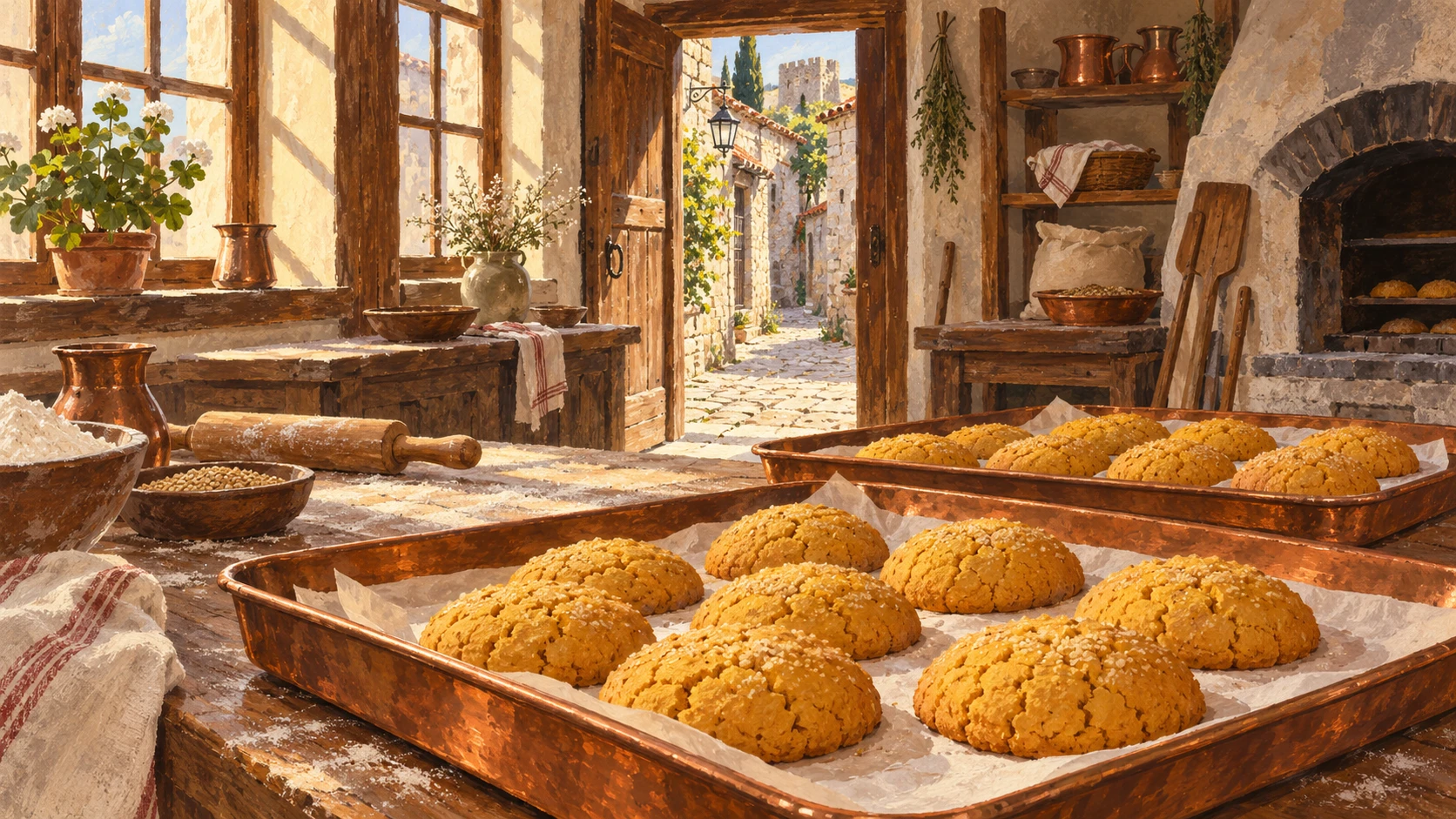
The March Spring Festival and Elbasan Confectionery Heritage
Elbasan celebrates Dita e Veres on March fourteenth as an ancient festive welcoming of spring renewal.
Ballokumeja serves as the symbolic culinary centerpiece prepared specifically for the annual spring celebration.
Municipal records document centuries of specialized artisan baking centered in Elbasan's historic Kala fortress neighborhood.
Households and commercial bakeries begin preparing extensive cookie batches several days before the official holiday.
The festival tradition emphasizes hospitality and neighborly gift sharing through exchanges of freshly baked confectionery.
Civic authorities organize public festivities in city squares where master bakers demonstrate historic preparation techniques.
Stone-Ground Maize and Farmstead Dairy Sourcing
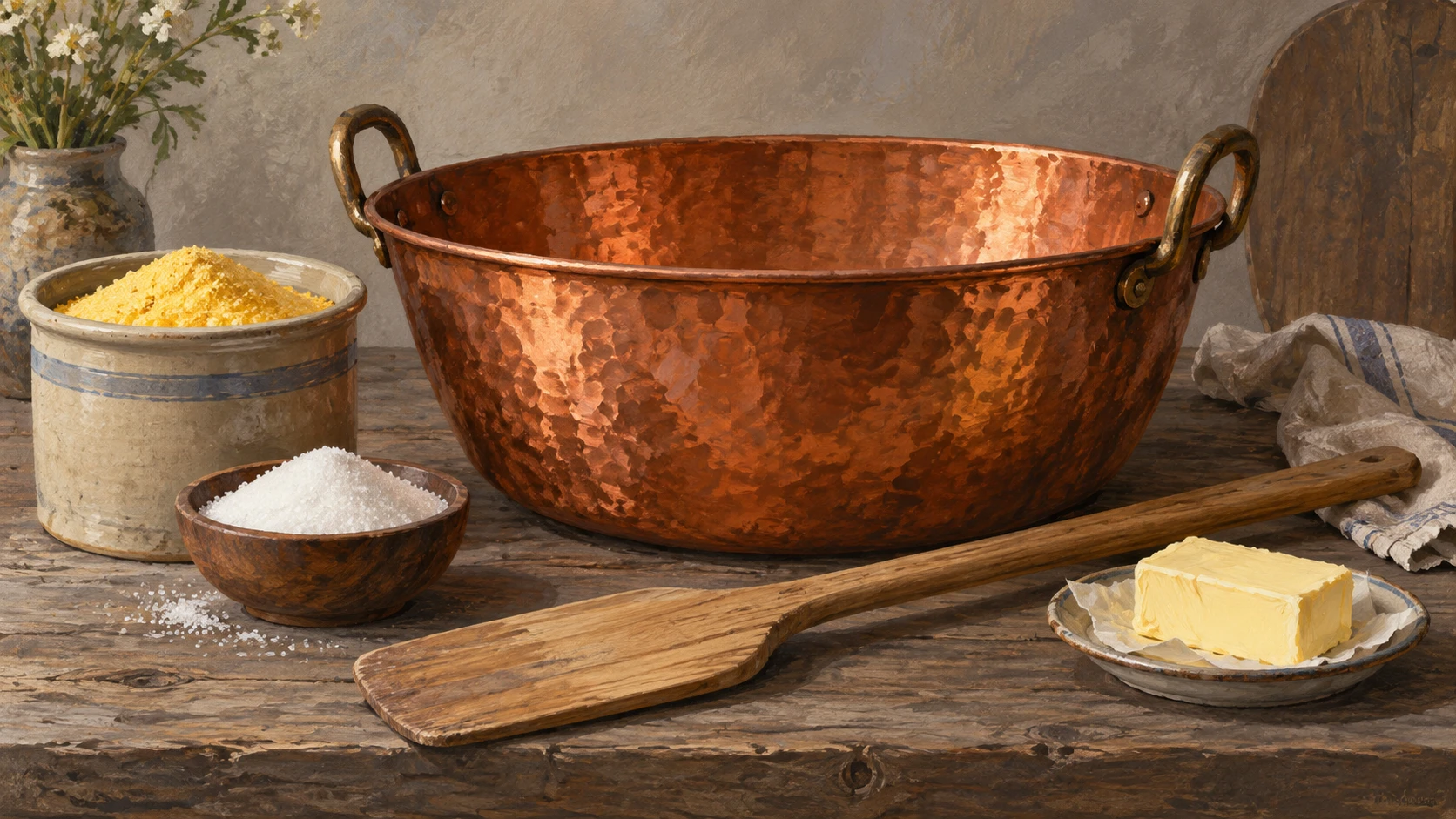
Authentic ballokume requires finely ground yellow cornflour milled from locally grown Albanian flint maize varieties.
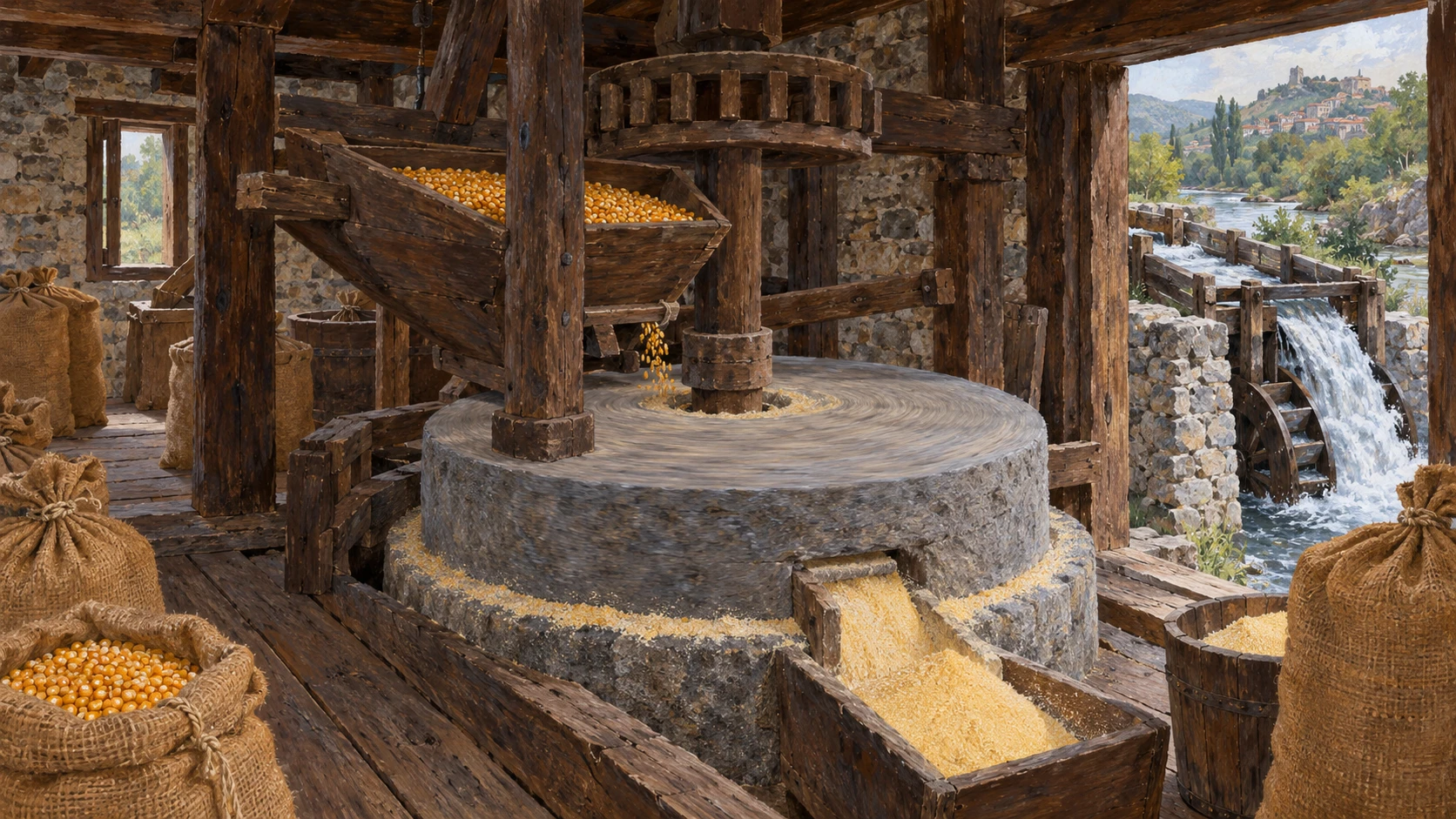
Historic watermills along the Shkumbin river basin use natural granite millstones that prevent overheating during corn grinding.
Slow stone milling preserves maize germ oils that provide characteristic aroma and moisture to the baked crumb.
Artisans combine stone-ground cornflour with clarified country butter churned from rich pasture-fed cow milk.
Farmstead butter must be melted and skimmed to remove residual milk solids before incorporation into dough.
Finely sifted white beet sugar and fresh free-range eggs supply structural emulsion and natural sweetness.
The Copper Basin Technique and Boxwood Paddle Aeration
Traditional preparation strictly utilizes a wide unlined copper basin known locally as tigan bakri.
The conductive unlined copper metal helps stabilize emulsion temperature and enhances egg foam volume during vigorous stirring.
Bakers beat clarified butter and crystalline sugar by hand using a heavy carved boxwood wooden paddle.
Hand creaming requires continuous rhythmic beating for up to an hour until the mixture forms a pale ivory cream.
Eggs are incorporated one by one into the whipped butter base to prevent curdling the delicate batter.
Cornflour is folded gradually into the whipped emulsion by hand to maintain incorporated air pockets without overworking gluten.
Wood-Fired Hearth Baking and Thermal Control
Portioned mounds of ballokume dough are shaped by hand and arranged widely spaced on heavy copper baking sheets.
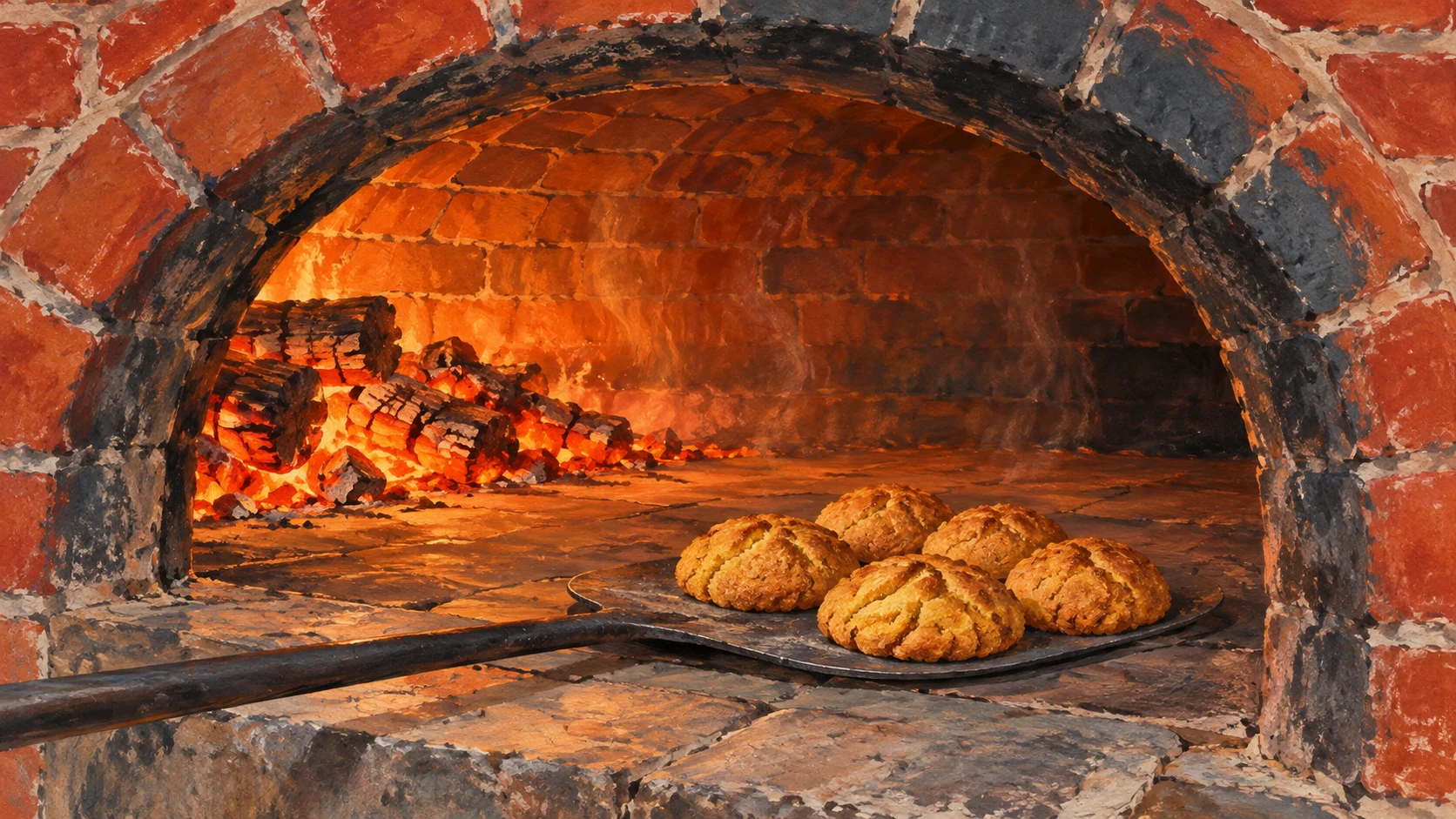
Traditional bakeries utilize vaulted masonry ovens heated solely with well-seasoned dry beechwood logs.
Bakers sweep glowing wood embers into oven corners to ensure gentle indirect radiant heat across the baking floor.
Baking requires moderate heat between one hundred sixty and one hundred eighty degrees Celsius for slow caramelization.
Successful baking produces large domed round cookies with delicate surface cracks, crisp edges, and tender crumb structure.
Baked ballokume are allowed to cool completely on wooden racks before handling to set their fragile crumb.
Seasonal Urban Demand and Festive Retail Economics
Commercial demand peaks intensely during the second week of March with bakeries producing hundreds of thousands of cookies.
Visitors from Tirana and across Albania travel to Elbasan specifically to purchase authentic fresh holiday batches.
Raw ingredient prices for country butter and locally milled cornflour experience sharp seasonal increases before the festival.
Traditional craft bakeries sell out daily production quotas within hours of opening their morning sales counters.
Seasonal ballokume sales generate substantial economic windfalls that support neighborhood bakery payrolls through late winter.
Postal couriers and express transit vans transport packaged festive tins to diaspora communities throughout Western Europe.
Heritage Safeguarding, Quality Standards, and Industrial Competition
Master confectioners formed a municipal association to defend authentic artisan recipes against industrial mass production.
Commercial factory imitations using hydrogenated vegetable oils, wheat flour, and mechanical mixers lack traditional crumb texture.
Municipal guidelines establish strict criteria requiring unlined copper basins, pure butter, and stone-ground cornflour for heritage labeling.
Educational workshops in Elbasan schools teach younger generations the manual labor and cultural symbolism of spring baking.
Preservation advocates seek national geographical indication status to protect Elbasan Ballokumeja as a registered culinary trademark.
Sustaining the handcrafted ballokume tradition keeps living culinary heritage, local grain milling, and festive community solidarity alive.
A2 · Elementary
The Copper Basin and the Wood Oven: Crafting Elbasan Ballokume for Spring
An empirical look at the artisanal preparation, local cornflour milling, wood-fired baking, and market demand for Elbasan's signature spring confection.
The March Spring Festival and Elbasan Confectionery Heritage
Elbasan celebrates Dita e Veres on March fourteenth as an ancient festive welcoming of spring renewal.
Ballokumeja serves as the symbolic culinary centerpiece prepared specifically for the annual spring celebration.
Municipal records document centuries of specialized artisan baking centered in Elbasan's historic Kala fortress neighborhood.
Households and commercial bakeries begin preparing extensive cookie batches several days before the official holiday.
The festival tradition emphasizes hospitality and neighborly gift sharing through exchanges of freshly baked confectionery.
Civic authorities organize public festivities in city squares where master bakers demonstrate historic preparation techniques.
Stone-Ground Maize and Farmstead Dairy Sourcing
Authentic ballokume requires finely ground yellow cornflour milled from locally grown Albanian flint maize varieties.
Historic watermills along the Shkumbin river basin use natural granite millstones that prevent overheating during corn grinding.
Slow stone milling preserves maize germ oils that provide characteristic aroma and moisture to the baked crumb.
Artisans combine stone-ground cornflour with clarified country butter churned from rich pasture-fed cow milk.
Farmstead butter must be melted and skimmed to remove residual milk solids before incorporation into dough.
Finely sifted white beet sugar and fresh free-range eggs supply structural emulsion and natural sweetness.
The Copper Basin Technique and Boxwood Paddle Aeration
Traditional preparation strictly utilizes a wide unlined copper basin known locally as tigan bakri.
The conductive unlined copper metal helps stabilize emulsion temperature and enhances egg foam volume during vigorous stirring.
Bakers beat clarified butter and crystalline sugar by hand using a heavy carved boxwood wooden paddle.
Hand creaming requires continuous rhythmic beating for up to an hour until the mixture forms a pale ivory cream.
Eggs are incorporated one by one into the whipped butter base to prevent curdling the delicate batter.
Cornflour is folded gradually into the whipped emulsion by hand to maintain incorporated air pockets without overworking gluten.
Wood-Fired Hearth Baking and Thermal Control
Portioned mounds of ballokume dough are shaped by hand and arranged widely spaced on heavy copper baking sheets.
Traditional bakeries utilize vaulted masonry ovens heated solely with well-seasoned dry beechwood logs.
Bakers sweep glowing wood embers into oven corners to ensure gentle indirect radiant heat across the baking floor.
Baking requires moderate heat between one hundred sixty and one hundred eighty degrees Celsius for slow caramelization.
Successful baking produces large domed round cookies with delicate surface cracks, crisp edges, and tender crumb structure.
Baked ballokume are allowed to cool completely on wooden racks before handling to set their fragile crumb.
Seasonal Urban Demand and Festive Retail Economics
Commercial demand peaks intensely during the second week of March with bakeries producing hundreds of thousands of cookies.
Visitors from Tirana and across Albania travel to Elbasan specifically to purchase authentic fresh holiday batches.
Raw ingredient prices for country butter and locally milled cornflour experience sharp seasonal increases before the festival.
Traditional craft bakeries sell out daily production quotas within hours of opening their morning sales counters.
Seasonal ballokume sales generate substantial economic windfalls that support neighborhood bakery payrolls through late winter.
Postal couriers and express transit vans transport packaged festive tins to diaspora communities throughout Western Europe.
Heritage Safeguarding, Quality Standards, and Industrial Competition
Master confectioners formed a municipal association to defend authentic artisan recipes against industrial mass production.
Commercial factory imitations using hydrogenated vegetable oils, wheat flour, and mechanical mixers lack traditional crumb texture.
Municipal guidelines establish strict criteria requiring unlined copper basins, pure butter, and stone-ground cornflour for heritage labeling.
Educational workshops in Elbasan schools teach younger generations the manual labor and cultural symbolism of spring baking.
Preservation advocates seek national geographical indication status to protect Elbasan Ballokumeja as a registered culinary trademark.
Sustaining the handcrafted ballokume tradition keeps living culinary heritage, local grain milling, and festive community solidarity alive.
B1 · Intermediate
The Copper Basin and the Wood Oven: Crafting Elbasan Ballokume for Spring
An empirical look at the artisanal preparation, local cornflour milling, wood-fired baking, and market demand for Elbasan's signature spring confection.
The March Spring Festival and Elbasan Confectionery Heritage
Elbasan celebrates Dita e Veres on March fourteenth as an ancient festive welcoming of spring renewal.
Ballokumeja serves as the symbolic culinary centerpiece prepared specifically for the annual spring celebration.
Municipal records document centuries of specialized artisan baking centered in Elbasan's historic Kala fortress neighborhood.
Households and commercial bakeries begin preparing extensive cookie batches several days before the official holiday.
The festival tradition emphasizes hospitality and neighborly gift sharing through exchanges of freshly baked confectionery.
Civic authorities organize public festivities in city squares where master bakers demonstrate historic preparation techniques.
Stone-Ground Maize and Farmstead Dairy Sourcing
Authentic ballokume requires finely ground yellow cornflour milled from locally grown Albanian flint maize varieties.
Historic watermills along the Shkumbin river basin use natural granite millstones that prevent overheating during corn grinding.
Slow stone milling preserves maize germ oils that provide characteristic aroma and moisture to the baked crumb.
Artisans combine stone-ground cornflour with clarified country butter churned from rich pasture-fed cow milk.
Farmstead butter must be melted and skimmed to remove residual milk solids before incorporation into dough.
Finely sifted white beet sugar and fresh free-range eggs supply structural emulsion and natural sweetness.
The Copper Basin Technique and Boxwood Paddle Aeration
Traditional preparation strictly utilizes a wide unlined copper basin known locally as tigan bakri.
The conductive unlined copper metal helps stabilize emulsion temperature and enhances egg foam volume during vigorous stirring.
Bakers beat clarified butter and crystalline sugar by hand using a heavy carved boxwood wooden paddle.
Hand creaming requires continuous rhythmic beating for up to an hour until the mixture forms a pale ivory cream.
Eggs are incorporated one by one into the whipped butter base to prevent curdling the delicate batter.
Cornflour is folded gradually into the whipped emulsion by hand to maintain incorporated air pockets without overworking gluten.
Wood-Fired Hearth Baking and Thermal Control
Portioned mounds of ballokume dough are shaped by hand and arranged widely spaced on heavy copper baking sheets.
Traditional bakeries utilize vaulted masonry ovens heated solely with well-seasoned dry beechwood logs.
Bakers sweep glowing wood embers into oven corners to ensure gentle indirect radiant heat across the baking floor.
Baking requires moderate heat between one hundred sixty and one hundred eighty degrees Celsius for slow caramelization.
Successful baking produces large domed round cookies with delicate surface cracks, crisp edges, and tender crumb structure.
Baked ballokume are allowed to cool completely on wooden racks before handling to set their fragile crumb.
Seasonal Urban Demand and Festive Retail Economics
Commercial demand peaks intensely during the second week of March with bakeries producing hundreds of thousands of cookies.
Visitors from Tirana and across Albania travel to Elbasan specifically to purchase authentic fresh holiday batches.
Raw ingredient prices for country butter and locally milled cornflour experience sharp seasonal increases before the festival.
Traditional craft bakeries sell out daily production quotas within hours of opening their morning sales counters.
Seasonal ballokume sales generate substantial economic windfalls that support neighborhood bakery payrolls through late winter.
Postal couriers and express transit vans transport packaged festive tins to diaspora communities throughout Western Europe.
Heritage Safeguarding, Quality Standards, and Industrial Competition
Master confectioners formed a municipal association to defend authentic artisan recipes against industrial mass production.
Commercial factory imitations using hydrogenated vegetable oils, wheat flour, and mechanical mixers lack traditional crumb texture.
Municipal guidelines establish strict criteria requiring unlined copper basins, pure butter, and stone-ground cornflour for heritage labeling.
Educational workshops in Elbasan schools teach younger generations the manual labor and cultural symbolism of spring baking.
Preservation advocates seek national geographical indication status to protect Elbasan Ballokumeja as a registered culinary trademark.
Sustaining the handcrafted ballokume tradition keeps living culinary heritage, local grain milling, and festive community solidarity alive.
B2 · Upper Intermediate
The Copper Basin and the Wood Oven: Crafting Elbasan Ballokume for Spring
An empirical look at the artisanal preparation, local cornflour milling, wood-fired baking, and market demand for Elbasan's signature spring confection.
The March Spring Festival and Elbasan Confectionery Heritage
Elbasan celebrates Dita e Veres on March fourteenth as an ancient festive welcoming of spring renewal.
Ballokumeja serves as the symbolic culinary centerpiece prepared specifically for the annual spring celebration.
Municipal records document centuries of specialized artisan baking centered in Elbasan's historic Kala fortress neighborhood.
Households and commercial bakeries begin preparing extensive cookie batches several days before the official holiday.
The festival tradition emphasizes hospitality and neighborly gift sharing through exchanges of freshly baked confectionery.
Civic authorities organize public festivities in city squares where master bakers demonstrate historic preparation techniques.
Stone-Ground Maize and Farmstead Dairy Sourcing
Authentic ballokume requires finely ground yellow cornflour milled from locally grown Albanian flint maize varieties.
Historic watermills along the Shkumbin river basin use natural granite millstones that prevent overheating during corn grinding.
Slow stone milling preserves maize germ oils that provide characteristic aroma and moisture to the baked crumb.
Artisans combine stone-ground cornflour with clarified country butter churned from rich pasture-fed cow milk.
Farmstead butter must be melted and skimmed to remove residual milk solids before incorporation into dough.
Finely sifted white beet sugar and fresh free-range eggs supply structural emulsion and natural sweetness.
The Copper Basin Technique and Boxwood Paddle Aeration
Traditional preparation strictly utilizes a wide unlined copper basin known locally as tigan bakri.
The conductive unlined copper metal helps stabilize emulsion temperature and enhances egg foam volume during vigorous stirring.
Bakers beat clarified butter and crystalline sugar by hand using a heavy carved boxwood wooden paddle.
Hand creaming requires continuous rhythmic beating for up to an hour until the mixture forms a pale ivory cream.
Eggs are incorporated one by one into the whipped butter base to prevent curdling the delicate batter.
Cornflour is folded gradually into the whipped emulsion by hand to maintain incorporated air pockets without overworking gluten.
Wood-Fired Hearth Baking and Thermal Control
Portioned mounds of ballokume dough are shaped by hand and arranged widely spaced on heavy copper baking sheets.
Traditional bakeries utilize vaulted masonry ovens heated solely with well-seasoned dry beechwood logs.
Bakers sweep glowing wood embers into oven corners to ensure gentle indirect radiant heat across the baking floor.
Baking requires moderate heat between one hundred sixty and one hundred eighty degrees Celsius for slow caramelization.
Successful baking produces large domed round cookies with delicate surface cracks, crisp edges, and tender crumb structure.
Baked ballokume are allowed to cool completely on wooden racks before handling to set their fragile crumb.
Seasonal Urban Demand and Festive Retail Economics
Commercial demand peaks intensely during the second week of March with bakeries producing hundreds of thousands of cookies.
Visitors from Tirana and across Albania travel to Elbasan specifically to purchase authentic fresh holiday batches.
Raw ingredient prices for country butter and locally milled cornflour experience sharp seasonal increases before the festival.
Traditional craft bakeries sell out daily production quotas within hours of opening their morning sales counters.
Seasonal ballokume sales generate substantial economic windfalls that support neighborhood bakery payrolls through late winter.
Postal couriers and express transit vans transport packaged festive tins to diaspora communities throughout Western Europe.
Heritage Safeguarding, Quality Standards, and Industrial Competition
Master confectioners formed a municipal association to defend authentic artisan recipes against industrial mass production.
Commercial factory imitations using hydrogenated vegetable oils, wheat flour, and mechanical mixers lack traditional crumb texture.
Municipal guidelines establish strict criteria requiring unlined copper basins, pure butter, and stone-ground cornflour for heritage labeling.
Educational workshops in Elbasan schools teach younger generations the manual labor and cultural symbolism of spring baking.
Preservation advocates seek national geographical indication status to protect Elbasan Ballokumeja as a registered culinary trademark.
Sustaining the handcrafted ballokume tradition keeps living culinary heritage, local grain milling, and festive community solidarity alive.
C1 · Advanced
The Copper Basin and the Wood Oven: Crafting Elbasan Ballokume for Spring
An empirical look at the artisanal preparation, local cornflour milling, wood-fired baking, and market demand for Elbasan's signature spring confection.
The March Spring Festival and Elbasan Confectionery Heritage
Elbasan celebrates Dita e Veres on March fourteenth as an ancient festive welcoming of spring renewal.
Ballokumeja serves as the symbolic culinary centerpiece prepared specifically for the annual spring celebration.
Municipal records document centuries of specialized artisan baking centered in Elbasan's historic Kala fortress neighborhood.
Households and commercial bakeries begin preparing extensive cookie batches several days before the official holiday.
The festival tradition emphasizes hospitality and neighborly gift sharing through exchanges of freshly baked confectionery.
Civic authorities organize public festivities in city squares where master bakers demonstrate historic preparation techniques.
Stone-Ground Maize and Farmstead Dairy Sourcing
Authentic ballokume requires finely ground yellow cornflour milled from locally grown Albanian flint maize varieties.
Historic watermills along the Shkumbin river basin use natural granite millstones that prevent overheating during corn grinding.
Slow stone milling preserves maize germ oils that provide characteristic aroma and moisture to the baked crumb.
Artisans combine stone-ground cornflour with clarified country butter churned from rich pasture-fed cow milk.
Farmstead butter must be melted and skimmed to remove residual milk solids before incorporation into dough.
Finely sifted white beet sugar and fresh free-range eggs supply structural emulsion and natural sweetness.
The Copper Basin Technique and Boxwood Paddle Aeration
Traditional preparation strictly utilizes a wide unlined copper basin known locally as tigan bakri.
The conductive unlined copper metal helps stabilize emulsion temperature and enhances egg foam volume during vigorous stirring.
Bakers beat clarified butter and crystalline sugar by hand using a heavy carved boxwood wooden paddle.
Hand creaming requires continuous rhythmic beating for up to an hour until the mixture forms a pale ivory cream.
Eggs are incorporated one by one into the whipped butter base to prevent curdling the delicate batter.
Cornflour is folded gradually into the whipped emulsion by hand to maintain incorporated air pockets without overworking gluten.
Wood-Fired Hearth Baking and Thermal Control
Portioned mounds of ballokume dough are shaped by hand and arranged widely spaced on heavy copper baking sheets.
Traditional bakeries utilize vaulted masonry ovens heated solely with well-seasoned dry beechwood logs.
Bakers sweep glowing wood embers into oven corners to ensure gentle indirect radiant heat across the baking floor.
Baking requires moderate heat between one hundred sixty and one hundred eighty degrees Celsius for slow caramelization.
Successful baking produces large domed round cookies with delicate surface cracks, crisp edges, and tender crumb structure.
Baked ballokume are allowed to cool completely on wooden racks before handling to set their fragile crumb.
Seasonal Urban Demand and Festive Retail Economics
Commercial demand peaks intensely during the second week of March with bakeries producing hundreds of thousands of cookies.
Visitors from Tirana and across Albania travel to Elbasan specifically to purchase authentic fresh holiday batches.
Raw ingredient prices for country butter and locally milled cornflour experience sharp seasonal increases before the festival.
Traditional craft bakeries sell out daily production quotas within hours of opening their morning sales counters.
Seasonal ballokume sales generate substantial economic windfalls that support neighborhood bakery payrolls through late winter.
Postal couriers and express transit vans transport packaged festive tins to diaspora communities throughout Western Europe.
Heritage Safeguarding, Quality Standards, and Industrial Competition
Master confectioners formed a municipal association to defend authentic artisan recipes against industrial mass production.
Commercial factory imitations using hydrogenated vegetable oils, wheat flour, and mechanical mixers lack traditional crumb texture.
Municipal guidelines establish strict criteria requiring unlined copper basins, pure butter, and stone-ground cornflour for heritage labeling.
Educational workshops in Elbasan schools teach younger generations the manual labor and cultural symbolism of spring baking.
Preservation advocates seek national geographical indication status to protect Elbasan Ballokumeja as a registered culinary trademark.
Sustaining the handcrafted ballokume tradition keeps living culinary heritage, local grain milling, and festive community solidarity alive.
C2 · Mastery
The Copper Basin and the Wood Oven: Crafting Elbasan Ballokume for Spring
An empirical look at the artisanal preparation, local cornflour milling, wood-fired baking, and market demand for Elbasan's signature spring confection.
The March Spring Festival and Elbasan Confectionery Heritage
Elbasan celebrates Dita e Veres on March fourteenth as an ancient festive welcoming of spring renewal.
Ballokumeja serves as the symbolic culinary centerpiece prepared specifically for the annual spring celebration.
Municipal records document centuries of specialized artisan baking centered in Elbasan's historic Kala fortress neighborhood.
Households and commercial bakeries begin preparing extensive cookie batches several days before the official holiday.
The festival tradition emphasizes hospitality and neighborly gift sharing through exchanges of freshly baked confectionery.
Civic authorities organize public festivities in city squares where master bakers demonstrate historic preparation techniques.
Stone-Ground Maize and Farmstead Dairy Sourcing
Authentic ballokume requires finely ground yellow cornflour milled from locally grown Albanian flint maize varieties.
Historic watermills along the Shkumbin river basin use natural granite millstones that prevent overheating during corn grinding.
Slow stone milling preserves maize germ oils that provide characteristic aroma and moisture to the baked crumb.
Artisans combine stone-ground cornflour with clarified country butter churned from rich pasture-fed cow milk.
Farmstead butter must be melted and skimmed to remove residual milk solids before incorporation into dough.
Finely sifted white beet sugar and fresh free-range eggs supply structural emulsion and natural sweetness.
The Copper Basin Technique and Boxwood Paddle Aeration
Traditional preparation strictly utilizes a wide unlined copper basin known locally as tigan bakri.
The conductive unlined copper metal helps stabilize emulsion temperature and enhances egg foam volume during vigorous stirring.
Bakers beat clarified butter and crystalline sugar by hand using a heavy carved boxwood wooden paddle.
Hand creaming requires continuous rhythmic beating for up to an hour until the mixture forms a pale ivory cream.
Eggs are incorporated one by one into the whipped butter base to prevent curdling the delicate batter.
Cornflour is folded gradually into the whipped emulsion by hand to maintain incorporated air pockets without overworking gluten.
Wood-Fired Hearth Baking and Thermal Control
Portioned mounds of ballokume dough are shaped by hand and arranged widely spaced on heavy copper baking sheets.
Traditional bakeries utilize vaulted masonry ovens heated solely with well-seasoned dry beechwood logs.
Bakers sweep glowing wood embers into oven corners to ensure gentle indirect radiant heat across the baking floor.
Baking requires moderate heat between one hundred sixty and one hundred eighty degrees Celsius for slow caramelization.
Successful baking produces large domed round cookies with delicate surface cracks, crisp edges, and tender crumb structure.
Baked ballokume are allowed to cool completely on wooden racks before handling to set their fragile crumb.
Seasonal Urban Demand and Festive Retail Economics
Commercial demand peaks intensely during the second week of March with bakeries producing hundreds of thousands of cookies.
Visitors from Tirana and across Albania travel to Elbasan specifically to purchase authentic fresh holiday batches.
Raw ingredient prices for country butter and locally milled cornflour experience sharp seasonal increases before the festival.
Traditional craft bakeries sell out daily production quotas within hours of opening their morning sales counters.
Seasonal ballokume sales generate substantial economic windfalls that support neighborhood bakery payrolls through late winter.
Postal couriers and express transit vans transport packaged festive tins to diaspora communities throughout Western Europe.
Heritage Safeguarding, Quality Standards, and Industrial Competition
Master confectioners formed a municipal association to defend authentic artisan recipes against industrial mass production.
Commercial factory imitations using hydrogenated vegetable oils, wheat flour, and mechanical mixers lack traditional crumb texture.
Municipal guidelines establish strict criteria requiring unlined copper basins, pure butter, and stone-ground cornflour for heritage labeling.
Educational workshops in Elbasan schools teach younger generations the manual labor and cultural symbolism of spring baking.
Preservation advocates seek national geographical indication status to protect Elbasan Ballokumeja as a registered culinary trademark.
Sustaining the handcrafted ballokume tradition keeps living culinary heritage, local grain milling, and festive community solidarity alive.
Check your understanding
Choose how closely you want to revisit the article. You can refer back while answering, and review explanations when you finish.
Quick Quiz A1
Try one question, then create a free account for the full Quick Quiz. Sign Up Free
Answer every question before checking. There is no time limit.
Your results
/ 1 correct (%)
Read the explanations to see how each answer connects to the article.
-
When does Elbasan celebrate Dita e Veres as an ancient welcoming of spring renewal?
1. Answer:
Quick Quiz A2
Try one question, then create a free account for the full Quick Quiz. Sign Up Free
Answer every question before checking. There is no time limit.
Your results
/ 1 correct (%)
Read the explanations to see how each answer connects to the article.
-
When does Elbasan celebrate Dita e Veres as an ancient welcoming of spring renewal?
1. Answer:
Quick Quiz B1
Try one question, then create a free account for the full Quick Quiz. Sign Up Free
Answer every question before checking. There is no time limit.
Your results
/ 1 correct (%)
Read the explanations to see how each answer connects to the article.
-
When does Elbasan celebrate Dita e Veres as an ancient welcoming of spring renewal?
1. Answer:
Quick Quiz B2
Try one question, then create a free account for the full Quick Quiz. Sign Up Free
Answer every question before checking. There is no time limit.
Your results
/ 1 correct (%)
Read the explanations to see how each answer connects to the article.
-
When does Elbasan celebrate Dita e Veres as an ancient welcoming of spring renewal?
1. Answer:
Quick Quiz C1
Try one question, then create a free account for the full Quick Quiz. Sign Up Free
Answer every question before checking. There is no time limit.
Your results
/ 1 correct (%)
Read the explanations to see how each answer connects to the article.
-
When does Elbasan celebrate Dita e Veres as an ancient welcoming of spring renewal?
1. Answer:
Quick Quiz C2
Try one question, then create a free account for the full Quick Quiz. Sign Up Free
Answer every question before checking. There is no time limit.
Your results
/ 1 correct (%)
Read the explanations to see how each answer connects to the article.
-
When does Elbasan celebrate Dita e Veres as an ancient welcoming of spring renewal?
1. Answer:
