A1 · Beginner
Karavasta Lagoon and Coastal Fishing Routes
An introductory study of wetland waters, seasonal fish runs, wooden weir barriers, and local fish markets in coastal Albania.
The Shallow Waters of the Coastal Lagoon
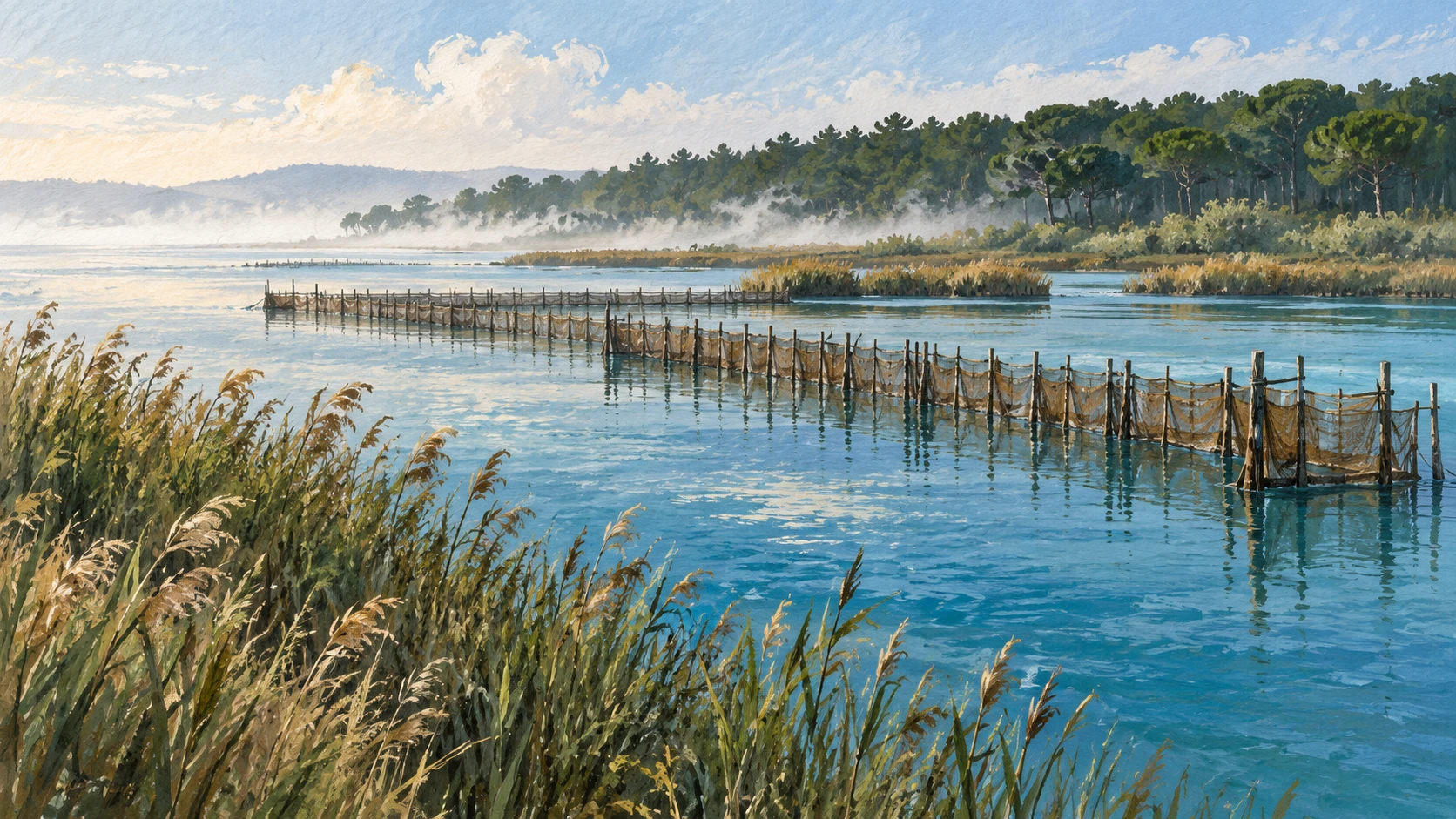
Karavasta Lagoon covers approximately 4,200 hectares in Albania. The water sits inside the larger Divjakë-Karavasta National Park perimeter.
The wetland holds international Ramsar designation. The lagoon maintains an average depth of 1.5 metres. The deepest channel depressions reach 2.2 metres.
Three shallow maritime channels connect the brackish water to the Adriatic Sea. Salt marshes and stone pine forests protect the long coastline.
Fish Movements Between Sea and Lagoon
Young marine fish enter the warm lagoon during spring months. They feed on rich benthic food in the calm water.
Adult fish begin a seaward migration toward the Adriatic during late autumn. They travel to spawn in deeper offshore waters.
Primary harvested species include gilthead seabream and grey mullet. European eels migrate through tidal channels during cold winter nights.
Traditional Wooden Traps in the Channels
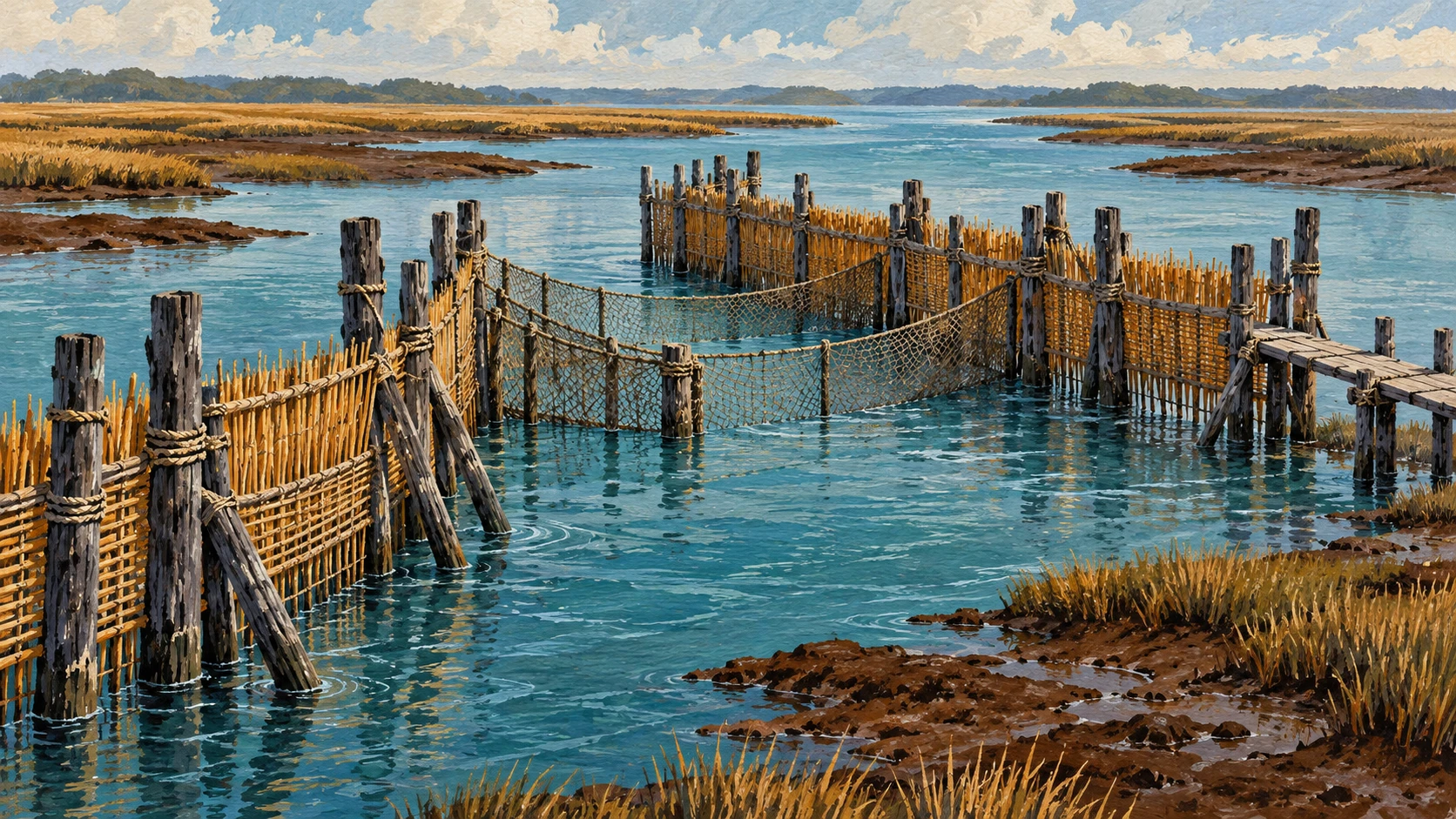
Local fishers capture outgoing fish using wooden barrier traps called dalljan. These barriers stand across tidal water passages.
The weir structures consist of vertical pine stakes and woven reed screens. V-shaped barrier wings direct moving schools into capture chambers.
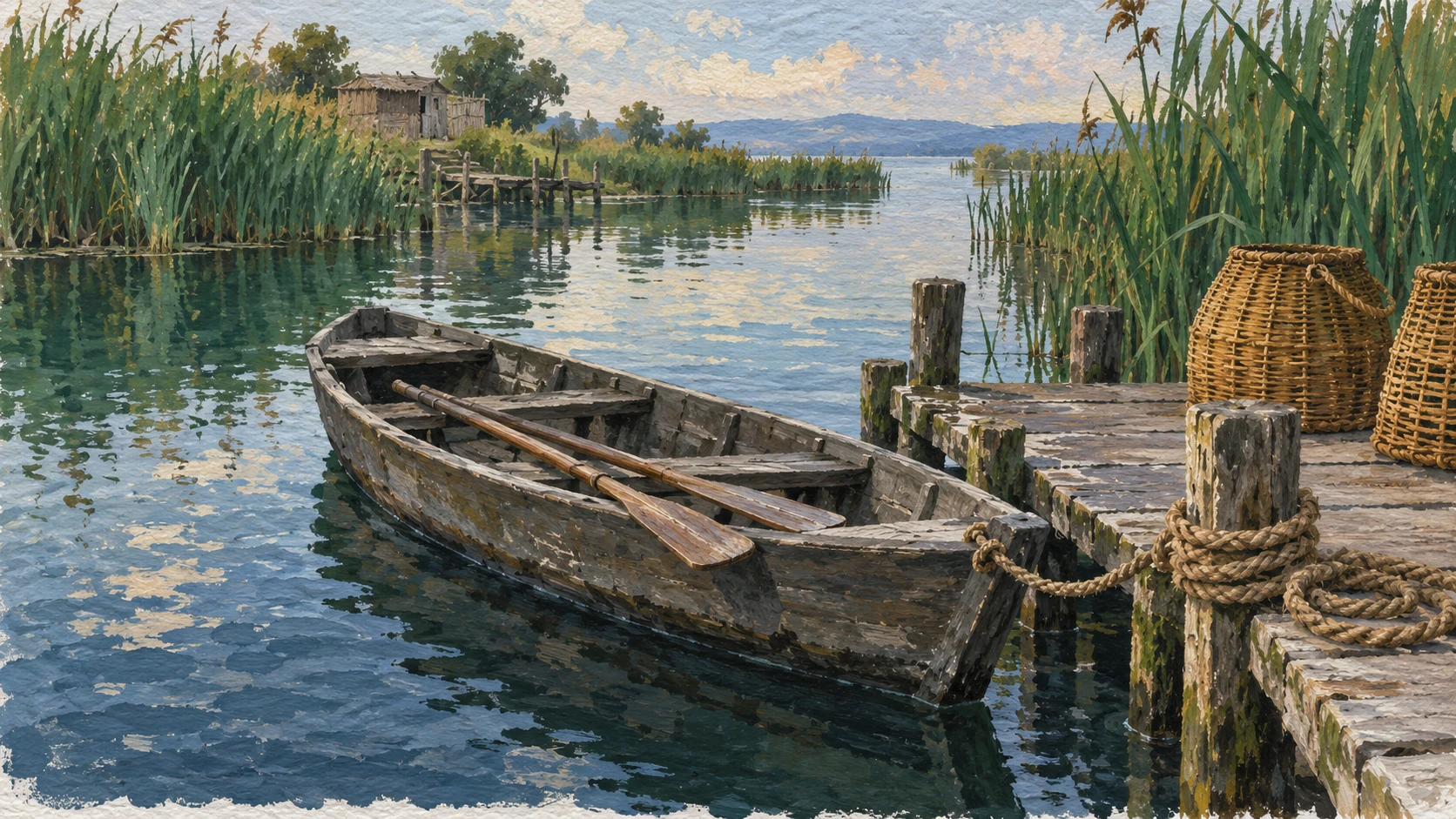
Fishers row flat wooden punts known locally as lundra. Statutory rules enforce minimum mesh spacing of 32 millimetres.
Cooperative Rules and Fishing Permits
Lagoon fishing rights belong to a local cooperative. The official register restricts commercial lagoon harvesting to exactly 65 licensed fishers.
Motorized trawling and monofilament gillnets are strictly banned inside the reserve. Park administration rangers conduct joint surveillance patrols every day.
Annual harvest quotas are adjusted based on scientific stock assessments. Regulations mandate minimum landing lengths of 20 centimetres for seabream. These rules protect wild fish stocks from overfishing.
Inspection Dock and Safe Fish Transport
Every lagoon harvest must be unloaded at the authorized central canal landing pier in Divjakë. No boat may land fish elsewhere.
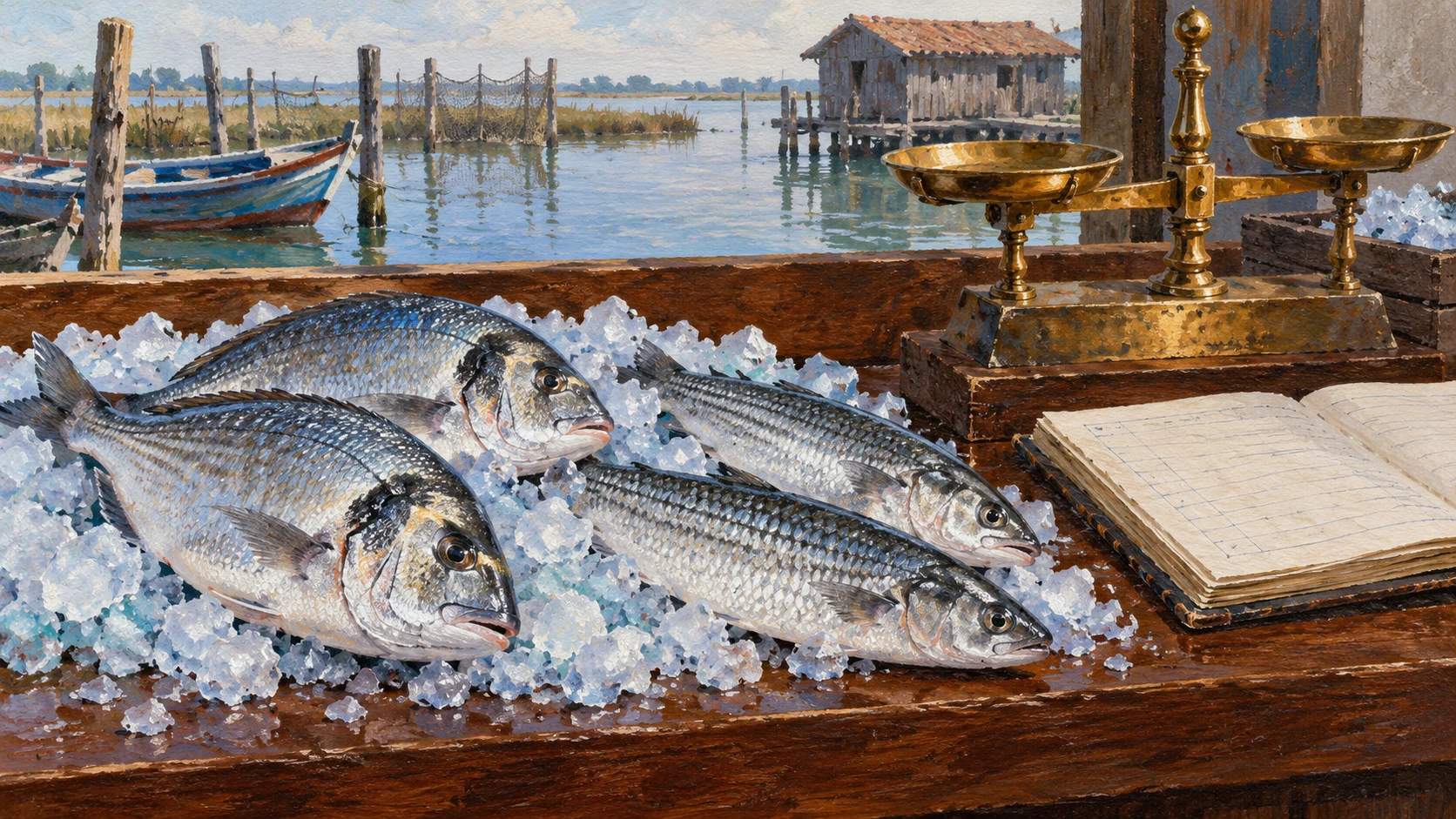
Veterinary inspectors examine landed batches and issue official certificates. Fish are sorted into sanitized containers chilled with crushed ice.
Barcoded identification tags are attached to fish crates. Checkpoints verify that refrigerated transport vehicles maintain cold chain records.
Fresh Catches for Markets and Kitchens
About 70 percent of landed lagoon fish supplies municipal markets in nearby towns. The remaining 30 percent travels daily to Tirana.
Wild lagoon fish commands a price premium over farmed fish. Local restaurants highlight whole grey mullet baked with garlic and fresh tomatoes.
Cured and dried grey mullet roe is known as botarga. Community agritourism initiatives provide complementary revenue for fishing households.
A2 · Elementary
Artisanal Fisheries and Estuarine Ecology in Karavasta Lagoon
A pre-intermediate field examination of coastal wetland hydrology, seasonal fish droving runs, cooperative weir barriers, and regulated seafood landings in Divjakë.
Hydrological Dimensions of the Coastal Wetland
Karavasta Lagoon covers approximately 4,200 hectares within the protected Divjakë-Karavasta National Park perimeter. The wetland basin forms one of the largest protected coastal aquatic systems in Southern Europe.
The lagoon maintains an average depth of 1.5 metres and maximum channel depressions reaching 2.2 metres. Lagoon salinity fluctuates between 15 and 38 practical salinity units according to seasonal precipitation and Adriatic tides.
Three shallow maritime channels connect the brackish lagoon basin to the open southern Adriatic Sea. Salt marshes and dense stone pine forests form a protective natural perimeter around the central water body.
Estuarine Migrations and Marine Fish Stocks
Juvenile marine fish enter the warm lagoon during spring months to feed on rich benthic invertebrates. The sheltered estuarine waters offer abundant nourishment and shelter from open maritime predators.
Adult fish begin a seaward migration toward the Adriatic during late autumn to spawn in deeper waters. Primary harvested species include gilthead seabream, European seabass, and multiple grey mullet varieties.
European eels migrate through tidal lagoon channels during winter months on their long oceanic journey. Park regulations enforce seasonal resting periods during spring recruitment to guarantee reproductive renewal.
Artisanal Engineering of Channel Fish Traps
Artisanal lagoon fishers capture outgoing migratory schools using traditional wooden barrier traps called dalljan. These historic barrier installations cross the natural tidal conduits linking lagoon and sea.
The weir structures consist of vertical pine stakes and woven reed screens driven into the lagoon floor. V-shaped barrier wings direct moving schools into capture chambers without injuring fish scales.
Crews navigate shallow channels using traditional flat-bottomed wooden punts known locally as lundra. Statutory rules enforce minimum barrier mesh spacing of 32 to 40 millimetres to allow juveniles to escape.
Cooperative Concessions and Conservation Safeguards
Lagoon fishing rights are managed through multi-year cooperative tenure concessions granted to local fishers. The park registry restricts commercial lagoon harvesting to exactly 65 licensed artisanal fishers.
Motorized trawling, monofilament gillnets, and spearfishing are banned inside the protected lagoon reserve. Park administration rangers conduct joint surveillance patrols with cooperative leaders to prevent illegal fishing.
Regulations mandate minimum landing lengths of 20 centimetres for seabream and 25 centimetres for seabass. Annual harvest quotas are adjusted based on scientific stock assessments produced by marine biology researchers.
Sanitary Checkpoints and Pier Inspection Audits
Every lagoon harvest must be unloaded at the authorized central canal landing pier in Divjakë. Designated harbor staff supervise vessel arrivals directly at the municipal dock.
Veterinary inspectors examine landed batches and issue official certificates before any vehicle departs. Fish are sorted into sanitized containers chilled with crushed ice between 0 and 4 degrees Celsius.
Barcoded identification tags are attached to fish crates to guarantee complete commercial traceability. Sanitary checkpoints verify that refrigerated transport vehicles maintain uninterrupted cold chain records.
Wholesale Fish Markets and Regional Food Systems
About 70 percent of landed lagoon fish supplies municipal markets and restaurants across Fier, Lushnjë, and Vlorë. The remaining 30 percent is transported daily to specialized wholesale fish merchants in Tirana.
Wild lagoon fish commands a 25 to 35 percent price premium over intensively farmed coastal aquaculture products. Local restaurant gastronomic traditions highlight whole grey mullet baked with garlic, fresh tomatoes, and olive oil.
Cured and dried grey mullet roe, known as botarga, forms a prized culinary delicacy across coastal towns. Community agritourism initiatives provide complementary revenue streams for artisanal fishing households in Divjakë.
B1 · Intermediate
Artisanal Fisheries and Wetland Ecology in Karavasta Lagoon
An intermediate investigation into coastal hydrology, seasonal catadromous migrations, traditional weir engineering, and municipal distribution chains in Divjakë-Karavasta.
Hydrological Balance and Wetland Geography
Karavasta Lagoon covers approximately 4,200 hectares within the protected Divjakë-Karavasta National Park perimeter, establishing a vital ecological reservoir along the low-lying central Albanian coastline. The aquatic basin constitutes an essential hydrological link between inland alluvial plains and the Adriatic littoral.
The lagoon maintains an average depth of 1.5 metres and maximum channel depressions reaching 2.2 metres across its submerged sand spits. Lagoon salinity fluctuates between 15 and 38 practical salinity units according to seasonal precipitation and Adriatic tides, generating highly variable estuarine conditions across distinct seasonal cycles.
Three shallow maritime channels connect the brackish lagoon basin to the open southern Adriatic Sea, allowing constant tidal flushing across sandy sandbars. Salt marshes and dense stone pine forests form a protective natural perimeter around the central wetland water body, filtering agricultural runoff and preserving natural water purity.
Seasonal Catadromous Migrations and Target Stocks
Juvenile marine fish enter the warm lagoon during spring months to feed on rich benthic invertebrates and organic detritus flourishing in shallow waters. The sheltered aquatic microclimate provides optimal developmental nourishment for post-larval fish seeking refuge from open sea turbulence before later catadromous migrations.
Adult fish begin a seaward migration toward the Adriatic during late autumn to spawn in deeper offshore marine waters as water temperatures decline. Primary harvested species include gilthead seabream, European seabass, and multiple grey mullet varieties, which concentrate near connecting maritime breaches.
European eels migrate through tidal lagoon channels during winter months on their long oceanic journey across the Atlantic to the distant Sargasso Sea. Park regulations enforce seasonal resting periods during spring recruitment to guarantee reproductive renewal and maintain long-term biodiversity balance.
Architecture of Traditional Channel Weirs
Artisanal lagoon fishers capture outgoing migratory schools using traditional wooden barrier traps called dalljan positioned across tidal waterways. These historic structures take advantage of natural hydrographic conduits created where lagoon waters discharge into the open sea.
The weir structures consist of vertical pine stakes and woven reed screens driven into the lagoon floor mud, forming an intricate barrier against seaward movement. V-shaped barrier wings direct moving schools into capture chambers without injuring fish scales, preserving market appearance and commercial value.
Crews navigate shallow channels using traditional flat-bottomed wooden punts known locally as lundra propelled by sturdy wooden oars and push poles. Statutory rules enforce minimum barrier mesh spacing of 32 to 40 millimetres to allow juveniles to escape unhindered.
Cooperative Tenure and Environmental Protection
Lagoon fishing rights are managed through multi-year cooperative tenure concessions granted to local fishers under formal co-management agreements with national environmental authorities. The park registry restricts commercial lagoon harvesting to exactly 65 licensed artisanal fishers to prevent unsustainable harvesting pressures.
Motorized trawling, monofilament gillnets, and spearfishing are banned inside the protected lagoon reserve to safeguard delicate benthic habitats from mechanical degradation. Park administration rangers conduct joint surveillance patrols with cooperative leaders to prevent illegal fishing and unauthorized night netting.
Regulations mandate minimum landing lengths of 20 centimetres for seabream and 25 centimetres for seabass to protect spawning cohorts from premature harvest. Annual harvest quotas are adjusted based on scientific stock assessments produced by marine biology researchers who monitor migratory biomass trends.
Dockside Inspection and Traceability Controls
Every lagoon harvest must be unloaded at the authorized central canal landing pier in Divjakë under the direct observation of park wardens and sanitary controllers. Unofficial offloading along peripheral sandbars is strictly penalized under national conservation statutes.
Veterinary inspectors examine landed batches and issue official certificates before any vehicle departs toward wholesale distribution centers. Fish are sorted into sanitized containers chilled with crushed ice between 0 and 4 degrees Celsius to halt enzymatic spoilage and preserve pristine freshness.
Barcoded identification tags are attached to fish crates to guarantee complete commercial traceability across all logistics nodes. Inspection logbooks register harvest timestamps, gear identifiers, species weights, and licensed fisher permits, establishing an unbroken paper and digital record.
Regional Wholesale Trade and Culinary Demand
About 70 percent of landed lagoon fish supplies municipal markets and restaurants across Fier, Lushnjë, and Vlorë within hours of landing. The remaining 30 percent is transported daily to specialized wholesale fish merchants in Tirana, meeting elevated demand from metropolitan fishmongers.
Wild lagoon fish commands a 25 to 35 percent price premium over intensively farmed coastal aquaculture products due to firm flesh texture and distinctive natural flavor. Local restaurant gastronomic traditions highlight whole grey mullet baked with garlic, fresh tomatoes, and olive oil, celebrating ancient coastal recipes.
Cured and dried grey mullet roe, known as botarga, forms a prized culinary delicacy across coastal towns, commanding substantial commercial value. Community agritourism initiatives provide complementary revenue streams for artisanal fishing households in Divjakë, linking wetland preservation with sustainable local livelihoods.
B2 · Upper Intermediate
Artisanal Fishery Ecology and Coastal Supply Chains in Karavasta Lagoon
An upper-intermediate analytical report on estuarine hydraulic dynamics, seasonal marine migration patterns, cooperative weir concessions, and cold-chain compliance in Albania.
Estuarine Hydrology and Environmental Protection Boundaries
Karavasta Lagoon covers approximately 4,200 hectares within the protected Divjakë-Karavasta National Park perimeter, representing one of the most ecologically significant coastal wetland complexes in the Mediterranean basin. The expanse acts as a critical hydrodynamic buffer between alluvial river drainages and the coastal Adriatic.
The lagoon maintains an average depth of 1.5 metres and maximum channel depressions reaching 2.2 metres along dredged navigation passes and natural scour pockets. Lagoon salinity fluctuates between 15 and 38 practical salinity units according to seasonal precipitation and Adriatic tides, creating pronounced environmental gradients that dictate species distributions.
Three shallow maritime channels connect the brackish lagoon basin to the open southern Adriatic Sea, facilitating vital water exchange and biological transport. Salt marshes and dense stone pine forests form a protective natural perimeter around the central aquatic zone, mitigating agricultural nutrient influx and stabilizing shifting dune boundaries.
Catadromous Migration Dynamics and Fishery Biomass
Juvenile marine fish enter the warm lagoon during spring months to feed on rich benthic invertebrates and detrital microorganisms flourishing in nutrient-dense shallows. The lagoon serves as an indispensable nursery environment, supporting rapid juvenile growth rates protected from pelagic marine predators.
Adult fish begin a seaward migration toward the Adriatic during late autumn to spawn in deeper marine trenches where hydrological stability favors larval survival. Primary harvested species include gilthead seabream, European seabass, and multiple grey mullet varieties, which undertake synchronized seasonal journeys through narrow lagoon exits.
European eels migrate through tidal lagoon channels during winter months on their long oceanic journey toward oceanic abyssal spawning grounds. Park regulations enforce seasonal resting periods during spring recruitment to guarantee reproductive renewal and maintain stable multi-species stock equilibriums.
Mechanical Design of Traditional Dalljan Fish Weirs
Artisanal lagoon fishers capture outgoing migratory schools using traditional wooden barrier traps called dalljan positioned across principal drainage cuts. These passive capture structures have evolved over centuries to harness natural tidal flow dynamics and catadromous flight behaviors.
The weir structures consist of vertical pine stakes and woven reed screens driven into the lagoon floor sediments to withstand strong outbound water currents. V-shaped barrier wings direct moving schools into capture chambers without injuring fish scales, preserving market appearance and minimizing commercial grading downgrades.
Crews navigate shallow channels using traditional flat-bottomed wooden punts known locally as lundra propelled by long ash poles and heavy balanced oars. Statutory rules enforce minimum barrier mesh spacing of 32 to 40 millimetres to allow juveniles to escape, ensuring that only market-sized adults are retained.
Cooperative Concessions, Regulatory Regimes, and Enforcement
Lagoon fishing rights are managed through multi-year cooperative tenure concessions granted to local fishers under formal co-management statutes that integrate community rights with statutory conservation goals. The park registry restricts commercial lagoon harvesting to exactly 65 licensed artisanal fishers, effectively capping effort levels.
Motorized trawling, monofilament gillnets, and spearfishing are banned inside the protected lagoon reserve to avoid physical destruction of fragile seagrass meadows and benthic macrofauna. Park administration rangers conduct joint surveillance patrols with cooperative leaders to prevent illegal fishing and dismantle unauthorized barrier netting.
Regulations mandate minimum landing lengths of 20 centimetres for seabream and 25 centimetres for seabass, establishing biological thresholds that protect maturing age classes. Annual harvest quotas are adjusted based on scientific stock assessments produced by marine biology researchers who monitor year-class recruitment strengths.
Sanitary Verification Protocols and Logistics Cold Chains
Every lagoon harvest must be unloaded at the authorized central canal landing pier in Divjakë under the direct supervision of certified inspection personnel. Bypassing this centralized landing terminal is strictly prohibited under national fisheries regulations.
Veterinary inspectors examine landed batches and issue official certificates before any vehicle departs toward regional or urban wholesale destinations. Fish are sorted into sanitized containers chilled with crushed ice between 0 and 4 degrees Celsius, maintaining critical thermal standards that prevent histamine development and bacteriological growth.
Barcoded identification tags are attached to fish crates to guarantee complete commercial traceability from wetland water to culinary point of sale. Inspection logbooks register harvest timestamps, gear identifiers, species weights, and licensed fisher permits, creating an immutable chain of custody record.
Wholesale Distribution Channels, Economics, and Agritourism
About 70 percent of landed lagoon fish supplies municipal markets and restaurants across Fier, Lushnjë, and Vlorë within hours of landing. The remaining 30 percent is transported daily to specialized wholesale fish merchants in Tirana, fulfilling culinary demand from high-end urban hospitality establishments.
Wild lagoon fish commands a 25 to 35 percent price premium over intensively farmed coastal aquaculture products due to superior flesh firmness and complex wild flavor. Local restaurant gastronomic traditions highlight whole grey mullet baked with garlic, fresh tomatoes, and olive oil, serving as an emblem of regional gastronomic heritage.
Cured and dried grey mullet roe, known as botarga, forms a prized culinary delicacy across coastal towns, commanding substantial commercial premiums in domestic and export markets. Community agritourism initiatives provide complementary revenue streams for artisanal fishing households in Divjakë, incentivizing local resource stewardship.
C1 · Advanced
Artisanal Lagoon Fisheries, Hydrology, and Food Systems in Karavasta
An advanced empirical analysis of coastal wetland hydrology, seasonal catadromous migrations, traditional dalljan weir architecture, and municipal seafood distribution in Albania.
Hydrological Regimes and Ramsar Protected Wetland Boundaries
Karavasta Lagoon covers approximately 4,200 hectares within the protected Divjakë-Karavasta National Park perimeter, constituting Albania's foremost coastal wetland ecosystem and an internationally recognized ecological benchmark under the Ramsar Convention. The shallow lagoon depression is bounded by dynamic barrier spit geomorphology, acting as an estuarine reservoir that dampens coastal storm surges while sustaining critical Mediterranean wetland bio-productivity.
The lagoon maintains an average depth of 1.5 metres and maximum channel depressions reaching 2.2 metres across its scour trenches and connecting navigational throats. Lagoon salinity fluctuates between 15 and 38 practical salinity units according to seasonal precipitation and Adriatic tides, generating complex horizontal and vertical haloclines that dictate the distribution of marine organisms.
Three shallow maritime channels connect the brackish lagoon basin to the open southern Adriatic Sea, enabling essential hydrodynamic exchange and fish droving passage. Salt marshes and dense stone pine forests form a protective natural perimeter around the central water surface, filtering terrestrial agro-chemical runoff and providing roosting canopy for diverse avian populations.
Catadromous Migration Phenology and Multi-Species Biomass Dynamics
Juvenile marine fish enter the warm lagoon during spring months to feed on rich benthic invertebrates, microalgae, and polychaete worms flourishing across the shallow sunlit mudflats. Catadromous migration phenology drives this annual influx, establishing the lagoon as a vital Mediterranean nursery ground where young fish experience accelerated somatic growth protected from pelagic marine piscivores.
Adult fish begin a seaward migration toward the Adriatic during late autumn to spawn in deeper pelagic waters where thermal stability and offshore currents optimize larval dispersal. Primary harvested species include gilthead seabream, European seabass, and multiple grey mullet varieties, which exhibit precise behavioural responses to falling water temperatures and autumn barometric pressure drops.
European eels migrate through tidal lagoon channels during winter months on their long oceanic journey across the Atlantic to spawning grounds in the Sargasso Sea. Park regulations enforce seasonal resting periods during spring recruitment to guarantee reproductive renewal, temporarily lifting weir traps to ensure uninhibited inward movement of post-larval recruits.
Engineering and Ethnohistory of Dalljan Channel Weirs
Artisanal lagoon fishers capture outgoing migratory schools using traditional wooden barrier traps called dalljan positioned across outgoing tidal channels. This passive interception technology represents centuries of accumulated vernacular engineering, aligning channel-spanning palisades with prevailing catadromous migratory paths without impeding tidal hydrodynamics.
The weir structures consist of vertical pine stakes and woven reed screens driven into the lagoon floor substrate, anchored by local hazel and willow binders. V-shaped barrier wings direct moving schools into capture chambers without injuring fish scales, preventing descaling abrasions and preserving commercial value for fresh municipal wholesale.
Crews navigate shallow channels using traditional flat-bottomed wooden punts known locally as lundra propelled by hand-carved oars and push poles designed to glide silently over submerged eelgrass beds. Statutory rules enforce minimum barrier mesh spacing of 32 to 40 millimetres to allow juveniles to escape unharmed back into the marine environment.
Co-Management Concessions, Permitting Quotas, and Ranger Enforcement
Lagoon fishing rights are managed through multi-year cooperative tenure concessions granted to local fishers, operating under formal contractual agreements between the artisanal fishing cooperative and the Ministry of Tourism and Environment. The park registry restricts commercial lagoon harvesting to exactly 65 licensed artisanal fishers, effectively preventing race-to-fish dynamics and capping total harvesting capacity.
Motorized trawling, monofilament gillnets, and spearfishing are banned inside the protected lagoon reserve to preserve benthic habitat integrity and prevent accidental mortality of non-target migratory fauna. Park administration rangers conduct joint surveillance patrols with cooperative leaders to prevent illegal fishing, utilizing thermal night-vision monitoring to intercept nocturnal poachers.
Regulations mandate minimum landing lengths of 20 centimetres for seabream and 25 centimetres for seabass, establishing statutory maturity safeguards that protect reproductive cohorts. Annual harvest quotas are adjusted based on scientific stock assessments produced by marine biology researchers from the University of Tirana.
Centralized Landing Governance, Cold-Chain Hygiene, and Traceability
Every lagoon harvest must be unloaded at the authorized central canal landing pier in Divjakë, where dockside infrastructure permits continuous veterinary inspection and legal recording. Landing fish at unauthorized points along peripheral barrier beaches constitutes an environmental offense punishable by licence forfeiture.
Veterinary inspectors examine landed batches and issue official certificates before any vehicle departs toward regional wholesale markets. Fish are sorted into sanitized containers chilled with crushed ice between 0 and 4 degrees Celsius, maintaining microbiological stability and preventing autolytic tissue degradation during transit.
Barcoded identification tags are attached to fish crates to guarantee complete commercial traceability through every tier of the seafood distribution network. Sanitary checkpoints verify that refrigerated transport vehicles maintain uninterrupted cold chain temperature records. Inspection logbooks register harvest timestamps, gear identifiers, species weights, and licensed fisher permits, furnishing an unalterable audit trail for national food safety authorities.
Market Intermediation, Price Premiums, and Agritourism Integration
Market intermediation directs about 70 percent of landed lagoon fish to municipal markets and restaurants across Fier, Lushnjë, and Vlorë within hours of landing, sustaining a remarkably compact regional food distribution radius. The remaining 30 percent is transported daily to specialized wholesale fish merchants in Tirana, meeting premium culinary demand from high-end urban dining establishments.
Wild lagoon fish commands a 25 to 35 percent price premium over intensively farmed coastal aquaculture products, reflecting consumer appreciation for superior flesh texture, natural fat composition, and absence of synthetic feed additives. Local restaurant gastronomic traditions highlight whole grey mullet baked with garlic, fresh tomatoes, and olive oil, anchoring regional culinary identity in authentic wetland harvest practices.
Cured and dried grey mullet roe, known as botarga, forms a prized culinary delicacy across coastal towns, commanding high-value export margins and specialty retail status. Community agritourism initiatives provide complementary revenue streams for artisanal fishing households in Divjakë, aligning household economic prosperity with long-term wetland conservation stewardship.
C2 · Mastery
Artisanal Fishery Systems, Wetland Ecology, and Commercial Networks in Karavasta Lagoon
A comprehensive investigation of estuarine lagoon hydrodynamics, seasonal marine migratory biology, cooperative weir concessions, and regulated coastal seafood logistics in Albania.
Estuarine Hydrodynamics, Sedimentology, and Ramsar Wetland Conservation
Karavasta Lagoon covers approximately 4,200 hectares within the protected Divjakë-Karavasta National Park perimeter, representing Albania's most expansive paralic ecosystem and a keystone ecological repository under the Ramsar Convention. Bound by dynamic maritime spits and alluvial depositional plains, the lagoon basin functions as a vital hydrodynamic sponge that attenuates open marine tidal surges while sustaining productive brackish trophic webs.
The lagoon maintains an average depth of 1.5 metres and maximum channel depressions reaching 2.2 metres across bathymetric scour trenches and inlet conduits. Lagoon salinity fluctuates between 15 and 38 practical salinity units according to seasonal precipitation and Adriatic tides, establishing pronounced horizontal and vertical salinity gradients that dictate benthic biological communities.
Three shallow maritime channels connect the brackish lagoon basin to the open southern Adriatic Sea, permitting continuous bidirectional hydraulic flushing across tidal delta shoals. Salt marshes and dense stone pine forests form a protective natural perimeter around the central aquatic body, mitigating diffuse agricultural nitrogen inputs and stabilizing shifting aeolian littoral dunes.
Catadromous Phenology, Recruitment Dynamics, and Migratory Fish Stocks
Juvenile marine fish enter the warm lagoon during spring months to feed on rich benthic invertebrates, microphytobenthos, and amphipods proliferating in nutrient-dense shallow flats. Catadromous migration phenology governs this nursery habitat, providing high somatic growth trajectories and essential refuge from pelagic piscivores inhabiting the open marine shelf.
Adult fish begin a seaward migration toward the Adriatic during late autumn to spawn in deeper offshore marine waters where high hydrostatic pressure and offshore currents favor gamete fertilization. Primary harvested species include gilthead seabream, European seabass, and multiple grey mullet varieties, which concentrate in migratory corridors when autumn barometric depressions trigger collective seaward movement.
European eels migrate through tidal lagoon channels during winter months on their long oceanic journey across the Atlantic abyss toward the Sargasso Sea. Park regulations enforce seasonal resting periods during spring recruitment to guarantee reproductive renewal, lifting barrier screens to allow uninhibited inland passage of post-larval glass eels and fry.
Hydro-Engineering, Vernacular Architecture, and Operation of Dalljan Weirs
Artisanal lagoon fishers capture outgoing migratory schools using traditional wooden barrier traps called dalljan installed across natural tidal cuts. This centuries-old passive entrapment system exploits the instinctive seaward escapement drive of mature teleosts, intercepting migrating schools without mechanical energy or motorized propulsion.
The weir structures consist of vertical pine stakes and woven reed screens driven into the lagoon floor sediments, reinforced by resilient willow and hazel cross-bracing. V-shaped barrier wings direct moving schools into capture chambers without injuring fish scales, completely preventing epidermal abrasions and maintaining peak aesthetic grade for wholesale realization.
Crews navigate shallow channels using traditional flat-bottomed wooden punts known locally as lundra propelled by ash push poles and counterweighted oars that maneuver across submerged macrophyte beds. Statutory rules enforce minimum barrier mesh spacing of 32 to 40 millimetres to allow juveniles to escape unhindered, preventing growth overfishing across successive cohorts.
Common-Property Tenure, Cooperative Concessions, and Protected Reserve Governance
Lagoon fishing rights are managed through multi-year cooperative tenure concessions granted to local fishers under formal co-management contracts with national protected area authorities. The park registry restricts commercial lagoon harvesting to exactly 65 licensed artisanal fishers, establishing durable common-property governance that prevents open-access resource depletion.
Motorized trawling, monofilament gillnets, and spearfishing are banned inside the protected lagoon reserve to preserve delicate benthic substrates and avoid incidental bycatch of non-target wetland avifauna. Park administration rangers conduct joint surveillance patrols with cooperative leaders to prevent illegal fishing, utilizing thermal night-vision optical devices to eliminate nocturnal poaching.
Regulations mandate minimum landing lengths of 20 centimetres for seabream and 25 centimetres for seabass, ensuring that individuals reproduce at least once prior to commercial exploitation. Annual harvest quotas are adjusted based on scientific stock assessments produced by marine biology researchers who evaluate age-structure histograms and cohort abundance.
Sanitary Landing Protocols, Cold-Chain Logistics, and Traceability Auditing
Every lagoon harvest must be unloaded at the authorized central canal landing pier in Divjakë under mandatory dockside oversight by municipal and environmental inspectors. Offloading catches at clandestine coastal landing points is strictly prohibited and subject to immediate administrative sanctions.
Veterinary inspectors examine landed batches and issue official certificates before any vehicle departs toward distribution markets. Fish are sorted into sanitized containers chilled with crushed ice between 0 and 4 degrees Celsius, maintaining rigid cold-chain standards that suppress bacterial reproduction and prevent enzymatic histamine accumulation.
Barcoded identification tags are attached to fish crates to guarantee complete commercial traceability across all logistics nodes. Inspection logbooks register harvest timestamps, gear identifiers, species weights, and licensed fisher permits, generating an unbroken digital and physical chain of custody for food safety audits.
Wholesale Price Premiums, Gastronomic Identity, and Agritourism Symbiosis
About 70 percent of landed lagoon fish supplies municipal markets and restaurants across Fier, Lushnjë, and Vlorë within hours of landing, sustaining a compact regional food web. The remaining 30 percent is transported daily to specialized wholesale fish merchants in Tirana, fulfilling culinary demand from high-end metropolitan gastronomic venues.
Wild lagoon fish commands a 25 to 35 percent price premium over intensively farmed coastal aquaculture products due to superior muscular firmness, pristine organoleptic properties, and distinct wild diet. Local restaurant gastronomic traditions highlight whole grey mullet baked with garlic, fresh tomatoes, and olive oil, reinforcing the cultural heritage of central coastal communities.
Cured and dried grey mullet roe, known as botarga, forms a prized culinary delicacy across coastal towns, yielding substantial economic returns in specialty export channels. Community agritourism initiatives provide complementary revenue streams for artisanal fishing households in Divjakë, cementing local economic alignment with wetland conservation imperatives.
Check your understanding
Choose how closely you want to revisit the article. You can refer back while answering, and review explanations when you finish.
Quick Quiz A1
Try one question, then create a free account for the full Quick Quiz. Sign Up Free
Answer every question before checking. There is no time limit.
Your results
/ 1 correct (%)
Read the explanations to see how each answer connects to the article.
-
How many hectares does Karavasta Lagoon cover in Albania?
1. Answer:
Quick Quiz A2
Try one question, then create a free account for the full Quick Quiz. Sign Up Free
Answer every question before checking. There is no time limit.
Your results
/ 1 correct (%)
Read the explanations to see how each answer connects to the article.
-
Where does Karavasta Lagoon sit within protected territory?
1. Answer:
Quick Quiz B1
Try one question, then create a free account for the full Quick Quiz. Sign Up Free
Answer every question before checking. There is no time limit.
Your results
/ 1 correct (%)
Read the explanations to see how each answer connects to the article.
-
Where is Karavasta Lagoon situated along the Albanian coast?
1. Answer:
Quick Quiz B2
Try one question, then create a free account for the full Quick Quiz. Sign Up Free
Answer every question before checking. There is no time limit.
Your results
/ 1 correct (%)
Read the explanations to see how each answer connects to the article.
-
Where is Karavasta Lagoon situated in Southern Europe?
1. Answer:
Quick Quiz C1
Try one question, then create a free account for the full Quick Quiz. Sign Up Free
Answer every question before checking. There is no time limit.
Your results
/ 1 correct (%)
Read the explanations to see how each answer connects to the article.
-
Where is Karavasta Lagoon located within Albania's protected conservation framework?
1. Answer:
Quick Quiz C2
Try one question, then create a free account for the full Quick Quiz. Sign Up Free
Answer every question before checking. There is no time limit.
Your results
/ 1 correct (%)
Read the explanations to see how each answer connects to the article.
-
Where is Karavasta Lagoon located within Albania's national park system?
1. Answer:
