
A1 · Beginner
Lake Ohrid and Pogradec: an ancient aquatic landscape
Ancient tectonic hydrology, endemic koran trout, and prehistoric pile dwellings in Albania.
An Ancient Deep Lake in the Mountains
Lake Ohrid is one of the oldest and deepest lakes in Europe. In 2019, UNESCO expanded the site to include the Albanian lake shore.
The maximum water depth reaches approximately 289 meters with clean clear water. In Albania, officials call this protected area Lake Pogradec.
The lake sits high in the mountains at 693 meters above sea level. Cold clear water holds plenty of oxygen for rare wildlife species.
Rare Animals and the Famous Koran Trout
Lake Ohrid protects over two hundred rare native animal species. The most famous local fish is the endemic trout known as koran.
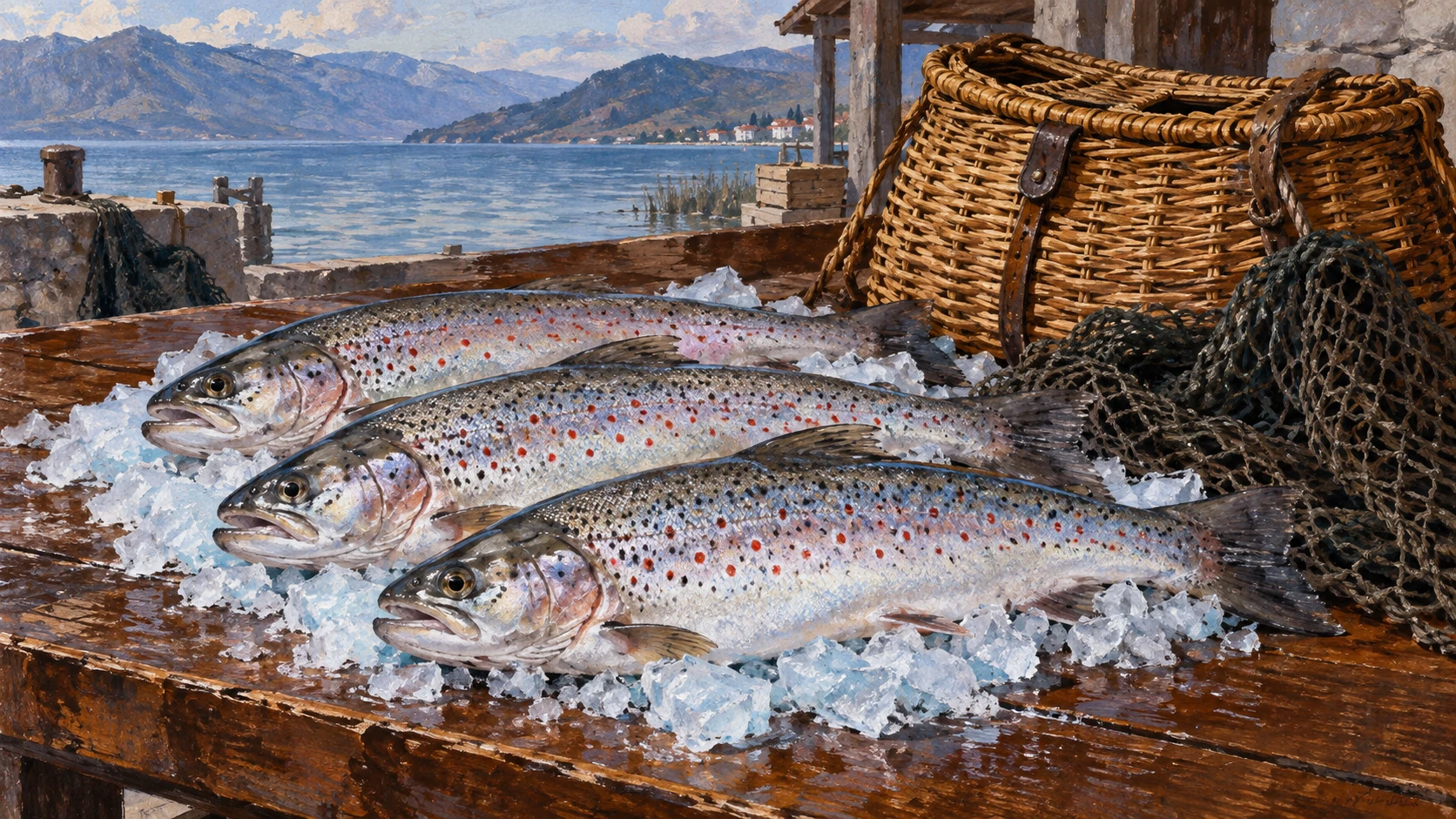
Koran trout show bright silver scales with small red spots along their sides. Strict seasonal fishing rules protect adult fish during winter breeding periods.
A fish hatchery in Tushemisht raises young trout to restock the deep lake. Many tiny water snails and fresh sponges also live here.
Fresh Underground Springs at Drilon
More than half of the lake water comes from fresh underwater springs. Water from Lake Prespa travels through hidden underground limestone caves and channels.
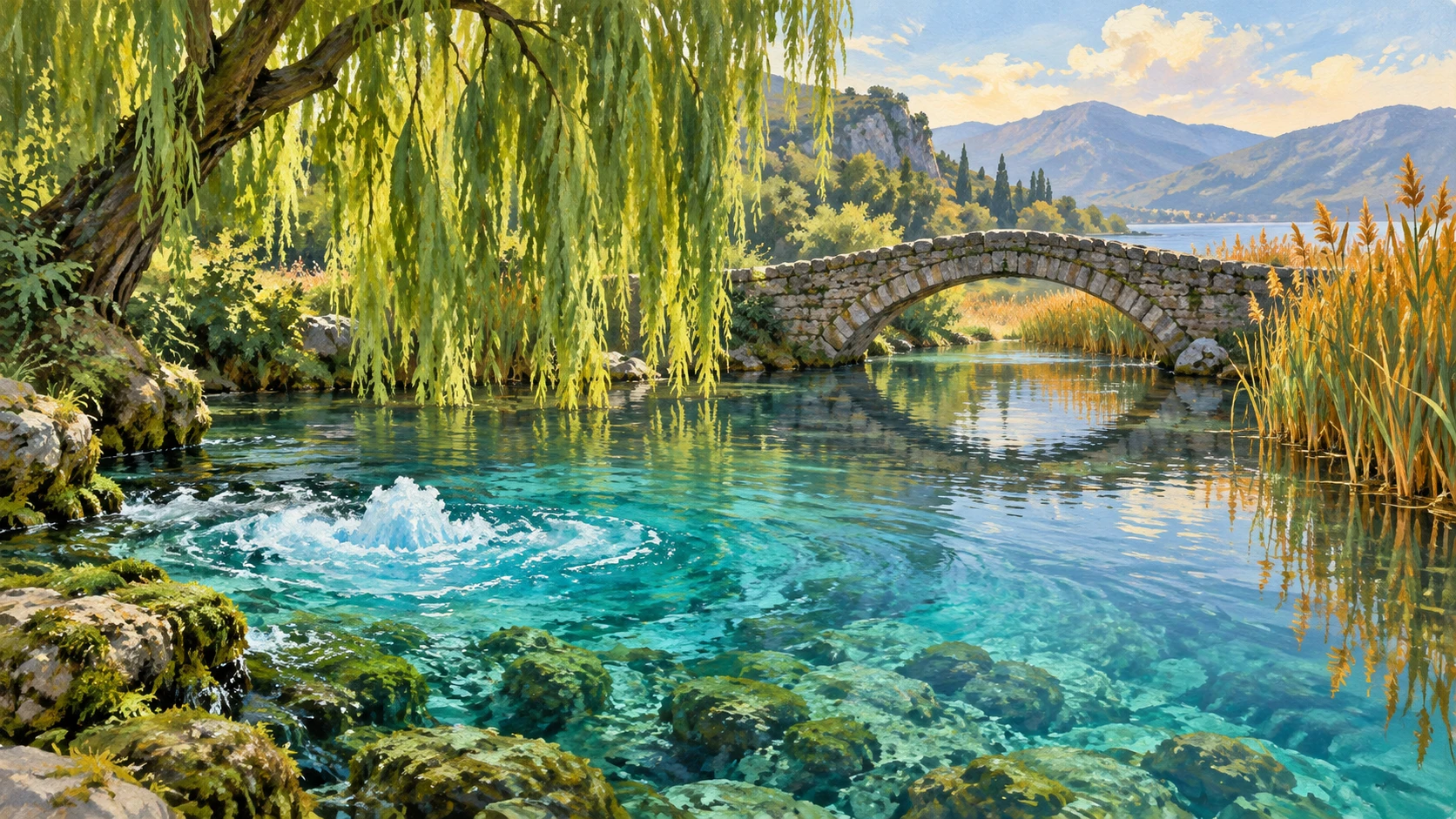
Great natural springs at Drilon and Tushemisht pour cold clean water into the lake. Green weeping willows and reed plants grow around quiet ponds.
Underwater springs bubble constantly from the sandy lake bed. Scientific tests prove water travels directly through the mountains from Lake Prespa.
Ancient Wooden Houses on the Lin Shore
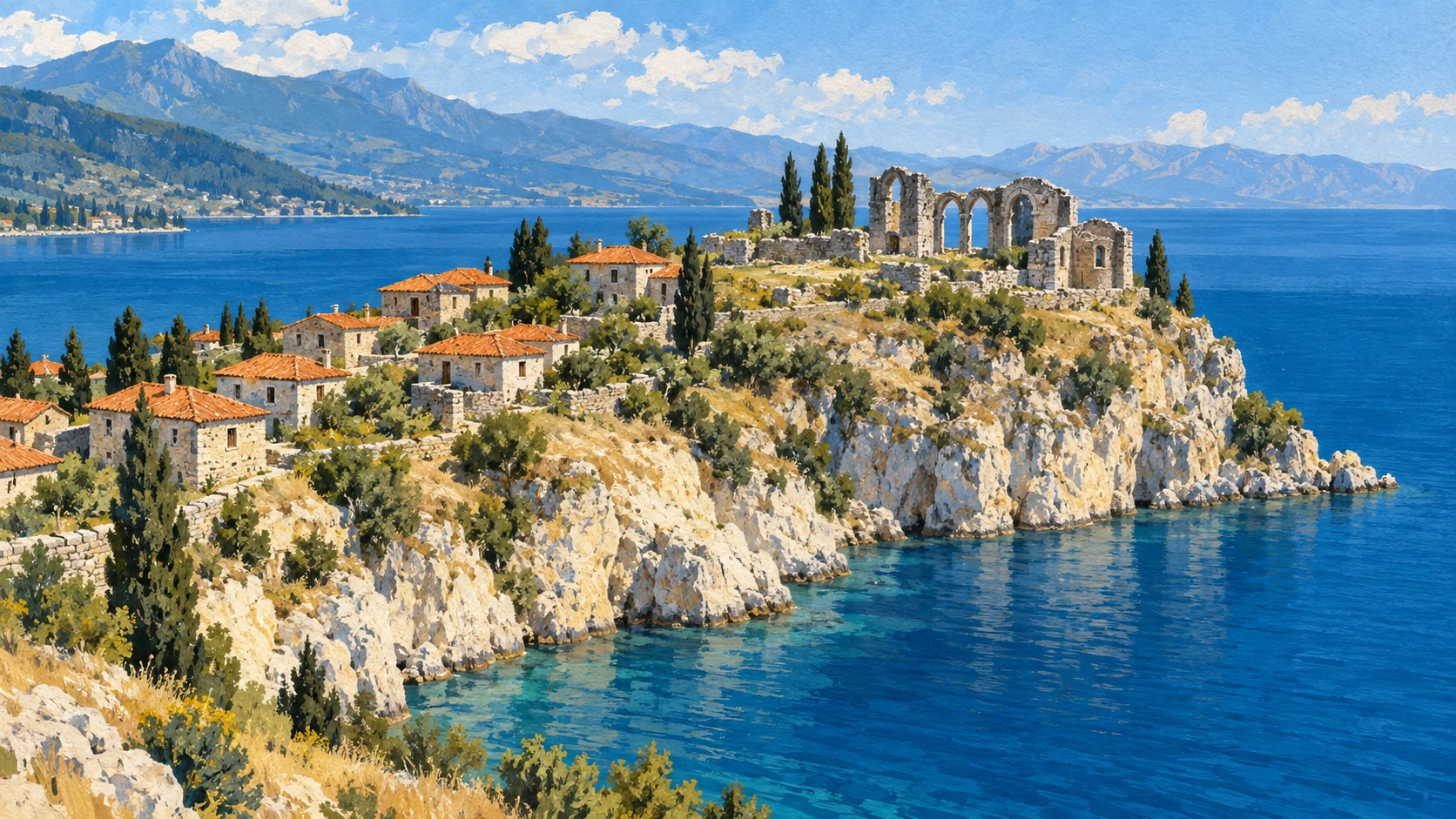
The rocky Lin Peninsula contains an ancient wooden village built over lake water. Archaeologists discovered thousands of old wooden stilts driven into the mud.
Thick fences made of pointed wooden posts protected the ancient stilt village. Early village farmers grew wheat and raised domestic sheep near the shore.
The hill above the village preserves an old Christian church with colorful floor mosaics. Wet mud provided waterlogged preservation for ancient wooden artifacts.
The Lakeside City of Pogradec
Pogradec is a peaceful lakeside town loved by Albanian poets and writers. A long stone promenade extends for several kilometers along the shoreline.
Traditional wooden rowing boats called varke rest on the quiet pebble beach. Local cooks bake fresh koran trout with walnuts and fragrant garden herbs.
Clean walking paths, bicycle lanes, and marked swimming areas welcome summer travelers. Historic villa architecture along the shore displays graceful stone walls and classic balconies.
Joint Care for the Shared Lake
A joint bilateral committee coordinates lake protection between Albania and North Macedonia. Both countries test water samples together to find pollutants and monitor rivers.
Modern wastewater plants clean municipal water before it enters the deep lake. Officials monitor nearby farm fields to stop chemical fertilizers from harming water.
Strict building rules along the shore protect natural wetland buffers from new construction. Scientists work across the border to keep Lake Ohrid clean and safe.
A2 · Elementary
Lake Ohrid and Pogradec: an ancient aquatic landscape
Ancient tectonic hydrology, endemic koran trout, and prehistoric pile dwellings in Albania.
Ancient Tectonic Origin and UNESCO Protection
Lake Ohrid represents one of the oldest and deepest tectonic lakes on the European continent, forming millions of years ago. In 2019, UNESCO approved a transboundary extension to incorporate the Albanian shoreline and Pogradec watershed into the World Heritage site.
The maximum water depth reaches approximately 289 meters, providing exceptional transparency across deep aquatic layers. The Albanian national authorities designate the regional aquatic zone as the Lake Pogradec Protected Landscape.
The lacustrine basin rests at an altitude of 693 meters above sea level between steep limestone mountain ranges. Pure oligotrophic water conditions sustain unique aquatic species requiring high dissolved oxygen and low nutrient concentrations.
Endemic Biodiversity and the Koran Trout Fishery
Lake Ohrid shelters more than two hundred endemic wildlife species that exist nowhere else in the world. The most celebrated native fish is the endemic Ohrid trout, known locally as koran and classified as Salmo letnica.
Koran trout display brilliant silver scales dotted with bright red spots and thrive in cold, deep subaquatic currents. Strict seasonal fishing bans and gear restrictions safeguard spawning adults during the vulnerable winter reproductive cycle.
A specialized state fish hatchery at Tushemisht breeds and releases millions of young trout fingerlings each year. The ecosystem also supports the native belushka trout, unique freshwater snails, and endemic lacustrine sponges.
Subterranean Karst Waters and Drilon Springs
More than fifty percent of Lake Ohrid's water supply enters through underground and subaquatic karstic springs. Higher-elevation Lake Prespa drains through porous underground limestone channels beneath the surrounding mountain ridges.
The famous springs at Drilon and Tushemisht discharge immense volumes of pristine, naturally filtered water into the lake basin. The Drilon natural monument features peaceful braided waterways shaded by weeping willows and diverse wetland vegetation.
Subaquatic springs bubbling continuously from the lake bed maintain stable low temperatures throughout the year. Isotopic scientific tracing experiments confirmed the direct subterranean connection linking Lake Prespa with the Drilon springs.
Prehistoric Stilt Dwellings on the Lin Peninsula
The picturesque Lin Peninsula preserves the oldest submerged stilt-dwelling settlement discovered in Europe, dating back to 6000 BC. Underwater archaeological teams from Switzerland and Albania uncovered thousands of wooden foundation posts driven into the lacustrine bed.
A defensive barrier constructed from pointed wooden palisades encircled the prehistoric village to protect early inhabitants. Excavated lake sediments revealed evidence of early farming, cereal cultivation, and domesticated cattle husbandry.
The rocky promontory above also preserves a sixth-century Early Christian basilica adorned with intricate geometric mosaics. Waterlogged anaerobic sediments preserved fragile Neolithic wooden artifacts, woven baskets, and plant fibers across eight millennia.
Waterfront Culture and Gastronomy in Pogradec
Pogradec developed as a distinguished cultural lakeside town, celebrated in famous poems composed by Lasgush Poradeci. A broad stone-paved promenade stretches along the shoreline, offering open vistas across the deep blue lake.
Traditional wooden flat-bottomed rowing boats called varke still navigate shallow waters near local reed beds. Regional culinary traditions celebrate oven-baked koran prepared with crushed walnuts, garlic, and fresh fragrant herbs.
Modern lakeside infrastructure features paved pedestrian promenades, dedicated bicycle tracks, and designated summer beaches. Historic stone villas built during the early twentieth century reflect traditional vernacular architecture adapted to lakeside life.
Transboundary Conservation and Ecological Monitoring
A bilateral management committee coordinates environmental protection policies between Albania and neighboring North Macedonia. Joint scientific teams monitor water quality, testing chemical parameters and tracking river inflows across the international frontier.
Modern wastewater treatment facilities in Pogradec process urban effluents before clean treated water reaches the fragile lake. Authorities monitor agricultural lands across the Korca plain to restrict phosphate fertilizers and prevent toxic algal blooms.
Strict zoning regulations along the lakeshore prohibit unauthorized construction and preserve natural reed buffer habitats. Cross-border ecological cooperation ensures long-term preservation of Lake Ohrid's extraordinary biodiversity and clear waters.
B1 · Intermediate
Lake Ohrid and Pogradec: an ancient aquatic landscape
Ancient tectonic hydrology, endemic koran trout, and prehistoric pile dwellings in Albania.
Ancient Limnology and UNESCO Transboundary Designation
Lake Ohrid represents one of the planet's oldest and deepest tectonic lakes, with geological origins extending back between two and three million years to the Pliocene epoch. In 2019, the UNESCO World Heritage Committee formally extended the existing World Heritage property across the international border, incorporating the Albanian shoreline, surrounding wetlands, and the Pogradec catchment area.
The lake reaches an extraordinary maximum depth of approximately 289 meters, supporting remarkable optical clarity and thermal stratification across its aquatic layers. Under Albanian environmental jurisdiction, the protected littoral zone is designated as the Lake Pogradec Protected Landscape, managed by the National Agency of Protected Areas.
Occupying an altitude of 693 meters above sea level, the aquatic basin is framed by rugged limestone mountain massifs including the Galicica and Mali i Thate ranges. Highly oligotrophic conditions prevail, defined by low dissolved nutrient concentrations and exceptional dissolved oxygen levels essential for ancient biological refugia.
Endemic Ichthyofauna and the Vulnerable Koran Trout
Biologists describe Lake Ohrid as a living museum of evolutionary history, harboring more than two hundred endemic species that evolved in prolonged geographic isolation. The preeminent icon of this endemic fauna is the Ohrid trout, known throughout Albania as koran and designated taxonomically as Salmo letnica.
Koran trout feature iridescent silver flanks covered with delicate crimson spots and inhabit the cold, highly oxygenated benthic depths of the lake basin. Rigorous statutory closed seasons and gear restrictions protect spawning adults during the vulnerable winter reproductive cycle from commercial overexploitation.
To sustain dwindling wild stocks, an advanced aquaculture hatchery at Tushemisht artificially fertilizes and incubates millions of juvenile koran fingerlings for annual restocking campaigns. The lacustrine ecosystem also shelters the native belushka trout, specialized endemic gastropods, flatworms, and unique freshwater sponges.
Subterranean Karstic Recharge and the Drilon Springs Complex
A defining characteristic of Lake Ohrid's hydrological equilibrium is that over fifty percent of its water volume derives from subaquatic and littoral karstic springs. The neighboring Lake Prespa, situated at an altitude roughly 150 meters higher, acts as a primary hydrological reservoir that continuously feeds Lake Ohrid through underground conduits.
Water percolates through vast subterranean karst networks beneath the porous limestone massif of Galicica before emerging as magnificent freshwater springs at Drilon and Tushemisht. The Drilon protected natural monument features crystal-clear braided ponds, weeping willows, and rich riparian reedbeds that provide critical resting habitat for migratory avifauna.
Subaquatic springs bubbling continuously through sand vents on the lake bed maintain a stable year-round water temperature between ten and twelve degrees Celsius. Precise environmental isotopic tracing studies have incontrovertibly verified the underground transit time and hydraulic connection between Lake Prespa and the Drilon spring complex.
Neolithic Stilt Architecture and Archaeology on the Lin Peninsula
On the western shore of Lake Ohrid, the Lin Peninsula preserves the most ancient submerged lacustrine pile-dwelling settlement ever excavated in Europe, dating to approximately 6000 BC. Joint Swiss and Albanian underwater archaeology teams uncovered dense arrays of oak and pine posts driven deep into the lake floor, indicating a sophisticated prehistoric stilt village.
The archaeological excavation revealed that a monumental defensive perimeter comprising tens of thousands of pointed timber palisades was erected around the stilt platforms. Paleobotanical analysis of waterlogged sediment cores evidenced early agrarian practices, including the systematic cultivation of domesticated emmer wheat and sheep husbandry.
On the rocky summit above the submerged settlement, visitors encounter the ruins of a sixth-century Early Christian basilica adorned with polychrome mosaic floors depicting aquatic motifs and peacocks. The dense, anaerobic lacustrine mud created ideal preservation conditions for perishable Neolithic wooden implements, textile fibers, and food remnants across eight millennia.
Waterfront Urban Fabric, Literary Identity, and Gastronomy in Pogradec
Pogradec established an enduring literary identity in Albanian national culture through the lyric poetry of Lasgush Poradeci, whose verses celebrated the shimmering moods of Lake Ohrid. A wide stone promenade stretches for several kilometers along the waterfront, punctuated by green parklands and public sculptures celebrating local literary figures.
Traditional flat-bottomed wooden skiffs called varke are still crafted by local carpenters and moored along the quiet pebble shores for artisanal net fishing. Pogradec's culinary heritage centers on baked koran trout prepared according to historic domestic recipes with crushed walnuts, garlic, vinegar, and fresh garden herbs.
Modern municipal infrastructure provides continuous pedestrian access, dedicated cycling lanes, and well-maintained public beaches that attract summer holidaymakers from across the Balkans. Elegant lakeside villas erected during the early twentieth century illustrate vernacular interpretations of neoclassical architecture adapted to regional lakefront living.
Transboundary Watershed Management and Ecological Safeguards
Environmental stewardship of Lake Ohrid is coordinated through the Bilateral Lake Ohrid Watershed Management Committee, establishing binding policy cooperation between Albania and North Macedonia. Joint scientific protocols harmonize water quality sampling routines, heavy metal detection, and tributary discharge measurements across the international boundary.
Modern municipal wastewater treatment plants operating in Pogradec intercept and process urban domestic effluents before treated discharge reaches the vulnerable lake basin. Environmental agencies continuously monitor agricultural runoff from the adjacent plain to restrict synthetic phosphate fertilizers that could trigger eutrophication and harmful cyanobacteria blooms.
Strict zoning regulations enforced along the lake perimeter strictly prohibit unauthorized construction, land reclamation, and the destruction of littoral reedbed buffers. This enduring binational cooperation serves as an international model for safeguarding transboundary aquatic ecosystems under accelerating climate pressures.
B2 · Upper Intermediate
Lake Ohrid and Pogradec: an ancient aquatic landscape
Ancient tectonic hydrology, endemic koran trout, and prehistoric pile dwellings in Albania.
Ancient Limnological Evolution and the Transboundary World Heritage Extension
Lake Ohrid represents one of the world's few ancient tectonic lakes of Tertiary origin, whose limnological genesis dates back between two and three million years to the late Pliocene epoch. In 2019, the UNESCO World Heritage Committee formally approved a landmark transboundary extension to incorporate the Albanian northwestern littoral zone and Pogradec watershed, uniting the entire aquatic basin within a shared international conservation regime.
The lake attains a maximum sounding depth of approximately 289 meters, exhibiting an average retention time of over seventy years that facilitates remarkable water clarity and persistent thermal stratification. Under Albanian environmental governance, the designated terrestrial and aquatic territory is gazetted as the Lake Pogradec Protected Landscape under the administrative purview of the National Agency of Protected Areas.
Situated at an altitude of 693 meters above sea level within a tectonic graben depression, the lacustrine basin is flanked by massive limestone mountain ridges including Galicica and Mali i Thate. The lake's ultra-oligotrophic state is maintained by exceptional water purity, low dissolved nutrient concentrations, and continuous subterranean karstic inflows that nourish unique endemic biological refugia.
Evolutionary Endemism, Ichthyofauna, and the Koran Trout Fishery
Lake Ohrid shelters an extraordinary degree of endemism, possessing more than two hundred relict and endemic taxa that evolved uninterrupted through long evolutionary isolation. The undisputed ecological flagship of this lacustrine community is the endemic Ohrid trout, celebrated in Albanian culture as koran and designated taxonomically as Salmo letnica.
Koran trout inhabit the pristine, highly oxygenated benthic layers of the lake, characterized morphologically by iridescent silver flanks ornamented with vivid crimson spots. Strict statutory seasonal closures and gillnet mesh-size regulations safeguard vulnerable breeding adults during their winter spawning aggregations against historical commercial overfishing.
To mitigate severe recruitment deficits in wild populations, an advanced aquaculture station in Tushemisht conducts controlled artificial stripping and incubation, releasing millions of viable fingerlings into the lake annually. The benthic biome simultaneously supports the endemic belushka trout, specialized endemic gastropods, flatworms, and relic silica-spiculed sponges.
Hydrogeological Connectivity and the Karstic Springs of Drilon
A paramount limnological feature governing Lake Ohrid's hydrological balance is that over fifty percent of its inflow originates from subaquatic and coastal karstic discharge points. The adjacent macro-lacustrine system of Lake Prespa, situated at an elevation roughly 150 meters higher, functions as a colossal elevated water reservoir that drains through subterranean limestone fissures.
Water percolates through the karstified mountain massif of Galicica before emerging as monumental spring resurgences at Drilon and Tushemisht on the southern Albanian shore. The Drilon protected natural monument encompasses serene braided spring ponds fringed by weeping willows and dense Phragmites reedbeds that function as critical staging grounds for endangered wetland avifauna.
Subaquatic cold-water springs bubbling persistently through sandy littoral vents maintain a steady temperature between ten and twelve degrees Celsius throughout seasonal extremes. Comprehensive environmental isotopic tracing studies employing tritium and noble gases have conclusively validated the direct subterranean transit pathways connecting Lake Prespa to the Drilon discharge complex.
Submerged Neolithic Palafittic Settlements on the Lin Peninsula
Projecting into the northwestern waters of Lake Ohrid, the Lin Peninsula preserves the most ancient submerged palafittic pile-dwelling settlement ever documented in Europe, dating to approximately 6000 BC. Rigorous underwater archaeological surveys directed by the University of Bern and Albanian heritage institutions exposed dense fields of preserved oak piles driven into lacustrine marl.
Excavations revealed an elaborate defensive enclosure consisting of tens of thousands of sharpened wooden palisades erected around the stilt platforms to defend against prehistoric territorial threats. Systematic archaeobotanical sieving of waterlogged sediment profiles demonstrated early agricultural domestication, including the harvesting of emmer wheat, barley, and cattle husbandry.
The rocky promontory overlooking the submerged Neolithic village features the preserved ruins of a sixth-century Early Christian basilica adorned with polychrome floor mosaics displaying rich aquatic iconography. The dense, permanently waterlogged anaerobic conditions prevented organic decay, preserving perishable Neolithic wooden tools, wicker baskets, and woven textile fibers for eight millennia.
Urban Morphology, Literary Heritage, and Gastronomy in Pogradec
Pogradec developed as a distinguished lakeside cultural center immortalized in Albanian national literature through the evocative lyric verses of Lasgush Poradeci. A broad stone promenade extends for several kilometers along the shoreline, providing an uninterrupted public interface between the municipal urban fabric and the expansive lake basin.
Traditional wooden flat-bottomed skiffs called varke remain anchored along the pebble beaches, reflecting an enduring vernacular boatbuilding craft passed down across lakeside fishing families. Local culinary traditions center upon tava e koranit, an artisanal dish featuring baked Ohrid trout cooked with crushed walnuts, garlic cloves, wine vinegar, and wild mountain herbs.
Recent municipal investments have introduced dedicated shoreline bicycle corridors, stone-paved pedestrian promenades, and regulated public swimming areas that accommodate growing summer tourism. Elegant early-twentieth-century residential villas lining the lakeshore display vernacular interpretations of neoclassical architecture, with carved timber cornices and panoramic lakeside verandas.
Transboundary Environmental Stewardship and Watershed Management
Bilateral governance of the shared catchment is coordinated through the Bilateral Lake Ohrid Watershed Management Committee, institutionalizing environmental policy alignment between Albania and North Macedonia. Joint scientific working groups conduct harmonized water sampling protocols, biological monitoring, and pollutant tracking across the international frontier.
Modern biological wastewater treatment plants operating in Pogradec intercept and purify municipal effluents prior to discharge, mitigating nutrient loading into the ultra-oligotrophic aquatic system. Regional authorities actively monitor agricultural drainage from the surrounding Korca plain to restrict synthetic phosphate runoff that could trigger eutrophication and harmful cyanobacterial blooms.
Strict spatial planning regulations along the shoreline prohibit unauthorized construction, marsh drainage, and the destruction of sensitive littoral reedbed buffers that filter terrestrial runoff. This institutionalized cross-border stewardship model establishes an essential framework for preserving Lake Ohrid's extraordinary ecological integrity amid accelerating climate and demographic pressures.
C1 · Advanced
Lake Ohrid and Pogradec: an ancient aquatic landscape
Ancient tectonic hydrology, endemic koran trout, and prehistoric pile dwellings in Albania.
Limnological Genesis, Hydrological Parameters, and UNESCO Transboundary Extension
Lake Ohrid constitutes one of the world's preeminent ancient graben lakes of Tertiary origin, whose limnological genesis extends back between two and three million years to the Pliocene epoch. In 2019, the UNESCO World Heritage Committee formally approved a landmark transboundary extension to incorporate the Albanian northwestern littoral zone and Pogradec catchment area, establishing unified international protection across the entire aquatic basin.
Attaining an extraordinary maximum sounding depth of approximately 289 meters, the lacustrine water column maintains an exceptional retention time exceeding seventy years that facilitates remarkable optical transparency and persistent summer thermal stratification. Under Albanian statutory jurisdiction, the protected aquatic and riparian territory is gazetted as the Lake Pogradec Protected Landscape under the stewardship of the National Agency of Protected Areas.
Occupying an altitude of 693 meters above sea level within a tectonic graben depression, the lacustrine basin is flanked by massive limestone mountain ridges including Galicica and Mali i Thate. The lake's ultra-oligotrophic state is maintained by exceptional water purity, low dissolved nutrient concentrations, and continuous subterranean karstic inflows that nourish unique endemic biological refugia.
Evolutionary Endemism, Benthic Communities, and the Koran Trout Fishery
Lake Ohrid harbors an extraordinary degree of biological endemism, sheltering more than two hundred relict and endemic taxa that evolved uninterrupted across millions of years of evolutionary isolation. The undisputed ecological flagship of this lacustrine community is the endemic Ohrid trout, celebrated in Albanian culture as koran and designated taxonomically as Salmo letnica.
Koran trout inhabit the pristine, highly oxygenated benthic layers of the lake, characterized morphologically by iridescent silver flanks ornamented with vivid crimson spots. Strict statutory seasonal closures and gillnet mesh-size regulations safeguard vulnerable breeding adults during their winter spawning aggregations against historical commercial overfishing.
To mitigate severe recruitment deficits in wild populations, an advanced aquaculture station in Tushemisht conducts controlled artificial stripping and incubation, releasing millions of viable fingerlings into the lake annually. The benthic biome simultaneously supports the endemic belushka trout, specialized endemic gastropods, flatworms, and relic silica-spiculed sponges.
Hydrogeological Connectivity, Subterranean Karst, and the Drilon Springs Complex
A paramount limnological feature governing Lake Ohrid's hydrological balance is that over fifty percent of its inflow originates from subaquatic and coastal karstic discharge points. The adjacent macro-lacustrine system of Lake Prespa, situated at an elevation roughly 150 meters higher, functions as a colossal elevated water reservoir that drains through subterranean limestone fissures.
Water percolates through the karstified mountain massif of Galicica before emerging as monumental spring resurgences at Drilon and Tushemisht on the southern Albanian shore. The Drilon protected natural monument encompasses serene braided spring ponds fringed by weeping willows and dense Phragmites reedbeds that function as critical staging grounds for endangered wetland avifauna.
Subaquatic cold-water springs bubbling persistently through sandy littoral vents maintain a steady temperature between ten and twelve degrees Celsius throughout seasonal extremes. Comprehensive environmental isotopic tracing studies employing tritium and noble gases have conclusively validated the direct subterranean transit pathways connecting Lake Prespa to the Drilon discharge complex.
Submerged Palafittic Settlements, Palisade Defenses, and Archaeology on the Lin Peninsula
Projecting into the northwestern waters of Lake Ohrid, the Lin Peninsula preserves the most ancient submerged palafittic pile-dwelling settlement ever documented in Europe, dating to approximately 6000 BC. Rigorous underwater archaeological surveys directed by the University of Bern and Albanian heritage institutions exposed dense fields of preserved oak piles driven into lacustrine marl.
Excavations revealed an elaborate defensive enclosure consisting of tens of thousands of sharpened wooden palisades erected around the stilt platforms to defend against prehistoric territorial threats. Systematic archaeobotanical sieving of waterlogged sediment profiles demonstrated early agricultural domestication, including the harvesting of emmer wheat, barley, and cattle husbandry.
The rocky promontory overlooking the submerged Neolithic village features the preserved ruins of a sixth-century Early Christian basilica adorned with polychrome floor mosaics displaying rich aquatic iconography. The dense, permanently waterlogged anaerobic conditions prevented organic decay, preserving perishable Neolithic wooden tools, wicker baskets, and woven textile fibers for eight millennia.
Urban Morphology, Literary Landscape, and Culinary Heritage in Pogradec
Pogradec developed as a distinguished lakeside cultural center immortalized in Albanian national literature through the evocative lyric verses of Lasgush Poradeci. A broad stone promenade extends for several kilometers along the shoreline, providing an uninterrupted public interface between the municipal urban fabric and the expansive lake basin.
Traditional wooden flat-bottomed skiffs called varke remain anchored along the pebble beaches, reflecting an enduring vernacular boatbuilding craft passed down across lakeside fishing families. Local culinary traditions center upon tava e koranit, an artisanal dish featuring baked Ohrid trout cooked with crushed walnuts, garlic cloves, wine vinegar, and wild mountain herbs.
Recent municipal investments have introduced dedicated shoreline bicycle corridors, stone-paved pedestrian promenades, and regulated public swimming areas that accommodate growing summer tourism. Elegant early-twentieth-century residential villas lining the lakeshore display vernacular interpretations of neoclassical architecture, with carved timber cornices and panoramic lakeside verandas.
Transboundary Watershed Governance, Environmental Controls, and Catchment Protection
Bilateral governance of the shared catchment is coordinated through the Bilateral Lake Ohrid Watershed Management Committee, institutionalizing environmental policy alignment between Albania and North Macedonia. Joint scientific working groups conduct harmonized water sampling protocols, biological monitoring, and pollutant tracking across the international frontier.
Modern biological wastewater treatment plants operating in Pogradec intercept and purify municipal effluents prior to discharge, mitigating nutrient loading into the ultra-oligotrophic aquatic system. Regional authorities actively monitor agricultural drainage from the surrounding Korca plain to restrict synthetic phosphate runoff that could trigger eutrophication and harmful cyanobacterial blooms.
Strict spatial planning regulations along the shoreline prohibit unauthorized construction, marsh drainage, and the destruction of sensitive littoral reedbed buffers that filter terrestrial runoff. This institutionalized cross-border stewardship model establishes an essential framework for preserving Lake Ohrid's extraordinary ecological integrity amid accelerating climate and demographic pressures.
C2 · Mastery
Lake Ohrid and Pogradec: an ancient aquatic landscape
Ancient tectonic hydrology, endemic koran trout, and prehistoric pile dwellings in Albania.
Limnological Genesis, Hydrological Parameters, and UNESCO Transboundary Extension
Lake Ohrid constitutes one of the world's preeminent ancient graben lakes of Tertiary origin, whose limnological genesis extends back between two and three million years to the Pliocene epoch. In 2019, the UNESCO World Heritage Committee formally approved a landmark transboundary extension to incorporate the Albanian northwestern littoral zone and Pogradec catchment area, establishing unified international protection across the entire aquatic basin.
Attaining an extraordinary maximum sounding depth of approximately 289 meters, the lacustrine water column maintains an exceptional retention time exceeding seventy years that facilitates remarkable optical transparency and persistent summer thermal stratification. Under Albanian statutory jurisdiction, the protected aquatic and riparian territory is gazetted as the Lake Pogradec Protected Landscape under the stewardship of the National Agency of Protected Areas.
Occupying an altitude of 693 meters above sea level within a tectonic graben depression, the lacustrine basin is flanked by massive limestone mountain ridges including Galicica and Mali i Thate. The lake's ultra-oligotrophic state is maintained by exceptional water purity, low dissolved nutrient concentrations, and continuous subterranean karstic inflows that nourish unique endemic biological refugia.
Evolutionary Endemism, Benthic Communities, and the Koran Trout Fishery
Lake Ohrid harbors an extraordinary degree of biological endemism, sheltering more than two hundred relict and endemic taxa that evolved uninterrupted across millions of years of evolutionary isolation. The undisputed ecological flagship of this lacustrine community is the endemic Ohrid trout, celebrated in Albanian culture as koran and designated taxonomically as Salmo letnica.
Koran trout inhabit the pristine, highly oxygenated benthic layers of the lake, characterized morphologically by iridescent silver flanks ornamented with vivid crimson spots. Strict statutory seasonal closures and gillnet mesh-size regulations safeguard vulnerable breeding adults during their winter spawning aggregations against historical commercial overfishing.
To mitigate severe recruitment deficits in wild populations, an advanced aquaculture station in Tushemisht conducts controlled artificial stripping and incubation, releasing millions of viable fingerlings into the lake annually. The benthic biome simultaneously supports the endemic belushka trout, specialized endemic gastropods, flatworms, and relic silica-spiculed sponges.
Hydrogeological Connectivity, Subterranean Karst, and the Drilon Springs Complex
A paramount limnological feature governing Lake Ohrid's hydrological balance is that over fifty percent of its inflow originates from subaquatic and coastal karstic discharge points. The adjacent macro-lacustrine system of Lake Prespa, situated at an elevation roughly 150 meters higher, functions as a colossal elevated water reservoir that drains through subterranean limestone fissures.
Water percolates through the karstified mountain massif of Galicica before emerging as monumental spring resurgences at Drilon and Tushemisht on the southern Albanian shore. The Drilon protected natural monument encompasses serene braided spring ponds fringed by weeping willows and dense Phragmites reedbeds that function as critical staging grounds for endangered wetland avifauna.
Subaquatic cold-water springs bubbling persistently through sandy littoral vents maintain a steady temperature between ten and twelve degrees Celsius throughout seasonal extremes. Comprehensive environmental isotopic tracing studies employing tritium and noble gases have conclusively validated the direct subterranean transit pathways connecting Lake Prespa to the Drilon discharge complex.
Submerged Palafittic Settlements, Palisade Defenses, and Archaeology on the Lin Peninsula
Projecting into the northwestern waters of Lake Ohrid, the Lin Peninsula preserves the most ancient submerged palafittic pile-dwelling settlement ever documented in Europe, dating to approximately 6000 BC. Rigorous underwater archaeological surveys directed by the University of Bern and Albanian heritage institutions exposed dense fields of preserved oak piles driven into lacustrine marl.
Excavations revealed an elaborate defensive enclosure consisting of tens of thousands of sharpened wooden palisades erected around the stilt platforms to defend against prehistoric territorial threats. Systematic archaeobotanical sieving of waterlogged sediment profiles demonstrated early agricultural domestication, including the harvesting of emmer wheat, barley, and cattle husbandry.
The rocky promontory overlooking the submerged Neolithic village features the preserved ruins of a sixth-century Early Christian basilica adorned with polychrome floor mosaics displaying rich aquatic iconography. The dense, permanently waterlogged anaerobic conditions prevented organic decay, preserving perishable Neolithic wooden tools, wicker baskets, and woven textile fibers for eight millennia.
Urban Morphology, Literary Landscape, and Culinary Heritage in Pogradec
Pogradec developed as a distinguished lakeside cultural center immortalized in Albanian national literature through the evocative lyric verses of Lasgush Poradeci. A broad stone promenade extends for several kilometers along the shoreline, providing an uninterrupted public interface between the municipal urban fabric and the expansive lake basin.
Traditional wooden flat-bottomed skiffs called varke remain anchored along the pebble beaches, reflecting an enduring vernacular boatbuilding craft passed down across lakeside fishing families. Local culinary traditions center upon tava e koranit, an artisanal dish featuring baked Ohrid trout cooked with crushed walnuts, garlic cloves, wine vinegar, and wild mountain herbs.
Recent municipal investments have introduced dedicated shoreline bicycle corridors, stone-paved pedestrian promenades, and regulated public swimming areas that accommodate growing summer tourism. Elegant early-twentieth-century residential villas lining the lakeshore display vernacular interpretations of neoclassical architecture, with carved timber cornices and panoramic lakeside verandas.
Transboundary Watershed Governance, Environmental Controls, and Catchment Protection
Bilateral governance of the shared catchment is coordinated through the Bilateral Lake Ohrid Watershed Management Committee, institutionalizing environmental policy alignment between Albania and North Macedonia. Joint scientific working groups conduct harmonized water sampling protocols, biological monitoring, and pollutant tracking across the international frontier.
Modern biological wastewater treatment plants operating in Pogradec intercept and purify municipal effluents prior to discharge, mitigating nutrient loading into the ultra-oligotrophic aquatic system. Regional authorities actively monitor agricultural drainage from the surrounding Korca plain to restrict synthetic phosphate runoff that could trigger eutrophication and harmful cyanobacterial blooms.
Strict spatial planning regulations along the shoreline prohibit unauthorized construction, marsh drainage, and the destruction of sensitive littoral reedbed buffers that filter terrestrial runoff. This institutionalized cross-border stewardship model establishes an essential framework for preserving Lake Ohrid's extraordinary ecological integrity amid accelerating climate and demographic pressures.
Check your understanding
Choose how closely you want to revisit the article. You can refer back while answering, and review explanations when you finish.
Quick Quiz A1
Try one question, then create a free account for the full Quick Quiz. Sign Up Free
Answer every question before checking. There is no time limit.
Your results
/ 1 correct (%)
Read the explanations to see how each answer connects to the article.
-
In what year did UNESCO expand the site to include the Albanian lake shore?
1. Answer:
Quick Quiz A2
Try one question, then create a free account for the full Quick Quiz. Sign Up Free
Answer every question before checking. There is no time limit.
Your results
/ 1 correct (%)
Read the explanations to see how each answer connects to the article.
-
Under what international convention was the transboundary extension approved in 2019?
1. Answer:
Quick Quiz B1
Try one question, then create a free account for the full Quick Quiz. Sign Up Free
Answer every question before checking. There is no time limit.
Your results
/ 1 correct (%)
Read the explanations to see how each answer connects to the article.
-
To what geological epoch do the ancient tectonic origins of Lake Ohrid extend?
1. Answer:
Quick Quiz B2
Try one question, then create a free account for the full Quick Quiz. Sign Up Free
Answer every question before checking. There is no time limit.
Your results
/ 1 correct (%)
Read the explanations to see how each answer connects to the article.
-
Under what international regime was the transboundary extension approved in 2019?
1. Answer:
Quick Quiz C1
Try one question, then create a free account for the full Quick Quiz. Sign Up Free
Answer every question before checking. There is no time limit.
Your results
/ 1 correct (%)
Read the explanations to see how each answer connects to the article.
-
Under what international regime was the transboundary extension approved in 2019?
1. Answer:
Quick Quiz C2
Try one question, then create a free account for the full Quick Quiz. Sign Up Free
Answer every question before checking. There is no time limit.
Your results
/ 1 correct (%)
Read the explanations to see how each answer connects to the article.
-
Under what international regime was the transboundary extension approved in 2019?
1. Answer:
