A1 · Beginner
Census 2023: Home Language Data and Multilingual Public Realities
A statistical table records language spoken at home while regional schools, bilingual town halls, and urban speech reveal living multilingualism.
National Statistical Tables and Home Language Enumeration
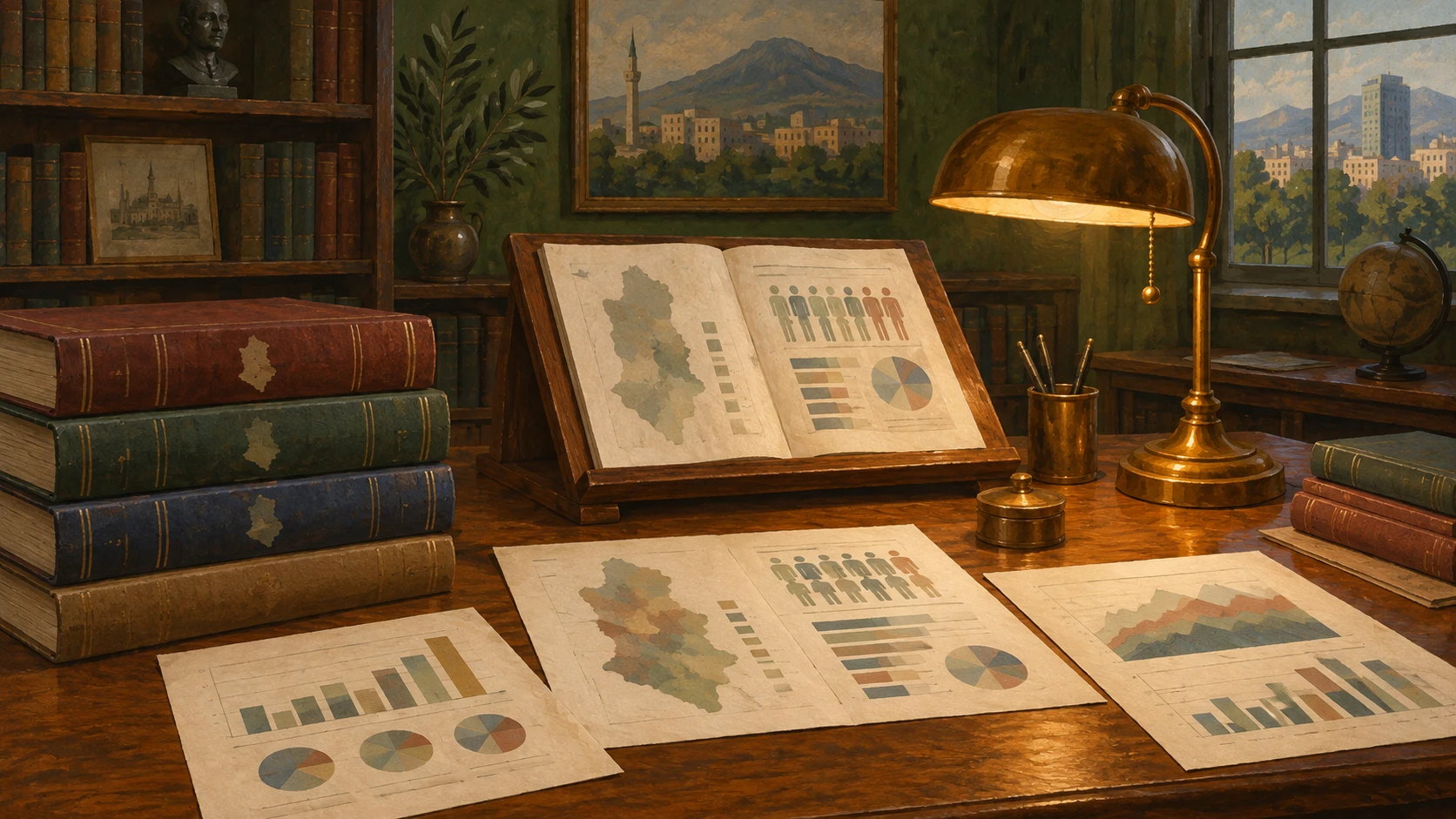
INSTAT Table 16 records the resident population of Albania by language usually spoken at home and sex. The overwhelming statistical majority of enumerated residents reported Albanian as their primary language spoken at home.
The census questionnaire relies on respondent self-declaration rather than objective linguistic proficiency testing. Census enumerators conducted face-to-face interviews across residential enumeration areas nationwide.
The table captures domestic household speech patterns rather than public conversational encounters. Linguistic researchers emphasize distinguishing domestic mother-tongue usage from active civic multilingualism.
Methodological Boundaries and Household Survey Scope
A single household language question cannot capture secondary language competence or passive bilingualism. The survey format does not record situational codeswitching between standard Albanian and regional dialects.
International monitoring bodies note that census home-language tallies should not be equated with ethnic identity. The statistical protocol excludes evaluations of reading literacy and formal writing skills in reported languages.
Multilingual individuals frequently choose the dominant state language when answering formal government surveys. Policy analysts recommend supplementing census figures with contextual sociolinguistic field observations.
Territorial Distribution of Traditional Minority Tongues
Greek remains widely spoken across southern municipal jurisdictions including Dropull and Finiq. Macedonian represents the primary community language spoken in the lakeside municipality of Pustec.
Aromanian or Vlach language varieties persist in dispersed urban settlements around Korca and Fier. Romani speakers preserve distinct oral dialects in suburban communities throughout central and central-western Albania.
Other officially recognized national minority tongues include Serbian, Montenegrin, and Bosnian in northern communes. Regional minority speech varieties exhibit rich loanword exchanges with regional Tosk and Gheg Albanian dialects.
Statutory Minority Rights in Local Public Administration
Albanian statutory law guarantees minority language access in local public administration where recognized thresholds are met. Municipal councils in Dropull and Finiq display official bilingual street names and directional traffic signs.
Citizens possess the legal right to submit administrative requests and receive responses in recognized minority languages. Judicial proceedings provide accredited certified interpreters for non-Albanian speakers under national procedural codes.
Civil registry offices issue dual-language birth and marriage verification certificates upon citizen request. Administrative bottlenecks occasionally arise from shortages of qualified certified translators in public service branches.
State-Funded Bilingual Schooling and Curricula
The Ministry of Education finances native-language primary schooling for recognized national minority students. Primary schools in Pustec provide core academic instruction in Macedonian alongside standard Albanian language classes.
Bilingual textbooks in Greek and Macedonian adhere to national curriculum frameworks and learning standards. Educators emphasize early bilingual acquisition to ensure equal educational advancement and civic integration.
Teacher training programs at regional public universities support specialized minority language instruction. Secondary school students transition to comprehensive bilingual educational pathways preparing for national examinations.
Urban Multilingual Encounters and Cosmopolitan Rhythms
Major metropolitan centers like Tirana and Durres exhibit widespread multilingual encounters shaped by return migration. Fluency in Italian and English is common among young urban professionals in commercial and digital service sectors.
A national census home-language table cannot capture fluid commercial language encounters in everyday urban life. Cosmopolitan cafe culture and retail markets incorporate multilingual conversational exchanges effortlessly.
Sociolinguistic research highlights how everyday multilingualism coexists with a cohesive national public sphere. Statistical tables provide a valuable demographic baseline while lived linguistic reality remains dynamic and plural.
A2 · Elementary
Census 2023: Home Language Data and Multilingual Public Realities
A statistical table records language spoken at home while regional schools, bilingual town halls, and urban speech reveal living multilingualism.
National Statistical Tables and Home Language Enumeration
INSTAT Table 16 records the resident population of Albania by language usually spoken at home and sex. The overwhelming statistical majority of enumerated residents reported Albanian as their primary language spoken at home.
The census questionnaire relies on respondent self-declaration rather than objective linguistic proficiency testing. Census enumerators conducted face-to-face interviews across residential enumeration areas nationwide.
The table captures domestic household speech patterns rather than public conversational encounters. Linguistic researchers emphasize distinguishing domestic mother-tongue usage from active civic multilingualism.
Methodological Boundaries and Household Survey Scope
A single household language question cannot capture secondary language competence or passive bilingualism. The survey format does not record situational codeswitching between standard Albanian and regional dialects.
International monitoring bodies note that census home-language tallies should not be equated with ethnic identity. The statistical protocol excludes evaluations of reading literacy and formal writing skills in reported languages.
Multilingual individuals frequently choose the dominant state language when answering formal government surveys. Policy analysts recommend supplementing census figures with contextual sociolinguistic field observations.
Territorial Distribution of Traditional Minority Tongues
Greek remains widely spoken across southern municipal jurisdictions including Dropull and Finiq. Macedonian represents the primary community language spoken in the lakeside municipality of Pustec.
Aromanian or Vlach language varieties persist in dispersed urban settlements around Korca and Fier. Romani speakers preserve distinct oral dialects in suburban communities throughout central and central-western Albania.
Other officially recognized national minority tongues include Serbian, Montenegrin, and Bosnian in northern communes. Regional minority speech varieties exhibit rich loanword exchanges with regional Tosk and Gheg Albanian dialects.
Statutory Minority Rights in Local Public Administration
Albanian statutory law guarantees minority language access in local public administration where recognized thresholds are met. Municipal councils in Dropull and Finiq display official bilingual street names and directional traffic signs.
Citizens possess the legal right to submit administrative requests and receive responses in recognized minority languages. Judicial proceedings provide accredited certified interpreters for non-Albanian speakers under national procedural codes.
Civil registry offices issue dual-language birth and marriage verification certificates upon citizen request. Administrative bottlenecks occasionally arise from shortages of qualified certified translators in public service branches.
State-Funded Bilingual Schooling and Curricula
The Ministry of Education finances native-language primary schooling for recognized national minority students. Primary schools in Pustec provide core academic instruction in Macedonian alongside standard Albanian language classes.
Bilingual textbooks in Greek and Macedonian adhere to national curriculum frameworks and learning standards. Educators emphasize early bilingual acquisition to ensure equal educational advancement and civic integration.
Teacher training programs at regional public universities support specialized minority language instruction. Secondary school students transition to comprehensive bilingual educational pathways preparing for national examinations.
Urban Multilingual Encounters and Cosmopolitan Rhythms
Major metropolitan centers like Tirana and Durres exhibit widespread multilingual encounters shaped by return migration. Fluency in Italian and English is common among young urban professionals in commercial and digital service sectors.
A national census home-language table cannot capture fluid commercial language encounters in everyday urban life. Cosmopolitan cafe culture and retail markets incorporate multilingual conversational exchanges effortlessly.
Sociolinguistic research highlights how everyday multilingualism coexists with a cohesive national public sphere. Statistical tables provide a valuable demographic baseline while lived linguistic reality remains dynamic and plural.
B1 · Intermediate
Census 2023: Home Language Data and Multilingual Public Realities
A statistical table records language spoken at home while regional schools, bilingual town halls, and urban speech reveal living multilingualism.
National Statistical Tables and Home Language Enumeration
INSTAT Table 16 records the resident population of Albania by language usually spoken at home and sex. The overwhelming statistical majority of enumerated residents reported Albanian as their primary language spoken at home.
The census questionnaire relies on respondent self-declaration rather than objective linguistic proficiency testing. Census enumerators conducted face-to-face interviews across residential enumeration areas nationwide.
The table captures domestic household speech patterns rather than public conversational encounters. Linguistic researchers emphasize distinguishing domestic mother-tongue usage from active civic multilingualism.
Methodological Boundaries and Household Survey Scope
A single household language question cannot capture secondary language competence or passive bilingualism. The survey format does not record situational codeswitching between standard Albanian and regional dialects.
International monitoring bodies note that census home-language tallies should not be equated with ethnic identity. The statistical protocol excludes evaluations of reading literacy and formal writing skills in reported languages.
Multilingual individuals frequently choose the dominant state language when answering formal government surveys. Policy analysts recommend supplementing census figures with contextual sociolinguistic field observations.
Territorial Distribution of Traditional Minority Tongues
Greek remains widely spoken across southern municipal jurisdictions including Dropull and Finiq. Macedonian represents the primary community language spoken in the lakeside municipality of Pustec.
Aromanian or Vlach language varieties persist in dispersed urban settlements around Korca and Fier. Romani speakers preserve distinct oral dialects in suburban communities throughout central and central-western Albania.
Other officially recognized national minority tongues include Serbian, Montenegrin, and Bosnian in northern communes. Regional minority speech varieties exhibit rich loanword exchanges with regional Tosk and Gheg Albanian dialects.
Statutory Minority Rights in Local Public Administration
Albanian statutory law guarantees minority language access in local public administration where recognized thresholds are met. Municipal councils in Dropull and Finiq display official bilingual street names and directional traffic signs.
Citizens possess the legal right to submit administrative requests and receive responses in recognized minority languages. Judicial proceedings provide accredited certified interpreters for non-Albanian speakers under national procedural codes.
Civil registry offices issue dual-language birth and marriage verification certificates upon citizen request. Administrative bottlenecks occasionally arise from shortages of qualified certified translators in public service branches.
State-Funded Bilingual Schooling and Curricula
The Ministry of Education finances native-language primary schooling for recognized national minority students. Primary schools in Pustec provide core academic instruction in Macedonian alongside standard Albanian language classes.
Bilingual textbooks in Greek and Macedonian adhere to national curriculum frameworks and learning standards. Educators emphasize early bilingual acquisition to ensure equal educational advancement and civic integration.
Teacher training programs at regional public universities support specialized minority language instruction. Secondary school students transition to comprehensive bilingual educational pathways preparing for national examinations.
Urban Multilingual Encounters and Cosmopolitan Rhythms
Major metropolitan centers like Tirana and Durres exhibit widespread multilingual encounters shaped by return migration. Fluency in Italian and English is common among young urban professionals in commercial and digital service sectors.
A national census home-language table cannot capture fluid commercial language encounters in everyday urban life. Cosmopolitan cafe culture and retail markets incorporate multilingual conversational exchanges effortlessly.
Sociolinguistic research highlights how everyday multilingualism coexists with a cohesive national public sphere. Statistical tables provide a valuable demographic baseline while lived linguistic reality remains dynamic and plural.
B2 · Upper Intermediate
Census 2023: Home Language Data and Multilingual Public Realities
A statistical table records language spoken at home while regional schools, bilingual town halls, and urban speech reveal living multilingualism.
National Statistical Tables and Home Language Enumeration
INSTAT Table 16 records the resident population of Albania by language usually spoken at home and sex. The overwhelming statistical majority of enumerated residents reported Albanian as their primary language spoken at home.
The census questionnaire relies on respondent self-declaration rather than objective linguistic proficiency testing. Census enumerators conducted face-to-face interviews across residential enumeration areas nationwide.
The table captures domestic household speech patterns rather than public conversational encounters. Linguistic researchers emphasize distinguishing domestic mother-tongue usage from active civic multilingualism.
Methodological Boundaries and Household Survey Scope
A single household language question cannot capture secondary language competence or passive bilingualism. The survey format does not record situational codeswitching between standard Albanian and regional dialects.
International monitoring bodies note that census home-language tallies should not be equated with ethnic identity. The statistical protocol excludes evaluations of reading literacy and formal writing skills in reported languages.
Multilingual individuals frequently choose the dominant state language when answering formal government surveys. Policy analysts recommend supplementing census figures with contextual sociolinguistic field observations.
Territorial Distribution of Traditional Minority Tongues
Greek remains widely spoken across southern municipal jurisdictions including Dropull and Finiq. Macedonian represents the primary community language spoken in the lakeside municipality of Pustec.
Aromanian or Vlach language varieties persist in dispersed urban settlements around Korca and Fier. Romani speakers preserve distinct oral dialects in suburban communities throughout central and central-western Albania.
Other officially recognized national minority tongues include Serbian, Montenegrin, and Bosnian in northern communes. Regional minority speech varieties exhibit rich loanword exchanges with regional Tosk and Gheg Albanian dialects.
Statutory Minority Rights in Local Public Administration
Albanian statutory law guarantees minority language access in local public administration where recognized thresholds are met. Municipal councils in Dropull and Finiq display official bilingual street names and directional traffic signs.
Citizens possess the legal right to submit administrative requests and receive responses in recognized minority languages. Judicial proceedings provide accredited certified interpreters for non-Albanian speakers under national procedural codes.
Civil registry offices issue dual-language birth and marriage verification certificates upon citizen request. Administrative bottlenecks occasionally arise from shortages of qualified certified translators in public service branches.
State-Funded Bilingual Schooling and Curricula
The Ministry of Education finances native-language primary schooling for recognized national minority students. Primary schools in Pustec provide core academic instruction in Macedonian alongside standard Albanian language classes.
Bilingual textbooks in Greek and Macedonian adhere to national curriculum frameworks and learning standards. Educators emphasize early bilingual acquisition to ensure equal educational advancement and civic integration.
Teacher training programs at regional public universities support specialized minority language instruction. Secondary school students transition to comprehensive bilingual educational pathways preparing for national examinations.
Urban Multilingual Encounters and Cosmopolitan Rhythms
Major metropolitan centers like Tirana and Durres exhibit widespread multilingual encounters shaped by return migration. Fluency in Italian and English is common among young urban professionals in commercial and digital service sectors.
A national census home-language table cannot capture fluid commercial language encounters in everyday urban life. Cosmopolitan cafe culture and retail markets incorporate multilingual conversational exchanges effortlessly.
Sociolinguistic research highlights how everyday multilingualism coexists with a cohesive national public sphere. Statistical tables provide a valuable demographic baseline while lived linguistic reality remains dynamic and plural.
C1 · Advanced
Census 2023: Home Language Data and Multilingual Public Realities
A statistical table records language spoken at home while regional schools, bilingual town halls, and urban speech reveal living multilingualism.
National Statistical Tables and Home Language Enumeration
INSTAT Table 16 records the resident population of Albania by language usually spoken at home and sex. The overwhelming statistical majority of enumerated residents reported Albanian as their primary language spoken at home.
The census questionnaire relies on respondent self-declaration rather than objective linguistic proficiency testing. Census enumerators conducted face-to-face interviews across residential enumeration areas nationwide.
The table captures domestic household speech patterns rather than public conversational encounters. Linguistic researchers emphasize distinguishing domestic mother-tongue usage from active civic multilingualism.
Methodological Boundaries and Household Survey Scope
A single household language question cannot capture secondary language competence or passive bilingualism. The survey format does not record situational codeswitching between standard Albanian and regional dialects.
International monitoring bodies note that census home-language tallies should not be equated with ethnic identity. The statistical protocol excludes evaluations of reading literacy and formal writing skills in reported languages.
Multilingual individuals frequently choose the dominant state language when answering formal government surveys. Policy analysts recommend supplementing census figures with contextual sociolinguistic field observations.
Territorial Distribution of Traditional Minority Tongues
Greek remains widely spoken across southern municipal jurisdictions including Dropull and Finiq. Macedonian represents the primary community language spoken in the lakeside municipality of Pustec.
Aromanian or Vlach language varieties persist in dispersed urban settlements around Korca and Fier. Romani speakers preserve distinct oral dialects in suburban communities throughout central and central-western Albania.
Other officially recognized national minority tongues include Serbian, Montenegrin, and Bosnian in northern communes. Regional minority speech varieties exhibit rich loanword exchanges with regional Tosk and Gheg Albanian dialects.
Statutory Minority Rights in Local Public Administration
Albanian statutory law guarantees minority language access in local public administration where recognized thresholds are met. Municipal councils in Dropull and Finiq display official bilingual street names and directional traffic signs.
Citizens possess the legal right to submit administrative requests and receive responses in recognized minority languages. Judicial proceedings provide accredited certified interpreters for non-Albanian speakers under national procedural codes.
Civil registry offices issue dual-language birth and marriage verification certificates upon citizen request. Administrative bottlenecks occasionally arise from shortages of qualified certified translators in public service branches.
State-Funded Bilingual Schooling and Curricula
The Ministry of Education finances native-language primary schooling for recognized national minority students. Primary schools in Pustec provide core academic instruction in Macedonian alongside standard Albanian language classes.
Bilingual textbooks in Greek and Macedonian adhere to national curriculum frameworks and learning standards. Educators emphasize early bilingual acquisition to ensure equal educational advancement and civic integration.
Teacher training programs at regional public universities support specialized minority language instruction. Secondary school students transition to comprehensive bilingual educational pathways preparing for national examinations.
Urban Multilingual Encounters and Cosmopolitan Rhythms
Major metropolitan centers like Tirana and Durres exhibit widespread multilingual encounters shaped by return migration. Fluency in Italian and English is common among young urban professionals in commercial and digital service sectors.
A national census home-language table cannot capture fluid commercial language encounters in everyday urban life. Cosmopolitan cafe culture and retail markets incorporate multilingual conversational exchanges effortlessly.
Sociolinguistic research highlights how everyday multilingualism coexists with a cohesive national public sphere. Statistical tables provide a valuable demographic baseline while lived linguistic reality remains dynamic and plural.
C2 · Mastery
Census 2023: Home Language Data and Multilingual Public Realities
A statistical table records language spoken at home while regional schools, bilingual town halls, and urban speech reveal living multilingualism.
National Statistical Tables and Home Language Enumeration
INSTAT Table 16 records the resident population of Albania by language usually spoken at home and sex. The overwhelming statistical majority of enumerated residents reported Albanian as their primary language spoken at home.
The census questionnaire relies on respondent self-declaration rather than objective linguistic proficiency testing. Census enumerators conducted face-to-face interviews across residential enumeration areas nationwide.
The table captures domestic household speech patterns rather than public conversational encounters. Linguistic researchers emphasize distinguishing domestic mother-tongue usage from active civic multilingualism.
Methodological Boundaries and Household Survey Scope
A single household language question cannot capture secondary language competence or passive bilingualism. The survey format does not record situational codeswitching between standard Albanian and regional dialects.
International monitoring bodies note that census home-language tallies should not be equated with ethnic identity. The statistical protocol excludes evaluations of reading literacy and formal writing skills in reported languages.
Multilingual individuals frequently choose the dominant state language when answering formal government surveys. Policy analysts recommend supplementing census figures with contextual sociolinguistic field observations.
Territorial Distribution of Traditional Minority Tongues
Greek remains widely spoken across southern municipal jurisdictions including Dropull and Finiq. Macedonian represents the primary community language spoken in the lakeside municipality of Pustec.
Aromanian or Vlach language varieties persist in dispersed urban settlements around Korca and Fier. Romani speakers preserve distinct oral dialects in suburban communities throughout central and central-western Albania.
Other officially recognized national minority tongues include Serbian, Montenegrin, and Bosnian in northern communes. Regional minority speech varieties exhibit rich loanword exchanges with regional Tosk and Gheg Albanian dialects.
Statutory Minority Rights in Local Public Administration
Albanian statutory law guarantees minority language access in local public administration where recognized thresholds are met. Municipal councils in Dropull and Finiq display official bilingual street names and directional traffic signs.
Citizens possess the legal right to submit administrative requests and receive responses in recognized minority languages. Judicial proceedings provide accredited certified interpreters for non-Albanian speakers under national procedural codes.
Civil registry offices issue dual-language birth and marriage verification certificates upon citizen request. Administrative bottlenecks occasionally arise from shortages of qualified certified translators in public service branches.
State-Funded Bilingual Schooling and Curricula
The Ministry of Education finances native-language primary schooling for recognized national minority students. Primary schools in Pustec provide core academic instruction in Macedonian alongside standard Albanian language classes.
Bilingual textbooks in Greek and Macedonian adhere to national curriculum frameworks and learning standards. Educators emphasize early bilingual acquisition to ensure equal educational advancement and civic integration.
Teacher training programs at regional public universities support specialized minority language instruction. Secondary school students transition to comprehensive bilingual educational pathways preparing for national examinations.
Urban Multilingual Encounters and Cosmopolitan Rhythms
Major metropolitan centers like Tirana and Durres exhibit widespread multilingual encounters shaped by return migration. Fluency in Italian and English is common among young urban professionals in commercial and digital service sectors.
A national census home-language table cannot capture fluid commercial language encounters in everyday urban life. Cosmopolitan cafe culture and retail markets incorporate multilingual conversational exchanges effortlessly.
Sociolinguistic research highlights how everyday multilingualism coexists with a cohesive national public sphere. Statistical tables provide a valuable demographic baseline while lived linguistic reality remains dynamic and plural.
Check your understanding
Choose how closely you want to revisit the article. You can refer back while answering, and review explanations when you finish.
Quick Quiz A1
Try one question, then create a free account for the full Quick Quiz. Sign Up Free
Answer every question before checking. There is no time limit.
Your results
/ 1 correct (%)
Read the explanations to see how each answer connects to the article.
-
What population breakdown does INSTAT Table 16 record for resident inhabitants in Albania?
1. Answer:
Quick Quiz A2
Try one question, then create a free account for the full Quick Quiz. Sign Up Free
Answer every question before checking. There is no time limit.
Your results
/ 1 correct (%)
Read the explanations to see how each answer connects to the article.
-
What population breakdown does INSTAT Table 16 record for resident inhabitants in Albania?
1. Answer:
Quick Quiz B1
Try one question, then create a free account for the full Quick Quiz. Sign Up Free
Answer every question before checking. There is no time limit.
Your results
/ 1 correct (%)
Read the explanations to see how each answer connects to the article.
-
What population breakdown does INSTAT Table 16 record for resident inhabitants in Albania?
1. Answer:
Quick Quiz B2
Try one question, then create a free account for the full Quick Quiz. Sign Up Free
Answer every question before checking. There is no time limit.
Your results
/ 1 correct (%)
Read the explanations to see how each answer connects to the article.
-
What population breakdown does INSTAT Table 16 record for resident inhabitants in Albania?
1. Answer:
Quick Quiz C1
Try one question, then create a free account for the full Quick Quiz. Sign Up Free
Answer every question before checking. There is no time limit.
Your results
/ 1 correct (%)
Read the explanations to see how each answer connects to the article.
-
What population breakdown does INSTAT Table 16 record for resident inhabitants in Albania?
1. Answer:
Quick Quiz C2
Try one question, then create a free account for the full Quick Quiz. Sign Up Free
Answer every question before checking. There is no time limit.
Your results
/ 1 correct (%)
Read the explanations to see how each answer connects to the article.
-
What population breakdown does INSTAT Table 16 record for resident inhabitants in Albania?
1. Answer:
