A1 · Beginner
Australian Football and the Melbourne Cricket Ground
Learn about Australia's favorite sport, fast games on big grass fields, and the famous stadium called the G.
The First Games and Early Rules
In 1858 a cricketer named Tom Wills wrote a letter asking people to play football in winter.
School boys played the first recorded match in August 1858 next to Richmond Paddock.
Players formed the Melbourne Football Club in May 1859 and wrote ten simple rules.
People link Australian football to an ancient Indigenous ball game called Marngrook.
Clubs formed the Victorian Football League in 1896 to play matches every weekend.
The original rules stopped rough hacking and allowed players to run freely across open grass.
The Giant Melbourne Cricket Ground
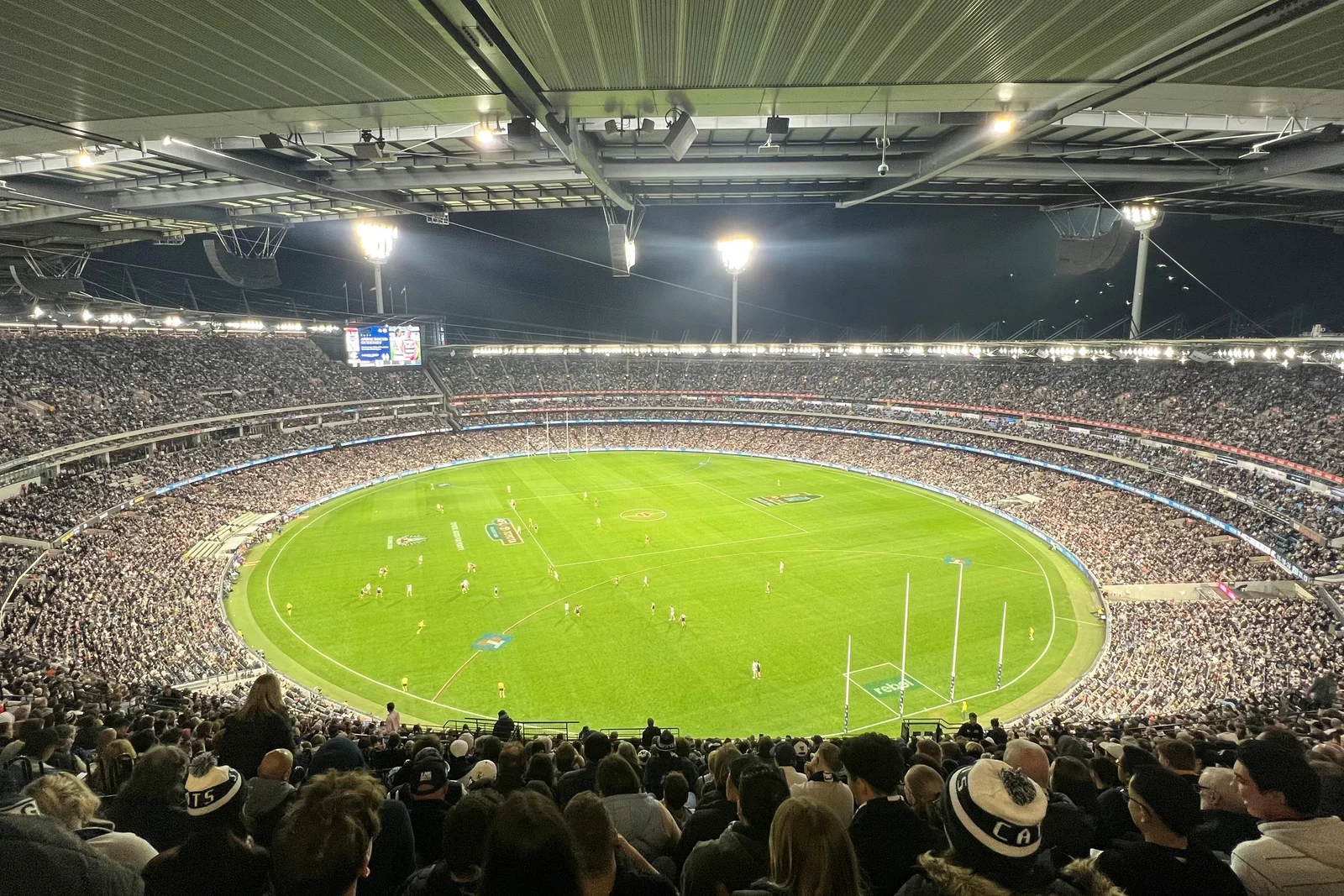
The Melbourne Cricket Ground opened in 1853 and holds over 100,000 cheering sports fans.
Local people love this giant stadium and call it the G.
The stadium hosted the 1956 Olympic Games with running races and big parades.
Fans pack the stadium every September to watch the exciting AFL Grand Final.
Every Anzac Day two big teams play at the stadium to honor brave soldiers.
Six tall light towers built in 1984 shine bright lights over night football games.

How Players Run, Jump, and Score
Teams play on a very large oval grass field with four white posts at each end.
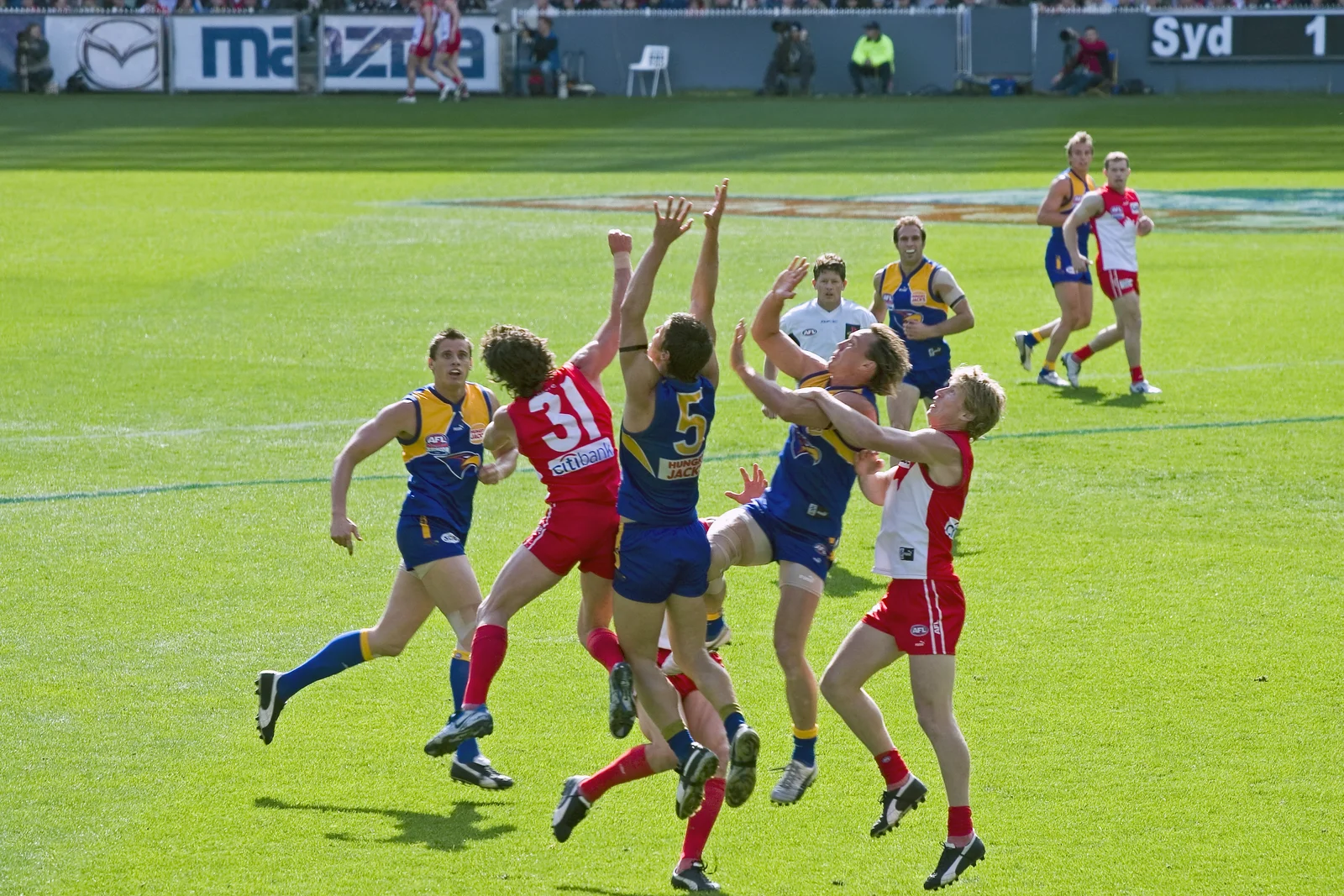
A player can jump high onto another player's back to catch a spectacular mark.
Catching the ball in the air gives the player a free kick without being tackled.
Players must kick the ball with their boots or punch it with a clenched fist.
Kicking the ball between the middle posts scores six points for a big goal.
Players kick a red leather Sherrin football that was first made in 1879.
A Big League for the Whole Country
The competition grew into the national Australian Football League in 1990 with clubs from many states.
Indigenous players make up ten percent of elite league stars and show great skill.
The exciting women's AFLW league started in February 2017 and welcomed many new girls.
More than seven million fans buy tickets to watch live games in stadiums every year.
Families and neighbors wear team scarves and support their local football clubs with deep passion.
Big television networks pay billions of dollars to broadcast every football match across the nation.

A2 · Elementary
Australian Rules Football and the Melbourne Cricket Ground
Discover the Victorian origins of Australian football, aerial marking skills, and the iconic Melbourne colosseum.
Victorian Origins and Early Football Laws
In July 1858 cricketer Tom Wills called for a winter football club to keep cricket athletes fit.
Melbourne Grammar and Scotch College contested the first recorded match beside Richmond Paddock in August 1858.
The Melbourne Football Club formed in May 1859 and published the first ten official rules.
Scholars trace cultural links between early Australian football and Marngrook, an ancient Indigenous ball game.
Eight leading teams formed the Victorian Football League in 1896 to create an elite winter competition.
Early rule makers eliminated offside restrictions and banned painful hacking to encourage fast running.
The Historic Stadium Known as the G
Established in 1853, the Melbourne Cricket Ground accommodates 100,024 spectators in modern grandstands.
Known fondly as The G, this beloved arena joined the Australian National Heritage List in 2005.
The venue hosted the 1956 Summer Olympic Games, earning global respect as a premier sporting arena.
Each September over one hundred thousand fans pack the stadium for the AFL Grand Final.
Collingwood and Essendon contest a famous Anzac Day match at the stadium before huge crowds.
Six massive light towers installed in 1984 illuminate the oval for spectacular night football broadcasts.
Oval Grounds, Marking, and Kicking Skills
Matches take place on a massive oval pitch that extends up to 185 meters in length.
The spectacular mark allows agile athletes to launch high above defenders to grasp the football.
Securing a clean mark awards an unimpeded free kick, creating instant attacking opportunities.
Athletes move the ball across the field by kicking or delivering a crisp clenched fist handpass.
A shot between the central goal posts earns six points, whereas a behind scores one point.
Teams compete using the traditional red leather Sherrin ball, which was designed by saddler T.W. Sherrin in 1879.
National Expansion and Australian Sporting Passion
The competition rebranded as the Australian Football League in 1990 after welcoming interstate clubs.
Indigenous Australians constitute approximately ten percent of AFL athletes, delivering exceptional pace and vision.
The launch of the AFLW competition in February 2017 transformed women's participation across the country.
Annual stadium attendances exceed seven million spectators, establishing Australian football as the nation's premier spectator sport.
Following a football club functions as a beloved family tradition that connects suburban communities.
Lucrative national broadcasting contracts generate billions of dollars to support grassroots clubs and junior development.
B1 · Intermediate
Australian Rules Football and the Heritage of the MCG
Exploring the nineteenth-century emergence of Australian football, the grandeur of the MCG, and the sport's cultural primacy.
Pioneering Codification and Marngrook Heritage
In July 1858, sportsman Tom Wills published a letter in Bell's Life in Victoria advocating a winter football code.
The historic inaugural match between Melbourne Grammar School and Scotch College took place near Richmond Paddock in August 1858.
Pioneering players established the Melbourne Football Club in May 1859, drafting ten concise rules to guide competition.
Cultural historians recognize significant similarities between this emerging Australian game and Marngrook, an Indigenous high-jumping ball tradition.
The Victorian Football Association emerged in 1877 before eight breakaway clubs founded the Victorian Football League in 1896.
The original Victorian rules discarded the offside rule and outlawed rugby hacking to ensure continuous open movement.
The Melbourne Cricket Ground and Civic Colosseum
Founded in 1853, the Melbourne Cricket Ground boasts a capacity of 100,024 seats, ranking among the world's largest sporting stadiums.
Affectionately referred to as The G, the ground was inscribed on the Australian National Heritage List in December 2005.
The stadium gained worldwide renown after staging the opening ceremony and track events of the 1956 Summer Olympics.
The AFL Grand Final takes place at the MCG on the last Saturday of September before a capacity crowd.
The annual Anzac Day blockbuster between Collingwood and Essendon attracts over 90,000 spectators in solemn military tribute.
Six landmark light towers erected in 1984 stand 75 meters tall, revolutionizing evening television coverage of the sport.
Game Mechanics, Aerial Marks, and the Sherrin
The sport is contested on a vast oval turf measuring up to 185 meters long and 155 meters wide.
The spectacular mark occurs when a soaring player springs off an opponent's shoulders to pluck the ball mid-air.
Earning a mark provides the player with an uninterrupted free kick, enabling rapid tactical ball movement.
Disposal requires either kicking or handpassing the oval ball by striking it with a clenched fist.
Kicking the ball cleanly between the tall central goal posts yields six points, while hitting the post produces a behind.
Every professional match employs the hand-stitched red leather Sherrin ball, originally crafted by saddler T.W. Sherrin in 1879.
The AFL Revolution, Diversity, and Cultural Primacy
The Victorian league transitioned into the national Australian Football League in 1990 by incorporating interstate franchises.
Indigenous Australian players account for approximately ten percent of senior AFL lists, enriching the sport with sublime artistry.
The inaugural AFLW season commenced in February 2017, catalyzing a nationwide surge in female athletic participation.
With more than seven million stadium attendances recorded annually, Australian football reigns supreme as the nation's premier spectator sport.
Generations of club supporters view football allegiance as a secular civic religion that defines suburban social life.
Massive commercial broadcasting contracts worth billions of dollars underpin the sport's commanding financial stature.
B2 · Upper Intermediate
Australian Rules Football: Origins, Mechanics, and the MCG
An analysis of Australia's indigenous football code, the monumental architecture of the MCG, and the sport's enduring social hegemony.
Origins, Nineteenth-Century Codification, and Marngrook
In July 1858, colonial sportsman Tom Wills penned a famous letter in Bell's Life in Victoria proposing winter football.
Melbourne Grammar School and Scotch College contested the sport's first recorded encounter beside Richmond Paddock in August 1858.
Formal organization solidified when the Melbourne Football Club formed in May 1859, crafting ten foundational rules of play.
Ethnographic accounts highlight remarkable parallels between early Australian rules and Marngrook, a jumping ball game played by Aboriginal communities.
Following the formation of the Victorian Football Association in 1877, eight breakaway clubs established the Victorian Football League in 1896.
The architects of the code deliberately discarded offside constraints and banned shin-hacking, fostering rapid 360-degree ball movement.
The Melbourne Cricket Ground: A Cathedral of Australian Sport
Established in 1853, the Melbourne Cricket Ground accommodates 100,024 spectators, making it the premier sporting arena in the Southern Hemisphere.
Known universally across Australia as The G, the stadium earned formal placement on the National Heritage List in 2005.
The arena hosted the 1956 Melbourne Olympics, confirming its position as an international amphitheater for world-class athletics.
Every September, the historic ground hosts the AFL Grand Final, packing the grandstands with over one hundred thousand passionate devotees.
The annual Anzac Day match between Collingwood and Essendon draws more than 90,000 spectators to honor military service personnel.
Six towering light towers standing 75 meters tall were constructed in 1984, transforming prime-time television broadcasts of night fixtures.
Tactical Dimensions, High-Flying Marks, and Equipment
Contests unfold across an expansive oval playing surface ranging between 135 and 185 meters in length.
The spectacular mark represents the pinnacle of aerial athleticism, as footballers vault above packs to secure the ball.
A successful mark secures an unimpeded free kick, converting heavy ground congestion into swift forward momentum.
Legal disposal is strictly restricted to kicking or handpassing, which demands punching the ball from an open palm.
Directing the ball between the central goal posts awards six points, whereas a deflection yields a single behind.
Matches feature the distinctive red leather Sherrin football, engineered by saddler T.W. Sherrin in 1879 for predictable flight.
Nationalization, AFLW Inclusion, and Societal Hegemony
The Victorian competition transformed into the national Australian Football League in 1990 through systematic interstate club expansion.
Indigenous footballers represent approximately ten percent of AFL lists, demonstrating unmatched spatial intelligence and evasive mastery.
The launch of the AFLW premiership in February 2017 ignited an unprecedented expansion in female participation across all Australian states.
More than seven million patrons attend stadium matches each season, maintaining Australian football as the continent's most attended spectator code.
Anthropologists frequently describe Australian football as a secular civic religion that commands intense multi-generational tribal devotion.
Multibillion-dollar media rights agreements guarantee the AFL's uncontested commercial dominance across the Australian sporting landscape.
C1 · Advanced
Australian Rules Football and the Melbourne Cricket Ground
A comprehensive examination of Victorian football codification, Marngrook influences, MCG architecture, and the cultural hegemony of the AFL.
Victorian Codification, Tom Wills, and Marngrook Lineages
In July 1858, colonial sportsman Tom Wills published a seminal letter in Bell's Life in Victoria advocating a winter football code.
The inaugural forty-a-side contest between Melbourne Grammar School and Scotch College took place beside Richmond Paddock in August 1858.
Formal codification commenced when the Melbourne Football Club formed in May 1859, drafting ten concise rules of play.
Historical scholarship emphasizes compelling affinities between early Australian football and Marngrook, an ancient Indigenous ball-kicking game.
The Victorian Football Association emerged in 1877 before eight elite clubs seceded to establish the Victorian Football League in 1896.
Pioneering rule makers discarded the offside constraint and banned brutal hacking, deliberately fostering dynamic 360-degree open play.
The Melbourne Cricket Ground: Monument of Civic Devotion
Founded in 1853, the Melbourne Cricket Ground features a seating capacity of 100,024 spectators, commanding monumental civic presence.
Colloquially reified as The G, this colossal stadium attained formal Australian National Heritage List inscription in December 2005.
The colosseum served as the centerpiece for the 1956 Summer Olympic Games, anchoring Melbourne's international athletic identity.
The AFL Grand Final occupies the venue on the final Saturday of September, generating an electrifying spectacle before 100,000 patrons.
The annual Anzac Day encounter between Collingwood and Essendon convenes over 90,000 supporters in solemn commemoration of martial sacrifice.
Six colossal light towers erected in 1984 stand 75 meters above the turf, inaugurating modern evening sports telecasting.
Biomechanical Dynamics, Aerial Contests, and the Sherrin
Matches unfold upon an expansive oval field spanning up to 185 meters long, demanding exceptional cardiovascular endurance.
The spectacular mark epitomizes the sport's acrobatic allure, permitting players to spring from opponents' shoulders to clutch the ball.
Securing a clean mark entitles the catching player to an unimpeded free kick, unlocking immediate territory across congested lines.
Legal disposal dictates either precision kicking or the handpass, which requires striking the ball with a clenched fist.
Navigating the ball between the central goal uprights generates six points, whereas an outer miss yields a solitary behind.
Every professional fixture utilizes the premium red leather Sherrin match ball, engineered by saddler T.W. Sherrin in 1879.
National Expansion, Indigenous Preeminence, and Commercial Supremacy
The Victorian league transitioned into the transcontinental Australian Football League in 1990 through strategic interstate club integration.
First Nations footballers constitute approximately ten percent of senior AFL playing lists, demonstrating sublime preeminence and improvisational vision.
The inaugural AFLW season launched in February 2017, instigating a transformative structural revolution across women's elite sport.
Annual turnstile counts surpass seven million spectators, consolidating Australian football as the continent's preeminent spectator sport.
Across southern and western Australia, football allegiance functions as a secular civic religion that binds metropolitan communities.
Multibillion-dollar broadcasting rights pacts consolidate the AFL's undisputed financial hegemony within the Australian sports market.
C2 · Mastery
Australian Rules Football and the MCG: Ritual, Space, and Hegemony
A definitive critique of Victorian football codification, Indigenous spatial precedents, the monumentalism of the MCG, and secular sporting devotion.
Nineteenth-Century Codification, Tom Wills, and Marngrook Precedents
In July 1858, athletic polymath Tom Wills published a celebrated letter in Bell's Life in Victoria urging winter football.
The seminal match between Melbourne Grammar School and Scotch College took place beside Richmond Paddock across three winter afternoons.
The Melbourne Football Club formally coalesced in May 1859, crafting ten foundational bylaws that inaugurated organized Australian football.
Historical scholarship traces structural homologies between the embryonic code and Marngrook, an Indigenous aerial ball game.
The Victorian Football Association formed in 1877 prior to the breakaway Victorian Football League established by eight clubs in 1896.
The codifiers eradicated offside strictures and outlawed rugby hacking, deliberately unleashing fluid multidirectional kinetic flow.
The Melbourne Cricket Ground: Monumentalism and Sacred Space
Established in 1853, the Melbourne Cricket Ground provides a capacity of 100,024 patrons, standing as the Southern Hemisphere's supreme colosseum.
Revered throughout the Commonwealth as The G, this monumental arena achieved National Heritage List inscription in 2005.
The amphitheater hosted the 1956 Summer Olympic Games, conferring global athletic prestige upon the Victorian metropolis.
The AFL Grand Final convenes at the stadium each September, staging an iconic ritual before a capacity crowd of 100,000.
The commemorative Anzac Day blockbuster between Collingwood and Essendon attracts over 90,000 attendees in poignant military veneration.
Six monolithic light towers erected in 1984 reach 75 meters skyward, fundamentally reshaping the visual syntax of nocturnal broadcasting.
Spatial Topography, Aerial Acrobatics, and Material Culture
The sprawling topography of the oval turf exceeds 180 meters in length, necessitating sustained aerobic stamina and intricate spatial maneuvering.
The iconic spectacular mark permits an aerialist to use an adversary as a launching pad to catch the ball.
Executing a clean mark guarantees an unimpeded free kick, shattering defensive gridlock through instantaneous offensive transition.
Disposal mechanics dictate either field kicking or the handpass, executed by striking the football from an open palm.
Guiding the ball through the central goal uprights confers six points, whereas striking the post produces a minor behind.
The hand-stitched red leather Sherrin football, engineered by saddler T.W. Sherrin in 1879, maintains unmatched hydrodynamic consistency.
Nationalized Geopolitics, First Nations Artistry, and Corporate Dominance
The provincial Victorian league metamorphosed into the national Australian Football League in 1990 through nationwide club expansion.
First Nations footballers comprise ten percent of senior AFL rosters, displaying unparalleled spatial perception and improvisational genius.
The inaugural AFLW premiership commenced in February 2017, catalyzing a dramatic demographic realignment across elite Australian sport.
Regular season turnstile tallies eclipse seven million admissions, securing Australian football's unchallenged primacy as the premier spectator code.
Sociologists classify Australian rules football as a secular civic religion that commands passionate multi-generational neighborhood devotion.
Billion-dollar broadcast rights transactions secure the AFL's unchallenged economic hegemony across the Australian media ecosystem.
Check your understanding
Choose how closely you want to revisit the article. You can refer back while answering, and review explanations when you finish.
Quick Quiz A1
Try one question, then create a free account for the full Quick Quiz. Sign Up Free
Answer every question before checking. There is no time limit.
Your results
/ 1 correct (%)
Read the explanations to see how each answer connects to the article.
-
Who published a letter in 1858 calling for a winter football club to keep cricketers fit?
1. Answer:
Quick Quiz A2
Try one question, then create a free account for the full Quick Quiz. Sign Up Free
Answer every question before checking. There is no time limit.
Your results
/ 1 correct (%)
Read the explanations to see how each answer connects to the article.
-
Who published a letter in 1858 calling for a winter football club to keep cricketers fit?
1. Answer:
Quick Quiz B1
Try one question, then create a free account for the full Quick Quiz. Sign Up Free
Answer every question before checking. There is no time limit.
Your results
/ 1 correct (%)
Read the explanations to see how each answer connects to the article.
-
Who published a letter in 1858 calling for a winter football club to keep cricketers fit?
1. Answer:
Quick Quiz B2
Try one question, then create a free account for the full Quick Quiz. Sign Up Free
Answer every question before checking. There is no time limit.
Your results
/ 1 correct (%)
Read the explanations to see how each answer connects to the article.
-
Who published a letter in 1858 calling for a winter football club to keep cricketers fit?
1. Answer:
Quick Quiz C1
Try one question, then create a free account for the full Quick Quiz. Sign Up Free
Answer every question before checking. There is no time limit.
Your results
/ 1 correct (%)
Read the explanations to see how each answer connects to the article.
-
Who published a letter in 1858 calling for a winter football club to keep cricketers fit?
1. Answer:
Quick Quiz C2
Try one question, then create a free account for the full Quick Quiz. Sign Up Free
Answer every question before checking. There is no time limit.
Your results
/ 1 correct (%)
Read the explanations to see how each answer connects to the article.
-
Who published a letter in 1858 calling for a winter football club to keep cricketers fit?
1. Answer:
