A1 · Beginner
Grilled Meat and Fresh Bread in Old Sarajevo
Skilled butchers make small beef sausages while neighborhood bakers bake warm flatbread in wood ovens.
Traditional Minced Meat Preparation and Butcher Standards
Cooks in old Sarajevo make small grilled sausages called cevapi for hungry visitors.
Butchers grind fresh beef and mix a little lamb fat with salt.
Workers mix the cold meat by hand to keep the pieces soft.
Butcher shops in the old town do not use pork in meat.
Makers shape the meat into short round rolls using simple kitchen funnels.
Meat grilling skills arrived in Bosnia many centuries ago during old trading times.
Wood-Fired Charcoal Grilling and Heat Management
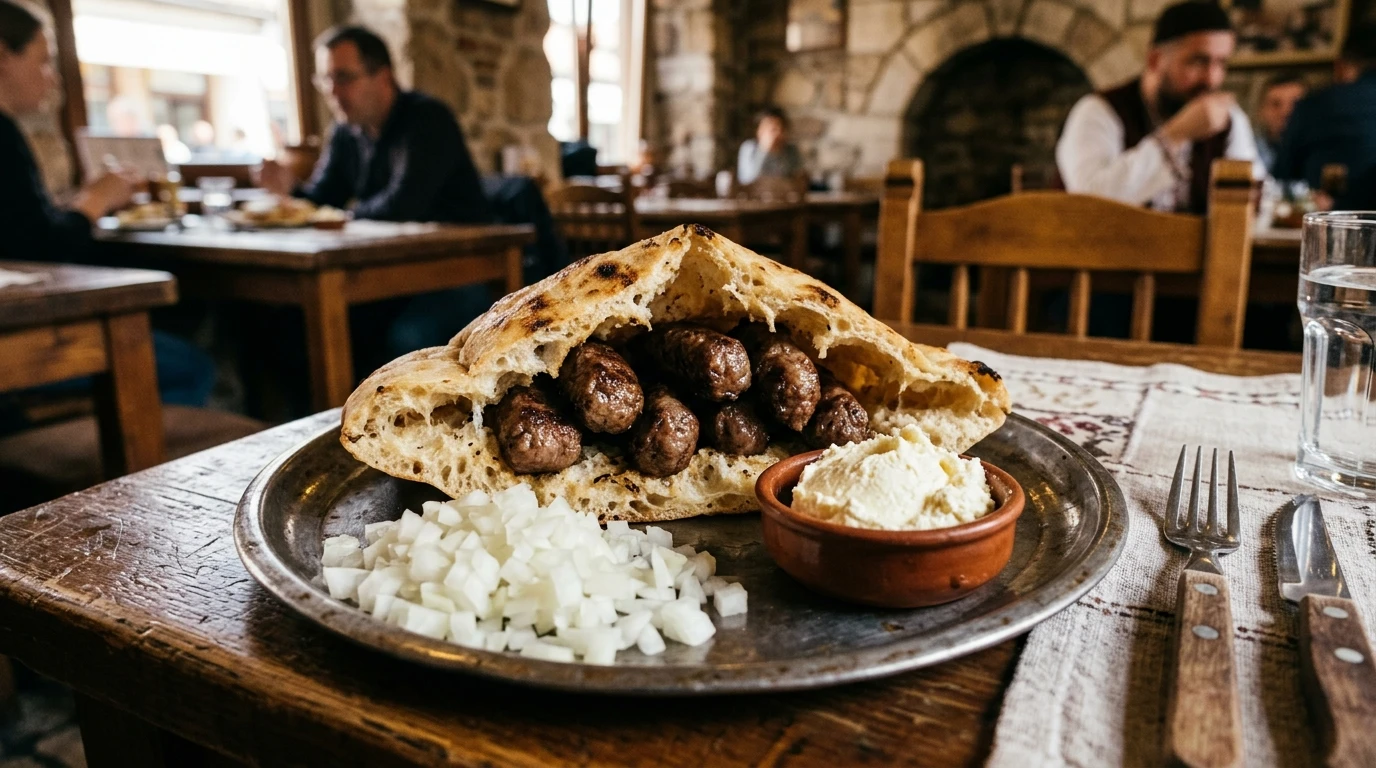
Grill chefs cook the meat over hot charcoal made from forest hardwood logs.
Cooks move the pieces across the warm iron grill to cook evenly.
Chefs turn the sausages quickly with long metal tongs over bright coals.
Bakers place flat somun bread on the warm grill above the meat.
Tall brick chimneys pull wood smoke away from the busy dining tables.
Cooking over real charcoal gives the meat a rich and smoky flavor.
Somun Flatbread Baking and Stone Oven Heritage
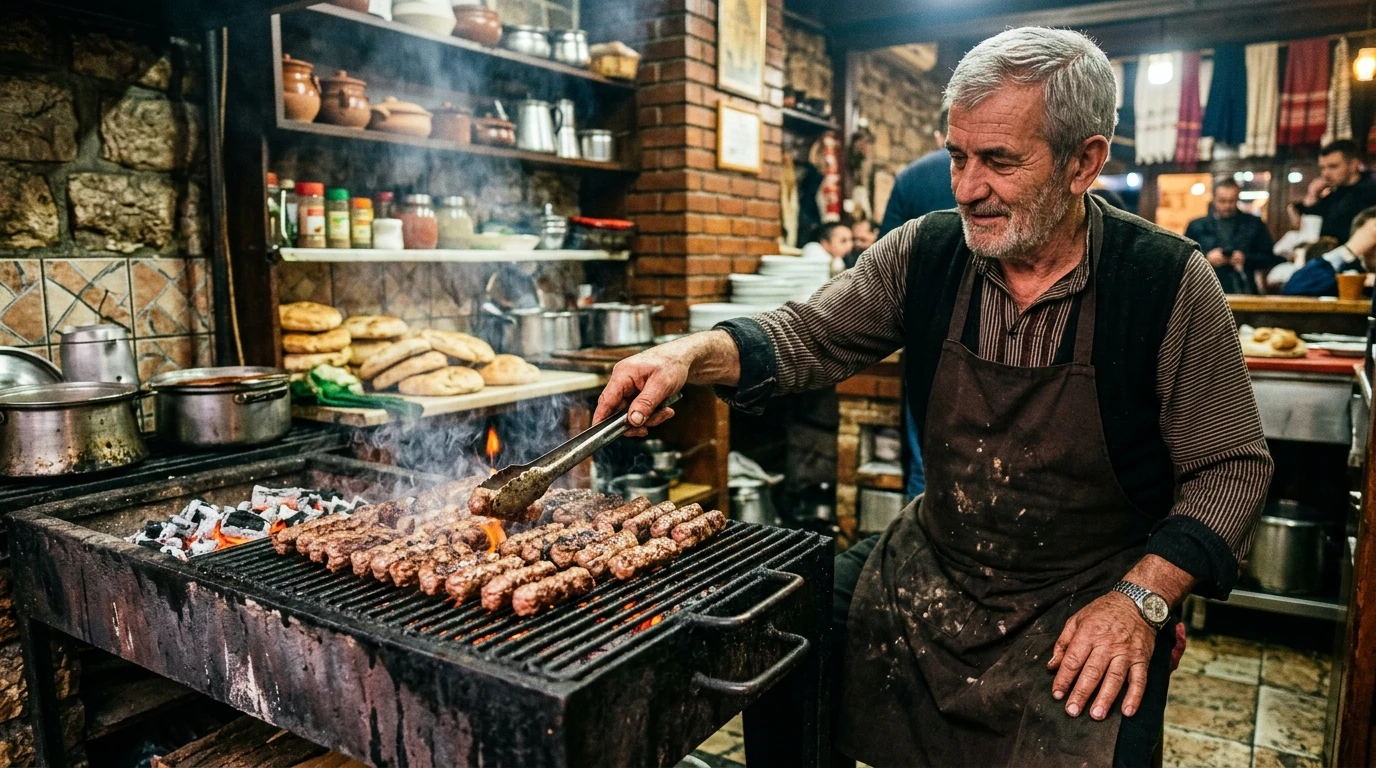
Bakers make round flat bread called somun inside hot stone brick ovens.
Bakers mix white flour, yeast, water, and salt inside large wooden tubs.
The baker presses a wooden grid on the dough to make lines.
Workers drop tiny black nigella seeds across the soft white dough rounds.
Hot stone ovens bake the flat bread in less than two minutes.
Intense oven heat puffs the dough into a hollow pocket for meat.
Dining Traditions, Dairy Accompaniments, and Community Eateries
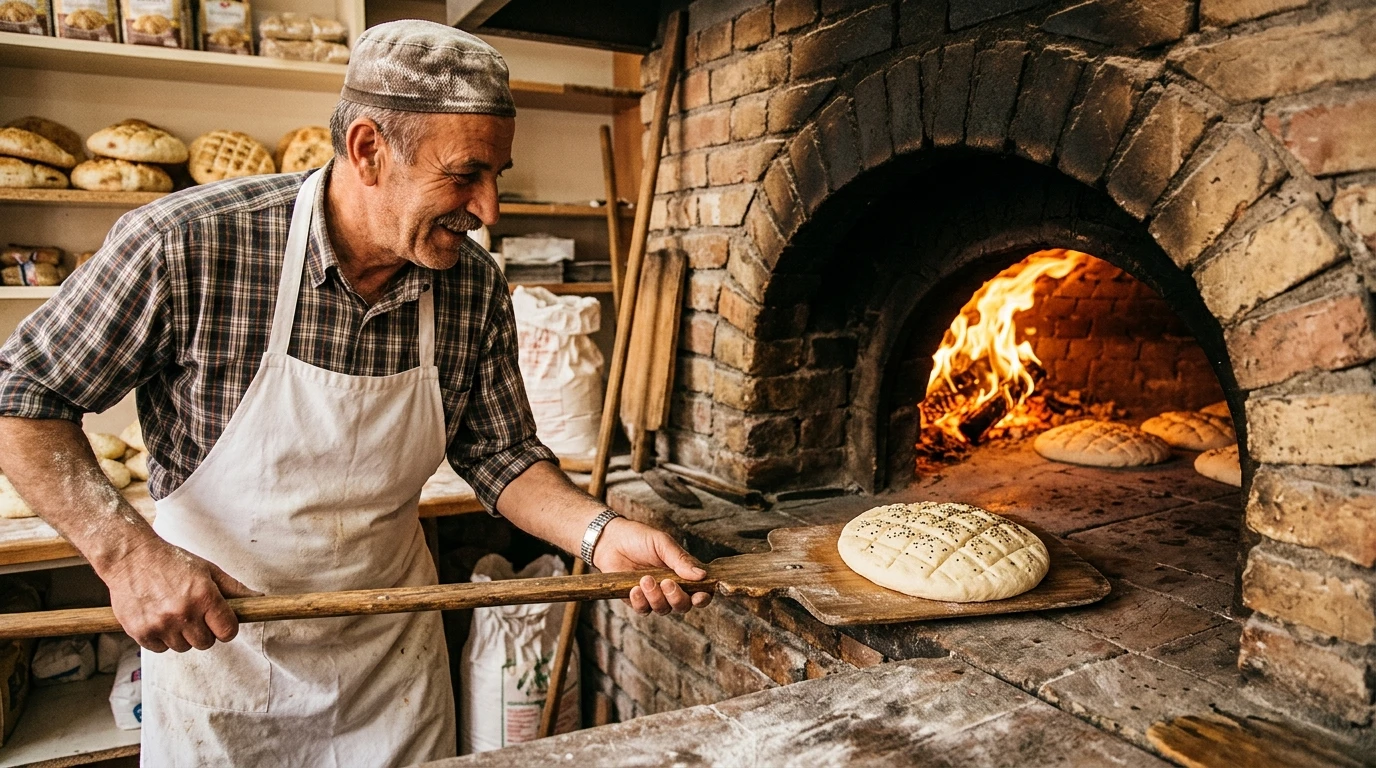
Customers order five or ten grilled sausages inside warm somun bread pockets.
Waiters serve chopped raw white onions on metal plates alongside the meat.
Guests often add cold salted cream called kajmak to their hot food.
People eat the warm meat and soft bread using their fingers.
Diners drink cold mineral water or fresh sour milk with their meal.
Friendly market venues along cobblestone alleys welcome local neighbors and traveling guests together.
A2 · Elementary
Sarajevo Cevapi and Wood-Fired Somun Bread Traditions
Artisanal butchers, charcoal grill masters, and stone-oven bakers sustain famous culinary traditions in Bascarsija.
Traditional Minced Meat Preparation and Butcher Standards
Sarajevo cevapi represent an iconic culinary tradition prepared according to craft guild standards in Bascarsija.
Traditional butchers mix ground beef cuts with lamb fat and season the meat with salt.
The minced meat mixture undergoes repeated kneading and rests overnight in cold storage.
Artisanal meat shops avoid pork entirely in accordance with long established dietary practices.
Cooks shape the seasoned mixture into uniform cylindrical sausages using manual funnel tools.
Historical records trace minced meat grilling customs to Ottoman merchants arriving in the fifteenth century.
Wood-Fired Charcoal Grilling and Heat Management
Grill masters cook the seasoned sausages over glowing beechwood charcoal on cast-iron grates.
Chefs maintain different thermal zones across the charcoal bed to prevent scorching the meat.
Cooks turn the sausages constantly with long metal tongs to ensure even surface browning.
Grill chefs place halved somun flatbread on the sausages to absorb fragrant cooking steam.
Heavy iron exhaust hoods and brick chimneys draw dense wood smoke out of restaurants.
Traditional charcoal grilling methods remain essential for achieving authentic flavor in family establishments.
Somun Flatbread Baking and Stone Oven Heritage
Somun is a leavened flatbread baked in wood-fired stone ovens throughout old Sarajevo neighborhoods.
Bakers combine wheat flour, lukewarm water, baker yeast, and salt in traditional wooden troughs.
Bakers score the surface with a wooden grid tool to create diamond cross-hatch marks.
Staff sprinkle aromatic black nigella seeds over the dough before baking begins.
Ovens heated above four hundred degrees bake each flatbread in less than two minutes.
Intense dry heat causes fast expansion, creating a hollow interior that holds grilled sausages.
Dining Traditions, Dairy Accompaniments, and Community Eateries
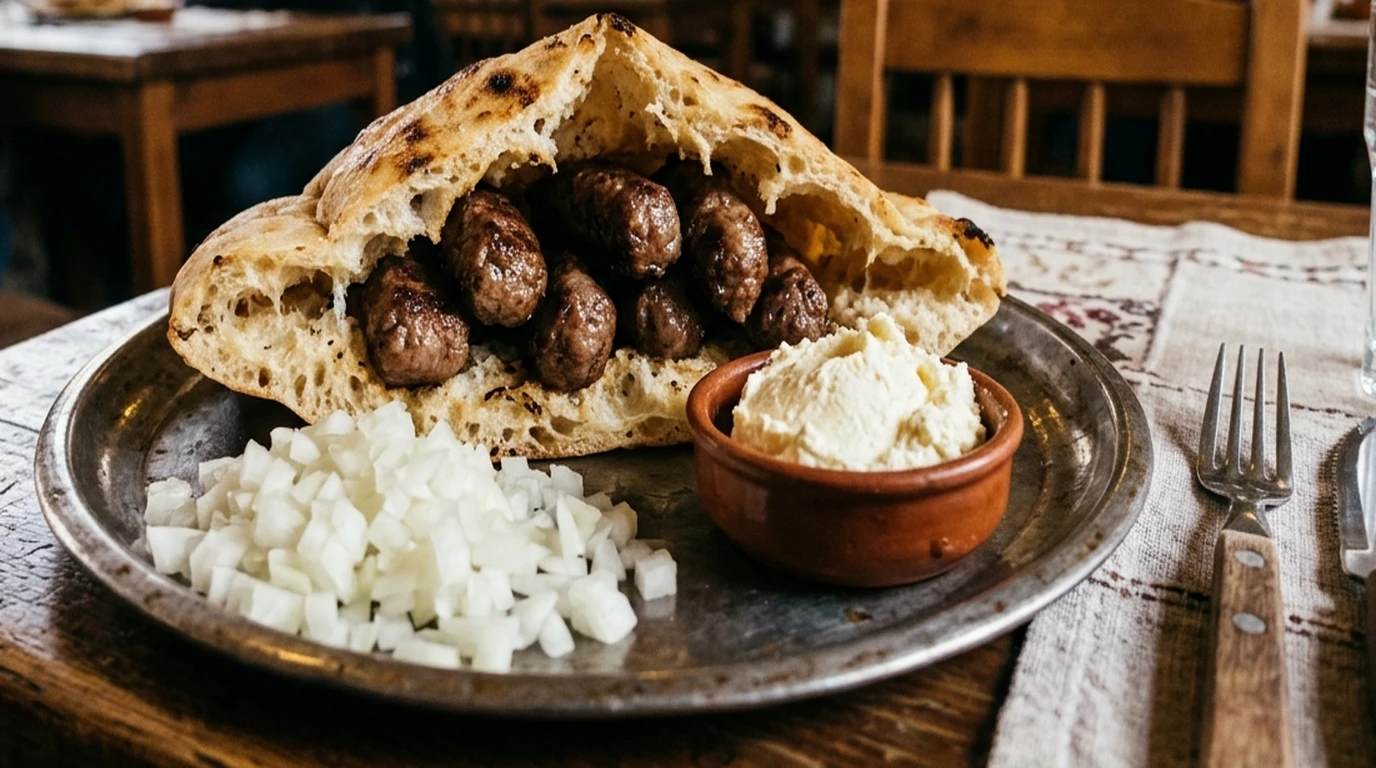
Diners commonly order portions of five or ten sausages inside a warm somun bread pocket.
Traditional table service includes large portions of finely diced raw white onions.
Customers frequently add rich kajmak, a salted clotted cream made from mountain cow milk.
Local dining etiquette encourages guests to eat the warm meal by hand without silverware.
Beverage customs favor drinking fermented plain yogurt or chilled spring water with the meal.
Family eateries along cobblestone streets serve as social gathering places for residents and visitors.
B1 · Intermediate
Artisanal Butcher Guilds and Charcoal Grilling in Sarajevo
Centuries of guild discipline, charcoal thermodynamics, and stone oven baking preserve authentic Bosnian culinary heritage.
Traditional Minced Meat Preparation and Butcher Standards
Sarajevo cevapi are small grilled sausages crafted according to exacting guild standards in historic Bascarsija.
Master butchers combine prime beef cuts with rendered lamb fat, relying on salt for preservation.
Repeated mechanical kneading and extended cold resting allow proteins to bind without artificial chemical additives.
Established butcher shops strictly exclude pork, adhering to centuries-old Ottoman dietary traditions in the capital.
Artisans press the chilled meat through cylindrical funnels to create uniform rolls several centimeters long.
Culinary historians link these seasoned minced meat traditions to fifteenth-century Ottoman garrison cooks and merchants.
Wood-Fired Charcoal Grilling and Heat Management
Experienced grill masters prepare the sausages over glowing beechwood charcoal on thick cast-iron roštilj grates.
Chefs carefully manage temperature zones across the charcoal bed to achieve rapid searing without drying.
Frequent rotation with polished metal tongs creates even caramelization while keeping the interior tender and moist.
Grill chefs place halved somun flatbread atop the sausages to absorb rising steam and savory juices.
Commercial kitchens utilize masonry chimney flues and powerful ventilation hoods to control hardwood charcoal smoke.
This dedication to authentic charcoal embers distinguishes respected family cevabdžinica venues from modern fast-food outlets.
Somun Flatbread Baking and Stone Oven Heritage
Somun flatbread serves as the essential companion and edible vessel for authentic Sarajevo grilled specialties.
Neighborhood bakers mix high-hydration dough from wheat flour, water, yeast, and salt in wooden troughs.
Before loading the loaves, bakers score the wet dough using wooden rods to imprint diamond patterns.
Scored loaves receive a scattering of black nigella seeds that release an herbal aroma during baking.
Wood-fueled stone brick ovens operating above four hundred degrees bake the dough in ninety seconds.
Extreme heat triggers dramatic steam expansion, creating a soft pocket perfectly proportioned for hot sausages.
Dining Traditions, Dairy Accompaniments, and Community Eateries
Orders traditionally arrive in standard servings of five or ten pieces nestled within sliced somun pockets.
Plates feature generous mounds of freshly chopped white onions that deliver a crisp, sharp contrast.
Diners often supplement their meal with savory kajmak, a decadent clotted cream skimmed from simmered milk.
Cultural convention in traditional eateries favors eating by hand rather than using conventional table cutlery.
Traditional beverage customs pair the savory meal with fermented plain yogurt or cold spring water.
These intimate dining rooms along Bascarsija cobblestone lanes provide democratic meeting grounds for diverse urban society.
B2 · Upper Intermediate
Culinary Guild Standards and Somun Bread Heritage in Sarajevo
An exploration of artisanal beef blending, charcoal heat control, and stone brick oven flatbread baking in the Bosnian capital.
Traditional Minced Meat Preparation and Butcher Standards
Sarajevo cevapi represent a celebrated cornerstone of urban Bosnian gastronomy governed by rigorous craft guild principles.
Master butchers blend finely ground beef cuts with selected lamb fat, seasoning the mixture exclusively with pure salt.
Double-grinding protocols and disciplined kneading allow natural myofibrillar protein binding during cold resting periods.
Culinary practitioners throughout historic Bascarsija reject pork completely, maintaining fidelity to long-standing halal dietary heritage.
The cohesive meat emulsion is extruded through manual funnels to produce uniform cylindrical sausages of calibrated dimensions.
Gastronomic historians document the transmission of skewered minced meat cookery during fifteenth-century Ottoman trade expansion.
Wood-Fired Charcoal Grilling and Heat Management
Artisanal grill masters roast the seasoned cylinders over dense beechwood charcoal embers on heavy cast-iron grates.
Operators calibrate thermal gradients across the charcoal hearth to ensure crust formation while preserving interior juiciness.
Continuous manipulation with elongated metal tongs secures uniform Maillard browning across all sausage surfaces.
Chefs momentarily steam halved somun flatbread directly over sizzling meat to infuse the crumb with aromatic juices.
Custom masonry flue systems and industrial exhaust hoods efficiently channel aromatic hardwood smoke away from dining halls.
Adherence to natural charcoal combustion remains the decisive technical criterion separating artisanal establishments from automated kitchens.
Somun Flatbread Baking and Stone Oven Heritage
Somun represents an ancient wood-fired leavened flatbread engineered specifically to cradle hot grilled meat portions.
Master bakers cultivate high-hydration dough formulations containing solely sifted wheat flour, lukewarm water, baker yeast, and salt.
Manual scoring using grooved wooden paddles embosses the characteristic diagonal grid pattern onto every individual loaf.
Bakers sprinkle pungent nigella seeds across the raw dough rounds, imparting signature herbal and peppery notes.
Refractory brick hearths burning hardwood embers reach intense temperatures exceeding four hundred degrees Celsius.
Immediate thermal shock produces an internal pocket that allows waiters to pack grilled sausages effortlessly.
Dining Traditions, Dairy Accompaniments, and Community Eateries
Standard gastronomic portions consist of five or ten grilled sausages enveloped in warm, freshly sliced somun.
Platters feature substantial mounds of minced white onions that provide crisp texture and sharp allium pungency.
Connoisseurs regularly accompany the meat with artisanal kajmak, a salted clotted cream skimmed from slow-cooked mountain milk.
Unwritten table etiquette inside traditional cevabdžinica dining rooms dictates eating by hand without conventional tableware.
Beverage customs pair the rich grilled meat with refreshing fermented yogurt or effervescent natural mineral water.
These historic dining rooms along Baščaršija pedestrian alleys function as cross-generational urban forums uniting citizens.
C1 · Advanced
Gastronomic Craftsmanship and Somun Hearth Heritage in Sarajevo
Butcher guild discipline, charcoal pyrodynamics, and refractory masonry baking sustain Sarajevo celebrated meat and flatbread culture.
Traditional Minced Meat Preparation and Butcher Standards
Sarajevo cevapi exemplify an exacting culinary tradition preserved through generational guild discipline across historic Baščaršija.
Master butchers select choice beef cuts blended with judicious lamb tallow, relying exclusively on salt for seasoning.
Meticulous double-grinding and exhaustive manual aeration stimulate natural myosin protein binding throughout overnight cold curing.
Butcher guilds strictly ban porcine ingredients, honoring centuries of Islamic culinary customs established under Ottoman administration.
The seasoned meat emulsion is extruded through calibrated funnels to maintain uniform cylindrical geometry across every batch.
Gastronomic historiography traces the emergence of skewered minced meat preparations to fifteenth-century Ottoman military provisioning.
Wood-Fired Charcoal Grilling and Heat Management
Grill masters cook the meat exclusively over glowing beechwood charcoal positioned beneath substantial cast-iron roštilj grates.
Chefs orchestrate localized heat zones across the charcoal bed to balance exterior caramelization against interior moisture retention.
Deft manipulation using elongated tongs prevents casing ruptures, ensuring uniform convective cooking across all cylindrical facets.
Cooks drape halved somun flatbreads over sizzling sausages, permitting meat drippings and fragrant vapor to permeate the crumb.
Specialized exhaust masonry flues and draft regulators efficiently evacuate dense hardwood combustion emissions from crowded dining rooms.
Uncompromising reliance on natural hardwood embers represents the defining marker of authenticity in traditional Baščaršija kitchens.
Somun Flatbread Baking and Stone Oven Heritage
Somun constitutes an ancient leavened flatbread whose structural elasticity makes it the quintessential vessel for grilled specialties.
Artisanal bakers knead a high-hydration dough comprising unbleached wheat flour, water, yeast, and salt within wooden troughs.
Before chamber entry, bakers employ wooden rods to etch a diamond lattice across the exterior crust.
Loaves receive generous distributions of black nigella sativa seeds that release distinctive herbal pungency under intense heat.
Refractory brick hearths fueled by split beechwood reach extreme temperatures that bake each loaf in ninety seconds.
Instantaneous thermal spring vaporizes internal moisture, producing a cavernous crumb pocket engineered to nestle grilled sausages.
Dining Traditions, Dairy Accompaniments, and Community Eateries
Standard culinary portions consist of five or ten grilled cylinders enveloped in warm, freshly sliced somun flatbread.
Plates arrive accompanied by abundant mounds of finely diced pungent white onions that cleanse the palate effectively.
Patrons frequently request artisanal kajmak, an unctuous salted clotted cream skimmed from slow-simmered mountain dairy milk.
Traditional etiquette inside heritage cevabdžinica venues strongly favors manual consumption, eschewing modern metallic table cutlery.
Beverage traditions favor refreshing fermented plain yogurt or chilled sparkling mineral water over sweetened commercial soda.
These venerable dining establishments along pedestrian thoroughfares serve as egalitarian civic spaces fostering neighborhood cohesion.
C2 · Mastery
Artisanal Butcher Guilds and Somun Bread Heritage in Sarajevo
Thermal pyrodynamics, leavened flatbread mechanics, and communal dining etiquette define the culinary anthropology of Bascarsija.
Traditional Minced Meat Preparation and Butcher Standards
Sarajevo cevapi embody an uncompromised gastronomic paradigm regulated by centuries of artisanal butcher guild governance.
Craft practitioners select choice bovine cuts combined with calibrated ovine tallow, seasoning the blend exclusively with unrefined salt.
Systematic double-milling followed by rigorous manual aeration induces extensive myosin extraction during overnight cold curing.
Butcher guilds enforce absolute proscription of porcine elements, honoring Islamic dietary conventions rooted in Ottoman history.
The cohesive meat emulsion is extruded through precision funnels to guarantee uniform cylindrical geometry across every portion.
Gastronomic historians document the fifteenth-century transmission of minced skewered meat traditions via imperial trade routes.
Wood-Fired Charcoal Grilling and Heat Management
Grill masters prepare the sausages exclusively over glowing beechwood charcoal positioned beneath heavy cast-iron roštilj grates.
Artisans calibrate localized thermal gradients across the charcoal hearth to optimize surface caramelization while safeguarding internal moisture.
Deft manipulation with elongated tongs prevents casing perforations, ensuring uniform convective cooking across all cylindrical facets.
Cooks drape halved somun flatbreads across sizzling sausages, enabling meat drippings and fragrant vapor to permeate the crumb.
Masonry chimney flues and calibrated dampers efficiently evacuate dense hardwood combustion emissions from crowded dining rooms.
Uncompromising reliance on natural hardwood embers constitutes the definitive benchmark separating artisanal eateries from industrial kitchens.
Somun Flatbread Baking and Stone Oven Heritage
Somun constitutes an ancient leavened flatbread whose structural elasticity makes it the quintessential vessel for grilled meat.
Bakers mix a high-hydration dough formulated exclusively from unbleached wheat flour, water, yeast, and salt in wooden troughs.
Prior to hearth entry, bakers utilize notched wooden rods to etch a diamond lattice across the exterior surface.
Unbaked rounds receive generous distributions of nigella sativa seeds that release distinctive herbal notes under thermal stress.
Refractory brick hearths burning hardwood embers attain searing temperatures that bake each individual loaf in ninety seconds.
Instantaneous oven spring produces a cavernous interior pocket engineered specifically to cradle hot grilled meat sausages.
Dining Traditions, Dairy Accompaniments, and Community Eateries
Standard restaurant portions feature five or ten grilled cylinders enveloped snugly within sliced somun flatbread.
Platters arrive accompanied by generous mounds of finely minced white onions that supply crisp texture and sharp allium contrast.
Patrons frequently complement the meal with artisanal kajmak, an unctuous salted clotted cream skimmed from simmered highland milk.
Dining convention inside historic cevabdžinica venues strongly prescribes manual consumption, eschewing modern metallic table cutlery.
Beverage traditions favor refreshing fermented plain yogurt or effervescent natural mineral water over sweetened commercial soda.
These venerable establishments along pedestrian cobblestone thoroughfares operate as egalitarian civic institutions fostering community solidarity.
Check your understanding
Choose how closely you want to revisit the article. You can refer back while answering, and review explanations when you finish.
Quick Quiz A1
Try one question, then create a free account for the full Quick Quiz. Sign Up Free
Answer every question before checking. There is no time limit.
Your results
/ 1 correct (%)
Read the explanations to see how each answer connects to the article.
-
What small grilled sausages are made in old Sarajevo?
1. Answer:
Quick Quiz A2
Try one question, then create a free account for the full Quick Quiz. Sign Up Free
Answer every question before checking. There is no time limit.
Your results
/ 1 correct (%)
Read the explanations to see how each answer connects to the article.
-
What iconic culinary tradition represents guild standards in Bascarsija?
1. Answer:
Quick Quiz B1
Try one question, then create a free account for the full Quick Quiz. Sign Up Free
Answer every question before checking. There is no time limit.
Your results
/ 1 correct (%)
Read the explanations to see how each answer connects to the article.
-
What small grilled sausages are crafted in historic Bascarsija?
1. Answer:
Quick Quiz B2
Try one question, then create a free account for the full Quick Quiz. Sign Up Free
Answer every question before checking. There is no time limit.
Your results
/ 1 correct (%)
Read the explanations to see how each answer connects to the article.
-
What celebrated cornerstone represents urban Bosnian gastronomy?
1. Answer:
Quick Quiz C1
Try one question, then create a free account for the full Quick Quiz. Sign Up Free
Answer every question before checking. There is no time limit.
Your results
/ 1 correct (%)
Read the explanations to see how each answer connects to the article.
-
What culinary tradition is preserved through guild discipline in Bascarsija?
1. Answer:
Quick Quiz C2
Try one question, then create a free account for the full Quick Quiz. Sign Up Free
Answer every question before checking. There is no time limit.
Your results
/ 1 correct (%)
Read the explanations to see how each answer connects to the article.
-
What gastronomic paradigm is regulated by butcher guild governance?
1. Answer:
