A1 · Beginner
Fort Langley Tourtiere and Tourtiere du Lac-Saint-Jean: Canadian Meat Pies
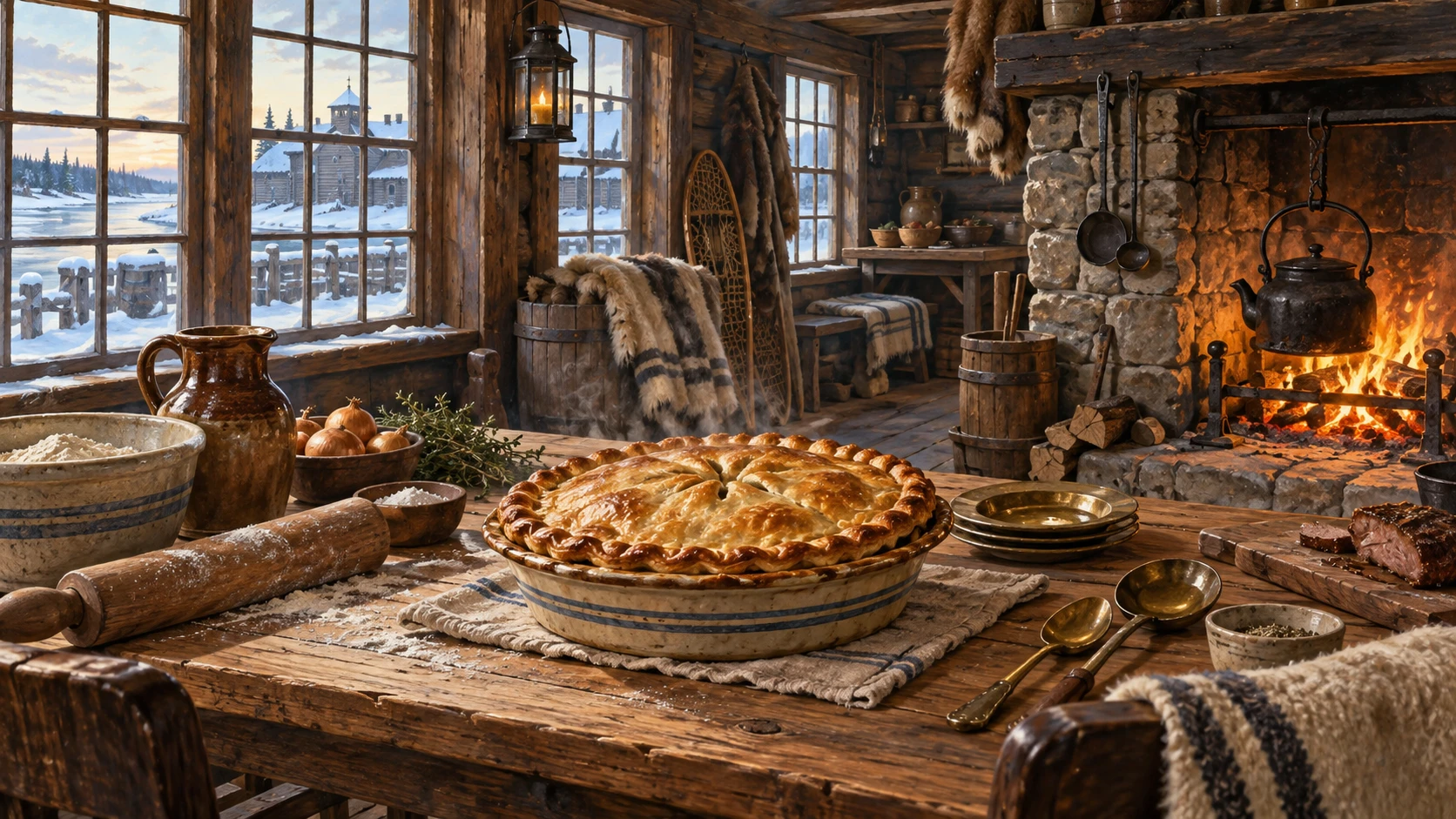
Two Canadian heritage recipes show different ways to bake traditional meat pies. Historic records describe distinct ingredients, dough crusts, and cooking pots in British Columbia and Quebec.
A historic trading post along the river
Fort Langley National Historic Site sits along the Fraser River in British Columbia. The Hudson's Bay Company established the fur trading post in 1827. The post served as a vital agricultural and salmon-packing centre. Workers supplied regional provisions across Pacific Northwest trading routes. In November 1858, Governor James Douglas proclaimed the creation of the Crown Colony of British Columbia inside the fort.
Living history programs and heritage kitchens interpret nineteenth-century culinary traditions. Historical provisioning records document that fort inhabitants consumed local game, cultivated root crops, and salted provisions during cold winter months. Parks Canada manages the fortified wooden palisade, storehouse, and heritage demonstration kitchen to preserve early trade history.
A documented heritage recipe from the fort
Parks Canada publishes an archival culinary dossier titled Fort Langley Tourtiere in its Heritage Gourmet series. The historic recipe presents a domestic adaptation reflecting French Canadian voyageurs and company employees stationed at the Pacific post. Culinary interpreters prepare the savoury pie during winter holiday demonstrations inside reconstructed nineteenth-century hearths.
The federal documentation frames the preparation as a specific heritage recipe rather than a standardized national dietary rule. Traditional spices in the meat filling include ground cinnamon, ground cloves, and dried summer savory. The dish illustrates how culinary practices from eastern fur trade routes migrated across continental waterways into British Columbia.
Ground meat and a double pastry crust
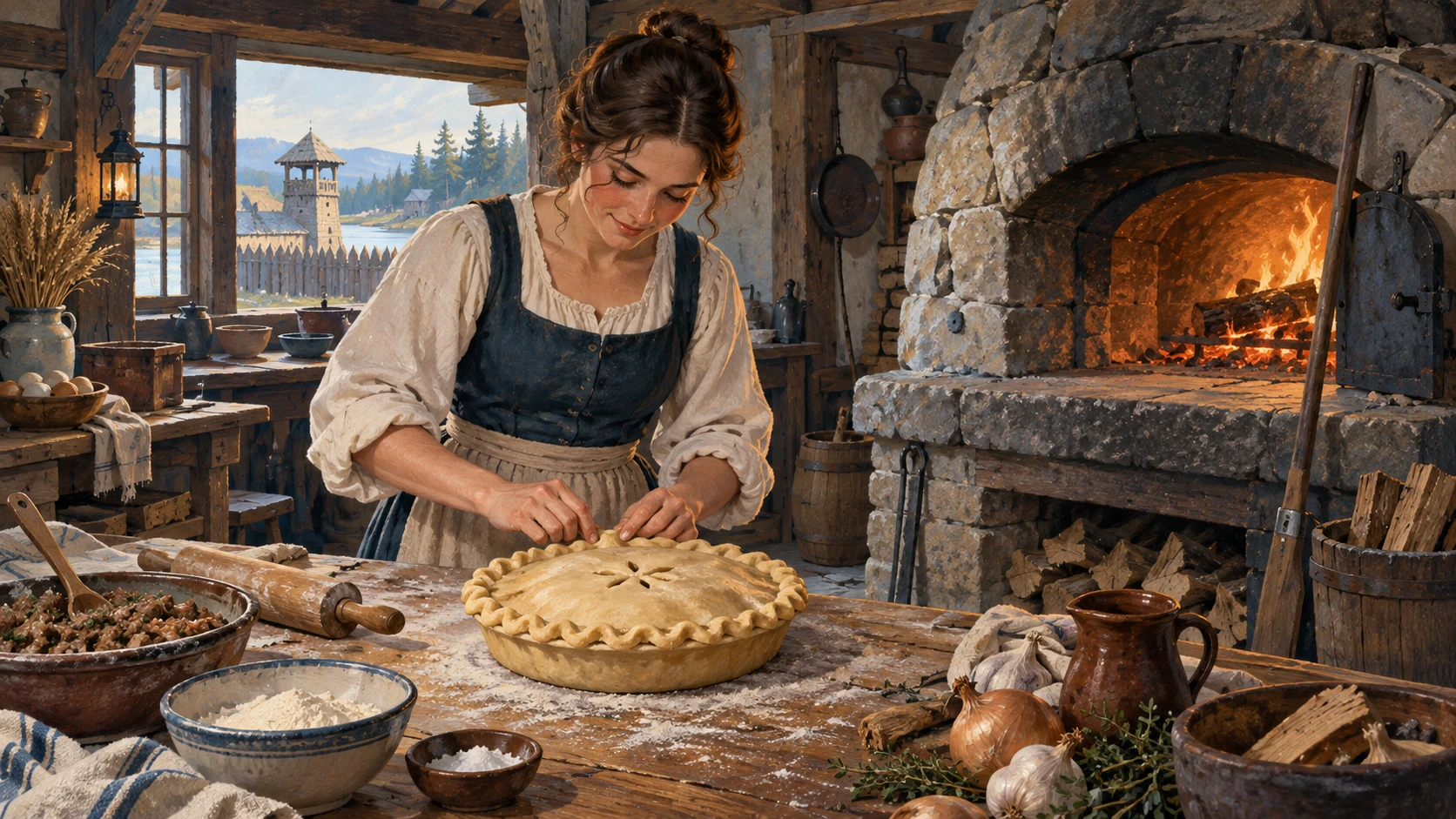
The Fort Langley preparation combines equal portions of lean ground pork and ground beef simmered with minced yellow onions. Chilled mashed russet potatoes are folded into the seasoned cooked meat mixture to absorb cooking juices and bind the filling. The filling is encased between two rolled layers of flaky pastry dough, forming a complete double-crust pie.
Bakers crimp the pastry edges securely and pierce steam vents into the top dough layer before baking at two hundred degrees Celsius. The resulting shallow pie features a tender, crumbly crust that holds its structure when sliced into individual portions. Culinary historians classify this pastry structure as closely aligned with shallow Quebec meat pies known colloquially as pate a la viande.
A famous regional dish from Quebec
Sidney Museum and Archives documents the distinct regional preparation known formally as Tourtiere du Lac-Saint-Jean. Originating in the Saguenay-Lac-Saint-Jean region of Quebec, the dish evolved from communal hunting and lumber camp traditions. The culinary tradition emerged in communities surrounding Lake Saint-Jean where seasonal cold winters demanded calorie-dense communal meals.
Regional culinary registries distinguish the Saguenay preparation from thin pastry pies through its deep-dish format and slow braising. Historical accounts note that early iterations often featured migratory passenger pigeons or wild waterfowl before modern domestic meats predominated. Tourtiere du Lac-Saint-Jean functions as a symbol of regional gastronomic identity across north-central Quebec.
Cubed meat and prolonged slow baking
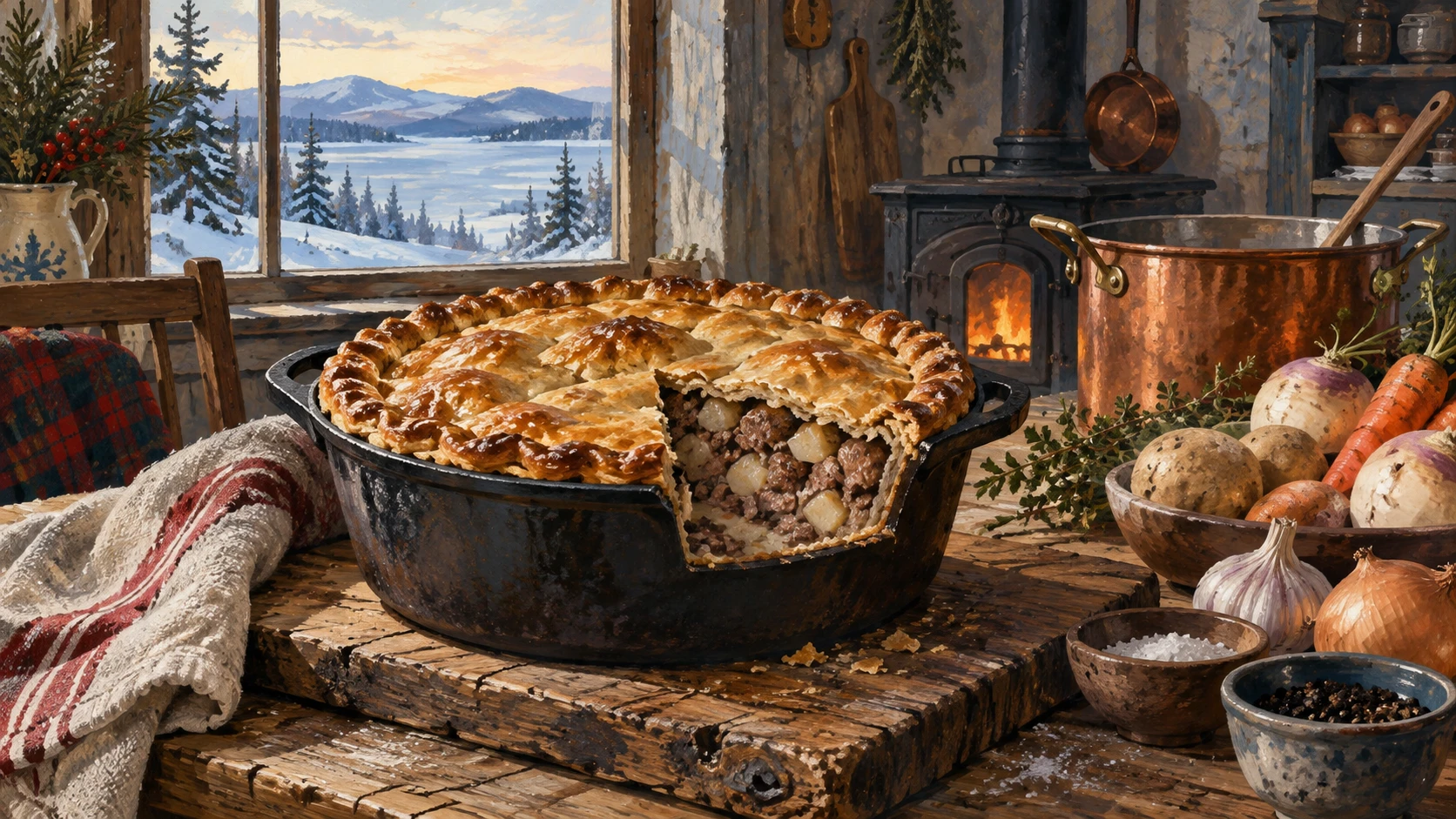
The Lac-Saint-Jean recipe requires cubed beef, pork, and game meats rather than finely ground or minced livestock cuts. Raw russet potatoes are peeled and diced into uniform small cubes before being interlayered with the raw seasoned meats. The ingredients are layered inside a deep, heavy earthenware pot or enameled cast-iron roaster capable of holding large communal volumes.
Rich poultry or beef broth is poured over the layered meat and potato mixture until the liquid rises just below the surface. A thick, sturdy rolled pastry crust covers the deep vessel, sealing in steam during a prolonged baking period of six to eight hours. Slow baking allows meat connective tissues to break down while diced potatoes absorb rich savory broth without dissolving into puree.
Archival records and family kitchen variations
Museum archives and federal recipe dossiers document specific historical preparations rather than universal household cooking habits. Written heritage recipes cannot establish that every family in British Columbia or Quebec prepares tourtiere using identical steps. Culinary historians emphasize that family recipes exhibit continuous variation in spice ratios, meat combinations, and crust formulas.
Archival documents do not demonstrate that tourtiere consumption was universally practiced across all Canadian social classes or regions. Designating one regional preparation as more authentic than another misrepresents dynamic culinary adaptations across immigrant communities. Responsible culinary history treats named recipes as bounded cultural snapshots rather than definitive national rules.
A2 · Elementary
Fort Langley Tourtiere and Tourtiere du Lac-Saint-Jean: Regional Meat Pies in Canada
Canadian culinary history features distinctive meat pie traditions across different provinces. Historic records from British Columbia and Quebec describe unique combinations of meats, potatoes, and baking methods.
The Hudson Bay post on the Fraser River
Fort Langley National Historic Site stands beside the Fraser River in southwestern British Columbia. The Hudson's Bay Company founded the fur trading post in 1827 to secure British commercial interests along the Pacific Northwest coast. In addition to fur trading, the post operated as a major agricultural and salmon-packing centre supplying regional provisions across western trading routes. On November 19, 1858, Governor James Douglas proclaimed the creation of the Crown Colony of British Columbia inside the fort's big house.
Today, living history programs and heritage kitchens interpret nineteenth-century culinary traditions for modern visitors. Historical provisioning records document that fort inhabitants consumed local game, cultivated root crops, and salted provisions during cold winter months. Parks Canada manages the fortified wooden palisade, storehouse, and heritage demonstration kitchen to preserve early trade history.
A documented heritage recipe from the Pacific post
Parks Canada publishes an archival culinary dossier titled Fort Langley Tourtiere as part of its Heritage Gourmet series. This historic recipe presents a domestic adaptation reflecting French Canadian voyageurs and company employees stationed at the Pacific post. Culinary interpreters prepare the savoury pie during winter holiday demonstrations inside reconstructed nineteenth-century hearths.
The federal documentation frames the preparation as a specific heritage recipe rather than a standardized national dietary rule. Traditional spices in the meat filling include ground cinnamon, ground cloves, and dried summer savory. The dish illustrates how culinary practices from eastern fur trade routes migrated across continental waterways into British Columbia.
Ground meats, mashed potatoes, and flaky pastry
The Fort Langley preparation combines equal portions of lean ground pork and ground beef simmered with minced yellow onions. Chilled mashed russet potatoes are folded into the seasoned cooked meat mixture to absorb cooking juices and bind the filling. The filling is encased between two rolled layers of flaky pastry dough, forming a complete double-crust pie.
Bakers crimp the pastry edges securely and pierce steam vents into the top dough layer before baking at two hundred degrees Celsius. The resulting shallow pie features a tender, crumbly crust that holds its structure when sliced into individual portions. Culinary historians classify this pastry structure as closely aligned with shallow Quebec meat pies known colloquially as pate a la viande.
Tourtiere du Lac-Saint-Jean and regional identity
Sidney Museum and Archives documents the distinct regional preparation known formally as Tourtiere du Lac-Saint-Jean. Originating in the Saguenay-Lac-Saint-Jean region of Quebec, the dish evolved from communal hunting and lumber camp traditions. The culinary tradition emerged in communities surrounding Lake Saint-Jean where seasonal cold winters demanded calorie-dense communal meals.
Regional culinary registries distinguish the Saguenay preparation from thin pastry pies through its deep-dish format and slow braising. Historical accounts note that early iterations often featured migratory passenger pigeons or wild waterfowl before modern domestic meats predominated. Tourtiere du Lac-Saint-Jean functions as a symbol of regional gastronomic identity across north-central Quebec.
Cubed game meats and slow braising in deep pots
The Lac-Saint-Jean recipe requires cubed beef, pork, and game meats rather than finely ground or minced livestock cuts. Raw russet potatoes are peeled and diced into uniform small cubes before being interlayered with the raw seasoned meats. The ingredients are layered inside a deep, heavy earthenware pot or enameled cast-iron roaster capable of holding large communal volumes.
Rich poultry or beef broth is poured over the layered meat and potato mixture until the liquid rises just below the surface. A thick, sturdy rolled pastry crust covers the deep vessel, sealing in steam during a prolonged baking period of six to eight hours. Slow baking allows meat connective tissues to break down while diced potatoes absorb rich savory broth without dissolving into puree.
Interpreting historical recipes and kitchen traditions
Museum archives and federal recipe dossiers document specific historical preparations rather than universal household cooking habits. Written heritage recipes cannot establish that every family in British Columbia or Quebec prepares tourtiere using identical steps. Culinary historians emphasize that family recipes exhibit continuous variation in spice ratios, meat combinations, and crust formulas.
Archival documents do not demonstrate that tourtiere consumption was universally practiced across all Canadian social classes or regions. Designating one regional preparation as more authentic than another misrepresents dynamic culinary adaptations across immigrant communities. Responsible culinary history treats named recipes as bounded cultural snapshots rather than definitive national rules.
B1 · Intermediate
Fort Langley Tourtiere and Tourtiere du Lac-Saint-Jean: Regional Meat Pies in Canadian Foodways
Canadian culinary history features distinctive meat pie traditions across different provinces. Archival records from British Columbia and Quebec document contrasting preparations using ground livestock cuts or cubed game meats.
Fur trade networks and the Fraser River post
Fort Langley National Historic Site stands along the lower Fraser River in southwestern British Columbia. Established by the Hudson's Bay Company in 1827, the fortified trading post secured British commercial interests and provisioned maritime fur trade expeditions across the Pacific Northwest. In addition to collecting beaver and sea otter pelts, Fort Langley developed extensive farming operations and a large-scale salmon-packing centre that exported salted fish to international markets. On November 19, 1858, Governor James Douglas proclaimed the official creation of the Crown Colony of British Columbia inside the fort's big house.
Modern living history demonstrations and reconstructed heritage kitchens interpret nineteenth-century culinary practices for public visitors. Historical provisioning records indicate that fort residents relied on local game, cultivated root crops, and salted meats during harsh winter months. Today, Parks Canada preserves the perimeter palisade, timber storehouses, and heritage kitchen to showcase early commercial life and cross-cultural trade.
The Parks Canada heritage culinary dossier
Parks Canada documents this trade post culinary legacy through an archival dossier titled Fort Langley Tourtiere, featured in its Heritage Gourmet culinary series. The recipe captures a domestic adaptation developed by French Canadian voyageurs and company servants stationed at the remote Pacific post. Heritage interpreters regularly prepare the savoury meat pie during winter holiday events inside restored open hearths.
Federal culinary historians emphasize that the recipe represents a documented local historical preparation rather than a rigid national culinary mandate. The meat filling is seasoned with classic spices including ground cinnamon, ground cloves, and dried summer savory. This preparation demonstrates how French Canadian culinary customs travelled across continental river networks and adapted to local provisions in British Columbia.
Ground meats, mashed potatoes, and double-crust assembly
The Fort Langley preparation begins by simmering equal quantities of lean ground pork and ground beef with finely chopped yellow onions. Chilled mashed russet potatoes are gently incorporated into the seasoned cooked meat mixture to absorb excess fat and bind the filling into a cohesive texture. Bakers transfer the seasoned mixture into a shallow pie plate lined with flaky pastry dough, covering it with a top pastry layer to form a classic double crust.
After crimping the pastry rim to prevent leakage, bakers cut decorative steam vents into the upper crust and bake the pie at two hundred degrees Celsius until golden brown. The finished pie exhibits a tender, crumbly pastry that retains its shape when cut into individual wedges. Culinary historians classify this shallow pastry format as closely related to traditional Quebec meat pies known colloquially as pate a la viande.
Tourtiere du Lac-Saint-Jean and regional identity
In contrast to shallow ground meat pies, Sidney Museum and Archives documents the distinct regional preparation known as Tourtiere du Lac-Saint-Jean. Emerging from the Saguenay-Lac-Saint-Jean region of Quebec, this substantial dish originated in communal hunting camps and winter logging settlements. The tradition developed in northern communities where isolated families required calorie-dense communal meals to endure extreme subzero winter temperatures.
Culinary registries distinguish the Saguenay preparation from ordinary meat pies by its deep-dish format and prolonged braising method. Early nineteenth-century records suggest that hunters originally prepared the dish with wild waterfowl or migratory passenger pigeons before domestic farm meats became widely available. Over generations, Tourtiere du Lac-Saint-Jean has grown into a powerful culinary symbol of regional heritage in northern Quebec.
Cubed game meats, diced potatoes, and slow braising
The preparation of Tourtiere du Lac-Saint-Jean relies on bite-sized cubes of beef, pork, and wild game rather than ground mince. Peeled russet potatoes are cut into uniform cubes and layered raw alongside the seasoned meats inside a heavy earthenware pot or enameled cast-iron roasting vessel. Seasoned poultry or beef broth is poured over the layered ingredients until the liquid reaches just below the top surface.
A thick, rolled pastry crust is placed over the roasting vessel to create a tight steam seal during a slow baking period lasting six to eight hours. Under low heat, tough meat connective tissues dissolve into gelatin while the diced potatoes absorb seasoned broth without breaking down into mush. This prolonged slow braising yields a rich, succulent communal stew encased beneath a crisp, golden crust.
Archival limitations and household culinary diversity
Culinary scholars note that museum archives and heritage recipe collections record specific historical recipes rather than universal domestic cooking practices. Published archival recipes cannot prove that every nineteenth-century household in British Columbia or Quebec followed uniform steps when baking meat pies. Oral histories and domestic records reveal continuous variations in seasoning choices, meat combinations, and crust formulas across private households.
Furthermore, historical evidence demonstrates that tourtiere consumption was never universal across every social class or geographical district in Canada. Declaring one specific regional recipe as inherently more authentic than another overlooks how migrant communities continually adapted their foodways to local conditions. Responsible food historians treat historical recipes as bounded cultural snapshots rather than definitive national rules.
B2 · Upper Intermediate
Fort Langley Tourtiere and Tourtiere du Lac-Saint-Jean: Regional Meat Pies in Canadian Foodways
A comparative analysis of two documented Canadian savoury pie traditions reveals contrasting approaches to livestock meats, wild game, pastry structure, and regional gastronomic identity in British Columbia and Quebec.
Fur trade networks and the Fraser River post
Fort Langley National Historic Site commands a strategic position along the lower reaches of the Fraser River in southwestern British Columbia. Established by the Hudson's Bay Company in 1827, the fortified trading post consolidated British commercial interests across the Pacific slope while outfitting transcontinental fur trade expeditions. Beyond harvesting high-value furs, Fort Langley functioned as a crucial agricultural provisioning hub and commercial salmon-packing centre that shipped salted fish across Pacific trading routes. On November 19, 1858, Governor James Douglas proclaimed the official creation of the Crown Colony of British Columbia inside the fort's big house.
Today, costumed interpreters and functioning heritage kitchens interpret nineteenth-century foodways for visitors seeking historical insight. Archival provisioning records confirm that trade post inhabitants subsisted on local game, cultivated root crops, and salted livestock provisions during severe winter months. Parks Canada maintains the wooden palisade, storehouse, and heritage kitchen to illuminate early commercial relations between Indigenous communities, European traders, and maritime merchant networks.
Archival documentation of the Fort Langley recipe
Parks Canada preserves this Pacific trade post heritage through an archival culinary dossier titled Fort Langley Tourtiere, catalogued in its Heritage Gourmet series. The documentation records a domestic adaptation fashioned by French Canadian voyageurs and company employees stationed far from their ancestral homes in eastern Canada. Culinary staff prepare this savoury meat pie during interpretive winter holiday programs held around reconstructed nineteenth-century hearths.
Heritage specialists note that federal documentation treats this preparation as a localized archival snapshot rather than a mandatory national standard. The minced filling is seasoned with traditional spices, notably ground cinnamon, ground cloves, and dried summer savory. The preparation exemplifies how culinary customs from eastern river networks migrated across continental waterways, evolving to accommodate seasonal supplies in British Columbia.
Ground meats, mashed potatoes, and double-crust pastry structure
The culinary execution of Fort Langley tourtiere relies on simmering equal quantities of lean ground pork and beef alongside finely minced yellow onions. Cold mashed russet potatoes are folded into the cooked mixture to bind the seasoned filling while absorbing rendered cooking juices. The blended mixture is deposited into a shallow pie pan lined with flaky pastry dough and encased beneath a rolled upper sheet to form an enclosed double crust.
Bakers crimp the perimeter edges to seal the pastry seams and cut decorative steam vents into the top dough before baking at two hundred degrees Celsius until golden brown. The finished pie exhibits a tender, crumbly pastry structure that slices cleanly into discrete individual servings. Food historians classify this shallow pastry format as directly related to traditional Quebec meat pies known colloquially as pate a la viande.
Tourtiere du Lac-Saint-Jean and regional identity
In marked contrast to shallow ground mince preparations, Sidney Museum and Archives documents the distinct regional tradition known formally as Tourtiere du Lac-Saint-Jean. Originating in the Saguenay-Lac-Saint-Jean region of Quebec, this substantial culinary monument evolved from communal hunting excursions and isolated winter logging camps. The dish flourished in settlements around Lake Saint-Jean where harsh subarctic winter conditions necessitated calorie-dense communal nourishment.
Provincial culinary registries differentiate the Saguenay preparation from conventional meat pies by its deep-dish format and prolonged braising methodology. Historical accounts indicate that frontier cooks originally prepared the pie with wild waterfowl or passenger pigeons prior to the widespread availability of domestic farm livestock. Over successive generations, Tourtiere du Lac-Saint-Jean has emerged as an enduring emblem of regional gastronomic heritage across north-central Quebec.
Cubed game meats, diced potatoes, and slow braising
The preparation of authentic Tourtiere du Lac-Saint-Jean demands coarse cubes of beef, pork, and wild game rather than finely ground livestock mince. Peeled russet potatoes are cut into uniform small dice and interlayered raw with the seasoned meats inside a heavy earthenware pot or enameled cast-iron roaster. Rich poultry or beef broth is poured into the vessel until the seasoned cooking liquid rises just below the surface layer.
A sturdy, rolled pastry crust is sealed over the top of the vessel to trap moisture throughout an extended baking cycle lasting six to eight hours. Gentle oven heat dissolves tough collagen in meat connective tissues into rich gelatin, while diced potatoes absorb savoury broth without losing their structural integrity. This slow braising process transforms rustic ingredients into a luscious communal feast protected beneath a bronzed pastry lid.
Archival limitations and household culinary variation
Culinary historians stress that archival documents and museum dossiers preserve specific written records rather than universal domestic cooking norms. Published historical recipes cannot demonstrate that every nineteenth-century household in British Columbia or Quebec adhered to identical culinary protocols. Domestic memoirs and oral histories demonstrate continual variations in spice measurements, meat selections, and pastry formulas across family kitchens.
Moreover, empirical evidence indicates that tourtiere consumption was never practiced uniformly across all Canadian socio-economic classes or regions. Asserting that one regional preparation possesses greater authenticity than another ignores how diverse communities negotiated local resource availability and cultural traditions. Rigorous food history treats named recipes as bounded cultural snapshots rather than prescriptive national rules.
C1 · Advanced
Fort Langley Tourtiere and Tourtiere du Lac-Saint-Jean: Divergent Meat Pie Traditions in Canadian Foodways
A critical examination of two documented Canadian savoury pie traditions reveals contrasting approaches to pastoral livestock, boreal game, pastry mechanics, and the historiography of regional gastronomic identity in British Columbia and Quebec.
Fur trade networks and the Fraser River post
Fort Langley National Historic Site occupies a pivotal geographic position along the navigable reaches of the lower Fraser River in southwestern British Columbia. Established by the Hudson's Bay Company in 1827, the fortified trading post consolidated British imperial and commercial interests across the Pacific slope while outfitting transcontinental fur trade expeditions. In addition to securing lucrative beaver and sea otter pelts, Fort Langley developed extensive pastoral husbandry and an industrial-scale salmon-packing centre that dispatched barrels of salted fish across maritime Pacific trade networks. On November 19, 1858, Governor James Douglas formally proclaimed the creation of the Crown Colony of British Columbia inside the fort's big house.
Today, living history programming and functioning heritage kitchens interpret nineteenth-century material foodways for contemporary observers. Archival provisioning records confirm that trade post inhabitants subsisted on local game, cultivated root crops, and salted livestock provisions during severe winter months. Parks Canada conserves the perimeter wooden palisade, timber storehouses, and heritage kitchen to illuminate early commercial encounters between Indigenous nations, European company servants, and Pacific maritime merchants.
Archival documentation of the Fort Langley recipe
Parks Canada curates this Pacific fur trade culinary legacy through an archival dossier titled Fort Langley Tourtiere, catalogued in its Heritage Gourmet culinary series. The documentation records a domestic adaptation fashioned by French Canadian voyageurs and company employees stationed far from their ancestral settlements in the Saint Lawrence River valley. Interpreters regularly demonstrate this savoury meat pie during winter holiday events conducted around reconstructed nineteenth-century hearths.
Federal culinary historians emphasize that the archival dossier represents a documented local historical preparation rather than a prescriptive national culinary mandate. The minced filling is seasoned with classic warming spices, notably ground cinnamon, ground cloves, and dried summer savory. This preparation demonstrates how culinary customs from eastern river networks migrated across continental waterways, evolving to accommodate seasonal provisions available in British Columbia.
Ground meats, mashed potatoes, and double-crust pastry structure
The culinary execution of Fort Langley tourtiere hinges on gently simmering equal proportions of lean ground pork and beef alongside finely minced yellow onions. Cold mashed russet potatoes are folded into the cooked mixture to bind the seasoned filling while absorbing rendered cooking juices. The blended mixture is deposited into a shallow pie pan lined with flaky pastry dough and encased beneath a rolled upper sheet to form an enclosed double crust.
Bakers crimp the perimeter edges to seal the pastry seams and cut decorative steam vents into the top dough before baking at two hundred degrees Celsius until golden brown. The finished pie exhibits a tender, crumbly pastry structure that slices cleanly into discrete individual servings. Food historians classify this shallow pastry format as directly related to traditional Quebec meat pies known colloquially as pate a la viande.
Tourtiere du Lac-Saint-Jean and regional identity
In marked contrast to shallow ground mince preparations, Sidney Museum and Archives documents the distinct regional tradition known formally as Tourtiere du Lac-Saint-Jean. Originating in the Saguenay-Lac-Saint-Jean region of Quebec, this substantial culinary monument evolved from communal hunting excursions and isolated winter logging camps. The dish flourished in settlements around Lake Saint-Jean where harsh subarctic winter conditions necessitated calorie-dense communal nourishment.
Provincial culinary registries differentiate the Saguenay preparation from conventional meat pies by its deep-dish format and prolonged braising methodology. Historical accounts indicate that frontier cooks originally prepared the pie with wild waterfowl or passenger pigeons prior to the widespread availability of domestic farm livestock. Over successive generations, Tourtiere du Lac-Saint-Jean has emerged as an enduring emblem of regional gastronomic heritage across north-central Quebec.
Cubed game meats, diced potatoes, and slow braising
The preparation of authentic Tourtiere du Lac-Saint-Jean demands coarse cubes of beef, pork, and wild game rather than finely ground livestock mince. Peeled russet potatoes are cut into uniform small dice and interlayered raw with the seasoned meats inside a heavy earthenware pot or enameled cast-iron roaster. Rich poultry or beef broth is poured into the vessel until the seasoned cooking liquid rises just below the surface layer.
A sturdy, rolled pastry crust is sealed over the top of the vessel to trap moisture throughout an extended baking cycle lasting six to eight hours. Gentle oven heat dissolves tough collagen in meat connective tissues into rich gelatin, while diced potatoes absorb savoury broth without losing their structural integrity. This slow braising process transforms rustic ingredients into a luscious communal feast protected beneath a bronzed pastry lid.
Archival limitations and household culinary variation
Culinary historians stress that archival documents and museum dossiers preserve specific written records rather than universal domestic cooking norms. Published historical recipes cannot demonstrate that every nineteenth-century household in British Columbia or Quebec adhered to identical culinary protocols. Domestic memoirs and oral histories demonstrate continual variations in spice measurements, meat selections, and pastry formulas across family kitchens.
Moreover, empirical evidence indicates that tourtiere consumption was never practiced uniformly across all Canadian socio-economic classes or regions. Asserting that one regional preparation possesses greater authenticity than another ignores how diverse communities negotiated local resource availability and cultural traditions. Rigorous food history treats named recipes as bounded cultural snapshots rather than prescriptive national rules.
C2 · Mastery
Fort Langley Tourtiere and Tourtiere du Lac-Saint-Jean: Divergent Savoury Pie Traditions in Canadian Foodways
A critical examination of two documented Canadian culinary traditions illuminates how fur trade outposts and boreal forest settlements generated distinct meat pie preparations, highlighting the historiographical limits of regional authenticity.
Fur trade networks and the Fraser River post
Fort Langley National Historic Site commands a vital strategic promontory along the navigable lower reaches of the Fraser River in southwestern British Columbia. Founded by the Hudson's Bay Company in 1827, the fortified trading post consolidated British imperial hegemony across the Pacific slope while outfitting transcontinental fur trade expeditions into the interior plateau. In addition to securing lucrative beaver and sea otter pelts, Fort Langley developed extensive pastoral husbandry and an industrial-scale salmon-packing centre that dispatched barrels of salted fish across maritime Pacific trade networks. On November 19, 1858, Governor James Douglas formally proclaimed the creation of the Crown Colony of British Columbia inside the fort's big house.
Today, living history programming and functioning heritage kitchens interpret nineteenth-century material foodways for contemporary observers. Archival provisioning records confirm that trade post inhabitants subsisted on local game, cultivated root crops, and salted livestock provisions during severe winter months. Parks Canada conserves the perimeter wooden palisade, timber storehouses, and heritage kitchen to illuminate early commercial encounters between Indigenous nations, European company servants, and Pacific maritime merchants.
Archival documentation of the Fort Langley recipe
Parks Canada curates this Pacific fur trade culinary legacy through an archival dossier titled Fort Langley Tourtiere, catalogued in its Heritage Gourmet culinary series. The documentation records a domestic adaptation fashioned by French Canadian voyageurs and company employees stationed far from their ancestral settlements in the Saint Lawrence River valley. Interpreters regularly demonstrate this savoury meat pie during winter holiday events conducted around reconstructed nineteenth-century hearths.
Federal culinary historians emphasize that the archival dossier represents a documented local historical preparation rather than a prescriptive national culinary mandate. The minced filling is seasoned with classic warming spices, notably ground cinnamon, ground cloves, and dried summer savory. This preparation demonstrates how culinary customs from eastern river networks migrated across continental waterways, evolving to accommodate seasonal provisions available in British Columbia.
Ground meats, mashed potatoes, and double-crust pastry structure
The culinary execution of Fort Langley tourtiere hinges on gently simmering equal proportions of lean ground pork and beef alongside finely minced yellow onions. Cold mashed russet potatoes are folded into the cooked mixture to bind the seasoned filling while absorbing rendered cooking juices. The blended mixture is deposited into a shallow pie pan lined with flaky pastry dough and encased beneath a rolled upper sheet to form an enclosed double crust.
Bakers crimp the perimeter edges to seal the pastry seams and cut decorative steam vents into the top dough before baking at two hundred degrees Celsius until golden brown. The finished pie exhibits a tender, crumbly pastry structure that slices cleanly into discrete individual servings. Food historians classify this shallow pastry format as directly related to traditional Quebec meat pies known colloquially as pate a la viande.
Tourtiere du Lac-Saint-Jean and regional identity
In marked contrast to shallow ground mince preparations, Sidney Museum and Archives documents the distinct regional tradition known formally as Tourtiere du Lac-Saint-Jean. Originating in the Saguenay-Lac-Saint-Jean region of Quebec, this substantial culinary monument evolved from communal hunting excursions and isolated winter logging camps. The dish flourished in settlements around Lake Saint-Jean where harsh subarctic winter conditions necessitated calorie-dense communal nourishment.
Provincial culinary registries differentiate the Saguenay preparation from conventional meat pies by its deep-dish format and prolonged braising methodology. Historical accounts indicate that frontier cooks originally prepared the pie with wild waterfowl or passenger pigeons prior to the widespread availability of domestic farm livestock. Over successive generations, Tourtiere du Lac-Saint-Jean has emerged as an enduring emblem of regional gastronomic heritage across north-central Quebec.
Cubed game meats, diced potatoes, and slow braising
The preparation of authentic Tourtiere du Lac-Saint-Jean demands coarse cubes of beef, pork, and wild game rather than finely ground livestock mince. Peeled russet potatoes are cut into uniform small dice and interlayered raw with the seasoned meats inside a heavy earthenware pot or enameled cast-iron roaster. Rich poultry or beef broth is poured into the vessel until the seasoned cooking liquid rises just below the surface layer.
A sturdy, rolled pastry crust is sealed over the top of the vessel to trap moisture throughout an extended baking cycle lasting six to eight hours. Gentle oven heat dissolves tough collagen in meat connective tissues into rich gelatin, while diced potatoes absorb savoury broth without losing their structural integrity. This slow braising process transforms rustic ingredients into a luscious communal feast protected beneath a bronzed pastry lid.
Archival limitations and household culinary variation
Culinary historians stress that archival documents and museum dossiers preserve specific written records rather than universal domestic cooking norms. Published historical recipes cannot demonstrate that every nineteenth-century household in British Columbia or Quebec adhered to identical culinary protocols. Domestic memoirs and oral histories demonstrate continual variations in spice measurements, meat selections, and pastry formulas across family kitchens.
Moreover, empirical evidence indicates that tourtiere consumption was never practiced uniformly across all Canadian socio-economic classes or regions. Asserting that one regional preparation possesses greater authenticity than another ignores how diverse communities negotiated local resource availability and cultural traditions. Rigorous food history treats named recipes as bounded cultural snapshots rather than prescriptive national rules.
Check your understanding
Choose how closely you want to revisit the article. You can refer back while answering, and review explanations when you finish.
Quick Quiz A1
Try one question, then create a free account for the full Quick Quiz. Sign Up Free
Answer every question before checking. There is no time limit.
Your results
/ 1 correct (%)
Read the explanations to see how each answer connects to the article.
-
Along which river does Fort Langley National Historic Site sit in British Columbia?
1. Answer:
Quick Quiz A2
Try one question, then create a free account for the full Quick Quiz. Sign Up Free
Answer every question before checking. There is no time limit.
Your results
/ 1 correct (%)
Read the explanations to see how each answer connects to the article.
-
Why did the Hudson's Bay Company found Fort Langley in 1827?
1. Answer:
Quick Quiz B1
Try one question, then create a free account for the full Quick Quiz. Sign Up Free
Answer every question before checking. There is no time limit.
Your results
/ 1 correct (%)
Read the explanations to see how each answer connects to the article.
-
What primary functions did Fort Langley serve along the Fraser River after 1827?
1. Answer:
Quick Quiz B2
Try one question, then create a free account for the full Quick Quiz. Sign Up Free
Answer every question before checking. There is no time limit.
Your results
/ 1 correct (%)
Read the explanations to see how each answer connects to the article.
-
What strategic commercial roles did Fort Langley fulfill along the Fraser River?
1. Answer:
Quick Quiz C1
Try one question, then create a free account for the full Quick Quiz. Sign Up Free
Answer every question before checking. There is no time limit.
Your results
/ 1 correct (%)
Read the explanations to see how each answer connects to the article.
-
What strategic commercial operations did the Hudson's Bay Company establish at Fort Langley in 1827?
1. Answer:
Quick Quiz C2
Try one question, then create a free account for the full Quick Quiz. Sign Up Free
Answer every question before checking. There is no time limit.
Your results
/ 1 correct (%)
Read the explanations to see how each answer connects to the article.
-
What strategic objectives guided the Hudson's Bay Company in establishing Fort Langley in 1827?
1. Answer:
