A1 · Beginner
Gulf of Georgia Cannery: Historic Salmon Processing at a Working Harbour
A historic wooden cannery in British Columbia packed millions of Pacific salmon for global export. Historic records show early machinery, harbour docks, and seasonal workers along the river.
A wooden cannery on the river estuary
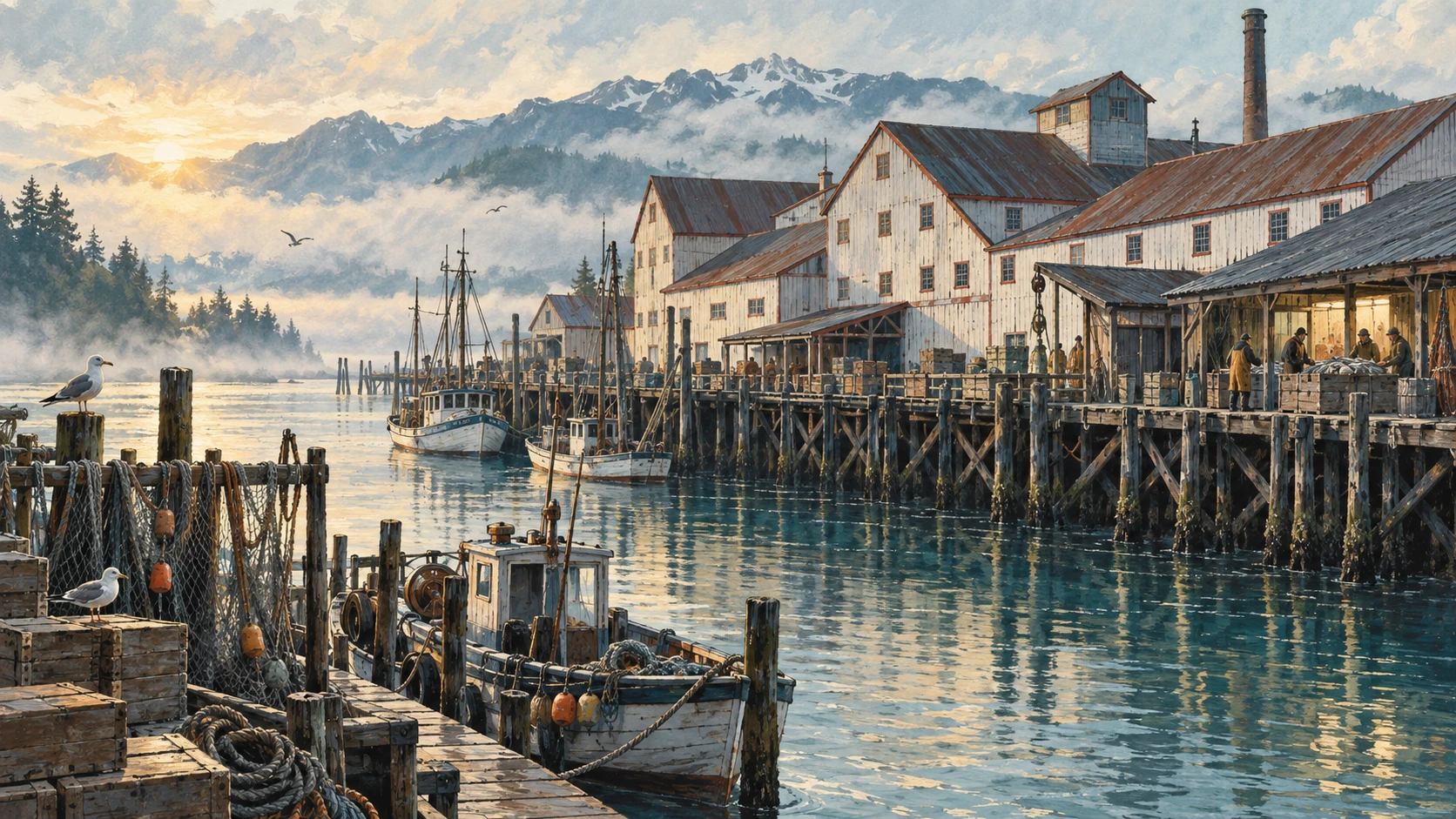
The Gulf of Georgia Cannery stands on wooden pilings over the Fraser River estuary at Steveston, British Columbia. Built in 1894, the cannery earned the moniker Monster Cannery as the largest salmon packing facility in British Columbia. Steveston operated as the commercial hub of the Pacific salmon boom, hosting over a dozen competing canneries along Cannery Row on the riverfront.
Millions of sockeye and pink salmon migrated annually through the south arm of the Fraser River to spawn in upstream interior lakes and tributaries. A seasonal fleet of hundreds of wooden gillnet fishing skiffs delivered fresh catches directly to the cannery wharves. Parks Canada and the Gulf of Georgia Cannery Society jointly manage the site as a National Historic Site commemorating industrial fishing history.
Receiving docks and automated butchering machines
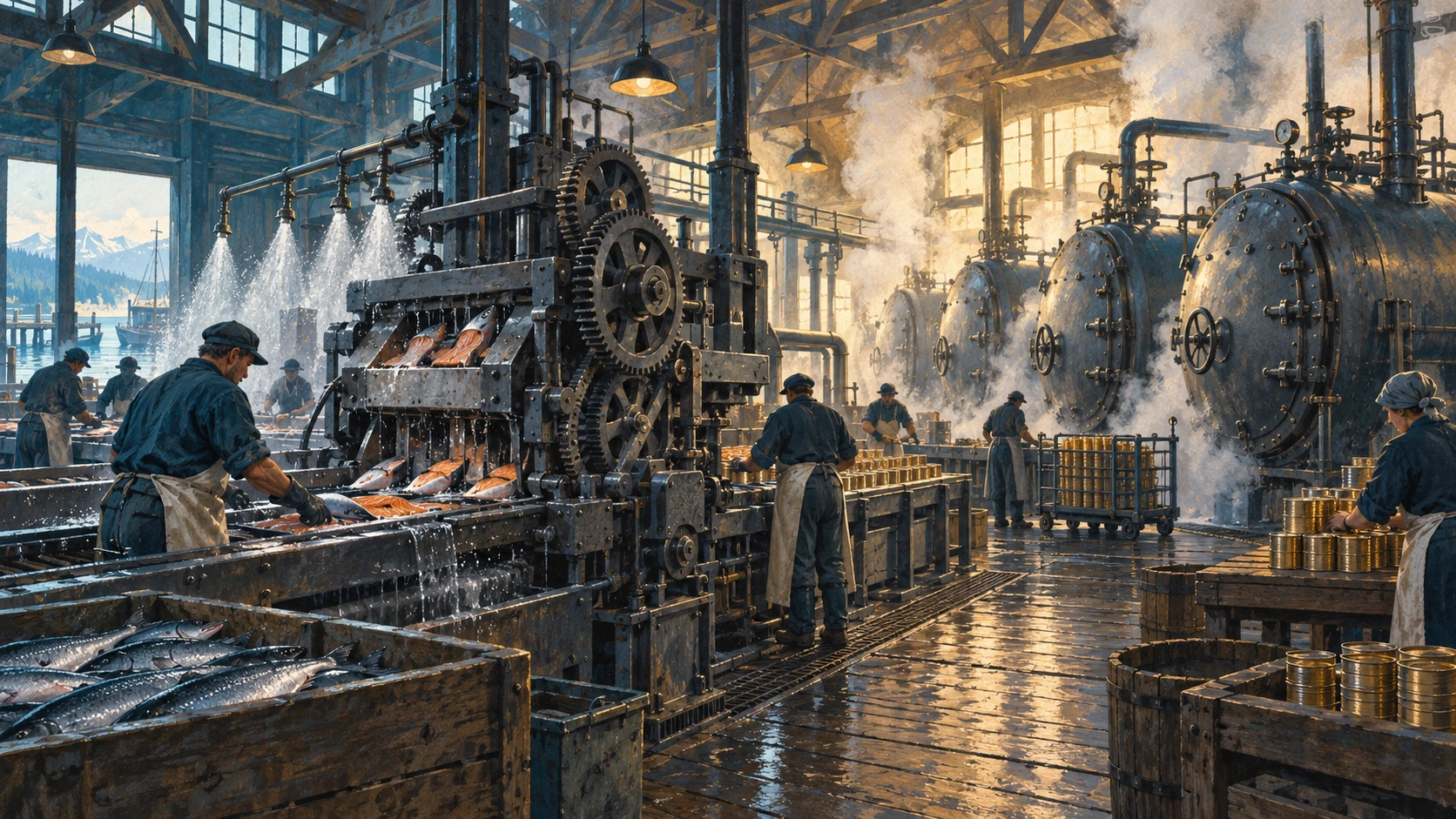
Fresh salmon were unloaded from fishing boats onto elevated receiving docks using wooden fish boxes and sluice chutes. Factory workers historically butchered and gutted salmon by hand on large wooden slime tables using curved butcher knives. In 1906, canneries adopted the automated salmon butchering machine known industrially as the Iron Chink to remove heads, tails, fins, and viscera.
Mechanical butcher systems processed up to sixty to seventy fish per minute, drastically accelerating line throughput. High-pressure water jets and rotating brushes scrubbed bloodlines and cleaned the fish cavity before mechanical rotary gang knives sliced the body into uniform can-sized steaks. The adoption of automated butchering machinery altered labour requirements while reinforcing industrial production tempos.
Filling tin cans and pressure cooking
Sliced salmon portions were hand-packed or mechanically filled into one-pound and half-pound tin cans. Early cans required hand-soldered lids before the invention of the sanitary double-seamer created airtight mechanical rolled seals. Filled cans passed through steam exhaust boxes to expel air pockets before lids were rolled tight to establish a vacuum.
Massive cylindrical iron steam retorts pressure-cooked the sealed cans at one hundred and sixteen degrees Celsius for ninety minutes. Pressurized thermal processing thoroughly sterilized fish contents and softened salmon bones into edible calcium-rich textures. After cooling in water baths, cans were inspected by sounding mallet tests, labeled with colourful lithographed paper labels, and packed into forty-eight-can wooden shipping cases.
A diverse workforce in a coastal town
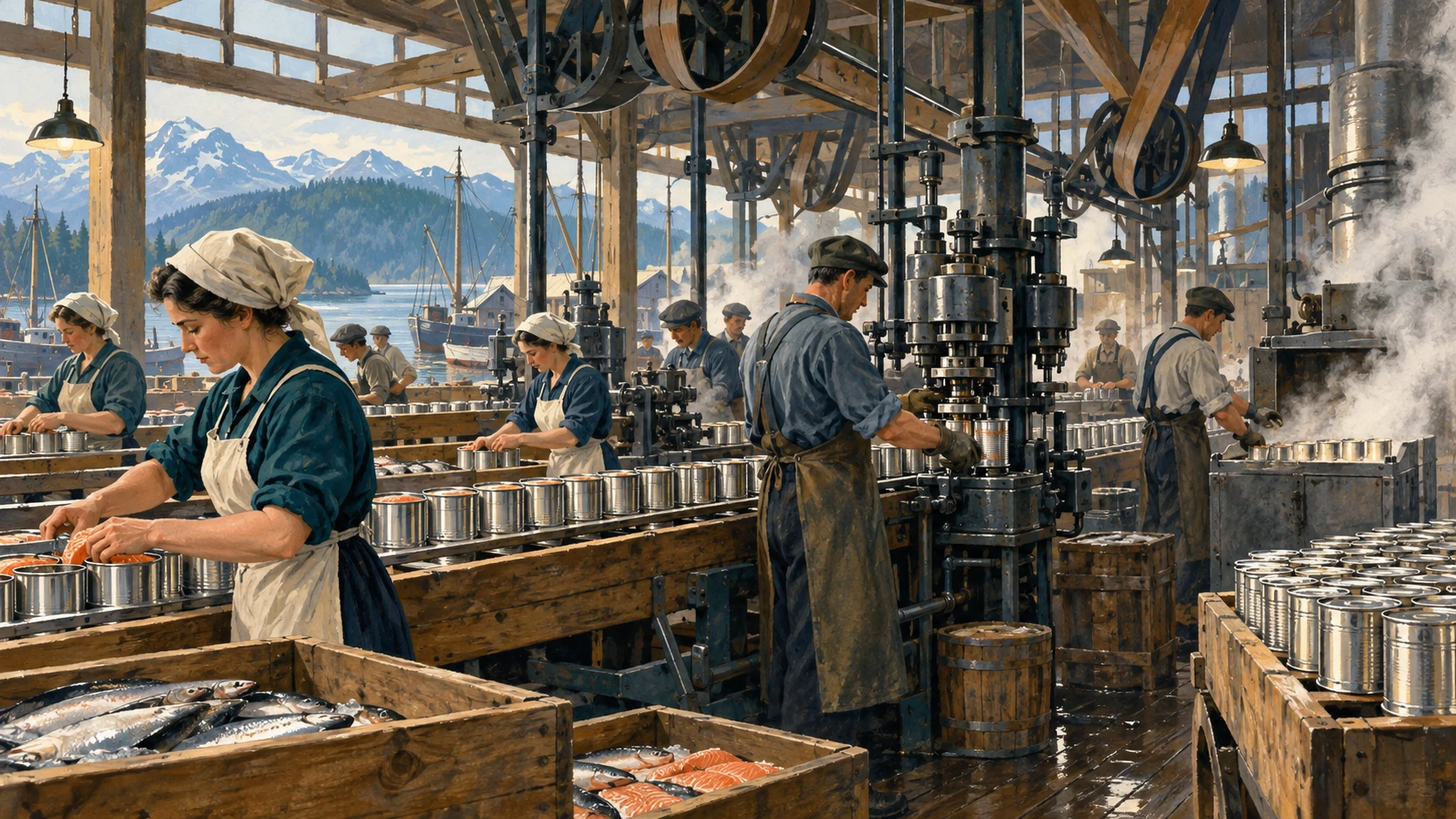
The Gulf of Georgia Cannery relied upon a distinctly segmented multicultural workforce comprising Indigenous, Chinese, Japanese, and European workers. Indigenous Musqueam, Katzie, Kwantlen, and other Coast Salish fishers provided essential skilled boatmanship and harvested huge volumes of migrating salmon. Indigenous women worked extensively as skilled onshore processors, cleaning fish and filling cans on the factory lines alongside their families.
Chinese Canadian workers were typically hired through a contractor system, managing butchering, tin-smithing, and warehouse labour while living in bunkhouses. Japanese Canadian fishers and boatbuilders dominated coastal gillnet fleets and contributed expert maritime navigation before discriminatory wartime internment. Historical documentation highlights distinct wage inequalities, separate living accommodations, and racial discrimination across the cannery compound.
Canned salmon exports to world markets
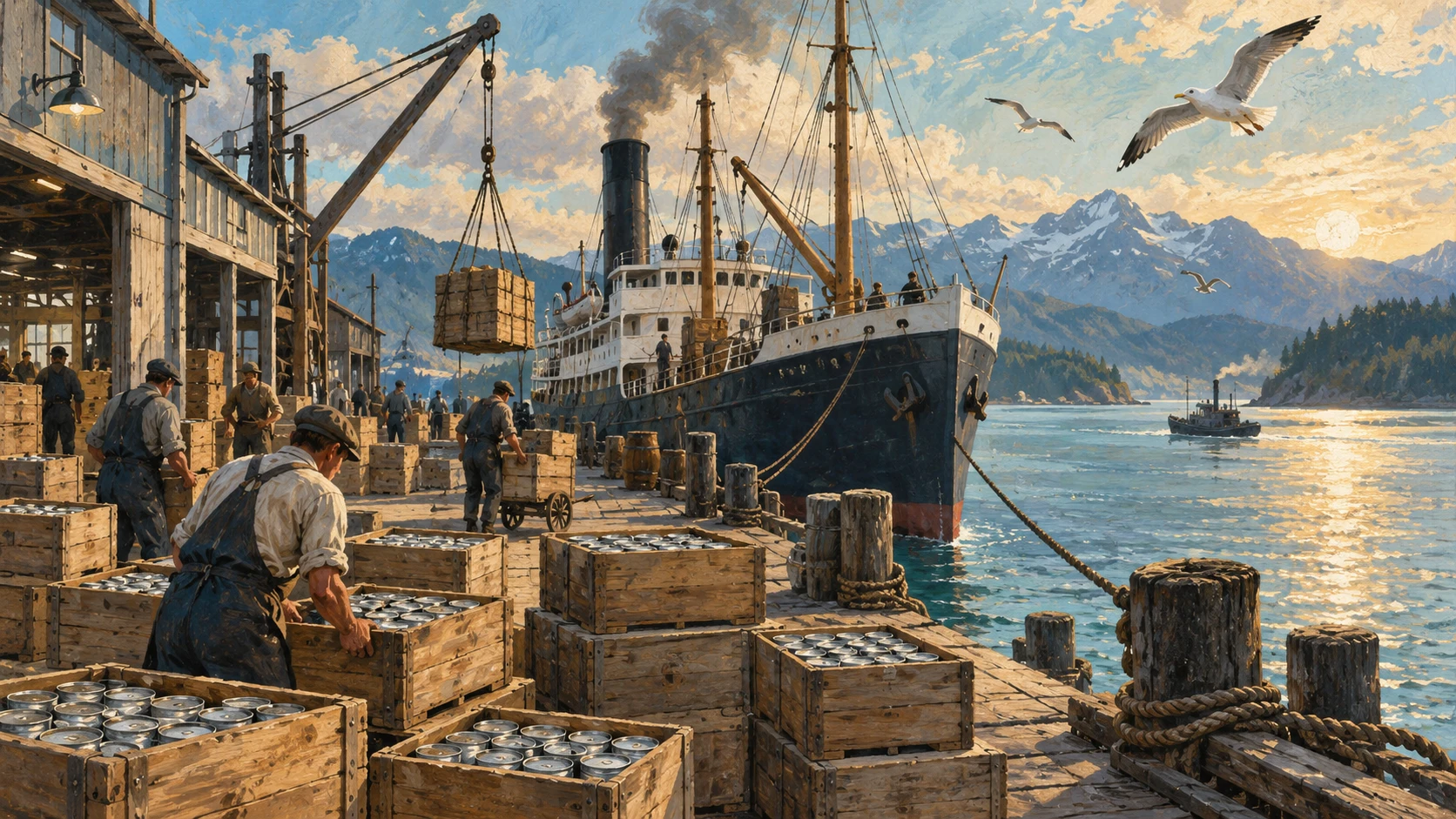
Canned salmon emerged as one of British Columbia's primary export commodities, shipping millions of cases annually across global maritime trade routes. The United Kingdom and the British Empire served as the predominant export market for Canadian canned red sockeye salmon. Canned salmon provided an affordable, non-perishable protein staple for working-class British families and military provisioning networks.
Ocean steamships loaded wooden crates of canned salmon directly from Steveston deep-water docks or transshipped cargoes through Vancouver harbor. Imperial trade preferences and British commercial tariffs sustained high export prices through the late nineteenth and early twentieth centuries. Global commercial competition and seasonal run fluctuations led to industry consolidation and the eventual formation of corporate canning conglomerates.
Archival records and historical boundaries
Cannery management plans and museum archives document historic production technologies rather than contemporary fisheries management practices. Historic production ledgers cannot determine modern salmon run abundance, habitat status, or current commercial fish stock viability. Archival labour contracts reflect colonial business records and do not represent the autonomous oral histories or complete perspectives of all workers.
Industrial cannery documentation cannot be treated as evidence of contemporary Indigenous consent, title, or modern treaty rights. Preserved factory machinery exhibits static technological snapshots rather than the fluid everyday experiences of seasonal working families. Rigorous industrial history treats archival cannery records as bounded historical artifacts rather than universal representations of coastal communities.
A2 · Elementary
Gulf of Georgia Cannery: Industrial Salmon Packing on the Fraser River
A historic wooden factory in British Columbia processed millions of salmon during the Pacific canning boom. Historic records document early machinery, waterfront docks, and diverse working families.
The wooden cannery on the Fraser River estuary
The Gulf of Georgia Cannery stands on wooden pilings over the Fraser River estuary at Steveston, British Columbia. Built in 1894, the cannery earned the moniker Monster Cannery as the largest salmon packing facility in British Columbia during the late nineteenth century. Steveston operated as the commercial hub of the Pacific salmon boom, hosting over a dozen competing canneries along Cannery Row on the riverfront.
Millions of sockeye and pink salmon migrated annually through the south arm of the Fraser River to spawn in upstream interior lakes and tributaries. A seasonal fleet of hundreds of wooden gillnet fishing skiffs delivered fresh catches directly to the cannery wharves. Today, Parks Canada and the Gulf of Georgia Cannery Society jointly manage the site as a National Historic Site commemorating industrial fishing history.
Receiving wharves and mechanical butchering
Fresh salmon were unloaded from fishing boats onto elevated receiving docks using wooden fish boxes and sluice chutes. Factory workers historically butchered and gutted salmon by hand on large wooden slime tables using curved butcher knives. In 1906, canneries adopted the automated salmon butchering machine known industrially as the Iron Chink to remove heads, tails, fins, and viscera.
Mechanical butcher systems processed up to sixty to seventy fish per minute, drastically accelerating line throughput. High-pressure water jets and rotating brushes scrubbed bloodlines and cleaned the fish cavity before mechanical rotary gang knives sliced the body into uniform can-sized steaks. The adoption of automated butchering machinery altered labour requirements while reinforcing industrial production tempos.
Tin cans, steam retorts, and protective cases
Sliced salmon portions were hand-packed or mechanically filled into one-pound and half-pound tin cans. Early cans required hand-soldered lids before the invention of the sanitary double-seamer created airtight mechanical rolled seals. Filled cans passed through steam exhaust boxes to expel air pockets before lids were rolled tight to establish a vacuum.
Massive cylindrical iron steam retorts pressure-cooked the sealed cans at one hundred and sixteen degrees Celsius for ninety minutes. Pressurized thermal processing thoroughly sterilized fish contents and softened salmon bones into edible calcium-rich textures. After cooling in water baths, cans were inspected by sounding mallet tests, labeled with colourful lithographed paper labels, and packed into forty-eight-can wooden shipping cases.
Multicultural working communities at Steveston
The Gulf of Georgia Cannery relied upon a distinctly segmented multicultural workforce comprising Indigenous, Chinese, Japanese, and European workers. Indigenous Musqueam, Katzie, Kwantlen, and other Coast Salish fishers provided essential skilled boatmanship and harvested huge volumes of migrating salmon. Indigenous women worked extensively as skilled onshore processors, cleaning fish and filling cans on the factory lines alongside their families.
Chinese Canadian workers were typically hired through a contractor system, managing butchering, tin-smithing, and warehouse labour while living in bunkhouses. Japanese Canadian fishers and boatbuilders dominated coastal gillnet fleets and contributed expert maritime navigation before discriminatory wartime internment. Historical documentation highlights distinct wage inequalities, separate living accommodations, and racial discrimination across the cannery compound.
Global shipping routes and British markets
Canned salmon emerged as one of British Columbia's primary export commodities, shipping millions of cases annually across global maritime trade routes. The United Kingdom and the British Empire served as the predominant export market for Canadian canned red sockeye salmon. Canned salmon provided an affordable, non-perishable protein staple for working-class British families and military provisioning networks.
Ocean steamships loaded wooden crates of canned salmon directly from Steveston deep-water docks or transshipped cargoes through Vancouver harbor. Imperial trade preferences and British commercial tariffs sustained high export prices through the late nineteenth and early twentieth centuries. Global commercial competition and seasonal run fluctuations led to industry consolidation and the eventual formation of corporate canning conglomerates.
Interpreting historical records and archival boundaries
Cannery management plans and museum archives document historic production technologies rather than contemporary fisheries management practices. Historic production ledgers cannot determine modern salmon run abundance, habitat status, or current commercial fish stock viability. Archival labour contracts reflect colonial business records and do not represent the autonomous oral histories or complete perspectives of all workers.
Industrial cannery documentation cannot be treated as evidence of contemporary Indigenous consent, title, or modern treaty rights. Preserved factory machinery exhibits static technological snapshots rather than the fluid everyday experiences of seasonal working families. Rigorous industrial history treats archival cannery records as bounded historical artifacts rather than universal representations of coastal communities.
B1 · Intermediate
Gulf of Georgia Cannery: Historic Salmon Processing at a Working Harbour
A historic wooden factory complex in British Columbia processed millions of salmon during the Pacific commercial canning boom. Industrial machinery, river docks, and diverse working families transformed Steveston into a global export hub.
The Fraser River estuary and Steveston harbour
The Gulf of Georgia Cannery stands on wooden pilings over the Fraser River estuary at Steveston, British Columbia. Built in 1894, the cannery earned the moniker Monster Cannery as the largest salmon packing facility in British Columbia during the late nineteenth century. Steveston operated as the commercial hub of the Pacific salmon boom, hosting over a dozen competing canneries along Cannery Row on the riverfront.
Millions of sockeye and pink salmon migrated annually through the south arm of the Fraser River to spawn in upstream interior lakes and tributaries. A seasonal fleet of hundreds of wooden gillnet fishing skiffs delivered fresh catches directly to the cannery wharves. Today, Parks Canada and the Gulf of Georgia Cannery Society jointly manage the site as a National Historic Site commemorating industrial fishing history.
Intake wharves and mechanical butchering technology
Fresh salmon were unloaded from fishing boats onto elevated receiving docks using wooden fish boxes and sluice chutes. Factory workers historically butchered and gutted salmon by hand on large wooden slime tables using curved butcher knives. In 1906, canneries adopted the automated salmon butchering machine known industrially as the Iron Chink to remove heads, tails, fins, and viscera.
Mechanical butcher systems processed up to sixty to seventy fish per minute, drastically accelerating line throughput. High-pressure water jets and rotating brushes scrubbed bloodlines and cleaned the fish cavity before mechanical rotary gang knives sliced the body into uniform can-sized steaks. The adoption of automated butchering machinery altered labour requirements while reinforcing industrial production tempos.
Sanitary canning, steam retorts, and case packing
Sliced salmon portions were hand-packed or mechanically filled into one-pound and half-pound tin cans. Early cans required hand-soldered lids before the invention of the sanitary double-seamer created airtight mechanical rolled seals. Filled cans passed through steam exhaust boxes to expel air pockets before lids were rolled tight to establish a vacuum.
Massive cylindrical iron steam retorts pressure-cooked the sealed cans at one hundred and sixteen degrees Celsius for ninety minutes. Pressurized thermal processing thoroughly sterilized fish contents and softened salmon bones into edible calcium-rich textures. After cooling in water baths, cans were inspected by sounding mallet tests, labeled with colourful lithographed paper labels, and packed into forty-eight-can wooden shipping cases.
Segmented labour and coastal working communities
The Gulf of Georgia Cannery relied upon a distinctly segmented multicultural workforce comprising Indigenous, Chinese, Japanese, and European workers. Indigenous Musqueam, Katzie, Kwantlen, and other Coast Salish fishers provided essential skilled boatmanship and harvested huge volumes of migrating salmon. Indigenous women worked extensively as skilled onshore processors, cleaning fish and filling cans on the factory lines alongside their families.
Chinese Canadian workers were typically hired through a contractor system, managing butchering, tin-smithing, and warehouse labour while living in bunkhouses. Japanese Canadian fishers and boatbuilders dominated coastal gillnet fleets and contributed expert maritime navigation before discriminatory wartime internment. Historical documentation highlights distinct wage inequalities, separate living accommodations, and racial discrimination across the cannery compound.
Global export routes and imperial trade markets
Canned salmon emerged as one of British Columbia's primary export commodities, shipping millions of cases annually across global maritime trade routes. The United Kingdom and the British Empire served as the predominant export market for Canadian canned red sockeye salmon. Canned salmon provided an affordable, non-perishable protein staple for working-class British families and military provisioning networks.
Ocean steamships loaded wooden crates of canned salmon directly from Steveston deep-water docks or transshipped cargoes through Vancouver harbor. Imperial trade preferences and British commercial tariffs sustained high export prices through the late nineteenth and early twentieth centuries. Global commercial competition and seasonal run fluctuations led to industry consolidation and the eventual formation of corporate canning conglomerates.
Historiographical limits and archival boundaries
Cannery management plans and museum archives document historic production technologies rather than contemporary fisheries management practices. Historic production ledgers cannot determine modern salmon run abundance, habitat status, or current commercial fish stock viability. Archival labour contracts reflect colonial business records and do not represent the autonomous oral histories or complete perspectives of all workers.
Industrial cannery documentation cannot be treated as evidence of contemporary Indigenous consent, title, or modern treaty rights. Preserved factory machinery exhibits static technological snapshots rather than the fluid everyday experiences of seasonal working families. Rigorous industrial history treats archival cannery records as bounded historical artifacts rather than universal representations of coastal communities.
B2 · Upper Intermediate
Gulf of Georgia Cannery: Industrial Salmon Packing on the Fraser River Estuary
A critical analysis of British Columbia's largest historic salmon cannery examines how steam-powered mechanization, a segmented multicultural workforce, and imperial export networks transformed Steveston into a global canning metropolis.
The Fraser River estuary and Steveston harbour
The Gulf of Georgia Cannery occupies an expansive footprint on wooden pilings over the tidal reaches of the Fraser River estuary at Steveston, British Columbia. Constructed in 1894, the industrial facility earned the contemporary moniker Monster Cannery as the largest salmon packing plant in British Columbia during the late nineteenth century. Steveston functioned as the commercial nexus of the Pacific salmon canning boom, supporting over a dozen competing canning establishments along the riverfront known colloquially as Cannery Row.
Millions of sockeye and pink salmon traversed the south arm of the Fraser River annually on upstream spawning migrations toward interior lakes and gravel tributaries. A seasonal fleet of hundreds of wooden gillnet fishing skiffs delivered fresh catches directly to the cannery wharves during peak tidal runs. Today, Parks Canada and the Gulf of Georgia Cannery Society jointly administer the complex as a National Historic Site commemorating Pacific industrial fishing history.
Intake wharves and mechanical butchering technology
Freshly harvested salmon were hoisted from fishing skiffs onto elevated receiving docks using wooden fish boxes and gravity-fed sluice chutes. Factory workers historically butchered and gutted salmon by hand on long wooden slime tables using curved butcher knives. In 1906, regional canneries adopted the automated salmon butchering machine known industrially as the Iron Chink to remove heads, tails, fins, and viscera with continuous mechanical precision.
These mechanical butcher systems processed up to sixty to seventy fish per minute, drastically accelerating line throughput across peak runs. High-pressure water jets and rotating brushes scrubbed bloodlines and cleaned the fish cavity before mechanical rotary gang knives sliced the body into uniform can-sized steaks. The widespread adoption of automated butchering machinery altered factory labour requirements while reinforcing relentless industrial production tempos.
Sanitary canning, steam retorts, and case packing
Uniform salmon portions were hand-packed or mechanically deposited into one-pound and half-pound cylindrical tin cans. Early canning relied on hand-soldered lids before the introduction of the sanitary double-seamer created airtight mechanical rolled seams without toxic lead solder. Filled cans traveled through steam exhaust boxes to expel trapped air pockets before lids were rolled tight under mechanical pressure to establish an internal vacuum.
Massive cylindrical iron steam retorts pressure-cooked the sealed cans at one hundred and sixteen degrees Celsius for ninety minutes. This pressurized thermal processing thoroughly sterilized fish contents and softened salmon bones into edible calcium-rich textures. After cooling in circulating water baths, cans were inspected by sounding mallet tests, labeled with colourful lithographed paper labels, and packed into forty-eight-can wooden shipping cases.
Segmented labour and coastal working communities
The Gulf of Georgia Cannery depended upon a distinctly segmented multicultural workforce comprising Indigenous, Chinese, Japanese, and European workers. Indigenous Musqueam, Katzie, Kwantlen, and other Coast Salish fishers provided essential skilled boatmanship and harvested huge volumes of migrating salmon across river channels. Indigenous women worked extensively as skilled onshore processors, cleaning fish and filling cans on factory lines alongside their extended families.
Chinese Canadian workers were typically recruited through a contractor system, managing butchering lines, can-making tinsmith operations, and warehouse logistics while residing in crowded company bunkhouses. Japanese Canadian fishers and boatbuilders dominated coastal gillnet fleets and contributed expert maritime navigation before enduring discriminatory wartime internment. Historical records document pronounced wage disparities, segregated living quarters, and institutional discrimination throughout the industrial cannery compound.
Global export routes and imperial trade markets
Canned salmon rapidly emerged as one of British Columbia's primary export commodities, sending millions of packed cases annually across global maritime trade routes. The United Kingdom and the broader British Empire served as the predominant export market for premium Canadian canned red sockeye salmon. The product provided an affordable, non-perishable protein staple for industrial working-class British households and imperial military provisioning networks.
Ocean steamships loaded wooden crates of canned salmon directly from Steveston deep-water docks or transshipped export cargoes through the expanding port of Vancouver. Imperial trade preferences and British commercial tariffs sustained high export prices through the late nineteenth and early twentieth centuries. Global commercial competition and unpredictable seasonal run fluctuations accelerated industry consolidation and the eventual formation of integrated corporate canning conglomerates.
Historiographical limits and archival boundaries
Cannery management plans and heritage archives preserve historic industrial records rather than contemporary fisheries management protocols. Historic production ledgers cannot determine modern salmon run abundance, watershed habitat health, or current commercial fish stock viability. Archival labour contracts reflect colonial business administration and omit the autonomous oral histories or complete perspectives of racialized seasonal workers.
Industrial cannery documentation cannot be construed as evidence of contemporary Indigenous consent, unceded title, or modern constitutional treaty rights. Preserved factory machinery exhibits static technological snapshots rather than the complex everyday experiences of seasonal working families. Rigorous industrial historiography treats archival cannery records as bounded historical artifacts rather than universal representations of coastal communities.
C1 · Advanced
Gulf of Georgia Cannery: Industrial Salmon Packing on the Fraser River Estuary
A critical examination of British Columbia's premier nineteenth-century salmon cannery illuminates how steam-driven mechanization, segmented racialized labour, and British imperial markets transformed Steveston into a global fish-processing powerhouse.
The Fraser River estuary and Steveston harbour
The Gulf of Georgia Cannery commands an expansive waterfront presence on wooden pilings over the tidal reaches of the Fraser River estuary at Steveston, British Columbia. Constructed in 1894, the industrial facility earned the contemporary moniker Monster Cannery as the largest salmon packing plant in British Columbia during the late nineteenth century. Steveston functioned as the commercial nexus of the Pacific salmon canning boom, supporting over a dozen competing canning establishments along the riverfront known colloquially as Cannery Row.
Millions of sockeye and pink salmon traversed the south arm of the Fraser River annually on upstream spawning migrations toward interior lakes and gravel tributaries. A seasonal fleet of hundreds of wooden gillnet fishing skiffs delivered fresh catches directly to the cannery wharves during peak tidal runs. Today, Parks Canada and the Gulf of Georgia Cannery Society jointly administer the complex as a National Historic Site commemorating Pacific industrial fishing history.
Intake wharves and mechanical butchering technology
Freshly harvested salmon were hoisted from fishing skiffs onto elevated receiving docks using wooden fish boxes and gravity-fed sluice chutes. Factory workers historically butchered and gutted salmon by hand on long wooden slime tables using curved butcher knives. In 1906, regional canneries adopted the automated salmon butchering machine known industrially as the Iron Chink to remove heads, tails, fins, and viscera with continuous mechanical precision.
These mechanical butcher systems processed up to sixty to seventy fish per minute, drastically accelerating line throughput across peak runs. High-pressure water jets and rotating brushes scrubbed bloodlines and cleaned the fish cavity before mechanical rotary gang knives sliced the body into uniform can-sized steaks. The widespread adoption of automated butchering machinery altered factory labour requirements while reinforcing relentless industrial production tempos.
Sanitary canning, steam retorts, and case packing
Uniform salmon portions were hand-packed or mechanically deposited into one-pound and half-pound cylindrical tin cans. Early canning relied on hand-soldered lids before the introduction of the sanitary double-seamer created airtight mechanical rolled seams without toxic lead solder. Filled cans traveled through steam exhaust boxes to expel trapped air pockets before lids were rolled tight under mechanical pressure to establish an internal vacuum.
Massive cylindrical iron steam retorts pressure-cooked the sealed cans at one hundred and sixteen degrees Celsius for ninety minutes. This pressurized thermal processing thoroughly sterilized fish contents and softened salmon bones into edible calcium-rich textures. After cooling in circulating water baths, cans were inspected by sounding mallet tests, labeled with colourful lithographed paper labels, and packed into forty-eight-can wooden shipping cases.
Segmented labour and coastal working communities
The Gulf of Georgia Cannery depended upon a distinctly segmented multicultural workforce comprising Indigenous, Chinese, Japanese, and European workers. Indigenous Musqueam, Katzie, Kwantlen, and other Coast Salish fishers provided essential skilled boatmanship and harvested huge volumes of migrating salmon across river channels. Indigenous women worked extensively as skilled onshore processors, cleaning fish and filling cans on factory lines alongside their extended families.
Chinese Canadian workers were typically recruited through a contractor system, managing butchering lines, can-making tinsmith operations, and warehouse logistics while residing in crowded company bunkhouses. Japanese Canadian fishers and boatbuilders dominated coastal gillnet fleets and contributed expert maritime navigation before enduring discriminatory wartime internment. Historical records document pronounced wage disparities, segregated living quarters, and institutional discrimination throughout the industrial cannery compound.
Global export routes and imperial trade markets
Canned salmon rapidly emerged as one of British Columbia's primary export commodities, sending millions of packed cases annually across global maritime trade routes. The United Kingdom and the broader British Empire served as the predominant export market for premium Canadian canned red sockeye salmon. The product provided an affordable, non-perishable protein staple for industrial working-class British households and imperial military provisioning networks.
Ocean steamships loaded wooden crates of canned salmon directly from Steveston deep-water docks or transshipped export cargoes through the expanding port of Vancouver. Imperial trade preferences and British commercial tariffs sustained high export prices through the late nineteenth and early twentieth centuries. Global commercial competition and unpredictable seasonal run fluctuations accelerated industry consolidation and the eventual formation of integrated corporate canning conglomerates.
Historiographical limits and archival boundaries
Cannery management plans and heritage archives preserve historic industrial records rather than contemporary fisheries management protocols. Historic production ledgers cannot determine modern salmon run abundance, watershed habitat health, or current commercial fish stock viability. Archival labour contracts reflect colonial business administration and omit the autonomous oral histories or complete perspectives of racialized seasonal workers.
Industrial cannery documentation cannot be construed as evidence of contemporary Indigenous consent, unceded title, or modern constitutional treaty rights. Preserved factory machinery exhibits static technological snapshots rather than the complex everyday experiences of seasonal working families. Rigorous industrial historiography treats archival cannery records as bounded historical artifacts rather than universal representations of coastal communities.
C2 · Mastery
Gulf of Georgia Cannery: Industrial Salmon Packing on the Fraser River Estuary
A critical examination of British Columbia's premier nineteenth-century salmon cannery illuminates how steam-driven mechanization, segmented racialized labour, and British imperial markets transformed Steveston into a global fish-processing powerhouse.
The Fraser River estuary and Steveston harbour
The Gulf of Georgia Cannery commands an expansive waterfront presence on wooden pilings over the tidal reaches of the Fraser River estuary at Steveston, British Columbia. Constructed in 1894, the industrial facility earned the contemporary moniker Monster Cannery as the largest salmon packing plant in British Columbia during the late nineteenth century. Steveston functioned as the commercial nexus of the Pacific salmon canning boom, supporting over a dozen competing canning establishments along the riverfront known colloquially as Cannery Row.
Millions of sockeye and pink salmon traversed the south arm of the Fraser River annually on upstream spawning migrations toward interior lakes and gravel tributaries. A seasonal fleet of hundreds of wooden gillnet fishing skiffs delivered fresh catches directly to the cannery wharves during peak tidal runs. Today, Parks Canada and the Gulf of Georgia Cannery Society jointly administer the complex as a National Historic Site commemorating Pacific industrial fishing history.
Intake wharves and mechanical butchering technology
Freshly harvested salmon were hoisted from fishing skiffs onto elevated receiving docks using wooden fish boxes and gravity-fed sluice chutes. Factory workers historically butchered and gutted salmon by hand on long wooden slime tables using curved butcher knives. In 1906, regional canneries adopted the automated salmon butchering machine known industrially as the Iron Chink to remove heads, tails, fins, and viscera with continuous mechanical precision.
These mechanical butcher systems processed up to sixty to seventy fish per minute, drastically accelerating line throughput across peak runs. High-pressure water jets and rotating brushes scrubbed bloodlines and cleaned the fish cavity before mechanical rotary gang knives sliced the body into uniform can-sized steaks. The widespread adoption of automated butchering machinery altered factory labour requirements while reinforcing relentless industrial production tempos.
Sanitary canning, steam retorts, and case packing
Uniform salmon portions were hand-packed or mechanically deposited into one-pound and half-pound cylindrical tin cans. Early canning relied on hand-soldered lids before the introduction of the sanitary double-seamer created airtight mechanical rolled seams without toxic lead solder. Filled cans traveled through steam exhaust boxes to expel trapped air pockets before lids were rolled tight under mechanical pressure to establish an internal vacuum.
Massive cylindrical iron steam retorts pressure-cooked the sealed cans at one hundred and sixteen degrees Celsius for ninety minutes. This pressurized thermal processing thoroughly sterilized fish contents and softened salmon bones into edible calcium-rich textures. After cooling in circulating water baths, cans were inspected by sounding mallet tests, labeled with colourful lithographed paper labels, and packed into forty-eight-can wooden shipping cases.
Segmented labour and coastal working communities
The Gulf of Georgia Cannery depended upon a distinctly segmented multicultural workforce comprising Indigenous, Chinese, Japanese, and European workers. Indigenous Musqueam, Katzie, Kwantlen, and other Coast Salish fishers provided essential skilled boatmanship and harvested huge volumes of migrating salmon across river channels. Indigenous women worked extensively as skilled onshore processors, cleaning fish and filling cans on factory lines alongside their extended families.
Chinese Canadian workers were typically recruited through a contractor system, managing butchering lines, can-making tinsmith operations, and warehouse logistics while residing in crowded company bunkhouses. Japanese Canadian fishers and boatbuilders dominated coastal gillnet fleets and contributed expert maritime navigation before enduring discriminatory wartime internment. Historical records document pronounced wage disparities, segregated living quarters, and institutional discrimination throughout the industrial cannery compound.
Global export routes and imperial trade markets
Canned salmon rapidly emerged as one of British Columbia's primary export commodities, sending millions of packed cases annually across global maritime trade routes. The United Kingdom and the broader British Empire served as the predominant export market for premium Canadian canned red sockeye salmon. The product provided an affordable, non-perishable protein staple for industrial working-class British households and imperial military provisioning networks.
Ocean steamships loaded wooden crates of canned salmon directly from Steveston deep-water docks or transshipped export cargoes through the expanding port of Vancouver. Imperial trade preferences and British commercial tariffs sustained high export prices through the late nineteenth and early twentieth centuries. Global commercial competition and unpredictable seasonal run fluctuations accelerated industry consolidation and the eventual formation of integrated corporate canning conglomerates.
Historiographical limits and archival boundaries
Cannery management plans and heritage archives preserve historic industrial records rather than contemporary fisheries management protocols. Historic production ledgers cannot determine modern salmon run abundance, watershed habitat health, or current commercial fish stock viability. Archival labour contracts reflect colonial business administration and omit the autonomous oral histories or complete perspectives of racialized seasonal workers.
Industrial cannery documentation cannot be construed as evidence of contemporary Indigenous consent, unceded title, or modern constitutional treaty rights. Preserved factory machinery exhibits static technological snapshots rather than the complex everyday experiences of seasonal working families. Rigorous industrial historiography treats archival cannery records as bounded historical artifacts rather than universal representations of coastal communities.
Check your understanding
Choose how closely you want to revisit the article. You can refer back while answering, and review explanations when you finish.
Quick Quiz A1
Try one question, then create a free account for the full Quick Quiz. Sign Up Free
Answer every question before checking. There is no time limit.
Your results
/ 1 correct (%)
Read the explanations to see how each answer connects to the article.
-
Where does the Gulf of Georgia Cannery stand in British Columbia?
1. Answer:
Quick Quiz A2
Try one question, then create a free account for the full Quick Quiz. Sign Up Free
Answer every question before checking. There is no time limit.
Your results
/ 1 correct (%)
Read the explanations to see how each answer connects to the article.
-
What nickname was given to the Gulf of Georgia Cannery when built in 1894?
1. Answer:
Quick Quiz B1
Try one question, then create a free account for the full Quick Quiz. Sign Up Free
Answer every question before checking. There is no time limit.
Your results
/ 1 correct (%)
Read the explanations to see how each answer connects to the article.
-
Where does the Gulf of Georgia Cannery stand in British Columbia?
1. Answer:
Quick Quiz B2
Try one question, then create a free account for the full Quick Quiz. Sign Up Free
Answer every question before checking. There is no time limit.
Your results
/ 1 correct (%)
Read the explanations to see how each answer connects to the article.
-
What geographic setting does the Gulf of Georgia Cannery occupy in British Columbia?
1. Answer:
Quick Quiz C1
Try one question, then create a free account for the full Quick Quiz. Sign Up Free
Answer every question before checking. There is no time limit.
Your results
/ 1 correct (%)
Read the explanations to see how each answer connects to the article.
-
What geographic setting does the Gulf of Georgia Cannery occupy in British Columbia?
1. Answer:
Quick Quiz C2
Try one question, then create a free account for the full Quick Quiz. Sign Up Free
Answer every question before checking. There is no time limit.
Your results
/ 1 correct (%)
Read the explanations to see how each answer connects to the article.
-
What geographic setting does the Gulf of Georgia Cannery occupy in British Columbia?
1. Answer:
