A1 · Beginner
Flamenco Music and Dance in Andalusia
A living musical art of singing, guitar, and dance thrives in neighborhood clubs and artisan workshops across southern Spain.
The Triad of Flamenco Artistry: Cante, Toque, and Baile
Flamenco is a famous musical art form from southern Spain. It brings together expressive singing, guitar music, and rhythmic dancing. This authentic cultural heritage unites cante singing, toque guitar playing, and baile dance. The tradition developed over centuries in the towns and cities of Andalusia. Singers perform deeply emotional songs using ancient musical scales.
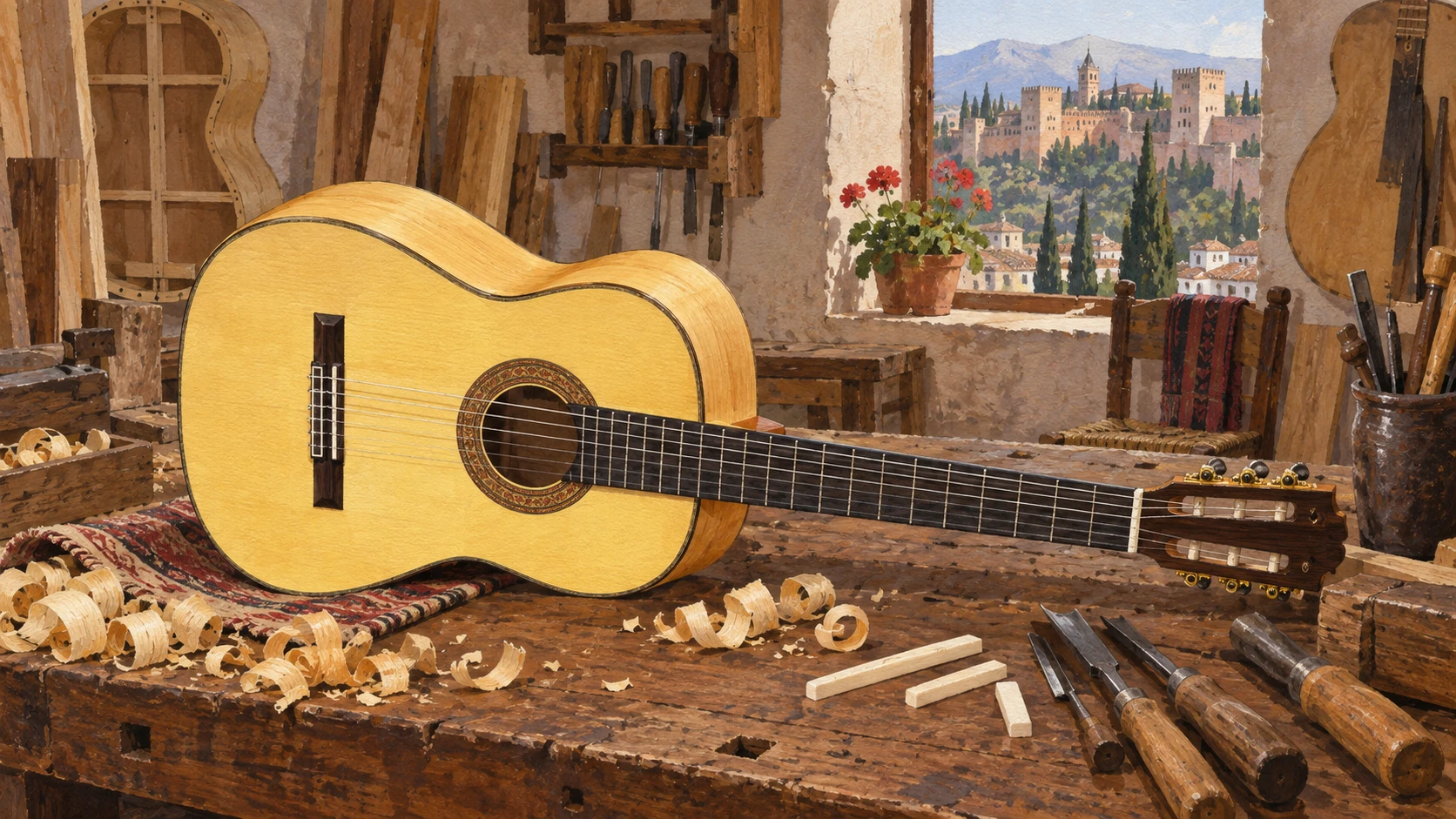
The flamenco guitar plays fast rhythms and bright chord strums. Dancers strike their heels against wooden floors with precise timing. Performers clap their hands to keep the steady pulse of the song. A wooden box called a cajon adds crisp drum beats to the music.
The Peña Flamenca and Communal Transmission
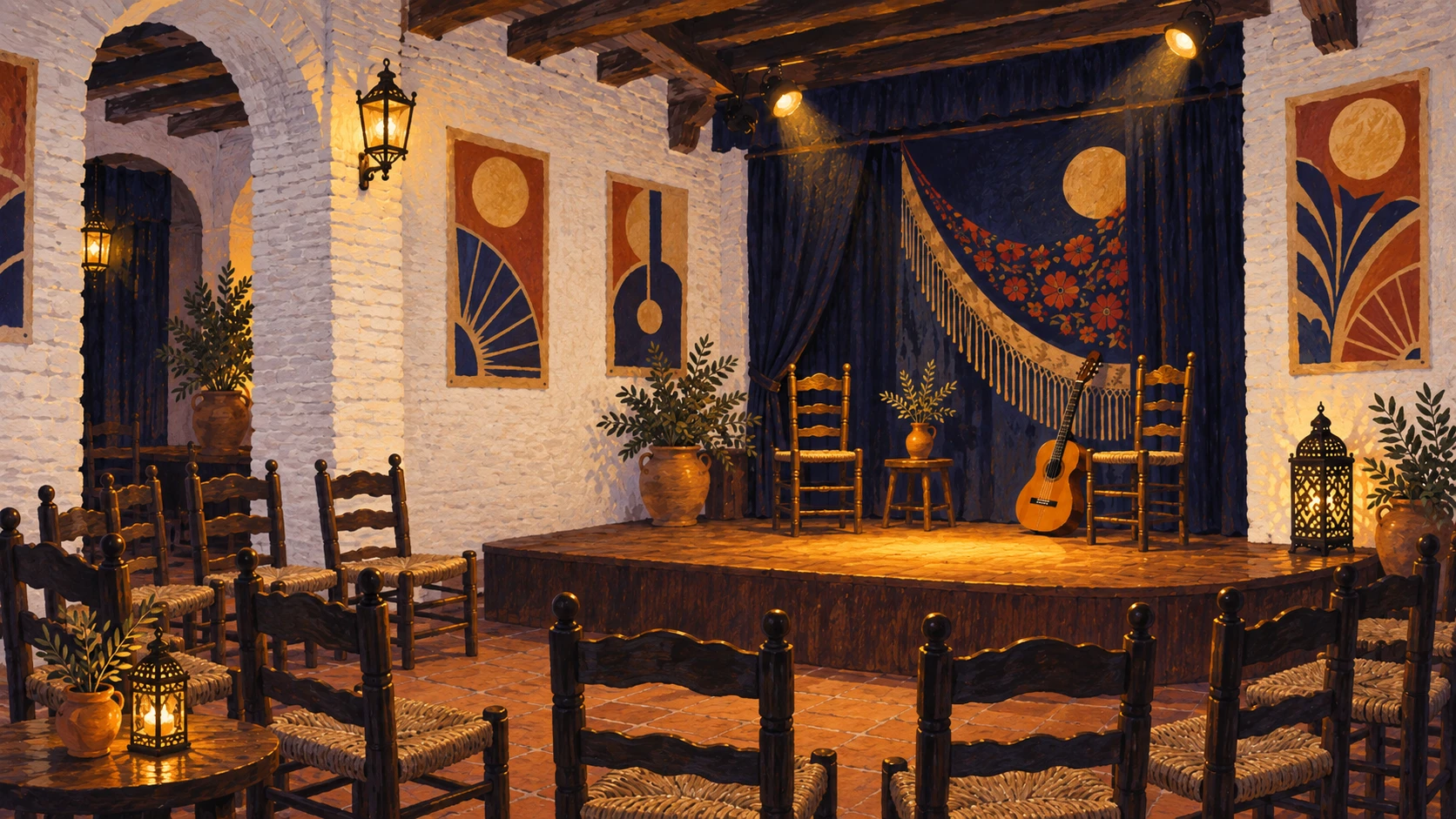
Local music clubs called penas flamencas meet in Andalusian neighborhoods. In these clubs, singers and guitarists share songs with close friends. Musical families pass down ancient song verses and melodies from parents to children. Famous districts in Seville, Jerez, and Cadiz keep the tradition strong.
Modern music schools teach classical guitar techniques and dance routines. Annual music festivals present major concerts across historic Andalusian theaters. Experienced artists guide young performers in learning complex rhythmic cycles. The local community supports live music venues throughout the year.
The Craft of the Flamenco Guitar: Lutherie and Materials
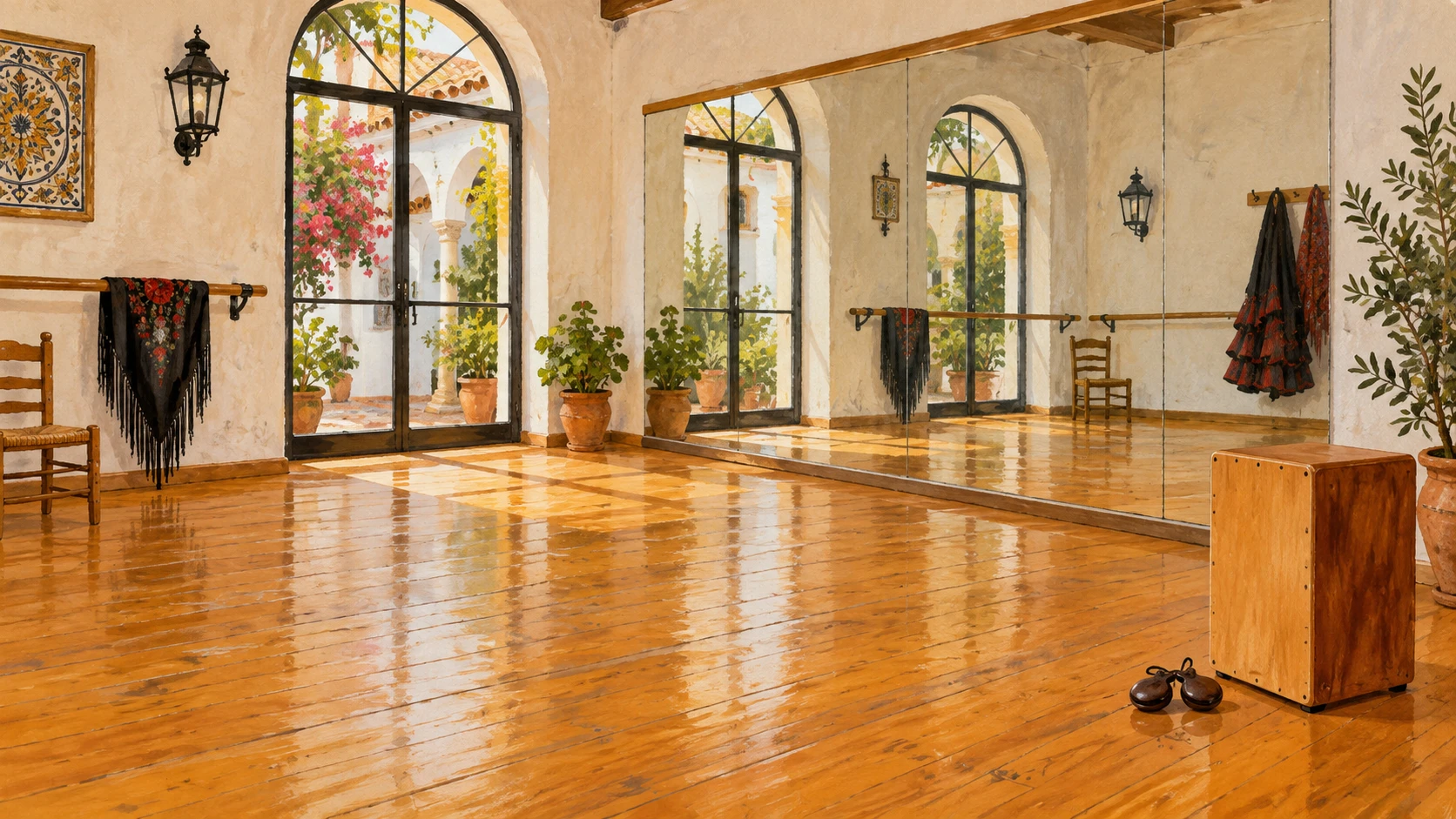
Master woodworkers build traditional flamenco guitars inside specialized artisan workshops. They use pale Spanish cypress wood for the back and sides of the instrument. The front soundboard is made from thin German spruce wood. These select woods give the guitar a bright, snappy acoustic sound.
A clear plastic tap plate protects the soft wood from sharp fingernail strikes. Builders carve tuning pegs from dense black ebony wood. Natural animal bone forms the bridge saddle and string nut. Handcrafted instruments provide light weight and rapid musical response for players.
Institutional Archiving, Research, and Living Heritage
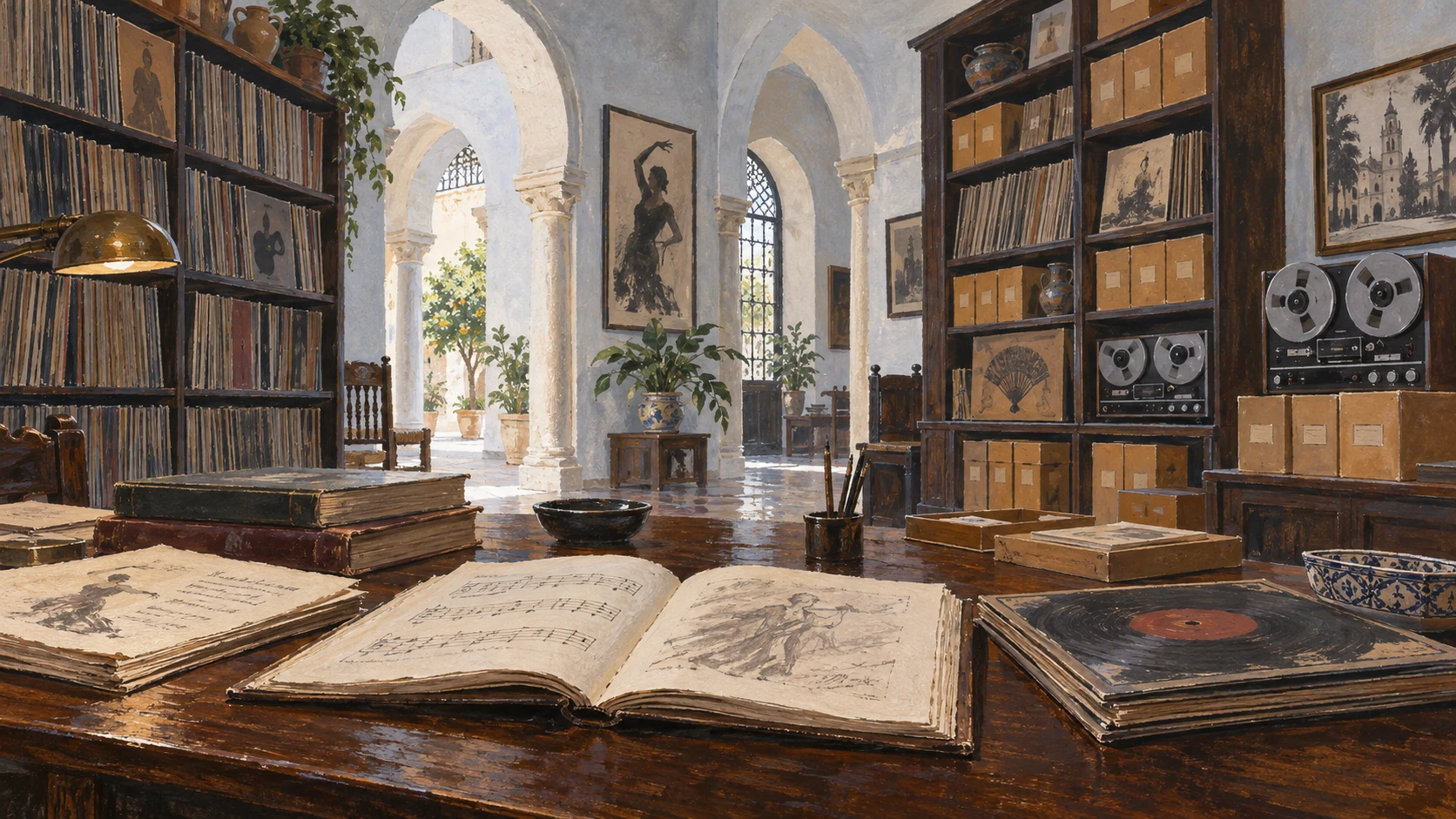
The Andalusian Documentation Center in Jerez holds an enormous musical archive. Specialists restore vintage recordings made on old wax cylinders and shellac records. Researchers study historic song lyrics and write down complex rhythms. Official heritage laws protect historic music clubs and fund student lessons.
Modern groups perform with classical orchestras and international jazz bands. The emotional feeling called duende remains at the heart of every performance. Regional schools teach flamenco songs and poetry to young students. This living musical heritage continues to inspire audiences worldwide.
A2 · Elementary
Flamenco: Andalusian Artistry, Communal Transmission, and Lutherie
From neighborhood peñas to artisan guitar ateliers, the living musical tradition of lower Andalusia preserves intricate compás and duende.
The Triad of Flamenco Artistry: Cante, Toque, and Baile
Inscribed on the UNESCO Representative List of the Intangible Cultural Heritage of Humanity in 2010, flamenco constitutes a profound tripartite artistic tradition originating in the multicultural crucible of lower Andalusia. The art form integrates cante, the vocal core; toque, the specialized guitar accompaniment; and baile, the percussive and expressive dance. Historically catalyzed by the confluence of Andalusian Romani communities alongside Moorish, Sephardic Jewish, and Castilian folkloric lineages, flamenco developed into a sophisticated modal musical idiom. The vocal repertory spans solemn palos such as the soleá and seguiriya, characterized by microtonal inflections, alongside exuberant syncopated forms like the bulería, all governed by rigorous twelve-beat compás cycles.
Instrumental performance relies on idiosyncratic technical conventions that diverge sharply from classical Spanish guitar methodology. Guitarists employ rapid rasgueados, percussive alzapúa thumb triplets, and rest-stroke picado scale runs to punctuate vocal cadences and drive choreographic momentum. Concurrently, the dancer interacts with the ensemble through resonant zapateado footwork strikes, nuanced brazeo arm phrasing, and intricate floreo wrist rotations. Rhythmic coherence is sustained through acoustic palmas, divided into bright dry palmas secas and muffled palmas sordas, frequently augmented in contemporary ensembles by the resonant wooden cajón percussion box.
The Peña Flamenca and Communal Transmission
Communal transmission of flamenco thrives primarily within the peña flamenca, an autonomous non-profit cultural association where aficionados, seasoned performers, and apprentices convene for unamplified recitals. Across Andalusia, more than three hundred registered peñas operate as civic bastions of repertoire preservation, curating traditional cante competitions and sustaining artists independent of commercial tourist tablaos. Historic urban enclaves, notably Triana in Seville, the Santiago quarter of Jerez de la Frontera, and the Santa María district of Cádiz, functioned as geographic cradles where musical dynastic families transmitted intricate rhythmic phrasing and unwritten poetic coplas across generations.
While oral domestic transmission remains an essential foundation of stylistic authenticity, formal educational frameworks increasingly complement grass-roots learning. Andalusian municipal music conservatories and professional academies offer accredited degrees in flamenco guitar performance, choreography, and ethnomusicology. Major international showcases, including the Bienal de Flamenco in Seville and the Festival de Jerez, serve as vital production platforms where avant-garde choreographic explorations coexist with rigorous canonical recitals.
The Craft of the Flamenco Guitar: Lutherie and Materials
The physical voice of flamenco music is shaped directly by specialized lutherie workshops concentrated in Granada, Seville, and Madrid, where master artisans handcraft concert instruments tailored to rapid percussive performance. Unlike heavier rosewood classical concert guitars, the traditional flamenco blanca guitar utilizes pale Spanish cypress for back and sides paired with a close-grained German spruce soundboard. This structural combination yields an explosive, immediate acoustic attack characterized by piercing trebles and rapid note decay, allowing complex arpeggios to cut cleanly through resonant dance footwork and vocal cries.
Luthiers calibrate flamenco guitars to exacting geometric tolerances, shaving soundboards thinner and setting the strings lower over the fretboard to facilitate rapid left-hand movement without inducing buzz. A transparent celluloid or plastic golpeador tap plate is laminated onto the soundboard surrounding the soundhole, shielding fragile spruce fibers from aggressive right-hand fingernail strikes. Traditionalists favor carved wooden friction tuning pegs known as clavijas, crafted from dense African ebony or Honduran rosewood, while hand-carved cattle bone nuts and bridge saddles calibrate millimeter-precise string spacing.
Institutional Archiving, Research, and Living Heritage
Safeguarding the historical patrimony of flamenco is institutionalized through the Centro Andaluz de Documentación del Flamenco, headquartered in the historic Palacio Pemartín in Jerez de la Frontera. As the world largest public repository dedicated to the genre, the center curates tens of thousands of audiovisual recordings, rare sheet music scores, historical press clippings, and musical manuscripts. Specialized sound engineers in its digitization laboratories clean and restore deteriorating wax cylinders, fragile 78-rpm shellac discs, and acetate field tapes, preserving irreplaceable vocal performances from the late nineteenth and early twentieth centuries.
Musicologists transcribe oral melodic micro-intervals into standardized notation, analyzing regional stylistic variations and publishing scholarly monographs on Jacobean and Andalusian musical lineages. Regional cultural statutes grant formal architectural protection to historic peña headquarters while financing structured apprenticeships for young vocalists and instrumentalists. On global concert stages, contemporary ensembles engage in cross-genre collaborations with symphonic orchestras and jazz innovators while preserving the elusive emotional vulnerability known as duende.
B1 · Intermediate
Flamenco: The Tripartite Tradition of Cante, Toque, and Baile
From neighborhood peñas to artisan guitar ateliers, the living musical tradition of lower Andalusia preserves intricate compás and duende.
The Triad of Flamenco Artistry: Cante, Toque, and Baile
Inscribed on the UNESCO Representative List of the Intangible Cultural Heritage of Humanity in 2010, flamenco constitutes a profound tripartite artistic tradition originating in the multicultural crucible of lower Andalusia. The art form integrates cante, the vocal core; toque, the specialized guitar accompaniment; and baile, the percussive and expressive dance. Historically catalyzed by the confluence of Andalusian Romani communities alongside Moorish, Sephardic Jewish, and Castilian folkloric lineages, flamenco developed into a sophisticated modal musical idiom. The vocal repertory spans solemn palos such as the soleá and seguiriya, characterized by microtonal inflections, alongside exuberant syncopated forms like the bulería, all governed by rigorous twelve-beat compás cycles.
Instrumental performance relies on idiosyncratic technical conventions that diverge sharply from classical Spanish guitar methodology. Guitarists employ rapid rasgueados, percussive alzapúa thumb triplets, and rest-stroke picado scale runs to punctuate vocal cadences and drive choreographic momentum. Concurrently, the dancer interacts with the ensemble through resonant zapateado footwork strikes, nuanced brazeo arm phrasing, and intricate floreo wrist rotations. Rhythmic coherence is sustained through acoustic palmas, divided into bright dry palmas secas and muffled palmas sordas, frequently augmented in contemporary ensembles by the resonant wooden cajón percussion box.
The Peña Flamenca and Communal Transmission
Communal transmission of flamenco thrives primarily within the peña flamenca, an autonomous non-profit cultural association where aficionados, seasoned performers, and apprentices convene for unamplified recitals. Across Andalusia, more than three hundred registered peñas operate as civic bastions of repertoire preservation, curating traditional cante competitions and sustaining artists independent of commercial tourist tablaos. Historic urban enclaves, notably Triana in Seville, the Santiago quarter of Jerez de la Frontera, and the Santa María district of Cádiz, functioned as geographic cradles where musical dynastic families transmitted intricate rhythmic phrasing and unwritten poetic coplas across generations.
While oral domestic transmission remains an essential foundation of stylistic authenticity, formal educational frameworks increasingly complement grass-roots learning. Andalusian municipal music conservatories and professional academies offer accredited degrees in flamenco guitar performance, choreography, and ethnomusicology. Major international showcases, including the Bienal de Flamenco in Seville and the Festival de Jerez, serve as vital production platforms where avant-garde choreographic explorations coexist with rigorous canonical recitals.
The Craft of the Flamenco Guitar: Lutherie and Materials
The physical voice of flamenco music is shaped directly by specialized lutherie workshops concentrated in Granada, Seville, and Madrid, where master artisans handcraft concert instruments tailored to rapid percussive performance. Unlike heavier rosewood classical concert guitars, the traditional flamenco blanca guitar utilizes pale Spanish cypress for back and sides paired with a close-grained German spruce soundboard. This structural combination yields an explosive, immediate acoustic attack characterized by piercing trebles and rapid note decay, allowing complex arpeggios to cut cleanly through resonant dance footwork and vocal cries.
Luthiers calibrate flamenco guitars to exacting geometric tolerances, shaving soundboards thinner and setting the strings lower over the fretboard to facilitate rapid left-hand movement without inducing buzz. A transparent celluloid or plastic golpeador tap plate is laminated onto the soundboard surrounding the soundhole, shielding fragile spruce fibers from aggressive right-hand fingernail strikes. Traditionalists favor carved wooden friction tuning pegs known as clavijas, crafted from dense African ebony or Honduran rosewood, while hand-carved cattle bone nuts and bridge saddles calibrate millimeter-precise string spacing.
Institutional Archiving, Research, and Living Heritage
Safeguarding the historical patrimony of flamenco is institutionalized through the Centro Andaluz de Documentación del Flamenco, headquartered in the historic Palacio Pemartín in Jerez de la Frontera. As the world largest public repository dedicated to the genre, the center curates tens of thousands of audiovisual recordings, rare sheet music scores, historical press clippings, and musical manuscripts. Specialized sound engineers in its digitization laboratories clean and restore deteriorating wax cylinders, fragile 78-rpm shellac discs, and acetate field tapes, preserving irreplaceable vocal performances from the late nineteenth and early twentieth centuries.
Musicologists transcribe oral melodic micro-intervals into standardized notation, analyzing regional stylistic variations and publishing scholarly monographs on Jacobean and Andalusian musical lineages. Regional cultural statutes grant formal architectural protection to historic peña headquarters while financing structured apprenticeships for young vocalists and instrumentalists. On global concert stages, contemporary ensembles engage in cross-genre collaborations with symphonic orchestras and jazz innovators while preserving the elusive emotional vulnerability known as duende.
B2 · Upper Intermediate
Flamenco: Rhythmic Architecture, Peñas, and Instrument Craft
From neighborhood peñas to artisan guitar ateliers, the living musical tradition of lower Andalusia preserves intricate compás and duende.
The Triad of Flamenco Artistry: Cante, Toque, and Baile
Inscribed on the UNESCO Representative List of the Intangible Cultural Heritage of Humanity in 2010, flamenco constitutes a profound tripartite artistic tradition originating in the multicultural crucible of lower Andalusia. The art form integrates cante, the vocal core; toque, the specialized guitar accompaniment; and baile, the percussive and expressive dance. Historically catalyzed by the confluence of Andalusian Romani communities alongside Moorish, Sephardic Jewish, and Castilian folkloric lineages, flamenco developed into a sophisticated modal musical idiom. The vocal repertory spans solemn palos such as the soleá and seguiriya, characterized by microtonal inflections, alongside exuberant syncopated forms like the bulería, all governed by rigorous twelve-beat compás cycles.
Instrumental performance relies on idiosyncratic technical conventions that diverge sharply from classical Spanish guitar methodology. Guitarists employ rapid rasgueados, percussive alzapúa thumb triplets, and rest-stroke picado scale runs to punctuate vocal cadences and drive choreographic momentum. Concurrently, the dancer interacts with the ensemble through resonant zapateado footwork strikes, nuanced brazeo arm phrasing, and intricate floreo wrist rotations. Rhythmic coherence is sustained through acoustic palmas, divided into bright dry palmas secas and muffled palmas sordas, frequently augmented in contemporary ensembles by the resonant wooden cajón percussion box.
The Peña Flamenca and Communal Transmission
Communal transmission of flamenco thrives primarily within the peña flamenca, an autonomous non-profit cultural association where aficionados, seasoned performers, and apprentices convene for unamplified recitals. Across Andalusia, more than three hundred registered peñas operate as civic bastions of repertoire preservation, curating traditional cante competitions and sustaining artists independent of commercial tourist tablaos. Historic urban enclaves, notably Triana in Seville, the Santiago quarter of Jerez de la Frontera, and the Santa María district of Cádiz, functioned as geographic cradles where musical dynastic families transmitted intricate rhythmic phrasing and unwritten poetic coplas across generations.
While oral domestic transmission remains an essential foundation of stylistic authenticity, formal educational frameworks increasingly complement grass-roots learning. Andalusian municipal music conservatories and professional academies offer accredited degrees in flamenco guitar performance, choreography, and ethnomusicology. Major international showcases, including the Bienal de Flamenco in Seville and the Festival de Jerez, serve as vital production platforms where avant-garde choreographic explorations coexist with rigorous canonical recitals.
The Craft of the Flamenco Guitar: Lutherie and Materials
The physical voice of flamenco music is shaped directly by specialized lutherie workshops concentrated in Granada, Seville, and Madrid, where master artisans handcraft concert instruments tailored to rapid percussive performance. Unlike heavier rosewood classical concert guitars, the traditional flamenco blanca guitar utilizes pale Spanish cypress for back and sides paired with a close-grained German spruce soundboard. This structural combination yields an explosive, immediate acoustic attack characterized by piercing trebles and rapid note decay, allowing complex arpeggios to cut cleanly through resonant dance footwork and vocal cries.
Luthiers calibrate flamenco guitars to exacting geometric tolerances, shaving soundboards thinner and setting the strings lower over the fretboard to facilitate rapid left-hand movement without inducing buzz. A transparent celluloid or plastic golpeador tap plate is laminated onto the soundboard surrounding the soundhole, shielding fragile spruce fibers from aggressive right-hand fingernail strikes. Traditionalists favor carved wooden friction tuning pegs known as clavijas, crafted from dense African ebony or Honduran rosewood, while hand-carved cattle bone nuts and bridge saddles calibrate millimeter-precise string spacing.
Institutional Archiving, Research, and Living Heritage
Safeguarding the historical patrimony of flamenco is institutionalized through the Centro Andaluz de Documentación del Flamenco, headquartered in the historic Palacio Pemartín in Jerez de la Frontera. As the world largest public repository dedicated to the genre, the center curates tens of thousands of audiovisual recordings, rare sheet music scores, historical press clippings, and musical manuscripts. Specialized sound engineers in its digitization laboratories clean and restore deteriorating wax cylinders, fragile 78-rpm shellac discs, and acetate field tapes, preserving irreplaceable vocal performances from the late nineteenth and early twentieth centuries.
Musicologists transcribe oral melodic micro-intervals into standardized notation, analyzing regional stylistic variations and publishing scholarly monographs on Jacobean and Andalusian musical lineages. Regional cultural statutes grant formal architectural protection to historic peña headquarters while financing structured apprenticeships for young vocalists and instrumentalists. On global concert stages, contemporary ensembles engage in cross-genre collaborations with symphonic orchestras and jazz innovators while preserving the elusive emotional vulnerability known as duende.
C1 · Advanced
Flamenco: Modal Idioms, Lutherie, and Intangible Heritage Stewardship
From neighborhood peñas to artisan guitar ateliers, the living musical tradition of lower Andalusia preserves intricate compás and duende.
The Triad of Flamenco Artistry: Cante, Toque, and Baile
Inscribed on the UNESCO Representative List of the Intangible Cultural Heritage of Humanity in 2010, flamenco constitutes a profound tripartite artistic tradition originating in the multicultural crucible of lower Andalusia. The art form integrates cante, the vocal core; toque, the specialized guitar accompaniment; and baile, the percussive and expressive dance. Historically catalyzed by the confluence of Andalusian Romani communities alongside Moorish, Sephardic Jewish, and Castilian folkloric lineages, flamenco developed into a sophisticated modal musical idiom. The vocal repertory spans solemn palos such as the soleá and seguiriya, characterized by microtonal inflections, alongside exuberant syncopated forms like the bulería, all governed by rigorous twelve-beat compás cycles.
Instrumental performance relies on idiosyncratic technical conventions that diverge sharply from classical Spanish guitar methodology. Guitarists employ rapid rasgueados, percussive alzapúa thumb triplets, and rest-stroke picado scale runs to punctuate vocal cadences and drive choreographic momentum. Concurrently, the dancer interacts with the ensemble through resonant zapateado footwork strikes, nuanced brazeo arm phrasing, and intricate floreo wrist rotations. Rhythmic coherence is sustained through acoustic palmas, divided into bright dry palmas secas and muffled palmas sordas, frequently augmented in contemporary ensembles by the resonant wooden cajón percussion box.
The Peña Flamenca and Communal Transmission
Communal transmission of flamenco thrives primarily within the peña flamenca, an autonomous non-profit cultural association where aficionados, seasoned performers, and apprentices convene for unamplified recitals. Across Andalusia, more than three hundred registered peñas operate as civic bastions of repertoire preservation, curating traditional cante competitions and sustaining artists independent of commercial tourist tablaos. Historic urban enclaves, notably Triana in Seville, the Santiago quarter of Jerez de la Frontera, and the Santa María district of Cádiz, functioned as geographic cradles where musical dynastic families transmitted intricate rhythmic phrasing and unwritten poetic coplas across generations.
While oral domestic transmission remains an essential foundation of stylistic authenticity, formal educational frameworks increasingly complement grass-roots learning. Andalusian municipal music conservatories and professional academies offer accredited degrees in flamenco guitar performance, choreography, and ethnomusicology. Major international showcases, including the Bienal de Flamenco in Seville and the Festival de Jerez, serve as vital production platforms where avant-garde choreographic explorations coexist with rigorous canonical recitals.
The Craft of the Flamenco Guitar: Lutherie and Materials
The physical voice of flamenco music is shaped directly by specialized lutherie workshops concentrated in Granada, Seville, and Madrid, where master artisans handcraft concert instruments tailored to rapid percussive performance. Unlike heavier rosewood classical concert guitars, the traditional flamenco blanca guitar utilizes pale Spanish cypress for back and sides paired with a close-grained German spruce soundboard. This structural combination yields an explosive, immediate acoustic attack characterized by piercing trebles and rapid note decay, allowing complex arpeggios to cut cleanly through resonant dance footwork and vocal cries.
Luthiers calibrate flamenco guitars to exacting geometric tolerances, shaving soundboards thinner and setting the strings lower over the fretboard to facilitate rapid left-hand movement without inducing buzz. A transparent celluloid or plastic golpeador tap plate is laminated onto the soundboard surrounding the soundhole, shielding fragile spruce fibers from aggressive right-hand fingernail strikes. Traditionalists favor carved wooden friction tuning pegs known as clavijas, crafted from dense African ebony or Honduran rosewood, while hand-carved cattle bone nuts and bridge saddles calibrate millimeter-precise string spacing.
Institutional Archiving, Research, and Living Heritage
Safeguarding the historical patrimony of flamenco is institutionalized through the Centro Andaluz de Documentación del Flamenco, headquartered in the historic Palacio Pemartín in Jerez de la Frontera. As the world largest public repository dedicated to the genre, the center curates tens of thousands of audiovisual recordings, rare sheet music scores, historical press clippings, and musical manuscripts. Specialized sound engineers in its digitization laboratories clean and restore deteriorating wax cylinders, fragile 78-rpm shellac discs, and acetate field tapes, preserving irreplaceable vocal performances from the late nineteenth and early twentieth centuries.
Musicologists transcribe oral melodic micro-intervals into standardized notation, analyzing regional stylistic variations and publishing scholarly monographs on Jacobean and Andalusian musical lineages. Regional cultural statutes grant formal architectural protection to historic peña headquarters while financing structured apprenticeships for young vocalists and instrumentalists. On global concert stages, contemporary ensembles engage in cross-genre collaborations with symphonic orchestras and jazz innovators while preserving the elusive emotional vulnerability known as duende.
C2 · Mastery
Flamenco: Ethnomusicology, Sonic Heritage, and Living Andalusian Traditions
From neighborhood peñas to artisan guitar ateliers, the living musical tradition of lower Andalusia preserves intricate compás and duende.
The Triad of Flamenco Artistry: Cante, Toque, and Baile
Inscribed on the UNESCO Representative List of the Intangible Cultural Heritage of Humanity in 2010, flamenco constitutes a profound tripartite artistic tradition originating in the multicultural crucible of lower Andalusia. The art form integrates cante, the vocal core; toque, the specialized guitar accompaniment; and baile, the percussive and expressive dance. Historically catalyzed by the confluence of Andalusian Romani communities alongside Moorish, Sephardic Jewish, and Castilian folkloric lineages, flamenco developed into a sophisticated modal musical idiom. The vocal repertory spans solemn palos such as the soleá and seguiriya, characterized by microtonal inflections, alongside exuberant syncopated forms like the bulería, all governed by rigorous twelve-beat compás cycles.
Instrumental performance relies on idiosyncratic technical conventions that diverge sharply from classical Spanish guitar methodology. Guitarists employ rapid rasgueados, percussive alzapúa thumb triplets, and rest-stroke picado scale runs to punctuate vocal cadences and drive choreographic momentum. Concurrently, the dancer interacts with the ensemble through resonant zapateado footwork strikes, nuanced brazeo arm phrasing, and intricate floreo wrist rotations. Rhythmic coherence is sustained through acoustic palmas, divided into bright dry palmas secas and muffled palmas sordas, frequently augmented in contemporary ensembles by the resonant wooden cajón percussion box.
The Peña Flamenca and Communal Transmission
Communal transmission of flamenco thrives primarily within the peña flamenca, an autonomous non-profit cultural association where aficionados, seasoned performers, and apprentices convene for unamplified recitals. Across Andalusia, more than three hundred registered peñas operate as civic bastions of repertoire preservation, curating traditional cante competitions and sustaining artists independent of commercial tourist tablaos. Historic urban enclaves, notably Triana in Seville, the Santiago quarter of Jerez de la Frontera, and the Santa María district of Cádiz, functioned as geographic cradles where musical dynastic families transmitted intricate rhythmic phrasing and unwritten poetic coplas across generations.
While oral domestic transmission remains an essential foundation of stylistic authenticity, formal educational frameworks increasingly complement grass-roots learning. Andalusian municipal music conservatories and professional academies offer accredited degrees in flamenco guitar performance, choreography, and ethnomusicology. Major international showcases, including the Bienal de Flamenco in Seville and the Festival de Jerez, serve as vital production platforms where avant-garde choreographic explorations coexist with rigorous canonical recitals.
The Craft of the Flamenco Guitar: Lutherie and Materials
The physical voice of flamenco music is shaped directly by specialized lutherie workshops concentrated in Granada, Seville, and Madrid, where master artisans handcraft concert instruments tailored to rapid percussive performance. Unlike heavier rosewood classical concert guitars, the traditional flamenco blanca guitar utilizes pale Spanish cypress for back and sides paired with a close-grained German spruce soundboard. This structural combination yields an explosive, immediate acoustic attack characterized by piercing trebles and rapid note decay, allowing complex arpeggios to cut cleanly through resonant dance footwork and vocal cries.
Luthiers calibrate flamenco guitars to exacting geometric tolerances, shaving soundboards thinner and setting the strings lower over the fretboard to facilitate rapid left-hand movement without inducing buzz. A transparent celluloid or plastic golpeador tap plate is laminated onto the soundboard surrounding the soundhole, shielding fragile spruce fibers from aggressive right-hand fingernail strikes. Traditionalists favor carved wooden friction tuning pegs known as clavijas, crafted from dense African ebony or Honduran rosewood, while hand-carved cattle bone nuts and bridge saddles calibrate millimeter-precise string spacing.
Institutional Archiving, Research, and Living Heritage
Safeguarding the historical patrimony of flamenco is institutionalized through the Centro Andaluz de Documentación del Flamenco, headquartered in the historic Palacio Pemartín in Jerez de la Frontera. As the world largest public repository dedicated to the genre, the center curates tens of thousands of audiovisual recordings, rare sheet music scores, historical press clippings, and musical manuscripts. Specialized sound engineers in its digitization laboratories clean and restore deteriorating wax cylinders, fragile 78-rpm shellac discs, and acetate field tapes, preserving irreplaceable vocal performances from the late nineteenth and early twentieth centuries.
Musicologists transcribe oral melodic micro-intervals into standardized notation, analyzing regional stylistic variations and publishing scholarly monographs on Jacobean and Andalusian musical lineages. Regional cultural statutes grant formal architectural protection to historic peña headquarters while financing structured apprenticeships for young vocalists and instrumentalists. On global concert stages, contemporary ensembles engage in cross-genre collaborations with symphonic orchestras and jazz innovators while preserving the elusive emotional vulnerability known as duende.
Check your understanding
Choose how closely you want to revisit the article. You can refer back while answering, and review explanations when you finish.
Quick Quiz A1
Try one question, then create a free account for the full Quick Quiz. Sign Up Free
Answer every question before checking. There is no time limit.
Your results
/ 1 correct (%)
Read the explanations to see how each answer connects to the article.
-
What is flamenco from southern Spain?
1. Answer:
Quick Quiz A2
Try one question, then create a free account for the full Quick Quiz. Sign Up Free
Answer every question before checking. There is no time limit.
Your results
/ 1 correct (%)
Read the explanations to see how each answer connects to the article.
-
What artistic elements integrate to form the core of the flamenco tradition?
1. Answer:
Quick Quiz B1
Try one question, then create a free account for the full Quick Quiz. Sign Up Free
Answer every question before checking. There is no time limit.
Your results
/ 1 correct (%)
Read the explanations to see how each answer connects to the article.
-
What artistic elements integrate to form the core of the flamenco tradition?
1. Answer:
Quick Quiz B2
Try one question, then create a free account for the full Quick Quiz. Sign Up Free
Answer every question before checking. There is no time limit.
Your results
/ 1 correct (%)
Read the explanations to see how each answer connects to the article.
-
What artistic elements integrate to form the core of the flamenco tradition?
1. Answer:
Quick Quiz C1
Try one question, then create a free account for the full Quick Quiz. Sign Up Free
Answer every question before checking. There is no time limit.
Your results
/ 1 correct (%)
Read the explanations to see how each answer connects to the article.
-
What artistic elements integrate to form the core of the flamenco tradition?
1. Answer:
Quick Quiz C2
Try one question, then create a free account for the full Quick Quiz. Sign Up Free
Answer every question before checking. There is no time limit.
Your results
/ 1 correct (%)
Read the explanations to see how each answer connects to the article.
-
What artistic elements integrate to form the core of the flamenco tradition?
1. Answer:
