A1 · Beginner
Talavera Ceramic Craft in Spain
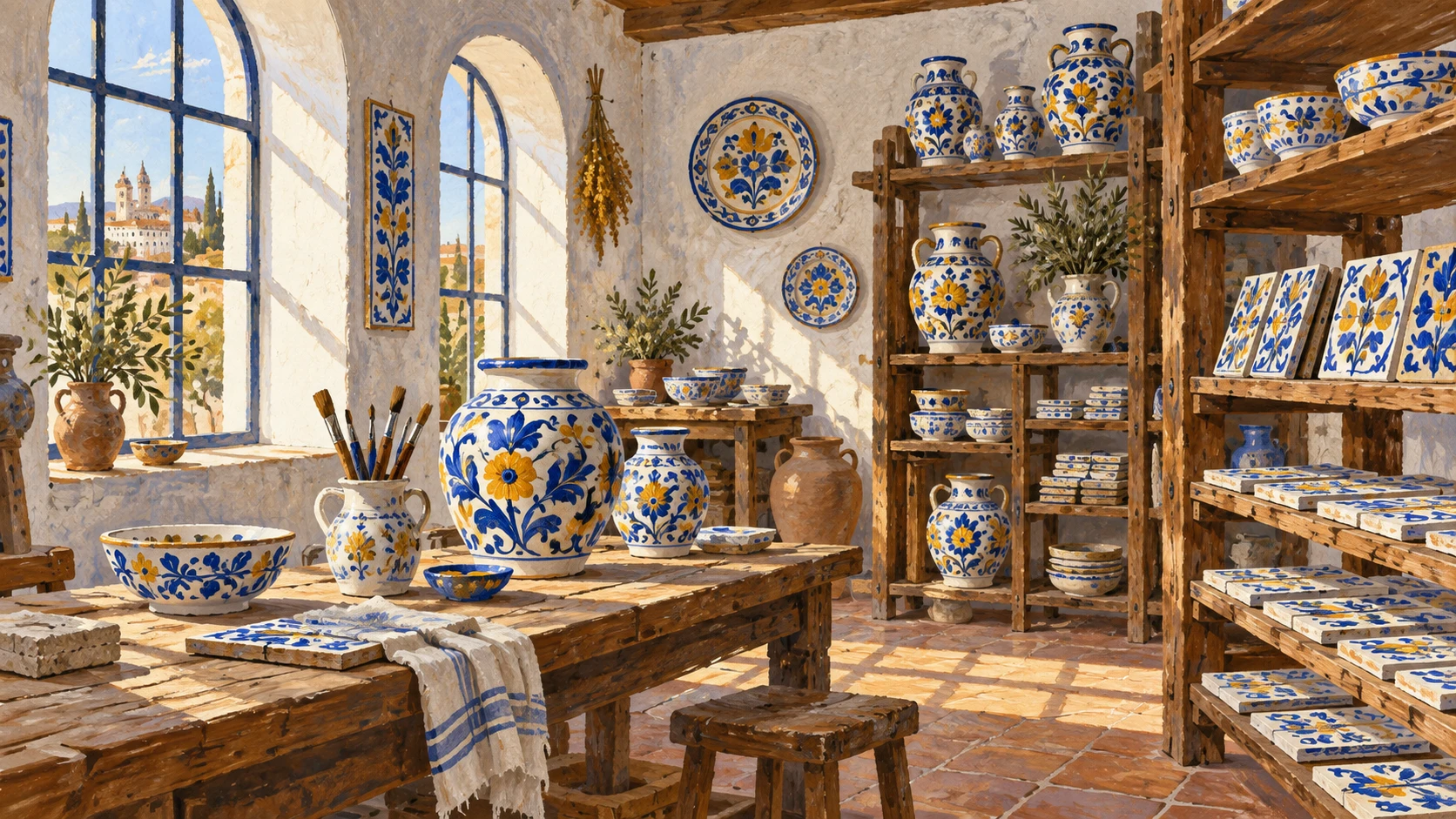
Handmade pottery in central Spain combines natural river clays, white tin glazes, and mineral brushwork in living workshop traditions.
Tagus Valley Clays and Manual Wheel Throwing
Talavera de la Reina is a historic city in central Spain famous for its handmade ceramics. Artisans have made decorative pottery in this region since the sixteenth century. This living craft is recognized as a global cultural heritage by UNESCO. Pottery workshops use two types of natural clay collected along the Tagus River basin. Workers combine dark red clay with pale white clay from nearby deposits to make a durable paste.
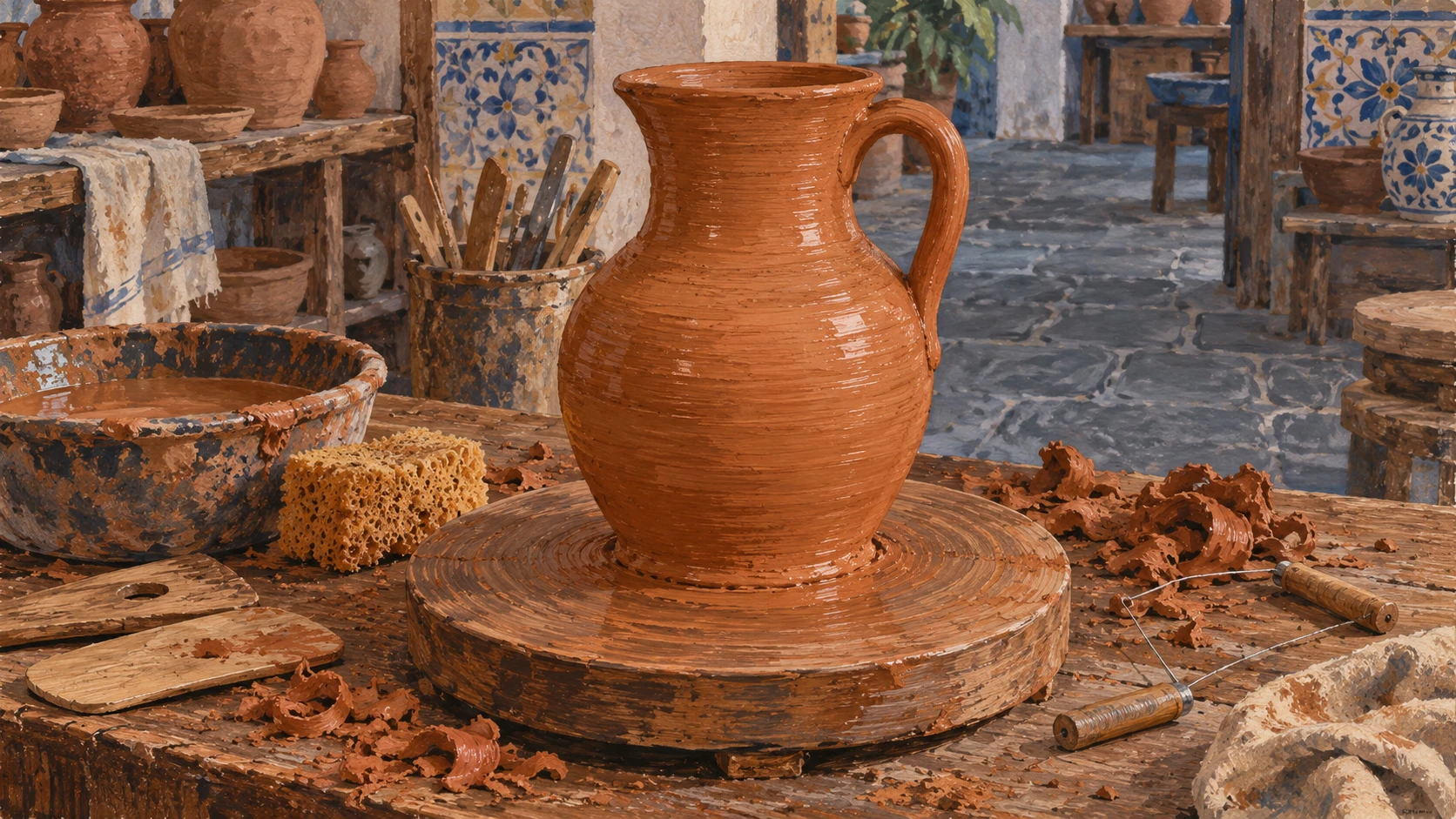
Workers clean the raw clay in large water basins called settling tanks to remove sand and small stones. Potters knead the damp clay on stone tables to remove air bubbles before working. Artisans shape round bowls and tall jugs on spinning potter wheels using wooden tools and wet sponges. Other craftworkers press flat clay slabs into plaster molds to create decorative wall tiles and relief plaques. Finished clay pieces dry slowly on wooden shelves inside shaded workshop rooms.
Tin-Glaze Chemistry and Biscuit Firing
Dry clay pieces receive a first kiln firing called biscuit firing at 980 degrees Celsius. This heat turns soft clay into hard, porous earthenware that can hold liquid glaze. Artisans dip each biscuit piece into a bath of white liquid tin glaze. The dry clay absorbs the water quickly and leaves behind a smooth white coating across the entire surface.
Workers carefully scrape excess glaze away from the bottom of each piece before painting. This step prevents the ceramic piece from sticking to kiln shelves during final firing. The raw white glaze creates an absorbent chalky surface that draws paint inward immediately. Painters cannot erase mistakes once liquid color touches the white surface, so every stroke must be accurate.
Freehand Mineral Brushwork and Traditional Motifs
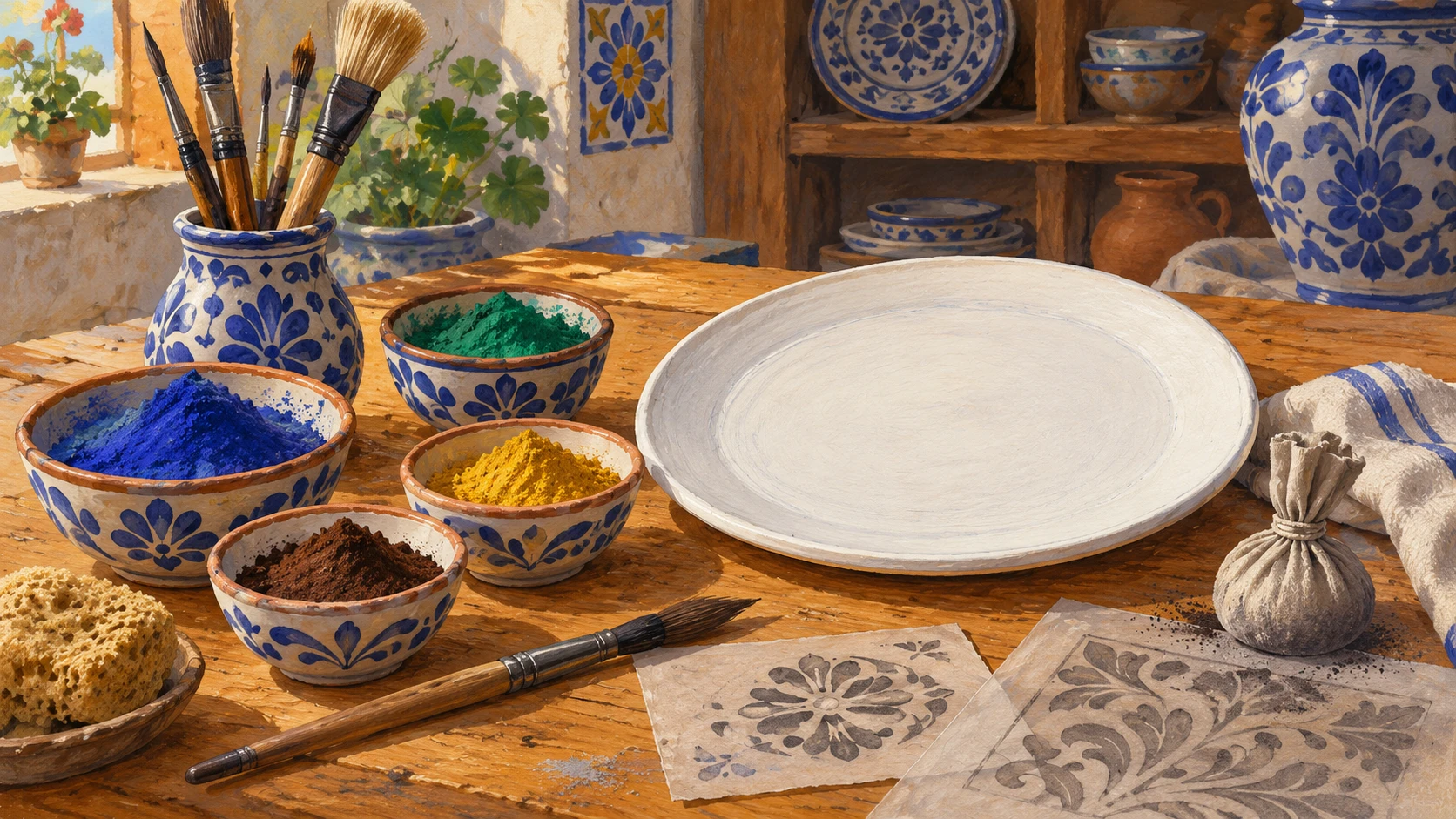
Painters decorate the white pottery using natural mineral pigments mixed with clean water. Cobalt oxide creates deep blue colors, copper produces rich green, and antimony makes bright yellow. Artists outline details with dark brown manganese and warm ochre made from iron. Master painters use fine brushes made from animal hair to paint clean lines and delicate floral patterns.
Painters use paper templates with tiny holes to dust charcoal outlines onto plates and vases. Traditional designs include sixteenth century blue patterns, forest hunting scenes, and colorful flower garlands. The nearby town of El Puente del Arzobispo is famous for green animal patterns and river birds. Workshops also make large ceramic tile murals that decorate public plazas, historic churches, and train stations.
Glost Kiln Firing and Guild Preservation
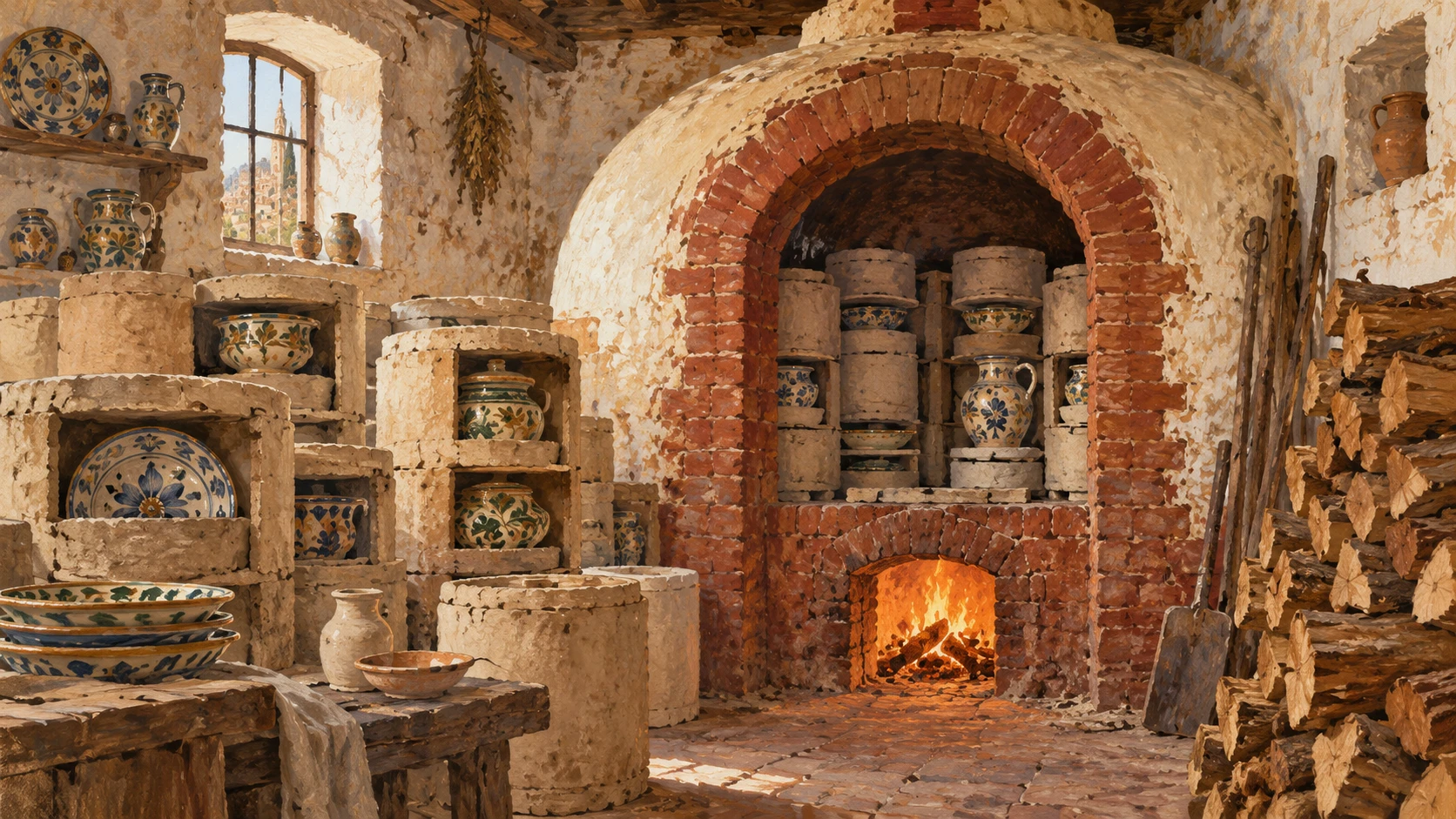
Painted pottery enters a second kiln firing called glost firing at 1050 degrees Celsius. High heat melts the white glaze and mineral pigments into a brilliant, shiny glass finish. Historic workshops burned fragrant rosemary wood inside traditional brick kilns to create clean flames. Workers stacked delicate plates inside protective clay boxes called saggers to keep ash away from the painted art.
The Ruiz de Luna Museum in Talavera displays historic ceramic collections from past centuries. The Tierras de Ceramica association helps local workshops preserve traditional pottery methods and guild standards. Experienced masters train young apprentices in clay mixing, wheel throwing, and brush painting. These active workshops ensure that traditional handmade Spanish pottery continues to flourish today.
A2 · Elementary
Talavera Ceramic Craft: Clays, Tin Glazes, and Kiln Traditions
From Tagus riverbed clays to tin-glaze calcination, the living ceramic heritage of Toledo province preserves five centuries of artisan mastery.
Tagus Valley Clays and Manual Wheel Throwing
Inscribed on the UNESCO Representative List of the Intangible Cultural Heritage of Humanity in 2019, the artisanal ceramics of Talavera de la Reina and El Puente del Arzobispo embody living pottery traditions practiced continuously since the sixteenth century. Across the Tagus River alluvial plains in western Toledo province, artisan ateliers maintain complex material protocols that transform raw mineral sediments into decorated earthenware. Production depends strictly upon blending two distinct regional deposits: plastic dark red alluvial clay dredged from local riverbanks and pale calcareous white clay quarried near Calera y Chozas. This deliberate geological union provides the exact balance of structural plasticity required for wheel forming and the structural porosity necessary for thermal stability during high-heat kiln firings.
Before shaping begins, raw extracted clays undergo exhaustive purification inside cascading outdoor settling tanks known as pilas de decantación. Suspended in water baths, heavy gravel and coarse grit settle to the basin floor while fine ceramic silts wash across successive filtering weirs. Once excess moisture evaporates, the refined clay mass is transferred onto solid granite benches for manual kneading, known locally as amasado. Master potters compress the dense paste repeatedly with heel strokes and cutting wires, methodically eliminating trapped microscopic air pockets that would otherwise expand and shatter hollow vessels under kiln heat. On traditional foot-powered momentum wheels, artisans center clay mounds with damp palms, pulling vessel walls upward with wooden ribs and water-soaked natural sponges. In parallel, architectural artisans press dense clay slabs into porous plaster matrix molds to fabricate geometric wall tiles and ornamental relief plaques, curing them through weeks of gradual drying in shaded workshop galleries.
Tin-Glaze Chemistry and Biscuit Firing
Once thoroughly dry to bone-white hardness, unfired clay pieces undergo an initial low-temperature biscuit firing, termed bizcochado, at approximately 980 degrees Celsius. This thermochemical transformation drives off residual structural moisture and vitrifies clay particles into firm yet porous terra cotta bodies capable of absorbing liquid glaze. The defining material canvas of Talavera ceramic art is an opaque milky glaze formulation composed of tin oxide, lead silicate, clean river sand, and dissolved mineral salts suspended in water. This traditional esmalte estannífero bath coats the earthenware in a uniform layer of microscopic metallic particles that fuse into an impenetrable vitreous shield upon subsequent firing.
Master decorators achieve uniform glaze thickness through a rapid, single-motion immersion that demands flawless manual judgment. Dipping porous vessels into the dense slurry for mere seconds, the dry biscuit substrate rapidly absorbs water through capillary suction, leaving behind an even, powdery white crust across inner and outer profiles. Before painting begins, artisans carefully scrape and wipe glaze paste away from footrings and base contact points using wet sponges and curved steel spatulas, preventing wares from bonding indelibly to kiln shelves. This raw, unfired tin glaze yields an extremely delicate, chalky ground that absorbs mineral paint instantly like blotting paper, precluding erasing, scraping, or subsequent overpainting. Every brushstroke delivered onto the porous white surface is immediate and permanent, requiring absolute precision and technical confidence.
Freehand Mineral Brushwork and Traditional Motifs
Artisans decorate the dry tin-glaze canvas exclusively with natural metallic oxides suspended in water, eschewing synthetic pigments to preserve historical optical depths. The classical Talavera palette relies on cobalt oxide for brilliant shades of royal blue, copper oxide for verdant greens, antimony for radiant yellows, iron oxide for warm ochre tones, and manganese carbonate for dark outlines. To execute intricate historical decorative motifs, artisans construct specialized brushes from fine ox-ear hair or red marta bristles, selected for their unique capacity to hold generous reservoirs of fluid mineral wash while maintaining a razor-sharp painting tip.
Complex repeating compositions and narrative cartouches are transferred onto curved vessels using the ancestral estarcido technique, in which finely ground vegetal charcoal dust is gently pounced through needle-perforated tracing patterns onto the absorbent glaze. Guild workshops maintain distinct decorative repertoires derived from centuries of continuous innovation, including Renaissance blue strapwork lace, polychrome Baroque hunting scenes designated as the serie de montería, and classical heraldic crests. In neighboring El Puente del Arzobispo, ateliers cultivate an unmistakable decorative idiom dominated by vivid emerald copper green pigments, lively depictions of native wild game, and stylized riparian waterfowl roaming river Tagus marshes. Working on monumental scales, Talavera masters assemble multi-tile murals, or retablos cerámicos, adorning religious facades, municipal fountain squares, and public halls throughout the Iberian Peninsula.
Glost Kiln Firing and Guild Preservation
The decorated wares enter the second and definitive glost firing, designated as the cocción de esmalte, conducted at approximately 1050 degrees Celsius over twenty-four hours. Under intense thermal loads, the raw white tin glaze and raw metallic oxides melt simultaneously into a unified vitreous layer, creating a rich lustrous sheen that permanently seals the decorated surface beneath transparent glass. Historic workshops historically fired wares inside monumental two-story brick kilns known as hornos árabes, fueled by dry mountain rosemary and rockrose scrub to generate clean, soot-free combustion flames across vaulted baking chambers.
To protect delicate hand-painted surfaces from wandering combustion embers, kiln drafts, and falling ash flakes, individual pieces were traditionally enclosed inside refractory ceramic containers termed saggers, or candilejas, separated by small three-pronged clay stilts. Headquartered in the former seventeenth-century monastery of San Agustín in Talavera de la Reina, the Museo de Cerámica Ruiz de Luna safeguards landmark collections spanning five centuries alongside original lutherie and pottery guild treatises. Today, the Asociación Tierras de Cerámica coordinates joint safeguarding initiatives with affiliated artisan communities in Puebla and Tlaxcala, maintaining educational curricula, municipal guild registries, and certified apprenticeship programs that safeguard manual tin-glaze traditions against modern industrial cast-ware.
B1 · Intermediate
Talavera Ceramic Craft: Alluvial Clays, Tin Glaze, and Freehand Painting
From Tagus riverbed clays to tin-glaze calcination, the living ceramic heritage of Toledo province preserves five centuries of artisan mastery.
Tagus Valley Clays and Manual Wheel Throwing
Inscribed on the UNESCO Representative List of the Intangible Cultural Heritage of Humanity in 2019, the artisanal ceramics of Talavera de la Reina and El Puente del Arzobispo embody living pottery traditions practiced continuously since the sixteenth century. Across the Tagus River alluvial plains in western Toledo province, artisan ateliers maintain complex material protocols that transform raw mineral sediments into decorated earthenware. Production depends strictly upon blending two distinct regional deposits: plastic dark red alluvial clay dredged from local riverbanks and pale calcareous white clay quarried near Calera y Chozas. This deliberate geological union provides the exact balance of structural plasticity required for wheel forming and the structural porosity necessary for thermal stability during high-heat kiln firings.
Before shaping begins, raw extracted clays undergo exhaustive purification inside cascading outdoor settling tanks known as pilas de decantación. Suspended in water baths, heavy gravel and coarse grit settle to the basin floor while fine ceramic silts wash across successive filtering weirs. Once excess moisture evaporates, the refined clay mass is transferred onto solid granite benches for manual kneading, known locally as amasado. Master potters compress the dense paste repeatedly with heel strokes and cutting wires, methodically eliminating trapped microscopic air pockets that would otherwise expand and shatter hollow vessels under kiln heat. On traditional foot-powered momentum wheels, artisans center clay mounds with damp palms, pulling vessel walls upward with wooden ribs and water-soaked natural sponges. In parallel, architectural artisans press dense clay slabs into porous plaster matrix molds to fabricate geometric wall tiles and ornamental relief plaques, curing them through weeks of gradual drying in shaded workshop galleries.
Tin-Glaze Chemistry and Biscuit Firing
Once thoroughly dry to bone-white hardness, unfired clay pieces undergo an initial low-temperature biscuit firing, termed bizcochado, at approximately 980 degrees Celsius. This thermochemical transformation drives off residual structural moisture and vitrifies clay particles into firm yet porous terra cotta bodies capable of absorbing liquid glaze. The defining material canvas of Talavera ceramic art is an opaque milky glaze formulation composed of tin oxide, lead silicate, clean river sand, and dissolved mineral salts suspended in water. This traditional esmalte estannífero bath coats the earthenware in a uniform layer of microscopic metallic particles that fuse into an impenetrable vitreous shield upon subsequent firing.
Master decorators achieve uniform glaze thickness through a rapid, single-motion immersion that demands flawless manual judgment. Dipping porous vessels into the dense slurry for mere seconds, the dry biscuit substrate rapidly absorbs water through capillary suction, leaving behind an even, powdery white crust across inner and outer profiles. Before painting begins, artisans carefully scrape and wipe glaze paste away from footrings and base contact points using wet sponges and curved steel spatulas, preventing wares from bonding indelibly to kiln shelves. This raw, unfired tin glaze yields an extremely delicate, chalky ground that absorbs mineral paint instantly like blotting paper, precluding erasing, scraping, or subsequent overpainting. Every brushstroke delivered onto the porous white surface is immediate and permanent, requiring absolute precision and technical confidence.
Freehand Mineral Brushwork and Traditional Motifs
Artisans decorate the dry tin-glaze canvas exclusively with natural metallic oxides suspended in water, eschewing synthetic pigments to preserve historical optical depths. The classical Talavera palette relies on cobalt oxide for brilliant shades of royal blue, copper oxide for verdant greens, antimony for radiant yellows, iron oxide for warm ochre tones, and manganese carbonate for dark outlines. To execute intricate historical decorative motifs, artisans construct specialized brushes from fine ox-ear hair or red marta bristles, selected for their unique capacity to hold generous reservoirs of fluid mineral wash while maintaining a razor-sharp painting tip.
Complex repeating compositions and narrative cartouches are transferred onto curved vessels using the ancestral estarcido technique, in which finely ground vegetal charcoal dust is gently pounced through needle-perforated tracing patterns onto the absorbent glaze. Guild workshops maintain distinct decorative repertoires derived from centuries of continuous innovation, including Renaissance blue strapwork lace, polychrome Baroque hunting scenes designated as the serie de montería, and classical heraldic crests. In neighboring El Puente del Arzobispo, ateliers cultivate an unmistakable decorative idiom dominated by vivid emerald copper green pigments, lively depictions of native wild game, and stylized riparian waterfowl roaming river Tagus marshes. Working on monumental scales, Talavera masters assemble multi-tile murals, or retablos cerámicos, adorning religious facades, municipal fountain squares, and public halls throughout the Iberian Peninsula.
Glost Kiln Firing and Guild Preservation
The decorated wares enter the second and definitive glost firing, designated as the cocción de esmalte, conducted at approximately 1050 degrees Celsius over twenty-four hours. Under intense thermal loads, the raw white tin glaze and raw metallic oxides melt simultaneously into a unified vitreous layer, creating a rich lustrous sheen that permanently seals the decorated surface beneath transparent glass. Historic workshops historically fired wares inside monumental two-story brick kilns known as hornos árabes, fueled by dry mountain rosemary and rockrose scrub to generate clean, soot-free combustion flames across vaulted baking chambers.
To protect delicate hand-painted surfaces from wandering combustion embers, kiln drafts, and falling ash flakes, individual pieces were traditionally enclosed inside refractory ceramic containers termed saggers, or candilejas, separated by small three-pronged clay stilts. Headquartered in the former seventeenth-century monastery of San Agustín in Talavera de la Reina, the Museo de Cerámica Ruiz de Luna safeguards landmark collections spanning five centuries alongside original lutherie and pottery guild treatises. Today, the Asociación Tierras de Cerámica coordinates joint safeguarding initiatives with affiliated artisan communities in Puebla and Tlaxcala, maintaining educational curricula, municipal guild registries, and certified apprenticeship programs that safeguard manual tin-glaze traditions against modern industrial cast-ware.
B2 · Upper Intermediate
Talavera Ceramic Craft: Pyrochemical Firing, Tin Glazes, and Guild Continuity
From Tagus riverbed clays to tin-glaze calcination, the living ceramic heritage of Toledo province preserves five centuries of artisan mastery.
Tagus Valley Clays and Manual Wheel Throwing
Inscribed on the UNESCO Representative List of the Intangible Cultural Heritage of Humanity in 2019, the artisanal ceramics of Talavera de la Reina and El Puente del Arzobispo embody living pottery traditions practiced continuously since the sixteenth century. Across the Tagus River alluvial plains in western Toledo province, artisan ateliers maintain complex material protocols that transform raw mineral sediments into decorated earthenware. Production depends strictly upon blending two distinct regional deposits: plastic dark red alluvial clay dredged from local riverbanks and pale calcareous white clay quarried near Calera y Chozas. This deliberate geological union provides the exact balance of structural plasticity required for wheel forming and the structural porosity necessary for thermal stability during high-heat kiln firings.
Before shaping begins, raw extracted clays undergo exhaustive purification inside cascading outdoor settling tanks known as pilas de decantación. Suspended in water baths, heavy gravel and coarse grit settle to the basin floor while fine ceramic silts wash across successive filtering weirs. Once excess moisture evaporates, the refined clay mass is transferred onto solid granite benches for manual kneading, known locally as amasado. Master potters compress the dense paste repeatedly with heel strokes and cutting wires, methodically eliminating trapped microscopic air pockets that would otherwise expand and shatter hollow vessels under kiln heat. On traditional foot-powered momentum wheels, artisans center clay mounds with damp palms, pulling vessel walls upward with wooden ribs and water-soaked natural sponges. In parallel, architectural artisans press dense clay slabs into porous plaster matrix molds to fabricate geometric wall tiles and ornamental relief plaques, curing them through weeks of gradual drying in shaded workshop galleries.
Tin-Glaze Chemistry and Biscuit Firing
Once thoroughly dry to bone-white hardness, unfired clay pieces undergo an initial low-temperature biscuit firing, termed bizcochado, at approximately 980 degrees Celsius. This thermochemical transformation drives off residual structural moisture and vitrifies clay particles into firm yet porous terra cotta bodies capable of absorbing liquid glaze. The defining material canvas of Talavera ceramic art is an opaque milky glaze formulation composed of tin oxide, lead silicate, clean river sand, and dissolved mineral salts suspended in water. This traditional esmalte estannífero bath coats the earthenware in a uniform layer of microscopic metallic particles that fuse into an impenetrable vitreous shield upon subsequent firing.
Master decorators achieve uniform glaze thickness through a rapid, single-motion immersion that demands flawless manual judgment. Dipping porous vessels into the dense slurry for mere seconds, the dry biscuit substrate rapidly absorbs water through capillary suction, leaving behind an even, powdery white crust across inner and outer profiles. Before painting begins, artisans carefully scrape and wipe glaze paste away from footrings and base contact points using wet sponges and curved steel spatulas, preventing wares from bonding indelibly to kiln shelves. This raw, unfired tin glaze yields an extremely delicate, chalky ground that absorbs mineral paint instantly like blotting paper, precluding erasing, scraping, or subsequent overpainting. Every brushstroke delivered onto the porous white surface is immediate and permanent, requiring absolute precision and technical confidence.
Freehand Mineral Brushwork and Traditional Motifs
Artisans decorate the dry tin-glaze canvas exclusively with natural metallic oxides suspended in water, eschewing synthetic pigments to preserve historical optical depths. The classical Talavera palette relies on cobalt oxide for brilliant shades of royal blue, copper oxide for verdant greens, antimony for radiant yellows, iron oxide for warm ochre tones, and manganese carbonate for dark outlines. To execute intricate historical decorative motifs, artisans construct specialized brushes from fine ox-ear hair or red marta bristles, selected for their unique capacity to hold generous reservoirs of fluid mineral wash while maintaining a razor-sharp painting tip.
Complex repeating compositions and narrative cartouches are transferred onto curved vessels using the ancestral estarcido technique, in which finely ground vegetal charcoal dust is gently pounced through needle-perforated tracing patterns onto the absorbent glaze. Guild workshops maintain distinct decorative repertoires derived from centuries of continuous innovation, including Renaissance blue strapwork lace, polychrome Baroque hunting scenes designated as the serie de montería, and classical heraldic crests. In neighboring El Puente del Arzobispo, ateliers cultivate an unmistakable decorative idiom dominated by vivid emerald copper green pigments, lively depictions of native wild game, and stylized riparian waterfowl roaming river Tagus marshes. Working on monumental scales, Talavera masters assemble multi-tile murals, or retablos cerámicos, adorning religious facades, municipal fountain squares, and public halls throughout the Iberian Peninsula.
Glost Kiln Firing and Guild Preservation
The decorated wares enter the second and definitive glost firing, designated as the cocción de esmalte, conducted at approximately 1050 degrees Celsius over twenty-four hours. Under intense thermal loads, the raw white tin glaze and raw metallic oxides melt simultaneously into a unified vitreous layer, creating a rich lustrous sheen that permanently seals the decorated surface beneath transparent glass. Historic workshops historically fired wares inside monumental two-story brick kilns known as hornos árabes, fueled by dry mountain rosemary and rockrose scrub to generate clean, soot-free combustion flames across vaulted baking chambers.
To protect delicate hand-painted surfaces from wandering combustion embers, kiln drafts, and falling ash flakes, individual pieces were traditionally enclosed inside refractory ceramic containers termed saggers, or candilejas, separated by small three-pronged clay stilts. Headquartered in the former seventeenth-century monastery of San Agustín in Talavera de la Reina, the Museo de Cerámica Ruiz de Luna safeguards landmark collections spanning five centuries alongside original lutherie and pottery guild treatises. Today, the Asociación Tierras de Cerámica coordinates joint safeguarding initiatives with affiliated artisan communities in Puebla and Tlaxcala, maintaining educational curricula, municipal guild registries, and certified apprenticeship programs that safeguard manual tin-glaze traditions against modern industrial cast-ware.
C1 · Advanced
Talavera Ceramic Craft: Materiality, Stanniferous Glazes, and Heritage Transmission
From Tagus riverbed clays to tin-glaze calcination, the living ceramic heritage of Toledo province preserves five centuries of artisan mastery.
Tagus Valley Clays and Manual Wheel Throwing
Inscribed on the UNESCO Representative List of the Intangible Cultural Heritage of Humanity in 2019, the artisanal ceramics of Talavera de la Reina and El Puente del Arzobispo embody living pottery traditions practiced continuously since the sixteenth century. Across the Tagus River alluvial plains in western Toledo province, artisan ateliers maintain complex material protocols that transform raw mineral sediments into decorated earthenware. Production depends strictly upon blending two distinct regional deposits: plastic dark red alluvial clay dredged from local riverbanks and pale calcareous white clay quarried near Calera y Chozas. This deliberate geological union provides the exact balance of structural plasticity required for wheel forming and the structural porosity necessary for thermal stability during high-heat kiln firings.
Before shaping begins, raw extracted clays undergo exhaustive purification inside cascading outdoor settling tanks known as pilas de decantación. Suspended in water baths, heavy gravel and coarse grit settle to the basin floor while fine ceramic silts wash across successive filtering weirs. Once excess moisture evaporates, the refined clay mass is transferred onto solid granite benches for manual kneading, known locally as amasado. Master potters compress the dense paste repeatedly with heel strokes and cutting wires, methodically eliminating trapped microscopic air pockets that would otherwise expand and shatter hollow vessels under kiln heat. On traditional foot-powered momentum wheels, artisans center clay mounds with damp palms, pulling vessel walls upward with wooden ribs and water-soaked natural sponges. In parallel, architectural artisans press dense clay slabs into porous plaster matrix molds to fabricate geometric wall tiles and ornamental relief plaques, curing them through weeks of gradual drying in shaded workshop galleries.
Tin-Glaze Chemistry and Biscuit Firing
Once thoroughly dry to bone-white hardness, unfired clay pieces undergo an initial low-temperature biscuit firing, termed bizcochado, at approximately 980 degrees Celsius. This thermochemical transformation drives off residual structural moisture and vitrifies clay particles into firm yet porous terra cotta bodies capable of absorbing liquid glaze. The defining material canvas of Talavera ceramic art is an opaque milky glaze formulation composed of tin oxide, lead silicate, clean river sand, and dissolved mineral salts suspended in water. This traditional esmalte estannífero bath coats the earthenware in a uniform layer of microscopic metallic particles that fuse into an impenetrable vitreous shield upon subsequent firing.
Master decorators achieve uniform glaze thickness through a rapid, single-motion immersion that demands flawless manual judgment. Dipping porous vessels into the dense slurry for mere seconds, the dry biscuit substrate rapidly absorbs water through capillary suction, leaving behind an even, powdery white crust across inner and outer profiles. Before painting begins, artisans carefully scrape and wipe glaze paste away from footrings and base contact points using wet sponges and curved steel spatulas, preventing wares from bonding indelibly to kiln shelves. This raw, unfired tin glaze yields an extremely delicate, chalky ground that absorbs mineral paint instantly like blotting paper, precluding erasing, scraping, or subsequent overpainting. Every brushstroke delivered onto the porous white surface is immediate and permanent, requiring absolute precision and technical confidence.
Freehand Mineral Brushwork and Traditional Motifs
Artisans decorate the dry tin-glaze canvas exclusively with natural metallic oxides suspended in water, eschewing synthetic pigments to preserve historical optical depths. The classical Talavera palette relies on cobalt oxide for brilliant shades of royal blue, copper oxide for verdant greens, antimony for radiant yellows, iron oxide for warm ochre tones, and manganese carbonate for dark outlines. To execute intricate historical decorative motifs, artisans construct specialized brushes from fine ox-ear hair or red marta bristles, selected for their unique capacity to hold generous reservoirs of fluid mineral wash while maintaining a razor-sharp painting tip.
Complex repeating compositions and narrative cartouches are transferred onto curved vessels using the ancestral estarcido technique, in which finely ground vegetal charcoal dust is gently pounced through needle-perforated tracing patterns onto the absorbent glaze. Guild workshops maintain distinct decorative repertoires derived from centuries of continuous innovation, including Renaissance blue strapwork lace, polychrome Baroque hunting scenes designated as the serie de montería, and classical heraldic crests. In neighboring El Puente del Arzobispo, ateliers cultivate an unmistakable decorative idiom dominated by vivid emerald copper green pigments, lively depictions of native wild game, and stylized riparian waterfowl roaming river Tagus marshes. Working on monumental scales, Talavera masters assemble multi-tile murals, or retablos cerámicos, adorning religious facades, municipal fountain squares, and public halls throughout the Iberian Peninsula.
Glost Kiln Firing and Guild Preservation
The decorated wares enter the second and definitive glost firing, designated as the cocción de esmalte, conducted at approximately 1050 degrees Celsius over twenty-four hours. Under intense thermal loads, the raw white tin glaze and raw metallic oxides melt simultaneously into a unified vitreous layer, creating a rich lustrous sheen that permanently seals the decorated surface beneath transparent glass. Historic workshops historically fired wares inside monumental two-story brick kilns known as hornos árabes, fueled by dry mountain rosemary and rockrose scrub to generate clean, soot-free combustion flames across vaulted baking chambers.
To protect delicate hand-painted surfaces from wandering combustion embers, kiln drafts, and falling ash flakes, individual pieces were traditionally enclosed inside refractory ceramic containers termed saggers, or candilejas, separated by small three-pronged clay stilts. Headquartered in the former seventeenth-century monastery of San Agustín in Talavera de la Reina, the Museo de Cerámica Ruiz de Luna safeguards landmark collections spanning five centuries alongside original lutherie and pottery guild treatises. Today, the Asociación Tierras de Cerámica coordinates joint safeguarding initiatives with affiliated artisan communities in Puebla and Tlaxcala, maintaining educational curricula, municipal guild registries, and certified apprenticeship programs that safeguard manual tin-glaze traditions against modern industrial cast-ware.
C2 · Mastery
Talavera Ceramic Craft: Alluvial Earthenware, Stanniferous Glaze, and Guild Lineages
From Tagus riverbed clays to tin-glaze calcination, the living ceramic heritage of Toledo province preserves five centuries of artisan mastery.
Tagus Valley Clays and Manual Wheel Throwing
Inscribed on the UNESCO Representative List of the Intangible Cultural Heritage of Humanity in 2019, the artisanal ceramics of Talavera de la Reina and El Puente del Arzobispo embody living pottery traditions practiced continuously since the sixteenth century. Across the Tagus River alluvial plains in western Toledo province, artisan ateliers maintain complex material protocols that transform raw mineral sediments into decorated earthenware. Production depends strictly upon blending two distinct regional deposits: plastic dark red alluvial clay dredged from local riverbanks and pale calcareous white clay quarried near Calera y Chozas. This deliberate geological union provides the exact balance of structural plasticity required for wheel forming and the structural porosity necessary for thermal stability during high-heat kiln firings.
Before shaping begins, raw extracted clays undergo exhaustive purification inside cascading outdoor settling tanks known as pilas de decantación. Suspended in water baths, heavy gravel and coarse grit settle to the basin floor while fine ceramic silts wash across successive filtering weirs. Once excess moisture evaporates, the refined clay mass is transferred onto solid granite benches for manual kneading, known locally as amasado. Master potters compress the dense paste repeatedly with heel strokes and cutting wires, methodically eliminating trapped microscopic air pockets that would otherwise expand and shatter hollow vessels under kiln heat. On traditional foot-powered momentum wheels, artisans center clay mounds with damp palms, pulling vessel walls upward with wooden ribs and water-soaked natural sponges. In parallel, architectural artisans press dense clay slabs into porous plaster matrix molds to fabricate geometric wall tiles and ornamental relief plaques, curing them through weeks of gradual drying in shaded workshop galleries.
Tin-Glaze Chemistry and Biscuit Firing
Once thoroughly dry to bone-white hardness, unfired clay pieces undergo an initial low-temperature biscuit firing, termed bizcochado, at approximately 980 degrees Celsius. This thermochemical transformation drives off residual structural moisture and vitrifies clay particles into firm yet porous terra cotta bodies capable of absorbing liquid glaze. The defining material canvas of Talavera ceramic art is an opaque milky glaze formulation composed of tin oxide, lead silicate, clean river sand, and dissolved mineral salts suspended in water. This traditional esmalte estannífero bath coats the earthenware in a uniform layer of microscopic metallic particles that fuse into an impenetrable vitreous shield upon subsequent firing.
Master decorators achieve uniform glaze thickness through a rapid, single-motion immersion that demands flawless manual judgment. Dipping porous vessels into the dense slurry for mere seconds, the dry biscuit substrate rapidly absorbs water through capillary suction, leaving behind an even, powdery white crust across inner and outer profiles. Before painting begins, artisans carefully scrape and wipe glaze paste away from footrings and base contact points using wet sponges and curved steel spatulas, preventing wares from bonding indelibly to kiln shelves. This raw, unfired tin glaze yields an extremely delicate, chalky ground that absorbs mineral paint instantly like blotting paper, precluding erasing, scraping, or subsequent overpainting. Every brushstroke delivered onto the porous white surface is immediate and permanent, requiring absolute precision and technical confidence.
Freehand Mineral Brushwork and Traditional Motifs
Artisans decorate the dry tin-glaze canvas exclusively with natural metallic oxides suspended in water, eschewing synthetic pigments to preserve historical optical depths. The classical Talavera palette relies on cobalt oxide for brilliant shades of royal blue, copper oxide for verdant greens, antimony for radiant yellows, iron oxide for warm ochre tones, and manganese carbonate for dark outlines. To execute intricate historical decorative motifs, artisans construct specialized brushes from fine ox-ear hair or red marta bristles, selected for their unique capacity to hold generous reservoirs of fluid mineral wash while maintaining a razor-sharp painting tip.
Complex repeating compositions and narrative cartouches are transferred onto curved vessels using the ancestral estarcido technique, in which finely ground vegetal charcoal dust is gently pounced through needle-perforated tracing patterns onto the absorbent glaze. Guild workshops maintain distinct decorative repertoires derived from centuries of continuous innovation, including Renaissance blue strapwork lace, polychrome Baroque hunting scenes designated as the serie de montería, and classical heraldic crests. In neighboring El Puente del Arzobispo, ateliers cultivate an unmistakable decorative idiom dominated by vivid emerald copper green pigments, lively depictions of native wild game, and stylized riparian waterfowl roaming river Tagus marshes. Working on monumental scales, Talavera masters assemble multi-tile murals, or retablos cerámicos, adorning religious facades, municipal fountain squares, and public halls throughout the Iberian Peninsula.
Glost Kiln Firing and Guild Preservation
The decorated wares enter the second and definitive glost firing, designated as the cocción de esmalte, conducted at approximately 1050 degrees Celsius over twenty-four hours. Under intense thermal loads, the raw white tin glaze and raw metallic oxides melt simultaneously into a unified vitreous layer, creating a rich lustrous sheen that permanently seals the decorated surface beneath transparent glass. Historic workshops historically fired wares inside monumental two-story brick kilns known as hornos árabes, fueled by dry mountain rosemary and rockrose scrub to generate clean, soot-free combustion flames across vaulted baking chambers.
To protect delicate hand-painted surfaces from wandering combustion embers, kiln drafts, and falling ash flakes, individual pieces were traditionally enclosed inside refractory ceramic containers termed saggers, or candilejas, separated by small three-pronged clay stilts. Headquartered in the former seventeenth-century monastery of San Agustín in Talavera de la Reina, the Museo de Cerámica Ruiz de Luna safeguards landmark collections spanning five centuries alongside original lutherie and pottery guild treatises. Today, the Asociación Tierras de Cerámica coordinates joint safeguarding initiatives with affiliated artisan communities in Puebla and Tlaxcala, maintaining educational curricula, municipal guild registries, and certified apprenticeship programs that safeguard manual tin-glaze traditions against modern industrial cast-ware.
Check your understanding
Choose how closely you want to revisit the article. You can refer back while answering, and review explanations when you finish.
Quick Quiz A1
Try one question, then create a free account for the full Quick Quiz. Sign Up Free
Answer every question before checking. There is no time limit.
Your results
/ 1 correct (%)
Read the explanations to see how each answer connects to the article.
-
What is Talavera de la Reina in central Spain famous for making?
1. Answer:
Quick Quiz A2
Try one question, then create a free account for the full Quick Quiz. Sign Up Free
Answer every question before checking. There is no time limit.
Your results
/ 1 correct (%)
Read the explanations to see how each answer connects to the article.
-
When were the artisanal ceramics of Talavera and El Puente del Arzobispo inscribed by UNESCO?
1. Answer:
Quick Quiz B1
Try one question, then create a free account for the full Quick Quiz. Sign Up Free
Answer every question before checking. There is no time limit.
Your results
/ 1 correct (%)
Read the explanations to see how each answer connects to the article.
-
When were the artisanal ceramics of Talavera and El Puente del Arzobispo inscribed by UNESCO?
1. Answer:
Quick Quiz B2
Try one question, then create a free account for the full Quick Quiz. Sign Up Free
Answer every question before checking. There is no time limit.
Your results
/ 1 correct (%)
Read the explanations to see how each answer connects to the article.
-
When were the artisanal ceramics of Talavera and El Puente del Arzobispo inscribed by UNESCO?
1. Answer:
Quick Quiz C1
Try one question, then create a free account for the full Quick Quiz. Sign Up Free
Answer every question before checking. There is no time limit.
Your results
/ 1 correct (%)
Read the explanations to see how each answer connects to the article.
-
When were the artisanal ceramics of Talavera and El Puente del Arzobispo inscribed by UNESCO?
1. Answer:
Quick Quiz C2
Try one question, then create a free account for the full Quick Quiz. Sign Up Free
Answer every question before checking. There is no time limit.
Your results
/ 1 correct (%)
Read the explanations to see how each answer connects to the article.
-
When were the artisanal ceramics of Talavera and El Puente del Arzobispo inscribed by UNESCO?
1. Answer:
