A1 · Beginner
Morning on the Madrid Metro
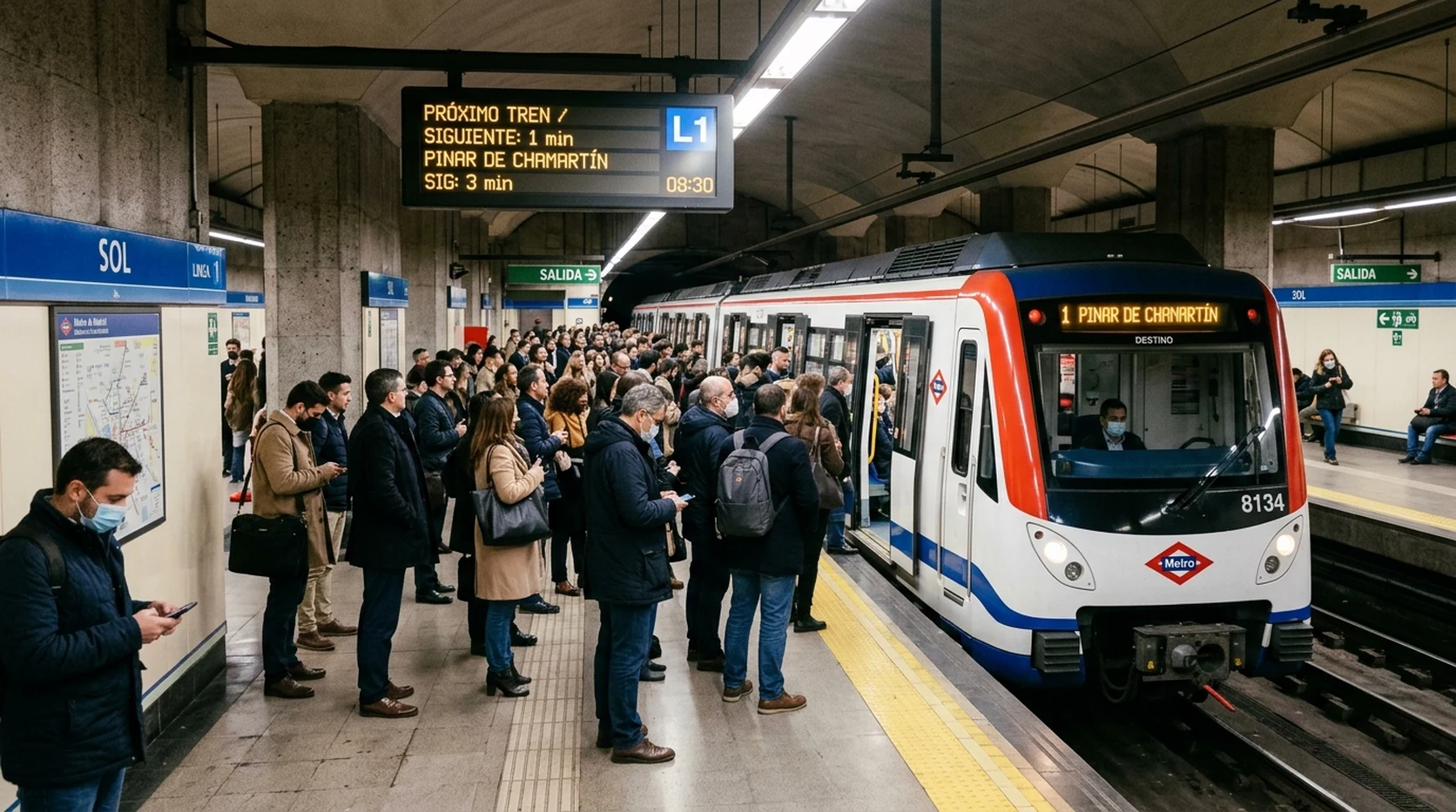
Every weekday morning, thousands of workers and students ride the Madrid Metro across busy stations, clean trains, and modern escalators.
Peak Hour Network Surge and Arterial Headways
Every morning between half past seven and half past nine, Madrid Metro carries thousands of workers. Train Line 1 and Line 6 run trains every two minutes. Operators in the main control center at Alto del Arenal watch train signals on big video screens. These railway signals help trains stay on time.
Commuters gather at busy stations like Sol, Nuevos Ministerios, and Avenida de América. People switch easily between underground trains, city buses, and regional trains. Automated signals send extra empty trains when station platforms become very crowded.
Interchange Architecture and Pedestrian Flow Dynamics
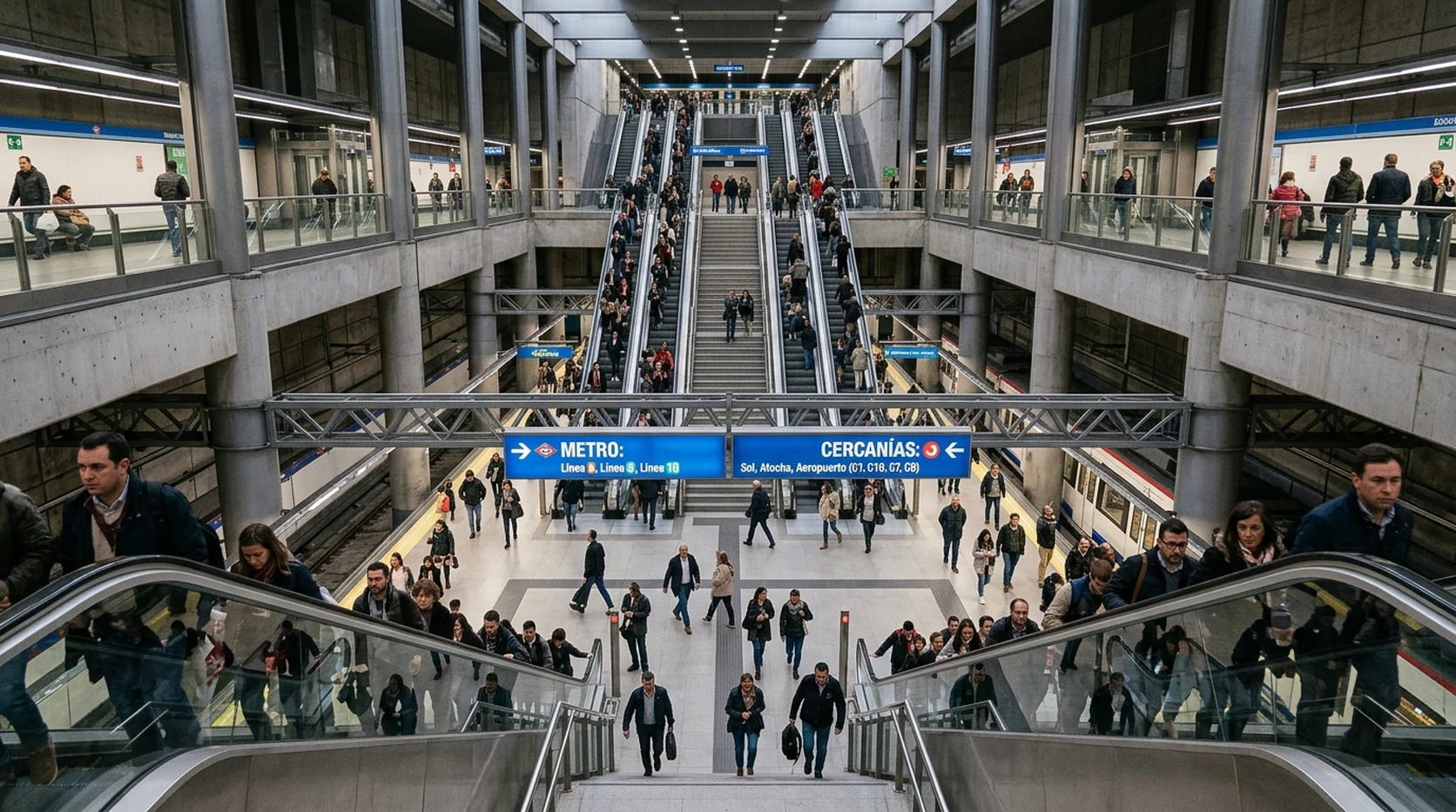
Deep stations have fast escalators and moving walkways to help passengers move between underground floors. Painted floor arrows guide commuters so crowds walk smoothly in one direction. Station workers in blue uniforms and security officers help passengers board trains safely.
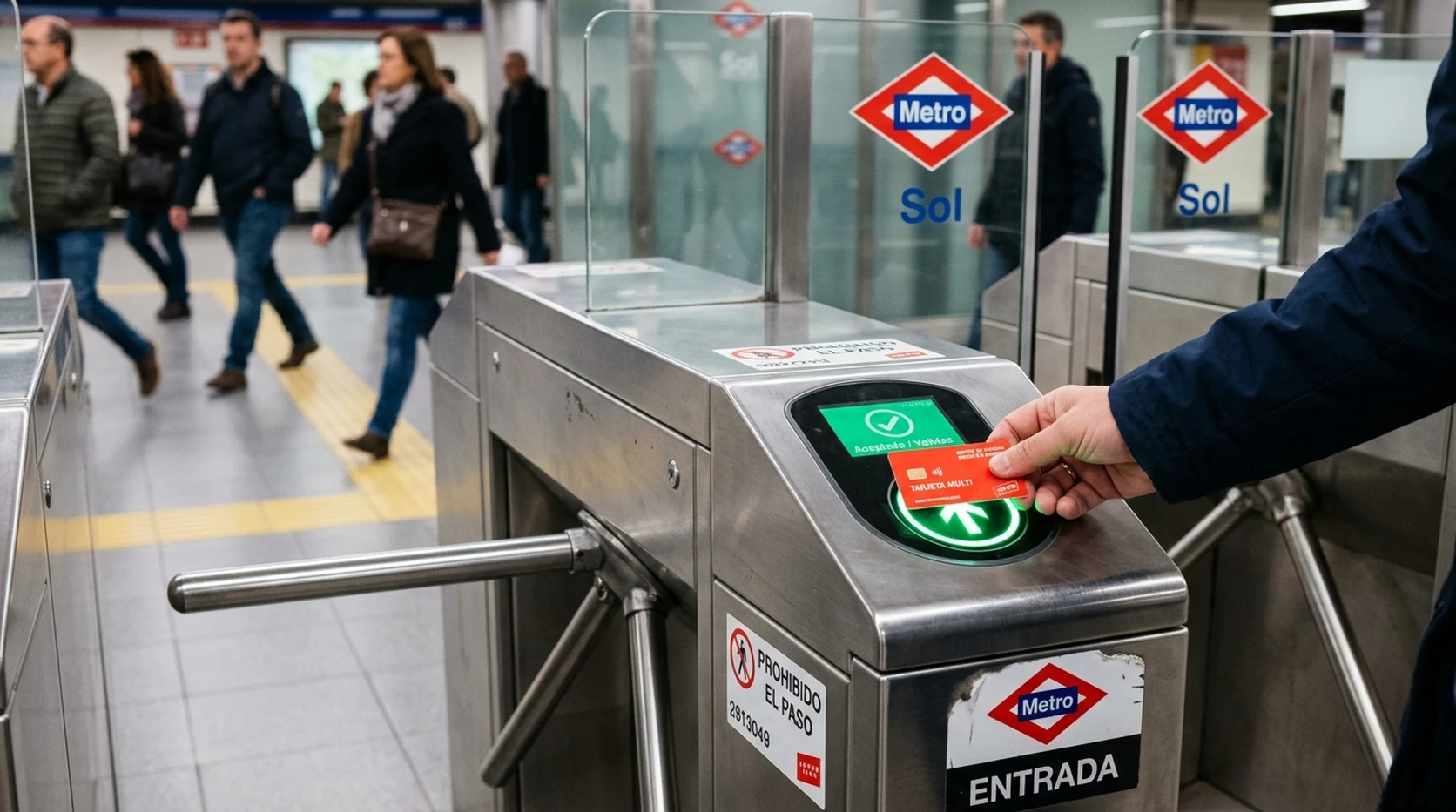
Commuters tap red plastic travel cards called Tarjeta Multi on electronic turnstiles to enter. Bright yellow textured tiles on platform floors guide visually impaired passengers. Large ventilation fans blow fresh air into underground tunnels to keep stations cool.
Rolling Stock Fleets and Traction Efficiency
Modern Spanish trains have wide open hallways between carriages so passengers can walk through. When trains slow down, electric motors turn braking force into clean electricity. This saved electric power lights up station lamps and powers moving staircases.
Automatic computer safety systems stop trains safely if they get too close together. At nocturnal maintenance depots in Canillejas, mechanics inspect wheels and brakes every night before morning deployment. Resilient rubber cushions and acoustic dampening pads placed under steel tracks reduce ground vibration beneath city buildings.
Regional Tariff Integration and Urban Sustainability
A regional transport agency manages simple ticket prices across buses, trains, and subways. Taking the subway keeps thousands of cars off busy Madrid highway roads like the M-30. Discount monthly travel passes give students and older citizens cheap travel across the capital.
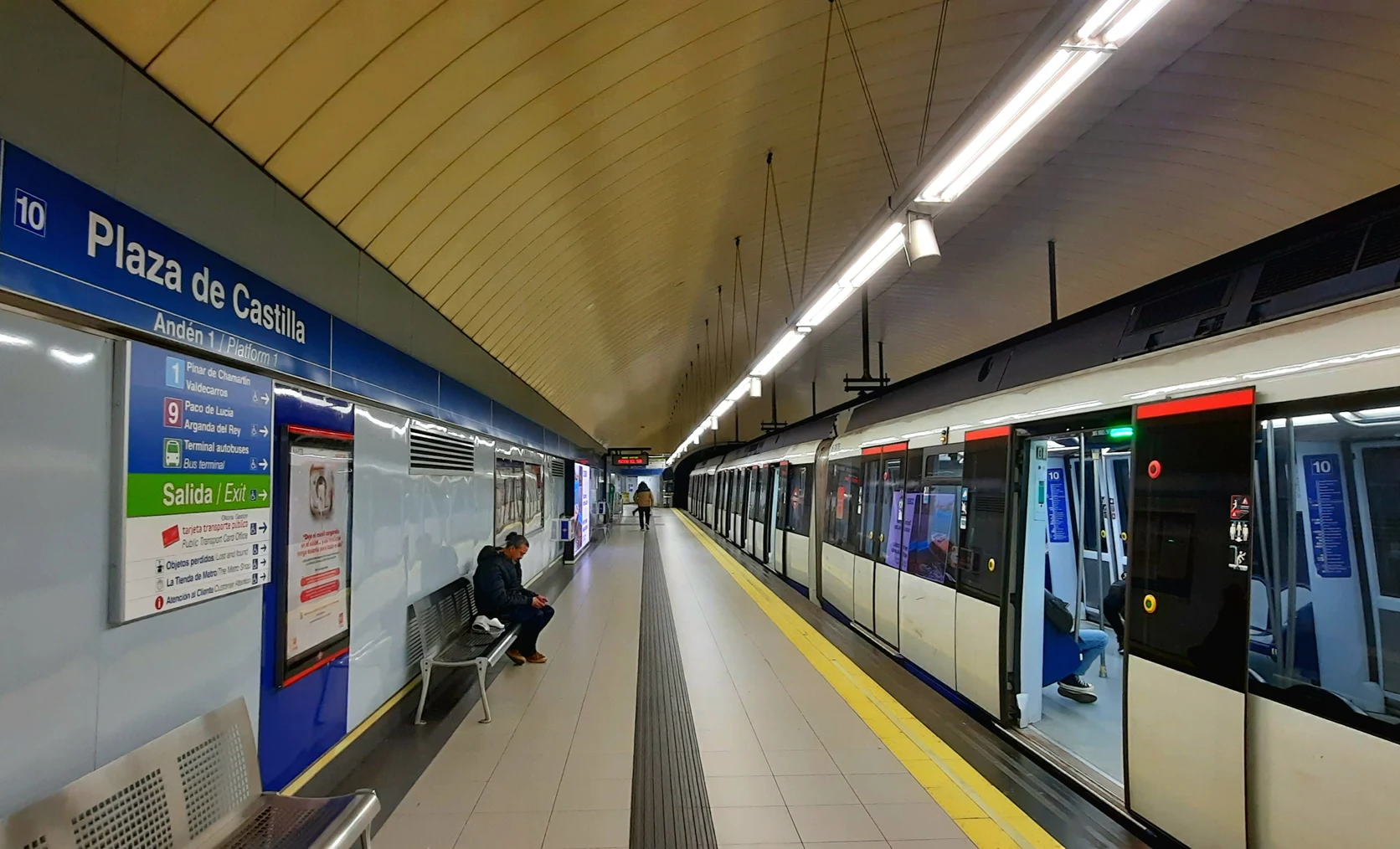
Digital television screens on platforms show the exact minutes until the next train arrives. Network modernization programs continually upgrade stations with step-free glass elevators so people in wheelchairs can reach all platforms. Electric trains produce no exhaust fumes, keeping Madrid city air clean and healthy.
A2 · Elementary
Madrid Metro Morning Commute: Arterial Headways, Deep Interchanges, and Suburban Transit
Between 07:30 and 09:30, Madrid Metro mobilizes high-frequency trainsets, automated turnstiles, and subterranean transfer hubs to absorb peak passenger volume.
Peak Hour Network Surge and Arterial Headways
Between 07:30 and 09:30 on weekday mornings, the Madrid Metro network absorbs peak commuter volume exceeding five hundred thousand trips across its twelve underground lines. Line 6 and Line 1 function as high-capacity arterial routes, operating train headways under one hundred and eighty seconds during morning rush hour. The Centralized Traffic Control center at Alto del Arenal monitors live train headways and platform passenger volumes through automated signaling telemetry.
Major interchange stations including Sol, Nuevos Ministerios, and Avenida de América record the highest passenger boarding and interchange volumes during the morning peak. Multi-modal connections link subterranean metro platforms directly with suburban bus interchanges and Cercanías commuter rail networks. Automated dispatch protocols adjust train frequency and dwell times dynamically when platform passenger sensors detect high crowding levels.
Interchange Architecture and Pedestrian Flow Dynamics
Multi-level interchange stations feature vertical cascades of high-speed escalators and moving walkways designed to transfer thousands of commuters between deep line platforms. One-way pedestrian circulation corridors and directional floor markings channel passenger flows to prevent head-on collisions and choke points during peak transfer windows. Uniformed customer service staff and transit security officers deploy across critical mezzanine junctions to maintain orderly passenger queues and platform dispersion.
Automated entry turnstiles process contactless validations in fractions of a second using contactless Tarjeta Multi cards and digital mobile transit passes. Tactile floor paving along platform edges and audible chime signals assist visually impaired commuters in navigating busy transfer corridors safely. Station ventilation shafts and powerful industrial air extractors circulate underground air to regulate subterranean temperature and air freshness across deep tunnels.
Rolling Stock Fleets and Traction Efficiency
Fleet trainsets including the CAF 8000 and 9000 series operate continuous walk-through gangways that allow commuters to distribute evenly across all six carriages. Regenerative braking technology converts train kinetic energy into electrical current during deceleration, feeding power back into the overhead catenary wire. Overhead electrical catenary feeds supply direct current traction power to train pantographs while regenerative energy powers station lighting and ascending escalators.
Automatic Train Protection and Automatic Train Operation systems enforce safe braking curves and maintain precise inter-train distance margins along heavily trafficked lines. Nocturnal rolling-stock maintenance depots at Canillejas and Cuatro Vientos conduct daily wheel inspection and electronic diagnostic checks before morning deployment. Resilient acoustic dampening pads installed beneath ballastless track slabs reduce rolling noise and ground vibration beneath historic Madrid urban buildings.
Regional Tariff Integration and Urban Sustainability
The Consorcio Regional de Transportes de Madrid coordinates unified tariff zones and intermodal ticketing across all metropolitan transit operators. Heavy metro ridership diverts hundreds of thousands of private automobile journeys away from congested radial highways including the M-30 ring road and A-6 corridor. Heavily subsidized youth and senior transit travel passes expand access to employment centers and university campuses for suburban residents.
Overhead digital platform displays and mobile applications provide real-time minute-by-minute train arrival predictions and service advisory alerts. Network modernization programs continually upgrade legacy stations with step-free elevator access and automated line signaling technologies. Electrified underground transit operations significantly reduce urban nitrogen dioxide emissions and greenhouse gases across the Madrid metropolitan basin.
B1 · Intermediate
Madrid Metro Morning Commute: Network Signaling, Multi-Modal Hubs, and Energy Recovery
Between 07:30 and 09:30, Madrid Metro mobilizes high-frequency trainsets, automated turnstiles, and subterranean transfer hubs to absorb peak passenger volume.
Peak Hour Network Surge and Arterial Headways
Between 07:30 and 09:30 on weekday mornings, the Madrid Metro network absorbs peak commuter volume exceeding five hundred thousand trips across its twelve underground lines. Line 6 and Line 1 function as high-capacity arterial routes, operating train headways under one hundred and eighty seconds during morning rush hour. The Centralized Traffic Control center at Alto del Arenal monitors live train headways and platform passenger volumes through automated signaling telemetry.
Major interchange stations including Sol, Nuevos Ministerios, and Avenida de América record the highest passenger boarding and interchange volumes during the morning peak. Multi-modal connections link subterranean metro platforms directly with suburban bus interchanges and Cercanías commuter rail networks. Automated dispatch protocols adjust train frequency and dwell times dynamically when platform passenger sensors detect high crowding levels.
Interchange Architecture and Pedestrian Flow Dynamics
Multi-level interchange stations feature vertical cascades of high-speed escalators and moving walkways designed to transfer thousands of commuters between deep line platforms. One-way pedestrian circulation corridors and directional floor markings channel passenger flows to prevent head-on collisions and choke points during peak transfer windows. Uniformed customer service staff and transit security officers deploy across critical mezzanine junctions to maintain orderly passenger queues and platform dispersion.
Automated entry turnstiles process contactless validations in fractions of a second using contactless Tarjeta Multi cards and digital mobile transit passes. Tactile floor paving along platform edges and audible chime signals assist visually impaired commuters in navigating busy transfer corridors safely. Station ventilation shafts and powerful industrial air extractors circulate underground air to regulate subterranean temperature and air freshness across deep tunnels.
Rolling Stock Fleets and Traction Efficiency
Fleet trainsets including the CAF 8000 and 9000 series operate continuous walk-through gangways that allow commuters to distribute evenly across all six carriages. Regenerative braking technology converts train kinetic energy into electrical current during deceleration, feeding power back into the overhead catenary wire. Overhead electrical catenary feeds supply direct current traction power to train pantographs while regenerative energy powers station lighting and ascending escalators.
Automatic Train Protection and Automatic Train Operation systems enforce safe braking curves and maintain precise inter-train distance margins along heavily trafficked lines. Nocturnal rolling-stock maintenance depots at Canillejas and Cuatro Vientos conduct daily wheel inspection and electronic diagnostic checks before morning deployment. Resilient acoustic dampening pads installed beneath ballastless track slabs reduce rolling noise and ground vibration beneath historic Madrid urban buildings.
Regional Tariff Integration and Urban Sustainability
The Consorcio Regional de Transportes de Madrid coordinates unified tariff zones and intermodal ticketing across all metropolitan transit operators. Heavy metro ridership diverts hundreds of thousands of private automobile journeys away from congested radial highways including the M-30 ring road and A-6 corridor. Heavily subsidized youth and senior transit travel passes expand access to employment centers and university campuses for suburban residents.
Overhead digital platform displays and mobile applications provide real-time minute-by-minute train arrival predictions and service advisory alerts. Network modernization programs continually upgrade legacy stations with step-free elevator access and automated line signaling technologies. Electrified underground transit operations significantly reduce urban nitrogen dioxide emissions and greenhouse gases across the Madrid metropolitan basin.
B2 · Upper Intermediate
Madrid Metro Morning Commute: Telemetric Dispatch, Regenerative Braking, and Metropolitan Mobility
Between 07:30 and 09:30, Madrid Metro mobilizes high-frequency trainsets, automated turnstiles, and subterranean transfer hubs to absorb peak passenger volume.
Peak Hour Network Surge and Arterial Headways
Between 07:30 and 09:30 on weekday mornings, the Madrid Metro network absorbs peak commuter volume exceeding five hundred thousand trips across its twelve underground lines. Line 6 and Line 1 function as high-capacity arterial routes, operating train headways under one hundred and eighty seconds during morning rush hour. The Centralized Traffic Control center at Alto del Arenal monitors live train headways and platform passenger volumes through automated signaling telemetry.
Major interchange stations including Sol, Nuevos Ministerios, and Avenida de América record the highest passenger boarding and interchange volumes during the morning peak. Multi-modal connections link subterranean metro platforms directly with suburban bus interchanges and Cercanías commuter rail networks. Automated dispatch protocols adjust train frequency and dwell times dynamically when platform passenger sensors detect high crowding levels.
Interchange Architecture and Pedestrian Flow Dynamics
Multi-level interchange stations feature vertical cascades of high-speed escalators and moving walkways designed to transfer thousands of commuters between deep line platforms. One-way pedestrian circulation corridors and directional floor markings channel passenger flows to prevent head-on collisions and choke points during peak transfer windows. Uniformed customer service staff and transit security officers deploy across critical mezzanine junctions to maintain orderly passenger queues and platform dispersion.
Automated entry turnstiles process contactless validations in fractions of a second using contactless Tarjeta Multi cards and digital mobile transit passes. Tactile floor paving along platform edges and audible chime signals assist visually impaired commuters in navigating busy transfer corridors safely. Station ventilation shafts and powerful industrial air extractors circulate underground air to regulate subterranean temperature and air freshness across deep tunnels.
Rolling Stock Fleets and Traction Efficiency
Fleet trainsets including the CAF 8000 and 9000 series operate continuous walk-through gangways that allow commuters to distribute evenly across all six carriages. Regenerative braking technology converts train kinetic energy into electrical current during deceleration, feeding power back into the overhead catenary wire. Overhead electrical catenary feeds supply direct current traction power to train pantographs while regenerative energy powers station lighting and ascending escalators.
Automatic Train Protection and Automatic Train Operation systems enforce safe braking curves and maintain precise inter-train distance margins along heavily trafficked lines. Nocturnal rolling-stock maintenance depots at Canillejas and Cuatro Vientos conduct daily wheel inspection and electronic diagnostic checks before morning deployment. Resilient acoustic dampening pads installed beneath ballastless track slabs reduce rolling noise and ground vibration beneath historic Madrid urban buildings.
Regional Tariff Integration and Urban Sustainability
The Consorcio Regional de Transportes de Madrid coordinates unified tariff zones and intermodal ticketing across all metropolitan transit operators. Heavy metro ridership diverts hundreds of thousands of private automobile journeys away from congested radial highways including the M-30 ring road and A-6 corridor. Heavily subsidized youth and senior transit travel passes expand access to employment centers and university campuses for suburban residents.
Overhead digital platform displays and mobile applications provide real-time minute-by-minute train arrival predictions and service advisory alerts. Network modernization programs continually upgrade legacy stations with step-free elevator access and automated line signaling technologies. Electrified underground transit operations significantly reduce urban nitrogen dioxide emissions and greenhouse gases across the Madrid metropolitan basin.
C1 · Advanced
Madrid Metro Morning Commute: Kinematic Passenger Flow, Traction Engineering, and Urban Transit Logistics
Between 07:30 and 09:30, Madrid Metro mobilizes high-frequency trainsets, automated turnstiles, and subterranean transfer hubs to absorb peak passenger volume.
Peak Hour Network Surge and Arterial Headways
Between 07:30 and 09:30 on weekday mornings, the Madrid Metro network absorbs peak commuter volume exceeding five hundred thousand trips across its twelve underground lines. Line 6 and Line 1 function as high-capacity arterial routes, operating train headways under one hundred and eighty seconds during morning rush hour. The Centralized Traffic Control center at Alto del Arenal monitors live train headways and platform passenger volumes through automated signaling telemetry.
Major interchange stations including Sol, Nuevos Ministerios, and Avenida de América record the highest passenger boarding and interchange volumes during the morning peak. Multi-modal connections link subterranean metro platforms directly with suburban bus interchanges and Cercanías commuter rail networks. Automated dispatch protocols adjust train frequency and dwell times dynamically when platform passenger sensors detect high crowding levels.
Interchange Architecture and Pedestrian Flow Dynamics
Multi-level interchange stations feature vertical cascades of high-speed escalators and moving walkways designed to transfer thousands of commuters between deep line platforms. One-way pedestrian circulation corridors and directional floor markings channel passenger flows to prevent head-on collisions and choke points during peak transfer windows. Uniformed customer service staff and transit security officers deploy across critical mezzanine junctions to maintain orderly passenger queues and platform dispersion.
Automated entry turnstiles process contactless validations in fractions of a second using contactless Tarjeta Multi cards and digital mobile transit passes. Tactile floor paving along platform edges and audible chime signals assist visually impaired commuters in navigating busy transfer corridors safely. Station ventilation shafts and powerful industrial air extractors circulate underground air to regulate subterranean temperature and air freshness across deep tunnels.
Rolling Stock Fleets and Traction Efficiency
Fleet trainsets including the CAF 8000 and 9000 series operate continuous walk-through gangways that allow commuters to distribute evenly across all six carriages. Regenerative braking technology converts train kinetic energy into electrical current during deceleration, feeding power back into the overhead catenary wire. Overhead electrical catenary feeds supply direct current traction power to train pantographs while regenerative energy powers station lighting and ascending escalators.
Automatic Train Protection and Automatic Train Operation systems enforce safe braking curves and maintain precise inter-train distance margins along heavily trafficked lines. Nocturnal rolling-stock maintenance depots at Canillejas and Cuatro Vientos conduct daily wheel inspection and electronic diagnostic checks before morning deployment. Resilient acoustic dampening pads installed beneath ballastless track slabs reduce rolling noise and ground vibration beneath historic Madrid urban buildings.
Regional Tariff Integration and Urban Sustainability
The Consorcio Regional de Transportes de Madrid coordinates unified tariff zones and intermodal ticketing across all metropolitan transit operators. Heavy metro ridership diverts hundreds of thousands of private automobile journeys away from congested radial highways including the M-30 ring road and A-6 corridor. Heavily subsidized youth and senior transit travel passes expand access to employment centers and university campuses for suburban residents.
Overhead digital platform displays and mobile applications provide real-time minute-by-minute train arrival predictions and service advisory alerts. Network modernization programs continually upgrade legacy stations with step-free elevator access and automated line signaling technologies. Electrified underground transit operations significantly reduce urban nitrogen dioxide emissions and greenhouse gases across the Madrid metropolitan basin.
C2 · Mastery
Madrid Metro Morning Commute: Arterial Synchronization, Subterranean Hydraulics, and Metropolitan Transit Governance
Between 07:30 and 09:30, Madrid Metro mobilizes high-frequency trainsets, automated turnstiles, and subterranean transfer hubs to absorb peak passenger volume.
Peak Hour Network Surge and Arterial Headways
Between 07:30 and 09:30 on weekday mornings, the Madrid Metro network absorbs peak commuter volume exceeding five hundred thousand trips across its twelve underground lines. Line 6 and Line 1 function as high-capacity arterial routes, operating train headways under one hundred and eighty seconds during morning rush hour. The Centralized Traffic Control center at Alto del Arenal monitors live train headways and platform passenger volumes through automated signaling telemetry.
Major interchange stations including Sol, Nuevos Ministerios, and Avenida de América record the highest passenger boarding and interchange volumes during the morning peak. Multi-modal connections link subterranean metro platforms directly with suburban bus interchanges and Cercanías commuter rail networks. Automated dispatch protocols adjust train frequency and dwell times dynamically when platform passenger sensors detect high crowding levels.
Interchange Architecture and Pedestrian Flow Dynamics
Multi-level interchange stations feature vertical cascades of high-speed escalators and moving walkways designed to transfer thousands of commuters between deep line platforms. One-way pedestrian circulation corridors and directional floor markings channel passenger flows to prevent head-on collisions and choke points during peak transfer windows. Uniformed customer service staff and transit security officers deploy across critical mezzanine junctions to maintain orderly passenger queues and platform dispersion.
Automated entry turnstiles process contactless validations in fractions of a second using contactless Tarjeta Multi cards and digital mobile transit passes. Tactile floor paving along platform edges and audible chime signals assist visually impaired commuters in navigating busy transfer corridors safely. Station ventilation shafts and powerful industrial air extractors circulate underground air to regulate subterranean temperature and air freshness across deep tunnels.
Rolling Stock Fleets and Traction Efficiency
Fleet trainsets including the CAF 8000 and 9000 series operate continuous walk-through gangways that allow commuters to distribute evenly across all six carriages. Regenerative braking technology converts train kinetic energy into electrical current during deceleration, feeding power back into the overhead catenary wire. Overhead electrical catenary feeds supply direct current traction power to train pantographs while regenerative energy powers station lighting and ascending escalators.
Automatic Train Protection and Automatic Train Operation systems enforce safe braking curves and maintain precise inter-train distance margins along heavily trafficked lines. Nocturnal rolling-stock maintenance depots at Canillejas and Cuatro Vientos conduct daily wheel inspection and electronic diagnostic checks before morning deployment. Resilient acoustic dampening pads installed beneath ballastless track slabs reduce rolling noise and ground vibration beneath historic Madrid urban buildings.
Regional Tariff Integration and Urban Sustainability
The Consorcio Regional de Transportes de Madrid coordinates unified tariff zones and intermodal ticketing across all metropolitan transit operators. Heavy metro ridership diverts hundreds of thousands of private automobile journeys away from congested radial highways including the M-30 ring road and A-6 corridor. Heavily subsidized youth and senior transit travel passes expand access to employment centers and university campuses for suburban residents.
Overhead digital platform displays and mobile applications provide real-time minute-by-minute train arrival predictions and service advisory alerts. Network modernization programs continually upgrade legacy stations with step-free elevator access and automated line signaling technologies. Electrified underground transit operations significantly reduce urban nitrogen dioxide emissions and greenhouse gases across the Madrid metropolitan basin.
Check your understanding
Choose how closely you want to revisit the article. You can refer back while answering, and review explanations when you finish.
Quick Quiz A1
Try one question, then create a free account for the full Quick Quiz. Sign Up Free
Answer every question before checking. There is no time limit.
Your results
/ 1 correct (%)
Read the explanations to see how each answer connects to the article.
-
When does Madrid Metro carry thousands of workers during the morning rush?
1. Answer:
Quick Quiz A2
Try one question, then create a free account for the full Quick Quiz. Sign Up Free
Answer every question before checking. There is no time limit.
Your results
/ 1 correct (%)
Read the explanations to see how each answer connects to the article.
-
How many trips does the Madrid Metro network absorb during the morning peak between 07:30 and 09:30?
1. Answer:
Quick Quiz B1
Try one question, then create a free account for the full Quick Quiz. Sign Up Free
Answer every question before checking. There is no time limit.
Your results
/ 1 correct (%)
Read the explanations to see how each answer connects to the article.
-
How many trips does the Madrid Metro network absorb during the morning peak between 07:30 and 09:30?
1. Answer:
Quick Quiz B2
Try one question, then create a free account for the full Quick Quiz. Sign Up Free
Answer every question before checking. There is no time limit.
Your results
/ 1 correct (%)
Read the explanations to see how each answer connects to the article.
-
How many trips does the Madrid Metro network absorb during the morning peak between 07:30 and 09:30?
1. Answer:
Quick Quiz C1
Try one question, then create a free account for the full Quick Quiz. Sign Up Free
Answer every question before checking. There is no time limit.
Your results
/ 1 correct (%)
Read the explanations to see how each answer connects to the article.
-
How many trips does the Madrid Metro network absorb during the morning peak between 07:30 and 09:30?
1. Answer:
Quick Quiz C2
Try one question, then create a free account for the full Quick Quiz. Sign Up Free
Answer every question before checking. There is no time limit.
Your results
/ 1 correct (%)
Read the explanations to see how each answer connects to the article.
-
How many trips does the Madrid Metro network absorb during the morning peak between 07:30 and 09:30?
1. Answer:
