A1 · Beginner
Kandyan Dance: Sacred Drums, Silver Costumes, and Processions
Dancers in Sri Lanka wear silver crowns, follow deep drum rhythms, and perform in temple festivals.
Ritual Origins and the Kohomba Kankariya
Kandyan dance is a famous traditional dance of Sri Lanka known as Uda Rata Natum.
It began as an ancient healing ritual called Kohomba Kankariya to honor village deities.
Stories say King Panduvasdeva held the first ritual to cure a painful affliction.
Dancers learn five main dance styles including the sacred Ves, Naiyandi, Uddekki, Pantheru, and Vannam.
Dancers bend their knees low in a wide stance called mandala sthana.
Students practice twelve basic exercises called dandiyavalkara to learn balance and footwork.
Kings welcomed these village dancers into royal palaces, making the dance famous across the island.
Rhythmic Grammar and the Geta Beraya
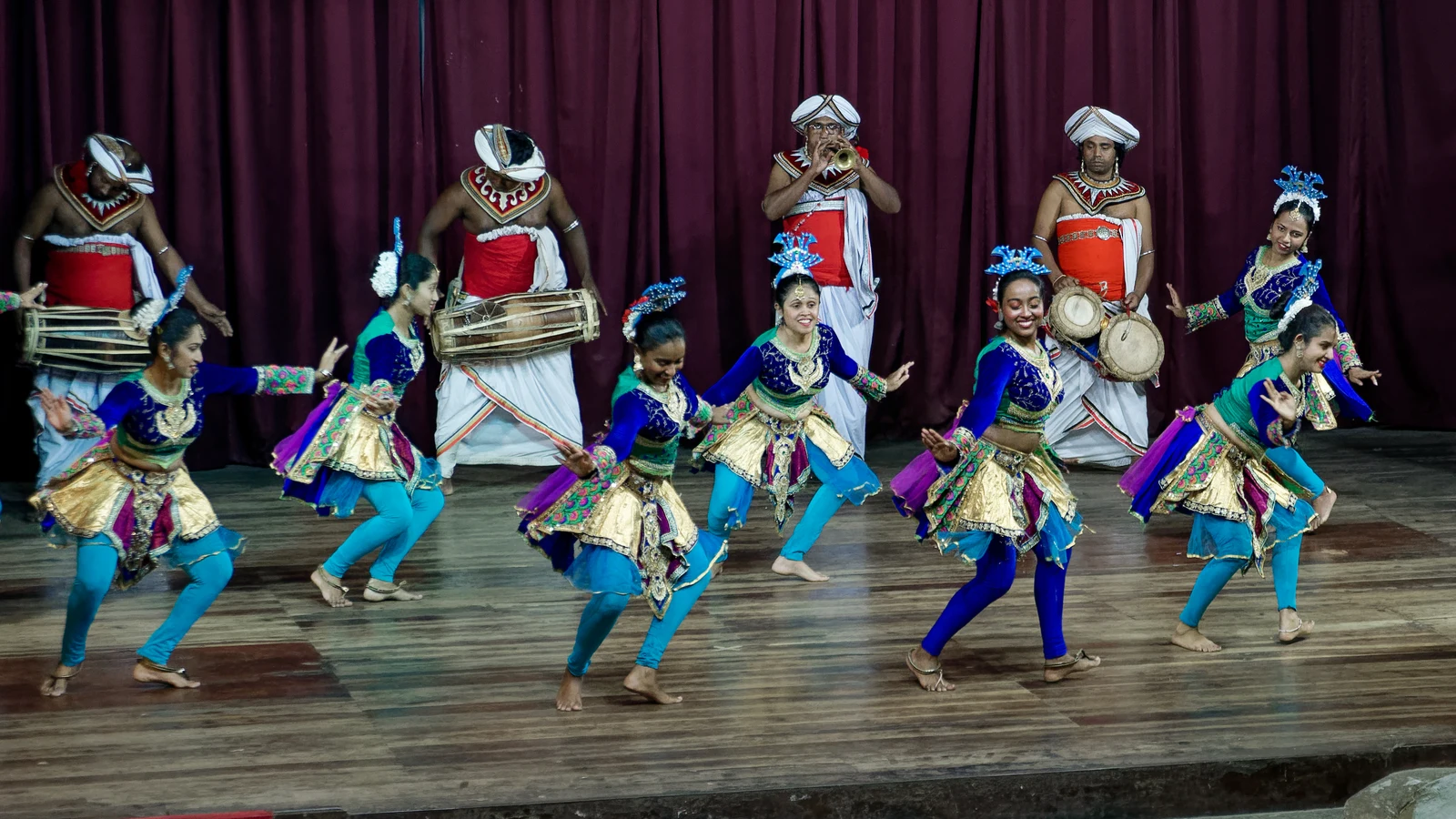
Musicians play a long two-headed wooden drum called the Geta Beraya.
The drum uses wood from kohomba trees and has different animal skins on each side.
The right side makes a sharp ring, while the left side produces a deep bass sound.
Teachers teach drum rhythms using spoken syllable words called bols such as tha-thi-thong-nha.
Small bronze cymbals called thalampota click clearly to keep the beat of the song.
Drummers play quick drum rolls called kasthiram and aragala to tell dancers when to speed up.
The music moves from slow vilambitha beats to very fast drutha tempo.
The Sacred Ves Regalia and the Investiture Rite
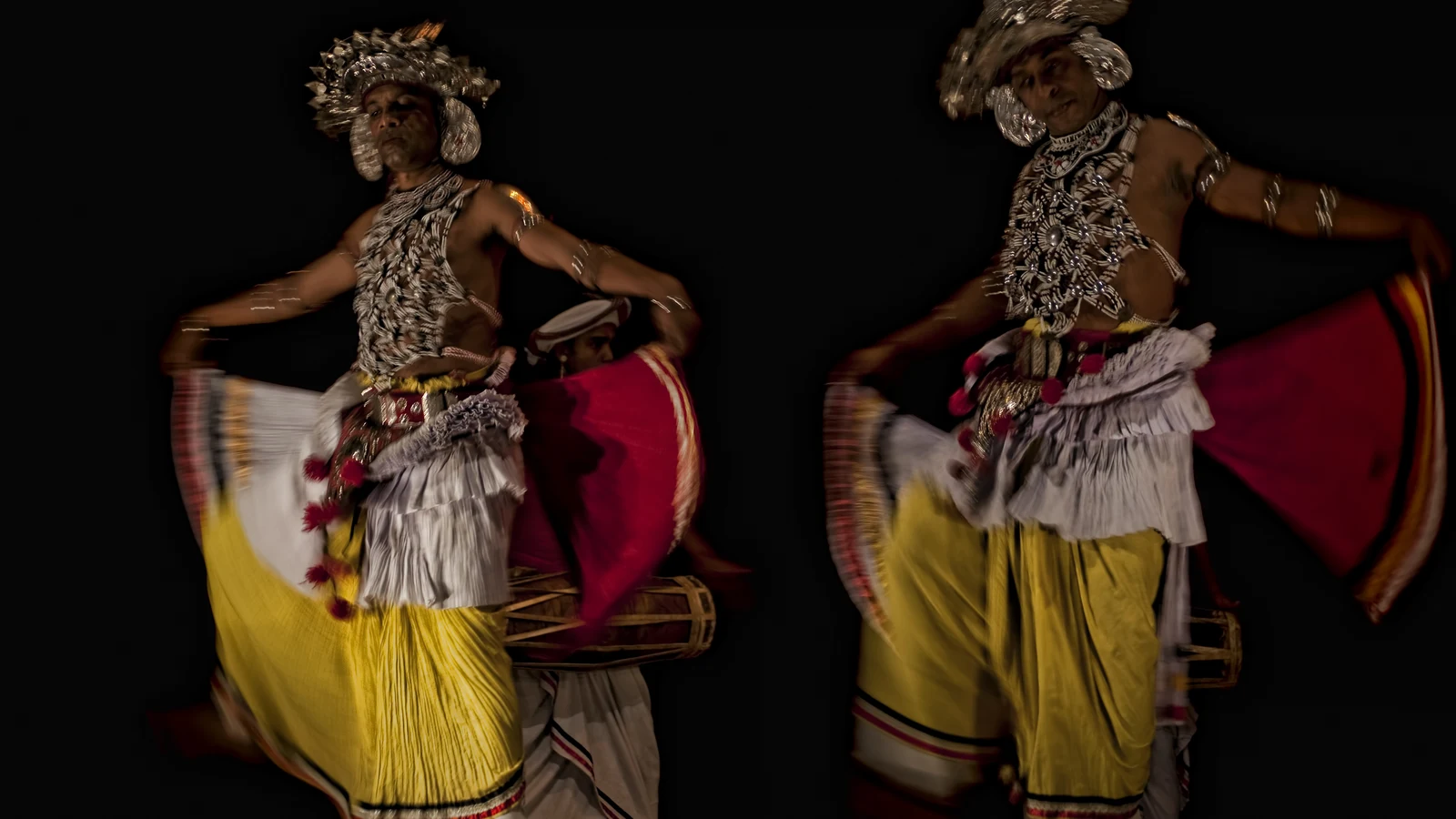
The sacred Ves dancer wears sixty-four traditional ornaments made of silver, beads, and cloth.
Dancers wear heavy brass bells called silambu around their ankles that ring with each step.
The most important piece is the Otunna, a tall silver headdress shaped like the sun.
A heavy chest ornament called the Avul-hera covers the body with strings of white beads.
Dancers complete an overnight temple ceremony called the Ves Bendeema to become master performers.
A master teacher ties on the silver headdress, giving the dancer the title of gurunnanse.
Custom rules forbid wearing the holy headdress outside sacred temple ceremonies.
Lineage Guilds, Classical Vannams, and Modern Stages
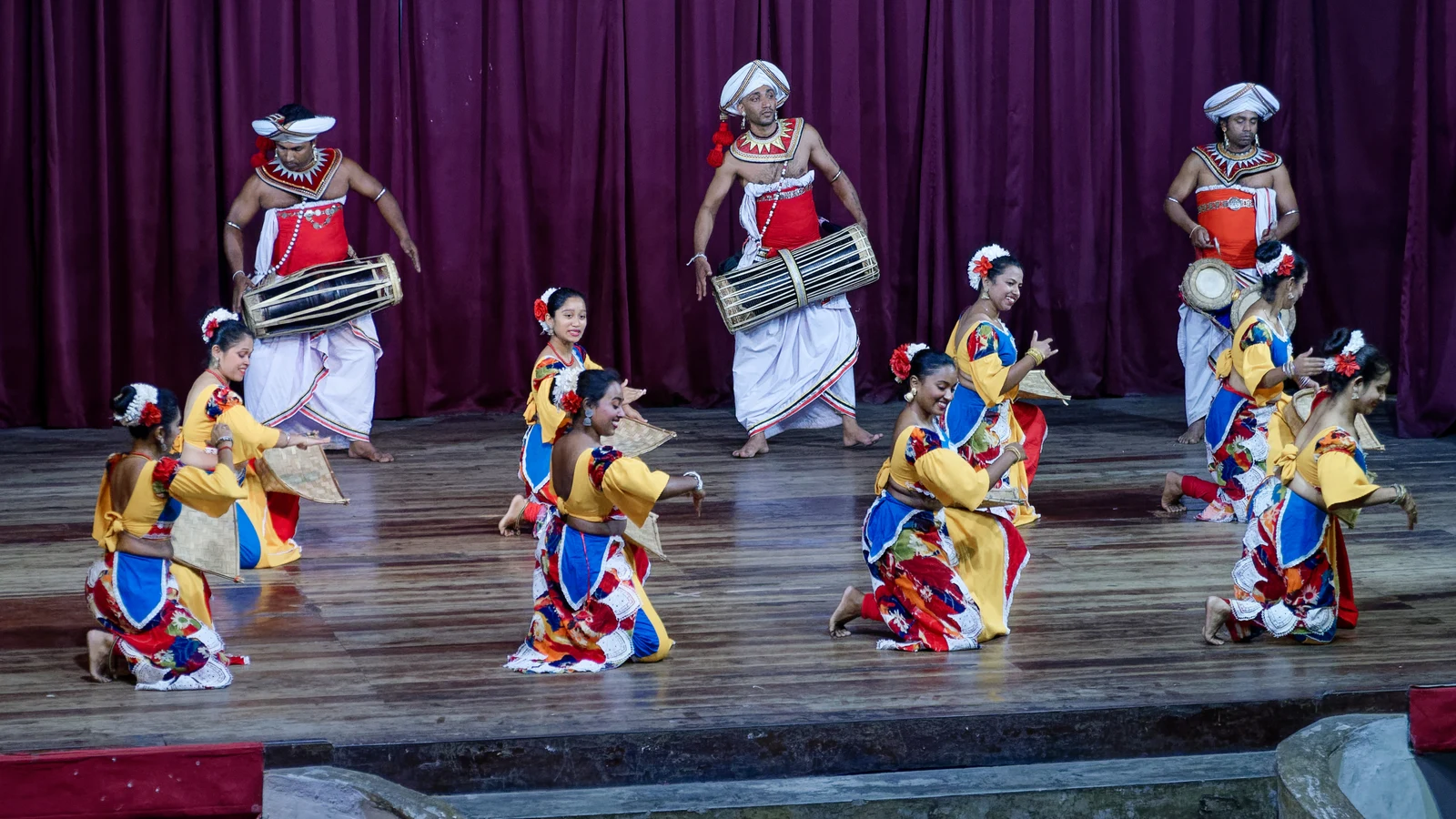
Families passed down dance skills across generations in famous artisan villages like Nittawela.
In the eighteenth century, King Sri Vira Parakrama Narendrasinha helped create eighteen classical Vannam dances.
These Vannam dances show the movements of animals such as the elephant in the Gajaga Vannama.
In modern times, pioneer artists like Chitrasena and Vajira brought traditional dance to world theater stages.
The university in Colombo now teaches college degrees in traditional Kandyan dance.
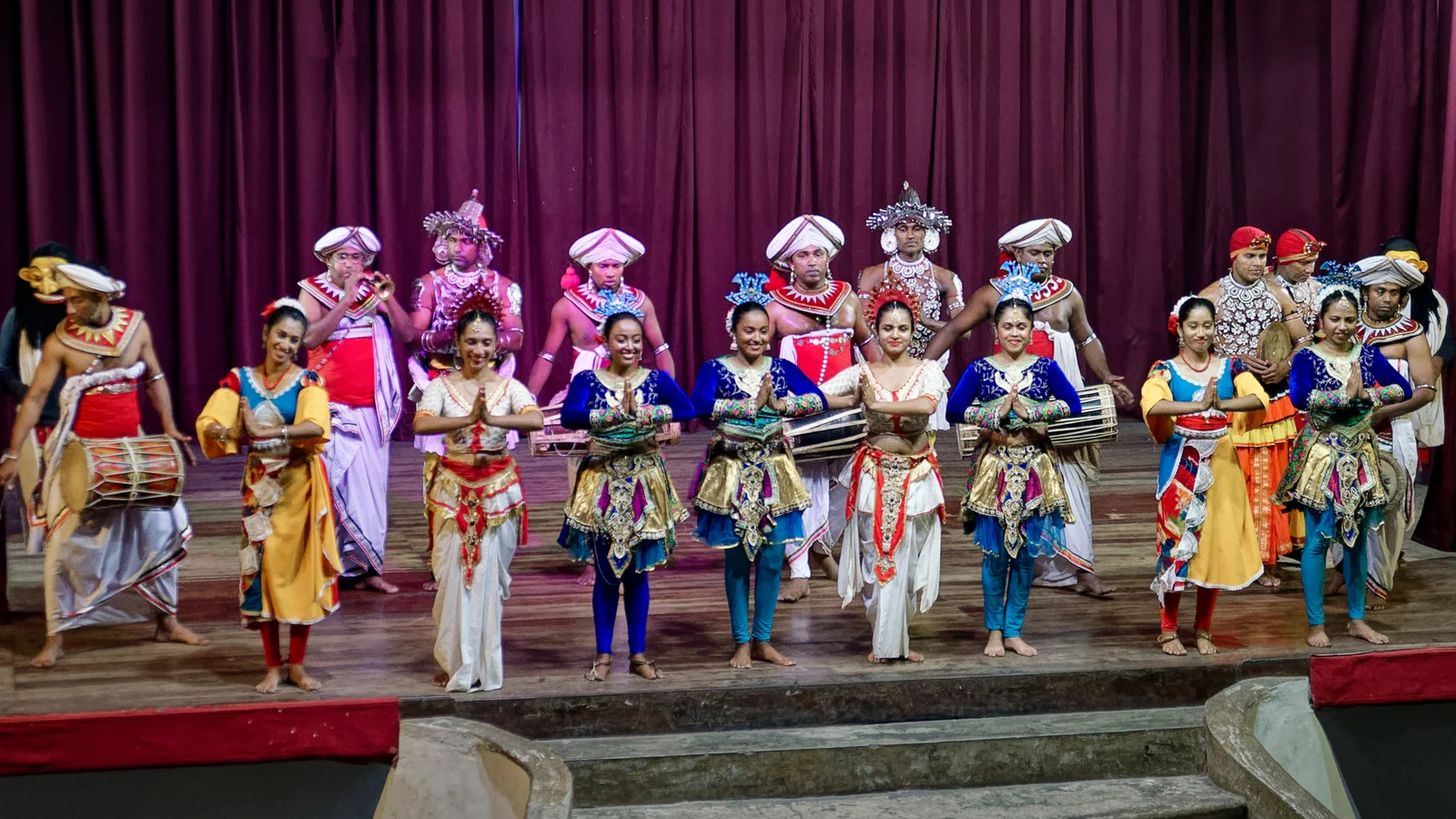
During the Kandy Esala Perahera, hundreds of dancers perform under torchlight before the sacred tooth relic.
A2 · Elementary
Kandyan Dance: Ritual Origins, Drum Rhythms, and Ves Headdresses
Traditional healing ceremonies, Geta Beraya drum rhythms, and sacred Ves costumes shape Sri Lanka classical dance.
Ritual Origins and the Kohomba Kankariya
Kandyan dance, known natively as Uda Rata Natum, originated as an ancient healing ritual called the Kohomba Kankariya performed to propitiate village deities. Historical mythology attributes the first Kohomba Kankariya to King Panduvasdeva, who sought ritual purification to cure a mysterious divine affliction. The dance system encompasses five primary classical forms: the sacred Ves, secular Naiyandi, acrobatic Uddekki, rhythmic Pantheru, and descriptive Vannam.
Performers maintain the mandala sthana, a foundational low-slung, wide-legged stance with bent knees that stabilizes dynamic footwork and sharp directional pivots. Traditional dance pedagogy is organized around twelve basic exercises known as dandiyavalkara, training apprentices in core posture, balance, and spatial coordination. Royal patronage under the Kingdom of Kandy transformed what was once an exclusive propitiatory village ritual into a prestigious court performance tradition.
Rhythmic Grammar and the Geta Beraya
Musical accompaniment is anchored by the Geta Beraya, an asymmetric double-headed barrel drum carved from the hardwood of kohomba or jak trees. The drum features distinct skins on each side, producing a high-pitched resonant tone on the right head and a deep muffled bass on the left. Drum masters articulate intricate rhythmic patterns through spoken mnemonic syllables called bols, including foundational phrases such as tha-thi-thong-nha.
A pair of handheld bronze cymbals known as thalampota provides high-register temporal accents, maintaining the fundamental cyclic meter of the performance. Drummers execute rapid improvisational flourishes known as kasthiram and aragala to signal dynamic transitions and climatic tempo accelerations to the dancers. The rhythmic structure operates across distinct tempos called laya, progressing systematically from slow vilambitha rhythms to exhilarating drutha speed.
The Sacred Ves Regalia and the Investiture Rite
The classical Ves costume comprises sixty-four sacred ornaments including silver armlets, beaded chest ornaments, and heavy cast-brass ankle bells known as silambu. The most sacred element of the regalia is the Otunna, a towering silver sun-disk headdress topped with filigree crests and pleated white side scarves. A complex beaded pectoral breastplate called the Avul-hera drapes across the dancer's torso, symbolizing divine armor and cosmic celestial order.
Male dancers undergo the rigorous Ves Bendeema investiture ceremony, an overnight initiation rite performed before an altar at a Buddhist temple or devale. During the Ves Bendeema, the apprentice's guru formally binds the sacred headdress for the first time, elevating the dancer to the revered rank of gurunnanse. Strict customary taboos prohibit wearing the full Ves headdress outside sacred ceremonial boundaries or without having completed the formal initiation ritual.
Lineage Guilds, Classical Vannams, and Modern Stages
Historical transmission was maintained through hereditary caste lineages known as paramparas, centered in ancestral artisan villages such as Nittawela and Kalgamuwa. In the eighteenth century during the reign of King Sri Vira Parakrama Narendrasinha, court poets and musicians composed the eighteen classical Vannam dances. The eighteen Vannams interpret the graceful movements and symbolic virtues of animals and mythological figures, including the majestic elephant in the Gajaga Vannama.
In the twentieth century, master performers and pioneer female dancers like Chitrasena and Vajira expanded the classical idiom to national theater stages and international tours. The University of the Visual and Performing Arts in Colombo institutionalized academic degree programs in Kandyan dance, standardizing notation and theoretical training. During the annual Kandy Esala Perahera, hundreds of Ves dancers and Geta Beraya drummers perform in nocturnal torchlit processions before the sacred tooth relic.
B1 · Intermediate
Ritual Lineages, Percussive Grammars, and Ves Regalia in Kandyan Dance
An analytical study of the Kohomba Kankariya, Geta Beraya rhythmic bols, and temple investiture rites in the Kandyan hills.
Ritual Origins and the Kohomba Kankariya
Kandyan dance, known natively as Uda Rata Natum, originated as an ancient healing ritual called the Kohomba Kankariya performed to propitiate village deities. Historical mythology attributes the first Kohomba Kankariya to King Panduvasdeva, who sought ritual purification to cure a mysterious divine affliction. The dance system encompasses five primary classical forms: the sacred Ves, secular Naiyandi, acrobatic Uddekki, rhythmic Pantheru, and descriptive Vannam.
Performers maintain the mandala sthana, a foundational low-slung, wide-legged stance with bent knees that stabilizes dynamic footwork and sharp directional pivots. Traditional dance pedagogy is organized around twelve basic exercises known as dandiyavalkara, training apprentices in core posture, balance, and spatial coordination. Royal patronage under the Kingdom of Kandy transformed what was once an exclusive propitiatory village ritual into a prestigious court performance tradition.
Rhythmic Grammar and the Geta Beraya
Musical accompaniment is anchored by the Geta Beraya, an asymmetric double-headed barrel drum carved from the hardwood of kohomba or jak trees. The drum features distinct skins on each side, producing a high-pitched resonant tone on the right head and a deep muffled bass on the left. Drum masters articulate intricate rhythmic patterns through spoken mnemonic syllables called bols, including foundational phrases such as tha-thi-thong-nha.
A pair of handheld bronze cymbals known as thalampota provides high-register temporal accents, maintaining the fundamental cyclic meter of the performance. Drummers execute rapid improvisational flourishes known as kasthiram and aragala to signal dynamic transitions and climatic tempo accelerations to the dancers. The rhythmic structure operates across distinct tempos called laya, progressing systematically from slow vilambitha rhythms to exhilarating drutha speed.
The Sacred Ves Regalia and the Investiture Rite
The classical Ves costume comprises sixty-four sacred ornaments including silver armlets, beaded chest ornaments, and heavy cast-brass ankle bells known as silambu. The most sacred element of the regalia is the Otunna, a towering silver sun-disk headdress topped with filigree crests and pleated white side scarves. A complex beaded pectoral breastplate called the Avul-hera drapes across the dancer's torso, symbolizing divine armor and cosmic celestial order.
Male dancers undergo the rigorous Ves Bendeema investiture ceremony, an overnight initiation rite performed before an altar at a Buddhist temple or devale. During the Ves Bendeema, the apprentice's guru formally binds the sacred headdress for the first time, elevating the dancer to the revered rank of gurunnanse. Strict customary taboos prohibit wearing the full Ves headdress outside sacred ceremonial boundaries or without having completed the formal initiation ritual.
Lineage Guilds, Classical Vannams, and Modern Stages
Historical transmission was maintained through hereditary caste lineages known as paramparas, centered in ancestral artisan villages such as Nittawela and Kalgamuwa. In the eighteenth century during the reign of King Sri Vira Parakrama Narendrasinha, court poets and musicians composed the eighteen classical Vannam dances. The eighteen Vannams interpret the graceful movements and symbolic virtues of animals and mythological figures, including the majestic elephant in the Gajaga Vannama.
In the twentieth century, master performers and pioneer female dancers like Chitrasena and Vajira expanded the classical idiom to national theater stages and international tours. The University of the Visual and Performing Arts in Colombo institutionalized academic degree programs in Kandyan dance, standardizing notation and theoretical training. During the annual Kandy Esala Perahera, hundreds of Ves dancers and Geta Beraya drummers perform in nocturnal torchlit processions before the sacred tooth relic.
B2 · Upper Intermediate
Choreographic Morphology, Percussive Acoustics, and Hereditary Transmission in Kandyan Dance
Examining sacred Ves regalia, complex tala metrics, parampara village lineages, and secular twentieth-century concert adaptations.
Ritual Origins and the Kohomba Kankariya
Kandyan dance, known natively as Uda Rata Natum, originated as an ancient healing ritual called the Kohomba Kankariya performed to propitiate village deities. Historical mythology attributes the first Kohomba Kankariya to King Panduvasdeva, who sought ritual purification to cure a mysterious divine affliction. The dance system encompasses five primary classical forms: the sacred Ves, secular Naiyandi, acrobatic Uddekki, rhythmic Pantheru, and descriptive Vannam.
Performers maintain the mandala sthana, a foundational low-slung, wide-legged stance with bent knees that stabilizes dynamic footwork and sharp directional pivots. Traditional dance pedagogy is organized around twelve basic exercises known as dandiyavalkara, training apprentices in core posture, balance, and spatial coordination. Royal patronage under the Kingdom of Kandy transformed what was once an exclusive propitiatory village ritual into a prestigious court performance tradition.
Rhythmic Grammar and the Geta Beraya
Musical accompaniment is anchored by the Geta Beraya, an asymmetric double-headed barrel drum carved from the hardwood of kohomba or jak trees. The drum features distinct skins on each side, producing a high-pitched resonant tone on the right head and a deep muffled bass on the left. Drum masters articulate intricate rhythmic patterns through spoken mnemonic syllables called bols, including foundational phrases such as tha-thi-thong-nha.
A pair of handheld bronze cymbals known as thalampota provides high-register temporal accents, maintaining the fundamental cyclic meter of the performance. Drummers execute rapid improvisational flourishes known as kasthiram and aragala to signal dynamic transitions and climatic tempo accelerations to the dancers. The rhythmic structure operates across distinct tempos called laya, progressing systematically from slow vilambitha rhythms to exhilarating drutha speed.
The Sacred Ves Regalia and the Investiture Rite
The classical Ves costume comprises sixty-four sacred ornaments including silver armlets, beaded chest ornaments, and heavy cast-brass ankle bells known as silambu. The most sacred element of the regalia is the Otunna, a towering silver sun-disk headdress topped with filigree crests and pleated white side scarves. A complex beaded pectoral breastplate called the Avul-hera drapes across the dancer's torso, symbolizing divine armor and cosmic celestial order.
Male dancers undergo the rigorous Ves Bendeema investiture ceremony, an overnight initiation rite performed before an altar at a Buddhist temple or devale. During the Ves Bendeema, the apprentice's guru formally binds the sacred headdress for the first time, elevating the dancer to the revered rank of gurunnanse. Strict customary taboos prohibit wearing the full Ves headdress outside sacred ceremonial boundaries or without having completed the formal initiation ritual.
Lineage Guilds, Classical Vannams, and Modern Stages
Historical transmission was maintained through hereditary caste lineages known as paramparas, centered in ancestral artisan villages such as Nittawela and Kalgamuwa. In the eighteenth century during the reign of King Sri Vira Parakrama Narendrasinha, court poets and musicians composed the eighteen classical Vannam dances. The eighteen Vannams interpret the graceful movements and symbolic virtues of animals and mythological figures, including the majestic elephant in the Gajaga Vannama.
In the twentieth century, master performers and pioneer female dancers like Chitrasena and Vajira expanded the classical idiom to national theater stages and international tours. The University of the Visual and Performing Arts in Colombo institutionalized academic degree programs in Kandyan dance, standardizing notation and theoretical training. During the annual Kandy Esala Perahera, hundreds of Ves dancers and Geta Beraya drummers perform in nocturnal torchlit processions before the sacred tooth relic.
C1 · Advanced
Ritual Geographies, Tala Metrics, and Hereditary Guild Pedagogies in Kandyan Dance
A critical investigation of the Kohomba Kankariya healing cycle, Geta Beraya percussive morphology, the Ves Bendeema rite, and classical Vannam compositions.
Ritual Origins and the Kohomba Kankariya
Kandyan dance, known natively as Uda Rata Natum, originated as an ancient healing ritual called the Kohomba Kankariya performed to propitiate village deities. Historical mythology attributes the first Kohomba Kankariya to King Panduvasdeva, who sought ritual purification to cure a mysterious divine affliction. The dance system encompasses five primary classical forms: the sacred Ves, secular Naiyandi, acrobatic Uddekki, rhythmic Pantheru, and descriptive Vannam.
Performers maintain the mandala sthana, a foundational low-slung, wide-legged stance with bent knees that stabilizes dynamic footwork and sharp directional pivots. Traditional dance pedagogy is organized around twelve basic exercises known as dandiyavalkara, training apprentices in core posture, balance, and spatial coordination. Royal patronage under the Kingdom of Kandy transformed what was once an exclusive propitiatory village ritual into a prestigious court performance tradition.
Rhythmic Grammar and the Geta Beraya
Musical accompaniment is anchored by the Geta Beraya, an asymmetric double-headed barrel drum carved from the hardwood of kohomba or jak trees. The drum features distinct skins on each side, producing a high-pitched resonant tone on the right head and a deep muffled bass on the left. Drum masters articulate intricate rhythmic patterns through spoken mnemonic syllables called bols, including foundational phrases such as tha-thi-thong-nha.
A pair of handheld bronze cymbals known as thalampota provides high-register temporal accents, maintaining the fundamental cyclic meter of the performance. Drummers execute rapid improvisational flourishes known as kasthiram and aragala to signal dynamic transitions and climatic tempo accelerations to the dancers. The rhythmic structure operates across distinct tempos called laya, progressing systematically from slow vilambitha rhythms to exhilarating drutha speed.
The Sacred Ves Regalia and the Investiture Rite
The classical Ves costume comprises sixty-four sacred ornaments including silver armlets, beaded chest ornaments, and heavy cast-brass ankle bells known as silambu. The most sacred element of the regalia is the Otunna, a towering silver sun-disk headdress topped with filigree crests and pleated white side scarves. A complex beaded pectoral breastplate called the Avul-hera drapes across the dancer's torso, symbolizing divine armor and cosmic celestial order.
Male dancers undergo the rigorous Ves Bendeema investiture ceremony, an overnight initiation rite performed before an altar at a Buddhist temple or devale. During the Ves Bendeema, the apprentice's guru formally binds the sacred headdress for the first time, elevating the dancer to the revered rank of gurunnanse. Strict customary taboos prohibit wearing the full Ves headdress outside sacred ceremonial boundaries or without having completed the formal initiation ritual.
Lineage Guilds, Classical Vannams, and Modern Stages
Historical transmission was maintained through hereditary caste lineages known as paramparas, centered in ancestral artisan villages such as Nittawela and Kalgamuwa. In the eighteenth century during the reign of King Sri Vira Parakrama Narendrasinha, court poets and musicians composed the eighteen classical Vannam dances. The eighteen Vannams interpret the graceful movements and symbolic virtues of animals and mythological figures, including the majestic elephant in the Gajaga Vannama.
In the twentieth century, master performers and pioneer female dancers like Chitrasena and Vajira expanded the classical idiom to national theater stages and international tours. The University of the Visual and Performing Arts in Colombo institutionalized academic degree programs in Kandyan dance, standardizing notation and theoretical training. During the annual Kandy Esala Perahera, hundreds of Ves dancers and Geta Beraya drummers perform in nocturnal torchlit processions before the sacred tooth relic.
C2 · Mastery
Liturgical Performance, Percussive Polyphony, and Lineage Transmutation in Kandyan Classical Dance
A rigorous analytical treatise on feudal court patronage, sacred regalia iconography, hereditary parampara guilds, and contemporary pedagogical institutionalization.
Ritual Origins and the Kohomba Kankariya
Kandyan dance, known natively as Uda Rata Natum, originated as an ancient healing ritual called the Kohomba Kankariya performed to propitiate village deities. Historical mythology attributes the first Kohomba Kankariya to King Panduvasdeva, who sought ritual purification to cure a mysterious divine affliction. The dance system encompasses five primary classical forms: the sacred Ves, secular Naiyandi, acrobatic Uddekki, rhythmic Pantheru, and descriptive Vannam.
Performers maintain the mandala sthana, a foundational low-slung, wide-legged stance with bent knees that stabilizes dynamic footwork and sharp directional pivots. Traditional dance pedagogy is organized around twelve basic exercises known as dandiyavalkara, training apprentices in core posture, balance, and spatial coordination. Royal patronage under the Kingdom of Kandy transformed what was once an exclusive propitiatory village ritual into a prestigious court performance tradition.
Rhythmic Grammar and the Geta Beraya
Musical accompaniment is anchored by the Geta Beraya, an asymmetric double-headed barrel drum carved from the hardwood of kohomba or jak trees. The drum features distinct skins on each side, producing a high-pitched resonant tone on the right head and a deep muffled bass on the left. Drum masters articulate intricate rhythmic patterns through spoken mnemonic syllables called bols, including foundational phrases such as tha-thi-thong-nha.
A pair of handheld bronze cymbals known as thalampota provides high-register temporal accents, maintaining the fundamental cyclic meter of the performance. Drummers execute rapid improvisational flourishes known as kasthiram and aragala to signal dynamic transitions and climatic tempo accelerations to the dancers. The rhythmic structure operates across distinct tempos called laya, progressing systematically from slow vilambitha rhythms to exhilarating drutha speed.
The Sacred Ves Regalia and the Investiture Rite
The classical Ves costume comprises sixty-four sacred ornaments including silver armlets, beaded chest ornaments, and heavy cast-brass ankle bells known as silambu. The most sacred element of the regalia is the Otunna, a towering silver sun-disk headdress topped with filigree crests and pleated white side scarves. A complex beaded pectoral breastplate called the Avul-hera drapes across the dancer's torso, symbolizing divine armor and cosmic celestial order.
Male dancers undergo the rigorous Ves Bendeema investiture ceremony, an overnight initiation rite performed before an altar at a Buddhist temple or devale. During the Ves Bendeema, the apprentice's guru formally binds the sacred headdress for the first time, elevating the dancer to the revered rank of gurunnanse. Strict customary taboos prohibit wearing the full Ves headdress outside sacred ceremonial boundaries or without having completed the formal initiation ritual.
Lineage Guilds, Classical Vannams, and Modern Stages
Historical transmission was maintained through hereditary caste lineages known as paramparas, centered in ancestral artisan villages such as Nittawela and Kalgamuwa. In the eighteenth century during the reign of King Sri Vira Parakrama Narendrasinha, court poets and musicians composed the eighteen classical Vannam dances. The eighteen Vannams interpret the graceful movements and symbolic virtues of animals and mythological figures, including the majestic elephant in the Gajaga Vannama.
In the twentieth century, master performers and pioneer female dancers like Chitrasena and Vajira expanded the classical idiom to national theater stages and international tours. The University of the Visual and Performing Arts in Colombo institutionalized academic degree programs in Kandyan dance, standardizing notation and theoretical training. During the annual Kandy Esala Perahera, hundreds of Ves dancers and Geta Beraya drummers perform in nocturnal torchlit processions before the sacred tooth relic.
Check your understanding
Choose how closely you want to revisit the article. You can refer back while answering, and review explanations when you finish.
Quick Quiz A1
Try one question, then create a free account for the full Quick Quiz. Sign Up Free
Answer every question before checking. There is no time limit.
Your results
/ 1 correct (%)
Read the explanations to see how each answer connects to the article.
-
What traditional name is given to Kandyan dance in Sri Lanka?
1. Answer:
Quick Quiz A2
Try one question, then create a free account for the full Quick Quiz. Sign Up Free
Answer every question before checking. There is no time limit.
Your results
/ 1 correct (%)
Read the explanations to see how each answer connects to the article.
-
What native Sinhala name designates the classical Kandyan dance tradition?
1. Answer:
Quick Quiz B1
Try one question, then create a free account for the full Quick Quiz. Sign Up Free
Answer every question before checking. There is no time limit.
Your results
/ 1 correct (%)
Read the explanations to see how each answer connects to the article.
-
What native Sinhala name designates the classical Kandyan dance tradition?
1. Answer:
Quick Quiz B2
Try one question, then create a free account for the full Quick Quiz. Sign Up Free
Answer every question before checking. There is no time limit.
Your results
/ 1 correct (%)
Read the explanations to see how each answer connects to the article.
-
What native Sinhala name designates the classical Kandyan dance tradition?
1. Answer:
Quick Quiz C1
Try one question, then create a free account for the full Quick Quiz. Sign Up Free
Answer every question before checking. There is no time limit.
Your results
/ 1 correct (%)
Read the explanations to see how each answer connects to the article.
-
What native Sinhala name designates the classical Kandyan dance tradition?
1. Answer:
Quick Quiz C2
Try one question, then create a free account for the full Quick Quiz. Sign Up Free
Answer every question before checking. There is no time limit.
Your results
/ 1 correct (%)
Read the explanations to see how each answer connects to the article.
-
What native Sinhala name designates the classical Kandyan dance tradition?
1. Answer:
