A1 · Beginner
Sinhala and Tamil Public Signs: Two Scripts on Roads and Stations
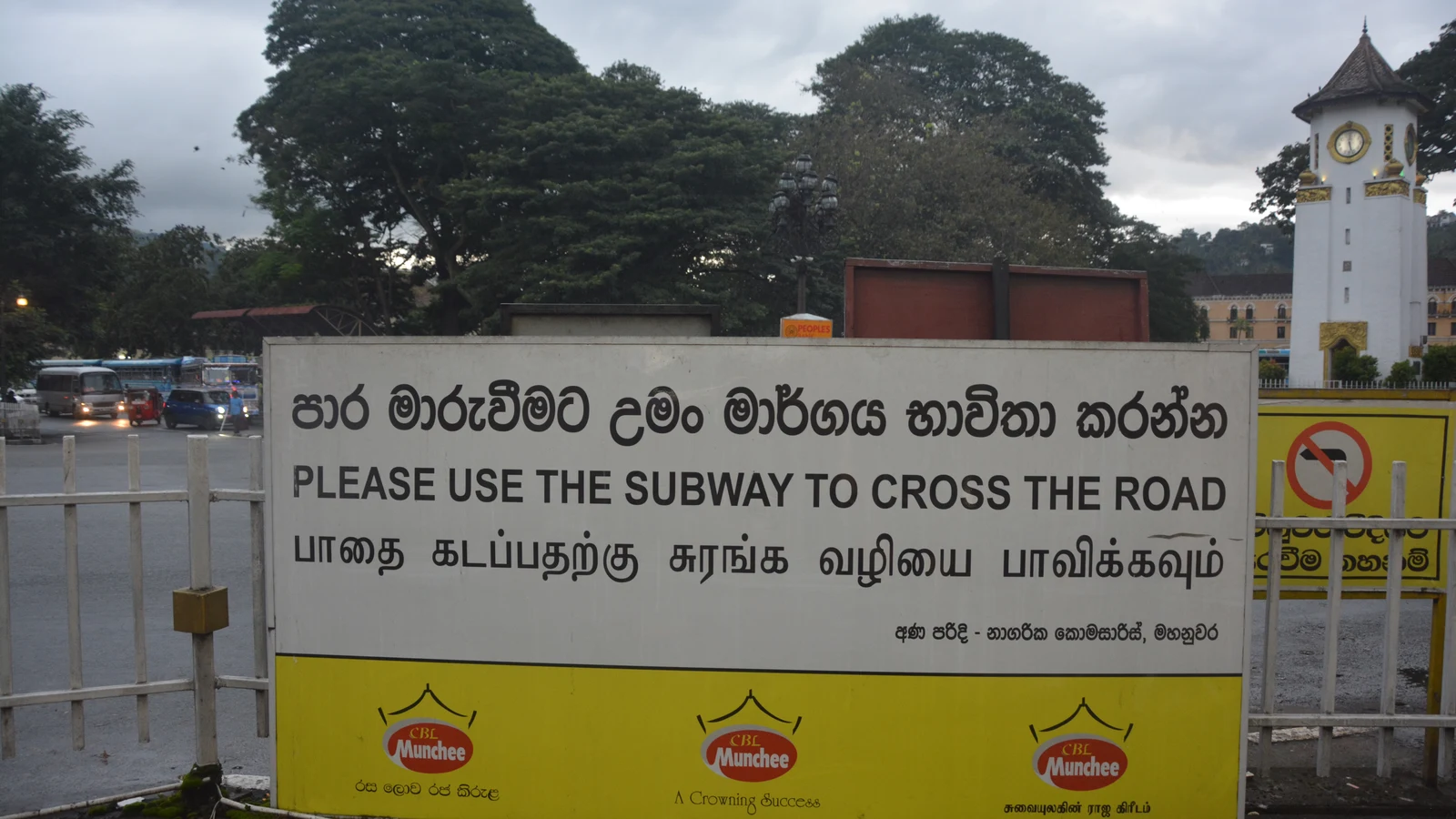
Signs across Sri Lanka show words in Sinhala, Tamil, and English on hospitals, highways, and railway platforms.
Constitutional Mandates and the Trilingual Landscape
Sri Lanka uses two official national languages called Sinhala and Tamil for public daily life.
Government offices must show signs in Sinhala, Tamil, and English with the same letter size.
Hospitals, law courts, and city halls put up signs showing all three languages together.
Officers visit public offices to check that signs include both national languages correctly.
Official citizen identity cards and paper birth forms show words printed in three languages.
Paper money notes display cash values written clearly in Sinhala, Tamil, and English.
Highway Wayfinding: Green Overhead Boards and Milestone Posts
Big green road signs stand beside national highways across the island.
Highway boards show city names with Sinhala on top, Tamil in the middle, and English below.
White concrete milestone posts along roads show distances to nearby towns in two scripts.
Road engineers make letters large and clear so night drivers can read road signs easily.
Towns in northern areas put Tamil words at the top of street name signs.
Electric road bridges over highways flash safe driving alerts in all three languages.
Station Nameboards: Railway Wayfinding across Nine Provinces
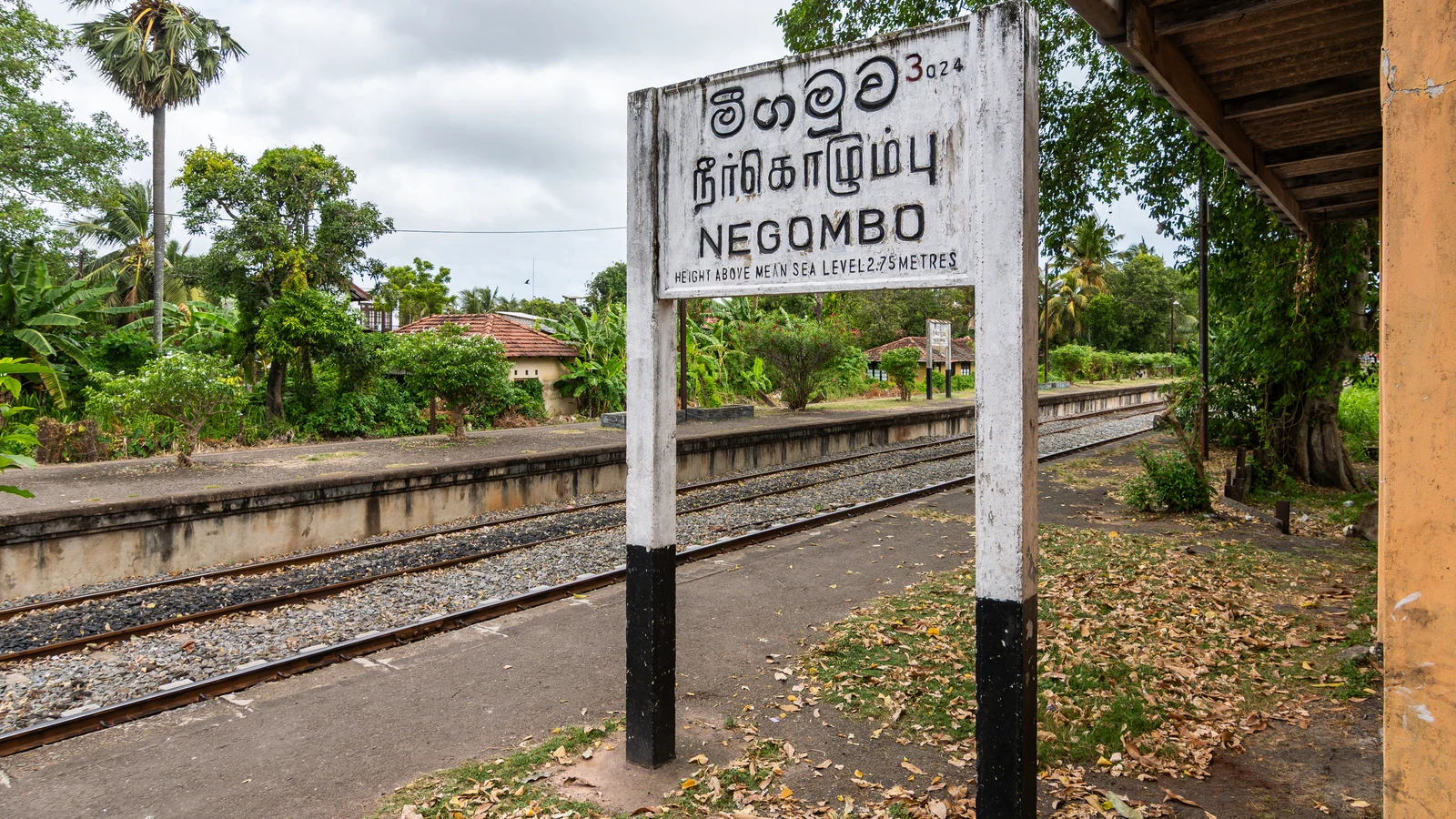
Every railway station in Sri Lanka uses long white nameboards on train platforms.
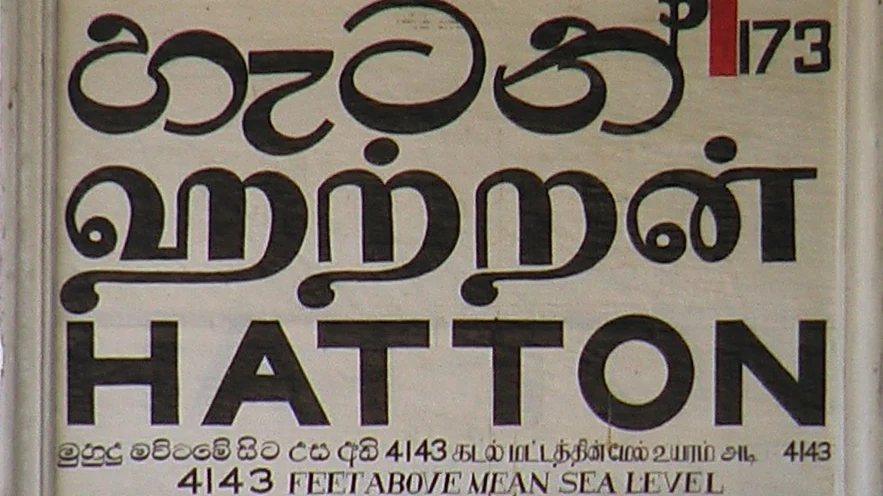
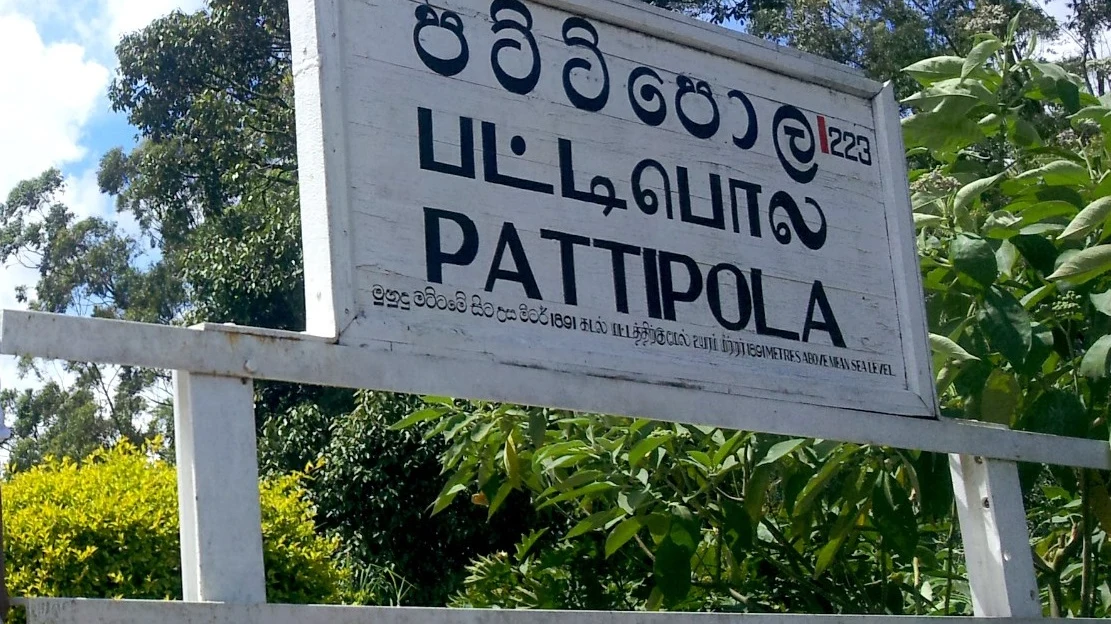
Station boards show town names in Sinhala on the left and Tamil in the middle.
The mountain station at Pattipola shows its high ground height in feet and metres.
Wooden boards hanging on train doors show starting stations and final stops in two languages.
Ticket window glass shows train times and ticket prices painted in three clear columns.
Workers keep old station letters safe while adding clean modern words in both languages.
Urban Realities: Translation Challenges and Community Corrections
Citizens take photos of spelling mistakes on street signs to help fix them.
People call a free government phone line to report missing words on public signs.
Shop owners in busy Colombo markets put three languages on shop front boards.
Bus number boards show route names in Sinhala and Tamil so travelers board quickly.
City councils put up new metal street signs with correct spelling across town.
Seeing two scripts every day helps people live together peacefully across the country.
A2 · Elementary
Sinhala and Tamil Public Signs: Green Highways and Platform Boards
Constitutional language parity, green highway destination boards, and station elevation signs shape public communication.
Constitutional Mandates and the Trilingual Landscape
Under the 16th Amendment to the Constitution of Sri Lanka, Sinhala and Tamil are recognized as the two official languages of administration, with English designated as the link language. The Official Languages Commission monitors public institutions to ensure state signs display Sinhala, Tamil, and English with equal visual prominence and identical font sizes. Across municipal boundaries, government ministries, hospitals, and courts must post trilingual entrance plaques identifying departmental services.
Linguistic compliance officers conduct periodic field inspections to verify that neither official language is omitted or subordinated on official public notices. National identity cards, driving licenses, and official birth certificates are issued with bilingual or trilingual headings and entries. The Central Bank of Sri Lanka prints currency notes featuring values and legal tender statements rendered simultaneously in Sinhala, Tamil, and English.
Highway Wayfinding: Green Overhead Boards and Milestone Posts
The Road Development Authority maintains standardized retroreflective green directional signs along national expressways and trunk roads. Directional boards display destination names and kilometre distances arranged vertically: Sinhala on top, Tamil in the middle, and English on the bottom. Concrete milestone markers along class-A highways feature carved or painted place initials and distances in alternating scripts.
Highway engineers calculate letter heights and stroke widths to ensure drivers travelling at speed can read each script under headlight illumination. In northern and eastern provinces with Tamil-majority populations, regional municipal councils prioritize Tamil script at the top of local street markers. Overhead electronic gantries on the Southern Expressway broadcast real-time traffic warnings and weather updates rotating through all three languages.
Station Nameboards: Railway Wayfinding across Nine Provinces
Sri Lanka Railways enforces a standardized rectangular nameboard format on every station platform from Colombo Fort to Jaffna and Badulla. Platform nameboards display the station name in large Sinhala letters on the left, Tamil letters in the middle, and English on the right or below. Summit stations like Pattipola prominently post ground elevation measurements in English feet and metric metres alongside the trilingual station name.
Manual wooden destination boards hung on passenger carriages indicate starting points and termini in Sinhala and Tamil characters. Ticket counter windows at regional terminals display fares, concession terms, and suburban timetables painted in three official columns. Station renovation guidelines strictly prohibit painting over historical colonial typography while requiring the addition of accurate modern Tamil and Sinhala orthography.
Urban Realities: Translation Challenges and Community Corrections
Independent civic watchdogs and language activists frequently photograph and document spelling errors, clumsy machine translations, and missing Tamil text on municipal signage. The Official Languages Commission operates a public complaints hotline where citizens report distorted transliterations or omitted scripts on government signboards. Private commercial shopfronts in multiethnic urban trading hubs like Pettah and Wellawatte voluntarily display trilingual merchant boards to welcome all shoppers.
Route number boards on private and state buses display primary destinations in Sinhala and Tamil to facilitate effortless passenger boarding. Municipal rectification programs replace non-compliant street nameplates with standardized baked-enamel trilingual signage across provincial capitals. The ubiquitous daily encounter with shared scripts normalizes linguistic coexistence across Sri Lanka's public roads, markets, and transit spaces.
B1 · Intermediate
Linguistic Parity, Retroreflective Signage, and Administrative Codes
An analytical study of the 16th Amendment, official language audits, and standardized railway typography across nine provinces.
Constitutional Mandates and the Trilingual Landscape
Under the 16th Amendment to the Constitution of Sri Lanka, Sinhala and Tamil are recognized as the two official languages of administration, with English designated as the link language. The Official Languages Commission monitors public institutions to ensure state signs display Sinhala, Tamil, and English with equal visual prominence and identical font sizes. Across municipal boundaries, government ministries, hospitals, and courts must post trilingual entrance plaques identifying departmental services.
Linguistic compliance officers conduct periodic field inspections to verify that neither official language is omitted or subordinated on official public notices. National identity cards, driving licenses, and official birth certificates are issued with bilingual or trilingual headings and entries. The Central Bank of Sri Lanka prints currency notes featuring values and legal tender statements rendered simultaneously in Sinhala, Tamil, and English.
Highway Wayfinding: Green Overhead Boards and Milestone Posts
The Road Development Authority maintains standardized retroreflective green directional signs along national expressways and trunk roads. Directional boards display destination names and kilometre distances arranged vertically: Sinhala on top, Tamil in the middle, and English on the bottom. Concrete milestone markers along class-A highways feature carved or painted place initials and distances in alternating scripts.
Highway engineers calculate letter heights and stroke widths to ensure drivers travelling at speed can read each script under headlight illumination. In northern and eastern provinces with Tamil-majority populations, regional municipal councils prioritize Tamil script at the top of local street markers. Overhead electronic gantries on the Southern Expressway broadcast real-time traffic warnings and weather updates rotating through all three languages.
Station Nameboards: Railway Wayfinding across Nine Provinces
Sri Lanka Railways enforces a standardized rectangular nameboard format on every station platform from Colombo Fort to Jaffna and Badulla. Platform nameboards display the station name in large Sinhala letters on the left, Tamil letters in the middle, and English on the right or below. Summit stations like Pattipola prominently post ground elevation measurements in English feet and metric metres alongside the trilingual station name.
Manual wooden destination boards hung on passenger carriages indicate starting points and termini in Sinhala and Tamil characters. Ticket counter windows at regional terminals display fares, concession terms, and suburban timetables painted in three official columns. Station renovation guidelines strictly prohibit painting over historical colonial typography while requiring the addition of accurate modern Tamil and Sinhala orthography.
Urban Realities: Translation Challenges and Community Corrections
Independent civic watchdogs and language activists frequently photograph and document spelling errors, clumsy machine translations, and missing Tamil text on municipal signage. The Official Languages Commission operates a public complaints hotline where citizens report distorted transliterations or omitted scripts on government signboards. Private commercial shopfronts in multiethnic urban trading hubs like Pettah and Wellawatte voluntarily display trilingual merchant boards to welcome all shoppers.
Route number boards on private and state buses display primary destinations in Sinhala and Tamil to facilitate effortless passenger boarding. Municipal rectification programs replace non-compliant street nameplates with standardized baked-enamel trilingual signage across provincial capitals. The ubiquitous daily encounter with shared scripts normalizes linguistic coexistence across Sri Lanka's public roads, markets, and transit spaces.
B2 · Upper Intermediate
Visual Parity, Variable Message Gantries, and Municipal Rectification
Investigating legibility metrics under vehicle illumination, summit station elevation records, and citizen watchdog reporting.
Constitutional Mandates and the Trilingual Landscape
Under the 16th Amendment to the Constitution of Sri Lanka, Sinhala and Tamil are recognized as the two official languages of administration, with English designated as the link language. The Official Languages Commission monitors public institutions to ensure state signs display Sinhala, Tamil, and English with equal visual prominence and identical font sizes. Across municipal boundaries, government ministries, hospitals, and courts must post trilingual entrance plaques identifying departmental services.
Linguistic compliance officers conduct periodic field inspections to verify that neither official language is omitted or subordinated on official public notices. National identity cards, driving licenses, and official birth certificates are issued with bilingual or trilingual headings and entries. The Central Bank of Sri Lanka prints currency notes featuring values and legal tender statements rendered simultaneously in Sinhala, Tamil, and English.
Highway Wayfinding: Green Overhead Boards and Milestone Posts
The Road Development Authority maintains standardized retroreflective green directional signs along national expressways and trunk roads. Directional boards display destination names and kilometre distances arranged vertically: Sinhala on top, Tamil in the middle, and English on the bottom. Concrete milestone markers along class-A highways feature carved or painted place initials and distances in alternating scripts.
Highway engineers calculate letter heights and stroke widths to ensure drivers travelling at speed can read each script under headlight illumination. In northern and eastern provinces with Tamil-majority populations, regional municipal councils prioritize Tamil script at the top of local street markers. Overhead electronic gantries on the Southern Expressway broadcast real-time traffic warnings and weather updates rotating through all three languages.
Station Nameboards: Railway Wayfinding across Nine Provinces
Sri Lanka Railways enforces a standardized rectangular nameboard format on every station platform from Colombo Fort to Jaffna and Badulla. Platform nameboards display the station name in large Sinhala letters on the left, Tamil letters in the middle, and English on the right or below. Summit stations like Pattipola prominently post ground elevation measurements in English feet and metric metres alongside the trilingual station name.
Manual wooden destination boards hung on passenger carriages indicate starting points and termini in Sinhala and Tamil characters. Ticket counter windows at regional terminals display fares, concession terms, and suburban timetables painted in three official columns. Station renovation guidelines strictly prohibit painting over historical colonial typography while requiring the addition of accurate modern Tamil and Sinhala orthography.
Urban Realities: Translation Challenges and Community Corrections
Independent civic watchdogs and language activists frequently photograph and document spelling errors, clumsy machine translations, and missing Tamil text on municipal signage. The Official Languages Commission operates a public complaints hotline where citizens report distorted transliterations or omitted scripts on government signboards. Private commercial shopfronts in multiethnic urban trading hubs like Pettah and Wellawatte voluntarily display trilingual merchant boards to welcome all shoppers.
Route number boards on private and state buses display primary destinations in Sinhala and Tamil to facilitate effortless passenger boarding. Municipal rectification programs replace non-compliant street nameplates with standardized baked-enamel trilingual signage across provincial capitals. The ubiquitous daily encounter with shared scripts normalizes linguistic coexistence across Sri Lanka's public roads, markets, and transit spaces.
C1 · Advanced
Linguistic Landscapes, Constitutional Semiotics, and Public Wayfinding in Sri Lanka
A critical examination of official trilingual policies, retroreflective highway cartography, and community rectification movements.
Constitutional Mandates and the Trilingual Landscape
Under the 16th Amendment to the Constitution of Sri Lanka, Sinhala and Tamil are recognized as the two official languages of administration, with English designated as the link language. The Official Languages Commission monitors public institutions to ensure state signs display Sinhala, Tamil, and English with equal visual prominence and identical font sizes. Across municipal boundaries, government ministries, hospitals, and courts must post trilingual entrance plaques identifying departmental services.
Linguistic compliance officers conduct periodic field inspections to verify that neither official language is omitted or subordinated on official public notices. National identity cards, driving licenses, and official birth certificates are issued with bilingual or trilingual headings and entries. The Central Bank of Sri Lanka prints currency notes featuring values and legal tender statements rendered simultaneously in Sinhala, Tamil, and English.
Highway Wayfinding: Green Overhead Boards and Milestone Posts
The Road Development Authority maintains standardized retroreflective green directional signs along national expressways and trunk roads. Directional boards display destination names and kilometre distances arranged vertically: Sinhala on top, Tamil in the middle, and English on the bottom. Concrete milestone markers along class-A highways feature carved or painted place initials and distances in alternating scripts.
Highway engineers calculate letter heights and stroke widths to ensure drivers travelling at speed can read each script under headlight illumination. In northern and eastern provinces with Tamil-majority populations, regional municipal councils prioritize Tamil script at the top of local street markers. Overhead electronic gantries on the Southern Expressway broadcast real-time traffic warnings and weather updates rotating through all three languages.
Station Nameboards: Railway Wayfinding across Nine Provinces
Sri Lanka Railways enforces a standardized rectangular nameboard format on every station platform from Colombo Fort to Jaffna and Badulla. Platform nameboards display the station name in large Sinhala letters on the left, Tamil letters in the middle, and English on the right or below. Summit stations like Pattipola prominently post ground elevation measurements in English feet and metric metres alongside the trilingual station name.
Manual wooden destination boards hung on passenger carriages indicate starting points and termini in Sinhala and Tamil characters. Ticket counter windows at regional terminals display fares, concession terms, and suburban timetables painted in three official columns. Station renovation guidelines strictly prohibit painting over historical colonial typography while requiring the addition of accurate modern Tamil and Sinhala orthography.
Urban Realities: Translation Challenges and Community Corrections
Independent civic watchdogs and language activists frequently photograph and document spelling errors, clumsy machine translations, and missing Tamil text on municipal signage. The Official Languages Commission operates a public complaints hotline where citizens report distorted transliterations or omitted scripts on government signboards. Private commercial shopfronts in multiethnic urban trading hubs like Pettah and Wellawatte voluntarily display trilingual merchant boards to welcome all shoppers.
Route number boards on private and state buses display primary destinations in Sinhala and Tamil to facilitate effortless passenger boarding. Municipal rectification programs replace non-compliant street nameplates with standardized baked-enamel trilingual signage across provincial capitals. The ubiquitous daily encounter with shared scripts normalizes linguistic coexistence across Sri Lanka's public roads, markets, and transit spaces.
C2 · Mastery
Visual Hegemonies, Script Equivalence, and Everyday Semiotic Landscapes in Sri Lanka
A comprehensive analytical monograph detailing state language policy enforcement, typographic preservation on railway heritage structures, and grassroots error oversight.
Constitutional Mandates and the Trilingual Landscape
Under the 16th Amendment to the Constitution of Sri Lanka, Sinhala and Tamil are recognized as the two official languages of administration, with English designated as the link language. The Official Languages Commission monitors public institutions to ensure state signs display Sinhala, Tamil, and English with equal visual prominence and identical font sizes. Across municipal boundaries, government ministries, hospitals, and courts must post trilingual entrance plaques identifying departmental services.
Linguistic compliance officers conduct periodic field inspections to verify that neither official language is omitted or subordinated on official public notices. National identity cards, driving licenses, and official birth certificates are issued with bilingual or trilingual headings and entries. The Central Bank of Sri Lanka prints currency notes featuring values and legal tender statements rendered simultaneously in Sinhala, Tamil, and English.
Highway Wayfinding: Green Overhead Boards and Milestone Posts
The Road Development Authority maintains standardized retroreflective green directional signs along national expressways and trunk roads. Directional boards display destination names and kilometre distances arranged vertically: Sinhala on top, Tamil in the middle, and English on the bottom. Concrete milestone markers along class-A highways feature carved or painted place initials and distances in alternating scripts.
Highway engineers calculate letter heights and stroke widths to ensure drivers travelling at speed can read each script under headlight illumination. In northern and eastern provinces with Tamil-majority populations, regional municipal councils prioritize Tamil script at the top of local street markers. Overhead electronic gantries on the Southern Expressway broadcast real-time traffic warnings and weather updates rotating through all three languages.
Station Nameboards: Railway Wayfinding across Nine Provinces
Sri Lanka Railways enforces a standardized rectangular nameboard format on every station platform from Colombo Fort to Jaffna and Badulla. Platform nameboards display the station name in large Sinhala letters on the left, Tamil letters in the middle, and English on the right or below. Summit stations like Pattipola prominently post ground elevation measurements in English feet and metric metres alongside the trilingual station name.
Manual wooden destination boards hung on passenger carriages indicate starting points and termini in Sinhala and Tamil characters. Ticket counter windows at regional terminals display fares, concession terms, and suburban timetables painted in three official columns. Station renovation guidelines strictly prohibit painting over historical colonial typography while requiring the addition of accurate modern Tamil and Sinhala orthography.
Urban Realities: Translation Challenges and Community Corrections
Independent civic watchdogs and language activists frequently photograph and document spelling errors, clumsy machine translations, and missing Tamil text on municipal signage. The Official Languages Commission operates a public complaints hotline where citizens report distorted transliterations or omitted scripts on government signboards. Private commercial shopfronts in multiethnic urban trading hubs like Pettah and Wellawatte voluntarily display trilingual merchant boards to welcome all shoppers.
Route number boards on private and state buses display primary destinations in Sinhala and Tamil to facilitate effortless passenger boarding. Municipal rectification programs replace non-compliant street nameplates with standardized baked-enamel trilingual signage across provincial capitals. The ubiquitous daily encounter with shared scripts normalizes linguistic coexistence across Sri Lanka's public roads, markets, and transit spaces.
Check your understanding
Choose how closely you want to revisit the article. You can refer back while answering, and review explanations when you finish.
Quick Quiz A1
Try one question, then create a free account for the full Quick Quiz. Sign Up Free
Answer every question before checking. There is no time limit.
Your results
/ 1 correct (%)
Read the explanations to see how each answer connects to the article.
-
What two official languages does Sri Lanka use for daily public life?
1. Answer:
Quick Quiz A2
Try one question, then create a free account for the full Quick Quiz. Sign Up Free
Answer every question before checking. There is no time limit.
Your results
/ 1 correct (%)
Read the explanations to see how each answer connects to the article.
-
What constitutional amendment recognizes Sinhala and Tamil as the two official languages?
1. Answer:
Quick Quiz B1
Try one question, then create a free account for the full Quick Quiz. Sign Up Free
Answer every question before checking. There is no time limit.
Your results
/ 1 correct (%)
Read the explanations to see how each answer connects to the article.
-
What constitutional amendment recognizes Sinhala and Tamil as the two official languages?
1. Answer:
Quick Quiz B2
Try one question, then create a free account for the full Quick Quiz. Sign Up Free
Answer every question before checking. There is no time limit.
Your results
/ 1 correct (%)
Read the explanations to see how each answer connects to the article.
-
What constitutional amendment recognizes Sinhala and Tamil as the two official languages?
1. Answer:
Quick Quiz C1
Try one question, then create a free account for the full Quick Quiz. Sign Up Free
Answer every question before checking. There is no time limit.
Your results
/ 1 correct (%)
Read the explanations to see how each answer connects to the article.
-
What constitutional amendment recognizes Sinhala and Tamil as the two official languages?
1. Answer:
Quick Quiz C2
Try one question, then create a free account for the full Quick Quiz. Sign Up Free
Answer every question before checking. There is no time limit.
Your results
/ 1 correct (%)
Read the explanations to see how each answer connects to the article.
-
What constitutional amendment recognizes Sinhala and Tamil as the two official languages?
1. Answer:
