A1 · Beginner
Sudan Date Palm Harvest: Green Groves and River Markets
Northern farms along the Nile grow sweet dates that workers climb, dry in the sun, and sell in town markets.
Cultivation and Palm Groves Along the Nile
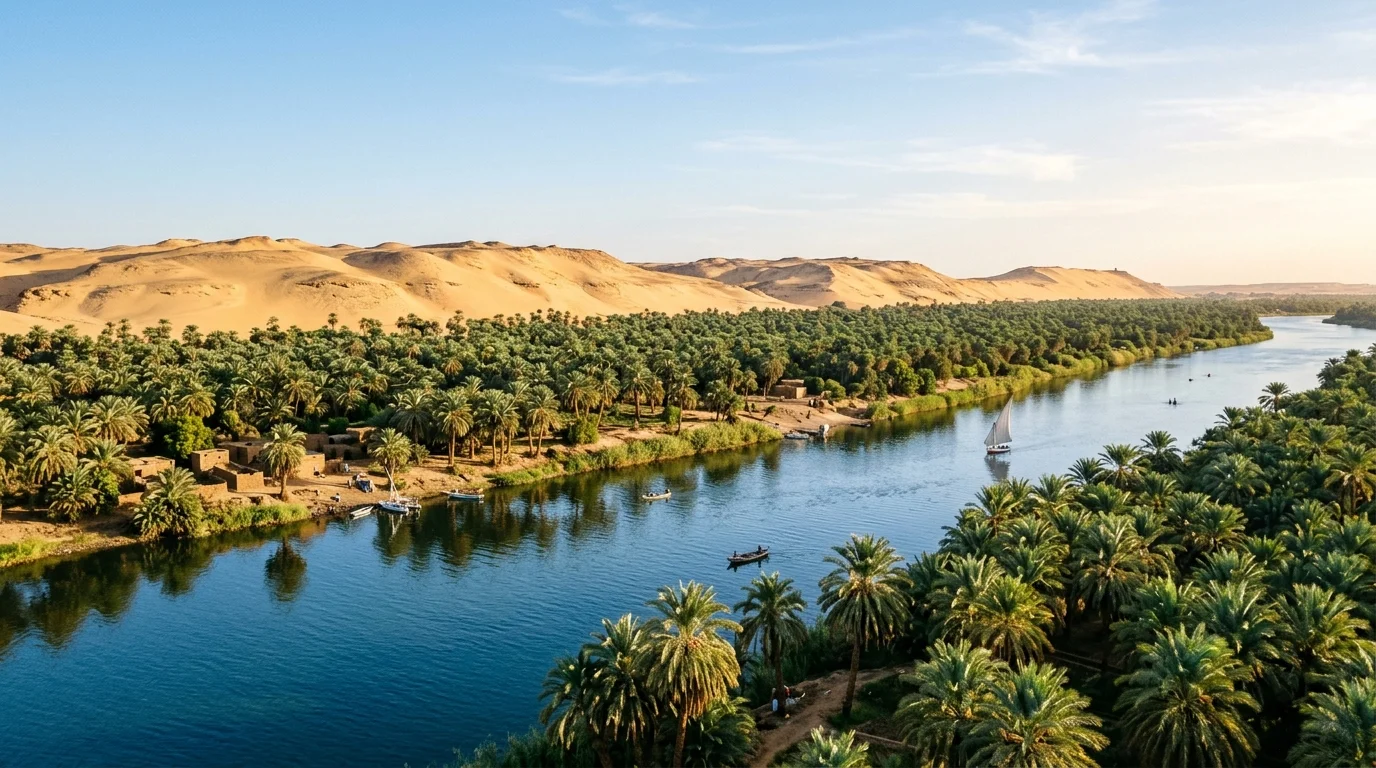
Northern State has green date palm groves along the Nile river.
Over eight million date palm trees grow in northern Sudan.
Barakawi dates and sweet cultivars grow well in the hot summer.
Water pumps and river flows bring water to town farms.
Date farming gives food and work to river families.
Tall date palm trees protect farm fields from desert sand.
Harvesting Mechanics and Arboreal Climbing
The annual date harvest takes place in late summer months.
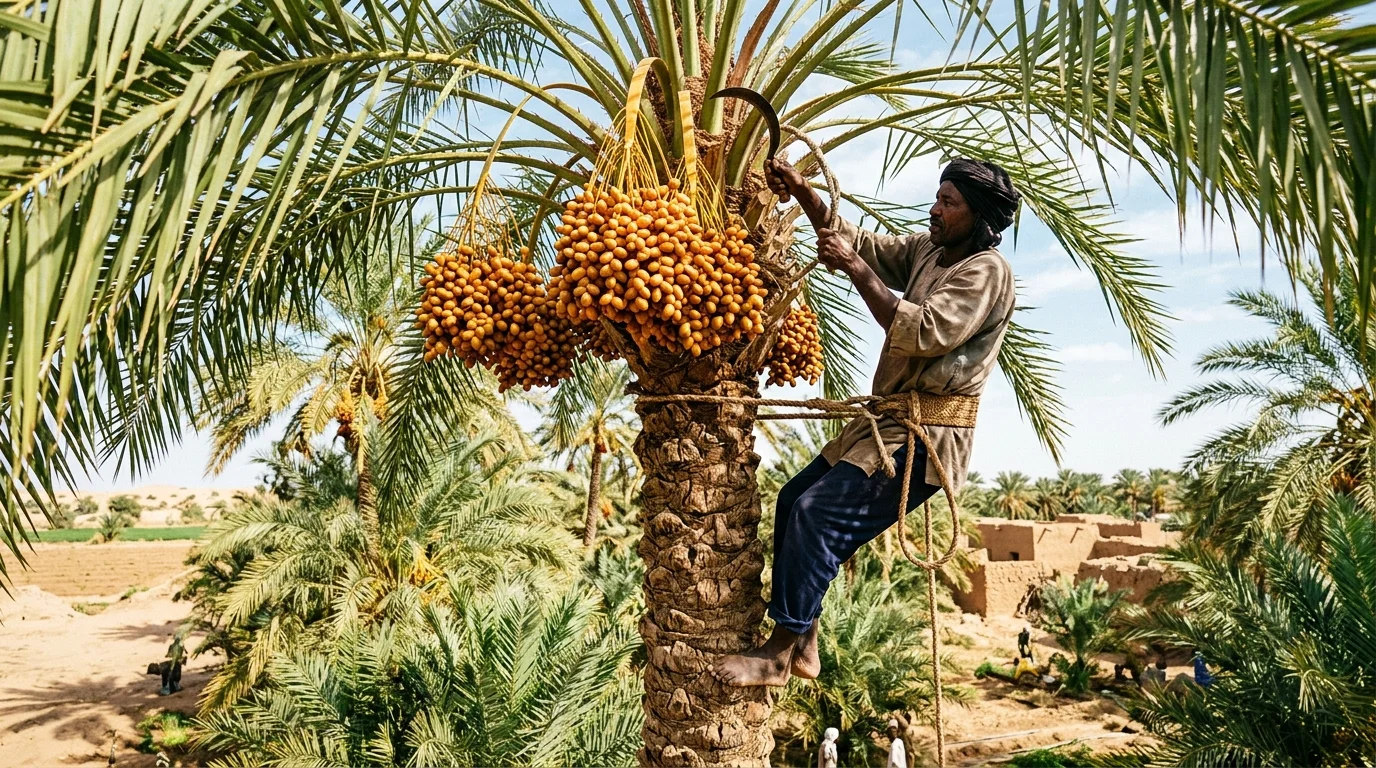
Workers climb tall date palm trees using strong rope belts.
Skilled climbers cut heavy date bunches with curved knives.
Workers catch falling date bunches in big canvas sheets.
Young workers learn palm climbing from older family members.
Climbers check tree trunk steps and ropes before climbing.
Solar Drying and Post-Harvest Curing
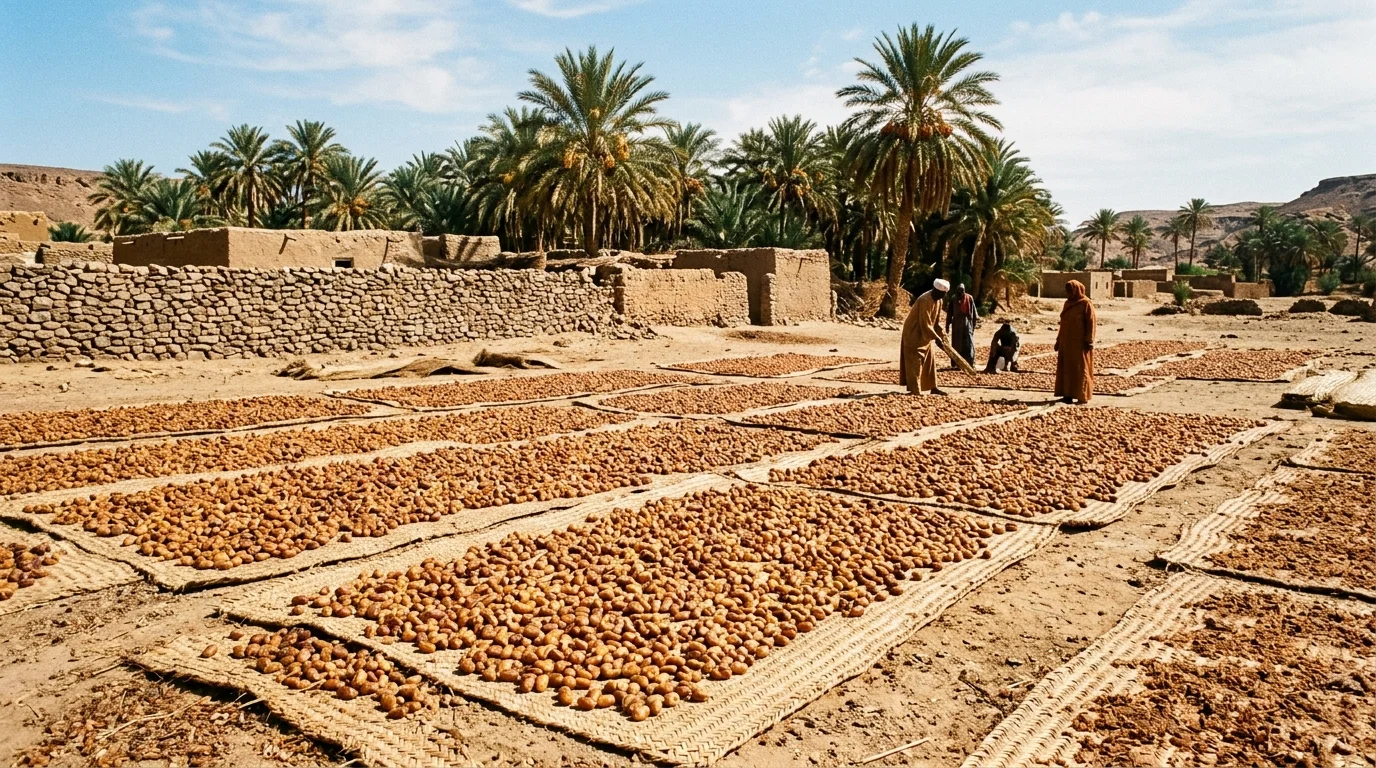
Workers put Barakawi dates on palm mats for sun drying.
Warm desert sunlight helps dry the sweet dates quickly.
Dry dates keep well in home storage for long years.
Farm workers sort sweet dates by good size and color.
Good dates go to town shops and others make date syrup.
Natural sun drying preserves sweet fruit sugars and food health.
Riverine Trade and Wholesale Markets
Town markets pack dry dates into big heavy sacks.
River boats and trucks carry dates to Port Sudan markets.
Sudan sends sweet dry dates to Egypt and African trade hubs.
Families eat sweet Barakawi dates during holy Ramadan fasting meals.
Riverbank auctions set good market prices for date farmers.
Cooperative farming groups help small growers sell sweet dates.

A2 · Elementary
Sudan Nile Date Harvest: Desert Palm Groves and Riverine Trade
Along the fertile riverbanks of Northern State, millions of date palms yield prized cultivars through skilled climbing, solar drying, and river trade.
Cultivation and Palm Groves Along the Nile
Northern State and River Nile State along the fertile Nile riverbanks comprise Sudan's premier date palm agricultural belt. Over eight million date palms grow along the northern Sudanese Nile, sustained by riverbank basin irrigation and rich alluvial silt deposits that provide vital soil sustenance. Barakawi, Gondeila, Jaw, and Mishrig cultivars represent the dominant commercial varieties uniquely adapted to extreme arid desert temperatures. Seasonal Nile river flows and solar-powered groundwater pumps nourish date palm groves stretching between Dongola, Karima, and Abu Hamad.
Date farming remains the primary agricultural livelihood and foundational staple food crop for riverine Nubian and northern Sudanese communities. Dense date palm groves establish protective microclimates that buffer narrow agricultural strips against encroaching Saharan sand dunes, preserving arable soil along the desert margins.
Harvesting Mechanics and Arboreal Climbing
The annual date harvest takes place between late August and November when intense summer heat ripens the fruit clusters across Northern State. Traditional harvesters scale palm trunks up to twenty meters high using a strong woven rope climbing belt known locally as the mathag. Skilled climbers utilize sharp curved harvesting knives to sever heavy fruit clusters weighing up to fifteen kilograms each, requiring specialized agility during daring arboreal ascents.
Cut date clusters are either lowered carefully with guide ropes or dropped onto canvas catching sheets held taut by ground crews. Climbing labor requires specialized intergenerational agility and arboreal knowledge passed down through riverine farming families. Harvest safety depends on rigorous inspection of trunk foot notches and fiber climbing harness integrity before ascending tall palms.
Solar Drying and Post-Harvest Curing
Barakawi and dry date varieties are spread out across vast open-air yards on woven palm-frond mats called birsh for natural sun-drying. Sudan's dry desert atmosphere and intense solar radiation naturally dehydrate the dates over two to three weeks without chemical additives. Solar drying reduces moisture content to under fifteen percent, producing a shelf-stable staple capable of multi-year room temperature storage.
Agricultural laborers manually sort and grade the cured dates according to fruit size, uniform color, and skin integrity. Manual sorting separates premium whole table dates from smaller grades destined for milling into traditional date flour or syrup. Natural solar curing preserves essential fruit sugars, potassium, and dietary fiber while completely preventing insect spoilage during long warehouse storage.
Riverine Trade and Wholesale Markets
Wholesale date markets in Karima, Dongola, and Atbara assemble thousands of tons of dried dates into heavy hundred-kilogram jute sacks. River freight and long-distance transport trucks haul Northern State dates southward to major consumption hubs in Omdurman and Port Sudan. Sudanese dry dates command substantial cross-border export demand across Egypt, Chad, and East African regional trading networks and desert trade corridors.
Barakawi dates serve as an indispensable dietary staple during the holy month of Ramadan across millions of Sudanese households celebrating the sunset breaking of daily fasting. Date auctions along the riverbank determine seasonal commodity prices that directly dictate annual agrarian incomes across Northern State. Trade credit and cooperative transport arrangements enable smallholder farmers to access distant consumer markets despite logistical infrastructure strains.
B1 · Intermediate
Date Palm Agriculture and Riverine Distribution in Northern Sudan
An analytical study of Nile basin irrigation, canopy harvesting methods, natural solar dehydration, and domestic date commerce.
Cultivation and Palm Groves Along the Nile
Northern State and River Nile State along the fertile Nile riverbanks comprise Sudan's premier date palm agricultural belt. Over eight million date palms grow along the northern Sudanese Nile, sustained by riverbank basin irrigation and rich alluvial silt deposits that provide vital soil sustenance. Barakawi, Gondeila, Jaw, and Mishrig cultivars represent the dominant commercial varieties uniquely adapted to extreme arid desert temperatures. Seasonal Nile river flows and solar-powered groundwater pumps nourish date palm groves stretching between Dongola, Karima, and Abu Hamad.
Date farming remains the primary agricultural livelihood and foundational staple food crop for riverine Nubian and northern Sudanese communities. Dense date palm groves establish protective microclimates that buffer narrow agricultural strips against encroaching Saharan sand dunes, preserving arable soil along the desert margins.
Harvesting Mechanics and Arboreal Climbing
The annual date harvest takes place between late August and November when intense summer heat ripens the fruit clusters across Northern State. Traditional harvesters scale palm trunks up to twenty meters high using a strong woven rope climbing belt known locally as the mathag. Skilled climbers utilize sharp curved harvesting knives to sever heavy fruit clusters weighing up to fifteen kilograms each, requiring specialized agility during daring arboreal ascents.
Cut date clusters are either lowered carefully with guide ropes or dropped onto canvas catching sheets held taut by ground crews. Climbing labor requires specialized intergenerational agility and arboreal knowledge passed down through riverine farming families. Harvest safety depends on rigorous inspection of trunk foot notches and fiber climbing harness integrity before ascending tall palms.
Solar Drying and Post-Harvest Curing
Barakawi and dry date varieties are spread out across vast open-air yards on woven palm-frond mats called birsh for natural sun-drying. Sudan's dry desert atmosphere and intense solar radiation naturally dehydrate the dates over two to three weeks without chemical additives. Solar drying reduces moisture content to under fifteen percent, producing a shelf-stable staple capable of multi-year room temperature storage.
Agricultural laborers manually sort and grade the cured dates according to fruit size, uniform color, and skin integrity. Manual sorting separates premium whole table dates from smaller grades destined for milling into traditional date flour or syrup. Natural solar curing preserves essential fruit sugars, potassium, and dietary fiber while completely preventing insect spoilage during long warehouse storage.
Riverine Trade and Wholesale Markets
Wholesale date markets in Karima, Dongola, and Atbara assemble thousands of tons of dried dates into heavy hundred-kilogram jute sacks. River freight and long-distance transport trucks haul Northern State dates southward to major consumption hubs in Omdurman and Port Sudan. Sudanese dry dates command substantial cross-border export demand across Egypt, Chad, and East African regional trading networks and desert trade corridors.
Barakawi dates serve as an indispensable dietary staple during the holy month of Ramadan across millions of Sudanese households celebrating the sunset breaking of daily fasting. Date auctions along the riverbank determine seasonal commodity prices that directly dictate annual agrarian incomes across Northern State. Trade credit and cooperative transport arrangements enable smallholder farmers to access distant consumer markets despite logistical infrastructure strains.
B2 · Upper Intermediate
Horticultural Resilience, Arboreal Harvesting, and Commodity Trade in Sudan
Investigating date palm microclimates, traditional mathag climbing belts, birsh mat solar curing, and regional cross-border date flows.
Cultivation and Palm Groves Along the Nile
Northern State and River Nile State along the fertile Nile riverbanks comprise Sudan's premier date palm agricultural belt. Over eight million date palms grow along the northern Sudanese Nile, sustained by riverbank basin irrigation and rich alluvial silt deposits that provide vital soil sustenance. Barakawi, Gondeila, Jaw, and Mishrig cultivars represent the dominant commercial varieties uniquely adapted to extreme arid desert temperatures. Seasonal Nile river flows and solar-powered groundwater pumps nourish date palm groves stretching between Dongola, Karima, and Abu Hamad.
Date farming remains the primary agricultural livelihood and foundational staple food crop for riverine Nubian and northern Sudanese communities. Dense date palm groves establish protective microclimates that buffer narrow agricultural strips against encroaching Saharan sand dunes, preserving arable soil along the desert margins.
Harvesting Mechanics and Arboreal Climbing
The annual date harvest takes place between late August and November when intense summer heat ripens the fruit clusters across Northern State. Traditional harvesters scale palm trunks up to twenty meters high using a strong woven rope climbing belt known locally as the mathag. Skilled climbers utilize sharp curved harvesting knives to sever heavy fruit clusters weighing up to fifteen kilograms each, requiring specialized agility during daring arboreal ascents.
Cut date clusters are either lowered carefully with guide ropes or dropped onto canvas catching sheets held taut by ground crews. Climbing labor requires specialized intergenerational agility and arboreal knowledge passed down through riverine farming families. Harvest safety depends on rigorous inspection of trunk foot notches and fiber climbing harness integrity before ascending tall palms.
Solar Drying and Post-Harvest Curing
Barakawi and dry date varieties are spread out across vast open-air yards on woven palm-frond mats called birsh for natural sun-drying. Sudan's dry desert atmosphere and intense solar radiation naturally dehydrate the dates over two to three weeks without chemical additives. Solar drying reduces moisture content to under fifteen percent, producing a shelf-stable staple capable of multi-year room temperature storage.
Agricultural laborers manually sort and grade the cured dates according to fruit size, uniform color, and skin integrity. Manual sorting separates premium whole table dates from smaller grades destined for milling into traditional date flour or syrup. Natural solar curing preserves essential fruit sugars, potassium, and dietary fiber while completely preventing insect spoilage during long warehouse storage.
Riverine Trade and Wholesale Markets
Wholesale date markets in Karima, Dongola, and Atbara assemble thousands of tons of dried dates into heavy hundred-kilogram jute sacks. River freight and long-distance transport trucks haul Northern State dates southward to major consumption hubs in Omdurman and Port Sudan. Sudanese dry dates command substantial cross-border export demand across Egypt, Chad, and East African regional trading networks and desert trade corridors.
Barakawi dates serve as an indispensable dietary staple during the holy month of Ramadan across millions of Sudanese households celebrating the sunset breaking of daily fasting. Date auctions along the riverbank determine seasonal commodity prices that directly dictate annual agrarian incomes across Northern State. Trade credit and cooperative transport arrangements enable smallholder farmers to access distant consumer markets despite logistical infrastructure strains.
C1 · Advanced
Agrarian Ecology, Arboreal Mechanics, and Riverine Date Commerce in Northern Sudan
A critical examination of Nile alluvial palm belts, generational climbing labor, natural solar dehydration, and regional export networks.
Cultivation and Palm Groves Along the Nile
Northern State and River Nile State along the fertile Nile riverbanks comprise Sudan's premier date palm agricultural belt. Over eight million date palms grow along the northern Sudanese Nile, sustained by riverbank basin irrigation and rich alluvial silt deposits that provide vital soil sustenance. Barakawi, Gondeila, Jaw, and Mishrig cultivars represent the dominant commercial varieties uniquely adapted to extreme arid desert temperatures. Seasonal Nile river flows and solar-powered groundwater pumps nourish date palm groves stretching between Dongola, Karima, and Abu Hamad.
Date farming remains the primary agricultural livelihood and foundational staple food crop for riverine Nubian and northern Sudanese communities. Dense date palm groves establish protective microclimates that buffer narrow agricultural strips against encroaching Saharan sand dunes, preserving arable soil along the desert margins.
Harvesting Mechanics and Arboreal Climbing
The annual date harvest takes place between late August and November when intense summer heat ripens the fruit clusters across Northern State. Traditional harvesters scale palm trunks up to twenty meters high using a strong woven rope climbing belt known locally as the mathag. Skilled climbers utilize sharp curved harvesting knives to sever heavy fruit clusters weighing up to fifteen kilograms each, requiring specialized agility during daring arboreal ascents.
Cut date clusters are either lowered carefully with guide ropes or dropped onto canvas catching sheets held taut by ground crews. Climbing labor requires specialized intergenerational agility and arboreal knowledge passed down through riverine farming families. Harvest safety depends on rigorous inspection of trunk foot notches and fiber climbing harness integrity before ascending tall palms.
Solar Drying and Post-Harvest Curing
Barakawi and dry date varieties are spread out across vast open-air yards on woven palm-frond mats called birsh for natural sun-drying. Sudan's dry desert atmosphere and intense solar radiation naturally dehydrate the dates over two to three weeks without chemical additives. Solar drying reduces moisture content to under fifteen percent, producing a shelf-stable staple capable of multi-year room temperature storage.
Agricultural laborers manually sort and grade the cured dates according to fruit size, uniform color, and skin integrity. Manual sorting separates premium whole table dates from smaller grades destined for milling into traditional date flour or syrup. Natural solar curing preserves essential fruit sugars, potassium, and dietary fiber while completely preventing insect spoilage during long warehouse storage.
Riverine Trade and Wholesale Markets
Wholesale date markets in Karima, Dongola, and Atbara assemble thousands of tons of dried dates into heavy hundred-kilogram jute sacks. River freight and long-distance transport trucks haul Northern State dates southward to major consumption hubs in Omdurman and Port Sudan. Sudanese dry dates command substantial cross-border export demand across Egypt, Chad, and East African regional trading networks and desert trade corridors.
Barakawi dates serve as an indispensable dietary staple during the holy month of Ramadan across millions of Sudanese households celebrating the sunset breaking of daily fasting. Date auctions along the riverbank determine seasonal commodity prices that directly dictate annual agrarian incomes across Northern State. Trade credit and cooperative transport arrangements enable smallholder farmers to access distant consumer markets despite logistical infrastructure strains.
C2 · Mastery
Ethno-Agrarian Topography, Canopy Labor Kinetics, and Riverine Commodity Circuits in Sudan
A comprehensive analytical monograph on riparian microclimate buffering, arboreal harvest safety, solar dehydration dynamics, and smallholder trade credit.
Cultivation and Palm Groves Along the Nile
Northern State and River Nile State along the fertile Nile riverbanks comprise Sudan's premier date palm agricultural belt. Over eight million date palms grow along the northern Sudanese Nile, sustained by riverbank basin irrigation and rich alluvial silt deposits that provide vital soil sustenance. Barakawi, Gondeila, Jaw, and Mishrig cultivars represent the dominant commercial varieties uniquely adapted to extreme arid desert temperatures. Seasonal Nile river flows and solar-powered groundwater pumps nourish date palm groves stretching between Dongola, Karima, and Abu Hamad.
Date farming remains the primary agricultural livelihood and foundational staple food crop for riverine Nubian and northern Sudanese communities. Dense date palm groves establish protective microclimates that buffer narrow agricultural strips against encroaching Saharan sand dunes, preserving arable soil along the desert margins.
Harvesting Mechanics and Arboreal Climbing
The annual date harvest takes place between late August and November when intense summer heat ripens the fruit clusters across Northern State. Traditional harvesters scale palm trunks up to twenty meters high using a strong woven rope climbing belt known locally as the mathag. Skilled climbers utilize sharp curved harvesting knives to sever heavy fruit clusters weighing up to fifteen kilograms each, requiring specialized agility during daring arboreal ascents.
Cut date clusters are either lowered carefully with guide ropes or dropped onto canvas catching sheets held taut by ground crews. Climbing labor requires specialized intergenerational agility and arboreal knowledge passed down through riverine farming families. Harvest safety depends on rigorous inspection of trunk foot notches and fiber climbing harness integrity before ascending tall palms.
Solar Drying and Post-Harvest Curing
Barakawi and dry date varieties are spread out across vast open-air yards on woven palm-frond mats called birsh for natural sun-drying. Sudan's dry desert atmosphere and intense solar radiation naturally dehydrate the dates over two to three weeks without chemical additives. Solar drying reduces moisture content to under fifteen percent, producing a shelf-stable staple capable of multi-year room temperature storage.
Agricultural laborers manually sort and grade the cured dates according to fruit size, uniform color, and skin integrity. Manual sorting separates premium whole table dates from smaller grades destined for milling into traditional date flour or syrup. Natural solar curing preserves essential fruit sugars, potassium, and dietary fiber while completely preventing insect spoilage during long warehouse storage.
Riverine Trade and Wholesale Markets
Wholesale date markets in Karima, Dongola, and Atbara assemble thousands of tons of dried dates into heavy hundred-kilogram jute sacks. River freight and long-distance transport trucks haul Northern State dates southward to major consumption hubs in Omdurman and Port Sudan. Sudanese dry dates command substantial cross-border export demand across Egypt, Chad, and East African regional trading networks and desert trade corridors.
Barakawi dates serve as an indispensable dietary staple during the holy month of Ramadan across millions of Sudanese households celebrating the sunset breaking of daily fasting. Date auctions along the riverbank determine seasonal commodity prices that directly dictate annual agrarian incomes across Northern State. Trade credit and cooperative transport arrangements enable smallholder farmers to access distant consumer markets despite logistical infrastructure strains.
Check your understanding
Choose how closely you want to revisit the article. You can refer back while answering, and review explanations when you finish.
Quick Quiz A1
Try one question, then create a free account for the full Quick Quiz. Sign Up Free
Answer every question before checking. There is no time limit.
Your results
/ 1 correct (%)
Read the explanations to see how each answer connects to the article.
-
Where does Northern State have green date palm groves?
1. Answer:
Quick Quiz A2
Try one question, then create a free account for the full Quick Quiz. Sign Up Free
Answer every question before checking. There is no time limit.
Your results
/ 1 correct (%)
Read the explanations to see how each answer connects to the article.
-
What agricultural feature along the Nile riverbanks does Northern State contain?
1. Answer:
Quick Quiz B1
Try one question, then create a free account for the full Quick Quiz. Sign Up Free
Answer every question before checking. There is no time limit.
Your results
/ 1 correct (%)
Read the explanations to see how each answer connects to the article.
-
What agricultural feature along the Nile riverbanks does Northern State contain?
1. Answer:
Quick Quiz B2
Try one question, then create a free account for the full Quick Quiz. Sign Up Free
Answer every question before checking. There is no time limit.
Your results
/ 1 correct (%)
Read the explanations to see how each answer connects to the article.
-
What agricultural feature along the Nile riverbanks does Northern State contain?
1. Answer:
Quick Quiz C1
Try one question, then create a free account for the full Quick Quiz. Sign Up Free
Answer every question before checking. There is no time limit.
Your results
/ 1 correct (%)
Read the explanations to see how each answer connects to the article.
-
What agricultural feature along the Nile riverbanks does Northern State contain?
1. Answer:
Quick Quiz C2
Try one question, then create a free account for the full Quick Quiz. Sign Up Free
Answer every question before checking. There is no time limit.
Your results
/ 1 correct (%)
Read the explanations to see how each answer connects to the article.
-
What agricultural feature along the Nile riverbanks does Northern State contain?
1. Answer:
