A1 · Beginner
Ba: Suriname Traditional Board Game of Strategy
From smooth gray warri seeds and carved wooden cups to dede oso night vigils and school math clubs, Ba connects generations.
Origins and Mathematical Mancala Typology
Ba is an ancient counting board game that African families brought to Suriname hundreds of years ago.
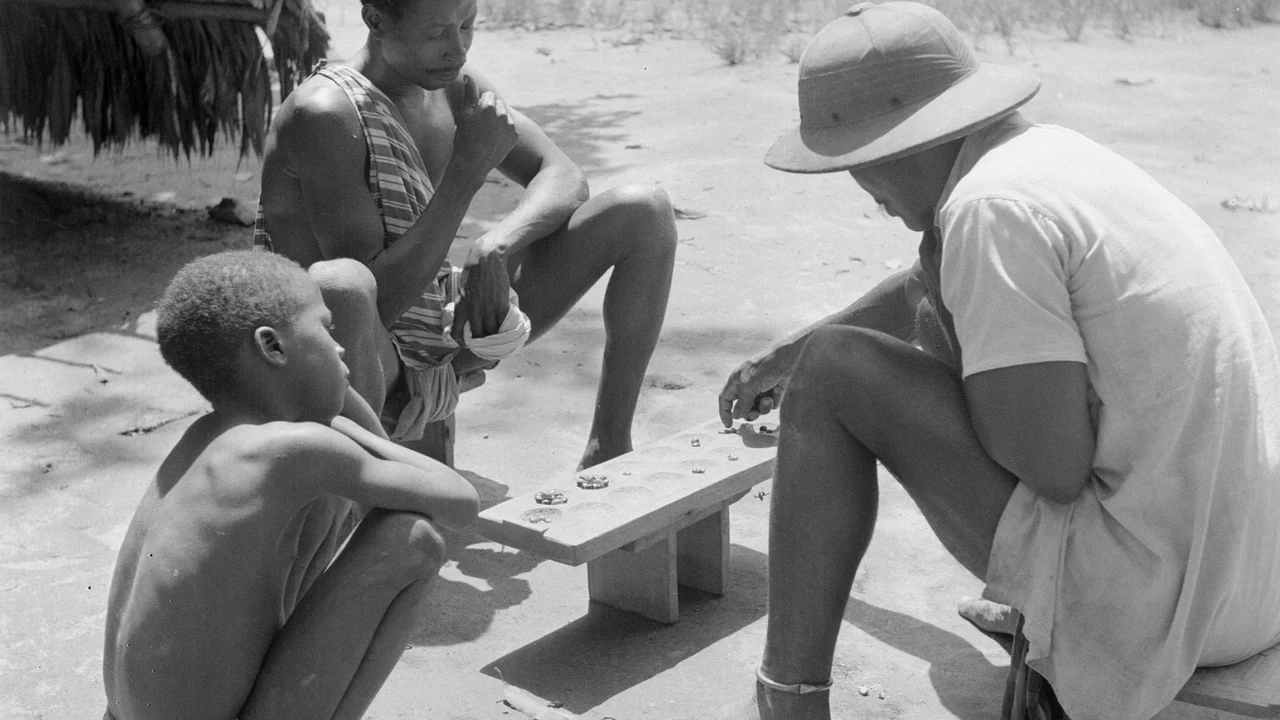
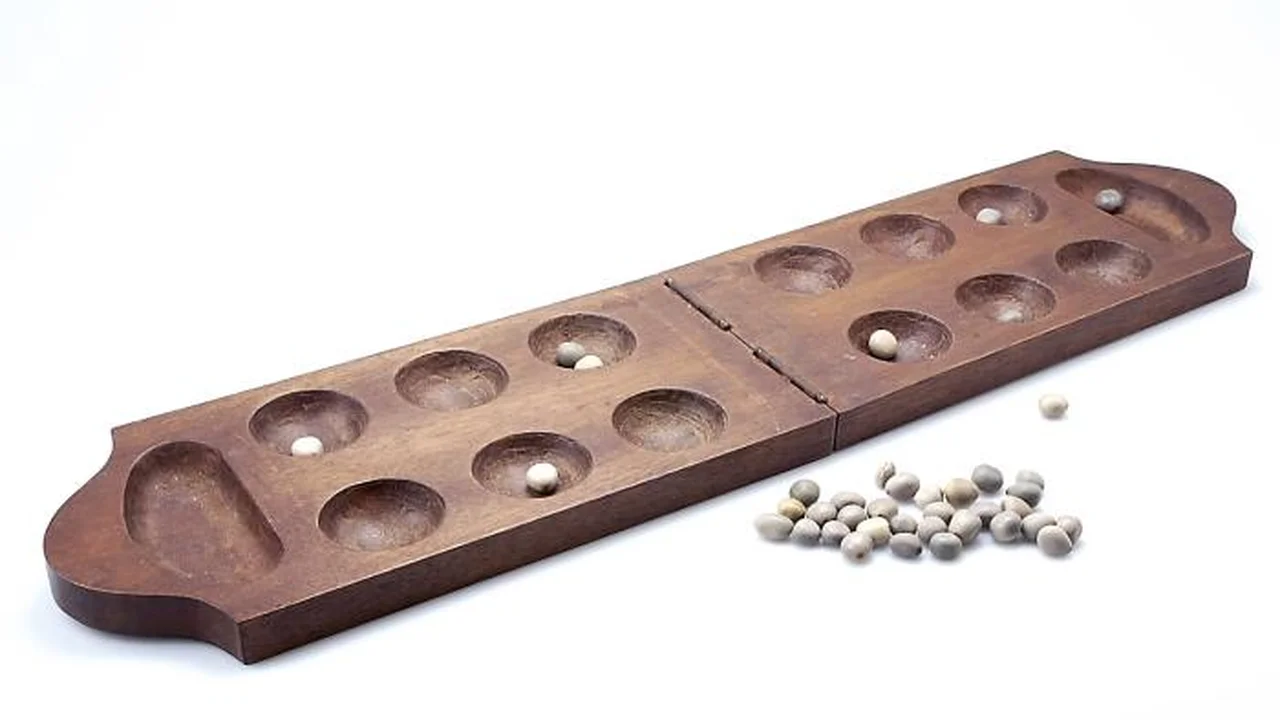
The long wooden board has two rows of six round cups with two big bowls at the ends.
Players use forty-eight round gray seeds called warri seeds collected from wild forest vines.
Two players sit across the board and take turns dropping seeds into empty cups in a circle.
A clever player counts numbers in their head to drop one seed into each cup along the row.
A player wins seeds from the other side when their last seed makes two or three seeds in a cup.
Crafting Bangi Boards and Botanical Counters
Village woodcarvers make handsome boards from single blocks of heavy forest cedar and mora wood.
Carvers decorate the wooden board borders with pretty geometric lines and colorful Tembe star patterns.
Some folding boards have wooden hinges and handles so travelers can carry them between river villages.
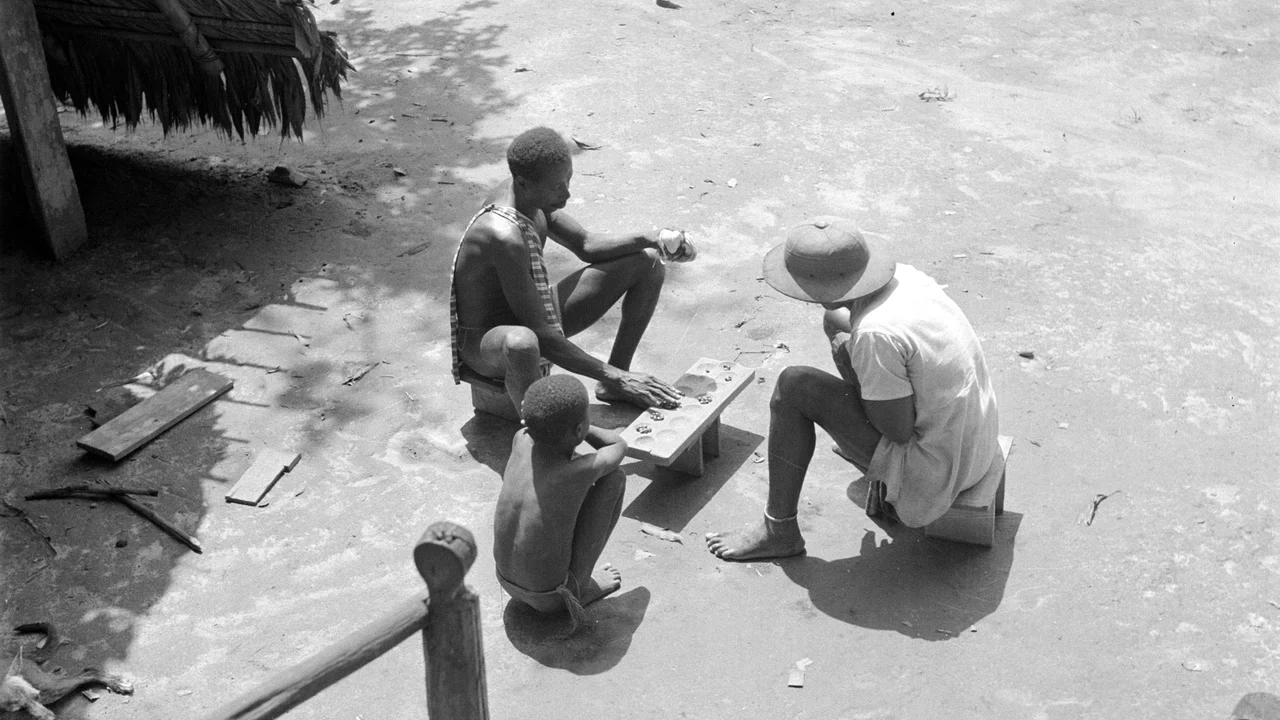
When players have no wooden board, they dig small round cups directly into clean dry dirt on the ground.
Smooth nickernut seeds work better than rough river pebbles because they feel pleasant and slide easily between quick fingers.
Boards made for village elders have deep wooden cups that stop round seeds from bouncing onto the dirt floor.
Communal Ritual and Funeral Wakes
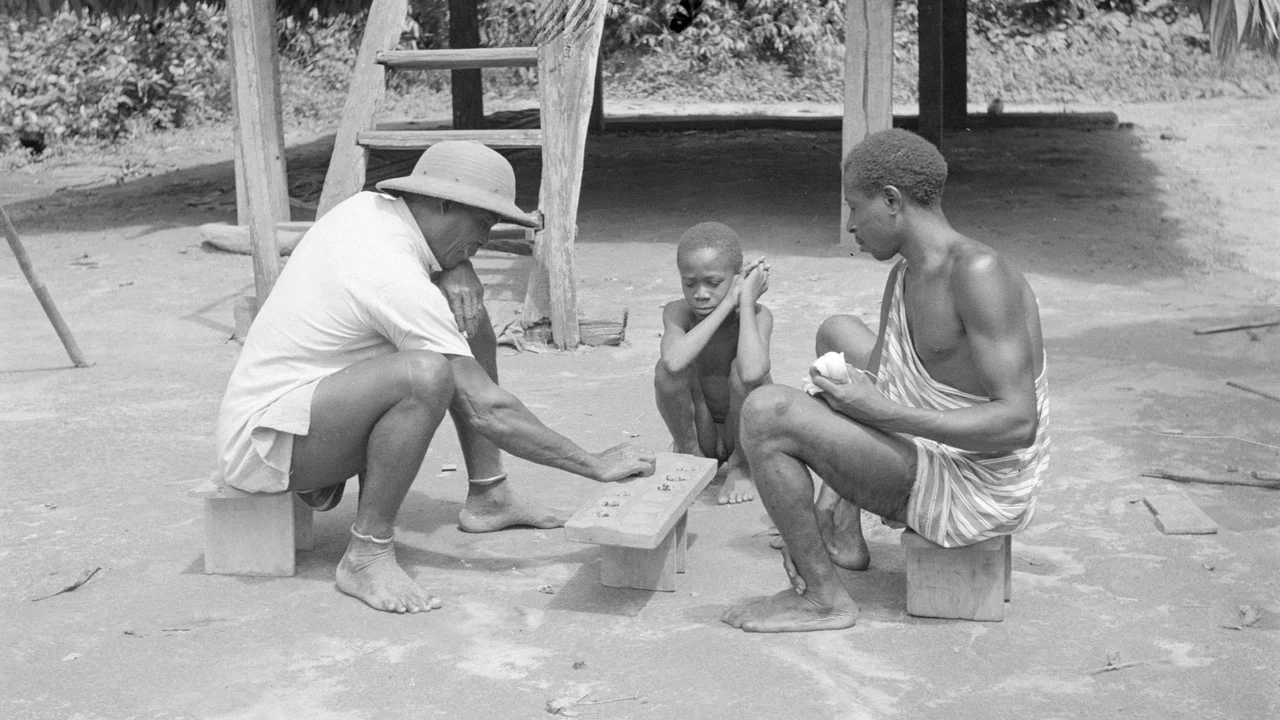
Families play Ba during traditional funeral gatherings called dede oso to remember ancestors and honor relatives.
Playing lively board games all night helps village families stay awake and watch over their home together.
Old forest customs once forbade daytime games in quiet villages to keep peace with guardian spirits.
Respected older players win high praise in the village by helping settle friendly arguments during hard tournament games.
Good players talk, laugh, and tease each other with funny jokes called prodo during exciting matches.
Friends stand around the board in circles to cheer good moves and watch clever seed traps succeed.
UNESCO Recognition and Intergenerational Safeguarding
In 2021, world leaders at UNESCO honored Ba as an important cultural treasure of human heritage.
Cultural teachers organize fun youth clubs in Paramaribo to teach children how to play traditional board games.
National game clubs hold yearly championship tournaments with clocks and fair prize rules for top players.
Elementary schools start after-school Ba clubs to help boys and girls practice math and quick thinking.
University researchers talk with wise village elders to write down old playing rules from different river regions.
New smartphone games and diaspora family clubs in Amsterdam help modern children keep this wonderful tradition alive.
A2 · Elementary
Ba: The Afro-Surinamese Mancala Game of Intelligence and Strategy
Analyzing awari bangi board anatomy, modular seed sowing mechanics, nocturnal dede oso ritual vigils, and UNESCO recognition.
Origins and Mathematical Mancala Typology
Ba is an ancient strategic count-and-capture board game belonging to the global mancala family preserved across Afro-Surinamese communities since the transatlantic slave trade.
The game board, historically termed an awari bangi in Maroon languages, consists of two parallel rows of six carved pits flanked by two larger end store reservoirs.
The game uses forty-eight hard botanical counters, typically gray nickernut seeds from the forest vine Caesalpinia bonduc, known locally as warri seeds.
Matches are played between two opposing participants who alternate counterclockwise seed distribution across the twelve active hollows.
The mathematical engine relies on modular arithmetic and dynamic lap counting where players distribute seeds singly into successive cups.
A player captures counters from the opponent side when the final distributed seed brings an enemy cup total to precisely two or three seeds.
Crafting Bangi Boards and Botanical Counters
Traditional Ba boards are hand-carved by village woodcarvers from single blocks of native tropical hardwood, including cedar, mora, and brownheart.
Carvers embellish the exterior rims and end pedestals with intricate geometric chip carvings and interlacing Tembe patterns.
Portable folding variations incorporate wooden hinges or carved continuous loop handles allowing players to carry boards between river villages.
When polished wooden boards are unavailable, informal outdoor matches take shape on cleared dirt clearings with cups scooped directly out of dry soil.
Wild-gathered nickernut seeds are preferred over stones because their spherical symmetry, hard enamel coats, and smooth surface ensure fluid finger handling.
Specialized boards carved for community elders feature deep scooped pits that accommodate rapid tactile grasping without seed spillover.
Communal Ritual and Funeral Wakes
Beyond casual recreation, Ba plays a central ceremonial role during Afro-Surinamese dede oso funeral wakes and ancestral remembrance rites.
Tradition dictates that playing Ba through the night sustains community vigilance and prevents slumber during nocturnal memorial observances.
Specific ritual taboos historically prohibited playing Ba during daylight hours in certain interior villages to preserve sacred ancestral boundaries.
Elderly master players command high communal prestige, acting as ethical advisors and arbitrating disputes during intense competitive village bouts.
Rapid verbal banter, theatrical gestures, and strategic taunting known as prodo accompany every move, testing an opponent psychological concentration.
Spectators form tight cheering circles around active boards, analyzing complex seed traps and debating multi-lap capturing maneuvers in real time.
UNESCO Recognition and Intergenerational Safeguarding
In December 2021, UNESCO inscribed Ba, game of intelligence and strategy on the Representative List of the Intangible Cultural Heritage of Humanity.
The Directorate of Culture launched national youth workshops in Paramaribo and regional districts to reverse digital distraction and encourage intergenerational play.
The Suriname Traditional Games Association organizes standardized national tournaments, establishing formal time controls and competitive rating frameworks.
Primary schools across Suriname have introduced Ba clubs into mathematics curricula to develop mental arithmetic, pattern recognition, and tactical reasoning.
Community elders collaborate with cultural researchers to record regional rule variations between Ndyuka, Saamaka, and urban coastal Creole playing traditions.
Contemporary digital mobile adaptations and international diaspora clubs in Amsterdam ensure the living transmission of Ba across new transnational generations.
B1 · Intermediate
Ba: Ethnomathematics, Communal Vigilance, and Mancala Strategy in Suriname
An analytical study of two-row twelve-pit board mechanics, nickernut seed organology, funeral wake traditions, and formal tournament frameworks.
Origins and Mathematical Mancala Typology
Ba is an ancient strategic count-and-capture board game belonging to the global mancala family preserved across Afro-Surinamese communities since the transatlantic slave trade.
The game board, historically termed an awari bangi in Maroon languages, consists of two parallel rows of six carved pits flanked by two larger end store reservoirs.
The game uses forty-eight hard botanical counters, typically gray nickernut seeds from the forest vine Caesalpinia bonduc, known locally as warri seeds.
Matches are played between two opposing participants who alternate counterclockwise seed distribution across the twelve active hollows.
The mathematical engine relies on modular arithmetic and dynamic lap counting where players distribute seeds singly into successive cups.
A player captures counters from the opponent side when the final distributed seed brings an enemy cup total to precisely two or three seeds.
Crafting Bangi Boards and Botanical Counters
Traditional Ba boards are hand-carved by village woodcarvers from single blocks of native tropical hardwood, including cedar, mora, and brownheart.
Carvers embellish the exterior rims and end pedestals with intricate geometric chip carvings and interlacing Tembe patterns.
Portable folding variations incorporate wooden hinges or carved continuous loop handles allowing players to carry boards between river villages.
When polished wooden boards are unavailable, informal outdoor matches take shape on cleared dirt clearings with cups scooped directly out of dry soil.
Wild-gathered nickernut seeds are preferred over stones because their spherical symmetry, hard enamel coats, and smooth surface ensure fluid finger handling.
Specialized boards carved for community elders feature deep scooped pits that accommodate rapid tactile grasping without seed spillover.
Communal Ritual and Funeral Wakes
Beyond casual recreation, Ba plays a central ceremonial role during Afro-Surinamese dede oso funeral wakes and ancestral remembrance rites.
Tradition dictates that playing Ba through the night sustains community vigilance and prevents slumber during nocturnal memorial observances.
Specific ritual taboos historically prohibited playing Ba during daylight hours in certain interior villages to preserve sacred ancestral boundaries.
Elderly master players command high communal prestige, acting as ethical advisors and arbitrating disputes during intense competitive village bouts.
Rapid verbal banter, theatrical gestures, and strategic taunting known as prodo accompany every move, testing an opponent psychological concentration.
Spectators form tight cheering circles around active boards, analyzing complex seed traps and debating multi-lap capturing maneuvers in real time.
UNESCO Recognition and Intergenerational Safeguarding
In December 2021, UNESCO inscribed Ba, game of intelligence and strategy on the Representative List of the Intangible Cultural Heritage of Humanity.
The Directorate of Culture launched national youth workshops in Paramaribo and regional districts to reverse digital distraction and encourage intergenerational play.
The Suriname Traditional Games Association organizes standardized national tournaments, establishing formal time controls and competitive rating frameworks.
Primary schools across Suriname have introduced Ba clubs into mathematics curricula to develop mental arithmetic, pattern recognition, and tactical reasoning.
Community elders collaborate with cultural researchers to record regional rule variations between Ndyuka, Saamaka, and urban coastal Creole playing traditions.
Contemporary digital mobile adaptations and international diaspora clubs in Amsterdam ensure the living transmission of Ba across new transnational generations.
B2 · Upper Intermediate
Ba: Combinatorial Logic, Tembe Board Craft, and Intangible Cultural Heritage
Investigating modular counting algorithms, tropical hardwood bangi carving, prodo psychological theatricality, and school mathematics integration.
Origins and Mathematical Mancala Typology
Ba is an ancient strategic count-and-capture board game belonging to the global mancala family preserved across Afro-Surinamese communities since the transatlantic slave trade.
The game board, historically termed an awari bangi in Maroon languages, consists of two parallel rows of six carved pits flanked by two larger end store reservoirs.
The game uses forty-eight hard botanical counters, typically gray nickernut seeds from the forest vine Caesalpinia bonduc, known locally as warri seeds.
Matches are played between two opposing participants who alternate counterclockwise seed distribution across the twelve active hollows.
The mathematical engine relies on modular arithmetic and dynamic lap counting where players distribute seeds singly into successive cups.
A player captures counters from the opponent side when the final distributed seed brings an enemy cup total to precisely two or three seeds.
Crafting Bangi Boards and Botanical Counters
Traditional Ba boards are hand-carved by village woodcarvers from single blocks of native tropical hardwood, including cedar, mora, and brownheart.
Carvers embellish the exterior rims and end pedestals with intricate geometric chip carvings and interlacing Tembe patterns.
Portable folding variations incorporate wooden hinges or carved continuous loop handles allowing players to carry boards between river villages.
When polished wooden boards are unavailable, informal outdoor matches take shape on cleared dirt clearings with cups scooped directly out of dry soil.
Wild-gathered nickernut seeds are preferred over stones because their spherical symmetry, hard enamel coats, and smooth surface ensure fluid finger handling.
Specialized boards carved for community elders feature deep scooped pits that accommodate rapid tactile grasping without seed spillover.
Communal Ritual and Funeral Wakes
Beyond casual recreation, Ba plays a central ceremonial role during Afro-Surinamese dede oso funeral wakes and ancestral remembrance rites.
Tradition dictates that playing Ba through the night sustains community vigilance and prevents slumber during nocturnal memorial observances.
Specific ritual taboos historically prohibited playing Ba during daylight hours in certain interior villages to preserve sacred ancestral boundaries.
Elderly master players command high communal prestige, acting as ethical advisors and arbitrating disputes during intense competitive village bouts.
Rapid verbal banter, theatrical gestures, and strategic taunting known as prodo accompany every move, testing an opponent psychological concentration.
Spectators form tight cheering circles around active boards, analyzing complex seed traps and debating multi-lap capturing maneuvers in real time.
UNESCO Recognition and Intergenerational Safeguarding
In December 2021, UNESCO inscribed Ba, game of intelligence and strategy on the Representative List of the Intangible Cultural Heritage of Humanity.
The Directorate of Culture launched national youth workshops in Paramaribo and regional districts to reverse digital distraction and encourage intergenerational play.
The Suriname Traditional Games Association organizes standardized national tournaments, establishing formal time controls and competitive rating frameworks.
Primary schools across Suriname have introduced Ba clubs into mathematics curricula to develop mental arithmetic, pattern recognition, and tactical reasoning.
Community elders collaborate with cultural researchers to record regional rule variations between Ndyuka, Saamaka, and urban coastal Creole playing traditions.
Contemporary digital mobile adaptations and international diaspora clubs in Amsterdam ensure the living transmission of Ba across new transnational generations.
C1 · Advanced
The Ethnomathematics and Social Epistemology of Surinamese Ba
A critical monograph examining transatlantic mancala preservation, botanical counter physics, nocturnal ancestral remembrance, and pedagogical safeguarding.
Origins and Mathematical Mancala Typology
Ba is an ancient strategic count-and-capture board game belonging to the global mancala family preserved across Afro-Surinamese communities since the transatlantic slave trade.
The game board, historically termed an awari bangi in Maroon languages, consists of two parallel rows of six carved pits flanked by two larger end store reservoirs.
The game uses forty-eight hard botanical counters, typically gray nickernut seeds from the forest vine Caesalpinia bonduc, known locally as warri seeds.
Matches are played between two opposing participants who alternate counterclockwise seed distribution across the twelve active hollows.
The mathematical engine relies on modular arithmetic and dynamic lap counting where players distribute seeds singly into successive cups.
A player captures counters from the opponent side when the final distributed seed brings an enemy cup total to precisely two or three seeds.
Crafting Bangi Boards and Botanical Counters
Traditional Ba boards are hand-carved by village woodcarvers from single blocks of native tropical hardwood, including cedar, mora, and brownheart.
Carvers embellish the exterior rims and end pedestals with intricate geometric chip carvings and interlacing Tembe patterns.
Portable folding variations incorporate wooden hinges or carved continuous loop handles allowing players to carry boards between river villages.
When polished wooden boards are unavailable, informal outdoor matches take shape on cleared dirt clearings with cups scooped directly out of dry soil.
Wild-gathered nickernut seeds are preferred over stones because their spherical symmetry, hard enamel coats, and smooth surface ensure fluid finger handling.
Specialized boards carved for community elders feature deep scooped pits that accommodate rapid tactile grasping without seed spillover.
Communal Ritual and Funeral Wakes
Beyond casual recreation, Ba plays a central ceremonial role during Afro-Surinamese dede oso funeral wakes and ancestral remembrance rites.
Tradition dictates that playing Ba through the night sustains community vigilance and prevents slumber during nocturnal memorial observances.
Specific ritual taboos historically prohibited playing Ba during daylight hours in certain interior villages to preserve sacred ancestral boundaries.
Elderly master players command high communal prestige, acting as ethical advisors and arbitrating disputes during intense competitive village bouts.
Rapid verbal banter, theatrical gestures, and strategic taunting known as prodo accompany every move, testing an opponent psychological concentration.
Spectators form tight cheering circles around active boards, analyzing complex seed traps and debating multi-lap capturing maneuvers in real time.
UNESCO Recognition and Intergenerational Safeguarding
In December 2021, UNESCO inscribed Ba, game of intelligence and strategy on the Representative List of the Intangible Cultural Heritage of Humanity.
The Directorate of Culture launched national youth workshops in Paramaribo and regional districts to reverse digital distraction and encourage intergenerational play.
The Suriname Traditional Games Association organizes standardized national tournaments, establishing formal time controls and competitive rating frameworks.
Primary schools across Suriname have introduced Ba clubs into mathematics curricula to develop mental arithmetic, pattern recognition, and tactical reasoning.
Community elders collaborate with cultural researchers to record regional rule variations between Ndyuka, Saamaka, and urban coastal Creole playing traditions.
Contemporary digital mobile adaptations and international diaspora clubs in Amsterdam ensure the living transmission of Ba across new transnational generations.
C2 · Mastery
Ba: Mathematical Rigor, Ritual Vigilance, and Living Intangible Heritage
A comprehensive analytical study investigating Suriname signature traditional board game across historical, organological, cognitive, and safeguarding frameworks.
Origins and Mathematical Mancala Typology
Ba is an ancient strategic count-and-capture board game belonging to the global mancala family preserved across Afro-Surinamese communities since the transatlantic slave trade.
The game board, historically termed an awari bangi in Maroon languages, consists of two parallel rows of six carved pits flanked by two larger end store reservoirs.
The game uses forty-eight hard botanical counters, typically gray nickernut seeds from the forest vine Caesalpinia bonduc, known locally as warri seeds.
Matches are played between two opposing participants who alternate counterclockwise seed distribution across the twelve active hollows.
The mathematical engine relies on modular arithmetic and dynamic lap counting where players distribute seeds singly into successive cups.
A player captures counters from the opponent side when the final distributed seed brings an enemy cup total to precisely two or three seeds.
Crafting Bangi Boards and Botanical Counters
Traditional Ba boards are hand-carved by village woodcarvers from single blocks of native tropical hardwood, including cedar, mora, and brownheart.
Carvers embellish the exterior rims and end pedestals with intricate geometric chip carvings and interlacing Tembe patterns.
Portable folding variations incorporate wooden hinges or carved continuous loop handles allowing players to carry boards between river villages.
When polished wooden boards are unavailable, informal outdoor matches take shape on cleared dirt clearings with cups scooped directly out of dry soil.
Wild-gathered nickernut seeds are preferred over stones because their spherical symmetry, hard enamel coats, and smooth surface ensure fluid finger handling.
Specialized boards carved for community elders feature deep scooped pits that accommodate rapid tactile grasping without seed spillover.
Communal Ritual and Funeral Wakes
Beyond casual recreation, Ba plays a central ceremonial role during Afro-Surinamese dede oso funeral wakes and ancestral remembrance rites.
Tradition dictates that playing Ba through the night sustains community vigilance and prevents slumber during nocturnal memorial observances.
Specific ritual taboos historically prohibited playing Ba during daylight hours in certain interior villages to preserve sacred ancestral boundaries.
Elderly master players command high communal prestige, acting as ethical advisors and arbitrating disputes during intense competitive village bouts.
Rapid verbal banter, theatrical gestures, and strategic taunting known as prodo accompany every move, testing an opponent psychological concentration.
Spectators form tight cheering circles around active boards, analyzing complex seed traps and debating multi-lap capturing maneuvers in real time.
UNESCO Recognition and Intergenerational Safeguarding
In December 2021, UNESCO inscribed Ba, game of intelligence and strategy on the Representative List of the Intangible Cultural Heritage of Humanity.
The Directorate of Culture launched national youth workshops in Paramaribo and regional districts to reverse digital distraction and encourage intergenerational play.
The Suriname Traditional Games Association organizes standardized national tournaments, establishing formal time controls and competitive rating frameworks.
Primary schools across Suriname have introduced Ba clubs into mathematics curricula to develop mental arithmetic, pattern recognition, and tactical reasoning.
Community elders collaborate with cultural researchers to record regional rule variations between Ndyuka, Saamaka, and urban coastal Creole playing traditions.
Contemporary digital mobile adaptations and international diaspora clubs in Amsterdam ensure the living transmission of Ba across new transnational generations.
Check your understanding
Choose how closely you want to revisit the article. You can refer back while answering, and review explanations when you finish.
Quick Quiz A1
Try one question, then create a free account for the full Quick Quiz. Sign Up Free
Answer every question before checking. There is no time limit.
Your results
/ 1 correct (%)
Read the explanations to see how each answer connects to the article.
-
Who brought the ancient counting board game of Ba to Suriname?
1. Answer:
Quick Quiz A2
Try one question, then create a free account for the full Quick Quiz. Sign Up Free
Answer every question before checking. There is no time limit.
Your results
/ 1 correct (%)
Read the explanations to see how each answer connects to the article.
-
To which global board game family does the ancient Afro-Surinamese game of Ba belong?
1. Answer:
Quick Quiz B1
Try one question, then create a free account for the full Quick Quiz. Sign Up Free
Answer every question before checking. There is no time limit.
Your results
/ 1 correct (%)
Read the explanations to see how each answer connects to the article.
-
To which global board game family does the ancient Afro-Surinamese game of Ba belong?
1. Answer:
Quick Quiz B2
Try one question, then create a free account for the full Quick Quiz. Sign Up Free
Answer every question before checking. There is no time limit.
Your results
/ 1 correct (%)
Read the explanations to see how each answer connects to the article.
-
To which global board game family does the ancient Afro-Surinamese game of Ba belong?
1. Answer:
Quick Quiz C1
Try one question, then create a free account for the full Quick Quiz. Sign Up Free
Answer every question before checking. There is no time limit.
Your results
/ 1 correct (%)
Read the explanations to see how each answer connects to the article.
-
To which global board game family does the ancient Afro-Surinamese game of Ba belong?
1. Answer:
Quick Quiz C2
Try one question, then create a free account for the full Quick Quiz. Sign Up Free
Answer every question before checking. There is no time limit.
Your results
/ 1 correct (%)
Read the explanations to see how each answer connects to the article.
-
To which global board game family does the ancient Afro-Surinamese game of Ba belong?
1. Answer:
