A1 · Beginner
Cassava Bread in Suriname: Indigenous Agronomy, Detoxification, and Baking
From sandy soil gardens and woven basket presses to hot iron plates and city shops, cassava bread feeds Suriname families.
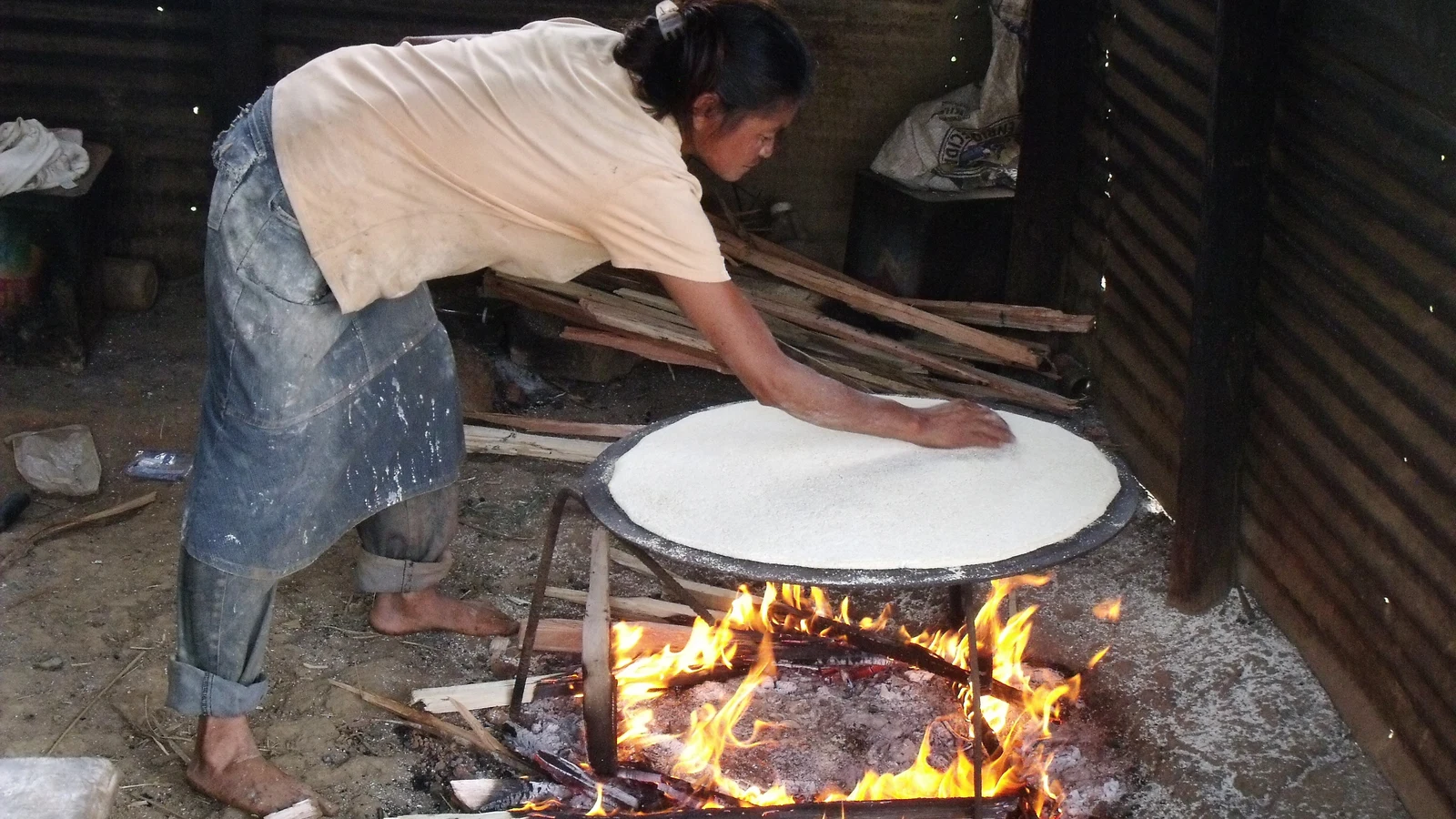
Indigenous Heritage and Botanical Agronomy of Bitter Cassava
Cassava is an old root crop grown in sandy soil across Suriname.
Indigenous Kalina and Lokono families planted this tall shrub for many centuries.
Farm families clear small forest gardens called kostgronden to grow strong green plants.
Bitter cassava roots grow big underground during nine to twelve warm months.
Fresh bitter roots have natural poison that must be removed before eating.
Elder village women teach young girls how to choose good stems and harvest roots.
Mechanical Detoxification, the Matapi Press, and Cyanogen Removal
Workers peel the brown root skin and grate the white pulp on metal boards.
Women pack wet grated pulp into a long woven basket tube called a matapi.
Heavy wood weights pull the matapi down to squeeze out bitter juice.
Squeezing the wet pulp removes most of the poison liquid into wooden pots.
Cooks boil the dark squeezed juice for hours to make a safe savory sauce.
The dry white cassava pulp comes out of the basket as a firm block.
Pulverizing, Griddle Baking, and Bread Curing Techniques
Bakers rub the firm block through round woven sieves to make fine flour.
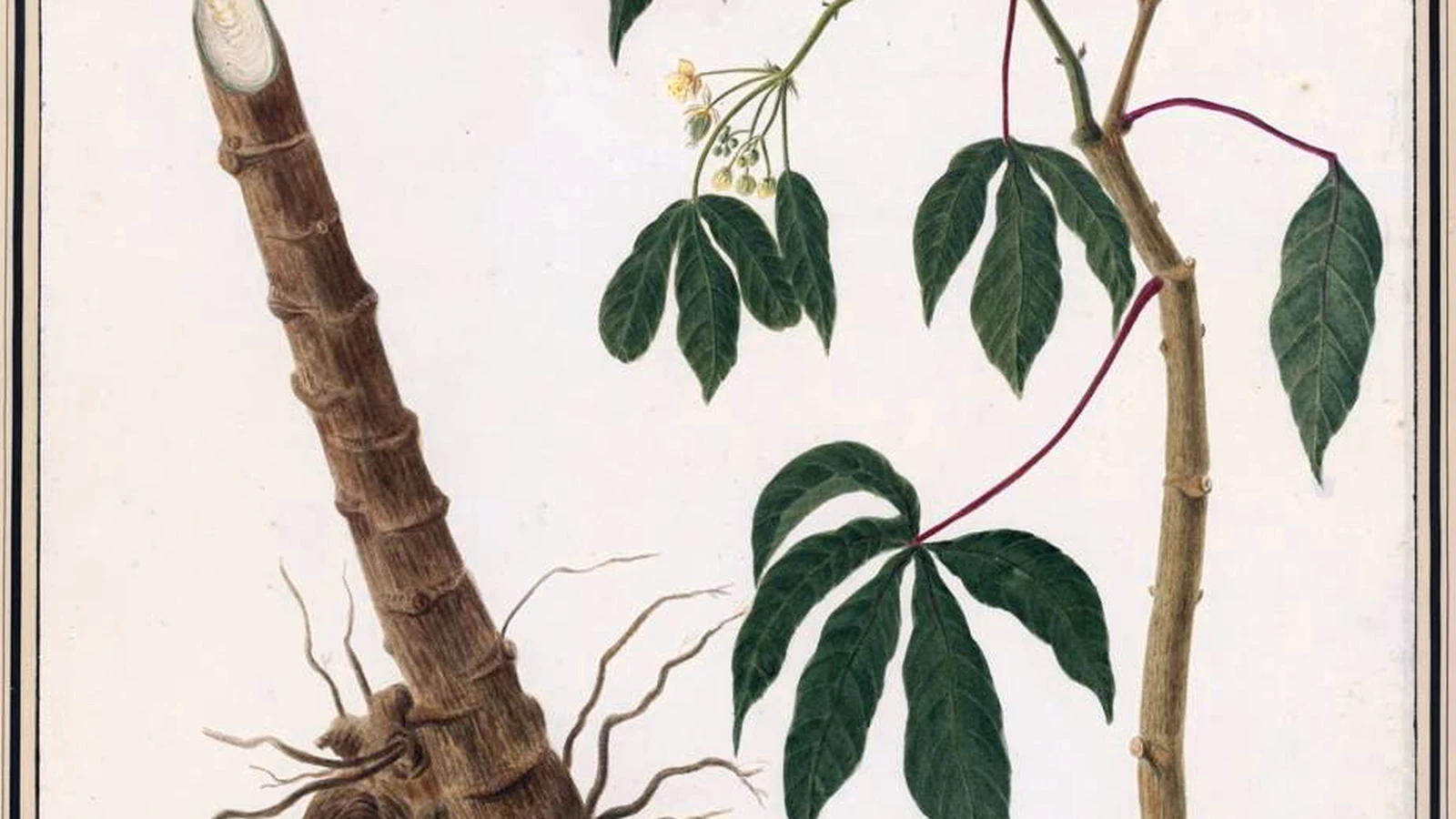
Cassava flour is baked outdoors on a big round iron plate over open fire.
Cooks spread the white flour evenly on the hot pan without butter or oil.
Hot fire turns loose flour into a wide round flatbread in ten minutes.
Bakers turn the big round bread with wooden tools to toast both sides.
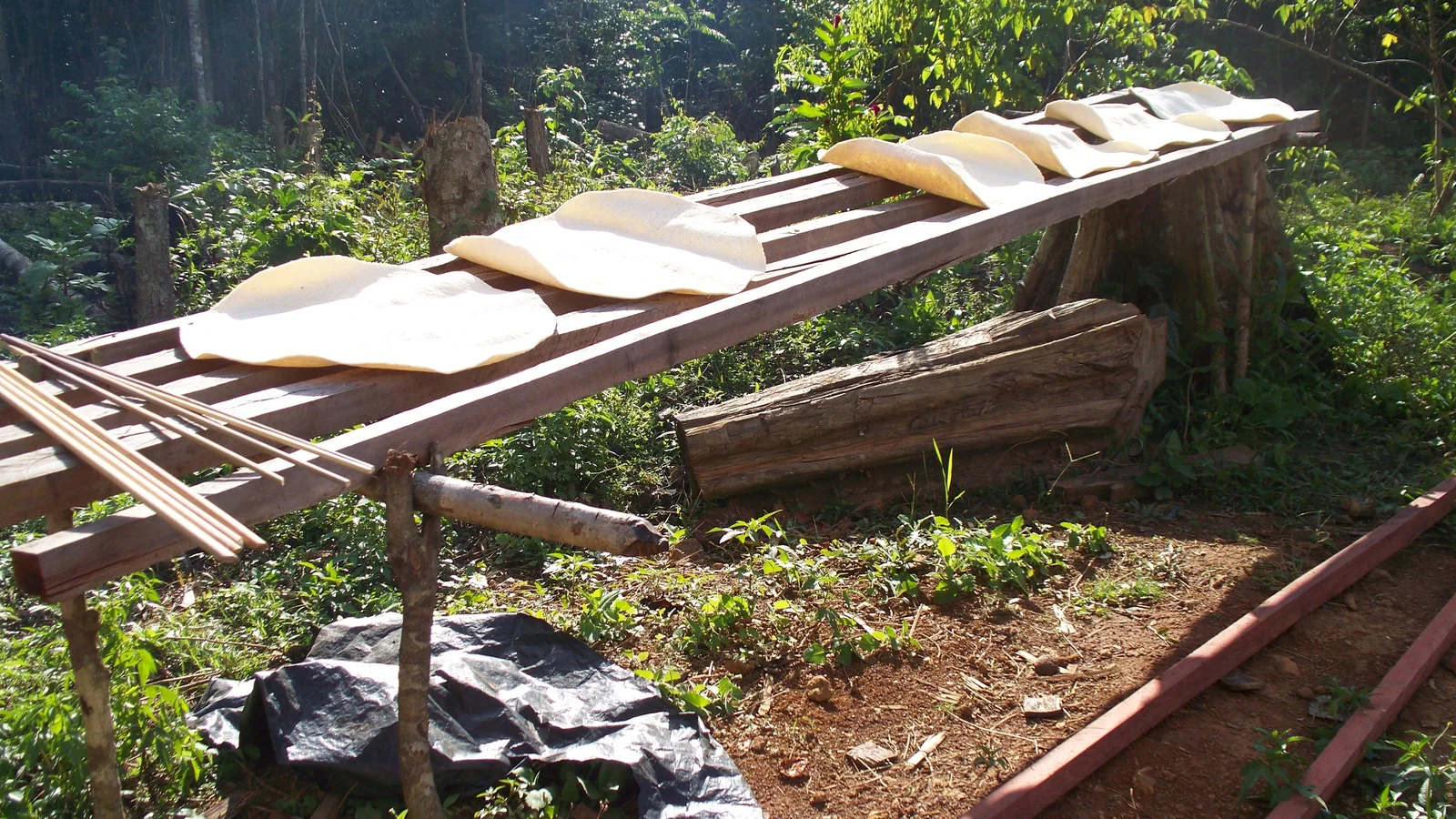
Workers lay baked flatbreads on high wooden tables under bright sun to dry.
Culinary Consumption, Rural Cooperatives, and Urban Distribution
Dry cassava flatbread stays good to eat for two years without any cold box.
Village families dip crisp dry bread into warm pepper stew and fresh fish soup.
Women groups in country towns share modern grating machines to bake more bread.
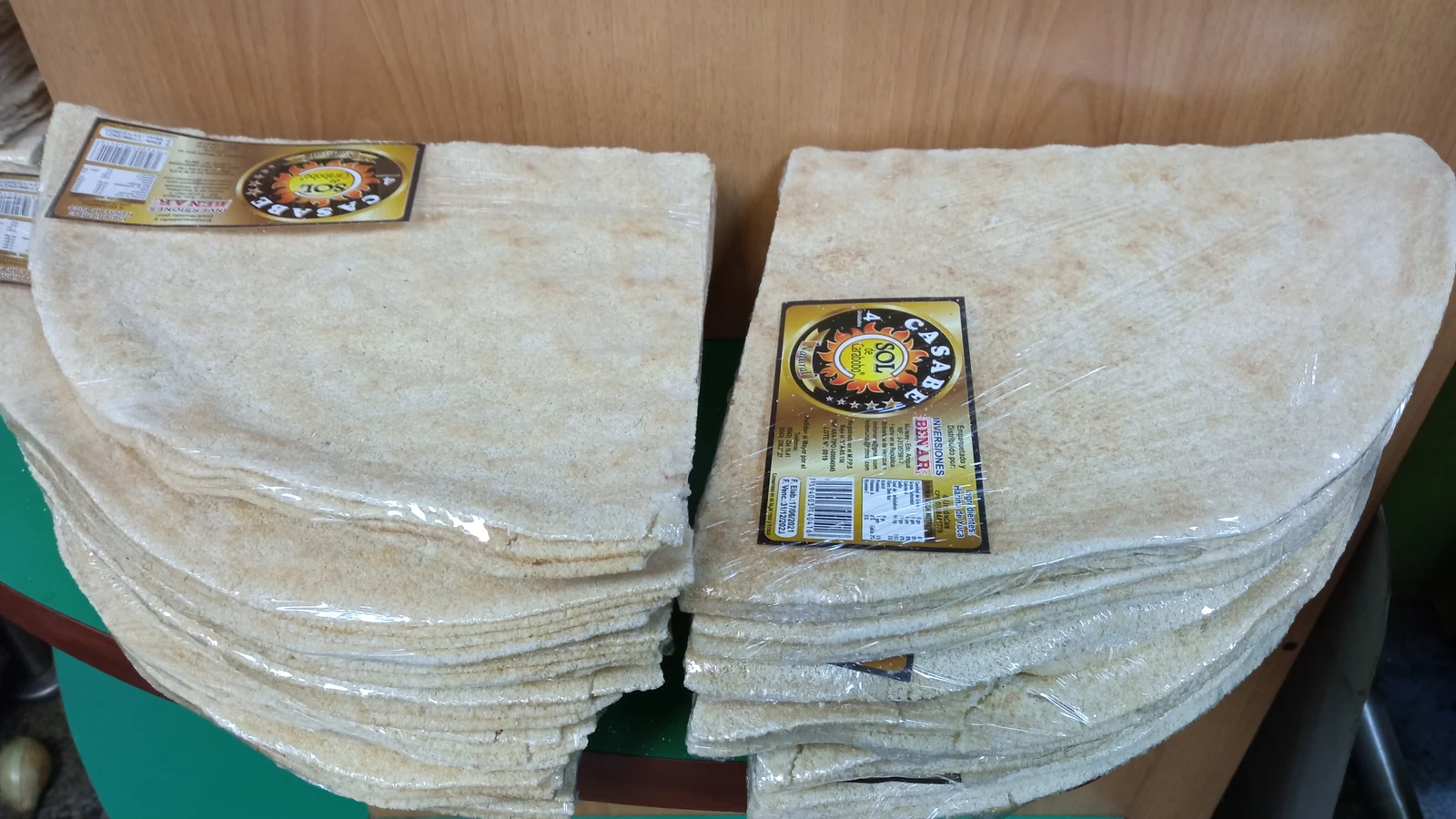
Wooden river boats carry tall stacks of packed cassava bread to city shops.
Shoppers in Paramaribo buy crisp round bread at open market stalls every week.
Baking cassava bread protects families against food trouble as an enduring village symbol.
A2 · Elementary
Cassava Bread in Suriname: Kalina-Lokono Heritage, Matapi Presses, and Baking
Examining traditional bitter cassava agronomy, cyanogen expression in woven matapi presses, griddle baking physics, and regional trade.
Indigenous Heritage and Botanical Agronomy of Bitter Cassava
Bitter cassava, classified botanically as Manihot esculenta and known locally as bittere cassave or kasaba, represents an ancient staple root crop cultivated across Suriname by indigenous Kalina and Lokono peoples for millennia prior to European contact. Agronomic field surveys by the Ministry of Agriculture record that smallholder farming households in the coastal savanna belt and interior river basins plant cassava cuttings in slash-and-mulch shifting agricultural plots known as kostgronden. Botanical research identifies that cassava shrubs thrive in nutrient-poor acidic sandy soils, reaching maturity and developing harvestable starchy root tubers within nine to twelve months after planting.
Bitter cassava varieties contain elevated levels of cyanogenic glucosides, specifically linamarin and lotaustralin, which yield toxic hydrogen cyanide when plant cell walls are ruptured during harvesting or processing. In addition to indigenous Amerindian villages, Maroon communities who established independent societies along the Cottica, Commewijne, and Suriname rivers adopted bitter cassava cultivation and bread baking as a core food security foundation. Cultural documentation from the Directorate of Culture records that traditional knowledge governing cassava landrace selection, soil rotation, and planting calendar timing is transmitted intergenerationally primarily through elder women.
Mechanical Detoxification, the Matapi Press, and Cyanogen Removal
Detoxifying bitter cassava requires a multi-stage mechanical process beginning with hand peeling and grating the raw tuber roots on wooden boards embedded with quartz chips or perforated sheet metal. The grated wet cassava pulp is packed into a flexible, diagonally woven tubular basketry press known as a matapi, woven from strips of peeled arum or maranta reed fiber. Suspending the matapi from an overhead beam while applying heavy downward leverage at the base contracts the basket diameter, expelling cyanogenic liquid juices through the porous weave.
Biochemical analyses by the Anton de Kom University of Suriname confirm that mechanical expression removes up to seventy percent of soluble linamarin before any thermal application. The expelled yellowish-brown liquid, rich in starch and free cyanide, is boiled continuously for hours to volatilize residual cyanide gas, yielding a savory, dark seasoned culinary condiment known as kasripo. Once pressing is complete, the compacted, moisture-reduced cassava mass is extracted from the matapi as a solid cylindrical cake ready for pulverizing and sifting.
Pulverizing, Griddle Baking, and Bread Curing Techniques
The pressed cylindrical cassava cake is broken apart and rubbed through circular woven basketry sieves called manari to produce a uniform, coarse, snow-white flour. Baking takes place outdoors on a wide, circular cast-iron or earthenware plate called a plaat or bapa, positioned over a wood-fire hearth elevated on three large stones or clay bricks. Bakers spread the sifted flour evenly across the hot griddle surface without adding oil, salt, or water, using a flat wooden paddle to smooth and compress the circular disc.
Sustained conductive heat between one hundred and fifty and one hundred and eighty degrees Celsius gelatinizes outer starch granules, binding the loose flour particles into a cohesive, circular flatbread measuring sixty to ninety centimeters across. Skillful bakers flip the broad cassava disc using flat wooden spades to toast both surfaces lightly while driving off remaining traces of volatile cyanide through thermal evaporation. Following griddle removal, the freshly baked cassava rounds are placed on elevated slatted wooden racks to sun-cure for several days, yielding a bone-dry flatbread resistant to fungal spoilage.
Culinary Consumption, Rural Cooperatives, and Urban Distribution
Cured cassava bread, known as kesaba or khali, possesses exceptional shelf stability, remaining edible for up to two years without refrigeration in humid tropical environments. In rural indigenous and Maroon households, crisp cassava bread is routinely broken into pieces and softened in savory pepperpot stews, fish broths, or morning hot beverages. Women-led agricultural cooperatives in Para and Marowijne districts operate communal processing facilities equipped with mechanized graters and stainless steel press tables to boost commercial bread output.
Transportation networks along interior rivers and lateral roadways deliver bundled stacks of cassava flatbread from rural villages directly to Paramaribo municipal wet markets. Consumer surveys by the General Bureau of Statistics record steady urban retail demand for traditional cassava bread among interior migrants and multicultural Paramaribo households. Cassava bread production represents both an essential nutritional buffer against food insecurity and an enduring symbol of indigenous Amazonian material technology surviving in contemporary Suriname.
B1 · Intermediate
Indigenous Agro-Ecology, Mechanical Detoxification, and Cassava Bread in Suriname
An analytical survey of shifting forest cultivation, linamarin reduction mechanics, open-air griddle heat, and village cooperatives.
Indigenous Heritage and Botanical Agronomy of Bitter Cassava
Bitter cassava, classified botanically as Manihot esculenta and known locally as bittere cassave or kasaba, represents an ancient staple root crop cultivated across Suriname by indigenous Kalina and Lokono peoples for millennia prior to European contact. Agronomic field surveys by the Ministry of Agriculture record that smallholder farming households in the coastal savanna belt and interior river basins plant cassava cuttings in slash-and-mulch shifting agricultural plots known as kostgronden. Botanical research identifies that cassava shrubs thrive in nutrient-poor acidic sandy soils, reaching maturity and developing harvestable starchy root tubers within nine to twelve months after planting.
Bitter cassava varieties contain elevated levels of cyanogenic glucosides, specifically linamarin and lotaustralin, which yield toxic hydrogen cyanide when plant cell walls are ruptured during harvesting or processing. In addition to indigenous Amerindian villages, Maroon communities who established independent societies along the Cottica, Commewijne, and Suriname rivers adopted bitter cassava cultivation and bread baking as a core food security foundation. Cultural documentation from the Directorate of Culture records that traditional knowledge governing cassava landrace selection, soil rotation, and planting calendar timing is transmitted intergenerationally primarily through elder women.
Mechanical Detoxification, the Matapi Press, and Cyanogen Removal
Detoxifying bitter cassava requires a multi-stage mechanical process beginning with hand peeling and grating the raw tuber roots on wooden boards embedded with quartz chips or perforated sheet metal. The grated wet cassava pulp is packed into a flexible, diagonally woven tubular basketry press known as a matapi, woven from strips of peeled arum or maranta reed fiber. Suspending the matapi from an overhead beam while applying heavy downward leverage at the base contracts the basket diameter, expelling cyanogenic liquid juices through the porous weave.
Biochemical analyses by the Anton de Kom University of Suriname confirm that mechanical expression removes up to seventy percent of soluble linamarin before any thermal application. The expelled yellowish-brown liquid, rich in starch and free cyanide, is boiled continuously for hours to volatilize residual cyanide gas, yielding a savory, dark seasoned culinary condiment known as kasripo. Once pressing is complete, the compacted, moisture-reduced cassava mass is extracted from the matapi as a solid cylindrical cake ready for pulverizing and sifting.
Pulverizing, Griddle Baking, and Bread Curing Techniques
The pressed cylindrical cassava cake is broken apart and rubbed through circular woven basketry sieves called manari to produce a uniform, coarse, snow-white flour. Baking takes place outdoors on a wide, circular cast-iron or earthenware plate called a plaat or bapa, positioned over a wood-fire hearth elevated on three large stones or clay bricks. Bakers spread the sifted flour evenly across the hot griddle surface without adding oil, salt, or water, using a flat wooden paddle to smooth and compress the circular disc.
Sustained conductive heat between one hundred and fifty and one hundred and eighty degrees Celsius gelatinizes outer starch granules, binding the loose flour particles into a cohesive, circular flatbread measuring sixty to ninety centimeters across. Skillful bakers flip the broad cassava disc using flat wooden spades to toast both surfaces lightly while driving off remaining traces of volatile cyanide through thermal evaporation. Following griddle removal, the freshly baked cassava rounds are placed on elevated slatted wooden racks to sun-cure for several days, yielding a bone-dry flatbread resistant to fungal spoilage.
Culinary Consumption, Rural Cooperatives, and Urban Distribution
Cured cassava bread, known as kesaba or khali, possesses exceptional shelf stability, remaining edible for up to two years without refrigeration in humid tropical environments. In rural indigenous and Maroon households, crisp cassava bread is routinely broken into pieces and softened in savory pepperpot stews, fish broths, or morning hot beverages. Women-led agricultural cooperatives in Para and Marowijne districts operate communal processing facilities equipped with mechanized graters and stainless steel press tables to boost commercial bread output.
Transportation networks along interior rivers and lateral roadways deliver bundled stacks of cassava flatbread from rural villages directly to Paramaribo municipal wet markets. Consumer surveys by the General Bureau of Statistics record steady urban retail demand for traditional cassava bread among interior migrants and multicultural Paramaribo households. Cassava bread production represents both an essential nutritional buffer against food insecurity and an enduring symbol of indigenous Amazonian material technology surviving in contemporary Suriname.
B2 · Upper Intermediate
Cassava Bread in Suriname: Biochemical Detoxification, Baking Physics, and Foodways
Investigating Manihot esculenta glucoside cleavage, matapi pressure dynamics, starch gelatinization, and interior transport networks.
Indigenous Heritage and Botanical Agronomy of Bitter Cassava
Bitter cassava, classified botanically as Manihot esculenta and known locally as bittere cassave or kasaba, represents an ancient staple root crop cultivated across Suriname by indigenous Kalina and Lokono peoples for millennia prior to European contact. Agronomic field surveys by the Ministry of Agriculture record that smallholder farming households in the coastal savanna belt and interior river basins plant cassava cuttings in slash-and-mulch shifting agricultural plots known as kostgronden. Botanical research identifies that cassava shrubs thrive in nutrient-poor acidic sandy soils, reaching maturity and developing harvestable starchy root tubers within nine to twelve months after planting.
Bitter cassava varieties contain elevated levels of cyanogenic glucosides, specifically linamarin and lotaustralin, which yield toxic hydrogen cyanide when plant cell walls are ruptured during harvesting or processing. In addition to indigenous Amerindian villages, Maroon communities who established independent societies along the Cottica, Commewijne, and Suriname rivers adopted bitter cassava cultivation and bread baking as a core food security foundation. Cultural documentation from the Directorate of Culture records that traditional knowledge governing cassava landrace selection, soil rotation, and planting calendar timing is transmitted intergenerationally primarily through elder women.
Mechanical Detoxification, the Matapi Press, and Cyanogen Removal
Detoxifying bitter cassava requires a multi-stage mechanical process beginning with hand peeling and grating the raw tuber roots on wooden boards embedded with quartz chips or perforated sheet metal. The grated wet cassava pulp is packed into a flexible, diagonally woven tubular basketry press known as a matapi, woven from strips of peeled arum or maranta reed fiber. Suspending the matapi from an overhead beam while applying heavy downward leverage at the base contracts the basket diameter, expelling cyanogenic liquid juices through the porous weave.
Biochemical analyses by the Anton de Kom University of Suriname confirm that mechanical expression removes up to seventy percent of soluble linamarin before any thermal application. The expelled yellowish-brown liquid, rich in starch and free cyanide, is boiled continuously for hours to volatilize residual cyanide gas, yielding a savory, dark seasoned culinary condiment known as kasripo. Once pressing is complete, the compacted, moisture-reduced cassava mass is extracted from the matapi as a solid cylindrical cake ready for pulverizing and sifting.
Pulverizing, Griddle Baking, and Bread Curing Techniques
The pressed cylindrical cassava cake is broken apart and rubbed through circular woven basketry sieves called manari to produce a uniform, coarse, snow-white flour. Baking takes place outdoors on a wide, circular cast-iron or earthenware plate called a plaat or bapa, positioned over a wood-fire hearth elevated on three large stones or clay bricks. Bakers spread the sifted flour evenly across the hot griddle surface without adding oil, salt, or water, using a flat wooden paddle to smooth and compress the circular disc.
Sustained conductive heat between one hundred and fifty and one hundred and eighty degrees Celsius gelatinizes outer starch granules, binding the loose flour particles into a cohesive, circular flatbread measuring sixty to ninety centimeters across. Skillful bakers flip the broad cassava disc using flat wooden spades to toast both surfaces lightly while driving off remaining traces of volatile cyanide through thermal evaporation. Following griddle removal, the freshly baked cassava rounds are placed on elevated slatted wooden racks to sun-cure for several days, yielding a bone-dry flatbread resistant to fungal spoilage.
Culinary Consumption, Rural Cooperatives, and Urban Distribution
Cured cassava bread, known as kesaba or khali, possesses exceptional shelf stability, remaining edible for up to two years without refrigeration in humid tropical environments. In rural indigenous and Maroon households, crisp cassava bread is routinely broken into pieces and softened in savory pepperpot stews, fish broths, or morning hot beverages. Women-led agricultural cooperatives in Para and Marowijne districts operate communal processing facilities equipped with mechanized graters and stainless steel press tables to boost commercial bread output.
Transportation networks along interior rivers and lateral roadways deliver bundled stacks of cassava flatbread from rural villages directly to Paramaribo municipal wet markets. Consumer surveys by the General Bureau of Statistics record steady urban retail demand for traditional cassava bread among interior migrants and multicultural Paramaribo households. Cassava bread production represents both an essential nutritional buffer against food insecurity and an enduring symbol of indigenous Amazonian material technology surviving in contemporary Suriname.
C1 · Advanced
The Political Ecology of Cassava Bread: Amazonian Technology and Living Foodways
A critical gastronomic monograph analyzing Kalina-Lokono crop origins, Maroon adoption, artisanal cyanogen removal, and urban markets.
Indigenous Heritage and Botanical Agronomy of Bitter Cassava
Bitter cassava, classified botanically as Manihot esculenta and known locally as bittere cassave or kasaba, represents an ancient staple root crop cultivated across Suriname by indigenous Kalina and Lokono peoples for millennia prior to European contact. Agronomic field surveys by the Ministry of Agriculture record that smallholder farming households in the coastal savanna belt and interior river basins plant cassava cuttings in slash-and-mulch shifting agricultural plots known as kostgronden. Botanical research identifies that cassava shrubs thrive in nutrient-poor acidic sandy soils, reaching maturity and developing harvestable starchy root tubers within nine to twelve months after planting.
Bitter cassava varieties contain elevated levels of cyanogenic glucosides, specifically linamarin and lotaustralin, which yield toxic hydrogen cyanide when plant cell walls are ruptured during harvesting or processing. In addition to indigenous Amerindian villages, Maroon communities who established independent societies along the Cottica, Commewijne, and Suriname rivers adopted bitter cassava cultivation and bread baking as a core food security foundation. Cultural documentation from the Directorate of Culture records that traditional knowledge governing cassava landrace selection, soil rotation, and planting calendar timing is transmitted intergenerationally primarily through elder women.
Mechanical Detoxification, the Matapi Press, and Cyanogen Removal
Detoxifying bitter cassava requires a multi-stage mechanical process beginning with hand peeling and grating the raw tuber roots on wooden boards embedded with quartz chips or perforated sheet metal. The grated wet cassava pulp is packed into a flexible, diagonally woven tubular basketry press known as a matapi, woven from strips of peeled arum or maranta reed fiber. Suspending the matapi from an overhead beam while applying heavy downward leverage at the base contracts the basket diameter, expelling cyanogenic liquid juices through the porous weave.
Biochemical analyses by the Anton de Kom University of Suriname confirm that mechanical expression removes up to seventy percent of soluble linamarin before any thermal application. The expelled yellowish-brown liquid, rich in starch and free cyanide, is boiled continuously for hours to volatilize residual cyanide gas, yielding a savory, dark seasoned culinary condiment known as kasripo. Once pressing is complete, the compacted, moisture-reduced cassava mass is extracted from the matapi as a solid cylindrical cake ready for pulverizing and sifting.
Pulverizing, Griddle Baking, and Bread Curing Techniques
The pressed cylindrical cassava cake is broken apart and rubbed through circular woven basketry sieves called manari to produce a uniform, coarse, snow-white flour. Baking takes place outdoors on a wide, circular cast-iron or earthenware plate called a plaat or bapa, positioned over a wood-fire hearth elevated on three large stones or clay bricks. Bakers spread the sifted flour evenly across the hot griddle surface without adding oil, salt, or water, using a flat wooden paddle to smooth and compress the circular disc.
Sustained conductive heat between one hundred and fifty and one hundred and eighty degrees Celsius gelatinizes outer starch granules, binding the loose flour particles into a cohesive, circular flatbread measuring sixty to ninety centimeters across. Skillful bakers flip the broad cassava disc using flat wooden spades to toast both surfaces lightly while driving off remaining traces of volatile cyanide through thermal evaporation. Following griddle removal, the freshly baked cassava rounds are placed on elevated slatted wooden racks to sun-cure for several days, yielding a bone-dry flatbread resistant to fungal spoilage.
Culinary Consumption, Rural Cooperatives, and Urban Distribution
Cured cassava bread, known as kesaba or khali, possesses exceptional shelf stability, remaining edible for up to two years without refrigeration in humid tropical environments. In rural indigenous and Maroon households, crisp cassava bread is routinely broken into pieces and softened in savory pepperpot stews, fish broths, or morning hot beverages. Women-led agricultural cooperatives in Para and Marowijne districts operate communal processing facilities equipped with mechanized graters and stainless steel press tables to boost commercial bread output.
Transportation networks along interior rivers and lateral roadways deliver bundled stacks of cassava flatbread from rural villages directly to Paramaribo municipal wet markets. Consumer surveys by the General Bureau of Statistics record steady urban retail demand for traditional cassava bread among interior migrants and multicultural Paramaribo households. Cassava bread production represents both an essential nutritional buffer against food insecurity and an enduring symbol of indigenous Amazonian material technology surviving in contemporary Suriname.
C2 · Mastery
Ethnobotanical Resilience, Cyanogenic Detoxification, and Commensality in Suriname
A comprehensive analytical study investigating cassava bread across agronomic, biochemical, material technological, and economic dimensions.
Indigenous Heritage and Botanical Agronomy of Bitter Cassava
Bitter cassava, classified botanically as Manihot esculenta and known locally as bittere cassave or kasaba, represents an ancient staple root crop cultivated across Suriname by indigenous Kalina and Lokono peoples for millennia prior to European contact. Agronomic field surveys by the Ministry of Agriculture record that smallholder farming households in the coastal savanna belt and interior river basins plant cassava cuttings in slash-and-mulch shifting agricultural plots known as kostgronden. Botanical research identifies that cassava shrubs thrive in nutrient-poor acidic sandy soils, reaching maturity and developing harvestable starchy root tubers within nine to twelve months after planting.
Bitter cassava varieties contain elevated levels of cyanogenic glucosides, specifically linamarin and lotaustralin, which yield toxic hydrogen cyanide when plant cell walls are ruptured during harvesting or processing. In addition to indigenous Amerindian villages, Maroon communities who established independent societies along the Cottica, Commewijne, and Suriname rivers adopted bitter cassava cultivation and bread baking as a core food security foundation. Cultural documentation from the Directorate of Culture records that traditional knowledge governing cassava landrace selection, soil rotation, and planting calendar timing is transmitted intergenerationally primarily through elder women.
Mechanical Detoxification, the Matapi Press, and Cyanogen Removal
Detoxifying bitter cassava requires a multi-stage mechanical process beginning with hand peeling and grating the raw tuber roots on wooden boards embedded with quartz chips or perforated sheet metal. The grated wet cassava pulp is packed into a flexible, diagonally woven tubular basketry press known as a matapi, woven from strips of peeled arum or maranta reed fiber. Suspending the matapi from an overhead beam while applying heavy downward leverage at the base contracts the basket diameter, expelling cyanogenic liquid juices through the porous weave.
Biochemical analyses by the Anton de Kom University of Suriname confirm that mechanical expression removes up to seventy percent of soluble linamarin before any thermal application. The expelled yellowish-brown liquid, rich in starch and free cyanide, is boiled continuously for hours to volatilize residual cyanide gas, yielding a savory, dark seasoned culinary condiment known as kasripo. Once pressing is complete, the compacted, moisture-reduced cassava mass is extracted from the matapi as a solid cylindrical cake ready for pulverizing and sifting.
Pulverizing, Griddle Baking, and Bread Curing Techniques
The pressed cylindrical cassava cake is broken apart and rubbed through circular woven basketry sieves called manari to produce a uniform, coarse, snow-white flour. Baking takes place outdoors on a wide, circular cast-iron or earthenware plate called a plaat or bapa, positioned over a wood-fire hearth elevated on three large stones or clay bricks. Bakers spread the sifted flour evenly across the hot griddle surface without adding oil, salt, or water, using a flat wooden paddle to smooth and compress the circular disc.
Sustained conductive heat between one hundred and fifty and one hundred and eighty degrees Celsius gelatinizes outer starch granules, binding the loose flour particles into a cohesive, circular flatbread measuring sixty to ninety centimeters across. Skillful bakers flip the broad cassava disc using flat wooden spades to toast both surfaces lightly while driving off remaining traces of volatile cyanide through thermal evaporation. Following griddle removal, the freshly baked cassava rounds are placed on elevated slatted wooden racks to sun-cure for several days, yielding a bone-dry flatbread resistant to fungal spoilage.
Culinary Consumption, Rural Cooperatives, and Urban Distribution
Cured cassava bread, known as kesaba or khali, possesses exceptional shelf stability, remaining edible for up to two years without refrigeration in humid tropical environments. In rural indigenous and Maroon households, crisp cassava bread is routinely broken into pieces and softened in savory pepperpot stews, fish broths, or morning hot beverages. Women-led agricultural cooperatives in Para and Marowijne districts operate communal processing facilities equipped with mechanized graters and stainless steel press tables to boost commercial bread output.
Transportation networks along interior rivers and lateral roadways deliver bundled stacks of cassava flatbread from rural villages directly to Paramaribo municipal wet markets. Consumer surveys by the General Bureau of Statistics record steady urban retail demand for traditional cassava bread among interior migrants and multicultural Paramaribo households. Cassava bread production represents both an essential nutritional buffer against food insecurity and an enduring symbol of indigenous Amazonian material technology surviving in contemporary Suriname.
Check your understanding
Choose how closely you want to revisit the article. You can refer back while answering, and review explanations when you finish.
Quick Quiz A1
Try one question, then create a free account for the full Quick Quiz. Sign Up Free
Answer every question before checking. There is no time limit.
Your results
/ 1 correct (%)
Read the explanations to see how each answer connects to the article.
-
Which families in Suriname have planted cassava shrubs for many centuries?
1. Answer:
Quick Quiz A2
Try one question, then create a free account for the full Quick Quiz. Sign Up Free
Answer every question before checking. There is no time limit.
Your results
/ 1 correct (%)
Read the explanations to see how each answer connects to the article.
-
Which indigenous peoples cultivated bitter cassava across Suriname for millennia prior to European contact?
1. Answer:
Quick Quiz B1
Try one question, then create a free account for the full Quick Quiz. Sign Up Free
Answer every question before checking. There is no time limit.
Your results
/ 1 correct (%)
Read the explanations to see how each answer connects to the article.
-
Which indigenous peoples cultivated bitter cassava across Suriname for millennia prior to European contact?
1. Answer:
Quick Quiz B2
Try one question, then create a free account for the full Quick Quiz. Sign Up Free
Answer every question before checking. There is no time limit.
Your results
/ 1 correct (%)
Read the explanations to see how each answer connects to the article.
-
Which indigenous peoples cultivated bitter cassava across Suriname for millennia prior to European contact?
1. Answer:
Quick Quiz C1
Try one question, then create a free account for the full Quick Quiz. Sign Up Free
Answer every question before checking. There is no time limit.
Your results
/ 1 correct (%)
Read the explanations to see how each answer connects to the article.
-
Which indigenous peoples cultivated bitter cassava across Suriname for millennia prior to European contact?
1. Answer:
Quick Quiz C2
Try one question, then create a free account for the full Quick Quiz. Sign Up Free
Answer every question before checking. There is no time limit.
Your results
/ 1 correct (%)
Read the explanations to see how each answer connects to the article.
-
Which indigenous peoples cultivated bitter cassava across Suriname for millennia prior to European contact?
1. Answer:
