A1 · Beginner
Paramaribo Central Market: Riverside Wharf Logistics and Urban Foodways
From morning river boats and vegetable trucks to busy fish rooms and low city food costs, the market feeds Paramaribo.
Riverside Architecture and Urban Wharf Logistics
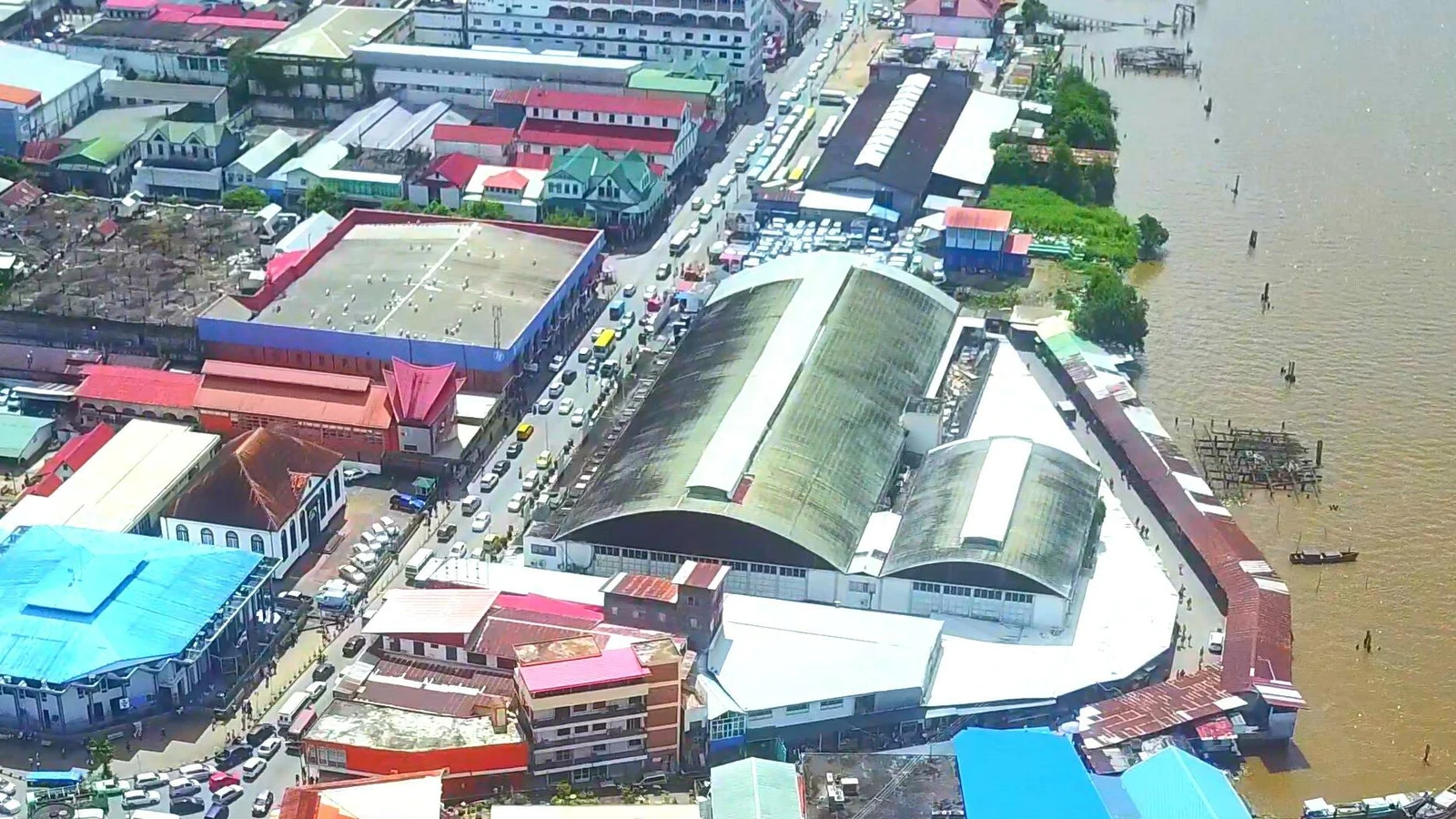
The Central Market is a big covered trading hall by the Suriname River.
Builders put up strong concrete and steel walls after an old fire.
Wooden river boats tie up at the water steps early every morning.
More than two thousand sellers work inside this busy two-story city building.
Big trucks bring fresh vegetables from country farms before dawn.
The lower floor sells fresh food while upper shops sell bright clothes.
Multi-Ethnic Foodways and Regional Supply Corridors
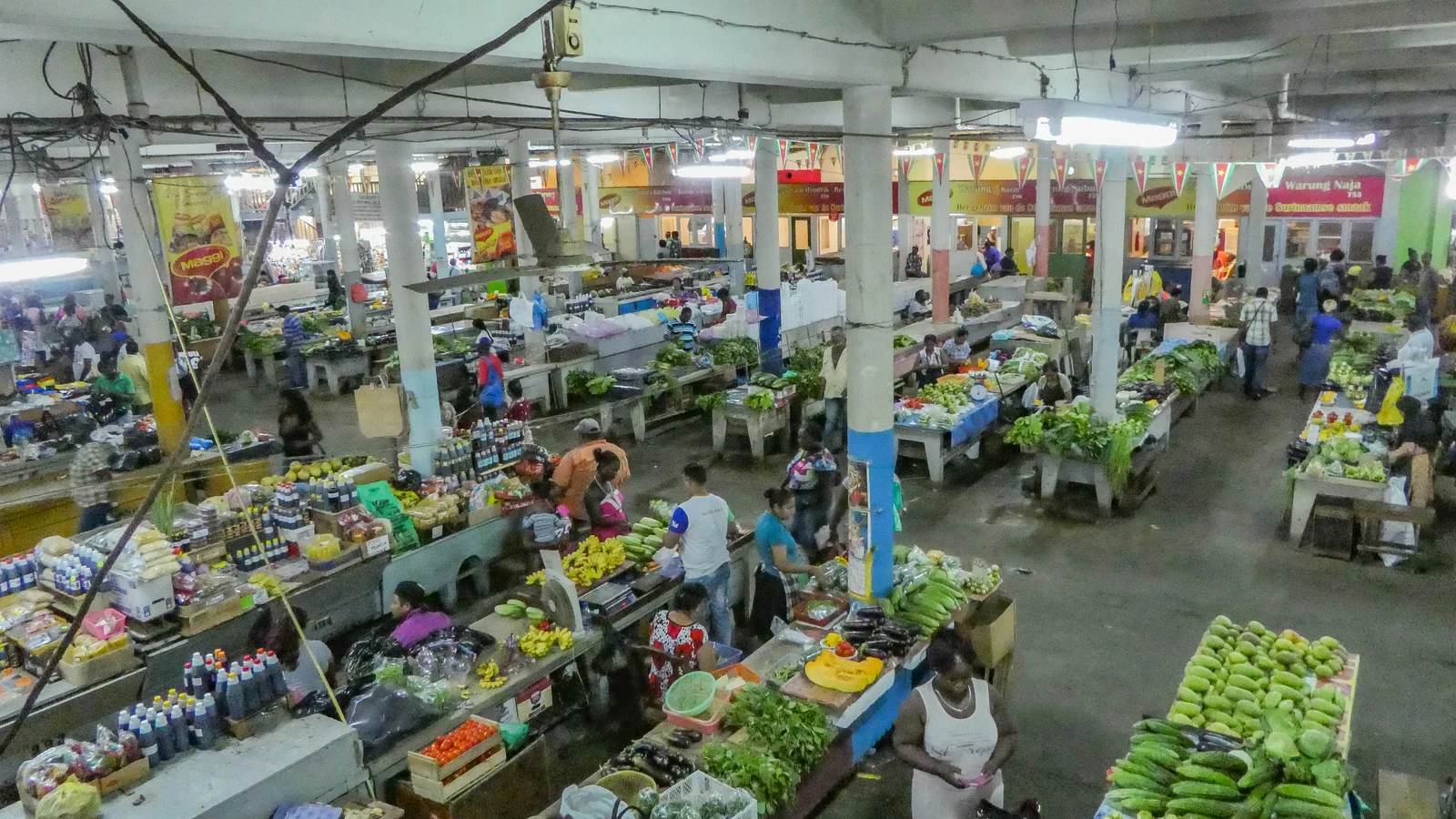
Surinamese vendor sections reflect culinary diversity across different cultures.
Hindustani farmers sell long beans, purple eggplants, and hot yellow peppers.
Javanese gardeners bring sweet green herbs, lemon grass, and spicy pastes.
Forest traders bring wild honey, cassava roots, and healthy tree bark.
The busy fish room receives fresh shrimp and river fish every day.
Vendor stalls stay organized in ethnic clusters across multiple family generations.
Price Mechanisms and Food Security Functions
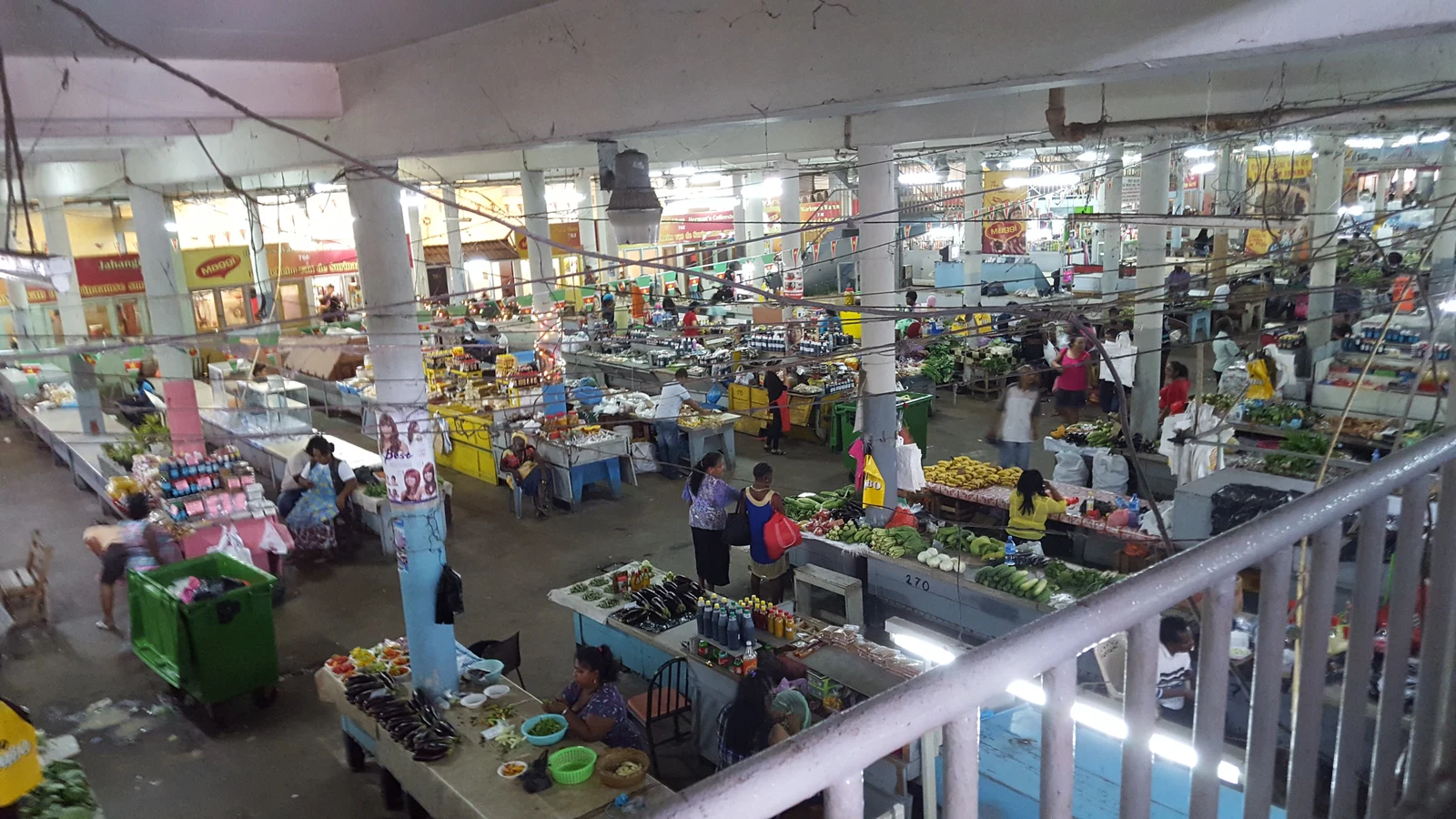
City families buy most of their fresh green food at this market.
Food prices here are much lower than in big modern supermarkets.
Government workers count prices every week to check national food costs.
Heavy summer rains sometimes slow down farm trucks and raise vegetable prices.
Buyers pay with cash money for all bags of fresh vegetables.
Cheap market food protects poor families from high city living costs.
Municipal Governance, Infrastructure, and Informal Commerce
City market officers walk through the big halls to check food rules.
Sellers pay small monthly fees to use concrete tables inside the hall.
Cleaning workers wash the floors and clear trash every single day.
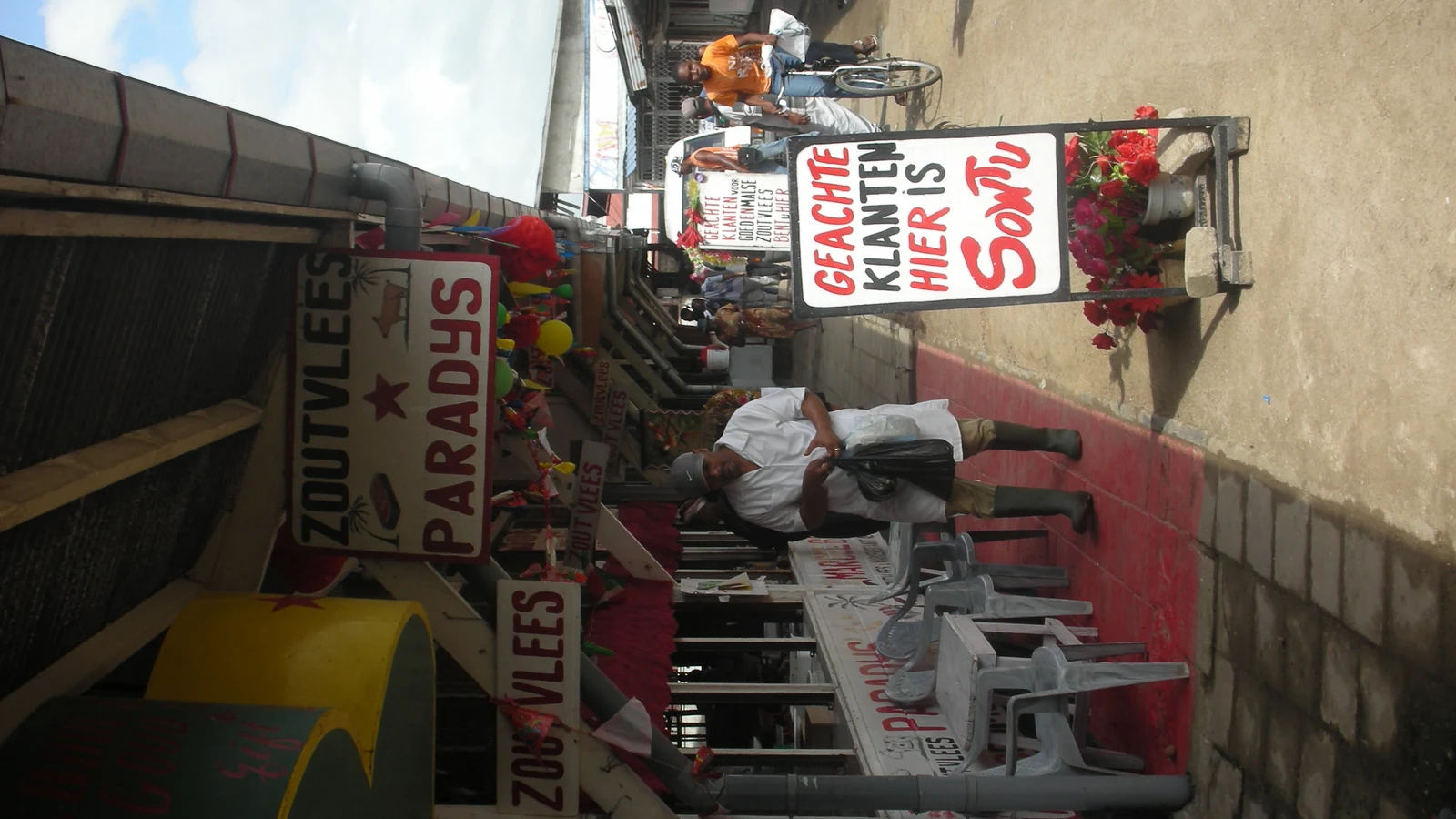
Street sellers on outer sidewalks compete with sellers inside the building.
New roof gutters and clean water pipes keep the old building safe.
The central market stays an essential commercial food engine for all families.
A2 · Elementary
Paramaribo Central Market: Waterfront Architecture, Supply Chains, and Pricing
Analyzing two-story covered trading halls, dawn river pirogue landings, multi-ethnic vendor stalls, and urban food security functions.
Riverside Architecture and Urban Wharf Logistics
Paramaribo Central Market, officially known as the Centrale Markt, stands as the largest covered municipal trading hall in Suriname, situated along the Suriname River waterfront at Saramaccastraat and Waterkant. The current concrete-and-steel two-story market complex was constructed in the mid-twentieth century to replace the older nineteenth-century wooden open-air market sheds destroyed by fire. The facility directly borders a designated commercial boat landing where motorized river pirogues and coastal cargo vessels unlade fresh agricultural produce at dawn.
Municipal administration reports by the District Commissariat record that the complex houses over two thousand licensed vendor stalls across its ground-floor and upper mezzanine halls. Dawn logistics begin between four and six in the morning when wholesale truck shipments from peri-urban farming districts converge at designated rear unloading bays. The ground floor accommodates bulk wholesale transactions of perishable staples, while the upper floor houses textile stalls, dry goods retailers, and informal food service canteens.
Multi-Ethnic Foodways and Regional Supply Corridors
The market operates as a crossroads of Surinamese culinary diversity, reflecting the country multi-ethnic demographic composition through specialized vendor sections. Hindustani smallholders from Saramacca and Wanica supply fresh subtropical vegetables, including bitter melon, yardlong beans, eggplants, and fresh hot madame jeanette peppers. Javanese market gardeners from Commewijne provide fresh aromatic culinary herbs, lemongrass bundles, galangal rhizomes, and hand-ground spice pastes.
Maroon and indigenous forest traders from Para and Sipaliwini transport harvested wild forest products, bitter cassava roots, medicinal plant bark, and wild game meat. The dedicated seafood section, known as the vismarkt, receives daily catches of Atlantic coastal fish, river catfish, and estuarine whiteleg shrimp from artisanal fishing boats. Spatial mapping by urban geographers reveals that vendor stalls are organized informally into ethnic and geographic clusters that have endured across multiple generations.
Price Mechanisms and Food Security Functions
Household food basket surveys by the General Bureau of Statistics establish that Paramaribo Central Market supplies over sixty percent of fresh produce consumed by urban working-class families. Retail pricing within the market hall operates through direct face-to-face price discovery, maintaining costs fifteen to thirty percent lower than formal supermarkets across Paramaribo. Ministry of Agriculture price enumerators conduct weekly surveys at the market to compute national benchmark retail price indices for essential agricultural commodities.
Seasonal weather variations, notably heavy rainfall during the Great Rainy Season from May to July, frequently trigger supply disruptions and temporary retail price spikes for leafy vegetables. The vast majority of market transactions occur strictly in cash, utilizing Surinamese dollars and informal credit arrangements extended between long-standing wholesale suppliers and stallholders. Economic assessments indicate that the market acts as an indispensable food security shock absorber, shielding lower-income urban populations from severe retail food inflation.
Municipal Governance, Infrastructure, and Informal Commerce
Day-to-day administrative oversight and regulatory enforcement are exercised by the District Commissariat Paramaribo-Zuidwest through on-site market supervisors and municipal inspectors. Licensed stallholders pay modest monthly municipal rental fees to occupy standard two-meter concrete vendor tables, with stall rights often bequeathed informally from mothers to daughters. Environmental health inspectors conduct daily enforcement sweeps to regulate food sanitation standards, solid waste clearance, and drainage canal water flow.
Spillover trading by unlicensed street hawkers along adjacent sidewalks and curbsides generates persistent operational tension with formal licensed stallholders. Municipal rehabilitation initiatives periodically upgrade roof drainage gutters, electrical wiring, and cold storage lockers to preserve structural safety and hygiene. Paramaribo Central Market remains both a vital commercial engine of domestic agricultural distribution and a living cultural institution embodying Surinamese everyday society.
B1 · Intermediate
Riverside Wharf Logistics, Ethnic Foodways, and Market Dynamics in Paramaribo
An analytical survey of twentieth-century market infrastructure, coastal horticultural inflows, face-to-face price discovery, and municipal regulation.
Riverside Architecture and Urban Wharf Logistics
Paramaribo Central Market, officially known as the Centrale Markt, stands as the largest covered municipal trading hall in Suriname, situated along the Suriname River waterfront at Saramaccastraat and Waterkant. The current concrete-and-steel two-story market complex was constructed in the mid-twentieth century to replace the older nineteenth-century wooden open-air market sheds destroyed by fire. The facility directly borders a designated commercial boat landing where motorized river pirogues and coastal cargo vessels unlade fresh agricultural produce at dawn.
Municipal administration reports by the District Commissariat record that the complex houses over two thousand licensed vendor stalls across its ground-floor and upper mezzanine halls. Dawn logistics begin between four and six in the morning when wholesale truck shipments from peri-urban farming districts converge at designated rear unloading bays. The ground floor accommodates bulk wholesale transactions of perishable staples, while the upper floor houses textile stalls, dry goods retailers, and informal food service canteens.
Multi-Ethnic Foodways and Regional Supply Corridors
The market operates as a crossroads of Surinamese culinary diversity, reflecting the country multi-ethnic demographic composition through specialized vendor sections. Hindustani smallholders from Saramacca and Wanica supply fresh subtropical vegetables, including bitter melon, yardlong beans, eggplants, and fresh hot madame jeanette peppers. Javanese market gardeners from Commewijne provide fresh aromatic culinary herbs, lemongrass bundles, galangal rhizomes, and hand-ground spice pastes.
Maroon and indigenous forest traders from Para and Sipaliwini transport harvested wild forest products, bitter cassava roots, medicinal plant bark, and wild game meat. The dedicated seafood section, known as the vismarkt, receives daily catches of Atlantic coastal fish, river catfish, and estuarine whiteleg shrimp from artisanal fishing boats. Spatial mapping by urban geographers reveals that vendor stalls are organized informally into ethnic and geographic clusters that have endured across multiple generations.
Price Mechanisms and Food Security Functions
Household food basket surveys by the General Bureau of Statistics establish that Paramaribo Central Market supplies over sixty percent of fresh produce consumed by urban working-class families. Retail pricing within the market hall operates through direct face-to-face price discovery, maintaining costs fifteen to thirty percent lower than formal supermarkets across Paramaribo. Ministry of Agriculture price enumerators conduct weekly surveys at the market to compute national benchmark retail price indices for essential agricultural commodities.
Seasonal weather variations, notably heavy rainfall during the Great Rainy Season from May to July, frequently trigger supply disruptions and temporary retail price spikes for leafy vegetables. The vast majority of market transactions occur strictly in cash, utilizing Surinamese dollars and informal credit arrangements extended between long-standing wholesale suppliers and stallholders. Economic assessments indicate that the market acts as an indispensable food security shock absorber, shielding lower-income urban populations from severe retail food inflation.
Municipal Governance, Infrastructure, and Informal Commerce
Day-to-day administrative oversight and regulatory enforcement are exercised by the District Commissariat Paramaribo-Zuidwest through on-site market supervisors and municipal inspectors. Licensed stallholders pay modest monthly municipal rental fees to occupy standard two-meter concrete vendor tables, with stall rights often bequeathed informally from mothers to daughters. Environmental health inspectors conduct daily enforcement sweeps to regulate food sanitation standards, solid waste clearance, and drainage canal water flow.
Spillover trading by unlicensed street hawkers along adjacent sidewalks and curbsides generates persistent operational tension with formal licensed stallholders. Municipal rehabilitation initiatives periodically upgrade roof drainage gutters, electrical wiring, and cold storage lockers to preserve structural safety and hygiene. Paramaribo Central Market remains both a vital commercial engine of domestic agricultural distribution and a living cultural institution embodying Surinamese everyday society.
B2 · Upper Intermediate
Paramaribo Central Market: Urban Spatial Organization, Price Mechanics, and Governance
Investigating Saramaccastraat wharf operations, seasonal rainfall volatility, cash liquidity mechanisms, and municipal environmental inspections.
Riverside Architecture and Urban Wharf Logistics
Paramaribo Central Market, officially known as the Centrale Markt, stands as the largest covered municipal trading hall in Suriname, situated along the Suriname River waterfront at Saramaccastraat and Waterkant. The current concrete-and-steel two-story market complex was constructed in the mid-twentieth century to replace the older nineteenth-century wooden open-air market sheds destroyed by fire. The facility directly borders a designated commercial boat landing where motorized river pirogues and coastal cargo vessels unlade fresh agricultural produce at dawn.
Municipal administration reports by the District Commissariat record that the complex houses over two thousand licensed vendor stalls across its ground-floor and upper mezzanine halls. Dawn logistics begin between four and six in the morning when wholesale truck shipments from peri-urban farming districts converge at designated rear unloading bays. The ground floor accommodates bulk wholesale transactions of perishable staples, while the upper floor houses textile stalls, dry goods retailers, and informal food service canteens.
Multi-Ethnic Foodways and Regional Supply Corridors
The market operates as a crossroads of Surinamese culinary diversity, reflecting the country multi-ethnic demographic composition through specialized vendor sections. Hindustani smallholders from Saramacca and Wanica supply fresh subtropical vegetables, including bitter melon, yardlong beans, eggplants, and fresh hot madame jeanette peppers. Javanese market gardeners from Commewijne provide fresh aromatic culinary herbs, lemongrass bundles, galangal rhizomes, and hand-ground spice pastes.
Maroon and indigenous forest traders from Para and Sipaliwini transport harvested wild forest products, bitter cassava roots, medicinal plant bark, and wild game meat. The dedicated seafood section, known as the vismarkt, receives daily catches of Atlantic coastal fish, river catfish, and estuarine whiteleg shrimp from artisanal fishing boats. Spatial mapping by urban geographers reveals that vendor stalls are organized informally into ethnic and geographic clusters that have endured across multiple generations.
Price Mechanisms and Food Security Functions
Household food basket surveys by the General Bureau of Statistics establish that Paramaribo Central Market supplies over sixty percent of fresh produce consumed by urban working-class families. Retail pricing within the market hall operates through direct face-to-face price discovery, maintaining costs fifteen to thirty percent lower than formal supermarkets across Paramaribo. Ministry of Agriculture price enumerators conduct weekly surveys at the market to compute national benchmark retail price indices for essential agricultural commodities.
Seasonal weather variations, notably heavy rainfall during the Great Rainy Season from May to July, frequently trigger supply disruptions and temporary retail price spikes for leafy vegetables. The vast majority of market transactions occur strictly in cash, utilizing Surinamese dollars and informal credit arrangements extended between long-standing wholesale suppliers and stallholders. Economic assessments indicate that the market acts as an indispensable food security shock absorber, shielding lower-income urban populations from severe retail food inflation.
Municipal Governance, Infrastructure, and Informal Commerce
Day-to-day administrative oversight and regulatory enforcement are exercised by the District Commissariat Paramaribo-Zuidwest through on-site market supervisors and municipal inspectors. Licensed stallholders pay modest monthly municipal rental fees to occupy standard two-meter concrete vendor tables, with stall rights often bequeathed informally from mothers to daughters. Environmental health inspectors conduct daily enforcement sweeps to regulate food sanitation standards, solid waste clearance, and drainage canal water flow.
Spillover trading by unlicensed street hawkers along adjacent sidewalks and curbsides generates persistent operational tension with formal licensed stallholders. Municipal rehabilitation initiatives periodically upgrade roof drainage gutters, electrical wiring, and cold storage lockers to preserve structural safety and hygiene. Paramaribo Central Market remains both a vital commercial engine of domestic agricultural distribution and a living cultural institution embodying Surinamese everyday society.
C1 · Advanced
The Political Geography of Paramaribo Central Market: Food Logistics and Urban Ecology
A critical economic study examining waterfront spatial zoning, peri-urban agrarian supply corridors, matrilineal stall succession, and informal street commerce.
Riverside Architecture and Urban Wharf Logistics
Paramaribo Central Market, officially known as the Centrale Markt, stands as the largest covered municipal trading hall in Suriname, situated along the Suriname River waterfront at Saramaccastraat and Waterkant. The current concrete-and-steel two-story market complex was constructed in the mid-twentieth century to replace the older nineteenth-century wooden open-air market sheds destroyed by fire. The facility directly borders a designated commercial boat landing where motorized river pirogues and coastal cargo vessels unlade fresh agricultural produce at dawn.
Municipal administration reports by the District Commissariat record that the complex houses over two thousand licensed vendor stalls across its ground-floor and upper mezzanine halls. Dawn logistics begin between four and six in the morning when wholesale truck shipments from peri-urban farming districts converge at designated rear unloading bays. The ground floor accommodates bulk wholesale transactions of perishable staples, while the upper floor houses textile stalls, dry goods retailers, and informal food service canteens.
Multi-Ethnic Foodways and Regional Supply Corridors
The market operates as a crossroads of Surinamese culinary diversity, reflecting the country multi-ethnic demographic composition through specialized vendor sections. Hindustani smallholders from Saramacca and Wanica supply fresh subtropical vegetables, including bitter melon, yardlong beans, eggplants, and fresh hot madame jeanette peppers. Javanese market gardeners from Commewijne provide fresh aromatic culinary herbs, lemongrass bundles, galangal rhizomes, and hand-ground spice pastes.
Maroon and indigenous forest traders from Para and Sipaliwini transport harvested wild forest products, bitter cassava roots, medicinal plant bark, and wild game meat. The dedicated seafood section, known as the vismarkt, receives daily catches of Atlantic coastal fish, river catfish, and estuarine whiteleg shrimp from artisanal fishing boats. Spatial mapping by urban geographers reveals that vendor stalls are organized informally into ethnic and geographic clusters that have endured across multiple generations.
Price Mechanisms and Food Security Functions
Household food basket surveys by the General Bureau of Statistics establish that Paramaribo Central Market supplies over sixty percent of fresh produce consumed by urban working-class families. Retail pricing within the market hall operates through direct face-to-face price discovery, maintaining costs fifteen to thirty percent lower than formal supermarkets across Paramaribo. Ministry of Agriculture price enumerators conduct weekly surveys at the market to compute national benchmark retail price indices for essential agricultural commodities.
Seasonal weather variations, notably heavy rainfall during the Great Rainy Season from May to July, frequently trigger supply disruptions and temporary retail price spikes for leafy vegetables. The vast majority of market transactions occur strictly in cash, utilizing Surinamese dollars and informal credit arrangements extended between long-standing wholesale suppliers and stallholders. Economic assessments indicate that the market acts as an indispensable food security shock absorber, shielding lower-income urban populations from severe retail food inflation.
Municipal Governance, Infrastructure, and Informal Commerce
Day-to-day administrative oversight and regulatory enforcement are exercised by the District Commissariat Paramaribo-Zuidwest through on-site market supervisors and municipal inspectors. Licensed stallholders pay modest monthly municipal rental fees to occupy standard two-meter concrete vendor tables, with stall rights often bequeathed informally from mothers to daughters. Environmental health inspectors conduct daily enforcement sweeps to regulate food sanitation standards, solid waste clearance, and drainage canal water flow.
Spillover trading by unlicensed street hawkers along adjacent sidewalks and curbsides generates persistent operational tension with formal licensed stallholders. Municipal rehabilitation initiatives periodically upgrade roof drainage gutters, electrical wiring, and cold storage lockers to preserve structural safety and hygiene. Paramaribo Central Market remains both a vital commercial engine of domestic agricultural distribution and a living cultural institution embodying Surinamese everyday society.
C2 · Mastery
Spatial Stratification, Supply Resilience, and Commercial Commensality in Paramaribo
A comprehensive analytical monograph exploring Suriname principal urban food market across infrastructural, ethnobotanical, and institutional dimensions.
Riverside Architecture and Urban Wharf Logistics
Paramaribo Central Market, officially known as the Centrale Markt, stands as the largest covered municipal trading hall in Suriname, situated along the Suriname River waterfront at Saramaccastraat and Waterkant. The current concrete-and-steel two-story market complex was constructed in the mid-twentieth century to replace the older nineteenth-century wooden open-air market sheds destroyed by fire. The facility directly borders a designated commercial boat landing where motorized river pirogues and coastal cargo vessels unlade fresh agricultural produce at dawn.
Municipal administration reports by the District Commissariat record that the complex houses over two thousand licensed vendor stalls across its ground-floor and upper mezzanine halls. Dawn logistics begin between four and six in the morning when wholesale truck shipments from peri-urban farming districts converge at designated rear unloading bays. The ground floor accommodates bulk wholesale transactions of perishable staples, while the upper floor houses textile stalls, dry goods retailers, and informal food service canteens.
Multi-Ethnic Foodways and Regional Supply Corridors
The market operates as a crossroads of Surinamese culinary diversity, reflecting the country multi-ethnic demographic composition through specialized vendor sections. Hindustani smallholders from Saramacca and Wanica supply fresh subtropical vegetables, including bitter melon, yardlong beans, eggplants, and fresh hot madame jeanette peppers. Javanese market gardeners from Commewijne provide fresh aromatic culinary herbs, lemongrass bundles, galangal rhizomes, and hand-ground spice pastes.
Maroon and indigenous forest traders from Para and Sipaliwini transport harvested wild forest products, bitter cassava roots, medicinal plant bark, and wild game meat. The dedicated seafood section, known as the vismarkt, receives daily catches of Atlantic coastal fish, river catfish, and estuarine whiteleg shrimp from artisanal fishing boats. Spatial mapping by urban geographers reveals that vendor stalls are organized informally into ethnic and geographic clusters that have endured across multiple generations.
Price Mechanisms and Food Security Functions
Household food basket surveys by the General Bureau of Statistics establish that Paramaribo Central Market supplies over sixty percent of fresh produce consumed by urban working-class families. Retail pricing within the market hall operates through direct face-to-face price discovery, maintaining costs fifteen to thirty percent lower than formal supermarkets across Paramaribo. Ministry of Agriculture price enumerators conduct weekly surveys at the market to compute national benchmark retail price indices for essential agricultural commodities.
Seasonal weather variations, notably heavy rainfall during the Great Rainy Season from May to July, frequently trigger supply disruptions and temporary retail price spikes for leafy vegetables. The vast majority of market transactions occur strictly in cash, utilizing Surinamese dollars and informal credit arrangements extended between long-standing wholesale suppliers and stallholders. Economic assessments indicate that the market acts as an indispensable food security shock absorber, shielding lower-income urban populations from severe retail food inflation.
Municipal Governance, Infrastructure, and Informal Commerce
Day-to-day administrative oversight and regulatory enforcement are exercised by the District Commissariat Paramaribo-Zuidwest through on-site market supervisors and municipal inspectors. Licensed stallholders pay modest monthly municipal rental fees to occupy standard two-meter concrete vendor tables, with stall rights often bequeathed informally from mothers to daughters. Environmental health inspectors conduct daily enforcement sweeps to regulate food sanitation standards, solid waste clearance, and drainage canal water flow.
Spillover trading by unlicensed street hawkers along adjacent sidewalks and curbsides generates persistent operational tension with formal licensed stallholders. Municipal rehabilitation initiatives periodically upgrade roof drainage gutters, electrical wiring, and cold storage lockers to preserve structural safety and hygiene. Paramaribo Central Market remains both a vital commercial engine of domestic agricultural distribution and a living cultural institution embodying Surinamese everyday society.
Check your understanding
Choose how closely you want to revisit the article. You can refer back while answering, and review explanations when you finish.
Quick Quiz A1
Try one question, then create a free account for the full Quick Quiz. Sign Up Free
Answer every question before checking. There is no time limit.
Your results
/ 1 correct (%)
Read the explanations to see how each answer connects to the article.
-
Where is the Central Market located in the capital city of Suriname?
1. Answer:
Quick Quiz A2
Try one question, then create a free account for the full Quick Quiz. Sign Up Free
Answer every question before checking. There is no time limit.
Your results
/ 1 correct (%)
Read the explanations to see how each answer connects to the article.
-
Where is Paramaribo Central Market situated along the Suriname River waterfront?
1. Answer:
Quick Quiz B1
Try one question, then create a free account for the full Quick Quiz. Sign Up Free
Answer every question before checking. There is no time limit.
Your results
/ 1 correct (%)
Read the explanations to see how each answer connects to the article.
-
Where is Paramaribo Central Market situated along the Suriname River waterfront?
1. Answer:
Quick Quiz B2
Try one question, then create a free account for the full Quick Quiz. Sign Up Free
Answer every question before checking. There is no time limit.
Your results
/ 1 correct (%)
Read the explanations to see how each answer connects to the article.
-
Where is Paramaribo Central Market situated along the Suriname River waterfront?
1. Answer:
Quick Quiz C1
Try one question, then create a free account for the full Quick Quiz. Sign Up Free
Answer every question before checking. There is no time limit.
Your results
/ 1 correct (%)
Read the explanations to see how each answer connects to the article.
-
Where is Paramaribo Central Market situated along the Suriname River waterfront?
1. Answer:
Quick Quiz C2
Try one question, then create a free account for the full Quick Quiz. Sign Up Free
Answer every question before checking. There is no time limit.
Your results
/ 1 correct (%)
Read the explanations to see how each answer connects to the article.
-
Where is Paramaribo Central Market situated along the Suriname River waterfront?
1. Answer:
