A1 · Beginner
Keti Koti in Paramaribo: Suriname Emancipation Holiday
From bright cotton koto dresses and brass music to the bronze Kwakoe statue, families in Paramaribo celebrate freedom every July first.
Emancipation Day and Urban Transformation
Keti Koti is an important national holiday celebrated on July first across Suriname.
The capital city of Paramaribo hosts big street parades and happy public celebrations.
Every year, city leaders close downtown streets to cars and buses.
People walk freely around the Garden of Palms and Independence Square.
Police officers help keep walking paths safe near the water.
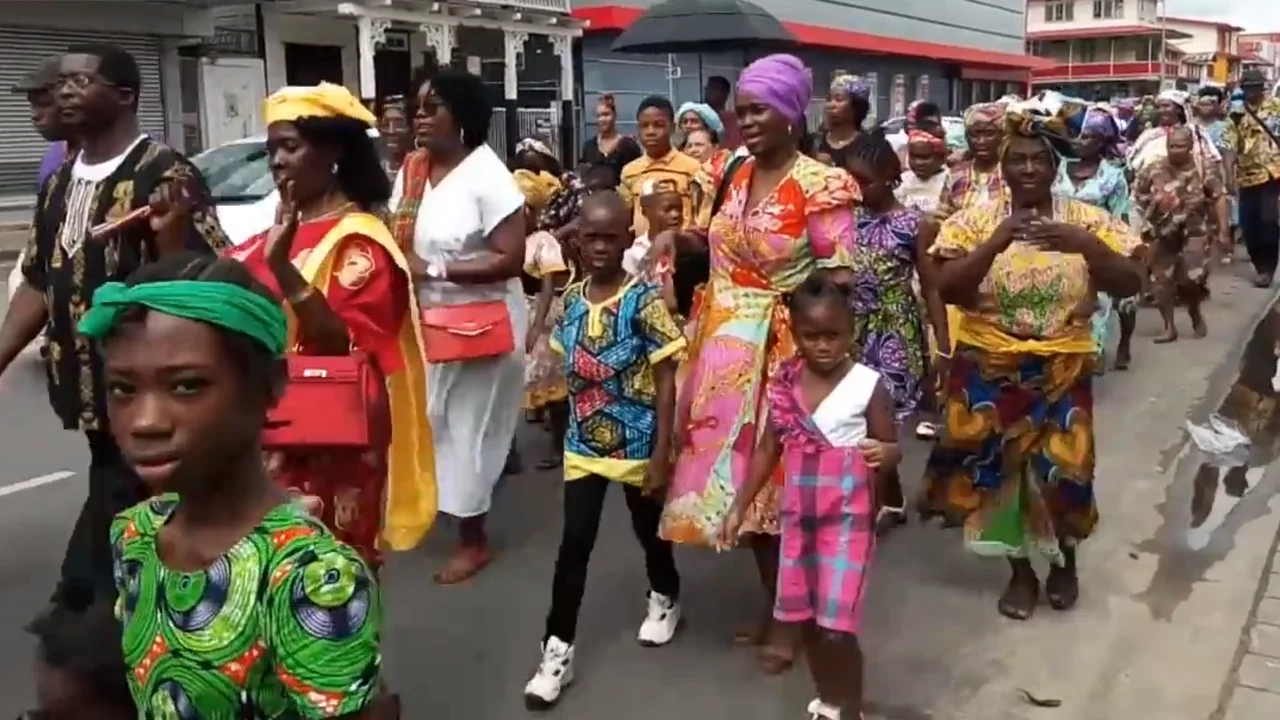
Crowds of happy families fill the streets without traffic problems.
Historical Abolition and Civic Coordination
The holiday honors July first in 1863 when slavery ended in Suriname.
Workers stayed on plantations for ten more years under state rules until 1873.
A national committee works with city leaders to plan the official celebrations.
Community groups organize music events and history lessons for young people.
History researchers keep old books and letters about brave people who fought for freedom.
Leaders and community elders open the morning with prayers for peace and freedom.
Bigi Spikri Parade and Material Culture
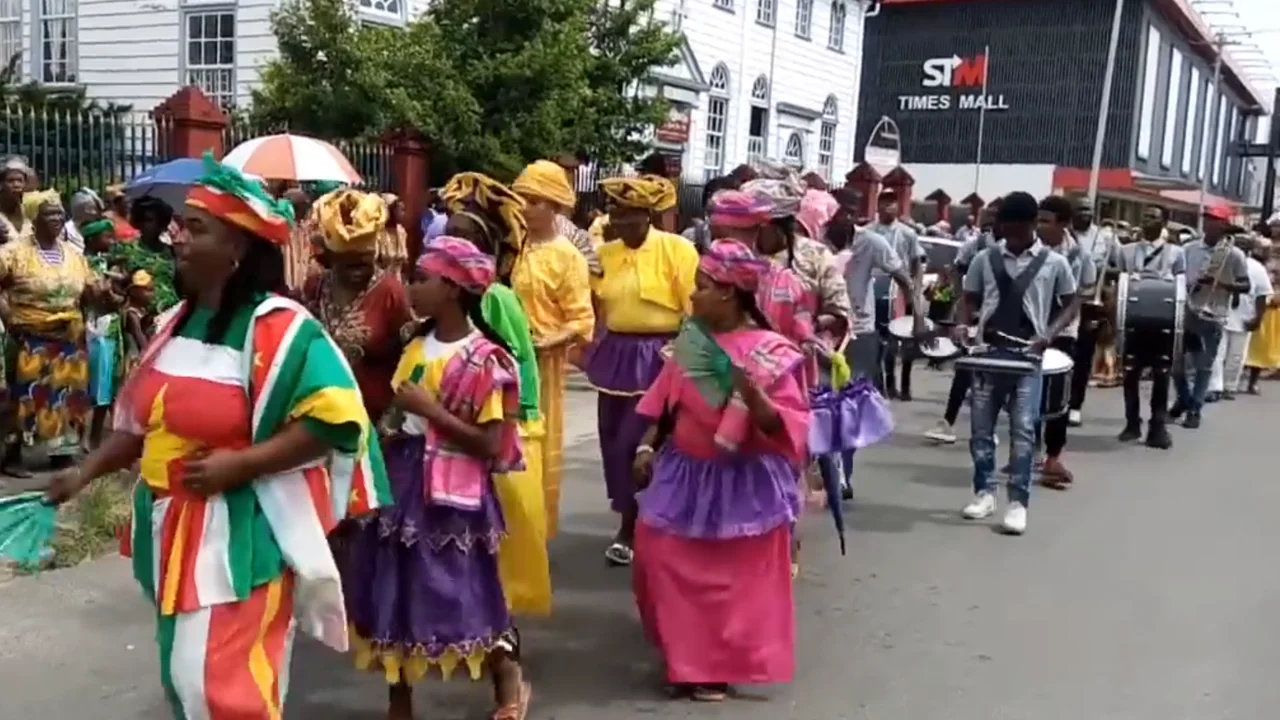
The Bigi Spikri parade is the colorful morning walk through Paramaribo.
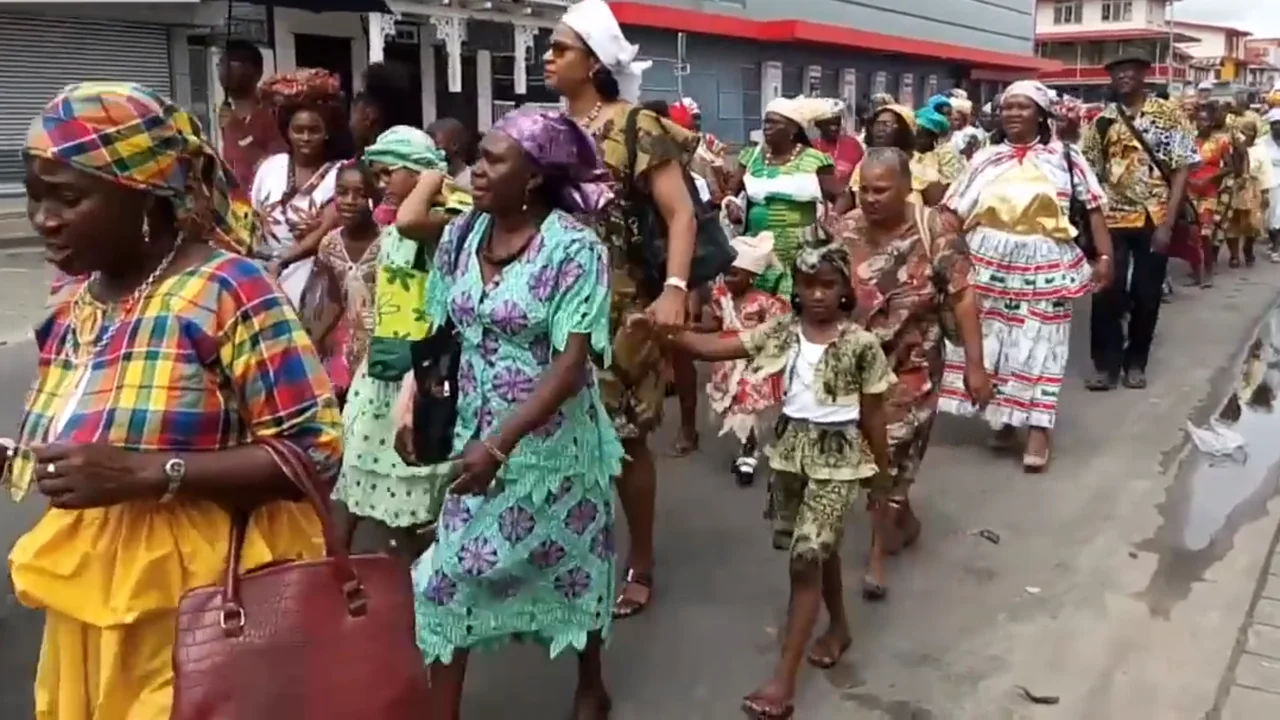
Women wear beautiful koto dresses made from bright cotton cloth.
Women fold special cotton head scarves called angisa into clever shapes.
Lively brass bands and energetic drummers play happy music along the street.
Cooks make traditional her'heri food with boiled cassava, sweet potatoes, and fish.
Marchers carry colorful parasols and wave bright flags near historic wooden buildings.
Kwakoe Monument and Living Commemoration
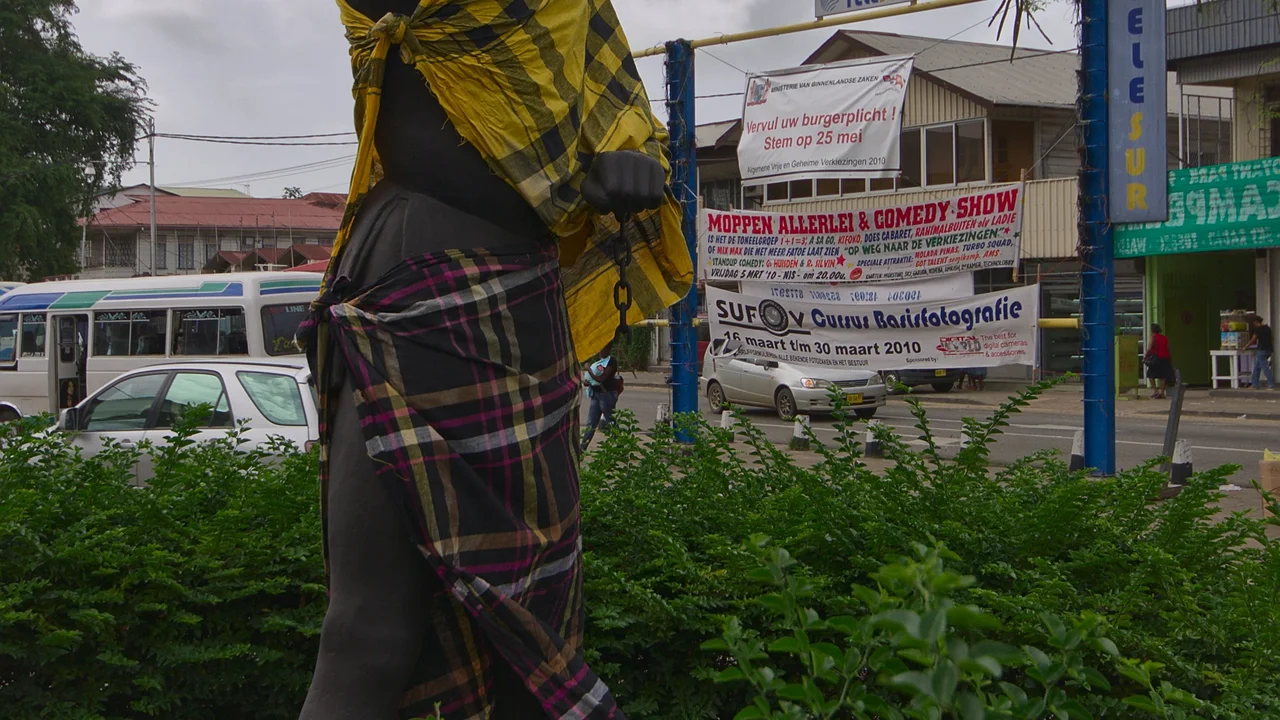
People gather around the bronze Kwakoe statue on Dr. Sophie Redmondstraat.
Surinamese artist Jozef Klas made the Kwakoe statue in 1963.
The statue shows an African man breaking iron chains to be free.
The President and civic leaders place fresh flowers at the statue.
National archives keep old government papers and photographs of past celebrations.
Every year, this holiday reminds everyone to respect human freedom and dignity.
A2 · Elementary
Keti Koti in Paramaribo: Emancipation Day and Civic Celebrations
Every July first, Paramaribo transforms its central streets with walking parades, traditional koto garments, and commemorative assemblies at the Kwakoe monument.
Emancipation Day and Urban Transformation
Keti Koti, translating from Sranan Tongo as chains cut or broken chains, is the annual national public holiday celebrated on July 1 across Suriname.
The capital city of Paramaribo serves as the primary urban center for national emancipation ceremonies, street processions, and evening cultural festivals.
Every July 1st, municipal authorities close major urban thoroughfares in Paramaribo to motorized vehicles to accommodate walking processions and assembly points.
The festival temporarily transforms civic plazas including the Garden of Palms and Independence Square into bustling pedestrian spaces with communal stalls.
Paramaribo police and municipal traffic wardens establish dedicated pedestrian zones connecting Waterkant waterfront boulevard to historic central arteries.
Civic reordering of public space during Keti Koti allows thousands of residents and overseas visitors to assemble freely without vehicular interference.
Historical Abolition and Civic Coordination
The date commemorates July 1, 1863, when the Dutch colonial administration officially enacted the Emancipation Act abolishing chattel slavery in Suriname.
Abolition legislation required freed enslaved people to complete a mandatory ten-year transition period of indentured plantation labor termed Staatstoezicht until 1873.
The National Committee for the Commemoration of Abolition ensures the coordination of official protocols in partnership with municipal and national government bodies.
Civic organizations, cultural associations, and Afro-Surinamese heritage foundations organize memorial lectures, musical tributes, and youth educational workshops.
Descendant communities and historical researchers maintain archival documentation honoring the resistance struggles of enslaved Africans and Maroons.
Government representatives, community elders, and religious leaders open the holiday with formal ecumenical prayers and reflections on historical freedom.
Bigi Spikri Parade and Material Culture
The Bigi Spikri parade, meaning big mirror in Sranan Tongo, forms the visual centerpiece of a morning street procession across downtown Paramaribo.
Procession participants dress in colorful traditional Afro-Surinamese koto skirts and matching jackets featuring vibrant patterned cotton textiles.
Women fold starched cotton headscarves called angisa into intricate structural shapes that historically communicated subtle social and personal messages.
Marching brass bands and Kawina percussion ensembles accompany the parade with lively acoustic rhythms, call-and-response singing, and drumming.
Communal kitchens and street vendors prepare and distribute her'heri, a historic dish of boiled cassava, sweet potatoes, plantains, and salted codfish.
Participants carry parasols and wave handheld flags as they march past historical timber landmarks toward central commemorative plazas.
Kwakoe Monument and Living Commemoration
The focal point of civic ceremonies is the bronze Kwakoe monument located at the junction of Dr. Sophie Redmondstraat and Zwartenhovenbrugstraat.
Created by Surinamese sculptor Jozef Klas, the Kwakoe statue was unveiled on June 30, 1963, to commemorate the centenary of emancipation.
The monument portrays an African man breaking free from his iron shackles, with Kwakoe representing the day name Wednesday when abolition occurred.
The President of Suriname, government ministers, and civic delegates lay ceremonial floral wreaths at the base of the Kwakoe statue during morning protocols.
National Archives and municipal registries safeguard historic emancipation registers, gazettes, and official photographic records of past centenary gatherings.
Continuous annual commemoration ensures that intergenerational memory, cultural expression, and reflections on human dignity remain active in public consciousness.
B1 · Intermediate
Keti Koti in Paramaribo: Urban Space, Cultural Memory, and Emancipation
An analytical study of July 1st commemorations in Paramaribo, tracing municipal street reordering, the Bigi Spikri parade, and historic abolition memorials.
Emancipation Day and Urban Transformation
Keti Koti, translating from Sranan Tongo as chains cut or broken chains, is the annual national public holiday celebrated on July 1 across Suriname.
The capital city of Paramaribo serves as the primary urban center for national emancipation ceremonies, street processions, and evening cultural festivals.
Every July 1st, municipal authorities close major urban thoroughfares in Paramaribo to motorized vehicles to accommodate walking processions and assembly points.
The festival temporarily transforms civic plazas including the Garden of Palms and Independence Square into bustling pedestrian spaces with communal stalls.
Paramaribo police and municipal traffic wardens establish dedicated pedestrian zones connecting Waterkant waterfront boulevard to historic central arteries.
Civic reordering of public space during Keti Koti allows thousands of residents and overseas visitors to assemble freely without vehicular interference.
Historical Abolition and Civic Coordination
The date commemorates July 1, 1863, when the Dutch colonial administration officially enacted the Emancipation Act abolishing chattel slavery in Suriname.
Abolition legislation required freed enslaved people to complete a mandatory ten-year transition period of indentured plantation labor termed Staatstoezicht until 1873.
The National Committee for the Commemoration of Abolition ensures the coordination of official protocols in partnership with municipal and national government bodies.
Civic organizations, cultural associations, and Afro-Surinamese heritage foundations organize memorial lectures, musical tributes, and youth educational workshops.
Descendant communities and historical researchers maintain archival documentation honoring the resistance struggles of enslaved Africans and Maroons.
Government representatives, community elders, and religious leaders open the holiday with formal ecumenical prayers and reflections on historical freedom.
Bigi Spikri Parade and Material Culture
The Bigi Spikri parade, meaning big mirror in Sranan Tongo, forms the visual centerpiece of a morning street procession across downtown Paramaribo.
Procession participants dress in colorful traditional Afro-Surinamese koto skirts and matching jackets featuring vibrant patterned cotton textiles.
Women fold starched cotton headscarves called angisa into intricate structural shapes that historically communicated subtle social and personal messages.
Marching brass bands and Kawina percussion ensembles accompany the parade with lively acoustic rhythms, call-and-response singing, and drumming.
Communal kitchens and street vendors prepare and distribute her'heri, a historic dish of boiled cassava, sweet potatoes, plantains, and salted codfish.
Participants carry parasols and wave handheld flags as they march past historical timber landmarks toward central commemorative plazas.
Kwakoe Monument and Living Commemoration
The focal point of civic ceremonies is the bronze Kwakoe monument located at the junction of Dr. Sophie Redmondstraat and Zwartenhovenbrugstraat.
Created by Surinamese sculptor Jozef Klas, the Kwakoe statue was unveiled on June 30, 1963, to commemorate the centenary of emancipation.
The monument portrays an African man breaking free from his iron shackles, with Kwakoe representing the day name Wednesday when abolition occurred.
The President of Suriname, government ministers, and civic delegates lay ceremonial floral wreaths at the base of the Kwakoe statue during morning protocols.
National Archives and municipal registries safeguard historic emancipation registers, gazettes, and official photographic records of past centenary gatherings.
Continuous annual commemoration ensures that intergenerational memory, cultural expression, and reflections on human dignity remain active in public consciousness.
B2 · Upper Intermediate
Keti Koti in Paramaribo: Spatial Reordering, Textile Codes, and Civic Commemoration
Investigating the civic transformation of Paramaribo during Emancipation Day, including municipal pedestrianization, angisa communication, and Kwakoe memorial ceremonies.
Emancipation Day and Urban Transformation
Keti Koti, translating from Sranan Tongo as chains cut or broken chains, is the annual national public holiday celebrated on July 1 across Suriname.
The capital city of Paramaribo serves as the primary urban center for national emancipation ceremonies, street processions, and evening cultural festivals.
Every July 1st, municipal authorities close major urban thoroughfares in Paramaribo to motorized vehicles to accommodate walking processions and assembly points.
The festival temporarily transforms civic plazas including the Garden of Palms and Independence Square into bustling pedestrian spaces with communal stalls.
Paramaribo police and municipal traffic wardens establish dedicated pedestrian zones connecting Waterkant waterfront boulevard to historic central arteries.
Civic reordering of public space during Keti Koti allows thousands of residents and overseas visitors to assemble freely without vehicular interference.
Historical Abolition and Civic Coordination
The date commemorates July 1, 1863, when the Dutch colonial administration officially enacted the Emancipation Act abolishing chattel slavery in Suriname.
Abolition legislation required freed enslaved people to complete a mandatory ten-year transition period of indentured plantation labor termed Staatstoezicht until 1873.
The National Committee for the Commemoration of Abolition ensures the coordination of official protocols in partnership with municipal and national government bodies.
Civic organizations, cultural associations, and Afro-Surinamese heritage foundations organize memorial lectures, musical tributes, and youth educational workshops.
Descendant communities and historical researchers maintain archival documentation honoring the resistance struggles of enslaved Africans and Maroons.
Government representatives, community elders, and religious leaders open the holiday with formal ecumenical prayers and reflections on historical freedom.
Bigi Spikri Parade and Material Culture
The Bigi Spikri parade, meaning big mirror in Sranan Tongo, forms the visual centerpiece of a morning street procession across downtown Paramaribo.
Procession participants dress in colorful traditional Afro-Surinamese koto skirts and matching jackets featuring vibrant patterned cotton textiles.
Women fold starched cotton headscarves called angisa into intricate structural shapes that historically communicated subtle social and personal messages.
Marching brass bands and Kawina percussion ensembles accompany the parade with lively acoustic rhythms, call-and-response singing, and drumming.
Communal kitchens and street vendors prepare and distribute her'heri, a historic dish of boiled cassava, sweet potatoes, plantains, and salted codfish.
Participants carry parasols and wave handheld flags as they march past historical timber landmarks toward central commemorative plazas.
Kwakoe Monument and Living Commemoration
The focal point of civic ceremonies is the bronze Kwakoe monument located at the junction of Dr. Sophie Redmondstraat and Zwartenhovenbrugstraat.
Created by Surinamese sculptor Jozef Klas, the Kwakoe statue was unveiled on June 30, 1963, to commemorate the centenary of emancipation.
The monument portrays an African man breaking free from his iron shackles, with Kwakoe representing the day name Wednesday when abolition occurred.
The President of Suriname, government ministers, and civic delegates lay ceremonial floral wreaths at the base of the Kwakoe statue during morning protocols.
National Archives and municipal registries safeguard historic emancipation registers, gazettes, and official photographic records of past centenary gatherings.
Continuous annual commemoration ensures that intergenerational memory, cultural expression, and reflections on human dignity remain active in public consciousness.
C1 · Advanced
The Spatial Politics and Cultural Topography of Keti Koti in Paramaribo
A critical journalistic monograph analyzing urban pedestrianization, Staatstoezicht archival memory, processional textile semiotics, and public commemoration around the Kwakoe statue.
Emancipation Day and Urban Transformation
Keti Koti, translating from Sranan Tongo as chains cut or broken chains, is the annual national public holiday celebrated on July 1 across Suriname.
The capital city of Paramaribo serves as the primary urban center for national emancipation ceremonies, street processions, and evening cultural festivals.
Every July 1st, municipal authorities close major urban thoroughfares in Paramaribo to motorized vehicles to accommodate walking processions and assembly points.
The festival temporarily transforms civic plazas including the Garden of Palms and Independence Square into bustling pedestrian spaces with communal stalls.
Paramaribo police and municipal traffic wardens establish dedicated pedestrian zones connecting Waterkant waterfront boulevard to historic central arteries.
Civic reordering of public space during Keti Koti allows thousands of residents and overseas visitors to assemble freely without vehicular interference.
Historical Abolition and Civic Coordination
The date commemorates July 1, 1863, when the Dutch colonial administration officially enacted the Emancipation Act abolishing chattel slavery in Suriname.
Abolition legislation required freed enslaved people to complete a mandatory ten-year transition period of indentured plantation labor termed Staatstoezicht until 1873.
The National Committee for the Commemoration of Abolition ensures the coordination of official protocols in partnership with municipal and national government bodies.
Civic organizations, cultural associations, and Afro-Surinamese heritage foundations organize memorial lectures, musical tributes, and youth educational workshops.
Descendant communities and historical researchers maintain archival documentation honoring the resistance struggles of enslaved Africans and Maroons.
Government representatives, community elders, and religious leaders open the holiday with formal ecumenical prayers and reflections on historical freedom.
Bigi Spikri Parade and Material Culture
The Bigi Spikri parade, meaning big mirror in Sranan Tongo, forms the visual centerpiece of a morning street procession across downtown Paramaribo.
Procession participants dress in colorful traditional Afro-Surinamese koto skirts and matching jackets featuring vibrant patterned cotton textiles.
Women fold starched cotton headscarves called angisa into intricate structural shapes that historically communicated subtle social and personal messages.
Marching brass bands and Kawina percussion ensembles accompany the parade with lively acoustic rhythms, call-and-response singing, and drumming.
Communal kitchens and street vendors prepare and distribute her'heri, a historic dish of boiled cassava, sweet potatoes, plantains, and salted codfish.
Participants carry parasols and wave handheld flags as they march past historical timber landmarks toward central commemorative plazas.
Kwakoe Monument and Living Commemoration
The focal point of civic ceremonies is the bronze Kwakoe monument located at the junction of Dr. Sophie Redmondstraat and Zwartenhovenbrugstraat.
Created by Surinamese sculptor Jozef Klas, the Kwakoe statue was unveiled on June 30, 1963, to commemorate the centenary of emancipation.
The monument portrays an African man breaking free from his iron shackles, with Kwakoe representing the day name Wednesday when abolition occurred.
The President of Suriname, government ministers, and civic delegates lay ceremonial floral wreaths at the base of the Kwakoe statue during morning protocols.
National Archives and municipal registries safeguard historic emancipation registers, gazettes, and official photographic records of past centenary gatherings.
Continuous annual commemoration ensures that intergenerational memory, cultural expression, and reflections on human dignity remain active in public consciousness.
C2 · Mastery
Keti Koti in Paramaribo: Urban Reordering, Living Heritage, and Emancipation Historiography
A comprehensive investigation of Suriname premier civic holiday, exploring the systemic transformation of Paramaribo public sphere, post-emancipation labor transitions, and intergenerational remembrance.
Emancipation Day and Urban Transformation
Keti Koti, translating from Sranan Tongo as chains cut or broken chains, is the annual national public holiday celebrated on July 1 across Suriname.
The capital city of Paramaribo serves as the primary urban center for national emancipation ceremonies, street processions, and evening cultural festivals.
Every July 1st, municipal authorities close major urban thoroughfares in Paramaribo to motorized vehicles to accommodate walking processions and assembly points.
The festival temporarily transforms civic plazas including the Garden of Palms and Independence Square into bustling pedestrian spaces with communal stalls.
Paramaribo police and municipal traffic wardens establish dedicated pedestrian zones connecting Waterkant waterfront boulevard to historic central arteries.
Civic reordering of public space during Keti Koti allows thousands of residents and overseas visitors to assemble freely without vehicular interference.
Historical Abolition and Civic Coordination
The date commemorates July 1, 1863, when the Dutch colonial administration officially enacted the Emancipation Act abolishing chattel slavery in Suriname.
Abolition legislation required freed enslaved people to complete a mandatory ten-year transition period of indentured plantation labor termed Staatstoezicht until 1873.
The National Committee for the Commemoration of Abolition ensures the coordination of official protocols in partnership with municipal and national government bodies.
Civic organizations, cultural associations, and Afro-Surinamese heritage foundations organize memorial lectures, musical tributes, and youth educational workshops.
Descendant communities and historical researchers maintain archival documentation honoring the resistance struggles of enslaved Africans and Maroons.
Government representatives, community elders, and religious leaders open the holiday with formal ecumenical prayers and reflections on historical freedom.
Bigi Spikri Parade and Material Culture
The Bigi Spikri parade, meaning big mirror in Sranan Tongo, forms the visual centerpiece of a morning street procession across downtown Paramaribo.
Procession participants dress in colorful traditional Afro-Surinamese koto skirts and matching jackets featuring vibrant patterned cotton textiles.
Women fold starched cotton headscarves called angisa into intricate structural shapes that historically communicated subtle social and personal messages.
Marching brass bands and Kawina percussion ensembles accompany the parade with lively acoustic rhythms, call-and-response singing, and drumming.
Communal kitchens and street vendors prepare and distribute her'heri, a historic dish of boiled cassava, sweet potatoes, plantains, and salted codfish.
Participants carry parasols and wave handheld flags as they march past historical timber landmarks toward central commemorative plazas.
Kwakoe Monument and Living Commemoration
The focal point of civic ceremonies is the bronze Kwakoe monument located at the junction of Dr. Sophie Redmondstraat and Zwartenhovenbrugstraat.
Created by Surinamese sculptor Jozef Klas, the Kwakoe statue was unveiled on June 30, 1963, to commemorate the centenary of emancipation.
The monument portrays an African man breaking free from his iron shackles, with Kwakoe representing the day name Wednesday when abolition occurred.
The President of Suriname, government ministers, and civic delegates lay ceremonial floral wreaths at the base of the Kwakoe statue during morning protocols.
National Archives and municipal registries safeguard historic emancipation registers, gazettes, and official photographic records of past centenary gatherings.
Continuous annual commemoration ensures that intergenerational memory, cultural expression, and reflections on human dignity remain active in public consciousness.
Check your understanding
Choose how closely you want to revisit the article. You can refer back while answering, and review explanations when you finish.
Quick Quiz A1
Try one question, then create a free account for the full Quick Quiz. Sign Up Free
Answer every question before checking. There is no time limit.
Your results
/ 1 correct (%)
Read the explanations to see how each answer connects to the article.
-
What important national holiday is celebrated on July first across Suriname?
1. Answer:
Quick Quiz A2
Try one question, then create a free account for the full Quick Quiz. Sign Up Free
Answer every question before checking. There is no time limit.
Your results
/ 1 correct (%)
Read the explanations to see how each answer connects to the article.
-
What does the name Keti Koti translate to in Sranan Tongo?
1. Answer:
Quick Quiz B1
Try one question, then create a free account for the full Quick Quiz. Sign Up Free
Answer every question before checking. There is no time limit.
Your results
/ 1 correct (%)
Read the explanations to see how each answer connects to the article.
-
What does the name Keti Koti translate to in Sranan Tongo?
1. Answer:
Quick Quiz B2
Try one question, then create a free account for the full Quick Quiz. Sign Up Free
Answer every question before checking. There is no time limit.
Your results
/ 1 correct (%)
Read the explanations to see how each answer connects to the article.
-
What does the name Keti Koti translate to in Sranan Tongo?
1. Answer:
Quick Quiz C1
Try one question, then create a free account for the full Quick Quiz. Sign Up Free
Answer every question before checking. There is no time limit.
Your results
/ 1 correct (%)
Read the explanations to see how each answer connects to the article.
-
What does the name Keti Koti translate to in Sranan Tongo?
1. Answer:
Quick Quiz C2
Try one question, then create a free account for the full Quick Quiz. Sign Up Free
Answer every question before checking. There is no time limit.
Your results
/ 1 correct (%)
Read the explanations to see how each answer connects to the article.
-
What does the name Keti Koti translate to in Sranan Tongo?
1. Answer:
