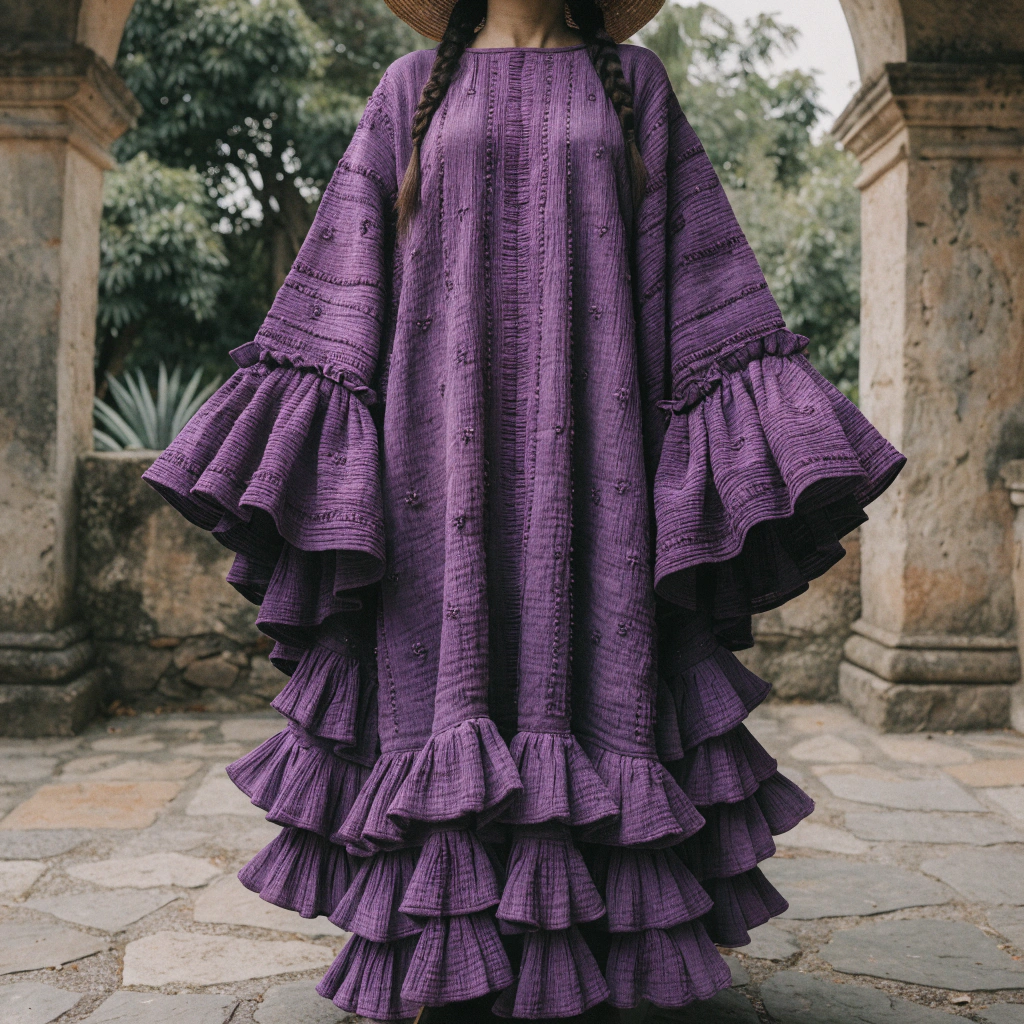
The Traditional Huipil of Mexico
The huipil is a traditional dress from Mexico. It is a very old garment. Indigenous women wear this dress every day. The huipil is a simple tunic. It has two or three pieces of fabric. The pieces are long and rectangular.
The huipil is not just a piece of clothing. It shows the history of the person. Each dress has special colors and patterns. These patterns tell a story about the family and the village.
Today, many women in Mexico still wear the huipil. It is very beautiful and colorful. It is an important part of Mexican culture.
Grammar Spotlight
Pattern: Present Simple: To Be
"The huipil is a traditional dress from Mexico."
We use 'is' for singular objects like 'the huipil'. It describes a fact or a state that is true right now.
Pattern: Present Simple: Plural Verbs
"Indigenous women wear this dress every day."
When the subject is plural (women), we use the base form of the verb (wear). We do not add an 's' at the end.
Test Your Understanding
10 questions · A1 Beginner · 1 free preview
Test what you learned from this article. Answer all questions to earn XP!
Where is the huipil from?
Want to finish the quiz?
9 more questions are waiting for you. Sign up free to unlock the full quiz and earn XP!
Sign Up FreeAlready have an account? Sign In
Question Breakdown
Where is the huipil from?
Your answer:
Correct answer: Mexico
The huipil is a new type of dress.
Your answer:
Correct answer: False
What is fabric?
Your answer:
Correct answer: Material for clothes
Each dress has special colors and _____.
Your answer:
Correct answer: patterns
The Huipil: A Special Dress from Mexico
The huipil is a traditional dress from Mexico. It is very old because indigenous women wore it for thousands of years. It is a simple tunic made from rectangular pieces of fabric. Usually, women join two or three pieces together to make one dress.
Each huipil is special because the patterns tell a story. In the past, the designs showed the woman’s village and her family history. Some huipils are more colorful than others. They have beautiful flowers and animals on them. These designs are often more complex in the south of Mexico.
Today, many women still wear the huipil for festivals and daily life. It is more popular than other traditional clothes because it is comfortable and beautiful. Younger generations also like it because it represents their culture. Even though Mexico changed a lot, the huipil stayed the same. It is a living piece of history that people still love today.
Grammar Spotlight
Pattern: Past Simple
"It is very old because indigenous women wore it for thousands of years."
We use the past simple to talk about things that happened in the past. In this sentence, 'wore' is the past form of the irregular verb 'wear'.
Pattern: Comparatives
"It is more popular than other traditional clothes because it is comfortable and beautiful."
We use 'more + adjective + than' to compare two things. For long adjectives like 'popular', we use 'more' instead of adding '-er' to the end.
Test Your Understanding
11 questions · A2 Elementary · 1 free preview
Test what you learned from this article. Answer all questions to earn XP!
What is a huipil?
Want to finish the quiz?
10 more questions are waiting for you. Sign up free to unlock the full quiz and earn XP!
Sign Up FreeAlready have an account? Sign In
Question Breakdown
What is a huipil?
Your answer:
Correct answer: A traditional dress
The huipil is a modern invention from the last 10 years.
Your answer:
Correct answer: False
What does 'fabric' mean?
Your answer:
Correct answer: Material used to make clothes
Each huipil is special because the patterns tell a _____.
Your answer:
Correct answer: story
How many pieces of fabric are used to make a huipil?
Your answer:
Correct answer: Two or three pieces
The Huipil: A Living History of Mexican Tradition
The huipil is perhaps the most famous traditional garment in Mexico. It is a beautiful tunic that has been worn by indigenous women for over two thousand years. This simple but elegant clothing is made from two or three rectangular pieces of fabric which are joined together.
The history of the huipil is very long. Evidence of its origins has been found in ancient Mayan murals and Aztec books. Even though many things have changed in Mexico over the centuries, the huipil has remained a powerful symbol of cultural identity. In many indigenous communities, the style of the huipil tells a specific story. The colors and patterns that are chosen by the weavers often represent the village where the woman lives. For example, some designs show local flowers, animals, or even the religious beliefs of the family.
The process of making a huipil takes a lot of time and skill. Most traditional huipils are woven on a backstrap loom. This is a special tool that is tied to a tree at one end and around the weaver's waist at the other. Because the work is so detailed, a single garment can take several months to finish. Each piece is unique because it reflects the personality of the person who created it.
Today, the huipil is still an important part of daily life in states like Oaxaca and Chiapas. It is not just a piece of history; it is a living tradition that connects the past with the present. Recently, many young designers have started to include these traditional patterns in modern fashion. By doing this, they ensure that the art of the huipil will be protected for future generations.
Grammar Spotlight
Pattern: Present Perfect
"The huipil has remained a powerful symbol of cultural identity."
The present perfect is used here to describe a state that started in the past and continues into the present. It is formed with 'has/have' + the past participle.
Pattern: Passive Voice
"The colors and patterns that are chosen by the weavers often represent the village."
The passive voice is used to focus on the action (choosing colors) rather than the person doing it. It is formed with 'to be' + the past participle.
Test Your Understanding
11 questions · B1 Intermediate · 1 free preview
Test what you learned from this article. Answer all questions to earn XP!
How long have indigenous women been wearing the huipil?
Want to finish the quiz?
10 more questions are waiting for you. Sign up free to unlock the full quiz and earn XP!
Sign Up FreeAlready have an account? Sign In
Question Breakdown
How long have indigenous women been wearing the huipil?
Your answer:
Correct answer: Over 2,000 years
The style of a huipil can indicate which village a woman is from.
Your answer:
Correct answer: True
What does the word 'garment' mean?
Your answer:
Correct answer: An item of clothing
The huipil is made from rectangular pieces of _____.
Your answer:
Correct answer: fabric
What tool is traditionally used to make a huipil?
Your answer:
Correct answer: A backstrap loom
The Huipil: A Living Document of Mexican Cultural Heritage
The huipil stands as a testament to the enduring nature of indigenous culture in Mexico. While many traditional garments have vanished under the weight of globalization, this sleeveless tunic has remained a central element of female identity for over two millennia. Its construction is deceptively simple, typically consisting of two or three rectangular pieces of cloth joined together; however, the symbolism woven into the fabric is incredibly complex. It is frequently described as a "living document," as the intricate patterns often convey specific information about the wearer's life and heritage.
Historically, the origins of the huipil can be traced back to the Pre-Hispanic era, with depictions found in ancient Mayan murals and Aztec codices, which illustrate the garment's historical importance. Despite centuries of colonial influence and the arrival of European fashion, the huipil has persisted with remarkable resilience. This continuity is often attributed to the deep spiritual connection between the weaver and her craft. For many indigenous communities, the act of weaving is a sacred tradition passed down through generations. Consequently, the garment serves as a narrative of the wearer’s lineage, marital status, and community affiliation.
The process of creating a high-quality huipil is exceptionally labor-intensive, often requiring several months of meticulous work on a backstrap loom. This ancient device allows the weaver to control the tension of the threads using her own body weight. Each region in Mexico boasts its own unique style, characterized by specific color palettes and symbolic motifs. For instance, a huipil from the Isthmus of Tehuantepec might feature bold, colorful floral embroidery, whereas those from the highlands of Chiapas often showcase dense, geometric designs. These stylistic variations allow individuals to communicate their geographical origin and social standing instantly.
In the contemporary era, the traditional huipil has faced significant challenges, most notably the rise of fast fashion and mass-produced imitations. Nevertheless, there has been a notable resurgence of interest in authentic, handmade textiles among both domestic and international audiences. By choosing to wear or collect these garments, individuals are not merely making a fashion statement; they are actively participating in the preservation of an ancient heritage. Furthermore, the global recognition of the huipil as a work of art has empowered indigenous artisans to sustain their livelihoods. Ultimately, the huipil remains a profound manifestation of cultural continuity, effectively bridging the gap between the ancient past and the modern world.
Grammar Spotlight
Pattern: Passive Voice
"This continuity is often attributed to the deep spiritual connection between the weaver and her craft."
The passive voice is used here to focus on the 'continuity' rather than who is doing the attributing. It is formed using the verb 'to be' and the past participle of the main verb.
Pattern: Concessive Clauses with 'While'
"While many traditional garments have vanished under the weight of globalization, this sleeveless tunic has remained a central element of female identity for over two millennia."
The word 'while' is used to introduce a contrast or concession between two ideas. It highlights that despite one fact being true, another surprising or contrasting fact also exists.
Pattern: Present Perfect Tense
"In the contemporary era, the traditional huipil has faced significant challenges, most notably the rise of fast fashion and mass-produced imitations."
The present perfect (has faced) connects a past situation to the present. It suggests that these challenges began in the past and are still relevant or ongoing today.
Test Your Understanding
11 questions · B2 Upper Intermediate · 1 free preview
Test what you learned from this article. Answer all questions to earn XP!
What is the primary function of the intricate patterns on a traditional huipil?
Want to finish the quiz?
10 more questions are waiting for you. Sign up free to unlock the full quiz and earn XP!
Sign Up FreeAlready have an account? Sign In
Question Breakdown
What is the primary function of the intricate patterns on a traditional huipil?
Your answer:
Correct answer: To convey specific information about the wearer's life and heritage
The huipil was only worn by noblewomen in the Pre-Hispanic era.
Your answer:
Correct answer: False
What does 'meticulous' mean?
Your answer:
Correct answer: Showing great attention to detail
The process of creating a high-quality huipil is exceptionally labor-_____.
Your answer:
Correct answer: intensive
How does a backstrap loom allow the weaver to control the tension of the threads?
Your answer:
Correct answer: Using her own body weight
The Huipil: A Semiotic Tapestry of Mexican Indigenous Identity
Rarely has a garment maintained such a profound grip on the collective consciousness of a nation as the Mexican huipil. For over two millennia, this sleeveless tunic, constructed from rectangular pieces of backstrap-loomed fabric, has served as a primary medium for indigenous self-expression. Far from being a mere vestige of the past, the huipil remains a vibrant, evolving sartorial tradition that bridges the chasm between the Pre-Hispanic era and the contemporary globalized world. To the casual observer, it is a colorful garment; to the wearer and her community, it is a living document of heritage.
The sheer complexity of the huipil’s construction belies the apparent simplicity of its form. Traditionally, two or three webs of cloth are joined together, leaving an opening for the head and arms. However, it is the intricate interplay between geometric motifs and ancestral narratives that elevates the garment beyond mere apparel. Not only does the huipil serve as a utilitarian tunic, but it also functions as a sophisticated semiotic system. Each embroidered thread or woven pattern acts as a signifier, denoting the wearer’s village, marital status, and social standing. In many regions, the iconography includes representations of the cosmos, local flora, and mythological deities, effectively turning the wearer into a walking map of her culture's worldview.
Throughout the colonial period, the huipil underwent a process of cultural syncretism. While the fundamental structure remained indigenous, the introduction of European materials—such as silk and wool—and new motifs transformed its aesthetic landscape. Yet, despite centuries of external pressure to conform to Western standards of dress, the huipil has demonstrated remarkable resilience. It is the meticulous selection of threads and the persistence of ancestral techniques that allow indigenous women to assert their agency in a society that has often marginalized them. The preservation of these laborious weaving techniques represents a defiant rejection of homogenized global fashion.
In the modern era, the huipil faces a dichotomy of appreciation and appropriation. While it is celebrated as a pinnacle of Mexican textile art in international galleries, the indigenous artisans often struggle against the commercialization of their intellectual property. Nevertheless, the garment continues to evolve. Modern weavers are increasingly incorporating contemporary themes while maintaining the core structural integrity of the traditional design. Ultimately, the huipil is not a static artifact; it is a testament to the indefatigable spirit of Mexico’s indigenous peoples, weaving the threads of history into the fabric of the future.
Grammar Spotlight
Pattern: Inversion with Negative Adverbials
"Rarely has a garment maintained such a profound grip on the collective consciousness of a nation as the Mexican huipil."
When an adverb with a negative or restrictive meaning (like 'rarely') starts a sentence, the subject and auxiliary verb are inverted for emphasis and formal tone.
Pattern: Cleft Sentences
"It is the intricate interplay between geometric motifs and ancestral narratives that elevates the garment beyond mere apparel."
Cleft sentences use 'It is... that' to focus on a specific part of the information, emphasizing the subject of the sentence.
Pattern: Nominalisation
"The preservation of these laborious weaving techniques represents a defiant rejection of homogenized global fashion."
Nominalisation involves turning verbs or adjectives into nouns (e.g., 'preserve' to 'preservation') to create a more formal, academic, and concise style.
Test Your Understanding
12 questions · C1 Advanced · 1 free preview
Test what you learned from this article. Answer all questions to earn XP!
What is the primary function of the huipil beyond being a piece of clothing?
Want to finish the quiz?
11 more questions are waiting for you. Sign up free to unlock the full quiz and earn XP!
Sign Up FreeAlready have an account? Sign In
Question Breakdown
What is the primary function of the huipil beyond being a piece of clothing?
Your answer:
Correct answer: A semiotic system communicating identity and heritage
The structural form of the huipil changed drastically during the colonial era to mimic Western styles.
Your answer:
Correct answer: False
Which word refers to the merging of different cultural influences?
Your answer:
Correct answer: Syncretism
The huipil demonstrates remarkable _____ by surviving centuries of external pressure.
Your answer:
Correct answer: resilience
What does the author suggest about modern huipil production?
Your answer:
Correct answer: It faces a conflict between artistic appreciation and commercial appropriation.
Nominalisation is used in the article to create a more formal and academic tone.
Your answer:
Correct answer: True
The Semiotics of Sovereignty: The Huipil as a Living Palimpsest of Mesoamerican Identity
To perceive the Mexican huipil as a mere sartorial relic is to commit a profound category error. Rather, it represents an indomitable thread of continuity that weaves through two millennia of Mesoamerican history, transcending the reductive binaries of tradition and modernity. This sleeveless tunic, typically constructed from two or three rectangular webs of backstrap-loomed fabric, remains the quintessential garment of indigenous women across Mexico and Guatemala. Seldom has a garment served as a more potent vessel for the preservation of indigenous cosmologies against the encroaching tides of global homogenization.
The huipil is inextricably linked to an ontological framework wherein the act of weaving is synonymous with the act of creation itself. For the weaver, the loom is not merely a tool but an extension of the self, and the resulting textile is a palimpsest upon which the history of a community is perpetually rewritten. Each brocaded motif—be it the rhomboid representing the universe or the stylized representations of local flora—functions as a semiotic marker. These symbols are not decorative afterthoughts; they are a linguistic system that communicates the wearer’s lineage, marital status, and locality. It is imperative that the weaver maintain a precise mathematical harmony during the construction process, for any deviation might be construed as a disruption of the cosmic order the garment is intended to mirror.
Historically, the huipil has demonstrated a remarkable capacity for syncretism. Following the Spanish Conquest, indigenous artisans were forced to navigate a landscape of colonial hegemony. Yet, rather than succumbing to European tailoring techniques, the huipil absorbed foreign elements—such as silk thread and lace—while retaining its fundamental rectilinear geometry. This resistance to the fitted silhouettes of the West was a silent yet defiant assertion of cultural sovereignty. Were one to strip away the intricate brocade, the underlying structure would remain a testament to pre-Hispanic geometry, stubbornly refusing the darts and seams of European fashion.
In the contemporary era, the huipil faces new ontological challenges. The rise of fast fashion and the commodification of indigenous aesthetics have led to concerns regarding cultural appropriation. It is often argued that when the huipil is divorced from its communal context, its semiotic depth is flattened into a mere aesthetic choice. Furthermore, the economic pressures on indigenous communities sometimes necessitate the simplification of traditional designs to meet the demands of the tourist market. Nevertheless, the garment remains a vestigial yet vibrant force. For many women, wearing the huipil is a political act—a refusal to be rendered invisible in a nation that has historically marginalized its indigenous roots.
Ultimately, the huipil serves as a bridge between the ephemeral nature of human life and the enduring legacy of ancestors. It is a garment that demands to be read as much as it is worn. As long as the backstrap loom continues to beat against the weaver’s waist, the huipil will remain an evolving document of resilience, ensuring that the voices of the past are not merely heard, but are worn with pride in the present.
Grammar Spotlight
Pattern: Inversion with negative adverbials
"Seldom has a garment served as a more potent vessel for the preservation of indigenous cosmologies."
When 'seldom' or other negative adverbs begin a sentence for emphasis, the subject and auxiliary verb are inverted. This is a common feature of formal and academic English to highlight rarity or significance.
Pattern: The Subjunctive Mood
"It is imperative that the weaver maintain a precise mathematical harmony..."
The subjunctive 'maintain' (not 'maintains') is used after adjectives of necessity like 'imperative' or 'essential'. It expresses a requirement or a desired state rather than a factual one.
Pattern: Inverted Conditionals (Third/Mixed variant)
"Were one to strip away the intricate brocade, the underlying structure would remain a testament to pre-Hispanic geometry."
This structure replaces 'If one were to...' with 'Were one to...'. It is a highly formal way of expressing a hypothetical or counterfactual condition in the present or future.
Test Your Understanding
12 questions · C2 Mastery · 1 free preview
Test what you learned from this article. Answer all questions to earn XP!
According to the article, what does the geometric structure of the huipil represent?
Want to finish the quiz?
11 more questions are waiting for you. Sign up free to unlock the full quiz and earn XP!
Sign Up FreeAlready have an account? Sign In
Question Breakdown
According to the article, what does the geometric structure of the huipil represent?
Your answer:
Correct answer: A deliberate rejection of European sartorial norms
The author suggests that the symbols on a huipil serve purely decorative purposes.
Your answer:
Correct answer: False
What does the term 'palimpsest' imply in the context of the huipil?
Your answer:
Correct answer: A layered history where traces of the past remain visible
The act of weaving is described as being _____ with the act of creation itself.
Your answer:
Correct answer: synonymous
Which challenge does the huipil face in the modern era?
Your answer:
Correct answer: The flattening of its semiotic depth due to commodification
The huipil's design remained unchanged even after the Spanish Conquest.
Your answer:
Correct answer: False
