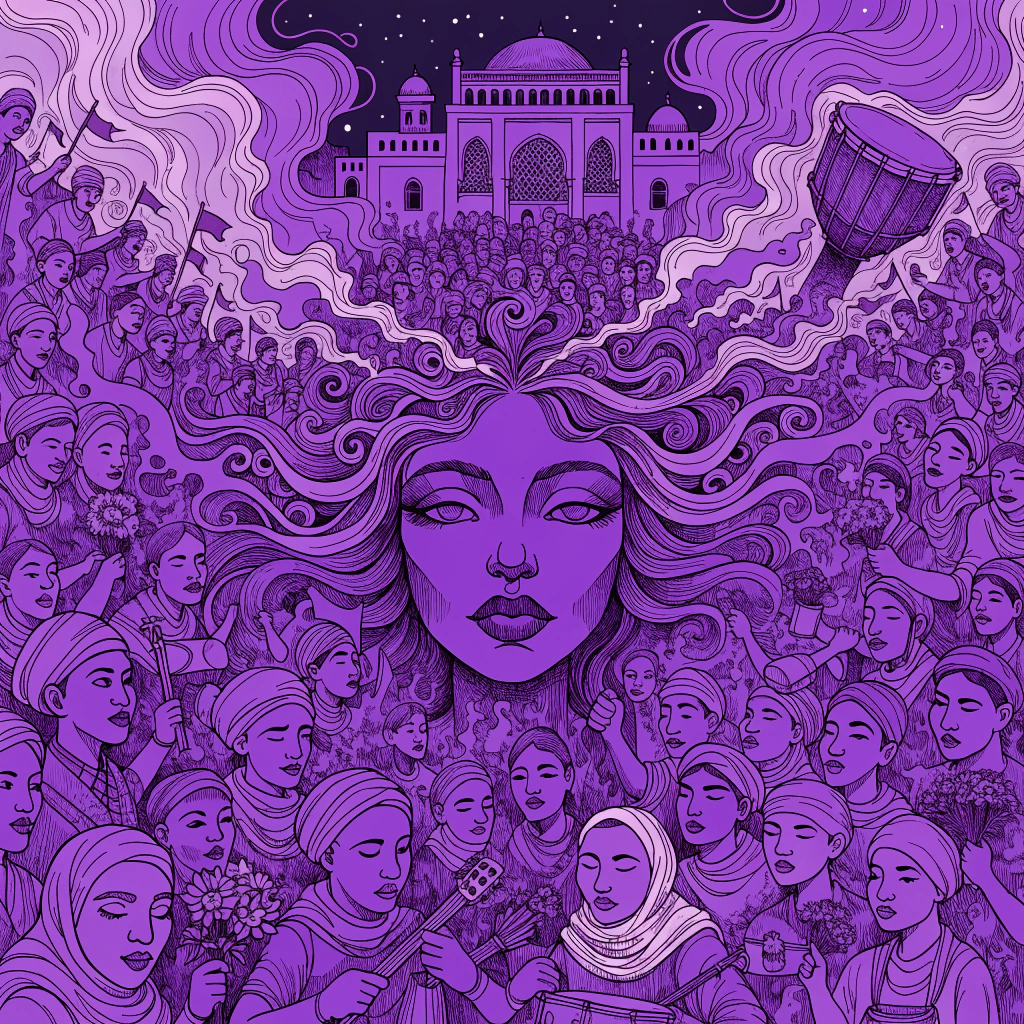
The Big Festival in Imilchil
Imilchil is a small village in Morocco. It is high in the Atlas Mountains. Every year, many people go there for a big festival. It is the Imilchil Marriage Festival. It is very famous and beautiful.
There is an old story about two lakes. Their names are Tislit and Isli. The lakes come from the tears of two people in love. They cannot marry, so they cry. Today, the festival helps people find love and get married.
Many people wear traditional clothes. Women wear colorful blankets. Men wear white robes. There is music, dancing, and food. It is a happy time for the tribes.
Grammar Spotlight
Pattern: Present Simple of 'To Be'
"Imilchil is a small village in Morocco."
We use 'is' for one person or place. It helps us describe things in the present.
Pattern: Present Simple for Facts
"Women wear colorful blankets."
We use the base verb 'wear' for 'they' or plural groups. It describes a regular action or a fact.
Test Your Understanding
10 questions · A1 Beginner · 1 free preview
Test what you learned from this article. Answer all questions to earn XP!
Where is the village of Imilchil?
Want to finish the quiz?
9 more questions are waiting for you. Sign up free to unlock the full quiz and earn XP!
Sign Up FreeAlready have an account? Sign In
Question Breakdown
Where is the village of Imilchil?
Your answer:
Correct answer: In the Atlas Mountains
The festival is a sad time for the tribes.
Your answer:
Correct answer: False
What does 'mountain' mean?
Your answer:
Correct answer: A very high hill
The lakes come from the _____ of two people.
Your answer:
Correct answer: tears
The Famous Marriage Festival of Imilchil
Every year, people travel to a small village high in the Atlas Mountains of Morocco. This place is called Imilchil. They go there in September for a very special event: the Imilchil Marriage Festival.
The festival started because of a famous local legend. Long ago, a young man and a young woman from different tribes fell in love. However, their families were rivals and did not want them to marry. The couple cried so much that their tears became two big lakes. These lakes are called Isli and Tislit. Local people still remember this story today.
Now, the festival is a happy time for everyone. People from many tribes meet to find a husband or a wife. They wear beautiful, traditional clothes and silver jewelry. The festival is bigger and more exciting than many other events in the mountains. Visitors can see traditional music, dancing, and many weddings. It is a great way to learn about Moroccan culture because these traditions are very old and special.
Grammar Spotlight
Pattern: Past Simple
"The festival started because of a famous local legend."
We use the Past Simple to talk about actions that finished in the past. For regular verbs, we usually add '-ed' to the end of the verb.
Pattern: Comparatives
"The festival is bigger and more exciting than many other events in the mountains."
We use comparatives to compare two things. We add '-er' to short adjectives and use 'more' before long adjectives.
Test Your Understanding
11 questions · A2 Elementary · 1 free preview
Test what you learned from this article. Answer all questions to earn XP!
Where does the Imilchil festival take place?
Want to finish the quiz?
10 more questions are waiting for you. Sign up free to unlock the full quiz and earn XP!
Sign Up FreeAlready have an account? Sign In
Question Breakdown
Where does the Imilchil festival take place?
Your answer:
Correct answer: High in the Atlas Mountains
The festival happens every year in December.
Your answer:
Correct answer: False
What is a 'legend'?
Your answer:
Correct answer: An old story from the past
The couple's tears became two big _____.
Your answer:
Correct answer: lakes
Why do people from different tribes meet at the festival today?
Your answer:
Correct answer: To find a husband or a wife
The Imilchil Marriage Festival: A Legend of the Atlas Mountains
High in the Atlas Mountains of Morocco, a unique event takes place every September. This is the Imilchil Marriage Festival, which is also known as 'Agdoud N'Oulmaghni.' For centuries, the Ait Hdiddou tribe has gathered in this remote village to celebrate their culture and find partners for marriage.
The festival is based on a famous local legend that is passed down through generations. It is said that two young lovers from different tribes, Isli and Tislit, were forbidden to marry by their families. They cried so much that their tears created two deep lakes that still exist today. To prevent such a tragic story from happening again, the local tribes decided that young people should be allowed to choose their own spouses.
During the three-day festival, the village is filled with colorful tents and traditional music. Many people wear beautiful clothes that have been handmade by local artisans. Women often wear striped wool blankets and heavy silver jewelry, while men wear traditional white robes. Visitors are welcomed with great hospitality, and they can see how ancient traditions are still kept alive in the modern world.
In recent years, the festival has changed slightly because it has become more popular with international tourists. However, the core meaning remains the same. It is a time for celebration, trade, and social connection between different mountain communities. People come from far away to sell their animals and buy supplies for the winter. For anyone who wants to experience the true spirit of Berber culture, the Imilchil festival is an unforgettable experience.
Grammar Spotlight
Pattern: Passive Voice
"The festival is based on a famous local legend that is passed down through generations."
The passive voice is used here to focus on the action (the legend being passed down) rather than the specific people doing it. It is formed using the verb 'to be' and the past participle of the main verb.
Pattern: Present Perfect Tense
"For centuries, the Ait Hdiddou tribe has gathered in this remote village."
This tense connects the past to the present. It shows that the tribe started gathering in the past and continues to do so today. It is formed using 'has/have' plus the past participle.
Test Your Understanding
11 questions · B1 Intermediate · 1 free preview
Test what you learned from this article. Answer all questions to earn XP!
Where does the Imilchil Marriage Festival take place?
Want to finish the quiz?
10 more questions are waiting for you. Sign up free to unlock the full quiz and earn XP!
Sign Up FreeAlready have an account? Sign In
Question Breakdown
Where does the Imilchil Marriage Festival take place?
Your answer:
Correct answer: In the Atlas Mountains
The legend says that two lakes were created by the tears of two lovers.
Your answer:
Correct answer: True
What does the word 'remote' mean in the article?
Your answer:
Correct answer: Far away and difficult to reach
During the festival, the village is _____ with colorful tents and traditional music.
Your answer:
Correct answer: filled
Why has the festival changed slightly in recent years?
Your answer:
Correct answer: Because it has become popular with international tourists
The Imilchil Marriage Festival: A Legacy of Love and Tradition
Nestled high within the rugged peaks of the High Atlas Mountains, the Imilchil Marriage Festival, locally known as Agdoud N'Oulmaghni, represents a profound intersection of cultural heritage and ancient folklore. This annual event, which takes place in the secluded village of Imilchil, is far more than a mere marketplace; it is a vital social institution for the Ait Hdiddou tribe. The origins of this gathering are rooted in a legendary tragedy involving two young lovers from rival tribes, Tislit and Isli. Forbidden from marrying due to ancestral animosity, the couple allegedly wept so profusely that their tears formed the twin lakes that still bear their names today.
To ensure that such a heartbreaking outcome would never be repeated, tribal leaders established the festival as a means of reconciliation and legal union. Consequently, the festival has evolved into a significant occasion where prospective couples meet and formalize their marriages under the supervision of local authorities and notaries. While the romantic narrative provides a mystical backdrop, the festival also serves a practical socio-economic purpose. It allows nomadic families from across the region to congregate, trade livestock, and reinforce communal bonds that might otherwise diminish due to their isolated lifestyles.
In contemporary times, the festival faces the challenge of maintaining its authenticity amidst increasing tourism and the encroaching pressures of modernization. Nevertheless, the Ait Hdiddou people have demonstrated a remarkable resilience, maintaining their ability to preserve their distinctive customs. Visitors are often captivated by the vibrant traditional attire, particularly the striped cloaks worn by women, and the rhythmic music that characterizes the celebration. It is essential to recognize that the festival is not merely a spectacle for outsiders but a sacred commemoration of identity. By participating in these rites, the younger generation ensures that their cultural legacy is passed down.
Ultimately, the Imilchil Marriage Festival remains a testament to the strength of Moroccan mountain culture. It highlights the importance of collective memory and the power of tradition to transform ancient grief into a modern celebration of communal unity. For the language learner, analyzing such events provides insight into how history and culture are inextricably linked, offering a window into a world where history is lived rather than just remembered.
Grammar Spotlight
Pattern: Non-defining Relative Clauses
"This annual event, which takes place in the secluded village of Imilchil, is far more than a mere marketplace."
These clauses add extra information about a noun but are not essential for the sentence to make sense. They are always separated by commas and use relative pronouns like 'which' or 'who'.
Pattern: Passive Voice with 'be rooted in'
"The origins of this gathering are rooted in a legendary tragedy involving two young lovers."
The passive voice is used here to focus on the origins rather than the person who rooted them. It is formed using the verb 'to be' plus the past participle.
Pattern: Modals for Hypothetical Outcomes
"...reinforce communal bonds that might otherwise diminish due to their isolated lifestyles."
The modal 'might' combined with 'otherwise' is used to describe a possible situation that would happen if the current conditions (the festival) were not present.
Test Your Understanding
11 questions · B2 Upper Intermediate · 1 free preview
Test what you learned from this article. Answer all questions to earn XP!
What is the legendary origin of the twin lakes in Imilchil?
Want to finish the quiz?
10 more questions are waiting for you. Sign up free to unlock the full quiz and earn XP!
Sign Up FreeAlready have an account? Sign In
Question Breakdown
What is the legendary origin of the twin lakes in Imilchil?
Your answer:
Correct answer: The tears of two lovers from rival tribes
The Imilchil Marriage Festival is primarily a commercial event with no social significance.
Your answer:
Correct answer: False
What does the word 'prospective' mean in the context of the article?
Your answer:
Correct answer: Potential or expected in the future
The festival was established as a means of _____ and legal union to prevent future tragedies.
Your answer:
Correct answer: reconciliation
Which tribe is primarily associated with the Agdoud N'Oulmaghni?
Your answer:
Correct answer: The Ait Hdiddou
The Imilchil Marriage Festival: A Synthesis of Myth, Memory, and Modernity
Nestled within the rugged folds of the High Atlas Mountains lies Imilchil, a village whose geographical isolation has facilitated the preservation of one of Morocco’s most evocative cultural phenomena: the Agdoud N’Oulmaghni. Far from being a mere commercial exchange, this annual congregation serves as a profound socio-cultural nexus for the Ait Hdiddou tribes. Central to the festival's identity is the poignant legend of Tislit and Isli, two lovers whose clandestine romance was thwarted by tribal animosity. Their subsequent demise, marked by the creation of two alpine lakes from their tears, provides the foundational narrative for what is colloquially known as the 'Marriage Festival.'
Seldom does a cultural event manage to intertwine the ephemeral nature of romance with the rigid structures of tribal law so seamlessly. While the romanticized version of the festival attracts global intrigue, the underlying reality is one of communal necessity. It is the collective memory of the Ait Hdiddou that ensures the continuity of this tradition, transforming what could be a simple marketplace into a space for matrimonial negotiation and legal validation. The nominalization of these social contracts reflects a sophisticated approach to tribal governance, where the formalization of marriage acts as a safeguard against the recurrence of the Tislit-Isli tragedy.
However, the increasing commercialization of the event presents a complex juxtaposition. As tourists flock to witness the 'authenticity' of the Atlas, the very fabric of the festival undergoes a subtle transformation. What was once a private, tribal affair is now subject to the gaze of the global outsider. This external scrutiny necessitates a critical analysis of whether such festivals can maintain their intrinsic value when their primary function shifts towards cultural tourism. The preservation of these ancestral rites serves as a bulwark against the homogenizing forces of modernity, yet it also invites a commodification of heritage.
Ultimately, the Imilchil Marriage Festival remains a testament to the endurance of myth. It is through the ritualized reenactment of these social bonds that the Ait Hdiddou navigate the tensions between their storied past and an uncertain future. Whether the festival can survive the encroaching vestiges of globalization without losing its soul remains to be seen, but for now, the echoes of Tislit and Isli continue to resonate across the plateau.
Grammar Spotlight
Pattern: Inversion with negative/restrictive adverbs
"Seldom does a cultural event manage to intertwine the ephemeral nature of romance with the rigid structures of tribal law so seamlessly."
When using restrictive words like 'seldom' at the start of a sentence for emphasis, the auxiliary verb comes before the subject. This creates a formal and dramatic tone typical of C1 academic writing.
Pattern: Cleft Sentences
"It is the collective memory of the Ait Hdiddou that ensures the continuity of this tradition."
Cleft sentences use 'It is/was... that' to focus on a specific piece of information. Here, it emphasizes that 'collective memory' is the specific reason for the tradition's survival.
Pattern: Nominalization for abstraction
"The preservation of these ancestral rites serves as a bulwark against the homogenizing forces of modernity."
By turning the verb 'preserve' into the noun 'preservation', the sentence becomes more objective and formal. This allows the writer to discuss complex concepts as entities.
Test Your Understanding
12 questions · C1 Advanced · 1 free preview
Test what you learned from this article. Answer all questions to earn XP!
What is the primary function of the Agdoud N’Oulmaghni beyond commerce?
Want to finish the quiz?
11 more questions are waiting for you. Sign up free to unlock the full quiz and earn XP!
Sign Up FreeAlready have an account? Sign In
Question Breakdown
What is the primary function of the Agdoud N’Oulmaghni beyond commerce?
Your answer:
Correct answer: A socio-cultural nexus for tribal negotiation
The legend of Tislit and Isli involves two lovers from the same tribe.
Your answer:
Correct answer: False
What does 'clandestine' mean?
Your answer:
Correct answer: Secret and often illicit
The festival serves as a _____ against the homogenizing forces of modernity.
Your answer:
Correct answer: bulwark
What does the author suggest about the role of tourism in the festival?
Your answer:
Correct answer: It introduces a complex juxtaposition and potential commodification.
Nominalization is used in the text to reflect sophisticated tribal governance.
Your answer:
Correct answer: True
The Agdoud N'Oulmaghni: A Socio-Anthropological Deconstruction of the Imilchil Betrothal Fair
The Imilchil Marriage Festival, known locally as Agdoud N'Oulmaghni, represents a profound socio-anthropological phenomenon nestled within the vertiginous reaches of Morocco's High Atlas Mountains. To the uninitiated, the event may appear as a quaint folkloric gathering, yet a more rigorous scholarly inquiry reveals a complex tapestry of tribal governance, economic pragmatism, and symbolic liturgy. This annual convergence of the Ait Hdiddou tribe is not merely a venue for betrothal but a vital mechanism for the preservation of a distinct Amazigh identity amidst the homogenizing pressures of the twenty-first century.
Central to the festival's existence is the poignant narrative of Isli and Tislit. Legend posits that two lovers from feuding factions of the Ait Hdiddou were forbidden from uniting, their consequent despair manifesting in a deluge of tears that birthed the eponymous lakes of the region. Lest such a tragedy be repeated, the tribal elders established a collective covenant, allowing for inter-tribal unions under the auspices of the Agdoud. This mythic foundation serves as more than just a romantic backdrop; it is the ethical cornerstone upon which the community's social cohesion is built. One might argue that the festival functions as a form of restorative justice, transmuting historical trauma into a celebratory rite of passage.
The economic dimensions of the festival are equally significant. Far from being a solipsistic ritual, the Agdoud acts as a pivotal macro-economic hub for the remote mountain communities. Here, the exchange of livestock, grain, and artisanal crafts occurs in tandem with the marital negotiations. This juxtaposition of the sacred and the profane illustrates the holistic nature of Berber life, where commerce and kinship are inextricably linked. Rarely has a cultural event so effectively navigated the vicissitudes of globalization while remaining anchored in primordial tradition. The festival provides a rare glimpse into a paradigm where communal welfare takes precedence over individualistic pursuits.
From an aesthetic perspective, the festival is a semiotic masterclass. The 'handira', a traditional woollen shawl adorned with intricate patterns, serves as a visual lexicon of a woman’s tribal affiliation and marital status. The meticulous care with which these garments are crafted reflects the enduring ethos of the Ait Hdiddou. Furthermore, the presence of the 'Adoul'—traditional Moroccan notaries—integrates the event into the broader national legal framework. It is within this high-altitude crucible that the juxtaposition of tradition and encroaching modernity becomes most salient. The bureaucratic formalization of the marriages ensures they are commensurate with contemporary civil requirements, yet the ceremony remains steeped in ancestral custom.
However, the festival is not without its challenges. The encroaching hegemony of global tourism threatens to dilute the authenticity of the Agdoud, potentially transforming a sacred tribal gathering into a mere spectacle for the voyeuristic gaze. It is imperative that the sanctity of this ritual be maintained, for it represents a bulwark against the cultural erosion that often accompanies modernization. While some critics might view the festival as a vestigial remnant of a bygone era, such a perspective fails to acknowledge the dynamic adaptability of the Amazigh people.
In conclusion, the Imilchil Marriage Festival is a testament to the resilience of indigenous structures. It is a space where the ephemeral nature of human emotion meets the enduring stability of tribal law. By bridging the gap between the mythical past and the pragmatic present, the Ait Hdiddou have created a cultural model that is both ancient and remarkably forward-looking. As the world continues to move toward a more homogenized future, the Agdoud N'Oulmaghni stands as a defiant celebration of local specificity and cultural depth.
Grammar Spotlight
Pattern: Negative Inversion
"Rarely has a cultural event so effectively navigated the vicissitudes of globalization while remaining anchored in primordial tradition."
This structure places a negative or restrictive adverb at the beginning of the sentence for rhetorical emphasis. It requires the auxiliary verb to come before the subject, similar to a question format.
Pattern: Present Subjunctive
"It is imperative that the sanctity of this ritual be maintained, for it represents a bulwark against the cultural erosion that often accompanies modernization."
The subjunctive mood is used here after the adjective 'imperative' to express necessity or urgency. The base form of the verb ('be') is used regardless of the subject.
Pattern: Cleft Sentences
"It is within this high-altitude crucible that the juxtaposition of tradition and encroaching modernity becomes most salient."
A cleft sentence is used to focus on a specific part of the information (the location/context). It typically follows the structure 'It is/was [emphasized part] that/who...'
Test Your Understanding
12 questions · C2 Mastery · 1 free preview
Test what you learned from this article. Answer all questions to earn XP!
According to the article, what is the primary social function of the Agdoud N'Oulmaghni beyond marriage?
Want to finish the quiz?
11 more questions are waiting for you. Sign up free to unlock the full quiz and earn XP!
Sign Up FreeAlready have an account? Sign In
Question Breakdown
According to the article, what is the primary social function of the Agdoud N'Oulmaghni beyond marriage?
Your answer:
Correct answer: A vital mechanism for preserving Amazigh identity and tribal governance
The legend of Isli and Tislit suggests that the local lakes were formed by the tears of star-crossed lovers.
Your answer:
Correct answer: True
Which word describes the 'characteristic spirit' or 'beliefs' of the Ait Hdiddou community?
Your answer:
Correct answer: Ethos
The festival is described as a _____ remnant of an ancestral social contract.
Your answer:
Correct answer: vestigial
What does the 'handira' represent in the context of the festival?
Your answer:
Correct answer: A visual lexicon of tribal affiliation and marital status
The article suggests that the festival is entirely solipsistic and disconnected from any economic activity.
Your answer:
Correct answer: False
