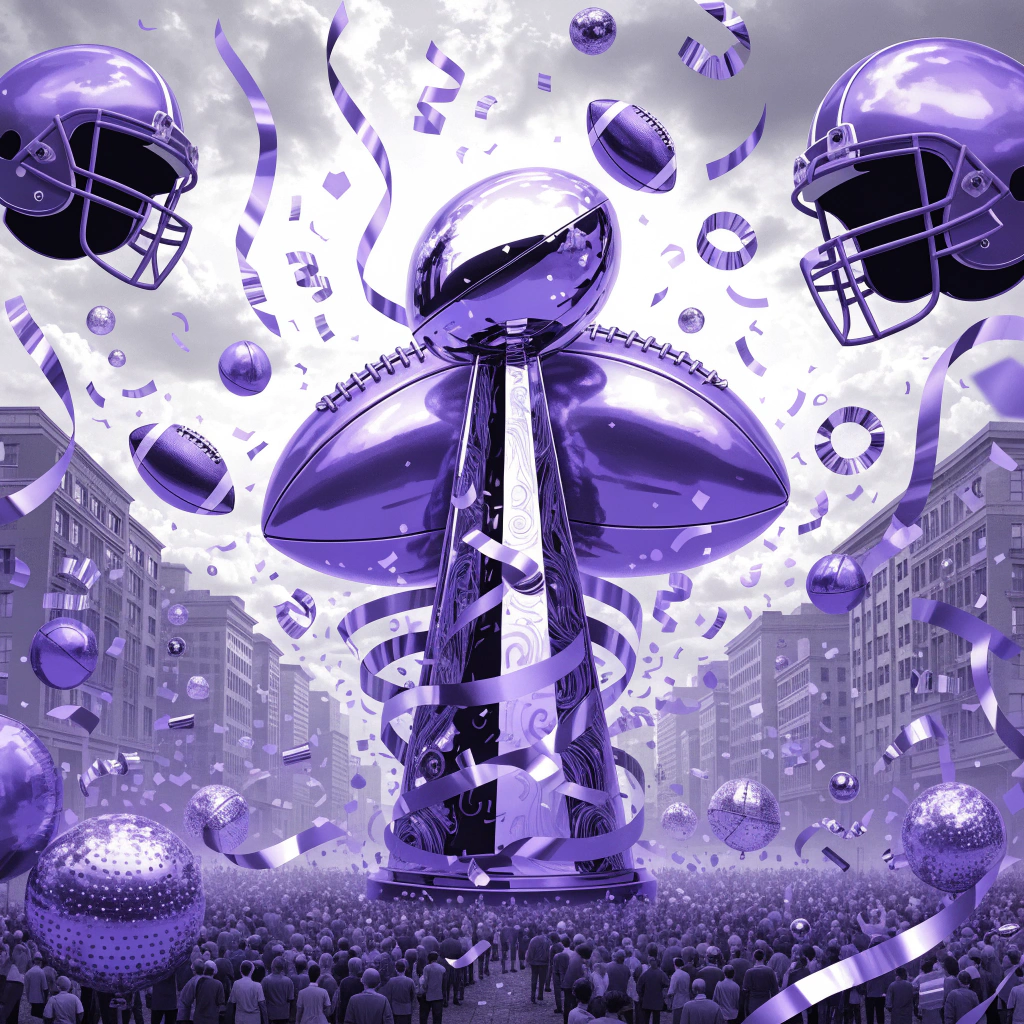
The Big Football Game
The Super Bowl is a very big game in the United States. It is in February. Many people watch this game on television. It is the most popular sport in America.
Two famous teams play American football. They play to win a big trophy. The players are very fast and strong. The game is long but exciting.
Families and friends meet at home. They eat many snacks like pizza and chips. It is a big party for everyone. Children and adults love the Super Bowl.
Grammar Spotlight
Pattern: Present Simple for Facts
"Many people watch this game on television."
We use the present simple to talk about things that are generally true. For 'many people' (plural), we use the base form of the verb 'watch'.
Pattern: Adjectives Before Nouns
"Two famous teams play American football."
In English, describing words like 'famous' and 'American' come before the thing they describe. We say 'famous teams', not 'teams famous'.
Test Your Understanding
10 questions · A1 Beginner · 1 free preview
Test what you learned from this article. Answer all questions to earn XP!
When is the Super Bowl?
Want to finish the quiz?
9 more questions are waiting for you. Sign up free to unlock the full quiz and earn XP!
Sign Up FreeAlready have an account? Sign In
Question Breakdown
When is the Super Bowl?
Your answer:
Correct answer: In February
The Super Bowl is a small game in the United States.
Your answer:
Correct answer: False
What does 'trophy' mean?
Your answer:
Correct answer: A prize for winning
Many people eat _____ like pizza and chips.
Your answer:
Correct answer: snacks
The Super Bowl: America’s Biggest Game
The Super Bowl is the biggest sports event in the United States. It is a very famous American football game. Every year, the two best teams play for the Vince Lombardi Trophy. The first Super Bowl happened in 1967. Today, it is more than just a game; it is like a national holiday.
Millions of people watch the event on the first or second Sunday in February. Most fans watch because they love football, but others watch for the half-time show. During this break, famous singers perform on a big stage. The television commercials are also very special. They are more expensive and funnier than normal advertisements.
Friends and families usually meet at home or in restaurants. They eat a lot of popular food like pizza, chips, and chicken wings. This day is very important in American culture. In fact, more people watch the Super Bowl than any other television program. It is an exciting day for everyone because it combines sports, music, and food.
Grammar Spotlight
Pattern: Past Simple
"The first Super Bowl happened in 1967."
We use the past simple to talk about completed actions at a specific time in the past. To form regular verbs, we usually add '-ed' to the base form.
Pattern: Comparatives
"They are more expensive and funnier than normal advertisements."
We use comparatives to compare two things. For long adjectives like 'expensive', we use 'more'. For short adjectives ending in 'y' like 'funny', we change the 'y' to 'i' and add '-er'.
Test Your Understanding
11 questions · A2 Elementary · 1 free preview
Test what you learned from this article. Answer all questions to earn XP!
When does the Super Bowl take place?
Want to finish the quiz?
10 more questions are waiting for you. Sign up free to unlock the full quiz and earn XP!
Sign Up FreeAlready have an account? Sign In
Question Breakdown
When does the Super Bowl take place?
Your answer:
Correct answer: In February
The first Super Bowl was held in 1967.
Your answer:
Correct answer: True
What does 'commercial' mean?
Your answer:
Correct answer: An advertisement
The winning teams play for the Vince Lombardi _____.
Your answer:
Correct answer: Trophy
What do famous singers do during the game?
Your answer:
Correct answer: They perform on a stage
The Super Bowl: More Than Just a Game
The Super Bowl is an annual event that has become a massive part of American culture. It is usually held on the first or second Sunday in February. This game marks the end of the National Football League (NFL) season, where the champions of the American Football Conference (AFC) and the National Football Conference (NFC) compete for the Vince Lombardi Trophy.
The first Super Bowl took place in 1967. Since then, it has grown from a simple football match into a global phenomenon. For many Americans, Super Bowl Sunday is considered an unofficial national holiday. It is a day when people gather with their friends and families to watch the game on television. Huge amounts of snacks, such as chicken wings and nachos, are consumed during these parties.
However, the Super Bowl is famous for more than just the sport. The half-time show, which features performances by world-famous musicians, is often as popular as the game itself. Many viewers who are not interested in football still tune in to see the spectacular lights and music. Furthermore, the television commercials have become a major part of the experience. Companies pay millions of dollars for just thirty seconds of airtime. These advertisements are specially created for the event and are often very funny or creative.
The location of the game changes every year, with different cities competing for the honor of hosting it. The stadium is always packed with fans who have traveled from all over the country. In conclusion, the Super Bowl has evolved into a unique mix of elite athletics, high-stakes entertainment, and commercial spectacles. It is an event that truly captures the spirit of modern America.
Grammar Spotlight
Pattern: Present Perfect Tense
"The Super Bowl has become a massive part of American culture."
The present perfect is used for actions that happened at an unspecified time in the past and have a result in the present. It is formed using 'has' or 'have' followed by the past participle of the verb.
Pattern: Passive Voice
"Huge amounts of snacks, such as chicken wings and nachos, are consumed during these parties."
The passive voice is used when the focus is on the action or the receiver of the action. It is formed using the verb 'to be' (are) and the past participle (consumed).
Test Your Understanding
11 questions · B1 Intermediate · 1 free preview
Test what you learned from this article. Answer all questions to earn XP!
When is the Super Bowl usually held?
Want to finish the quiz?
10 more questions are waiting for you. Sign up free to unlock the full quiz and earn XP!
Sign Up FreeAlready have an account? Sign In
Question Breakdown
When is the Super Bowl usually held?
Your answer:
Correct answer: The first or second Sunday in February
The first Super Bowl took place in 1967.
Your answer:
Correct answer: True
What does 'performance' mean?
Your answer:
Correct answer: The act of singing or dancing for an audience
The winning team receives the Vince Lombardi _____.
Your answer:
Correct answer: Trophy
Why do many people watch the Super Bowl even if they do not like football?
Your answer:
Correct answer: For the half-time show and creative commercials
Beyond the Gridiron: The Cultural Phenomenon of the Super Bowl
The Super Bowl, the annual championship game of the National Football League (NFL), has evolved into much more than a mere sporting event. Held every February, it represents the culmination of a grueling season where the top teams from the American and National Football Conferences compete for the prestigious Vince Lombardi Trophy. While the athletic prowess on display is undeniably world-class, the event's significance extends far beyond the final score, embedding itself deeply into the fabric of American culture.
One of the most distinctive aspects of the Super Bowl is its status as a massive commercial spectacle. For many viewers, the advertisements shown during the broadcast are as anticipated as the game itself. Companies invest millions of dollars for a mere thirty seconds of airtime, often debuting high-budget, cinematic commercials that are analyzed and ranked by the public long after the game has concluded. This extravagant spending highlights the event's unparalleled reach, as it consistently secures the highest television viewership of any broadcast in the United States.
Furthermore, the halftime show has transformed into a global stage for the world’s most renowned musical artists. What began as simple marching band performances has morphed into a sophisticated, high-tech production that attracts audiences who might otherwise have little interest in football. Had the NFL not recognized the potential for entertainment beyond the sport, the Super Bowl might never have achieved its current level of global prominence.
Socially, Super Bowl Sunday functions as an unofficial national holiday. Across the country, friends and families gather for "Super Bowl parties," centered around traditional snacks like chicken wings and nachos. This collective experience fosters a sense of community, even among those who do not follow the sport regularly. It is estimated that millions of pounds of food are consumed during the four-hour broadcast, making it the second-largest day for food consumption in the U.S. after Thanksgiving.
Ultimately, the Super Bowl serves as a mirror reflecting American values: a love for intense competition, a passion for grand entertainment, and the dominance of commercial enterprise. Whether one watches for the tactical brilliance of the athletes or the glamour of the halftime performance, the event remains an essential annual ritual that continues to captivate domestic and international audiences alike.
Grammar Spotlight
Pattern: Third Conditional with Inversion
"Had the NFL not recognized the potential for entertainment beyond the sport, the Super Bowl might never have achieved its current level of global prominence."
This formal structure replaces 'If the NFL had not recognized'. It is used to discuss hypothetical situations in the past and their results.
Pattern: Passive Voice (Present Perfect)
"cinematic commercials that are analyzed and ranked by the public long after the game has concluded."
The passive voice is used here to focus on the commercials rather than the people analyzing them. It is formed using 'to be' + past participle.
Pattern: Relative Clauses with Modals
"audiences who might otherwise have little interest in football."
The relative pronoun 'who' introduces a clause that describes the 'audiences'. The modal 'might' expresses a hypothetical possibility.
Test Your Understanding
11 questions · B2 Upper Intermediate · 1 free preview
Test what you learned from this article. Answer all questions to earn XP!
What does the author suggest about Super Bowl advertisements?
Want to finish the quiz?
10 more questions are waiting for you. Sign up free to unlock the full quiz and earn XP!
Sign Up FreeAlready have an account? Sign In
Question Breakdown
What does the author suggest about Super Bowl advertisements?
Your answer:
Correct answer: They are often as popular as the game itself.
The Super Bowl is an official government holiday in the United States.
Your answer:
Correct answer: False
What does 'unparalleled' mean in the context of the article?
Your answer:
Correct answer: Having no equal
The Super Bowl represents the _____ of the NFL season.
Your answer:
Correct answer: culmination
Which of these is mentioned as a factor in the Super Bowl's global popularity?
Your answer:
Correct answer: The high-tech halftime show
Beyond the Gridiron: The Super Bowl as a Cultural Hegemon
The Super Bowl, the annual championship game of the National Football League (NFL), has evolved far beyond its humble beginnings in 1967. No longer is it merely the culmination of a grueling athletic season; it has metamorphosed into a pervasive cultural phenomenon that stops a nation in its tracks. Rarely does a sporting event command such undivided attention, transcending the boundaries of traditional athletics to become an unofficial national holiday. This orchestration of elite sportsmanship, high-stakes entertainment, and massive commercial spectacles serves as a profound manifestation of American identity and consumerism. The crystallization of American cultural identity through the lens of a football game is a fascinating study in modern sociology.
What makes the Super Bowl unique is not just the competition for the Vince Lombardi Trophy, but the sheer scale of its surrounding ecosystem. It is the intersection of commerce and art that truly defines the event for many viewers. For those who harbor little interest in the tactical nuances of American football, the halftime show and the exorbitant television commercials provide a parallel narrative. Companies invest millions for a mere thirty seconds of airtime, hoping to capture the ephemeral attention of an audience that numbers in the hundreds of millions. Such is the institutionalized nature of this commercial blitz that the advertisements themselves are often as scrutinized as the quarterback’s performance.
The dichotomy between the grit of the gridiron and the glitz of the entertainment industry is a masterclass in modern marketing. The transformation of a game into a ubiquitous social ritual has led to a shared experience that spans across different demographics. Families and friends congregate, not only to witness the crowning of the American Football Conference (AFC) or National Football Conference (NFC) champions but to participate in a communal feast. From the specialized snacks to the betting pools, the event’s reach is total, permeating every facet of suburban and urban life alike.
Underpinning this spectacle is a complex layer of cultural significance. Critically speaking, one might argue that the Super Bowl represents the peak of American exceptionalism, where the 'bigger is better' mantra is realized in every firework and touchdown. However, this perspective overlooks the genuine sense of community the game fosters. In an increasingly fragmented media landscape, the Super Bowl remains one of the few remaining 'water cooler' moments—a singular thread that binds a diverse population through a common, albeit commercialized, narrative.
Ultimately, the Super Bowl is an architectural feat of branding. It successfully blends the primal appeal of physical competition with the sophisticated machinery of 21st-century media. Whether viewed as a pinnacle of sporting achievement or a bloated exercise in consumerism, its status as a cornerstone of American culture is undeniable. As the final whistle blows and the confetti falls, the game leaves behind more than just a winner; it leaves an indelible mark on the global cultural consciousness, proving that the event is as much about the spectacle as it is about the score.
Grammar Spotlight
Pattern: Inversion
"Rarely does a sporting event command such undivided attention, transcending the boundaries of traditional athletics."
Inversion is used for emphasis by placing the auxiliary verb before the subject. It often follows negative or restrictive adverbs like 'rarely' or 'never' to create a more formal, dramatic tone.
Pattern: Cleft Sentences
"It is the intersection of commerce and art that truly defines the event for many viewers."
A cleft sentence divides a single clause into two parts, each with its own verb, to focus on specific information. It follows the structure 'It is/was + [focused part] + that/who...'
Pattern: Nominalization
"The crystallization of American cultural identity through the lens of a football game is a fascinating study."
Nominalization involves turning verbs or adjectives into nouns (e.g., 'crystallization' from 'crystallize'). This creates a more academic, dense, and abstract style typical of C1 level writing.
Test Your Understanding
12 questions · C1 Advanced · 1 free preview
Test what you learned from this article. Answer all questions to earn XP!
According to the article, why might someone who dislikes football still watch the Super Bowl?
Want to finish the quiz?
11 more questions are waiting for you. Sign up free to unlock the full quiz and earn XP!
Sign Up FreeAlready have an account? Sign In
Question Breakdown
According to the article, why might someone who dislikes football still watch the Super Bowl?
Your answer:
Correct answer: To see the halftime show and high-budget commercials.
The Super Bowl has been an 'unofficial national holiday' since its very first game in 1967.
Your answer:
Correct answer: False
What does 'ubiquitous' mean in the context of the social ritual mentioned?
Your answer:
Correct answer: Existing everywhere simultaneously.
The article describes the advertisements as being _____ by the audience as much as the players' performance.
Your answer:
Correct answer: scrutinized
What does the 'dichotomy' mentioned in the text refer to?
Your answer:
Correct answer: The contrast between physical toughness and glamorous entertainment.
The author suggests that the Super Bowl acts as a unifying factor in a fragmented media environment.
Your answer:
Correct answer: True
The Super Bowl: A Cultural Juggernaut and the Nexus of Modern Americana
The Super Bowl, ostensibly a mere championship game concluding the National Football League season, has transmuted into a cultural juggernaut that defines the very essence of modern Americana. Were one to dissect the American psyche, the Super Bowl would undoubtedly emerge as a nexus where sports, commerce, and national identity converge in a gargantuan display of excess and athletic prowess. Since its inception in 1967, the event has ascended from a modest inter-league competition to an unofficial national holiday, characterized by a level of sociocultural hegemony that few other spectacles can rival.
The event represents the culmination of a grueling season, yet its significance extends far beyond the gridiron. It is an exercise in the commodification of leisure, where every second is scrutinized for its market value. Not only does the event command the highest television ratings in the United States, but it also serves as a laboratory for high-stakes advertising. The commercials, often costing millions for a mere thirty seconds of airtime, strive for a degree of verisimilitude and creative ingenuity that often eclipses the game itself. These advertisements are not merely promotional tools; they are cultural artifacts that reflect and occasionally subvert the prevailing social stratification of the era. The financial implications of these broadcasts are profound, fostering an environment where corporations engage in a relentless pursuit of viral relevance. This competitive landscape has birthed a unique genre of filmmaking, where narrative brevity meets immense production value.
The halftime show, a cornerstone of the Super Bowl experience, further illustrates the event's penchant for the grandiose. What was once a performance by university marching bands has evolved into a global platform for the musical elite. This transformation underscores the ephemeral nature of modern fame, as artists attempt to encapsulate their entire careers in a twelve-minute medley designed to captivate a worldwide audience. It is a moment where the lines between athlete and entertainer become inextricably blurred, creating a synthesis of performance that borders on the operatic. The audience has developed a sophisticated, almost cynical, appreciation for these messages, judging them with the same fervor typically reserved for the athletes' performances. This stratification of viewership—those watching for the game and those for the 'advertainment'—highlights the multifaceted nature of the event.
From a sociological perspective, the Super Bowl acts as a mechanism for collective effervescence. Families and friends gather in a ritualistic manner, consuming vast quantities of food and engaging in communal viewing. This phenomenon, while ostensibly centered on sport, reinforces social bonds and provides a shared narrative in an increasingly fragmented digital landscape. However, some critics argue that this obsession with the spectacle is a modern iteration of 'panem et circenses' (bread and circuses), designed to distract the populace from more pressing socio-political concerns.
Furthermore, the Super Bowl’s influence permeates global markets, asserting a form of soft power that exports American values and consumerist ideals to every corner of the globe. While the sport itself may lack the universal appeal of association football, the 'Super Bowl' brand is a recognized shorthand for peak production value and cultural dominance. This hegemony ensures that even those with little interest in the intricacies of a blitz or a touchdown are drawn into the gravitational pull of the spectacle. It is this unique ability to transcend its own medium that secures its place in the annals of cultural history. Host cities invest billions in infrastructure, anticipating a windfall that is sometimes more symbolic than tangible. The logistical complexities of hosting such an event require a level of coordination that mirrors a military operation.
In conclusion, the Super Bowl remains a mercurial entity, constantly reinventing itself to maintain its relevance in a changing world. It is a mirror reflecting the aspirations, contradictions, and sheer vitality of the United States. Whether viewed as a pinnacle of athletic achievement or a cynical triumph of capitalism, its status as a foundational pillar of the American experience is indisputable. As long as the desire for shared experience and spectacular entertainment persists, the Super Bowl will continue its reign as the undisputed monarch of the American sporting calendar.
Grammar Spotlight
Pattern: The Subjunctive Mood
"Were one to dissect the American psyche, the Super Bowl would undoubtedly emerge as a nexus..."
This is a conditional structure using 'were' to express a hypothetical or formal premise. It is an inversion of 'If one were to...' and is common in academic or highly formal C2 prose.
Pattern: Negative Inversion
"Not only does the event command the highest television ratings in the United States, but it also serves as a laboratory..."
When a sentence starts with a negative or restrictive expression like 'Not only', the auxiliary verb comes before the subject. This adds rhetorical weight and emphasis to the statement.
Pattern: Cleft Sentences
"It is this unique ability to transcend its own medium that secures its place in the annals of cultural history."
A cleft sentence is used to focus on a specific part of the information. By starting with 'It is...', the writer emphasizes the specific 'ability' as the primary cause for its historical status.
Test Your Understanding
12 questions · C2 Mastery · 1 free preview
Test what you learned from this article. Answer all questions to earn XP!
What does the term 'panem et circenses' suggest about the Super Bowl in the text?
Want to finish the quiz?
11 more questions are waiting for you. Sign up free to unlock the full quiz and earn XP!
Sign Up FreeAlready have an account? Sign In
Question Breakdown
What does the term 'panem et circenses' suggest about the Super Bowl in the text?
Your answer:
Correct answer: It acts as a distraction from political issues
The halftime show has remained largely unchanged since the first Super Bowl in 1967.
Your answer:
Correct answer: False
Which word describes the appearance of being real or true?
Your answer:
Correct answer: Verisimilitude
The halftime show underscores the _____ nature of modern fame.
Your answer:
Correct answer: ephemeral
According to the article, why are Super Bowl commercials significant beyond promotion?
Your answer:
Correct answer: They reflect and subvert social stratification
Host cities always receive a financial return that exceeds their infrastructure investment.
Your answer:
Correct answer: False
