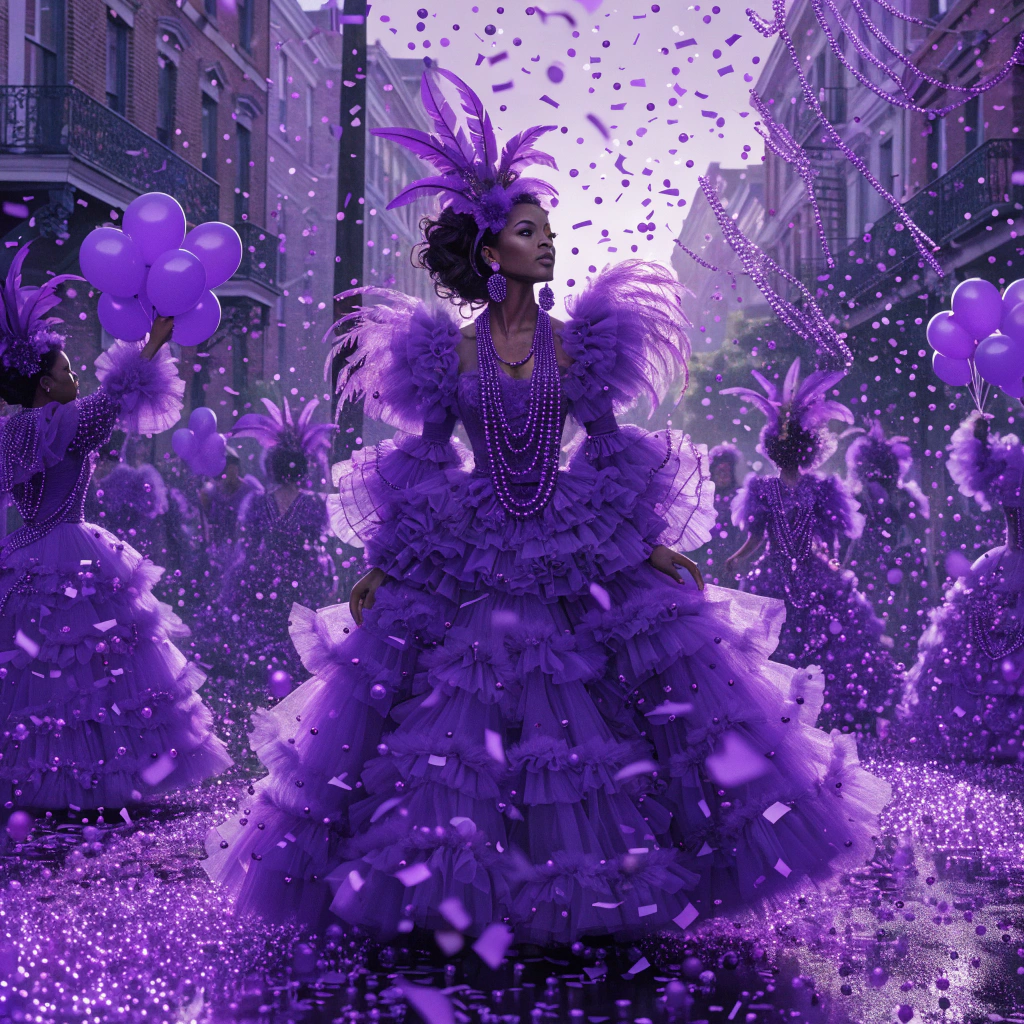
A Big Party: Mardi Gras
Mardi Gras is a big party in New Orleans. It is in the United States. People call it "Fat Tuesday." This festival is usually in February or March. It is very famous.
There are many colorful parades in the streets. People wear bright costumes and masks. The special colors are purple, green, and gold. Music is everywhere.
People throw beads and small toys from the floats. Everyone is happy and they dance. Families eat a special cake called King Cake. It is a very fun day for children and adults.
Grammar Spotlight
Pattern: Present Simple (to be)
"It is in the United States."
Use 'is' for singular subjects like 'it' or names of places. This pattern describes facts and general truths.
Pattern: Plural Nouns with -s
"There are many colorful parades in the streets."
Add the letter 's' to the end of a noun to show there is more than one. For example, one 'parade' becomes many 'parades'.
Test Your Understanding
10 questions · A1 Beginner · 1 free preview
Test what you learned from this article. Answer all questions to earn XP!
Where is the Mardi Gras party?
Want to finish the quiz?
9 more questions are waiting for you. Sign up free to unlock the full quiz and earn XP!
Sign Up FreeAlready have an account? Sign In
Question Breakdown
Where is the Mardi Gras party?
Your answer:
Correct answer: New Orleans
The special colors are purple, green, and gold.
Your answer:
Correct answer: True
What is a 'mask'?
Your answer:
Correct answer: Something for your face
People throw _____ and small toys from the floats.
Your answer:
Correct answer: beads
Mardi Gras: A Big Party in New Orleans
Mardi Gras is a very famous festival in the United States. The name is French and it means "Fat Tuesday." This celebration happens every year in the city of New Orleans. It is a time for music, food, and big parties.
French explorers brought the tradition to Louisiana a long time ago. Over many years, the festival changed. Today, it is more popular and bigger than in the past. The season officially starts in January and ends in February or March.
During Mardi Gras, there are many colorful parades in the streets. People wear beautiful masks and bright costumes. They stand on the street and watch large floats go by. People on the floats throw plastic beads and small coins to the crowd. It is louder and more exciting than a normal day.
Food is also important. Families eat a special dessert called "King Cake." This cake is delicious because it has a lot of sugar and cinnamon. Visitors love Mardi Gras because the atmosphere is friendly and the colors are amazing.
Grammar Spotlight
Pattern: Past Simple (Irregular Verbs)
"French explorers brought the tradition to Louisiana a long time ago."
We use the past simple to talk about actions that finished in the past. For irregular verbs like 'bring', the spelling changes completely to 'brought'.
Pattern: Comparatives
"It is louder and more exciting than a normal day."
We use comparatives to compare two things. For short adjectives like 'loud', we add -er. For long adjectives like 'exciting', we use 'more' before the word.
Test Your Understanding
11 questions · A2 Elementary · 1 free preview
Test what you learned from this article. Answer all questions to earn XP!
In which city does the big celebration happen?
Want to finish the quiz?
10 more questions are waiting for you. Sign up free to unlock the full quiz and earn XP!
Sign Up FreeAlready have an account? Sign In
Question Breakdown
In which city does the big celebration happen?
Your answer:
Correct answer: New Orleans
The name Mardi Gras means 'Fat Tuesday' in French.
Your answer:
Correct answer: True
What is a 'float'?
Your answer:
Correct answer: A large decorated vehicle
People wear beautiful _____ and bright costumes.
Your answer:
Correct answer: masks
When does the Mardi Gras season officially start?
Your answer:
Correct answer: January
Mardi Gras: The Most Colorful Party in America
Mardi Gras is one of the most famous festivals in the United States, especially in the city of New Orleans. The name is French and means "Fat Tuesday." It is celebrated the day before Ash Wednesday, which is the start of the Christian season of Lent. This colorful festival has been part of Louisiana's culture for hundreds of years.
The tradition was brought to America by French explorers in the late 17th century. Since then, it has evolved into a massive event that attracts millions of tourists every year. During the season, which officially starts on January 6, the streets are filled with music and joy.
The celebration is organized by private social clubs called "krewes." These groups build huge, artistic floats that are pulled through the streets during parades. People on the floats throw small gifts, like colorful plastic beads and toy coins, to the crowds. Many people wear masks and costumes, which allows everyone to participate in the fun without being recognized.
Food is also a very important part of Mardi Gras. The most famous treat is the "King Cake." This is a sweet bread decorated with purple, green, and gold sugar. A tiny plastic baby is hidden inside the cake. The person who finds the baby has to buy the next cake or host the next party.
Although Mardi Gras is celebrated in many places, the party in New Orleans is unique. It is a time when the whole city comes together to enjoy music, food, and history before a quieter season begins.
Grammar Spotlight
Pattern: Passive Voice (Past Simple)
"The tradition was brought to America by French explorers in the late 17th century."
We use the passive voice when the action is more important than the person doing it. It is formed using 'was/were' + the past participle of the verb.
Pattern: Relative Clauses (Non-defining)
"Many people wear masks and costumes, which allows everyone to participate in the fun without being recognized."
Relative clauses starting with 'which' add extra information to the sentence. In this case, it explains the result of wearing masks.
Test Your Understanding
11 questions · B1 Intermediate · 1 free preview
Test what you learned from this article. Answer all questions to earn XP!
When does the Mardi Gras season officially begin?
Want to finish the quiz?
10 more questions are waiting for you. Sign up free to unlock the full quiz and earn XP!
Sign Up FreeAlready have an account? Sign In
Question Breakdown
When does the Mardi Gras season officially begin?
Your answer:
Correct answer: January 6
The name 'Mardi Gras' means 'Fat Tuesday' in French.
Your answer:
Correct answer: True
What does 'unique' mean?
Your answer:
Correct answer: The only one of its kind
A tiny plastic _____ is hidden inside the King Cake.
Your answer:
Correct answer: baby
Who brought the Mardi Gras tradition to Louisiana?
Your answer:
Correct answer: French explorers
The Cultural Significance and Evolution of Mardi Gras in New Orleans
Mardi Gras, which translates to 'Fat Tuesday,' represents the spectacular climax of the Carnival season in the United States. Although many observers associate the event solely with a single day of revelry, the season officially commences on the Feast of the Epiphany and builds in intensity over several weeks. Historically, the tradition has its roots in medieval Europe, having been introduced to Louisiana by French explorers during the late 17th century. Since that time, it has evolved into a uniquely American cultural phenomenon, centered primarily in the vibrant city of New Orleans.
The celebration is characterized by a series of elaborate parades organized by 'krewes,' which are private social clubs responsible for the festivities. These organizations spend months preparing magnificent floats and intricate costumes that reflect various themes, often ranging from mythology to political satire. As these floats traverse the city streets, participants throw 'trinkets'—most notably colorful plastic beads—to the enthusiastic crowds. This tradition, while seemingly chaotic, is deeply rooted in the local heritage and serves as a vital component of social cohesion within the community. The streets are filled with the rhythmic sounds of brass bands, further enhancing the atmosphere of public performance.
From an economic perspective, Mardi Gras is indispensable to the region. The massive influx of tourists from around the globe results in significant prosperity for local businesses, including hotels, restaurants, and independent artisans. However, the event is more than just a commercial opportunity; it is a profound expression of collective identity. By the time the season culminates on Fat Tuesday, the city has transformed into a grand stage for artistic expression. Residents and visitors alike embrace the opportunity to wear masks, allowing them to temporarily transcend social boundaries and participate in a shared cultural legacy.
Furthermore, the spiritual aspect of the holiday should not be overlooked. Mardi Gras serves as a final period of indulgence before the solemn season of Lent begins on Ash Wednesday. This sharp contrast between extravagant celebration and the upcoming period of sacrifice highlights the cultural complexity of the event. Despite the modernization and commercialization of the festival, the core values of community spirit and historical preservation remain intact. Consequently, Mardi Gras continues to be a testament to the enduring legacy of French influence in the American South, blending old-world customs with contemporary flair.
Grammar Spotlight
Pattern: Passive Voice with Perfect Participle
"Historically, the tradition has its roots in medieval Europe, having been introduced to Louisiana by French explorers..."
The phrase 'having been introduced' uses the perfect passive participle to indicate that an action was completed before the main action of the sentence. It provides historical context while maintaining a formal, academic tone.
Pattern: Non-defining Relative Clauses
"The celebration is characterized by a series of elaborate parades organized by 'krewes,' which are private social clubs responsible for the festivities."
The clause starting with 'which' provides extra information about the noun 'krewes'. It is separated by a comma because the sentence would still be grammatically complete without it.
Pattern: Present Perfect Simple for Evolution
"Since that time, it has evolved into a uniquely American cultural phenomenon..."
The present perfect 'has evolved' is used here to describe a process that began in the past (the 17th century) and continues to have relevance or has reached its current state in the present.
Test Your Understanding
11 questions · B2 Upper Intermediate · 1 free preview
Test what you learned from this article. Answer all questions to earn XP!
What is the primary role of 'krewes' during the Mardi Gras season?
Want to finish the quiz?
10 more questions are waiting for you. Sign up free to unlock the full quiz and earn XP!
Sign Up FreeAlready have an account? Sign In
Question Breakdown
What is the primary role of 'krewes' during the Mardi Gras season?
Your answer:
Correct answer: To organize and manage the parades and festivities
The Mardi Gras season officially begins on Ash Wednesday.
Your answer:
Correct answer: False
Which word describes the state of being financially successful and flourishing?
Your answer:
Correct answer: Prosperity
Mardi Gras represents the spectacular _____ of the Carnival season.
Your answer:
Correct answer: climax
According to the article, how did the Mardi Gras tradition arrive in the United States?
Your answer:
Correct answer: French explorers brought it in the late 17th century
The Ephemeral Splendor of Mardi Gras: A Sociological and Cultural Tapestry
Seldom does the casual observer grasp the intricate social stratification hidden beneath the masks of the Mardi Gras krewes. While the uninitiated may perceive only a chaotic display of indulgence, the reality is a meticulously orchestrated performance of heritage and hierarchy. It is the historical legacy of French explorers that provides the foundational bedrock for these festivities, yet the contemporary manifestation has evolved into a uniquely American paradigm of excess. The institutionalization of revelry serves as a psychological safety valve, allowing for a temporary subversion of societal norms.
Historically, the season officially commences on the Feast of the Epiphany, building in momentum until the crescendo of Fat Tuesday. This period is marked by the opulence of private balls and public parades, where the elite and the commoner momentarily occupy the same physical space, though rarely the same social one. The krewes, secret societies that organize these events, represent a vestige of Old World aristocracy repurposed for the New World. Membership in these organizations often signifies a lifetime of social positioning, yet their public face is one of inclusive celebration.
However, the commercialization of the event often threatens to overshadow its profound communal significance. Critics argue that the influx of tourism has diluted the subversive power of the carnival, transforming a local rite of passage into a commodified spectacle. Yet, for the denizens of New Orleans, the ephemeral nature of the celebration is what grants it such poignancy. Once the clock strikes midnight on Ash Wednesday, the transition from gluttony to penance is instantaneous, highlighting the paradox of human nature.
Furthermore, the aesthetic of Mardi Gras—characterized by the traditional colors of purple for justice, green for faith, and gold for power—acts as a semiotic system that conveys deeper meanings to those capable of decoding them. The act of masking, in particular, facilitates a radical anonymity, where the constraints of identity are discarded in favor of a collective, festive persona. Ultimately, Mardi Gras remains a testament to the enduring human need for ritual, providing a space where history, art, and social critique converge in a vibrant, albeit temporary, explosion of life.
Grammar Spotlight
Pattern: Negative Inversion
"Seldom does the casual observer grasp the intricate social stratification hidden beneath the masks of the Mardi Gras krewes."
Inversion is used after negative or restrictive adverbs (like 'seldom') to create emphasis. The auxiliary verb 'does' precedes the subject 'the casual observer'.
Pattern: Cleft Sentence
"It is the historical legacy of French explorers that provides the foundational bedrock for these festivities."
This structure (It + is/was + noun phrase + that/who) is used to focus on a specific piece of information, in this case, the 'historical legacy'.
Pattern: Nominalisation
"The institutionalization of revelry serves as a psychological safety valve."
Nominalisation turns verbs or adjectives into nouns (institutionalize -> institutionalization). It makes the writing more formal and allows the author to discuss complex concepts as abstract entities.
Test Your Understanding
12 questions · C1 Advanced · 1 free preview
Test what you learned from this article. Answer all questions to earn XP!
What does the author suggest about the relationship between the elite and commoners during Mardi Gras?
Want to finish the quiz?
11 more questions are waiting for you. Sign up free to unlock the full quiz and earn XP!
Sign Up FreeAlready have an account? Sign In
Question Breakdown
What does the author suggest about the relationship between the elite and commoners during Mardi Gras?
Your answer:
Correct answer: They occupy the same physical space but remain socially separate.
The article states that Mardi Gras officially begins on Ash Wednesday.
Your answer:
Correct answer: False
What is the meaning of 'ephemeral' as used in the text?
Your answer:
Correct answer: Lasting for a very short time
The _____ of revelry serves as a psychological safety valve for society.
Your answer:
Correct answer: institutionalization
According to the text, what does the color purple represent in the context of Mardi Gras?
Your answer:
Correct answer: Justice
Masking allows individuals to adopt a collective, festive persona by hiding their identity.
Your answer:
Correct answer: True
The Socio-Cultural Tapestry of Mardi Gras: A Dialectic of Excess and Order
To the uninitiated, the annual iteration of Mardi Gras in New Orleans might appear as a mere paroxysm of hedonism—a transient lapse in the sobriety of civic life. However, beneath the veneer of beads and bourbon lies a complex socio-cultural tapestry woven from the threads of history, theology, and racial stratification. Were one to trace the lineage of this spectacle, one would find its progenitors in the medieval 'Boeuf Gras' of France, transplanted to the swampy outposts of Louisiana in 1699 by Iberville and Bienville. Yet, the contemporary manifestation is less a vestigial European relic and more a uniquely American synthesis of the subversive and the sacred. The season officially commences on the Feast of the Epiphany, a liturgical marker that initiates a crescendo of festivities culminating in Fat Tuesday. This period is not merely an excuse for licentiousness; it serves as a structural counterpoint to the impending austerity of Lent. It is through this lens of Mikhail Bakhtin’s 'carnivalesque' that we must interpret the temporary suspension of hierarchical norms. During the parade, the pauper may be crowned king, and the social order is playfully, albeit briefly, inverted. Central to this architecture are the 'Krewes'—private social organizations that fund and orchestrate the elaborate processions. Historically, these Krewes were bastions of white, male hegemony, serving to reinforce the stratification of New Orleans society through exclusionary membership. Rarely has the tension between the parochial and the global been so palpable as in the intricate designs of the parade floats, which often utilize biting satire to critique contemporary political figures. Despite the ostentation of the floats and the ephemeral nature of the 'throws'—the trinkets tossed to the crowds—the festival remains a serious economic engine. It could be argued that the commodification of Mardi Gras threatens its authenticity, yet the local commitment to preserving the 'esprit de fête' remains undiminished. Were it not for the clandestine efforts of the early Krewes during periods of civic unrest, the festival might have succumbed to the puritanical pressures of the 19th-century elite. Instead, it evolved, incorporating the vibrant traditions of the Mardi Gras Indians—African American communities who mask in elaborate bead-and-feather suits to honor Native American resistance. This intersectionality elevates the event from a simple street party to a profound narrative of survival and cultural hybridity. Ultimately, Mardi Gras is a testament to the human need for ritualized release. It is a moment where the city breathes in unison, a collective sigh of defiance against the mundane. As the clock strikes midnight on Ash Wednesday, the revelry ceases with a jarring suddenness, reminding participants that the carnival is, by definition, a fleeting escape from the inexorable march of time and duty.
Grammar Spotlight
Pattern: Negative Inversion
"Rarely has the tension between the parochial and the global been so palpable as in the intricate designs of the parade floats."
This structure places a negative or restrictive adverb at the beginning for emphasis, requiring the auxiliary verb to precede the subject. It is common in formal, academic writing to highlight the rarity or intensity of a situation.
Pattern: Subjunctive Conditional (Inverted)
"Were one to trace the lineage of this spectacle, one would find its progenitors in the medieval 'Boeuf Gras' of France."
This is a formal way of expressing a hypothetical condition without using 'if'. By starting with 'Were' followed by the subject, the writer achieves a more scholarly and sophisticated tone.
Pattern: Cleft Sentences
"It is through this lens of Mikhail Bakhtin’s 'carnivalesque' that we must interpret the temporary suspension of hierarchical norms."
A cleft sentence focuses on a specific part of the information by using 'It is/was... that'. This helps the writer emphasize the specific framework (Bakhtin's theory) being used for analysis.
Test Your Understanding
12 questions · C2 Mastery · 1 free preview
Test what you learned from this article. Answer all questions to earn XP!
According to the article, what was the historical role of the 'Krewes' in New Orleans?
Want to finish the quiz?
11 more questions are waiting for you. Sign up free to unlock the full quiz and earn XP!
Sign Up FreeAlready have an account? Sign In
Question Breakdown
According to the article, what was the historical role of the 'Krewes' in New Orleans?
Your answer:
Correct answer: To maintain social stratification through exclusive membership.
The author argues that Mardi Gras is a purely modern American invention with no European roots.
Your answer:
Correct answer: False
What does the term 'ephemeral' refer to in the context of the article?
Your answer:
Correct answer: The short-lived nature of the parade trinkets.
The author uses the term _____ to describe the dominance of certain social groups within the early Krewes.
Your answer:
Correct answer: hegemony
What is the significance of the Mardi Gras Indians mentioned in the text?
Your answer:
Correct answer: They embody cultural hybridity and resistance through their traditions.
The article suggests that the transition from Fat Tuesday to Ash Wednesday is gradual and subtle.
Your answer:
Correct answer: False
