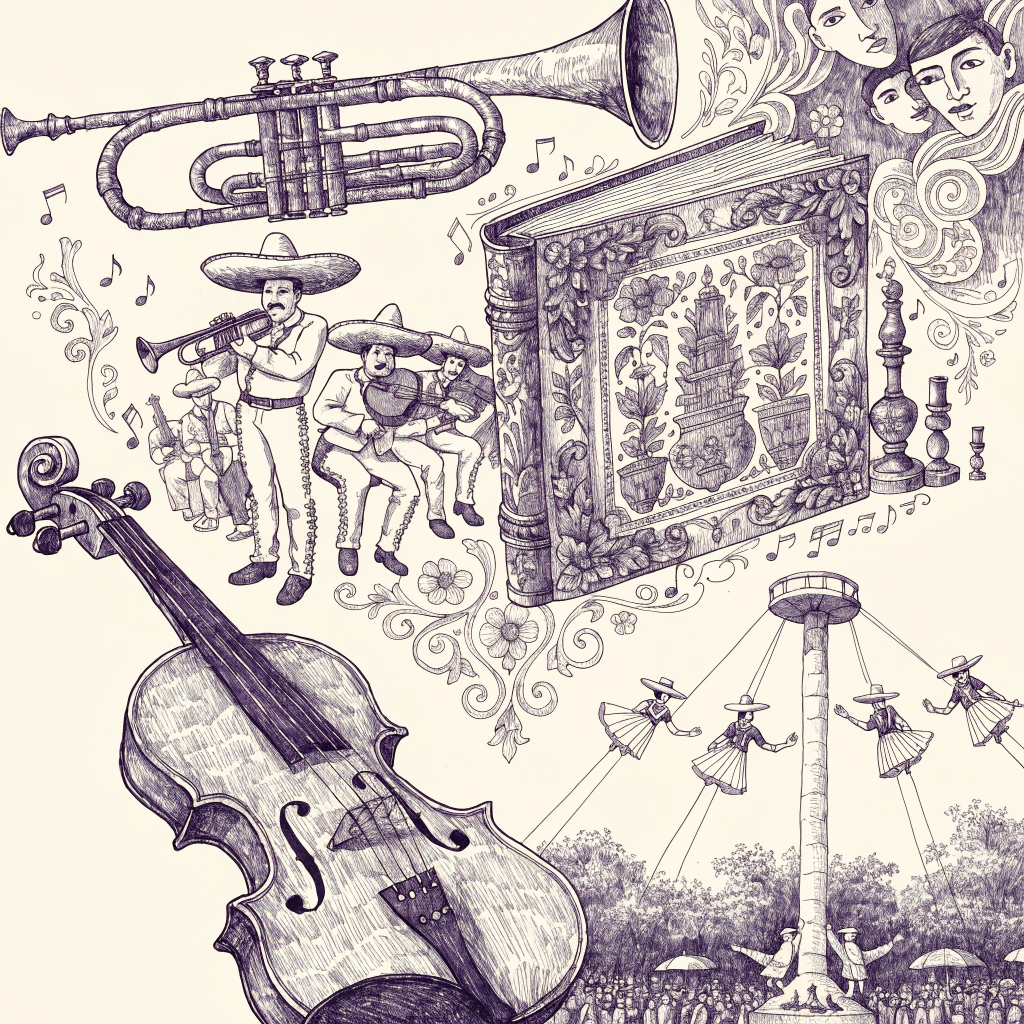
Mariachi: Musik aus Mexiko
Mariachi ist eine Musik aus Mexiko. Es ist sehr bekannt in der ganzen Welt. Mariachi-Musiker tragen besondere Kleidung. Diese Kleidung heißt 'Traje de Charro'. Sie spielen verschiedene Instrumente. Zum Beispiel gibt es Gitarren und Trompeten. Viele Musiker singen auch schöne Lieder. Mariachi ist fröhlich und oft sehr laut. Die Musik ist ein wichtiges Symbol für Mexiko. Viele Leute in Mexiko und in anderen Ländern hören Mariachi gern. Sie tanzen auch oft dazu. Mariachi macht Freude und ist ein Teil der Kultur.
Grammatik-Spotlight
Muster: Präsens (Gegenwart)
"Mariachi ist eine Musik aus Mexiko."
Das Präsens benutzen wir, um über Dinge zu sprechen, die jetzt passieren oder immer wahr sind. Für 'sein' (to be) sagen wir 'ich bin', 'du bist', 'er/sie/es ist', 'wir sind', 'ihr seid', 'sie sind'.
Muster: Nomen und Artikel
"Die Musik ist ein wichtiges Symbol für Mexiko."
Im Deutschen haben Nomen ein Geschlecht (maskulin, feminin, neutral). Dazu gibt es Artikel wie 'der' (maskulin), 'die' (feminin), 'das' (neutral) für bestimmte Dinge und 'ein', 'eine' für unbestimmte Dinge.
Teste dein Verständnis
10 Fragen · A1 Anfänger · 1 kostenlose Vorschau
Teste, was du aus diesem Artikel gelernt hast. Beantworte alle Fragen und sammle XP!
Was ist Mariachi?
Möchtest du das Quiz beenden?
9 weitere Fragen warten auf dich. Registriere dich kostenlos, um das vollständige Quiz freizuschalten und XP zu sammeln!
Kostenlos registrierenHast du schon ein Konto? Anmelden
Gut gemacht!
Weiter üben!
Bereits abgeschlossen — keine zusätzlichen XP
Registriere dich, um XP zu verdienenFragenübersicht
Was ist Mariachi?
Deine Antwort:
Richtige Antwort: Eine Musik
Mariachi-Musiker tragen normale Alltagskleidung.
Deine Antwort:
Richtige Antwort: Falsch
Was bedeutet 'bekannt'?
Deine Antwort:
Richtige Antwort: berühmt
Mariachi ist eine _____ aus Mexiko.
Deine Antwort:
Richtige Antwort: Musik
Mariachi: Musik aus Mexiko
Mariachi ist eine sehr bekannte Musik aus Mexiko. Diese Musik ist ein wichtiges Symbol für die mexikanische Kultur und Identität. Mariachi-Musik ist nicht neu, sie ist schon sehr alt. Sie ist im 18. und 19. Jahrhundert in der Region Jalisco entstanden, besonders in kleinen Städten wie Cocula. Früher haben die Musiker oft auf kleinen Festen in Dörfern gespielt. Die Musik war damals eher eine ländliche Tradition.
Die Mariachi-Gruppen haben typische Instrumente. Dazu gehören die Geige, die Trompete und verschiedene Gitarren. Eine besondere Gitarre ist die Vihuela; sie ist klein und hat einen hohen Klang. Eine andere große Gitarre ist der Guitarrón; er macht tiefe Töne und den Bass. Die Musiker tragen oft bunte Trachten mit großen Hüten, den Sombreros. Sie singen und spielen oft Lieder über Liebe, Heimat und mexikanische Geschichten.
Heute ist Mariachi weltweit bekannt. Viele Menschen lieben diese fröhliche und traditionelle Musik. Wenn man Mariachi hört, denkt man oft an Mexiko und seine lebendige Kultur. Es ist ein wichtiger Teil des Lebens in Mexiko.
Grammatik-Spotlight
Muster: Das Perfekt mit "sein"
"Sie ist im 18. und 19. Jahrhundert in der Region Jalisco entstanden."
Wir nutzen das Perfekt, um über eine abgeschlossene Handlung in der Vergangenheit zu sprechen. Bei Verben, die eine Bewegung oder eine Zustandsänderung beschreiben (wie 'entstehen'), bilden wir das Perfekt mit 'sein' und dem Partizip II.
Muster: Präposition "in" mit Dativ
"Sie ist im 18. und 19. Jahrhundert in der Region Jalisco entstanden."
Die Präposition 'in' kann eine feste Position oder einen Ort angeben. Wenn sie eine Position beschreibt, steht sie oft mit dem Dativ. 'In der Region' bedeutet, dass es sich dort befindet.
Teste dein Verständnis
11 Fragen · A2 Grundkenntnisse · 1 kostenlose Vorschau
Teste, was du aus diesem Artikel gelernt hast. Beantworte alle Fragen und sammle XP!
Was ist Mariachi?
Möchtest du das Quiz beenden?
10 weitere Fragen warten auf dich. Registriere dich kostenlos, um das vollständige Quiz freizuschalten und XP zu sammeln!
Kostenlos registrierenHast du schon ein Konto? Anmelden
Gut gemacht!
Weiter üben!
Bereits abgeschlossen — keine zusätzlichen XP
Registriere dich, um XP zu verdienenFragenübersicht
Was ist Mariachi?
Deine Antwort:
Richtige Antwort: eine Musik aus Mexiko
Mariachi-Musik ist sehr jung.
Deine Antwort:
Richtige Antwort: Falsch
Was bedeutet "entstanden"?
Deine Antwort:
Richtige Antwort: hat begonnen
Mariachi ist ein wichtiges __________ für die mexikanische Kultur.
Deine Antwort:
Richtige Antwort: Symbol
Die Musik ist in der Region __________ entstanden.
Deine Antwort:
Richtige Antwort: Jalisco
Mariachi: Der lebendige Klang Mexikos
Mariachi ist mehr als nur Musik; es ist ein tief verwurzelter Teil der mexikanischen Kultur und Identität. Diese lebendige Musikform hat ihren Ursprung im Westen Mexikos, besonders im Bundesstaat Jalisco, und hat sich im Laufe der Jahrhunderte zu einem globalen Symbol des Landes entwickelt.
Ursprünglich waren Mariachi-Gruppen kleine ländliche Ensembles, die Streichinstrumente spielten. Typische Instrumente, die bis heute verwendet werden, sind Violinen, die Vihuela (eine kleine, hoch klingende Gitarre mit fünf Saiten) und der Guitarrón (eine große Bassgitarre). Diese Instrumente bilden das rhythmische und harmonische Fundament der Musik. Später kamen Trompeten hinzu, die dem Mariachi seinen unverwechselbaren, festlichen Klang gaben, den viele Menschen heute kennen.
Die Musiker, die Mariachis, tragen oft traditionelle Kleidung, den sogenannten "Traje de Charro". Diese elegante Kleidung besteht aus einer bestickten Jacke, einer engen Hose, einem breiten Gürtel und einem großen Sombrero. Diese Kleidung hat sich aus der traditionellen Kleidung mexikanischer Reiter entwickelt und ist ein wichtiger Teil der Mariachi-Tradition.
Mariachi-Musik wird bei vielen Gelegenheiten gespielt: bei Hochzeiten, Geburtstagen, nationalen Feiertagen und in Restaurants. Sie erzählt Geschichten von Liebe, Leidenschaft, Trauer und Patriotismus. Lieder wie "Cielito Lindo" oder "La Bamba" sind weltweit bekannt und werden oft mit Mexiko verbunden. Es ist eine Musik, die Freude bringt und die Herzen vieler Menschen auf der ganzen Welt berührt hat. Mariachi wurde sogar von der UNESCO als immaterielles Kulturerbe der Menschheit anerkannt, was seine globale Bedeutung unterstreicht. Diese Anerkennung zeigt, wie wichtig diese Musik für das kulturelle Erbe Mexikos und der Welt ist.
Grammatik-Spotlight
Muster: Relativsätze mit "der/die/das"
"Typische Instrumente, die bis heute verwendet werden, sind Violinen..."
Relativsätze geben zusätzliche Informationen zu einem Nomen. Sie werden mit Relativpronomen wie "der", "die" oder "das" eingeleitet, die sich in Genus und Numerus nach dem Bezugswort richten. Das konjugierte Verb steht am Ende des Relativsatzes.
Muster: Passiv mit "werden"
"Mariachi-Musik wird bei vielen Gelegenheiten gespielt..."
Das Passiv wird verwendet, um eine Handlung zu beschreiben, bei der die Handlung wichtiger ist als die Person, die sie ausführt. Es wird mit einer Form von "werden" und dem Partizip II des Hauptverbs gebildet. Der Handelnde kann mit "von" oder "durch" genannt werden, ist aber oft unbekannt oder unwichtig.
Teste dein Verständnis
11 Fragen · B1 Mittelstufe · 1 kostenlose Vorschau
Teste, was du aus diesem Artikel gelernt hast. Beantworte alle Fragen und sammle XP!
Wo hat die Mariachi-Musik ihren Ursprung?
Möchtest du das Quiz beenden?
10 weitere Fragen warten auf dich. Registriere dich kostenlos, um das vollständige Quiz freizuschalten und XP zu sammeln!
Kostenlos registrierenHast du schon ein Konto? Anmelden
Gut gemacht!
Weiter üben!
Bereits abgeschlossen — keine zusätzlichen XP
Registriere dich, um XP zu verdienenFragenübersicht
Wo hat die Mariachi-Musik ihren Ursprung?
Deine Antwort:
Richtige Antwort: Im Westen Mexikos
Die traditionelle Mariachi-Kleidung heißt "Traje de Charro".
Deine Antwort:
Richtige Antwort: Richtig
Was bedeutet "Ursprung"?
Deine Antwort:
Richtige Antwort: Der Anfang von etwas
Mariachi-Musik wird oft bei _____, Geburtstagen und nationalen Feiertagen gespielt.
Deine Antwort:
Richtige Antwort: Hochzeiten
Welche Instrumente waren ursprünglich typisch für Mariachi-Gruppen?
Deine Antwort:
Richtige Antwort: Violinen, Vihuela und Guitarrón
The Cultural Resonance of Mariachi: More Than Just Music
Mariachi is not merely a musical genre; it is a profound expression of Mexican identity that has come to represent the nation’s soul on the global stage. The genre is often regarded as the quintessential sound of Mexico, blending indigenous, European, and African influences into a vibrant tapestry of sound. Although its exact origins are debated, it is widely accepted that the tradition emerged in the western state of Jalisco during the 18th and 19th centuries. Originally, these rural ensembles performed at local festivals and social gatherings, utilizing a specific array of string instruments that remain emblematic of the style today.
Throughout its history, Mariachi has evolved from its humble rural origins into a sophisticated urban art form. In the early days, the groups consisted primarily of violins, the vihuela—a high-pitched five-string guitar—and the guitarrón, a large acoustic bass. The guitarrón, which provides the deep rhythmic foundation, is essential for the ensemble. However, as the music moved into the cities during the 20th century, particularly Mexico City, it underwent a significant transformation. The addition of trumpets in the 1930s provided a brilliant, piercing quality that allowed the music to be heard more clearly in larger venues and on the radio. This shift was instrumental in popularizing the genre nationwide.
The visual aesthetic of the Mariachi is just as distinguishable as its sound. Musicians typically wear the 'traje de charro,' a highly decorated suit inspired by the clothing of 19th-century horsemen. These outfits, often adorned with intricate silver or gold embroidery and wide-brimmed hats, signify a deep respect for tradition and craftsmanship. Furthermore, the lyrics of Mariachi songs often explore themes of love, betrayal, politics, and revolutionary history, ensuring that the music continues to resonate with listeners across different generations.
In 2011, UNESCO recognized Mariachi by inscribing it on the Representative List of the Intangible Cultural Heritage of Humanity. This designation highlights the importance of the music in maintaining community bonds and cultural continuity. Despite the pressures of globalization, the genre remains a vital part of Mexican life, serving as the musical accompaniment for weddings, birthdays, and national holidays. Consequently, Mariachi is not only a relic of the past but a living tradition that continues to shape the contemporary cultural landscape of Mexico and beyond.
Grammatik-Spotlight
Muster: The Passive Voice
"The genre is often regarded as the quintessential sound of Mexico."
The passive voice is used here to focus on the genre itself rather than who is doing the regarding. It is formed using the verb 'to be' plus the past participle.
Muster: Present Perfect
"Mariachi has evolved from its humble rural origins into a sophisticated urban art form."
The present perfect describes an action that started in the past and has continuing relevance or has just been completed. It is formed using 'has/have' and the past participle.
Muster: Non-Defining Relative Clauses
"The guitarrón, which provides the deep rhythmic foundation, is essential for the ensemble."
This clause provides extra information about the guitarrón. It is separated by commas and uses 'which' to add detail without changing the core meaning of the sentence.
Teste dein Verständnis
11 Fragen · B2 Obere Mittelstufe · 1 kostenlose Vorschau
Teste, was du aus diesem Artikel gelernt hast. Beantworte alle Fragen und sammle XP!
Where is Mariachi music widely believed to have originated?
Möchtest du das Quiz beenden?
10 weitere Fragen warten auf dich. Registriere dich kostenlos, um das vollständige Quiz freizuschalten und XP zu sammeln!
Kostenlos registrierenHast du schon ein Konto? Anmelden
Gut gemacht!
Weiter üben!
Bereits abgeschlossen — keine zusätzlichen XP
Registriere dich, um XP zu verdienenFragenübersicht
Where is Mariachi music widely believed to have originated?
Deine Antwort:
Richtige Antwort: Jalisco
Trumpets were part of the original Mariachi ensembles in the 18th century.
Deine Antwort:
Richtige Antwort: Falsch
What does the word 'emblematic' mean in the context of the article?
Deine Antwort:
Richtige Antwort: Serving as a symbol of a style
Mariachi is described as a profound expression of Mexican _____.
Deine Antwort:
Richtige Antwort: identity
What is the traditional suit worn by Mariachi musicians called?
Deine Antwort:
Richtige Antwort: Traje de charro
The Resonant Soul of Mexico: A Critical Analysis of Mariachi's Evolution
Rarely does a musical genre encapsulate the multifaceted identity of a nation as comprehensively as Mariachi does for Mexico. Rooted in the fertile cultural soil of Jalisco, this tradition has transcended its rural origins to become a global emblem of Mexicanidad. It was during the 18th and 19th centuries that the embryonic forms of Mariachi began to coalesce, initially manifesting as string ensembles in towns like Cocula. These early groups, far removed from the polished spectacles of today, were the voice of the peasantry, articulating the joys and tribulations of rural life through the resonant strings of the vihuela and the guitarrón. The latter, a deep-bodied acoustic bass, remains the rhythmic heartbeat of the ensemble, providing a foundation upon which the violins and trumpets weave their intricate melodies.
The transformation of Mariachi from a regional folk style to a national iconography was significantly accelerated by the Golden Age of Mexican Cinema in the mid-20th century. Films featuring charros—the idealized Mexican cowboys—clothed in ornate, silver-studded suits, solidified the visual aesthetic of the modern Mariachi. However, this cinematic romanticization also triggered a complex process of commodification. What was once a localized expression of communal identity became a standardized product for mass consumption. Despite this, the emotional resonance of the music remains undiminished. It is this emotional depth that allows Mariachi to navigate the delicate balance between commercial appeal and cultural authenticity.
Central to the Mariachi tradition is the concept of syncretism. The genre represents a poignant fusion of indigenous, European, and African musical influences. The orchestration itself reflects this history, with Spanish-influenced string instruments meeting rhythmic patterns that evoke pre-Hispanic traditions. In 2011, UNESCO recognized Mariachi as part of the Intangible Cultural Heritage of Humanity, a designation that highlights the importance of the preservation of this heritage. Yet, the preservation of the genre is not merely about maintaining a static museum piece; it is about the ongoing negotiation of identity in a globalized world.
In contemporary Mexico, the role of Mariachi continues to evolve. While it remains a staple of life-cycle rituals—from weddings to funerals—it also faces modern challenges. The increasing professionalization of the genre has led to higher musical standards, yet some critics argue that the raw, improvisational spirit of the original 'sones' is being lost. Furthermore, the inclusion of women in what was historically a male-dominated sphere represents a significant socio-cultural shift. Ultimately, the enduring power of Mariachi lies in its ability to adapt. As long as it continues to give voice to the collective Mexican experience, its place in the global cultural landscape is secure.
Grammatik-Spotlight
Muster: Inversion with negative/restrictive adverbs
"Rarely does a musical genre encapsulate the multifaceted identity of a nation as comprehensively as Mariachi does for Mexico."
When starting a sentence with a negative or restrictive adverb like 'Rarely', the subject and auxiliary verb are inverted. This adds emphasis and a formal, sophisticated tone common in C1 writing.
Muster: Cleft Sentences
"It was during the 18th and 19th centuries that the embryonic forms of Mariachi began to coalesce."
Cleft sentences (It + is/was + [focus] + that/who) are used to emphasize a specific part of the information. Here, the focus is on the specific time period.
Muster: Nominalisation
"The transformation of Mariachi from a regional folk style to a national iconography was significantly accelerated by the Golden Age of Mexican Cinema."
Nominalisation involves turning verbs or adjectives into nouns (transform -> transformation). It allows for more complex sentence structures and a more academic, objective tone.
Teste dein Verständnis
12 Fragen · C1 Fortgeschritten · 1 kostenlose Vorschau
Teste, was du aus diesem Artikel gelernt hast. Beantworte alle Fragen und sammle XP!
According to the article, what was the primary catalyst for Mariachi's transition to a national icon?
Möchtest du das Quiz beenden?
11 weitere Fragen warten auf dich. Registriere dich kostenlos, um das vollständige Quiz freizuschalten und XP zu sammeln!
Kostenlos registrierenHast du schon ein Konto? Anmelden
Gut gemacht!
Weiter üben!
Bereits abgeschlossen — keine zusätzlichen XP
Registriere dich, um XP zu verdienenFragenübersicht
According to the article, what was the primary catalyst for Mariachi's transition to a national icon?
Deine Antwort:
Richtige Antwort: The Golden Age of Mexican Cinema
The guitarrón serves as the primary melodic instrument in a Mariachi ensemble.
Deine Antwort:
Richtige Antwort: Falsch
Which word describes the process of turning a cultural expression into a commercial product?
Deine Antwort:
Richtige Antwort: Commodification
The genre represents a _____ fusion of indigenous, European, and African musical influences.
Deine Antwort:
Richtige Antwort: poignant
What concern do some critics have regarding the professionalization of Mariachi?
Deine Antwort:
Richtige Antwort: The improvisational spirit of the music is being diminished.
UNESCO's recognition of Mariachi implies that the genre should remain a static museum piece.
Deine Antwort:
Richtige Antwort: Falsch
The Ethnomusicological Tapestry of Mariachi: A Study in Mexican National Identity
Seldom has a musical genre so profoundly encapsulated the collective psyche of a nation as Mariachi has for Mexico. To the uninitiated, Mariachi may appear as a mere festive accompaniment; however, a more scholarly interrogation reveals it to be a sophisticated confluence of historical narratives and cultural syncretism. Originating in the 18th and 19th centuries within the rural confines of Jalisco—specifically in municipalities such as Cocula—the ensemble began as a vestige of colonial string music, gradually evolving into a quintessential symbol of Mexicanidad. Were one to trace the lineage of Mariachi, one would find its roots inextricably linked to the 'son,' a diverse category of Mexican folk music that blends Spanish rhythmic structures with indigenous sensibilities.
The instrumental architecture of Mariachi is governed by a rigorous idiosyncrasy. At its core lies the rhythmic section, comprising the vihuela—a high-pitched, five-stringed guitar that provides percussive vitality—and the guitarrón, a deep-bodied acoustic bass that serves as the ensemble's harmonic anchor. It is through the interplay of the vihuela and the guitarrón that the genre achieves its distinctive harmonic depth, a resonance that is often punctuated by the soaring, melancholic melodies of the violins and the triumphant clarion calls of the trumpets. The latter, notably, were not integrated into the fold until the early 20th century, a modification facilitated by the advent of radio and the need for a more piercing sound that could transcend the limitations of early broadcasting technology.
Following the Mexican Revolution, the state sought to consolidate a unified national identity, and Mariachi was strategically elevated from its regional origins to a national paradigm. This period saw the transformation of the 'charro'—the traditional Mexican horseman—into a stylized icon, with the Mariachi ensemble adopting the ornate 'traje de charro' as their definitive uniform. This aesthetic shift was not merely ornamental; it served to subsume various regional identities under a singular, romanticized image of the Mexican soul. Consequently, the music evolved into a visceral paean to the landscape, the romantic tribulations, and the revolutionary fervor of the Mexican people.
Despite its global proliferation, Mariachi remains a subject of academic hedging regarding its etymology. While popular legend suggests a derivation from the French word 'mariage' during the French Intervention in the 1860s, contemporary linguists largely dismiss this as an evanescent myth, pointing instead to indigenous Coca roots. Regardless of its linguistic genesis, the genre’s inclusion in the UNESCO Representative List of the Intangible Cultural Heritage of Humanity in 2011 underscores its enduring significance. Today, as Mariachi traverses international borders, it continues to adapt, yet it retains a core authenticity that resists total homogenization. Should the genre continue to evolve at its current trajectory, it will likely remain the most potent auditory signifier of Mexican heritage, bridging the chasm between the traditional past and a globalized future.
Grammatik-Spotlight
Muster: Inversion with Negative Adverbials
"Seldom has a musical genre so profoundly encapsulated the collective psyche of a nation as Mariachi has for Mexico."
When a sentence begins with a negative or restrictive adverbial like 'seldom' or 'never', the auxiliary verb is placed before the subject for rhetorical emphasis. This is common in formal, academic C2-level writing.
Muster: Subjunctive Mood in Conditionals
"Were one to trace the lineage of Mariachi, one would find its roots inextricably linked to the 'son'."
The use of 'Were one to...' is a formal alternative to 'If one were to...', expressing a hypothetical or theoretical condition in the subjunctive mood. It elevates the scholarly tone of the discourse.
Muster: Cleft Sentences for Emphasis
"It is through the interplay of the vihuela and the guitarrón that the genre achieves its distinctive harmonic depth."
A cleft sentence (It + is/was + [emphasized part] + that/who...) is used to focus on a specific piece of information. Here, it emphasizes the specific instruments responsible for the genre's harmonic characteristics.
Teste dein Verständnis
12 Fragen · C2 Meisterschaft · 1 kostenlose Vorschau
Teste, was du aus diesem Artikel gelernt hast. Beantworte alle Fragen und sammle XP!
What was the primary reason for the inclusion of trumpets in Mariachi ensembles during the early 20th century?
Möchtest du das Quiz beenden?
11 weitere Fragen warten auf dich. Registriere dich kostenlos, um das vollständige Quiz freizuschalten und XP zu sammeln!
Kostenlos registrierenHast du schon ein Konto? Anmelden
Gut gemacht!
Weiter üben!
Bereits abgeschlossen — keine zusätzlichen XP
Registriere dich, um XP zu verdienenFragenübersicht
What was the primary reason for the inclusion of trumpets in Mariachi ensembles during the early 20th century?
Deine Antwort:
Richtige Antwort: To provide a sound that could be better captured by radio broadcasting
The term 'Mariachi' is definitively proven to have originated from the French word for marriage.
Deine Antwort:
Richtige Antwort: Falsch
What does 'subsume' mean in the context of the article?
Deine Antwort:
Richtige Antwort: To incorporate or absorb into a larger whole
The ensemble began as a _____ of colonial string music, gradually evolving into a symbol of Mexican identity.
Deine Antwort:
Richtige Antwort: vestige
According to the text, what role did the post-revolutionary state play in the history of Mariachi?
Deine Antwort:
Richtige Antwort: It promoted Mariachi as a national paradigm to unify Mexican identity.
The guitarrón provides the percussive vitality in the rhythmic section of the ensemble.
Deine Antwort:
Richtige Antwort: Falsch

