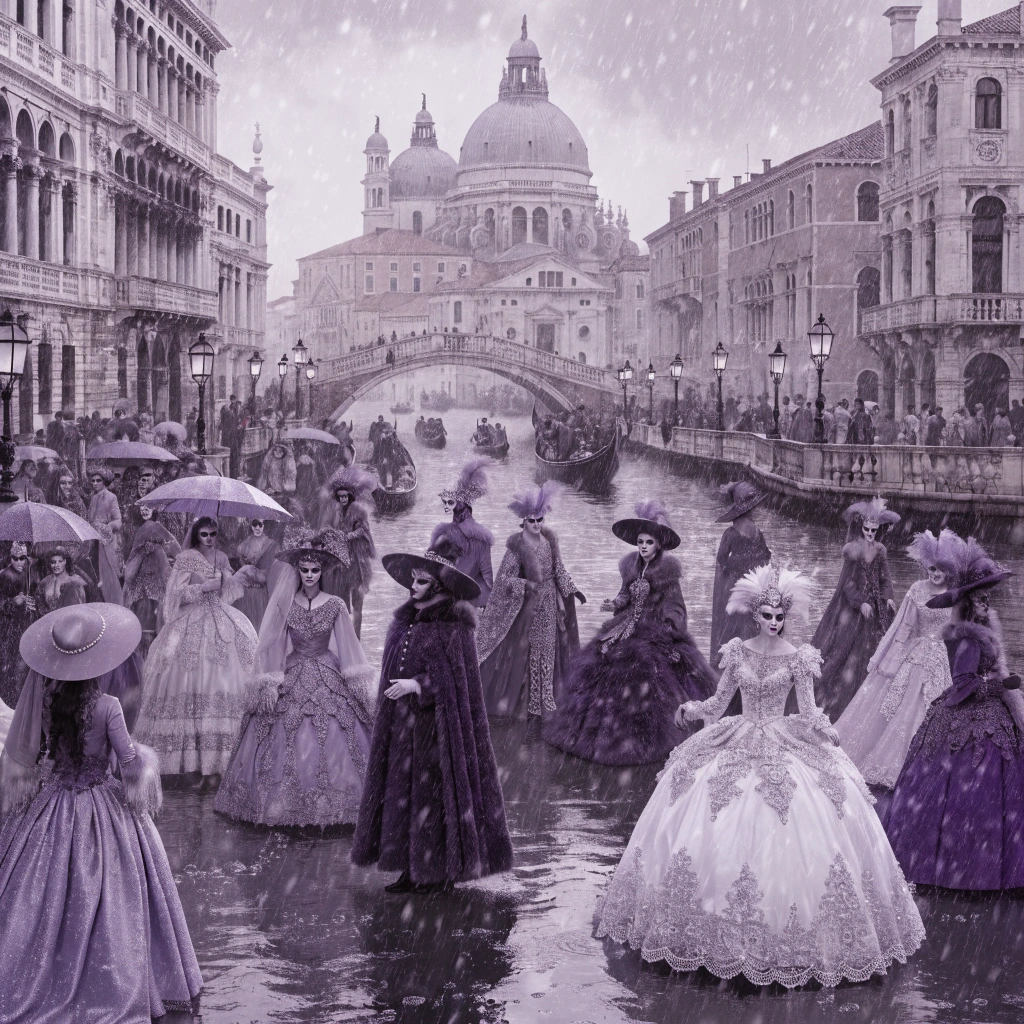
The Carnival of Venice
Venice is a beautiful city in Italy. In February, there is a big festival. It is the Carnival of Venice. This festival is very old and famous.
Many people visit the city for the party. They wear beautiful masks and colorful clothes. The masks are very special. People do not see your face.
There is music in the streets. There are many parades on the water. People eat good food and dance. It is a very happy time. Tourists take many photos. It is a great festival for everyone.
व्याकरण स्पॉटलाइट
पैटर्न: Present Simple (to be)
"Venice is a beautiful city in Italy."
We use 'is' to talk about a singular place or fact. It describes what something is like. In this sentence, it tells us about the city.
पैटर्न: Present Simple (Action Verbs)
"Tourists take many photos."
We use the base form of the verb for habits or facts with plural subjects. We do not add -s to 'take' because 'tourists' is plural.
अपनी समझ जाँचें
10 सवाल · A1 शुरुआती · 1 मुफ्त प्रीव्यू
इस लेख से आपने जो सीखा उसकी जाँच करें। सभी सवालों के जवाब दें और XP कमाएँ!
Where is Venice?
क्या आप क्विज़ समाप्त करना चाहते हैं?
9 और सवाल आपका इंतज़ार कर रहे हैं। पूरा क्विज़ अनलॉक करने और XP कमाने के लिए मुफ्त साइन अप करें!
मुफ़्त साइन अप करोपहले से अकाउंट है? साइन इन करो
बहुत बढ़िया!
अभ्यास जारी रखें!
पहले से पूर्ण — कोई अतिरिक्त XP नहीं
XP कमाने के लिए साइन अप करोसवालों का विवरण
Where is Venice?
आपका जवाब:
सही जवाब: Italy
The festival is in the month of February.
आपका जवाब:
सही जवाब: सही
What are 'masks'?
आपका जवाब:
सही जवाब: Something to cover the face
Many people _____ the city for the party.
आपका जवाब:
सही जवाब: visit
The Magic of the Carnival of Venice
Venice is a beautiful city in Italy. Every year, the city has a big party called Carnevale. It is very old and famous around the world. The festival started a long time ago in 1162. In the past, people wore masks because they wanted to be equal. Rich people and poor people were the same behind the masks, so they could celebrate together.
Today, the streets of Venice are full of colors and music. People wear beautiful costumes and expensive masks. These masks are often made of glass or paper. You can see many people on the canals in traditional boats called gondolas. It is more exciting than a normal day in Venice. Thousands of tourists visit the city in February to see the parade. They take many photos and enjoy the magic of the festival. It is a very special time for everyone in the city.
व्याकरण स्पॉटलाइट
पैटर्न: साधारण भूतकाल (नियमित क्रियाएँ)
"The festival started a long time ago in 1162."
साधारण भूतकाल (Past Simple) का प्रयोग अतीत में समाप्त हो चुके कार्यों के बारे में बात करने के लिए करो। नियमित क्रियाओं को बनाने के लिए, क्रिया के मूल रूप में '-ed' जोड़ें।
पैटर्न: तुलनात्मक (लंबे विशेषण)
"It is more exciting than a normal day in Venice."
'Exciting' जैसे लंबे विशेषणों के साथ दो चीज़ों की तुलना करने के लिए, विशेषण से पहले 'more' और उसके बाद 'than' का प्रयोग करें।
अपनी समझ जाँचें
11 सवाल · A2 बिगिनर · 1 मुफ्त प्रीव्यू
इस लेख से आपने जो सीखा उसकी जाँच करें। सभी सवालों के जवाब दें और XP कमाएँ!
वेनिस का उत्सव कब शुरू हुआ?
क्या आप क्विज़ समाप्त करना चाहते हैं?
10 और सवाल आपका इंतज़ार कर रहे हैं। पूरा क्विज़ अनलॉक करने और XP कमाने के लिए मुफ्त साइन अप करें!
मुफ़्त साइन अप करोपहले से अकाउंट है? साइन इन करो
बहुत बढ़िया!
अभ्यास जारी रखें!
पहले से पूर्ण — कोई अतिरिक्त XP नहीं
XP कमाने के लिए साइन अप करोसवालों का विवरण
वेनिस का उत्सव कब शुरू हुआ?
आपका जवाब:
सही जवाब: 1162
अतीत में, लोग मुखौटे पहनते थे ताकि अमीर और गरीब लोग समान हो सकें।
आपका जवाब:
सही जवाब: सही
'Expensive' का क्या अर्थ है?
आपका जवाब:
सही जवाब: बहुत महँगा
वेनिस की सड़कें _____ और संगीत से भरी हैं।
आपका जवाब:
सही जवाब: colors
वेनिस में पारंपरिक नावों को क्या कहा जाता है?
आपका जवाब:
सही जवाब: गोंडोला
The Magic of the Venice Carnival
The Carnival of Venice, which is known internationally as Carnevale di Venezia, is one of the most famous and colorful festivals in the world. Every year, the historic streets and romantic canals of Venice are filled with people wearing beautiful costumes and mysterious masks. It is a time when the whole city transforms into a giant stage for art and history.
The origins of this celebration date back to 1162, following a military victory. For many centuries, it was a special time when the strict social rules of Venice were completely forgotten. Because people wore masks, they could easily hide their identity. This meant that the poor could act like the rich, and the rich could enjoy the lives of ordinary people without being recognized. However, the festival was banned in 1797 by the Holy Roman Emperor. Fortunately, it was successfully revived in 1979 to help the local economy and bring tourists back to the city.
Today, Venice has become a global hub of art and culture during the Carnival. Thousands of visitors have already arrived this year to see the 'Flight of the Angel,' which is a traditional event where a brave person flies on a rope over St. Mark's Square. The masks are still considered the most important part of the festival. They are often handmade from leather, porcelain, or glass, and they are decorated with expensive gold and bright feathers.
If you visit Venice during this magical time, you will feel like you have traveled back to the 18th century. It is an unforgettable experience that combines history, mystery, and celebration. Although the city is very crowded and busy, the atmosphere remains unique. It is definitely a destination that should be visited at least once in your life to see the beauty of Italian tradition.
व्याकरण स्पॉटलाइट
पैटर्न: The Passive Voice (Past Simple)
"However, the festival was banned in 1797 by the Holy Roman Emperor."
The passive voice is used when the action is more important than the person who did it. It is formed using the verb 'to be' plus the past participle of the main verb.
पैटर्न: Relative Clauses
"Thousands of visitors have already arrived this year to see the 'Flight of the Angel,' which is a traditional event..."
Relative clauses use words like 'which', 'who', or 'that' to provide extra information about a noun. They help join two ideas into one complex sentence.
अपनी समझ जाँचें
11 सवाल · B1 मध्यम · 1 मुफ्त प्रीव्यू
इस लेख से आपने जो सीखा उसकी जाँच करें। सभी सवालों के जवाब दें और XP कमाएँ!
When did the origins of the Venice Carnival begin?
क्या आप क्विज़ समाप्त करना चाहते हैं?
10 और सवाल आपका इंतज़ार कर रहे हैं। पूरा क्विज़ अनलॉक करने और XP कमाने के लिए मुफ्त साइन अप करें!
मुफ़्त साइन अप करोपहले से अकाउंट है? साइन इन करो
बहुत बढ़िया!
अभ्यास जारी रखें!
पहले से पूर्ण — कोई अतिरिक्त XP नहीं
XP कमाने के लिए साइन अप करोसवालों का विवरण
When did the origins of the Venice Carnival begin?
आपका जवाब:
सही जवाब: 1162
The festival was never banned in history.
आपका जवाब:
सही जवाब: गलत
What does the word 'revived' mean in the text?
आपका जवाब:
सही जवाब: Brought back to use
Because people wore masks, they could easily hide their _____.
आपका जवाब:
सही जवाब: identity
What is the 'Flight of the Angel'?
आपका जवाब:
सही जवाब: A traditional event in St. Mark's Square
Unmasking the Mystery: The Historical Zenith and Revival of the Venice Carnival
The Carnival of Venice, or Carnevale di Venezia, stands as a testament to the enduring allure of Italian heritage and the complex interplay between historical tradition and modern tourism. While many contemporary festivals focus solely on entertainment, the Venetian Carnival is deeply rooted in a narrative of victory and social subversion that dates back to the 12th century. Legend has it that the festivities commenced in 1162 following a military triumph over the Patriarch of Aquileia. To commemorate this victory, the people of Venice gathered in San Marco Square to dance and celebrate, establishing a tradition that would eventually evolve into one of the most sophisticated cultural events in Europe.
The festival reached its zenith during the 18th century, a period when Venice gained a reputation as a global hub of hedonism and mystery. It was during this era that the iconic masks became indispensable to the Venetian lifestyle. These masks served a dual purpose: they provided a veil of anonymity, allowing citizens from disparate social classes to interact without the constraints of rigid hierarchy, while also facilitating a culture of political and romantic intrigue. Furthermore, the 18th-century Venice was characterized by a unique social atmosphere where the boundaries of status were blurred by the presence of the 'Bauta' mask, which enabled the wearer to speak and eat without revealing their identity. Nevertheless, this golden age came to an abrupt end in 1797. Under the rule of the Holy Roman Emperor, Francis II, the use of masks was strictly forbidden, and the festival gradually faded into obscurity for nearly two centuries.
It was not until 1979 that the Italian government decided to revive the Carnival to bolster the city's economy and restore its cultural prestige. This modern iteration has successfully recaptured the historical essence of the event while adapting to the demands of global tourism. Today, the 'Flight of the Angel' remains a centerpiece of the celebration, where a guest artist flies along a zip-line from the San Marco bell tower to the square below. However, the revival has not been without its critics. Some argue that the influx of millions of visitors has commercialized a sacred tradition, transforming the city into a mere stage for photographers. Yet, provided that the authorities balance commercial interests with preservation, the Carnival will continue to be a profound symbol of Venetian identity. In conclusion, the Carnevale is more than just a costume party; it is a sophisticated reflection of a city that has always balanced the mask of public duty with the secret face of private desire.
व्याकरण स्पॉटलाइट
पैटर्न: The Passive Voice
"Under the rule of the Holy Roman Emperor, Francis II, the use of masks was strictly forbidden."
The passive voice is used here to focus on the action (the ban) and the object (the masks) rather than the person who performed the action. It is formed using the verb 'to be' and the past participle of the main verb.
पैटर्न: Relative Clauses with 'When'
"The festival reached its zenith during the 18th century, a period when Venice gained a reputation as a global hub of hedonism."
This is a non-defining relative clause that provides extra information about a specific time or period. 'When' is used as a relative adverb to link the time to the description of what happened during it.
पैटर्न: Conditional Conjunctions (Provided that)
"Yet, provided that the authorities balance commercial interests with preservation, the Carnival will continue to be a profound symbol."
The phrase 'provided that' is used as a formal alternative to 'if'. it expresses a requirement or condition that must be met for a certain outcome to occur.
अपनी समझ जाँचें
11 सवाल · B2 अपर इंटरमीडिएट · 1 मुफ्त प्रीव्यू
इस लेख से आपने जो सीखा उसकी जाँच करें। सभी सवालों के जवाब दें और XP कमाएँ!
What was the primary social function of masks during the 18th century?
क्या आप क्विज़ समाप्त करना चाहते हैं?
10 और सवाल आपका इंतज़ार कर रहे हैं। पूरा क्विज़ अनलॉक करने और XP कमाने के लिए मुफ्त साइन अप करें!
मुफ़्त साइन अप करोपहले से अकाउंट है? साइन इन करो
बहुत बढ़िया!
अभ्यास जारी रखें!
पहले से पूर्ण — कोई अतिरिक्त XP नहीं
XP कमाने के लिए साइन अप करोसवालों का विवरण
What was the primary social function of masks during the 18th century?
आपका जवाब:
सही जवाब: To allow different social classes to interact anonymously
The Venice Carnival was banned for nearly two hundred years starting in 1797.
आपका जवाब:
सही जवाब: सही
What does 'allure' mean in the context of the article?
आपका जवाब:
सही जवाब: A mysterious and fascinating attraction
The 18th century is described as the _____ of the festival, representing its most successful period.
आपका जवाब:
सही जवाब: zenith
What is the 'Flight of the Angel' in the modern festival?
आपका जवाब:
सही जवाब: An artist flying along a zip-line from a bell tower
The Duality of the Mask: A Critical Examination of the Carnevale di Venezia
Underpinned by a historical military conquest, the inception of the Carnevale di Venezia is inextricably linked to the Venetian Republic's triumph over the Patriarch of Aquileia in 1162. To commemorate this victory, citizens gathered in Piazza San Marco to dance and celebrate, effectively laying the foundation for what would eventually evolve into a global cultural phenomenon. Not only did the festival serve as a jubilant expression of civic pride, but it also functioned as a sophisticated tool for social management during times of political tension. Over the centuries, the festivities expanded from a brief victory celebration into a months-long period of revelry that defined the Venetian way of life.
Deep-seated in the fabric of Venetian identity is the mask, an artifact that transcends mere ornamentation. In a city where social stratification was exceptionally rigid, the mask acted as a subversive leveler. It was through this anonymity that the commoner could mingle with the nobility, effectively suspending the rigid hierarchy that governed daily life. Seldom has an object possessed such transformative power, allowing for a temporary abandonment of one's prescribed identity and the constraints of their social class. The 'Bauta', perhaps the most iconic mask, was specifically designed with a protruding chin to allow the wearer to eat and drink without unmasking, thus maintaining their privacy even in the most public of settings.
By the 18th century, the Carnival had reached its zenith, transforming Venice into a hub of hedonistic pursuits that attracted travelers from across the continent. The city became synonymous with opulence and intrigue, where the boundaries between reality and artifice were perpetually blurred. However, the systematic suppression of the festival following the fall of the Republic and the subsequent rule of the Holy Roman Emperor in 1797 led to its near-total disappearance. Napoleon’s later conquest further ensured the festival's decline, as he feared the potential for political conspiracies hidden behind the masks. For almost two centuries, the Carnival remained a mere vestige of its former glory, surviving only as a memory until its strategic revival in 1979.
What the 1979 revival achieved was more than just a restoration of tradition; it was a calculated move by the Italian government to stimulate the Venetian economy and restore the city's cultural prominence. This modern era introduced events such as the 'Flight of the Angel', where a costumed guest descends from the bell tower of San Marco. Critics often argue that the contemporary iteration lacks the subversive spirit of its predecessor, having been heavily commodified for the global tourist industry. Yet, the ephemeral beauty of the elaborate costumes remains a testament to the enduring allure of Venice. The juxtaposition of historical authenticity and modern commercialism creates a complex landscape that challenges the observer to look beyond the surface of the masks.
Ultimately, the Carnevale di Venezia serves as a poignant reminder of humanity’s innate desire for reinvention and escapism. Whether viewed as a hollow spectacle for mass tourism or a profound piece of cultural heritage, its ubiquitous presence in the global consciousness is undeniable. The mask remains, as it always was, a symbol of the duality of the human experience—the tension between the public persona we project and the private self we often seek to conceal. As Venice grapples with the pressures of over-tourism, the Carnival stands as a beacon of its historical resilience. In this sense, the festival is as much an exploration of human psychology as it is a display of historical pageantry.
व्याकरण स्पॉटलाइट
पैटर्न: Negative Inversion
"Seldom has an object possessed such transformative power..."
This pattern involves placing a negative or restrictive adverb at the beginning of a sentence, followed by auxiliary verb-subject inversion. It is used in formal English to create emphasis or a dramatic effect.
पैटर्न: Cleft Sentences
"It was through this anonymity that the commoner could mingle with the nobility..."
Cleft sentences use the structure 'It + be + [emphasized part] + that/who' to focus on a specific piece of information. This shifts the listener's attention to the most important element of the statement.
पैटर्न: Nominalisation
"The systematic suppression of the festival following the fall of the Republic..."
Nominalisation is the process of turning verbs or adjectives into nouns (e.g., 'suppress' to 'suppression'). It is a hallmark of C1/C2 writing, making the text sound more academic, concise, and objective.
अपनी समझ जाँचें
12 सवाल · C1 उन्नत · 1 मुफ्त प्रीव्यू
इस लेख से आपने जो सीखा उसकी जाँच करें। सभी सवालों के जवाब दें और XP कमाएँ!
According to the article, what was a primary social function of the mask during the historical Carnival?
क्या आप क्विज़ समाप्त करना चाहते हैं?
11 और सवाल आपका इंतज़ार कर रहे हैं। पूरा क्विज़ अनलॉक करने और XP कमाने के लिए मुफ्त साइन अप करें!
मुफ़्त साइन अप करोपहले से अकाउंट है? साइन इन करो
बहुत बढ़िया!
अभ्यास जारी रखें!
पहले से पूर्ण — कोई अतिरिक्त XP नहीं
XP कमाने के लिए साइन अप करोसवालों का विवरण
According to the article, what was a primary social function of the mask during the historical Carnival?
आपका जवाब:
सही जवाब: To act as a subversive leveler of social classes
Napoleon Bonaparte suppressed the Carnival because he feared political conspiracies.
आपका जवाब:
सही जवाब: सही
What does the word 'ephemeral' mean in the context of the article?
आपका जवाब:
सही जवाब: Lasting for a very short time
The 1979 revival was a _____ move to stimulate the Venetian economy.
आपका जवाब:
सही जवाब: calculated
Which mask design allowed the wearer to eat and drink while remaining anonymous?
आपका जवाब:
सही जवाब: The Bauta
The modern revival of the Carnival has been criticized for being too subversive.
आपका जवाब:
सही जवाब: गलत
The Venetian Masquerade: A Sociopolitical Palimpsest of Hedonism and Artifice
The Carnival of Venice, or Carnevale di Venezia, transcends the mere classification of a seasonal festivity; it serves as a profound sociopolitical palimpsest whereon the layers of Venetian history, identity, and artifice are inextricably etched. To perceive it merely as a pageant of aesthetic splendor is to overlook the nuanced subtext of sovereignty and subversion that has defined the Serenissima for centuries. Originating in 1162 to commemorate a military triumph by the Republic against the Patriarch of Aquileia, the festival underwent a slow metamorphosis during the Renaissance, eventually crystallizing into the zenith of 18th-century European hedonism. It was during this epoch that the mask became not merely a decorative accessory, but a vital instrument of egalitarian suspension, allowing the rigid social strata to dissolve within the liminal spaces of the lagoon.
Had the Venetian Republic not succumbed to the encroachment of the Holy Roman Empire in 1797, the Carnival might have maintained its uninterrupted continuity. Instead, it was summarily proscribed by Francis II, the Holy Roman Emperor, whose administration feared the subversive potential of masked anonymity. Its disappearance marked the end of a world where the boundaries between reality and performance were perpetually blurred, and the city’s decadence was shielded by the 'Bauta'. It was not until 1979 that a concerted effort by the Italian government and local artisans sought to resuscitate this vestige of past glory, rebranding the city as a global nexus of cultural heritage and tourism. Yet, this revival invites a scholarly inquiry into whether the modern iteration retains its subversive essence or has succumbed to the weight of ostentatious commercialization.
The masks themselves—ranging from the iconic Bauta to the chillingly functional Medico della Peste—are semiotic markers of a society historically obsessed with the concealment of the self. This cultural preoccupation with anonymity suggests an underlying collective anxiety regarding the evanescence of power and the inevitability of civic decay. In the 18th century, the mask afforded a degree of freedom that was otherwise unthinkable, facilitating clandestine political maneuvers and illicit romantic dalliances alike. It is imperative that the observer consider the Carnival through this analytical lens, acknowledging that the artifice of the mask is, paradoxically, the most honest reflection of Venice's historical psyche.
Furthermore, the 'carnivalesque' nature of the event—characterized by the temporary overturning of social hierarchies—highlights a fundamental human need for the suspension of normative constraints. Even in its contemporary, highly polished form, the Carnival remains a testament to the enduring allure of the ephemeral. While some critics argue that the spectacle has become a mere simulacrum of its former self, there remains an undeniable magnetism in the way the city’s ancient stones resonate with the echoes of a thousand masked revelers. Ultimately, the Carnevale di Venezia persists as a bridge between the historical tangible and the theatrical intangible, a site where the ghost of the Republic still dances amidst the mist of the Grand Canal, reminding us that in Venice, the mask is never truly removed.
व्याकरण स्पॉटलाइट
पैटर्न: Inverted Third Conditional
"Had the Venetian Republic not succumbed to the encroachment of the Holy Roman Empire in 1797, the Carnival might have maintained its uninterrupted continuity."
This formal structure replaces 'If the Venetian Republic had not succumbed...'. It is used to discuss hypothetical past situations with a high degree of literary sophistication.
पैटर्न: Subjunctive Mood with Mandative Expressions
"It is imperative that the observer consider the Carnival through this analytical lens..."
The base form of the verb 'consider' is used after adjectives of necessity (imperative, essential). It indicates a requirement or strong suggestion rather than a statement of fact.
पैटर्न: Complex Nominalization with Relative Clauses
"Yet, this revival invites a scholarly inquiry into whether the modern iteration retains its subversive essence..."
The sentence uses a noun phrase ('scholarly inquiry') followed by a dependent 'whether' clause to hedge an analytical question, a hallmark of C2 academic writing.
अपनी समझ जाँचें
12 सवाल · C2 महारत · 1 मुफ्त प्रीव्यू
इस लेख से आपने जो सीखा उसकी जाँच करें। सभी सवालों के जवाब दें और XP कमाएँ!
What was the primary sociological function of the mask during the 18th-century Carnival according to the text?
क्या आप क्विज़ समाप्त करना चाहते हैं?
11 और सवाल आपका इंतज़ार कर रहे हैं। पूरा क्विज़ अनलॉक करने और XP कमाने के लिए मुफ्त साइन अप करें!
मुफ़्त साइन अप करोपहले से अकाउंट है? साइन इन करो
बहुत बढ़िया!
अभ्यास जारी रखें!
पहले से पूर्ण — कोई अतिरिक्त XP नहीं
XP कमाने के लिए साइन अप करोसवालों का विवरण
What was the primary sociological function of the mask during the 18th-century Carnival according to the text?
आपका जवाब:
सही जवाब: To facilitate the suspension of rigid social hierarchies
The Carnival was continuously celebrated from 1162 until the modern era without any interruptions.
आपका जवाब:
सही जवाब: गलत
What does the word 'liminal' mean in the context of the article?
आपका जवाब:
सही जवाब: A transitional or boundary-crossing state
_____ the Venetian Republic not succumbed to the encroachment of the Holy Roman Empire, the festival might not have been banned.
आपका जवाब:
सही जवाब: Had
Why did Francis II ban the Carnival in 1797?
आपका जवाब:
सही जवाब: Because of the subversive potential of masked anonymity
The author suggests that the modern Carnival is viewed by some as a mere 'simulacrum' of its original version.
आपका जवाब:
सही जवाब: सही

