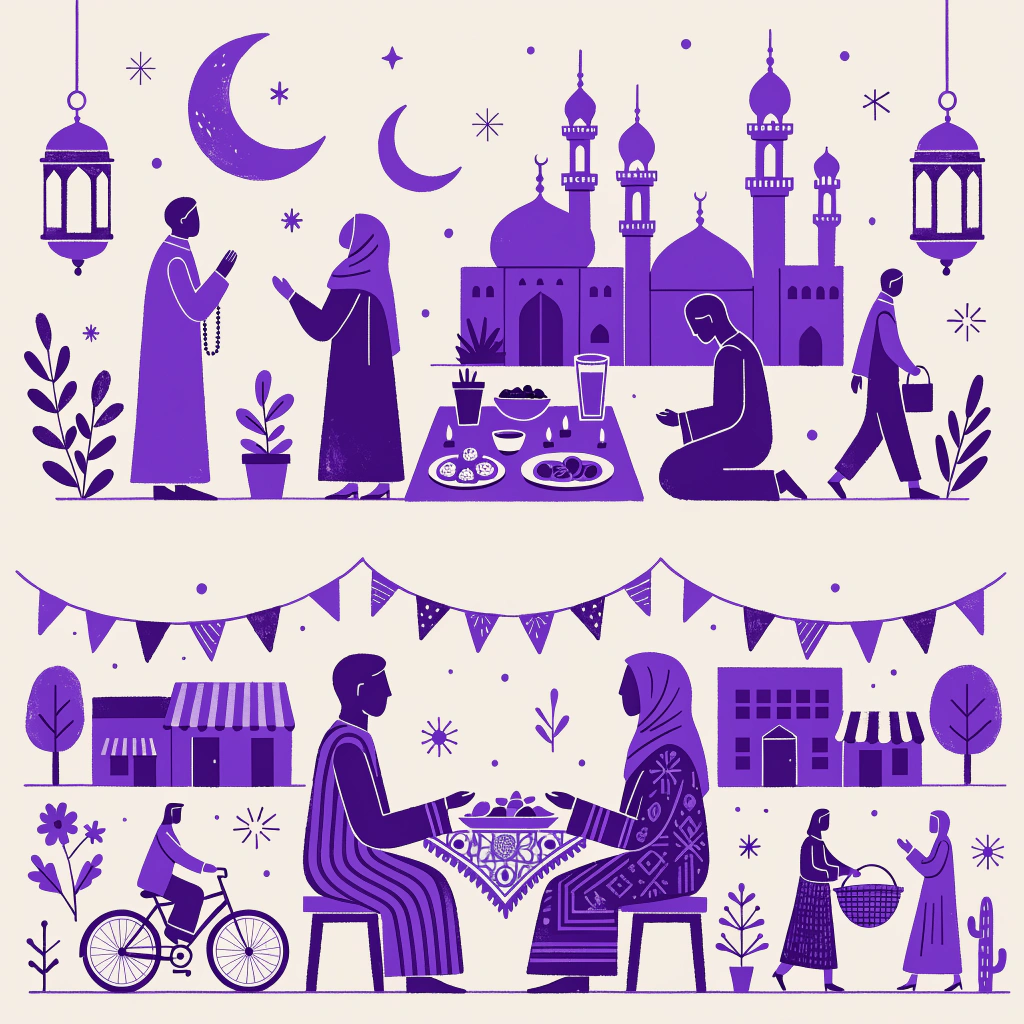
सऊदी अरब में रमजान और ईद उल-फितर
यह सऊदी अरब में रमजान का महीना है। यह इस्लाम का पवित्र महीना है। लोग सुबह से शाम तक खाना और पानी नहीं खाते हैं। इसे 'रोज़ा' कहते हैं। लोग बहुत प्रार्थना करते हैं और दान देते हैं। दिन में शहर शांत रहते हैं। शाम को लोग 'इफ्तार' करते हैं। यह खाने का समय है। परिवार और दोस्त एक साथ खाना खाते हैं। वे खजूर और पानी से रोज़ा खोलते हैं। रमजान के बाद 'ईद उल-फितर' आती है। यह खुशी का त्योहार है। लोग नए कपड़े पहनते हैं और एक-दूसरे से मिलते हैं।
व्याकरण स्पॉटलाइट
पैटर्न: है / हैं (क्रिया 'होना' का वर्तमान काल)
"यह सऊदी अरब में रमजान का महीना है।"
क्रिया 'होना' (to be) के लिए 'है' एकवचन के लिए और 'हैं' बहुवचन के लिए उपयोग होता है। यह बताता है कि कोई चीज़ क्या है या कहाँ है। जैसे, 'वह एक लड़का है' या 'वे दोस्त हैं'।
पैटर्न: नहीं (नकारात्मक वाक्य)
"लोग सुबह से शाम तक खाना और पानी नहीं खाते हैं।"
'नहीं' का उपयोग किसी क्रिया को नकारने के लिए किया जाता है। यह बताता है कि कोई काम नहीं हो रहा है या कोई चीज़ मौजूद नहीं है। 'नहीं' हमेशा क्रिया से पहले आता है।
अपनी समझ जाँचें
10 सवाल · A1 शुरुआती · 1 मुफ्त प्रीव्यू
इस लेख से आपने जो सीखा उसकी जाँच करें। सभी सवालों के जवाब दें और XP कमाएँ!
रमजान में लोग सुबह से शाम तक क्या नहीं करते हैं?
क्या आप क्विज़ समाप्त करना चाहते हैं?
9 और सवाल आपका इंतज़ार कर रहे हैं। पूरा क्विज़ अनलॉक करने और XP कमाने के लिए मुफ्त साइन अप करें!
मुफ़्त साइन अप करोपहले से अकाउंट है? साइन इन करो
बहुत बढ़िया!
अभ्यास जारी रखें!
पहले से पूर्ण — कोई अतिरिक्त XP नहीं
XP कमाने के लिए साइन अप करोसवालों का विवरण
रमजान में लोग सुबह से शाम तक क्या नहीं करते हैं?
आपका जवाब:
सही जवाब: खाना खाते हैं
ईद उल-फितर खुशी का त्योहार है।
आपका जवाब:
सही जवाब: सही
'पानी' का क्या मतलब है?
आपका जवाब:
सही जवाब: जो हम पीते हैं
रमजान के बाद _____ उल-फितर आती है।
आपका जवाब:
सही जवाब: ईद
Ramadan and Eid al-Fitr in Saudi Arabia
Ramadan is the most important month in the Islamic calendar. In Saudi Arabia, life changes a lot during this time. From sunrise to sunset, Muslims do not eat or drink. This is called fasting. The streets are quieter during the day because many people stay at home to pray and rest.
When the sun goes down, the cities become very busy and exciting. Families gather for Iftar, which is the meal to break the fast. They often share dates and water first. People are kinder during Ramadan, and they give money to the poor as an act of charity.
After the month of Ramadan, there is a big festival called Eid al-Fitr. It is more colorful than normal days. People wear their best new clothes and visit their relatives. Children are very happy because they receive gifts and money. Families eat delicious traditional food together. It is a beautiful time of peace and joy for everyone in the country.
व्याकरण स्पॉटलाइट
पैटर्न: Superlative Adjectives
"Ramadan is the most important month in the Islamic calendar."
We use 'the most' with long adjectives to compare one thing to a whole group. It shows that something has the highest quality of that adjective.
पैटर्न: Comparative Adjectives
"The streets are quieter during the day because many people stay at home."
To compare two things or times, we add '-er' to short adjectives. We often use 'than' after the adjective to show the comparison.
अपनी समझ जाँचें
11 सवाल · A2 बिगिनर · 1 मुफ्त प्रीव्यू
इस लेख से आपने जो सीखा उसकी जाँच करें। सभी सवालों के जवाब दें और XP कमाएँ!
What do Muslims do from sunrise to sunset during Ramadan?
क्या आप क्विज़ समाप्त करना चाहते हैं?
10 और सवाल आपका इंतज़ार कर रहे हैं। पूरा क्विज़ अनलॉक करने और XP कमाने के लिए मुफ्त साइन अप करें!
मुफ़्त साइन अप करोपहले से अकाउंट है? साइन इन करो
बहुत बढ़िया!
अभ्यास जारी रखें!
पहले से पूर्ण — कोई अतिरिक्त XP नहीं
XP कमाने के लिए साइन अप करोसवालों का विवरण
What do Muslims do from sunrise to sunset during Ramadan?
आपका जवाब:
सही जवाब: Fast from food and drink
The streets in Saudi Arabia are very busy during the day in Ramadan.
आपका जवाब:
सही जवाब: गलत
What is Iftar?
आपका जवाब:
सही जवाब: The meal to break the fast
Children are happy during Eid because they receive gifts and _____.
आपका जवाब:
सही जवाब: money
Which festival happens after Ramadan ends?
आपका जवाब:
सही जवाब: Eid al-Fitr
The Spiritual Journey of Ramadan and Eid in Saudi Arabia
Ramadan is the most sacred month in the Islamic calendar, and it has always been a significant time for people in Saudi Arabia. During this month, the rhythm of daily life shifts dramatically. From dawn until sunset, Muslims abstain from food and drink to focus on prayer, charity, and self-discipline.
In the daytime, the atmosphere in the cities is uniquely spiritual and quiet. Most shops have changed their working hours, so the streets are often empty during the afternoon. However, the cities burst into life after sunset. The 'Iftar', which is the meal to break the fast, is a communal event. Families, and even strangers, gather to share dates and water. This tradition has been practiced for centuries and remains a core part of the culture.
Charity is also very important during Ramadan. Large amounts of food are donated to those who are in need. Many people believe that this month is an opportunity to become a better person. It is a time when people reflect on their lives and try to help others. This focus on kindness creates a very peaceful environment throughout the country.
When the month of fasting ends, the celebration of Eid al-Fitr begins. This is a joyful holiday that lasts for three days. During Eid, children are given new clothes and small gifts of money, which are called 'Eidiya'. Traditional dishes are prepared by families to share with their neighbors and friends. It is a beautiful time of year where the community is brought together by faith and generosity. Visitors to Saudi Arabia during this period can see how much these traditions have shaped the local identity.
व्याकरण स्पॉटलाइट
पैटर्न: Present Perfect
"Most shops have changed their working hours."
The present perfect is formed with 'have/has' and the past participle. It is used here to describe a recent change that affects the present situation.
पैटर्न: Passive Voice
"Traditional dishes are prepared by families."
The passive voice is formed with 'be' + past participle. It is used when the action or the object is more important than the person doing the action.
अपनी समझ जाँचें
11 सवाल · B1 मध्यम · 1 मुफ्त प्रीव्यू
इस लेख से आपने जो सीखा उसकी जाँच करें। सभी सवालों के जवाब दें और XP कमाएँ!
What happens to the rhythm of life in Saudi Arabia during Ramadan?
क्या आप क्विज़ समाप्त करना चाहते हैं?
10 और सवाल आपका इंतज़ार कर रहे हैं। पूरा क्विज़ अनलॉक करने और XP कमाने के लिए मुफ्त साइन अप करें!
मुफ़्त साइन अप करोपहले से अकाउंट है? साइन इन करो
बहुत बढ़िया!
अभ्यास जारी रखें!
पहले से पूर्ण — कोई अतिरिक्त XP नहीं
XP कमाने के लिए साइन अप करोसवालों का विवरण
What happens to the rhythm of life in Saudi Arabia during Ramadan?
आपका जवाब:
सही जवाब: It changes significantly.
The 'Iftar' is a private meal that people only eat alone.
आपका जवाब:
सही जवाब: गलत
What does 'communal' mean?
आपका जवाब:
सही जवाब: Shared by a group
During Eid, children are given new clothes and _____ called 'Eidiya'.
आपका जवाब:
सही जवाब: money
Which grammar structure is used in: 'This tradition has been practiced for centuries'?
आपका जवाब:
सही जवाब: Present perfect passive
सऊदी अरब में रमज़ान और ईद अल-फ़ित्र: एक आध्यात्मिक और सामुदायिक अनुभव
इस्लामी कैलेंडर में रमज़ान का महीना सबसे पवित्र माना जाता है, और इस दौरान सऊदी अरब में जीवन की लय नाटकीय रूप से बदल जाती है। यह वह समय होता है जब मुसलमान सूर्योदय से सूर्यास्त तक भोजन और पेय पदार्थों से परहेज करते हैं, अपना ध्यान प्रार्थना, दान और आत्मसंयम पर केंद्रित करते हैं। सऊदी अरब में, वातावरण विशेष रूप से आध्यात्मिक होता है; दिन के समय शहर शांत रहते हैं और सूर्यास्त के बाद जीवन से भर उठते हैं। यह परिवर्तन न केवल धार्मिक निष्ठा का प्रतीक है, बल्कि एक गहरी सामुदायिक भावना का भी परिचायक है।
इफ़्तार, यानी रोज़ा तोड़ने का भोजन, एक महत्वपूर्ण सामुदायिक आयोजन है जहाँ परिवार और यहां तक कि अजनबी भी खजूर और पानी साझा करने के लिए एक साथ आते हैं। यह सामूहिकता केवल इफ़्तार तक सीमित नहीं है, बल्कि तरावीह की विशेष रात्रिकालीन प्रार्थनाओं में भी परिलक्षित होती है, जो मस्जिदों को नमाज़ियों से भर देती हैं। रमज़ान के दौरान, दान और परोपकार के कार्य बढ़ जाते हैं, क्योंकि मुसलमान ज़कात और सदक़ा के माध्यम से ज़रूरतमंदों की मदद करने का प्रयास करते हैं। यह महीने भर चलने वाला अनुष्ठान आत्म-शुद्धि और ईश्वर के प्रति समर्पण का प्रतीक है।
रमज़ान के अंत में, ईद अल-फ़ित्र का त्योहार आता है, जिसे 'रोज़ा तोड़ने का त्योहार' भी कहा जाता है। यह खुशी, कृतज्ञता और उत्सव का अवसर होता है। ईद का दिन सुबह की नमाज़ के साथ शुरू होता है, जिसके बाद लोग नए कपड़े पहनते हैं, स्वादिष्ट भोजन तैयार करते हैं और परिवार तथा दोस्तों के साथ उपहारों का आदान-प्रदान करते हैं। बच्चे विशेष रूप से इस दिन का आनंद लेते हैं, क्योंकि उन्हें अक्सर 'ईदी' (नकद उपहार) प्राप्त होती है। सऊदी अरब में, ईद अल-फ़ित्र एक भव्य आयोजन होता है, जहाँ सार्वजनिक स्थानों और घरों को सजाया जाता है, और लोग मिल-जुलकर इस पवित्र महीने के सफल समापन का जश्न मनाते हैं।
यह त्योहार मुसलमानों के बीच एकजुटता और भाईचारे की भावना को सुदृढ़ करता है। विभिन्न सामाजिक और आर्थिक पृष्ठभूमि के लोग एक साथ मिलकर इस आध्यात्मिक यात्रा के समापन का जश्न मनाते हैं। वस्तुतः, रमज़ान और ईद अल-फ़ित्र सऊदी अरब में केवल धार्मिक अनुष्ठान मात्र नहीं हैं; वे सामाजिक ताने-बाने के अभिन्न अंग हैं जो समुदाय को एक साथ बांधते हैं और साझा मूल्यों तथा परंपराओं को मजबूत करते हैं। इस प्रकार, ये पर्व न केवल व्यक्तिगत श्रद्धा का प्रदर्शन करते हैं, बल्कि एक सामूहिक पहचान और सांस्कृतिक समृद्धि को भी दर्शाते हैं।
व्याकरण स्पॉटलाइट
पैटर्न: संयुक्त क्रियाएँ (Compound Verbs)
"जीवन की लय नाटकीय रूप से बदल जाती है।"
संयुक्त क्रियाएँ दो या दो से अधिक क्रियाओं के मेल से बनती हैं, जहाँ पहली मुख्य क्रिया होती है और दूसरी सहायक क्रिया। ये क्रियाएँ वाक्य में क्रिया के अर्थ में विशिष्टता, पूर्णता या निरंतरता जोड़ती हैं। जैसे 'बदल जाना' (to change completely) में 'जाना' पूर्णता को दर्शाता है।
पैटर्न: के दौरान (के साथ संबंधबोधक)
"इस दौरान सऊदी अरब में जीवन की लय नाटकीय रूप से बदल जाती है।"
'के दौरान' एक संबंधबोधक है जिसका उपयोग किसी निश्चित समय अवधि के भीतर किसी घटना के होने को दर्शाने के लिए किया जाता है। यह 'during' या 'while' के अर्थ में प्रयुक्त होता है। इसका प्रयोग अक्सर समय-संबंधी संज्ञाओं के बाद होता है।
पैटर्न: न केवल... बल्कि... भी (Correlative Conjunctions)
"यह परिवर्तन न केवल धार्मिक निष्ठा का प्रतीक है, बल्कि एक गहरी सामुदायिक भावना का भी परिचायक है।"
यह संरचना दो समान विचारों या तत्वों को जोड़ने के लिए उपयोग की जाती है, जहाँ दूसरा तत्व पहले की तुलना में अधिक महत्वपूर्ण या अतिरिक्त होता है। 'न केवल... बल्कि... भी' का अर्थ 'not only... but also...' होता है, जो दो कथनों को एक साथ प्रस्तुत करता है।
अपनी समझ जाँचें
11 सवाल · B2 अपर इंटरमीडिएट · 1 मुफ्त प्रीव्यू
इस लेख से आपने जो सीखा उसकी जाँच करें। सभी सवालों के जवाब दें और XP कमाएँ!
रमज़ान के दौरान मुसलमान सूर्योदय से सूर्यास्त तक किस चीज़ से परहेज करते हैं?
क्या आप क्विज़ समाप्त करना चाहते हैं?
10 और सवाल आपका इंतज़ार कर रहे हैं। पूरा क्विज़ अनलॉक करने और XP कमाने के लिए मुफ्त साइन अप करें!
मुफ़्त साइन अप करोपहले से अकाउंट है? साइन इन करो
बहुत बढ़िया!
अभ्यास जारी रखें!
पहले से पूर्ण — कोई अतिरिक्त XP नहीं
XP कमाने के लिए साइन अप करोसवालों का विवरण
रमज़ान के दौरान मुसलमान सूर्योदय से सूर्यास्त तक किस चीज़ से परहेज करते हैं?
आपका जवाब:
सही जवाब: भोजन और पेय पदार्थों से
इफ़्तार केवल परिवार के सदस्यों के लिए एक निजी आयोजन होता है।
आपका जवाब:
सही जवाब: गलत
'कृतज्ञता' शब्द का अर्थ क्या है?
आपका जवाब:
सही जवाब: धन्यवाद का भाव
रमज़ान के अंत में, _____ का त्योहार आता है, जिसे 'रोज़ा तोड़ने का त्योहार' भी कहा जाता है।
आपका जवाब:
सही जवाब: ईद अल-फ़ित्र
सऊदी अरब में रमज़ान के दौरान दिन के समय शहर कैसे होते हैं?
आपका जवाब:
सही जवाब: शांत
The Metamorphosis of the Kingdom: Navigating the Spiritual and Social Fabric of Ramadan in Saudi Arabia
Seldom does a geographical entity undergo such a profound temporal shift as Saudi Arabia during the month of Ramadan. As the holiest period in the Islamic calendar, Ramadan necessitates a total reconfiguration of the circadian rhythm for millions. The intensification of spiritual devotion is mirrored by a significant deceleration in the pace of commerce during daylight hours. This daytime austerity, characterized by the practice of abstinence from all sustenance, creates a hushed atmosphere across the Kingdom's urban centers. However, to view this period merely as a time of withdrawal would be a reductionist perspective; rather, it is a period of internal recalibration and communal reinforcement.
Not only does the sun's descent signal the end of the daily fast, but it also triggers a remarkable nocturnal vibrancy. The streets of Riyadh and Jeddah, formerly quiet under the scorching sun, transform into bustling hubs of social reciprocity. It is the communal breaking of the fast, known as Iftar, that truly encapsulates the spirit of the month. Families, friends, and even complete strangers congregate to share dates and water, a tradition that transcends socioeconomic boundaries and fosters a pervasive sense of altruism. The sheer scale of these gatherings reflects a deep-seated cultural commitment to hospitality, where the individual's needs are subsumed by the welfare of the collective.
As the month progresses, the spiritual atmosphere reaches a crescendo during the final ten nights, leading toward the anticipation of Eid al-Fitr. This transition is not merely a return to normalcy but a celebratory culmination of a month-long journey of self-discipline. What defines the Saudi experience of Eid is the juxtaposition of traditional customs with modern festivities. The ephemeral nature of the month’s quietude gives way to grand celebrations, where the exchange of gifts and the wearing of new clothes symbolize a spiritual and social renewal. This cyclical pattern of restraint followed by celebration provides a unique insight into the resilience of tradition within a rapidly modernizing state. Despite the influx of global influences, the core tenets of Ramadan and Eid remain the bedrock of Saudi social cohesion, proving that even in a high-tech era, the values of faith and community continue to dictate the rhythm of life.
व्याकरण स्पॉटलाइट
पैटर्न: Inversion with negative/restrictive adverbs
"Seldom does a geographical entity undergo such a profound temporal shift as Saudi Arabia during the month of Ramadan."
When 'seldom' or other restrictive adverbs start a sentence, the auxiliary verb comes before the subject. This is used for formal emphasis and to vary sentence structure.
पैटर्न: Cleft Sentences
"It is the communal breaking of the fast, known as Iftar, that truly encapsulates the spirit of the month."
Cleft sentences (It + is/was + [noun phrase] + that/who) are used to focus on specific information, highlighting 'Iftar' as the most important element of the statement.
पैटर्न: Nominalisation
"The intensification of spiritual devotion is mirrored by a significant deceleration in the pace of commerce during daylight hours."
Using nouns (intensification, deceleration) instead of verbs (intensify, decelerate) creates a more academic, formal tone and allows for denser information delivery.
अपनी समझ जाँचें
12 सवाल · C1 उन्नत · 1 मुफ्त प्रीव्यू
इस लेख से आपने जो सीखा उसकी जाँच करें। सभी सवालों के जवाब दें और XP कमाएँ!
What is the primary focus of the first paragraph regarding the shift in Saudi Arabia?
क्या आप क्विज़ समाप्त करना चाहते हैं?
11 और सवाल आपका इंतज़ार कर रहे हैं। पूरा क्विज़ अनलॉक करने और XP कमाने के लिए मुफ्त साइन अप करें!
मुफ़्त साइन अप करोपहले से अकाउंट है? साइन इन करो
बहुत बढ़िया!
अभ्यास जारी रखें!
पहले से पूर्ण — कोई अतिरिक्त XP नहीं
XP कमाने के लिए साइन अप करोसवालों का विवरण
What is the primary focus of the first paragraph regarding the shift in Saudi Arabia?
आपका जवाब:
सही जवाब: The change in the daily rhythm and spiritual focus.
The author argues that the quietness of the day should be seen as a form of social withdrawal.
आपका जवाब:
सही जवाब: गलत
Which word describes the state of lasting for a very short time?
आपका जवाब:
सही जवाब: Ephemeral
The streets transform into hubs of social _____ after sunset.
आपका जवाब:
सही जवाब: reciprocity
According to the text, what does Iftar represent in Saudi society?
आपका जवाब:
सही जवाब: A communal act that transcends socioeconomic levels.
The article suggests that modern global influences have completely replaced traditional Saudi values.
आपका जवाब:
सही जवाब: गलत
The Socio-Spiritual Dialectic: Navigating Ramadan and Eid al-Fitr in the Saudi Context
The observance of Ramadan within the Kingdom of Saudi Arabia transcends mere religious adherence, manifesting instead as a profound reconfiguration of the socio-temporal fabric. Were one to traverse the urban landscapes of Riyadh or Jeddah during this sacred hiatus, one would encounter a diurnal quiescence that borders on the ethereal. This stillness, however, is but a prelude to the nocturnal resurgence that characterizes the month. The fast, or Sawm, serves as a catalyst for a collective introspection, necessitating a temporary departure from the mundane preoccupations of material existence. Not only does the month facilitate spiritual growth, but it also fosters a unique sense of national identity through shared sacrifice.
Central to this experience is the concept of Iftar. Far from being a mere nutritional replenishment, it serves as a cornerstone of communal solidarity. It is imperative that the observer acknowledge the egalitarian spirit pervading these gatherings; whether in the opulent halls of the elite or the modest confines of the disenfranchised, the breaking of bread—or more traditionally, the consumption of dates—acts as a leveling mechanism. Should the observer scrutinize the underlying socio-economic dynamics, they might discern a deliberate subversion of hierarchy in favor of a unified spiritual identity. This period represents an ontological shift, where the needs of the soul are prioritized over the demands of the body.
Furthermore, the philanthropic impulse, or Zakat, reaches its zenith during this period. It is not merely a matter of obligation but an ontological commitment to the welfare of the 'Ummah'. The generosity displayed is often so pervasive that it challenges conventional economic theories of rational self-interest. One might argue that the Saudi context provides a unique laboratory for observing the intersection of traditional piety and modern urbanity. The city becomes a living organism, breathing in rhythm with the call to prayer, and exhaling the tensions of the previous year.
As the month wanes, the anticipation of Eid al-Fitr begins to permeate the atmosphere. This transition is marked by a shift from the contemplative to the celebratory. It is as though the collective psyche, having been purified by the rigors of abstinence, seeks a jubilant outlet. The festivities are characterized by a lavish display of hospitality, yet they remain anchored in the spiritual gains of the preceding weeks. To suggest that Eid is merely a hedonistic release would be to overlook the profound sense of gratitude and renewal that underpins the celebration. The intricate tapestry of social visits and the exchange of gifts are inextricably linked to the previous month's discipline.
In essence, the cycle of Ramadan and Eid in Saudi Arabia represents a sophisticated negotiation between the temporal and the transcendent, ensuring that the spiritual remains inextricably linked to the social. The experience is both a personal journey and a collective affirmation, a time when the boundaries between the self and the community are blurred in the pursuit of a higher purpose. Through this annual metamorphosis, the Kingdom reaffirms its cultural heritage while navigating the complexities of the modern world, proving that tradition and progress are not mutually exclusive but are, in fact, complementary forces.
व्याकरण स्पॉटलाइट
पैटर्न: Subjunctive Mood in Hypothetical Conditionals
"Were one to traverse the urban landscapes of Riyadh or Jeddah during this sacred hiatus, one would encounter a diurnal quiescence."
The 'were' subjunctive is used here to express a hypothetical or formal conditional situation. It replaces 'if one were to traverse' to achieve a more academic and sophisticated tone.
पैटर्न: Negative Inversion
"Not only does the month facilitate spiritual growth, but it also fosters a unique sense of national identity."
This structure places a negative or restrictive adverbial at the start of the sentence, requiring the auxiliary verb to come before the subject. It is used for rhetorical emphasis.
पैटर्न: Academic Hedging with Modals
"One might argue that the Saudi context provides a unique laboratory for observing the intersection of traditional piety and modern urbanity."
Hedging is a crucial C2 skill used to avoid over-generalization. Using 'might argue' instead of 'argues' acknowledges that the statement is an interpretation rather than an absolute fact.
अपनी समझ जाँचें
12 सवाल · C2 महारत · 1 मुफ्त प्रीव्यू
इस लेख से आपने जो सीखा उसकी जाँच करें। सभी सवालों के जवाब दें और XP कमाएँ!
What is the primary focus of the author's analysis regarding Ramadan in Saudi Arabia?
क्या आप क्विज़ समाप्त करना चाहते हैं?
11 और सवाल आपका इंतज़ार कर रहे हैं। पूरा क्विज़ अनलॉक करने और XP कमाने के लिए मुफ्त साइन अप करें!
मुफ़्त साइन अप करोपहले से अकाउंट है? साइन इन करो
बहुत बढ़िया!
अभ्यास जारी रखें!
पहले से पूर्ण — कोई अतिरिक्त XP नहीं
XP कमाने के लिए साइन अप करोसवालों का विवरण
What is the primary focus of the author's analysis regarding Ramadan in Saudi Arabia?
आपका जवाब:
सही जवाब: The profound socio-temporal and spiritual reconfiguration of life.
The author suggests that the communal nature of Iftar helps to dissolve social hierarchies temporarily.
आपका जवाब:
सही जवाब: सही
Which word best describes a state of inactivity or stillness as mentioned in the text?
आपका जवाब:
सही जवाब: Quiescence
The fast serves as a _____ for collective introspection, necessitating a departure from material preoccupations.
आपका जवाब:
सही जवाब: catalyst
How does the author characterize the transition from Ramadan to Eid al-Fitr?
आपका जवाब:
सही जवाब: As a move from contemplative discipline to a jubilant yet grounded celebration.
According to the article, the philanthropic impulse during Ramadan is driven solely by rational self-interest.
आपका जवाब:
सही जवाब: गलत

