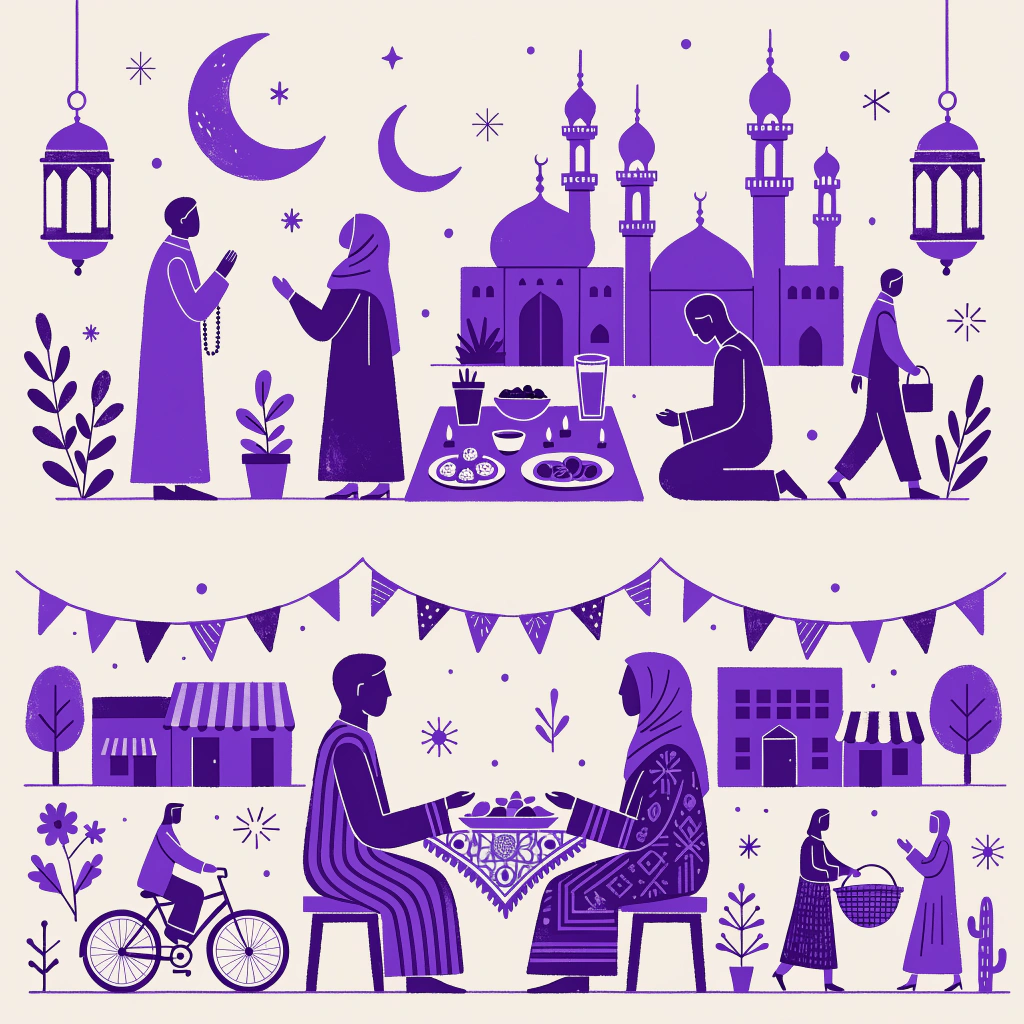
Ramadan and Eid in Saudi Arabia
Ramadan is a special month in Saudi Arabia. It is a holy time for Muslims. During the day, people do not eat or drink. This is called fasting. People pray and help poor people. The cities are very quiet in the morning.
At sunset, families eat a meal. This meal is Iftar. They eat dates and drink water first. Then they eat big meals together. After thirty days, it is Eid al-Fitr. This is a big festival. People wear new clothes and visit friends. Children get money or gifts. Everyone is very happy.
Point grammaire
Structure: Present Simple (Negative)
"People do not eat or drink."
We use 'do not' before a verb to make a negative sentence in the present simple. This is used for facts and routines.
Structure: Present Simple (To Be)
"It is a holy time for Muslims."
We use the verb 'to be' (am, is, are) to describe things. We use 'is' for singular subjects like 'it' or 'Ramadan'.
Teste ta compréhension
10 questions · A1 Débutant · 1 aperçu gratuit
Teste ce que tu as appris dans cet article. Réponds à toutes les questions pour gagner des XP !
When do families eat Iftar?
Tu veux terminer le quiz ?
9 questions supplémentaires t'attendent. Inscris-toi gratuitement pour débloquer le quiz complet et gagner des XP !
S'inscrire gratuitementTu as dj un compte ? Connexion
Bien joué !
Continue à pratiquer !
Déjà terminé — pas de XP supplémentaire
Inscris-toi pour gagner des XPDétail des questions
When do families eat Iftar?
Ta réponse:
Bonne réponse: At sunset
People eat and drink during the day in Ramadan.
Ta réponse:
Bonne réponse: Faux
What does 'gifts' mean?
Ta réponse:
Bonne réponse: Things you give to someone
After Ramadan, it is _____ al-Fitr.
Ta réponse:
Bonne réponse: Eid
Ramadan and Eid al-Fitr in Saudi Arabia
Ramadan is the most important month in the Islamic calendar. In Saudi Arabia, life changes a lot during this time. From sunrise to sunset, Muslims do not eat or drink. This is called fasting. The streets are quieter during the day because many people stay at home to pray and rest.
When the sun goes down, the cities become very busy and exciting. Families gather for Iftar, which is the meal to break the fast. They often share dates and water first. People are kinder during Ramadan, and they give money to the poor as an act of charity.
After the month of Ramadan, there is a big festival called Eid al-Fitr. It is more colorful than normal days. People wear their best new clothes and visit their relatives. Children are very happy because they receive gifts and money. Families eat delicious traditional food together. It is a beautiful time of peace and joy for everyone in the country.
Point grammaire
Structure: Superlative Adjectives
"Ramadan is the most important month in the Islamic calendar."
We use 'the most' with long adjectives to compare one thing to a whole group. It shows that something has the highest quality of that adjective.
Structure: Comparative Adjectives
"The streets are quieter during the day because many people stay at home."
To compare two things or times, we add '-er' to short adjectives. We often use 'than' after the adjective to show the comparison.
Teste ta compréhension
11 questions · A2 mentaire · 1 aperçu gratuit
Teste ce que tu as appris dans cet article. Réponds à toutes les questions pour gagner des XP !
What do Muslims do from sunrise to sunset during Ramadan?
Tu veux terminer le quiz ?
10 questions supplémentaires t'attendent. Inscris-toi gratuitement pour débloquer le quiz complet et gagner des XP !
S'inscrire gratuitementTu as dj un compte ? Connexion
Bien joué !
Continue à pratiquer !
Déjà terminé — pas de XP supplémentaire
Inscris-toi pour gagner des XPDétail des questions
What do Muslims do from sunrise to sunset during Ramadan?
Ta réponse:
Bonne réponse: Fast from food and drink
The streets in Saudi Arabia are very busy during the day in Ramadan.
Ta réponse:
Bonne réponse: Faux
What is Iftar?
Ta réponse:
Bonne réponse: The meal to break the fast
Children are happy during Eid because they receive gifts and _____.
Ta réponse:
Bonne réponse: money
Which festival happens after Ramadan ends?
Ta réponse:
Bonne réponse: Eid al-Fitr
The Spiritual Journey of Ramadan and Eid in Saudi Arabia
Ramadan is the most sacred month in the Islamic calendar, and it has always been a significant time for people in Saudi Arabia. During this month, the rhythm of daily life shifts dramatically. From dawn until sunset, Muslims abstain from food and drink to focus on prayer, charity, and self-discipline.
In the daytime, the atmosphere in the cities is uniquely spiritual and quiet. Most shops have changed their working hours, so the streets are often empty during the afternoon. However, the cities burst into life after sunset. The 'Iftar', which is the meal to break the fast, is a communal event. Families, and even strangers, gather to share dates and water. This tradition has been practiced for centuries and remains a core part of the culture.
Charity is also very important during Ramadan. Large amounts of food are donated to those who are in need. Many people believe that this month is an opportunity to become a better person. It is a time when people reflect on their lives and try to help others. This focus on kindness creates a very peaceful environment throughout the country.
When the month of fasting ends, the celebration of Eid al-Fitr begins. This is a joyful holiday that lasts for three days. During Eid, children are given new clothes and small gifts of money, which are called 'Eidiya'. Traditional dishes are prepared by families to share with their neighbors and friends. It is a beautiful time of year where the community is brought together by faith and generosity. Visitors to Saudi Arabia during this period can see how much these traditions have shaped the local identity.
Point grammaire
Structure: Present Perfect
"Most shops have changed their working hours."
The present perfect is formed with 'have/has' and the past participle. It is used here to describe a recent change that affects the present situation.
Structure: Passive Voice
"Traditional dishes are prepared by families."
The passive voice is formed with 'be' + past participle. It is used when the action or the object is more important than the person doing the action.
Teste ta compréhension
11 questions · B1 Intermédiaire · 1 aperçu gratuit
Teste ce que tu as appris dans cet article. Réponds à toutes les questions pour gagner des XP !
What happens to the rhythm of life in Saudi Arabia during Ramadan?
Tu veux terminer le quiz ?
10 questions supplémentaires t'attendent. Inscris-toi gratuitement pour débloquer le quiz complet et gagner des XP !
S'inscrire gratuitementTu as dj un compte ? Connexion
Bien joué !
Continue à pratiquer !
Déjà terminé — pas de XP supplémentaire
Inscris-toi pour gagner des XPDétail des questions
What happens to the rhythm of life in Saudi Arabia during Ramadan?
Ta réponse:
Bonne réponse: It changes significantly.
The 'Iftar' is a private meal that people only eat alone.
Ta réponse:
Bonne réponse: Faux
What does 'communal' mean?
Ta réponse:
Bonne réponse: Shared by a group
During Eid, children are given new clothes and _____ called 'Eidiya'.
Ta réponse:
Bonne réponse: money
Which grammar structure is used in: 'This tradition has been practiced for centuries'?
Ta réponse:
Bonne réponse: Present perfect passive
The Spiritual and Social Transformation: Ramadan and Eid al-Fitr in Saudi Arabia
Ramadan in Saudi Arabia represents a profound cultural and spiritual transformation that fundamentally alters the rhythm of daily existence. For thirty days, the kingdom undergoes a shift where the conventional boundaries of time seem to dissolve. From dawn until the setting of the sun, Muslims abstain from all forms of nourishment and hydration, a practice intended to cultivate self-discipline and empathy for the less fortunate. Consequently, the urban landscape adopts a contemplative stillness during the daylight hours, as businesses adjust their operating schedules to accommodate those observing the fast.
However, as the sun begins to descend, the atmosphere undergoes a remarkable metamorphosis. The 'Iftar', which marks the conclusion of the daily fast, is rarely a solitary affair. Instead, it is a communal event characterized by immense hospitality. In Saudi Arabia, it is traditional for families to open their homes, and for mosques to provide vast quantities of food for the public. This philanthropic spirit is not merely a social custom but is deeply rooted in the spiritual significance of the month. People share dates and water, followed by a variety of traditional dishes, fostering a sense of unity that transcends social status.
Furthermore, the spiritual devotion of Ramadan culminates in the joyous celebration of Eid al-Fitr. This festival, which lasts for several days, is characterized by widespread anticipation and communal prayer. It serves as a time for family reunions, where children are often gifted new clothes and money, known as 'Eidia'. The social cohesion observed during this period is a testament to the enduring strength of Saudi traditions in an increasingly modern world.
In evaluation, the observance of Ramadan and Eid al-Fitr in Saudi Arabia provides a unique insight into the nation’s identity. While the kingdom continues to modernize rapidly, these religious practices ensure that the core values of generosity and community remain central to the social fabric. The period is not simply a religious obligation but a collective experience that reinforces the bonds between individuals and their heritage. By the time the crescent moon for the next month is sighted, the populace has undergone a period of reflection that prepares them for the year ahead.
Point grammaire
Structure: Passive Voice for Purpose
"a practice intended to cultivate self-discipline and empathy for the less fortunate."
The passive participle 'intended' is used here to describe the purpose of the practice without needing to mention the person who intended it. This is common in formal writing to focus on the action or concept.
Structure: Relative Clauses with 'Which'
"The 'Iftar', which marks the conclusion of the daily fast, is rarely a solitary affair."
This is a non-defining relative clause used to provide extra information about the subject. It is separated by commas and adds descriptive detail to the noun 'Iftar'.
Structure: Present Perfect for Completed Change
"the populace has undergone a period of reflection that prepares them for the year ahead."
The present perfect 'has undergone' is used to show a past action that has a strong connection to or result in the present moment.
Teste ta compréhension
11 questions · B2 Intermédiaire supérieur · 1 aperçu gratuit
Teste ce que tu as appris dans cet article. Réponds à toutes les questions pour gagner des XP !
What is the primary purpose of abstaining from food and drink during Ramadan according to the text?
Tu veux terminer le quiz ?
10 questions supplémentaires t'attendent. Inscris-toi gratuitement pour débloquer le quiz complet et gagner des XP !
S'inscrire gratuitementTu as dj un compte ? Connexion
Bien joué !
Continue à pratiquer !
Déjà terminé — pas de XP supplémentaire
Inscris-toi pour gagner des XPDétail des questions
What is the primary purpose of abstaining from food and drink during Ramadan according to the text?
Ta réponse:
Bonne réponse: To develop self-discipline and empathy
The article suggests that Iftar in Saudi Arabia is typically a private, individual meal.
Ta réponse:
Bonne réponse: Faux
What does the word 'philanthropic' mean in the context of the article?
Ta réponse:
Bonne réponse: Promoting the welfare of others through charity
The festival of Eid al-Fitr is characterized by widespread _____ and communal prayer.
Ta réponse:
Bonne réponse: anticipation
What does the author conclude about Saudi traditions in the modern world?
Ta réponse:
Bonne réponse: They maintain their strength and reinforce social bonds
Ramadan et Aïd al-Fitr en Arabie Saoudite : Une Immersion Spirituelle et Culturelle
Le Ramadan, mois sacré par excellence du calendrier islamique, opère une métamorphose profonde du rythme de vie en Arabie Saoudite. Loin d'être un simple jeûne, il constitue une période d'introspection intense, de dévotion accrue et de solidarité communautaire, dont l'impact se ressent à tous les niveaux de la société. C'est en effet une véritable réorientation des priorités qui s'observe, où les préoccupations matérielles cèdent le pas à la quête spirituelle.
Dès l'aube, et ce jusqu'au coucher du soleil, les musulmans s'abstiennent de toute nourriture et boisson. L'accent est mis sur la prière, la récitation du Coran, la charité (Zakat) et la maîtrise de soi. Ce n'est pas tant une privation qu'une discipline volontaire, visant à purifier l'âme et à renforcer la connexion avec le divin. L'atmosphère, singulièrement spirituelle, confère aux villes saoudiennes une dichotomie fascinante : elles s'apaisent le jour, pour mieux s'animer d'une effervescence joyeuse et conviviale une fois la nuit tombée.
La rupture du jeûne, ou Iftar, est un moment emblématique de partage et de convivialité. Ce n'est pas seulement un repas, mais un événement social majeur où familles, amis et même parfois des étrangers se rassemblent. Traditionnellement, l'Iftar débute par des dattes et de l'eau, suivant la Sunna du Prophète Muhammad, avant de laisser place à un festin de plats variés et savoureux. La générosité est de mise, et il n'est pas rare de voir des tables dressées dans les rues ou les mosquées pour accueillir les passants et les nécessiteux. L'hospitalité, valeur cardinale dans la culture saoudienne, atteint son paroxysme durant ce mois béni.
Au-delà de l'Iftar, les nuits de Ramadan sont dédiées aux prières spéciales, notamment les Tarawih, effectuées en congrégation dans les mosquées, lesquelles grouillent de fidèles jusqu'à tard dans la nuit. L'intensité de la foi est palpable, et l'architecture grandiose des lieux de culte, souvent illuminés de mille feux, ne fait qu'accentuer cette magnificence. L'on assiste alors à une véritable symbiose entre spiritualité, tradition et vie sociale, qui façonne l'identité collective et individuelle.
L'apogée de ce mois sacré est l'Aïd al-Fitr, la Fête de la rupture du jeûne, qui marque la fin du Ramadan. C'est un jour de célébration exubérante, de gratitude et de réjouissances. Les familles se réunissent pour des prières spéciales de l'Aïd le matin, revêtant leurs plus beaux habits. S'ensuivent des visites aux proches, des échanges de cadeaux, en particulier pour les enfants, et des banquets somptueux. La Zakat al-Fitr, une aumône obligatoire, est versée avant la prière de l'Aïd, assurant ainsi que les moins fortunés puissent également participer aux festivités. C'est l'occasion d'un renouveau, d'un pardon mutuel et d'un renforcement des liens sociaux.
En somme, le Ramadan et l'Aïd al-Fitr en Arabie Saoudite ne sont pas de simples observances religieuses ; ils incarnent un mode de vie, une tradition profondément enracinée qui transcende les générations. Ce sont des périodes où la foi se manifeste avec une ferveur particulière, où la communauté se resserre et où les valeurs d'humilité, de partage et de compassion sont mises à l'honneur. La singularité de cette expérience réside précisément dans cette capacité à transformer le quotidien en une célébration continue de la spiritualité et de l'unité.
Point grammaire
Structure: La nominalisation
"Loin d'être un simple jeûne, il constitue une période d'introspection intense, de dévotion accrue et de solidarité communautaire, dont l'impact se ressent à tous les niveaux de la société."
La nominalisation consiste à transformer un verbe ou un adjectif en nom pour exprimer une idée de manière plus concise et formelle. Ici, 'introspection', 'dévotion' et 'solidarité' sont des noms abstraits qui permettent de condenser des actions ou des qualités en concepts. Elle est fréquente dans les textes formels et académiques pour sa densité sémantique.
Structure: La phrase clivée (C'est... qui/que)
"C'est en effet une véritable réorientation des priorités qui s'observe, où les préoccupations matérielles cèdent le pas à la quête spirituelle."
La phrase clivée (ou emphatique) est utilisée pour mettre en relief un élément de la phrase. Elle se construit généralement avec 'C'est... qui' pour un sujet ou 'C'est... que' pour un complément. Dans l'exemple, 'une véritable réorientation des priorités' est mis en évidence comme étant l'objet de l'observation, renforçant l'importance de ce changement.
Structure: L'inversion du sujet (dans une subordonnée relative ou après certains adverbes)
"L'atmosphère, singulièrement spirituelle, confère aux villes saoudiennes une dichotomie fascinante : elles s'apaisent le jour, pour mieux s'animer d'une effervescence joyeuse et conviviale une fois la nuit tombée."
Bien que l'exemple donné ne soit pas une inversion sujet-verbe classique pour une question, il illustre une structure de phrase complexe et élégante typique du C1, où la subordonnée temporelle 'une fois la nuit tombée' est placée de manière à créer un effet stylistique. L'inversion est souvent utilisée dans les questions directes ou après certains adverbes (Ex: 'Peut-être viendra-t-il.') pour un style plus soutenu.
Teste ta compréhension
12 questions · C1 Avancé · 1 aperçu gratuit
Teste ce que tu as appris dans cet article. Réponds à toutes les questions pour gagner des XP !
Quel est l'objectif principal du Ramadan, au-delà de l'abstinence de nourriture et de boisson ?
Tu veux terminer le quiz ?
11 questions supplémentaires t'attendent. Inscris-toi gratuitement pour débloquer le quiz complet et gagner des XP !
S'inscrire gratuitementTu as dj un compte ? Connexion
Bien joué !
Continue à pratiquer !
Déjà terminé — pas de XP supplémentaire
Inscris-toi pour gagner des XPDétail des questions
Quel est l'objectif principal du Ramadan, au-delà de l'abstinence de nourriture et de boisson ?
Ta réponse:
Bonne réponse: Renforcer la connexion spirituelle et la discipline personnelle.
Pendant le Ramadan en Arabie Saoudite, les villes sont plus animées le jour que la nuit.
Ta réponse:
Bonne réponse: Faux
Que signifie le mot 'effervescence' dans le contexte de l'article ?
Ta réponse:
Bonne réponse: Une agitation joyeuse et animée.
L'Iftar commence traditionnellement par la consommation de dattes et d'_____.
Ta réponse:
Bonne réponse: eau
Quelle est l'une des valeurs cardinales de la culture saoudienne qui atteint son paroxysme pendant le Ramadan ?
Ta réponse:
Bonne réponse: La générosité et l'hospitalité.
L'Aïd al-Fitr est un jour de tristesse marquant la fin du jeûne.
Ta réponse:
Bonne réponse: Faux
The Socio-Spiritual Dialectic: Navigating Ramadan and Eid al-Fitr in the Saudi Context
The observance of Ramadan within the Kingdom of Saudi Arabia transcends mere religious adherence, manifesting instead as a profound reconfiguration of the socio-temporal fabric. Were one to traverse the urban landscapes of Riyadh or Jeddah during this sacred hiatus, one would encounter a diurnal quiescence that borders on the ethereal. This stillness, however, is but a prelude to the nocturnal resurgence that characterizes the month. The fast, or Sawm, serves as a catalyst for a collective introspection, necessitating a temporary departure from the mundane preoccupations of material existence. Not only does the month facilitate spiritual growth, but it also fosters a unique sense of national identity through shared sacrifice.
Central to this experience is the concept of Iftar. Far from being a mere nutritional replenishment, it serves as a cornerstone of communal solidarity. It is imperative that the observer acknowledge the egalitarian spirit pervading these gatherings; whether in the opulent halls of the elite or the modest confines of the disenfranchised, the breaking of bread—or more traditionally, the consumption of dates—acts as a leveling mechanism. Should the observer scrutinize the underlying socio-economic dynamics, they might discern a deliberate subversion of hierarchy in favor of a unified spiritual identity. This period represents an ontological shift, where the needs of the soul are prioritized over the demands of the body.
Furthermore, the philanthropic impulse, or Zakat, reaches its zenith during this period. It is not merely a matter of obligation but an ontological commitment to the welfare of the 'Ummah'. The generosity displayed is often so pervasive that it challenges conventional economic theories of rational self-interest. One might argue that the Saudi context provides a unique laboratory for observing the intersection of traditional piety and modern urbanity. The city becomes a living organism, breathing in rhythm with the call to prayer, and exhaling the tensions of the previous year.
As the month wanes, the anticipation of Eid al-Fitr begins to permeate the atmosphere. This transition is marked by a shift from the contemplative to the celebratory. It is as though the collective psyche, having been purified by the rigors of abstinence, seeks a jubilant outlet. The festivities are characterized by a lavish display of hospitality, yet they remain anchored in the spiritual gains of the preceding weeks. To suggest that Eid is merely a hedonistic release would be to overlook the profound sense of gratitude and renewal that underpins the celebration. The intricate tapestry of social visits and the exchange of gifts are inextricably linked to the previous month's discipline.
In essence, the cycle of Ramadan and Eid in Saudi Arabia represents a sophisticated negotiation between the temporal and the transcendent, ensuring that the spiritual remains inextricably linked to the social. The experience is both a personal journey and a collective affirmation, a time when the boundaries between the self and the community are blurred in the pursuit of a higher purpose. Through this annual metamorphosis, the Kingdom reaffirms its cultural heritage while navigating the complexities of the modern world, proving that tradition and progress are not mutually exclusive but are, in fact, complementary forces.
Point grammaire
Structure: Subjunctive Mood in Hypothetical Conditionals
"Were one to traverse the urban landscapes of Riyadh or Jeddah during this sacred hiatus, one would encounter a diurnal quiescence."
The 'were' subjunctive is used here to express a hypothetical or formal conditional situation. It replaces 'if one were to traverse' to achieve a more academic and sophisticated tone.
Structure: Negative Inversion
"Not only does the month facilitate spiritual growth, but it also fosters a unique sense of national identity."
This structure places a negative or restrictive adverbial at the start of the sentence, requiring the auxiliary verb to come before the subject. It is used for rhetorical emphasis.
Structure: Academic Hedging with Modals
"One might argue that the Saudi context provides a unique laboratory for observing the intersection of traditional piety and modern urbanity."
Hedging is a crucial C2 skill used to avoid over-generalization. Using 'might argue' instead of 'argues' acknowledges that the statement is an interpretation rather than an absolute fact.
Teste ta compréhension
12 questions · C2 Maîtrise · 1 aperçu gratuit
Teste ce que tu as appris dans cet article. Réponds à toutes les questions pour gagner des XP !
What is the primary focus of the author's analysis regarding Ramadan in Saudi Arabia?
Tu veux terminer le quiz ?
11 questions supplémentaires t'attendent. Inscris-toi gratuitement pour débloquer le quiz complet et gagner des XP !
S'inscrire gratuitementTu as dj un compte ? Connexion
Bien joué !
Continue à pratiquer !
Déjà terminé — pas de XP supplémentaire
Inscris-toi pour gagner des XPDétail des questions
What is the primary focus of the author's analysis regarding Ramadan in Saudi Arabia?
Ta réponse:
Bonne réponse: The profound socio-temporal and spiritual reconfiguration of life.
The author suggests that the communal nature of Iftar helps to dissolve social hierarchies temporarily.
Ta réponse:
Bonne réponse: Vrai
Which word best describes a state of inactivity or stillness as mentioned in the text?
Ta réponse:
Bonne réponse: Quiescence
The fast serves as a _____ for collective introspection, necessitating a departure from material preoccupations.
Ta réponse:
Bonne réponse: catalyst
How does the author characterize the transition from Ramadan to Eid al-Fitr?
Ta réponse:
Bonne réponse: As a move from contemplative discipline to a jubilant yet grounded celebration.
According to the article, the philanthropic impulse during Ramadan is driven solely by rational self-interest.
Ta réponse:
Bonne réponse: Faux

