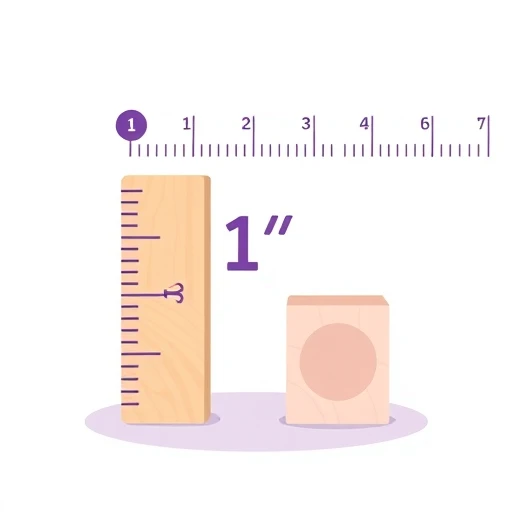
inch 30 सेकंड में
- A standard unit of length in the Imperial system, primarily used in the US and UK, equal to exactly 2.54 centimeters or 1/12 of a foot.
- Commonly used to measure small objects, screen sizes, rainfall, and personal height, often appearing in compound adjectives like 'six-inch'.
- Functions as a verb meaning to move very slowly and incrementally, often used with prepositions like 'forward', 'toward', or 'along'.
- Appears in many common English idioms to represent a tiny margin, stubbornness, or a near-miss, such as 'within an inch of'.
The word inch is a fundamental unit of measurement that carries both physical precision and metaphorical weight in the English language. Historically derived from the Latin 'uncia', meaning a twelfth part, it serves as the primary small-scale unit in the Imperial and United States customary systems. When you look at a standard ruler, the inch is that familiar gap, roughly the width of an adult's thumb at the base of the nail, which provides a human-scale reference for the world around us. In a technical sense, since 1959, the international inch has been defined as exactly 2.54 centimeters, bridging the gap between the Imperial system and the Metric system used by most of the world. This precision is vital in engineering, construction, and manufacturing, where a fraction of an inch can be the difference between a perfect fit and a mechanical failure.
- Physical Measurement
- Used to quantify length, height, or width in small increments, such as the size of a screen, the thickness of a book, or the amount of rainfall.
Beyond its role as a noun for measurement, 'inch' transforms into a vivid verb. To inch somewhere is to move with extreme caution and slowness, often because the path is dangerous, crowded, or requires great effort. Imagine a car in a massive traffic jam; it doesn't drive, it inches forward. This usage captures the essence of progress made in tiny, almost imperceptible steps. It suggests a level of persistence and patience that 'move' or 'walk' simply cannot convey. When we say someone is 'inching toward a goal,' we are highlighting the difficulty of the journey and the incremental nature of their success.
The carpenter carefully marked every inch of the timber to ensure the cabinet would fit perfectly in the alcove.
The word is also deeply embedded in English idioms. Because an inch is a small amount, it is often used to represent the smallest possible margin. If someone escapes 'within an inch of their life,' they were terrifyingly close to death. If you refuse to 'give an inch' in an argument, you are being completely uncompromising. These expressions rely on the listener's understanding that an inch is a tiny distance, making the refusal to move even that much a sign of extreme stubbornness or the closeness of the encounter a sign of extreme danger. This versatility makes 'inch' a word that appears in both the blueprint of a skyscraper and the climax of a thriller novel.
- Metaphorical Progress
- Describing slow, deliberate advancement in a task or a physical space where speed is impossible.
The climbers had to inch their way along the narrow mountain ledge, mindful of the steep drop below.
In cultural contexts, the inch remains a symbol of the 'old ways' in many parts of the world that have officially adopted the metric system. In the UK, for example, while the metric system is taught in schools, people still frequently describe their height in feet and inches or talk about 'inching along' in traffic. This persistence shows how deeply measurement systems are woven into the fabric of daily thought and language. The inch is not just a number; it is a way of seeing and interacting with the physical world, representing a scale that is intimately tied to the human body and human experience.
- Idiomatic Stubbornness
- Used to express a total lack of flexibility, as in the phrase 'not budging an inch'.
Despite the mounting pressure from the board, the CEO refused to inch on his decision to veto the merger.
The tide began to inch higher, slowly reclaiming the sandy beach where the children had built their castles.
Every inch of the gallery was covered in vibrant, modern artwork that challenged the viewers' perceptions.
Using the word inch correctly requires an understanding of its dual nature as a countable noun and an intransitive verb. As a noun, it follows standard pluralization rules (one inch, two inches). It is frequently used in compound adjectives to describe the dimensions of objects. For example, a 'six-inch blade' or a 'two-inch gap'. Note that when used as an adjective before a noun, the singular form is used with a hyphen. This is a common point of confusion for learners who might mistakenly say a 'six-inches blade'. Precision in these small grammatical details helps convey a higher level of fluency and technical accuracy.
- Compound Adjectives
- Forming descriptions of size: 'A three-inch margin is required for the binding of the thesis.'
When employing 'inch' as a verb, the focus is on the manner of movement. It is a 'manner-of-motion' verb that implies small, discrete increments. It is rarely used without a directional preposition. You don't just 'inch'; you 'inch forward' or 'inch away'. This verb is particularly effective in creative writing to build tension. If a character 'inches' toward a door, the reader feels the suspense of their slow progress. It can also be used figuratively to describe the gradual change in a situation, such as 'stock prices inching upward' or 'the deadline inching closer'. In these cases, it suggests a steady, relentless approach that might be overlooked if one isn't paying close attention.
The detective had to inch the heavy curtain aside to peer into the darkened room without being seen.
In mathematical and scientific contexts, the inch is often subdivided into fractions rather than decimals, unlike the metric system. You will hear 'half an inch', 'a quarter of an inch', or even 'an eighth of an inch'. This fractional usage is standard in American construction and DIY. When writing these out, it is common to use the double prime symbol (") as an abbreviation, though in formal writing, the word should be spelled out. For instance, 5" represents five inches. Understanding this shorthand is crucial for anyone reading technical manuals or architectural plans in the US or UK.
- Fractional Subdivisions
- Commonly used in non-decimal increments: 'The screw was only a quarter of an inch too long.'
She won the race by a mere inch, a victory so narrow it required a photo finish to confirm.
Furthermore, the word 'inch' is used to emphasize the totality of something when paired with 'every'. To search 'every inch' of a place means to look everywhere with extreme thoroughness. This phrase is a powerful rhetorical tool. Instead of saying 'I searched the whole house,' saying 'I searched every inch of the house' implies a much more rigorous and exhaustive effort. It paints a picture of someone looking under rugs, behind furniture, and in every tiny corner. This emphatic use is common in both spoken and written English to convey intensity and dedication to a task.
- Emphatic Totality
- Using 'every inch' to describe complete coverage: 'He looked every inch a king in his ceremonial robes.'
The rescue team searched every inch of the forest for the missing hiker before nightfall.
Could you move just an inch to the left? You're blocking the light for the photograph.
The snail continued to inch across the sidewalk, oblivious to the giant feet passing by.
In the modern world, you will encounter the word inch in a variety of specific, high-frequency contexts. Perhaps the most common is in the realm of consumer electronics. Television and computer monitor sizes are globally marketed in inches. Whether you are in Tokyo, Paris, or New York, a '55-inch TV' is a standard term. This is one of the few areas where the Imperial unit has maintained a global dominance, largely due to the historical influence of American technology companies. When you hear a tech reviewer talking about 'pixel density' or 'screen-to-body ratio', the diagonal measurement in inches is the foundational piece of information they are referencing.
- Consumer Electronics
- Standardized measurement for screens: 'The new smartphone features a 6.7-inch OLED display.'
Another major arena for this word is the weather report, particularly in North America. Meteorologists describe rainfall and snowfall in inches. 'We expect three inches of rain over the weekend' is a common phrase that helps people visualize the potential for flooding or the need for an umbrella. Similarly, in winter, 'six inches of snow' is a significant threshold that often triggers school closures or changes in travel plans. In these contexts, the inch is a practical, relatable unit that helps the general public understand the severity of environmental conditions. It is much more common to hear 'an inch of rain' than 'twenty-five millimeters of rain' in American news broadcasts.
The storm dropped over four inches of snow in just two hours, paralyzing the morning commute.
In the world of sports, particularly American football, the inch is a unit of extreme drama. The game is often described as a 'game of inches'. This refers to the fact that a player might fail to reach a first down or score a touchdown by a distance so small it can barely be measured. Commentators use this phrase to emphasize how tiny margins determine the outcome of massive events. You will also hear it in track and field, where a long jump or a shot put might be decided by a fraction of an inch. In these high-stakes environments, the inch represents the boundary between victory and defeat, making it a word charged with emotion and tension.
- Sports Commentary
- Describing narrow margins: 'He missed the world record by less than an inch.'
In professional football, every inch on the field is hard-fought and can change the momentum of the entire game.
Finally, you will hear 'inch' used frequently in DIY and home improvement contexts. If you go to a hardware store in the US, Canada, or the UK, you will find lumber, screws, and pipes measured in inches. A 'two-by-four' is a standard piece of wood (though its actual dimensions are slightly less than 2 inches by 4 inches). For anyone engaging in woodworking or home repair, the inch is the primary language of construction. Instructions for assembling furniture or installing appliances will almost certainly use inches, making it an essential part of the vocabulary for practical, everyday tasks. Even in countries that are primarily metric, certain legacy industries still rely on these measurements.
- Construction and DIY
- Standard units for materials: 'You'll need a three-inch screw to secure that bracket to the wall stud.'
The plumber noticed a small crack, barely an inch long, in the main water pipe.
The tailor suggested taking the hem up by an inch to make the trousers sit perfectly on the shoes.
As the crowd surged forward, we were forced to inch toward the exit for safety.
One of the most frequent errors learners make with the word inch involves the pluralization of compound adjectives. As mentioned earlier, when 'inch' is part of a multi-word adjective modifying a noun, it must remain in the singular form. For example, 'a ten-inch pizza' is correct, while 'a ten-inches pizza' is a common grammatical slip. This rule applies to all units of measurement in English when they function as adjectives. Remembering to drop the 'es' in these specific structures is a hallmark of advanced proficiency. It is a small detail, but it significantly impacts the naturalness of your speech and writing.
- Adjectival Singular
- Mistake: 'A 12-inches ruler.' Correct: 'A 12-inch ruler.'
Another common mistake is the confusion between the noun and the verb forms in terms of sentence structure. Because 'inch' is so commonly a noun, learners sometimes forget that as a verb, it is typically intransitive and requires a preposition to indicate direction. Saying 'He inched the room' is incorrect if you mean he moved slowly through it; you must say 'He inched across the room'. Without the preposition, the verb often lacks the necessary context to make sense to a native speaker. The preposition provides the 'path' for the slow movement, which is essential for the verb's meaning.
Incorrect: The car inched the heavy traffic. Correct: The car inched through the heavy traffic.
A more subtle error occurs in the misuse of idioms. For instance, the phrase 'give them an inch and they'll take a mile' is often misquoted or used in contexts where it doesn't quite fit. This idiom is specifically about people who take advantage of a small concession to demand much more. Using it to simply mean someone is greedy is a slight misuse. Similarly, 'within an inch of' is almost always used with 'one's life' or 'death'. Using it for trivial things, like 'within an inch of finishing my homework,' while understandable, is not standard idiomatic usage and can sound slightly 'off' to a native ear.
- Idiomatic Precision
- Avoid using 'within an inch of' for non-critical situations; it is reserved for near-catastrophes.
If you give an inch to the toddlers, they will end up taking over the entire living room.
Finally, there is the confusion between 'inch' and 'centimeter' in regions where both systems are used. While 1 inch is 2.54 cm, people often round this to 2.5 in casual conversation, which can lead to errors in precision-sensitive tasks like sewing or carpentry. Furthermore, because an inch is larger than a centimeter, mistaking the two can lead to significant errors in scale. If you are asked for a 'two-inch margin' and you provide a 'two-centimeter margin', the result will be much smaller than intended. Always double-check which unit is being requested, especially in international contexts where both might be present on the same tool or document.
- Unit Confusion
- Ensure you are not using metric measurements when Imperial 'inches' are specified, as the difference is over 250%.
The blueprint was in inches, but the contractor mistakenly used a metric tape measure, causing a major delay.
Inch by inch, the gardener cleared the overgrown weeds until the flowerbed was visible again.
The cat began to inch toward the bird, its body low to the ground and perfectly still between movements.
When looking for alternatives to inch, it is important to distinguish between its role as a measurement and its role as a verb of motion. As a measurement, the most direct alternative is the centimeter. While they are not equal, they occupy the same conceptual space of 'small unit of length'. In more casual settings, you might use 'a bit', 'a smidge', or 'a tad' to represent a small, non-specific distance. For example, 'Move it a smidge to the left' is a very natural way to ask for a movement of about an inch without being technically precise. These informal terms are excellent for social situations where exactness isn't required.
- Inch vs. Centimeter
- An inch (2.54 cm) is significantly larger than a centimeter (0.39 inches). Use 'inch' for Imperial contexts and 'centimeter' for Metric ones.
As a verb, 'inch' has several synonyms that convey similar slow movement but with different nuances. Creep suggests stealth and a desire not to be noticed, often with a slightly negative or eerie connotation. Edge implies moving sideways or cautiously toward a boundary. Crawl is used for very slow movement, often physically on the ground, but can also describe slow traffic. Sidle specifically means to move sideways in a shy or secretive manner. Choosing 'inch' over these others specifically emphasizes the small, incremental nature of the progress rather than the stealth or the physical posture of the mover.
Instead of inching forward, the shy boy decided to edge toward the back of the room.
In more formal or technical writing, you might replace the verb 'inch' with advance gradually or proceed incrementally. These phrases lack the vividness of 'inch' but are more appropriate for academic or professional reports. For example, in a business report, you might write, 'The company is gradually advancing toward its quarterly targets,' rather than 'The company is inching toward its targets.' However, in journalism or storytelling, 'inch' remains the superior choice for its ability to create a mental image of slow, painstaking effort. It is a word that bridges the gap between technical measurement and evocative description.
- Inch vs. Edge
- 'Inch' focuses on the small steps of progress; 'edge' focuses on moving toward or along a specific border or limit.
The negotiator managed to inch the two parties closer to an agreement, though many issues remained.
Finally, consider the word millimeter when extreme precision is needed. While an inch is a small unit, a millimeter is much smaller (about 1/25th of an inch). In engineering or high-end manufacturing, 'inching' might be too coarse a term, and 'moving by millimeters' would be more accurate. Conversely, in a broad metaphorical sense, 'mile' is the opposite of 'inch'. We often compare the two to show scale, as in 'He's miles away from the truth' versus 'He's within an inch of the truth'. Understanding these relationships helps you place 'inch' correctly on the spectrum of distance and movement in English.
- Inch vs. Creep
- 'Inch' is neutral regarding intent; 'creep' often implies something sneaky, unwanted, or slightly frightening.
The shadow began to inch across the floor as the sun set, eventually covering the entire room in darkness.
The glacier continues to inch down the valley, a slow but unstoppable force of nature.
The tailor measured the inch-wide ribbon before sewing it onto the edge of the silk dress.
How Formal Is It?
रोचक तथ्य
Before standardization, an inch was often defined as the width of a man's thumb. In 1324, King Edward II of England defined it as the length of three grains of barley, dry and round, placed end to end.
उच्चारण मार्गदर्शिका
- Pronouncing the 'i' like 'ee' (e.g., 'eench').
- Softening the 'ch' to a 'sh' sound (e.g., 'insh').
- Adding an extra vowel sound at the end (e.g., 'in-chu').
- Confusing the 'n' sound with an 'm' sound.
- Not making the 'ch' sound sharp enough.
कठिनाई स्तर
The word is short and common, but idioms can be tricky.
Pluralization and compound adjective rules (singular form) require care.
Easy to pronounce, though the 'ch' sound should be clear.
Distinct sound makes it easy to recognize in conversation.
आगे क्या सीखें
पूर्वापेक्षाएँ
आगे सीखें
उन्नत
ज़रूरी व्याकरण
Pluralization of units
One inch, two inches. (Add -es to words ending in -ch).
Compound adjectives with measurements
A ten-inch ruler (not ten-inches ruler).
Intransitive verb usage
The snail inched *along* the path. (Requires a preposition).
Articles with vowel sounds
An inch (use 'an' because 'inch' starts with a vowel sound).
Fractions as modifiers
A half-inch gap (hyphenated when used as an adjective).
स्तर के अनुसार उदाहरण
The pencil is six inches long.
Le crayon mesure six pouces de long.
Use 'inches' for plural.
I need an inch of tape.
J'ai besoin d'un pouce de ruban adhésif.
'An' is used before 'inch' because it starts with a vowel sound.
The box is ten inches wide.
La boîte fait dix pouces de large.
Adjective 'wide' follows the measurement.
Is that one inch?
Est-ce que c'est un pouce ?
Question form with 'is'.
My book is two inches thick.
Mon livre fait deux pouces d'épaisseur.
'Thick' describes the depth of the object.
The snow is one inch deep.
La neige a un pouce de profondeur.
'Deep' is used for height of accumulation.
There are 12 inches in a foot.
Il y a 12 pouces dans un pied.
Basic measurement fact.
The screen is 5 inches.
L'écran fait 5 pouces.
Commonly used for screen sizes.
He grew two inches this summer.
Il a grandi de deux pouces cet été.
Used with the verb 'grow' to show change in height.
The car inched forward slowly.
La voiture a avancé petit à petit.
Verb 'inch' used with the adverb 'slowly'.
Please move an inch to the left.
S'il vous plaît, bougez d'un pouce vers la gauche.
Imperative sentence for a small request.
The water rose by several inches.
L'eau a monté de plusieurs pouces.
'By' indicates the amount of change.
I have a four-inch scar on my arm.
J'ai une cicatrice de quatre pouces sur le bras.
Compound adjective 'four-inch' (singular).
The snail moved inch by inch.
L'escargot avançait pouce par pouce.
Idiomatic phrase 'inch by inch' for slow progress.
The paper is 8.5 inches by 11 inches.
Le papier fait 8,5 pouces sur 11 pouces.
Standard way to give dimensions (length by width).
She was within an inch of the finish line.
Elle était à un pouce de la ligne d'arrivée.
Prepositional phrase showing extreme closeness.
The cat inched toward the mouse.
Le chat s'est glissé vers la souris.
Verb 'inch' followed by the preposition 'toward'.
If you give him an inch, he'll take a mile.
Si tu lui donnes un doigt, il te prendra le bras.
Classic idiom about taking advantage of kindness.
The margin should be exactly one inch.
La marge doit être exactement d'un pouce.
Used for formal document formatting.
He inched the sofa across the room.
Il a fait avancer le canapé petit à petit à travers la pièce.
Transitive use of 'inch' (moving an object).
The temperature is inching upward.
La température grimpe petit à petit.
Figurative use for gradual change.
The nail was only half an inch long.
Le clou ne mesurait qu'un demi-pouce.
Fractional measurement 'half an inch'.
They searched every inch of the garden.
Ils ont fouillé chaque recoin du jardin.
Emphatic phrase 'every inch' meaning 'everywhere'.
The car missed the wall by an inch.
La voiture a raté le mur d'un pouce.
Shows a very narrow margin.
The negotiations are inching toward a resolution.
Les négociations avancent à petits pas vers une résolution.
Abstract use of the verb 'inch'.
He was within an inch of losing his job.
Il était à deux doigts de perdre son emploi.
Idiom for being very close to a bad outcome.
She looked every inch the professional athlete.
Elle avait tout d'une athlète professionnelle.
Idiom 'every inch' used for appearance/character.
The climber inched his way up the cliff.
Le grimpeur a gravi la falaise centimètre par centimètre.
Reflexive-style use 'inched his way'.
A three-inch difference might not seem like much.
Une différence de trois pouces peut sembler peu.
Compound adjective 'three-inch'.
The tide inched higher and higher.
La marée montait de plus en plus.
Repetition for emphasis on continuous movement.
He wouldn't budge an inch on the price.
Il n'a pas voulu céder d'un pouce sur le prix.
Idiom 'not budge an inch' for stubbornness.
The recipe calls for a one-inch cube of ginger.
La recette demande un cube de gingembre d'un pouce.
Precise cooking instruction.
The project is inching closer to completion despite the delays.
Le projet se rapproche lentement de son achèvement malgré les retards.
Describes slow progress in a complex task.
He survived the crash, but it was within an inch of his life.
Il a survécu à l'accident, mais il l'a échappé belle.
High-level idiomatic expression for a near-death experience.
The detective examined every inch of the crime scene.
Le détective a examiné chaque centimètre carré de la scène de crime.
Emphasizes extreme thoroughness.
The stock market inched up after the positive news.
La bourse a légèrement progressé après les nouvelles positives.
Financial context for small movements.
She refused to give an inch in the debate.
Elle a refusé de céder le moindre terrain lors du débat.
Idiomatic use for intellectual or political stubbornness.
The glacier's movement is measured in inches per year.
Le mouvement du glacier se mesure en pouces par an.
Scientific context for extremely slow rates.
The tailor made a half-inch adjustment to the waist.
Le tailleur a fait un ajustement d'un demi-pouce à la taille.
Technical precision in tailoring.
The tension in the room inched higher as the clock ticked.
La tension dans la pièce montait d'un cran à chaque seconde.
Metaphorical use for atmosphere or emotion.
The legislation inched through the committee stage.
La législation a progressé péniblement à travers l'étape du comité.
Describes the slow, difficult progress of a bill.
He is every inch the gentleman, always putting others first.
C'est un parfait gentleman, il fait toujours passer les autres en premier.
Idiom 'every inch' used for character traits.
The spacecraft inched toward the docking station with pinpoint accuracy.
Le vaisseau spatial s'est approché lentement de la station d'amarrage avec une précision extrême.
Technical context for delicate maneuvers.
The margin of error was less than a tenth of an inch.
La marge d'erreur était de moins d'un dixième de pouce.
Describes extreme technical precision.
The cultural shift inched forward, almost imperceptibly at first.
Le changement culturel a progressé lentement, presque imperceptiblement au début.
Abstract sociological use.
They fought for every inch of ground in the grueling conflict.
Ils se sont battus pour chaque pouce de terrain dans ce conflit épuisant.
Military/historical context for intense struggle.
The spider inched down its silken thread toward the unsuspecting fly.
L'araignée descendait lentement le long de son fil de soie vers la mouche insouciante.
Literary/descriptive use for predatory movement.
The truth inched out, one revelation at a time.
La vérité a fini par éclater, une révélation à la fois.
Metaphorical use for the slow disclosure of information.
सामान्य शब्द संयोजन
सामान्य वाक्यांश
— To refuse to change one's opinion or position even slightly. It shows extreme stubbornness.
Despite the evidence, he would not budge an inch on his theory.
— Extremely accurate or precise, especially in sports. It means something was done exactly right.
The quarterback delivered an inch-perfect pass to the receiver.
— By a very small margin or distance. It is often used to describe near-misses.
The arrow missed the target by an inch.
— Completely or entirely a certain type of person. It emphasizes that someone fits a description perfectly.
In that suit, he looked every inch a successful businessman.
— Almost to the point of death. It is used to describe very dangerous or violent situations.
The explorer was beaten within an inch of his life by the storm.
— To move very slowly in the direction of something. It can be physical or metaphorical.
The two countries are slowly inching toward a peace treaty.
— A warning that if you allow someone a small favor, they will take advantage and ask for much more.
Don't let him borrow your car; give him an inch and he'll take a mile.
— A common fractional measurement used for small adjustments. It is half of 2.54 cm.
The shelf needs to be moved up about half an inch.
— A small, approximate distance. It is used when exact measurement isn't necessary.
Just move the chair an inch or two to the left.
— Moving slowly with great difficulty or effort. It emphasizes the struggle involved.
The survivors crawled through the tunnel inch by painful inch.
अक्सर इससे भ्रम होता है
An 'itch' is a feeling on your skin that makes you want to scratch. An 'inch' is a measurement. They sound similar but are very different.
'Each' refers to every individual in a group. 'Inch' is a unit of length. Beginners sometimes confuse the vowel sounds.
An 'inchworm' is a specific type of caterpillar. While it contains the word 'inch', it refers to the animal, not the measurement itself.
मुहावरे और अभिव्यक्तियाँ
— If you make a small concession to someone, they will take advantage of you and ask for much more.
I let her leave early once, and now she expects it every Friday; give an inch and they'll take a mile.
informal— Almost to the point of dying; very severely.
He was worked within an inch of his life during the busy season.
neutral— In every way; completely.
She looked every inch a queen in her coronation robes.
neutral— To be completely firm and refuse to change one's mind or position.
The union leaders would not budge an inch on their demands for higher pay.
neutral— A situation where the smallest margins or details determine success or failure.
Football is a game of inches; one small slip can cost you the championship.
informal/sports— A motivational phrase meaning that difficult tasks are easy if you take them one small step at a time.
Don't worry about the whole project; just focus on today's task. Inch by inch, it's a cinch.
informal— To narrowly defeat someone or to just barely achieve a victory.
The incumbent managed to inch out a victory in the local elections.
neutral— Extremely close to something.
We were within an inch of crashing into the deer on the road.
neutral— Every single part of a place or area, without exception.
They painted every square inch of the nursery a soft blue.
neutral— To yield or compromise even a tiny amount.
In a high-stakes negotiation, you cannot afford to give an inch too early.
formal/neutralआसानी से भ्रमित होने वाले
Both are small units of length.
An inch is much larger than a centimeter (1 inch = 2.54 cm). They belong to different measurement systems (Imperial vs. Metric).
I need an inch of ribbon, not a centimeter; a centimeter is too short.
They rhyme and both can refer to small amounts.
A 'pinch' is an action (squeezing with fingers) or a tiny amount of powder (like salt). An 'inch' is a specific length.
Add a pinch of salt and move the pot an inch to the left.
Both can be verbs meaning to move slowly.
'Edge' often implies moving sideways or toward a border. 'Inch' implies moving in tiny forward/backward increments.
He inched forward in the line, while she edged toward the exit.
Both describe slow movement.
'Creep' implies being quiet or sneaky. 'Inch' simply implies being very slow and incremental.
The cat inched toward the bird, trying to creep through the tall grass.
Both are Imperial units of length.
A foot is much larger, consisting of exactly 12 inches.
The board is one foot long, which means it is 12 inches.
वाक्य संरचनाएँ
It is [number] inches.
It is three inches.
A [number]-inch [noun].
A six-inch sandwich.
[Subject] inched [preposition] [object].
The car inched toward the gate.
Every inch of [noun].
Every inch of the wall was covered.
Within an inch of [noun].
Within an inch of disaster.
Not budge an inch.
He would not budge an inch.
Inching toward [abstract noun].
Inching toward a compromise.
Every inch the [noun].
Every inch the professional.
शब्द परिवार
संज्ञा
क्रिया
विशेषण
संबंधित
इसे कैसे इस्तेमाल करें
Very high in US/UK English; moderate in global technical/tech contexts.
-
A 10-inches screen.
→
A 10-inch screen.
When a measurement is used as an adjective before a noun, it should be in the singular form.
-
The snail inched the wall.
→
The snail inched up the wall.
The verb 'inch' usually requires a preposition to indicate the direction of the slow movement.
-
I am 170 inches tall.
→
I am 5 feet 7 inches tall.
People's height is usually given in feet and inches, not just inches. 170 inches would be over 14 feet tall!
-
He wouldn't move an inchs.
→
He wouldn't move an inch.
'An' is singular, so you must use 'inch', not the plural 'inches'.
-
The gap was 2 inch.
→
The gap was 2 inches.
When the number is greater than one and not part of a compound adjective, you must use the plural form.
सुझाव
Compound Adjectives
When using 'inch' as part of a description before a noun, always use the singular form and a hyphen. Write 'a six-inch sub,' not 'a six-inches sub.' This is a very common rule for all units of measurement in English.
Verb Prepositions
The verb 'inch' almost always needs a partner word to show direction. Common partners include 'forward', 'backward', 'along', 'toward', and 'across'. Without these, the sentence often feels incomplete.
Plural Form
The plural of 'inch' is 'inches'. Because the word ends in 'ch', you must add '-es' instead of just '-s'. This is the same rule as 'churches', 'watches', and 'sandwiches'.
Screen Sizes
Remember that TVs and computer monitors are measured diagonally. A '32-inch TV' means the distance from one top corner to the opposite bottom corner is 32 inches, not the width of the screen.
Within an Inch
The phrase 'within an inch of' is most commonly used with 'his/her/their life' or 'death'. It's a dramatic way to say someone almost died. Using it for small things like 'within an inch of finishing' is less common.
Imperial vs Metric
If you are traveling to the US, be prepared to use inches for everything. In most other countries, you will only see inches for technology and sometimes clothing. Knowing the 2.54 conversion is very helpful.
Building Tension
In creative writing, use the verb 'inch' to slow down a scene. It makes the reader feel the effort and the passage of time, which is great for suspenseful or difficult moments.
Clear 'CH'
Make sure the 'ch' sound at the end of 'inch' is sharp and distinct. If it sounds too much like 'sh', people might confuse it with other words or find it harder to understand you.
Fractions
Inches are often divided into halves, quarters, eighths, and sixteenths. Practice saying 'half an inch' or 'three-quarters of an inch' to sound more natural in technical or DIY contexts.
Thumb Rule
If you don't have a ruler, the distance from the tip of your thumb to the first knuckle is roughly one inch for many adults. It's a handy way to estimate small distances quickly.
याद करें
स्मृति सहायक
Think of an 'Inch' as the 'Inside' of your thumb's top joint. Both start with 'I'. It's a small distance you always have with you.
दृश्य संबंध
Imagine a tiny 'inchworm' slowly measuring a ruler, moving its body up and down in small steps. This helps you remember both the measurement and the slow movement.
Word Web
चैलेंज
Try to find five objects in your room and guess their length in inches. Then, use a ruler to see how close you were. Write a sentence for each using the word 'inch'.
शब्द की उत्पत्ति
The word 'inch' comes from the Old English 'ynce', which was borrowed from the Latin 'uncia'. In Latin, 'uncia' meant a twelfth part, referring to 1/12 of a Roman foot (pes). This is also the root of the word 'ounce', which is 1/12 of a Roman pound (libra).
मूल अर्थ: A twelfth part of a foot.
Germanic (Old English) with Latin roots.सांस्कृतिक संदर्भ
There are no major sensitivities, but be aware that using inches in a scientific context outside the US might be seen as unprofessional or confusing.
In the US, 'inches' are used for rainfall and snowfall, while most other countries use 'millimeters' or 'centimeters'.
असल ज़िंदगी में अभ्यास करें
वास्तविक संदर्भ
Buying a TV
- What's the screen size in inches?
- I'm looking for a 65-inch model.
- Does it come in a 50-inch version?
- The diagonal measurement is 40 inches.
Driving in Traffic
- We're just inching along.
- The traffic is barely moving an inch.
- I had to inch forward to see the sign.
- We inched through the construction zone.
DIY/Carpentry
- Cut it two inches from the edge.
- It's about an inch too short.
- I need a three-inch screw.
- Mark every inch on the board.
Weather Reports
- Two inches of rain fell overnight.
- We're expecting six inches of snow.
- The water level rose by three inches.
- An inch of ice covered the roads.
Describing People
- He's every inch a leader.
- She grew an inch over the summer.
- He's a few inches taller than me.
- She looked every inch the professional.
बातचीत की शुरुआत
"Do you prefer using inches or centimeters when you measure things?"
"Have you ever been in traffic so bad that you could only inch forward?"
"What's the biggest TV screen size (in inches) you think is reasonable for a living room?"
"In your country, do people use inches for their height or do they use the metric system?"
"Can you think of a time when you were 'within an inch' of something exciting or dangerous?"
डायरी विषय
Describe a goal you are 'inching toward' right now. What small steps are you taking to get there?
Write about a time you had a narrow escape. How close were you to a different outcome?
If you had to switch all your measurements to inches today, what would be the hardest thing to adjust to?
Describe a person you know who is 'every inch' a certain character (e.g., every inch a teacher, every inch a rebel).
Think about a project that felt like it moved 'inch by inch'. How did you stay motivated during the slow progress?
अक्सर पूछे जाने वाले सवाल
10 सवालThere are exactly 2.54 centimeters in one international inch. This definition has been standardized since 1959 to ensure consistency between the Imperial and Metric systems. If you are doing a quick mental conversion, you can think of an inch as roughly two and a half centimeters.
Yes, 'inch' is still widely used in the UK despite the country being officially metric. You will hear it used for personal height, waist measurements for clothing, and in many common idioms. However, for most official, scientific, and commercial purposes, centimeters and millimeters are the standard.
The phrase 'inch by inch' means to do something very slowly and gradually, usually with a lot of effort or patience. For example, 'Inch by inch, she finished the difficult puzzle.' It emphasizes that progress is being made, even if it is very small at each step.
Yes, 'inch' can be a verb meaning to move very slowly and carefully. It is usually used with a preposition like 'forward', 'away', or 'toward'. For example, 'The snail inched across the leaf.' It can also be used figuratively, such as 'The stock market is inching upward.'
The most common abbreviation for inch is 'in.' (with a period). In technical or informal contexts, a double prime symbol (") is also used. For example, 5 inches can be written as 5 in. or 5". In formal writing, it is usually best to spell out the word 'inches'.
This is a popular idiom used to describe people who take advantage of a small favor or concession. It suggests that if you are flexible even a little bit, the other person will become greedy and demand much more. It's a way of saying 'don't be too generous with people who might exploit you.'
When you say someone is 'every inch' a certain thing, it means they completely embody that role or characteristic. For example, 'He looked every inch a soldier' means his appearance, posture, and attitude were exactly what you would expect from a soldier. It means 'entirely' or 'completely'.
Yes, an inch is significantly larger than a centimeter. One inch is equal to 2.54 centimeters. This means that an object that is 10 inches long is much longer than an object that is 10 centimeters long (which would only be about 4 inches).
A square inch is a unit of area, representing the space inside a square where each side is one inch long. It is used to measure the size of small surfaces, like a postage stamp or the pressure on a specific point (pounds per square inch).
You should use 'inch' when you want to emphasize that the movement is extremely slow, careful, or difficult. 'Move' is a general word, but 'inch' creates a specific mental image of tiny, incremental steps. It is perfect for describing traffic, stalking animals, or gradual progress toward a goal.
खुद को परखो 190 सवाल
Write a sentence using 'inch' as a noun to describe an object.
Well written! Good try! Check the sample answer below.
Write a sentence using 'inch' as a verb to describe a car.
Well written! Good try! Check the sample answer below.
Use the idiom 'give an inch' in a sentence about a boss.
Well written! Good try! Check the sample answer below.
Describe a screen size using the word 'inch'.
Well written! Good try! Check the sample answer below.
Write a sentence using 'every inch' to describe a person's appearance.
Well written! Good try! Check the sample answer below.
Use 'inch by inch' to describe a difficult task.
Well written! Good try! Check the sample answer below.
Write a sentence about weather using 'inches'.
Well written! Good try! Check the sample answer below.
Use 'within an inch of' in a dramatic sentence.
Well written! Good try! Check the sample answer below.
Write a sentence about a small adjustment using 'half an inch'.
Well written! Good try! Check the sample answer below.
Use 'inching toward' to describe a political situation.
Well written! Good try! Check the sample answer below.
Describe a snail's movement using 'inch'.
Well written! Good try! Check the sample answer below.
Write a sentence using 'square inch'.
Well written! Good try! Check the sample answer below.
Use 'not budge an inch' in a sentence about a child.
Well written! Good try! Check the sample answer below.
Write a sentence using 'inch' to describe a scar.
Well written! Good try! Check the sample answer below.
Use 'inching closer' to describe a deadline.
Well written! Good try! Check the sample answer below.
Write a sentence about tailoring using 'inch'.
Well written! Good try! Check the sample answer below.
Use 'every inch of' to describe searching for something.
Well written! Good try! Check the sample answer below.
Write a sentence about a narrow victory using 'inch'.
Well written! Good try! Check the sample answer below.
Use 'inch' in a sentence about a caterpillar.
Well written! Good try! Check the sample answer below.
Write a sentence using 'inch-perfect'.
Well written! Good try! Check the sample answer below.
Describe the size of your phone screen using 'inches'.
Read this aloud:
तुमने कहा:
Speech recognition is not supported in your browser. Try Chrome or Edge.
Tell a short story about being stuck in traffic using the verb 'inch'.
Read this aloud:
तुमने कहा:
Speech recognition is not supported in your browser. Try Chrome or Edge.
Explain the idiom 'give an inch' to a friend.
Read this aloud:
तुमने कहा:
Speech recognition is not supported in your browser. Try Chrome or Edge.
Describe someone you know who is 'every inch' a certain profession.
Read this aloud:
तुमने कहा:
Speech recognition is not supported in your browser. Try Chrome or Edge.
Talk about a goal you are 'inching toward'.
Read this aloud:
तुमने कहा:
Speech recognition is not supported in your browser. Try Chrome or Edge.
How would you ask someone to move just a tiny bit using 'inch'?
Read this aloud:
तुमने कहा:
Speech recognition is not supported in your browser. Try Chrome or Edge.
Discuss the difference between an inch and a centimeter.
Read this aloud:
तुमने कहा:
Speech recognition is not supported in your browser. Try Chrome or Edge.
Describe a time you were 'within an inch' of something.
Read this aloud:
तुमने कहा:
Speech recognition is not supported in your browser. Try Chrome or Edge.
Use 'inch by inch' to describe learning a new language.
Read this aloud:
तुमने कहा:
Speech recognition is not supported in your browser. Try Chrome or Edge.
Explain why 'a game of inches' is a common phrase in sports.
Read this aloud:
तुमने कहा:
Speech recognition is not supported in your browser. Try Chrome or Edge.
Pronounce 'inches' and 'itch' and explain the difference.
Read this aloud:
तुमने कहा:
Speech recognition is not supported in your browser. Try Chrome or Edge.
Tell someone how much snow fell using 'inches'.
Read this aloud:
तुमने कहा:
Speech recognition is not supported in your browser. Try Chrome or Edge.
Describe a project that is moving slowly using 'inching'.
Read this aloud:
तुमने कहा:
Speech recognition is not supported in your browser. Try Chrome or Edge.
How would you use 'inch' in a hardware store?
Read this aloud:
तुमने कहा:
Speech recognition is not supported in your browser. Try Chrome or Edge.
Describe a person's height using feet and inches.
Read this aloud:
तुमने कहा:
Speech recognition is not supported in your browser. Try Chrome or Edge.
Use 'every square inch' to describe a messy room.
Read this aloud:
तुमने कहा:
Speech recognition is not supported in your browser. Try Chrome or Edge.
Explain the meaning of 'not budging an inch'.
Read this aloud:
तुमने कहा:
Speech recognition is not supported in your browser. Try Chrome or Edge.
Talk about a time you had to 'inch' something heavy.
Read this aloud:
तुमने कहा:
Speech recognition is not supported in your browser. Try Chrome or Edge.
Describe a caterpillar's movement using 'inch'.
Read this aloud:
तुमने कहा:
Speech recognition is not supported in your browser. Try Chrome or Edge.
Use 'inch-perfect' to describe a sports play.
Read this aloud:
तुमने कहा:
Speech recognition is not supported in your browser. Try Chrome or Edge.
Listen for the measurement: 'The board is 10 inches long.' What is the length?
Listen for the verb: 'The cat inched toward the mouse.' How did the cat move?
Listen for the idiom: 'He won't budge an inch.' Is the person being flexible?
Listen for the screen size: 'It's a 15-inch laptop.' What is the size?
Listen for the weather: 'We got an inch of rain.' How much rain was there?
Listen for the phrase: 'Every inch of the wall was painted.' How much was painted?
Listen for the near-miss: 'The car missed by an inch.' Was it a big or small gap?
Listen for the height: 'She is five-four.' (Meaning 5 feet 4 inches). How many inches over 5 feet is she?
Listen for the progress: 'We are inching toward a solution.' Is the solution coming fast?
Listen for the instruction: 'Cut a two-inch piece.' How long should the piece be?
Listen for the idiom: 'Give an inch, take a mile.' What is the speaker worried about?
Listen for the precision: 'It was inch-perfect.' How accurate was it?
Listen for the plural: 'The gap was three inches.' Is it 'inch' or 'inches'?
Listen for the character: 'He was every inch a gentleman.' What kind of person is he?
Listen for the movement: 'The glacier inched down the mountain.' Is it moving fast?
/ 190 correct
Perfect score!
Summary
The word 'inch' is essential for both physical measurement and describing slow, deliberate movement. Whether you are measuring a screen or 'inching' through traffic, it emphasizes small, precise increments and tiny margins in both literal and figurative contexts.
- A standard unit of length in the Imperial system, primarily used in the US and UK, equal to exactly 2.54 centimeters or 1/12 of a foot.
- Commonly used to measure small objects, screen sizes, rainfall, and personal height, often appearing in compound adjectives like 'six-inch'.
- Functions as a verb meaning to move very slowly and incrementally, often used with prepositions like 'forward', 'toward', or 'along'.
- Appears in many common English idioms to represent a tiny margin, stubbornness, or a near-miss, such as 'within an inch of'.
Compound Adjectives
When using 'inch' as part of a description before a noun, always use the singular form and a hyphen. Write 'a six-inch sub,' not 'a six-inches sub.' This is a very common rule for all units of measurement in English.
Verb Prepositions
The verb 'inch' almost always needs a partner word to show direction. Common partners include 'forward', 'backward', 'along', 'toward', and 'across'. Without these, the sentence often feels incomplete.
Plural Form
The plural of 'inch' is 'inches'. Because the word ends in 'ch', you must add '-es' instead of just '-s'. This is the same rule as 'churches', 'watches', and 'sandwiches'.
Screen Sizes
Remember that TVs and computer monitors are measured diagonally. A '32-inch TV' means the distance from one top corner to the opposite bottom corner is 32 inches, not the width of the screen.