Yalda Night in Iran
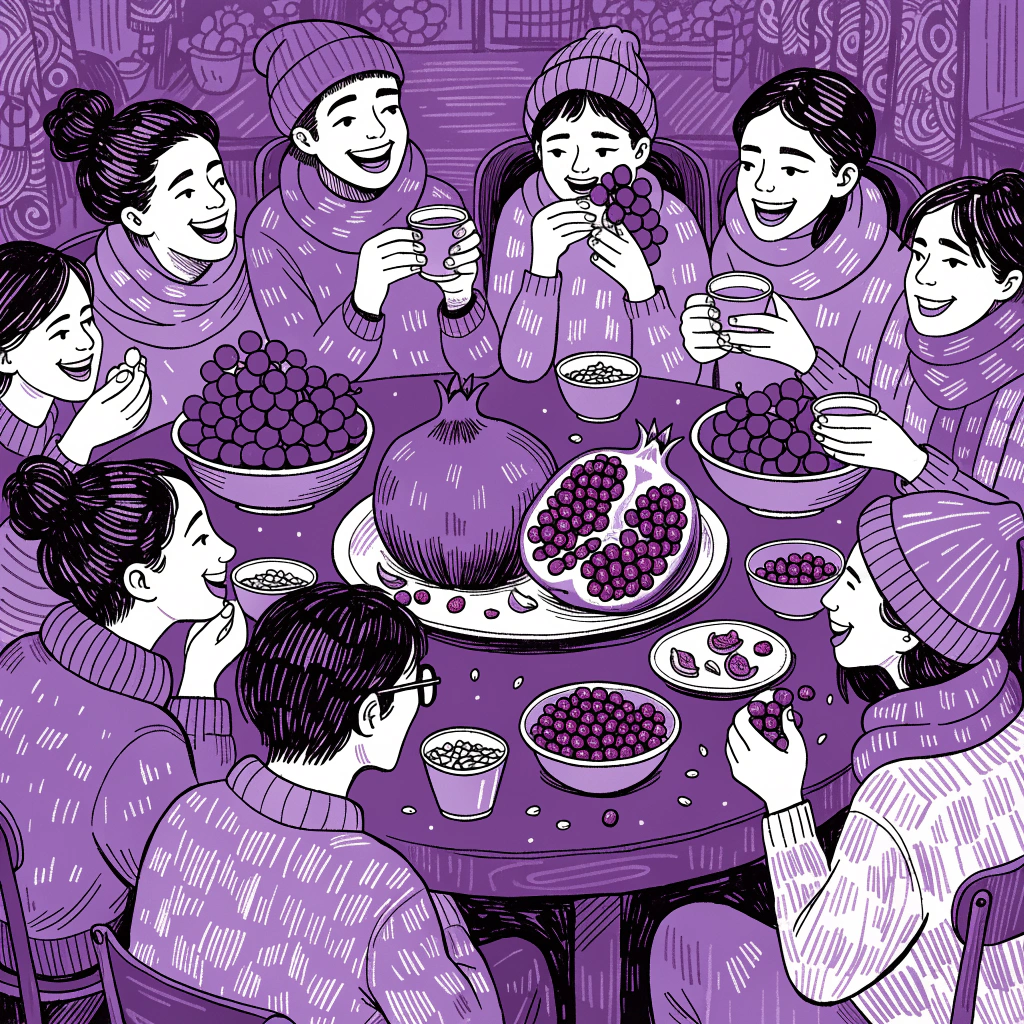
Yalda is a special night in Iran. It is the longest night of the year. People celebrate the end of autumn and the start of winter. Families meet at the house of the grandparents. They sit together and talk.
They eat delicious food. They eat red fruits like watermelons and pomegranates. Red is the color of the sun. People also read beautiful poems. Everyone is happy because the days become longer after this night. It is a festival of light and love.
Grammar Spotlight
Pattern: Present Simple (to be)
"Yalda is a special night in Iran."
We use 'is' with singular nouns like 'Yalda' or 'night' to describe facts. It shows a state or a quality of the subject.
Pattern: Present Simple (Plural Verbs)
"Families meet at the house of the grandparents."
With plural subjects like 'Families' or 'They', we use the base form of the verb without adding an 's'. This describes regular habits or traditions.
Test Your Understanding
10 questions · A1 Beginner · 1 free preview
Test what you learned from this article. Answer all questions to earn XP!
Where do families usually meet for Yalda?
Want to finish the quiz?
9 more questions are waiting for you. Sign up free to unlock the full quiz and earn XP!
Sign Up FreeAlready have an account? Sign In
Question Breakdown
Where do families usually meet for Yalda?
Your answer:
Correct answer: At the grandparents' house
Yalda is the shortest night of the year.
Your answer:
Correct answer: False
What does 'delicious' mean?
Your answer:
Correct answer: Tastes very good
Red is the color of the _____.
Your answer:
Correct answer: sun
Yalda Night: The Longest Night in Iran
Yalda Night is a very old and beautiful festival in Iran. It happens on the last night of autumn. This is the longest night of the year. People call it Shab-e Yalda. It is a time when families and friends stay together to celebrate the end of the long, dark nights.
On this night, most people go to their grandparents' houses. They sit around a big table and eat special food. They usually eat red fruits like watermelon and pomegranate. These fruits are important because red represents the color of the sun. They also eat nuts and sweets while they talk and laugh.
Reading poetry is another important part of the night. Many families read poems by Hafez, a famous Iranian poet. Older people tell stories to the children. Yalda is more popular than many other festivals because it brings people closer. It shows that even on the longest night, light and warmth will return.
Grammar Spotlight
Pattern: Superlative Adjectives
"This is the longest night of the year."
We use 'the' + adjective + '-est' to compare one thing to all others in a group. For 'long', we add '-est' to make it 'the longest'.
Pattern: Comparative Adjectives
"Yalda is more popular than many other festivals because it brings people closer."
We use 'more' + long adjective + 'than' to compare two things. For the short adjective 'close', we add '-er' to make 'closer'.
Test Your Understanding
11 questions · A2 Elementary · 1 free preview
Test what you learned from this article. Answer all questions to earn XP!
When does Yalda Night happen?
Want to finish the quiz?
10 more questions are waiting for you. Sign up free to unlock the full quiz and earn XP!
Sign Up FreeAlready have an account? Sign In
Question Breakdown
When does Yalda Night happen?
Your answer:
Correct answer: On the last night of autumn
People usually stay home alone on Yalda Night.
Your answer:
Correct answer: False
What does 'represent' mean?
Your answer:
Correct answer: To be a symbol of something
Many families read _____ by Hafez.
Your answer:
Correct answer: poetry
Where do most people go on this night?
Your answer:
Correct answer: To their grandparents' houses
Yalda Night: Celebrating the Victory of Light in Iran
Yalda Night, which is known as Shab-e Yalda in Iran, is one of the most ancient and cherished festivals in the country. It has been celebrated for thousands of years to mark the winter solstice. This special occasion falls on the longest night of the year, which usually occurs on December 20th or 21st. For Iranians, this event symbolizes the victory of light over darkness and the birth of the sun.
On this night, family members gather at the homes of their elders to stay awake until dawn. Large tables are decorated with traditional snacks that have been carefully prepared throughout the day. Pomegranates and watermelons are the most significant fruits on the table. Their red color represents the crimson of the morning sun and the glow of life. It is believed that eating these fruits will keep people healthy during the cold winter months.
Besides eating, Yalda is a night for literature and reflection. The poetry of Hafez, which is deeply respected in Persian culture, plays a central role. A book of Hafez is opened at random, and the poem that is chosen is read aloud to predict the future. This practice is called 'Fal-e Hafez.'
Although modern life has changed many things, Yalda has remained a vital part of Iranian identity. It is a time when the bonds of family are strengthened through shared stories and ancient customs. Even in the darkest and coldest moments of the year, people find warmth in togetherness. This beautiful festival reminds everyone that light will always return to the world.
Grammar Spotlight
Pattern: Relative Clauses
"Yalda Night, which is known as Shab-e Yalda in Iran, is one of the most ancient festivals."
Relative clauses provide extra information about a noun. In this case, 'which' is used to add a detail about Yalda Night without starting a new sentence.
Pattern: Passive Voice
"Large tables are decorated with traditional snacks that have been carefully prepared."
The passive voice is used when the action is more important than the person doing it. It is formed using 'be' + past participle.
Test Your Understanding
11 questions · B1 Intermediate · 1 free preview
Test what you learned from this article. Answer all questions to earn XP!
What does the red color of the fruits represent during Yalda?
Want to finish the quiz?
10 more questions are waiting for you. Sign up free to unlock the full quiz and earn XP!
Sign Up FreeAlready have an account? Sign In
Question Breakdown
What does the red color of the fruits represent during Yalda?
Your answer:
Correct answer: The morning sun and the glow of life
Yalda Night is celebrated during the summer solstice.
Your answer:
Correct answer: False
What is the meaning of 'elders'?
Your answer:
Correct answer: People who are older
Yalda Night occurs on the _____ night of the year.
Your answer:
Correct answer: longest
Which famous poet's work is read during the celebration?
Your answer:
Correct answer: Hafez
Yalda Night: A Celebration of Light and Literary Heritage
Shab-e Yalda, often referred to as Yalda Night, is one of the most ancient and cherished festivals in Iran, marking the winter solstice—the longest and darkest night of the year. Historically, this occasion commemorates the victory of light over darkness and the symbolic birth of Mithra, the ancient sun god. In Persian culture, the solstice represents a pivotal turning point where the days begin to lengthen, signifying the eventual triumph of warmth over the cold of winter. Consequently, it is a night defined by togetherness, culinary traditions, and literary reflection. For centuries, the Iranian people have celebrated the winter solstice with rituals intended to protect them from evil during the long night.
During the festivities, families congregate in the homes of their eldest members, often gathering around a 'Korsi.' This is a low table with a heater underneath, covered by a heavy quilt, which provides warmth as the family sits together. The atmosphere is one of intimacy and joy, as relatives share stories and laughter while waiting for the sun to rise. Furthermore, specific foods play a central role in the celebration. The consumption of red-colored fruits, such as pomegranates and watermelons, is considered essential. These fruits symbolize the crimson hues of dawn and the glow of life, and it is believed that eating them will ensure health and prosperity throughout the coming year.
Beyond the food, one of the most profound aspects of Yalda is the recitation of poetry. Iranians have a deep-rooted connection with literature, and no Yalda night is complete without consulting the 'Divan-e Hafez.' This practice, known as 'Faal-e Hafez,' involves opening the book to a random page and interpreting the poem as a glimpse into one's future. The verses of Hafez offer spiritual guidance and comfort, reinforcing the cultural identity of the participants.
Despite the rapid modernization of Iranian society and the prevalence of digital distractions, Yalda has remained a cornerstone of Persian identity. It serves as a reminder of the resilience of ancient traditions in the face of change. In a world that often feels fragmented, Yalda brings people back to their roots, emphasizing the importance of family and the shared human hope for the return of the light. Therefore, the festival is not merely a historical relic but a living, breathing part of modern Iranian life that continues to inspire and unite generations.
Grammar Spotlight
Pattern: Passive Voice for General Beliefs
"The consumption of red-colored fruits, such as pomegranates and watermelons, is considered essential."
The passive voice is used here to express a widely held opinion or cultural belief without mentioning a specific person. It is formed using 'is/are' + past participle.
Pattern: Present Perfect for Continuing Traditions
"Yalda has remained a cornerstone of Persian identity."
The present perfect tense connects the past to the present. It shows that the status of Yalda as a cornerstone began in the past and continues to be true today.
Pattern: Non-defining Relative Clauses
"This is a low table with a heater underneath, covered by a heavy quilt, which provides warmth as the family sits together."
The relative pronoun 'which' adds extra information about the 'Korsi' or the quilt. It is used to provide descriptive detail without being essential to the main meaning of the sentence.
Test Your Understanding
11 questions · B2 Upper Intermediate · 1 free preview
Test what you learned from this article. Answer all questions to earn XP!
What does the color red symbolize during Yalda Night?
Want to finish the quiz?
10 more questions are waiting for you. Sign up free to unlock the full quiz and earn XP!
Sign Up FreeAlready have an account? Sign In
Question Breakdown
What does the color red symbolize during Yalda Night?
Your answer:
Correct answer: The crimson hues of dawn and the glow of life
Yalda Night marks the summer solstice, the longest day of the year.
Your answer:
Correct answer: False
What does 'profound' mean?
Your answer:
Correct answer: Very great, intense, or showing deep insight
Historically, Yalda commemorates the victory of _____ over darkness.
Your answer:
Correct answer: light
Which poet's work is traditionally consulted for guidance during Yalda?
Your answer:
Correct answer: Hafez
The Luminous Vigil: Deciphering the Cultural Tapestry of Shab-e Yalda
The persistent endurance of ancient traditions in the face of rapid globalization serves as a testament to the resilience of Persian identity. Among these, Shab-e Yalda, the winter solstice festival, stands as a poignant reminder of the primordial struggle between light and darkness. Seldom do modern festivities manage to preserve such a profound sense of continuity with the Zoroastrian past. Historically, the longest night of the year was perceived not merely as a meteorological event but as a precarious moment when the forces of Ahriman—the spirit of darkness—were at their zenith. Consequently, the gathering of family and friends became a defensive act of communal fortitude, intended to safeguard the light through collective vigilance.
It is within the intimate confines of the family circle that the quintessence of Yalda is most vividly expressed. Central to this observance is the 'Korsi,' a traditional low table with a heater underneath, around which participants huddle to stave off the winter chill. The table is typically adorned with an array of symbolic foods, most notably pomegranates and watermelons. The crimson hue of these fruits is far from arbitrary; it represents the glow of dawn and the promise of the returning sun. The consumption of these items is believed to imbue the individual with health and protection against the forthcoming cold. It is the juxtaposition of these vibrant colors against the backdrop of the year’s deepest shadows that defines the night's aesthetic and emotional resonance.
Beyond the culinary aspects, Yalda is inextricably linked to the literary heritage of Iran. What characterizes the evening for many is the ritualistic consultation of the Diwan of Hafez. This practice, known as 'Fal-e Hafez,' involves opening the book to a random page to seek guidance or omens for the future. The interpretation of these verses requires a nuanced understanding of metaphorical language, as the poetry of Hafez is celebrated for its multi-layered meanings. This intellectual engagement reflects a cultural prioritization of introspection and spiritual inquiry over mere superficial celebration. Through these readings, the ephemeral nature of worldly struggles is contrasted with the eternal wisdom found in classical literature.
In contemporary Iran, the nomenclature of the festival may have shifted slightly, yet the underlying philosophy remains remarkably intact. The transformation of a religious necessity into a cultural mainstay illustrates the adaptability of Persian customs. While the theological urgency of warding off ancient demons has faded, the symbolic victory of light over darkness continues to resonate as a powerful metaphor for hope. In an era characterized by fragmentation, Yalda provides a crucial sense of social cohesion, bridging the gap between the historical and the modern. Ultimately, the celebration of Yalda is an affirmation that even in the depths of winter, the seeds of spring are being sown, reminding us that no darkness is absolute.
Grammar Spotlight
Pattern: Negative Inversion
"Seldom do modern festivities manage to preserve such a profound sense of continuity with the Zoroastrian past."
Inversion is used after restrictive adverbs like 'seldom' or 'rarely' to create emphasis. The auxiliary verb 'do' precedes the subject 'festivities' in this formal structure.
Pattern: Cleft Sentences
"It is within the intimate confines of the family circle that the quintessence of Yalda is most vividly expressed."
Cleft sentences use 'It is... that' to focus on a specific piece of information, in this case, the setting of the celebration. This adds rhetorical weight to the location mentioned.
Pattern: Nominalization
"The persistent endurance of ancient traditions in the face of rapid globalization serves as a testament to the resilience of Persian identity."
Nominalization involves turning verbs (endure) and adjectives (resilient) into nouns (endurance, resilience). This is a hallmark of C1-level academic and formal writing, allowing for more concise and abstract argumentation.
Test Your Understanding
12 questions · C1 Advanced · 1 free preview
Test what you learned from this article. Answer all questions to earn XP!
What was the historical purpose of gathering during Yalda according to the text?
Want to finish the quiz?
11 more questions are waiting for you. Sign up free to unlock the full quiz and earn XP!
Sign Up FreeAlready have an account? Sign In
Question Breakdown
What was the historical purpose of gathering during Yalda according to the text?
Your answer:
Correct answer: A defensive act of communal fortitude to protect the light
The crimson color of the fruits served is purely for decoration without symbolic meaning.
Your answer:
Correct answer: False
What does 'quintessence' refer to in the context of the article?
Your answer:
Correct answer: The most perfect or typical example of something
The practice of seeking guidance from Hafez's poetry is a form of _____, known as 'Fal-e Hafez'.
Your answer:
Correct answer: divination
Which literary figure is central to the Yalda celebration?
Your answer:
Correct answer: Hafez
The text suggests that Yalda has lost all its original symbolic meaning in modern Iran.
Your answer:
Correct answer: False
The Ontological Radiance of Shab-e Yalda: A Persian Tapestry of Light
The winter solstice has long functioned as a pivot upon which the human imagination rotates, yet nowhere is this more palpable than in the observance of Shab-e Yalda. This ancient Persian festival, celebrated on the longest night of the year, transcends mere seasonal transition to become a profound ontological anchor for the Iranian soul. It is not merely a temporal marker but a sophisticated manifestation of the eternal struggle between light and darkness, a theme that has permeated the Iranian plateau for millennia. Should one delve into the historical strata of this festival, one finds a profound syncretism between pre-Zoroastrian Mithraism and later theological developments. Historically, the night was perceived as an inauspicious period during which the forces of Ahriman—the primordial spirit of evil—were at their zenith. To counteract this malevolence, it is imperative that the hearth remain lit throughout the night, ensuring that the communal fire serves as a bulwark against the encroaching gloom.
The nomenclature itself, 'Yalda', is of Syriac origin, denoting 'birth'—specifically the birth of Mithra, the ancient sun god. This linguistic infusion highlights the cross-cultural exchanges that have historically shaped the region. As the sun begins its gradual ascent to dominance following the solstice, the festival celebrates the eventual triumph of warmth over the frigid bite of winter. Rarely does a cultural phenomenon encapsulate the human psyche so thoroughly as Yalda does, blending astronomical precision with deeply rooted spiritual tenets. The evening is characterized by a quintessentially Persian juxtaposition: the harsh, ephemeral darkness of the exterior world versus the vibrant, enduring warmth of the domestic sphere. Families gather around the 'Korsi', a traditional low table with a heater underneath, to partake in a feast that is as symbolic as it is nutritious.
Central to the Yalda table are fruits of a specific hue—most notably pomegranates and watermelons. The pomegranate, with its crimson seeds, is emblematic of the dawn and the glow of life, while the watermelon is consumed in the belief that its summer essence will shield the individual from winter ailments. This culinary semiotics reinforces the festival's theme of resilience. However, the night is not merely a gastronomic affair; it is a literary one. The practice of bibliomancy, specifically involving the Divan of Hafez, provides a metaphysical dimension to the gathering. Known as 'Fal-e Hafez', this tradition involves opening the book at random to seek guidance or reflection. The lyrical ambiguity of Hafez’s poetry allows for a personal resonance that bridges the gap between the medieval past and the contemporary present, offering a moment of quietude amidst the festive clamor.
In the modern era, despite the relentless march of globalization and urban fragmentation, there has been a significant resurgence of interest in Yalda. It serves as a secular unifying force, a moment where the disparate threads of modern Iranian identity are woven back into a coherent whole. The celebration is an act of defiance against the cold, both literal and metaphorical. By prioritizing togetherness and the recitation of classical verse, participants assert the primacy of cultural continuity over the fleeting nature of political or social vicissitudes. Ultimately, Shab-e Yalda remains a testament to the enduring power of myth and the human necessity to find meaning in the celestial cycles that govern our existence. It is a night where the ephemeral yields to the eternal, and where the light, however dim it may seem at midnight, is celebrated as an inevitable victor.
Grammar Spotlight
Pattern: Inverted Conditionals (Should)
"Should one delve into the historical strata of this festival, one finds a profound syncretism..."
This formal structure replaces the 'if' clause. It is formed by placing 'should' before the subject, used here to express a hypothetical condition in a scholarly tone.
Pattern: Negative Inversion
"Rarely does a cultural phenomenon encapsulate the human psyche so thoroughly as Yalda does..."
When a sentence begins with a negative or restrictive adverb like 'rarely', the auxiliary verb comes before the subject. This adds rhetorical emphasis to the rarity of the event.
Pattern: Subjunctive Mood
"It is imperative that the hearth remain lit throughout the night..."
The subjunctive 'remain' (not 'remains') is used after adjectives expressing necessity or importance. It reflects a formal, analytical style of writing.
Test Your Understanding
12 questions · C2 Mastery · 1 free preview
Test what you learned from this article. Answer all questions to earn XP!
What is the primary philosophical dichotomy celebrated during Shab-e Yalda?
Want to finish the quiz?
11 more questions are waiting for you. Sign up free to unlock the full quiz and earn XP!
Sign Up FreeAlready have an account? Sign In
Question Breakdown
What is the primary philosophical dichotomy celebrated during Shab-e Yalda?
Your answer:
Correct answer: The triumph of light over darkness
The term 'Yalda' has its linguistic roots in the Old Persian language.
Your answer:
Correct answer: False
What does 'bibliomancy' refer to in the context of the article?
Your answer:
Correct answer: Seeking guidance by randomly selecting a book passage
The winter _____ marks the longest night of the year and the start of Yalda.
Your answer:
Correct answer: solstice
Which fruit is specifically mentioned as being emblematic of the dawn?
Your answer:
Correct answer: Pomegranate
According to the article, Yalda has seen a decline in interest due to modern globalization.
Your answer:
Correct answer: False
