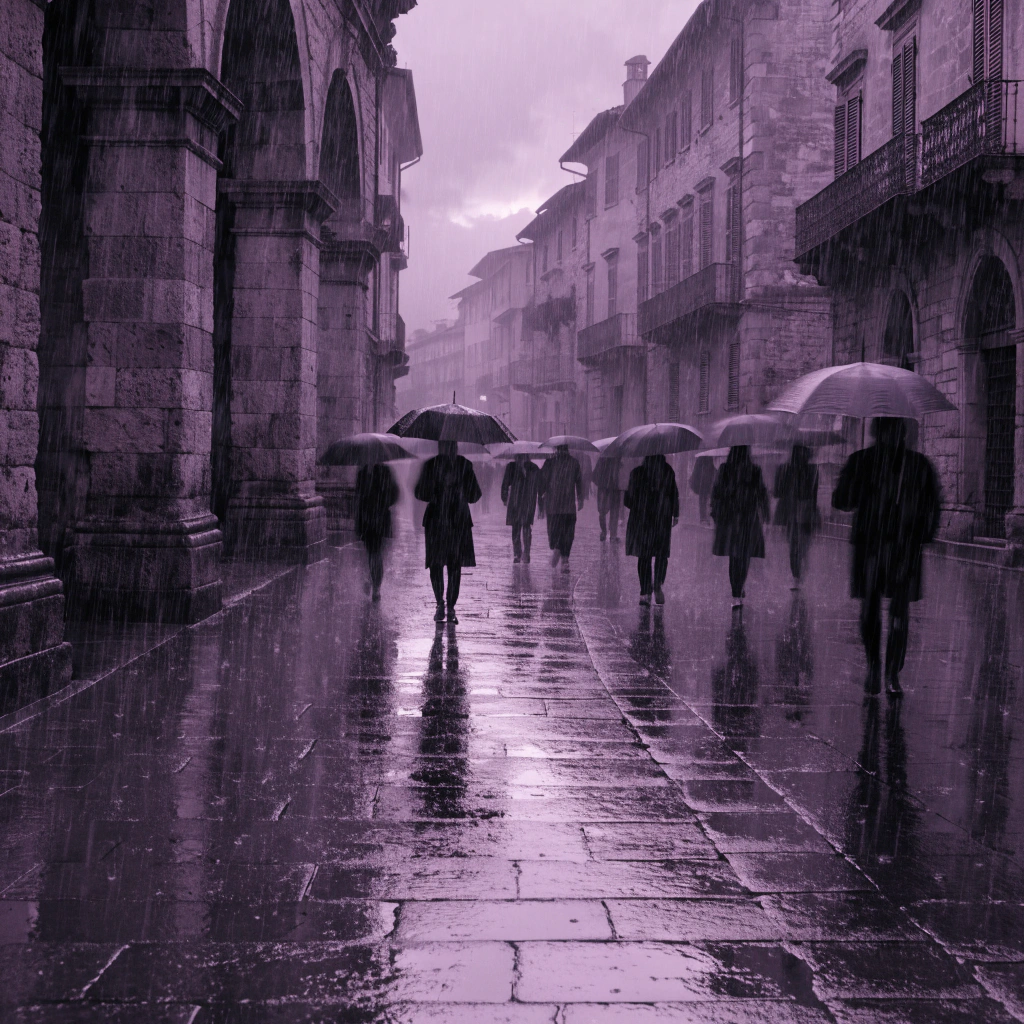
A Special Walk in Italy
In Italy, people love a special tradition. It is called "La Passeggiata." This name means "the little walk." Every evening, people go outside. They walk in the city center or in the main square.
Men, women, and children walk together. They talk to friends and neighbors. They wear nice clothes for the walk. Usually, the walk is before dinner. It is a very slow walk.
This tradition is very important in Italy. It is a time for family and friends. People see many people. They smile and say "hello." Italy is a beautiful country for a walk.
Grammar Spotlight
Pattern: Present Simple 'To Be'
"This tradition is very important in Italy."
We use 'is' with singular subjects like 'tradition' to describe a fact or a state. It is one of the most common verbs in English.
Pattern: Present Simple (Habits)
"They talk to friends and neighbors."
We use the base form of the verb (talk) for plural subjects like 'they'. This pattern describes things people do regularly.
Test Your Understanding
10 questions · A1 Beginner · 1 free preview
Test what you learned from this article. Answer all questions to earn XP!
What is 'La Passeggiata'?
Want to finish the quiz?
9 more questions are waiting for you. Sign up free to unlock the full quiz and earn XP!
Sign Up FreeAlready have an account? Sign In
Question Breakdown
What is 'La Passeggiata'?
Your answer:
Correct answer: A little walk
The walk usually happens in the morning.
Your answer:
Correct answer: False
What is a 'neighbor'?
Your answer:
Correct answer: A person who lives near you
Italy is a beautiful _____ for a walk.
Your answer:
Correct answer: country
The Beautiful Italian Walk
Every evening in Italy, people do something very special. They go for a walk called 'La Passeggiata.' This means 'the little walk' in English. It is a famous tradition in many Italian towns.
Between 5:00 PM and 8:00 PM, the streets become very busy. People leave their homes and go to the main square. Families walk together, and friends meet to talk. You can see young children and older grandparents.
This walk is not for exercise. People wear their best clothes because they want to look nice. They walk slowly and look at the shop windows. Many people stop to buy a gelato or a coffee. They talk about their day and enjoy the beautiful weather.
In the past, this was the best way to meet new people. Today, it is still a great way to see friends. It is slower than a normal walk, but it is much more social. It is a beautiful part of Italian life.
Grammar Spotlight
Pattern: Comparative Adjectives
"It is slower than a normal walk, but it is much more social."
We use comparatives to compare two things. For short words, we add '-er' (slow -> slower). For long words, we use 'more' (more social).
Pattern: Past Simple of 'To Be'
"In the past, this was the best way to meet new people."
We use 'was' or 'were' to talk about situations in the past. 'Was' is the past form of 'am' and 'is'.
Test Your Understanding
11 questions · A2 Elementary · 1 free preview
Test what you learned from this article. Answer all questions to earn XP!
When does 'La Passeggiata' usually happen?
Want to finish the quiz?
10 more questions are waiting for you. Sign up free to unlock the full quiz and earn XP!
Sign Up FreeAlready have an account? Sign In
Question Breakdown
When does 'La Passeggiata' usually happen?
Your answer:
Correct answer: Between 5:00 PM and 8:00 PM
The main reason for the walk is to get fast exercise.
Your answer:
Correct answer: False
What does the word 'square' mean?
Your answer:
Correct answer: An open area in a town
Between 5:00 PM and 8:00 PM, the streets become very _____.
Your answer:
Correct answer: busy
Why do people wear their best clothes?
Your answer:
Correct answer: Because they want to look nice
The Italian Art of the Evening Walk
Have you ever visited Italy and noticed that the streets become crowded just before sunset? This tradition is called 'La Passeggiata,' which literally means 'the little walk.' It is one of the most enduring social rituals in Italian life. Every evening, typically between 5:00 PM and 8:00 PM, residents leave their homes to walk through the historic centers of their towns.
This activity has been part of Italian culture for many generations. It is not just a simple walk for exercise; it is an occasion to see friends and be seen by the community. People often dress in their most elegant clothes because the goal is to make a good impression. The main streets, which are often closed to cars, are filled with people of all ages. You will see grandparents walking with children and teenagers laughing together.
The walk usually takes place along the main pedestrian street or around the central square, known as the 'piazza.' It is a time when the busy pace of the day slows down. Friends stop to chat, and families enjoy an ice cream before they go home for their evening meal.
While many things have changed in modern Italy, La Passeggiata remains a vital part of the day. It is a tradition which helps people feel connected to their neighbors. If you visit Italy, you should definitely join in. It is a relaxed way to experience the local lifestyle and enjoy the beautiful atmosphere of the 'centro storico'.
Grammar Spotlight
Pattern: Present Perfect
"This activity has been part of Italian culture for many generations."
The present perfect is used to describe an action or state that started in the past and continues to the present. It is formed with 'have' or 'has' plus the past participle.
Pattern: Passive Voice
"The main streets, which are often closed to cars, are filled with people of all ages."
The passive voice shifts the focus from the person doing the action to the person or thing receiving it. It is formed using the verb 'to be' and the past participle of the main verb.
Test Your Understanding
11 questions · B1 Intermediate · 1 free preview
Test what you learned from this article. Answer all questions to earn XP!
What is the primary purpose of La Passeggiata?
Want to finish the quiz?
10 more questions are waiting for you. Sign up free to unlock the full quiz and earn XP!
Sign Up FreeAlready have an account? Sign In
Question Breakdown
What is the primary purpose of La Passeggiata?
Your answer:
Correct answer: To socialize and see other people
La Passeggiata usually takes place after people have finished their evening meal.
Your answer:
Correct answer: False
What does 'elegant' mean in the context of the article?
Your answer:
Correct answer: Stylish and attractive
The walk usually takes place along the main _____ street.
Your answer:
Correct answer: pedestrian
Where does the walk typically happen?
Your answer:
Correct answer: In the historic centers of towns
The Art of the Italian Stroll: Understanding La Passeggiata
In the heart of every Italian town, as the sun begins its gradual descent, a remarkable transformation occurs. This daily ritual, known as 'La Passeggiata,' is far more than a simple evening stroll; it is a sophisticated social performance that has defined Italian communal life for centuries. Typically occurring between the hours of five and eight in the evening, this tradition involves residents of all generations congregating in the historic center to walk slowly along the main pedestrian thoroughfares. This movement is not directed toward a specific destination; rather, the journey itself is the objective.
While an outsider might perceive this activity merely as a form of light exercise, the practice is deeply rooted in the concept of 'bella figura'—the art of presenting one’s best self to the world. Consequently, participants are often dressed with meticulous care, reflecting an aesthetic standard that transcends mere fashion. This emphasis on appearance facilitates a complex dance of social observation, as individuals acknowledge neighbors, exchange brief greetings, and subtly evaluate the changes in their community. It is a time for public display where the private lives of citizens momentarily intersect in the shared space of the piazza.
Furthermore, the ritual serves as a vital mechanism for social cohesion, ensuring that the elderly remain visible and integrated within the community while the younger generation learns the nuances of local etiquette. Unlike the structured environment of an office or a school, the street provides a neutral ground where hierarchies are softened. Despite the rise of digital communication and the allure of social media, La Passeggiata remains an enduring pillar of Italian identity. It provides a spontaneous forum for political debate, romantic encounters, and family bonding that cannot be replicated through a screen.
The rhythmic pace of the walk, which is never rushed, encourages a meditative state that contrasts sharply with the frantic nature of modern globalized life. Were this tradition to disappear, the very fabric of Italian urban existence would be significantly diminished. In an era where many societies are becoming increasingly fragmented, this communal experience highlights the profound human need for physical presence and shared public spaces. Ultimately, the stroll is a testament to the Italian belief that life should be savored collectively, rather than consumed in isolation, proving that some traditions are too essential to be abandoned.
Grammar Spotlight
Pattern: Passive Voice
"the practice is deeply rooted in the concept of 'bella figura'"
The passive voice is used here to focus on the practice itself rather than the people performing it. It is formed using the verb 'to be' plus the past participle.
Pattern: Relative Clauses
"The rhythmic pace of the walk, which is never rushed, encourages a meditative state"
This non-defining relative clause provides extra information about the 'pace of the walk'. It is separated by commas and uses 'which' to refer back to the noun.
Pattern: Second Conditional (Inverted)
"Were this tradition to disappear, the very fabric of Italian urban existence would be significantly diminished."
This is a formal version of 'If this tradition were to disappear'. The inversion of 'were' and the subject creates a more academic and hypothetical tone.
Test Your Understanding
11 questions · B2 Upper Intermediate · 1 free preview
Test what you learned from this article. Answer all questions to earn XP!
What is the primary objective of La Passeggiata according to the text?
Want to finish the quiz?
10 more questions are waiting for you. Sign up free to unlock the full quiz and earn XP!
Sign Up FreeAlready have an account? Sign In
Question Breakdown
What is the primary objective of La Passeggiata according to the text?
Your answer:
Correct answer: The act of walking and socializing itself
La Passeggiata is a modern tradition that started with the rise of social media.
Your answer:
Correct answer: False
What does the word 'aesthetic' refer to in the article?
Your answer:
Correct answer: A concern with beauty and appearance
The ritual serves as a vital mechanism for social _____, keeping the elderly integrated.
Your answer:
Correct answer: cohesion
What does the concept of 'bella figura' involve?
Your answer:
Correct answer: Presenting one's best self to the public
Beyond the Promenade: The Sociocultural Significance of La Passeggiata
In towns and cities scattered across the Italian peninsula, as the sun initiates its slow, golden descent, an ephemeral yet pervasive transformation occurs within the urban fabric. This is the hour of 'La Passeggiata', a ritualized promenade that transcends the mundane requirements of physical exertion. Far from being a mere constitutional, it represents a sophisticated choreography of social interaction, wherein the 'centro storico' is repurposed as a grand stage for the manifestation of collective identity. Seldom does one witness such a seamless integration of public space and private identity as during these twilight hours. The streets, often centuries old and steeped in historical significance, serve as an open-air sanctuary for discourse, observation, and mutual recognition. This practice is not merely a stagnant relic of a bygone era; rather, it is a living testament to the resilience of Italian communal life in the face of increasing digital isolation and the encroachment of globalized consumerism.
It is the concept of 'bella figura' that dictates the unspoken sartorial requirements and behavioral norms of the evening. This term, which encapsulates a meticulous attention to outward appearance and social grace, ensures that the promenade remains a heightened aesthetic experience. This curation of self is not merely a matter of vanity; it is a profound social obligation to contribute to the collective beauty of the town. Participants do not merely walk; they present a curated version of themselves to their peers, engaging in a silent, visual dialogue that reaffirms their place within the local social hierarchy. While some critics might dismiss this display as inherently ostentatious or superficial, a more nuanced analysis reveals it to be a surprisingly egalitarian exercise. Regardless of socio-economic status, the piazza remains accessible to all, fostering a sense of belonging that is increasingly rare in the context of modern urban planning.
Furthermore, the preservation of communal bonds through the ritual of the walk prevents the total atomization of society. In an age where social media often acts as a surrogate for physical presence, La Passeggiata offers a tangible and necessary counterpoint. It facilitates the spontaneous exchange of local news, the bridging of generational divides as the elderly walk alongside the youth, and the reinforcement of regional heritage. The rhythmic, unhurried pace of the walk allows for a depth of conversation and reflection that the frantic nature of contemporary life typically precludes. Moreover, the architectural layout of Italian towns, typically centered around a primary piazza, is fundamental to the success of this tradition. The environment encourages the 'gaze'—the act of both seeing and being seen—which serves as a form of social glue. This mutual observation acts as an informal mechanism for social cohesion, where the community self-regulates and celebrates its continued existence.
Ultimately, the enduring popularity of this tradition suggests that the fundamental human need for physical connection and public affirmation remains undiminished. While globalization may threaten to homogenize local customs, the Italian promenade stands as a bastion of cultural continuity. It serves as a poignant reminder that the essence of a vibrant community is not found within its static infrastructure, but in the deliberate, shared movements and interactions of its people. As the lights of the trattorias begin to flicker on, the walkers slowly disperse, yet the social fabric has been subtly reinforced for another day.
Grammar Spotlight
Pattern: Inversion
"Seldom does one witness such a seamless integration of public space and private identity as during these twilight hours."
Inversion is used here for emphasis by placing a negative adverbial ('Seldom') at the start, followed by the auxiliary verb 'does' before the subject 'one'.
Pattern: Cleft Sentences
"It is the concept of 'bella figura' that dictates the unspoken sartorial requirements and behavioral norms of the evening."
An 'It-cleft' focuses on a specific noun phrase ('the concept of bella figura') to highlight it as the primary cause or agent within the sentence.
Pattern: Nominalisation
"The preservation of communal bonds through the ritual of the walk prevents the total atomization of society."
Nominalisation turns verbs like 'preserve' and 'atomize' into nouns ('preservation', 'atomization'), creating a more formal, academic tone typical of C1 English.
Test Your Understanding
12 questions · C1 Advanced · 1 free preview
Test what you learned from this article. Answer all questions to earn XP!
What is the primary role of the 'centro storico' during La Passeggiata?
Want to finish the quiz?
11 more questions are waiting for you. Sign up free to unlock the full quiz and earn XP!
Sign Up FreeAlready have an account? Sign In
Question Breakdown
What is the primary role of the 'centro storico' during La Passeggiata?
Your answer:
Correct answer: A stage for the manifestation of collective identity
The author suggests that La Passeggiata is a stagnant relic with no relevance to modern life.
Your answer:
Correct answer: False
Which word describes a belief in equality for all participants in the ritual?
Your answer:
Correct answer: Egalitarian
The walk prevents the total _____ of society by maintaining communal bonds.
Your answer:
Correct answer: atomization
According to the text, how does 'bella figura' affect the participants?
Your answer:
Correct answer: It dictates their attention to appearance and social grace.
The architectural layout of Italian towns is fundamental to the tradition's success.
Your answer:
Correct answer: True
The Choreography of the Corso: An Analytical Inquiry into the Italian Passeggiata
To the uninitiated observer, the evening ritual known as 'la passeggiata' might appear to be nothing more than a pedestrian excursion. However, such a reductionist view fails to account for the profound sociological underpinnings of this Italian institution. It is, in essence, a performative exhibition of communal identity, a twilight theater where the street becomes a stage and the citizenry both actors and audience. Rarely does one witness such a seamless blending of the private and public spheres as during these hours between five and eight in the evening. The temporal placement of the passeggiata is hardly coincidental. Occurring in the liminal space between the cessation of professional labor and the commencement of the evening meal, it serves as a psychological buffer. It is a moment of collective suspension, where the rigors of the clock are momentarily subverted in favor of a slow, rhythmic cadence. Should one deign to rush through the corso, they would be perceived as an anomaly, for the very essence of the ritual is its deliberate lack of urgency.
Central to this practice is the concept of 'bella figura'. While often crudely translated as 'the beautiful figure,' its implications are far more nuanced, encompassing a moral and aesthetic imperative to present oneself with dignity and poise. It is essential that the participant adhere to the unspoken codes of this philosophy, for to do otherwise would be to invite social censure. This is not merely an exercise in vanity or ostentation; rather, it is a vestigial remnant of a courtly culture that prizes grace and external harmony. The architectural configuration of the Italian town—centered around the piazza and the pedestrianized corso—is not merely a backdrop but an active participant in the ritual. The physical layout necessitates proximity, thereby precluding the possibility of total social withdrawal. This spatial intimacy fosters a unique form of civic engagement that is both pervasive and profound.
The ubiquity of the gaze during the passeggiata creates a self-regulating ecosystem where social norms are reinforced without the need for overt coercion. Information is exchanged, alliances are subtly reinforced, and the hierarchy of the community is perpetually renegotiated through brief encounters with one’s interlocutors. Were this ritual to vanish, the very fabric of Italian civic life would arguably unravel, as the shared spaces that foster such interactions are increasingly threatened by the pervasive encroachment of digital isolation. Critics might argue that such a tradition is an archaic subterfuge, a facade designed to mask the underlying economic anxieties of modern Italy. Yet, the propensity of the youth to participate alongside their elders suggests a resilient continuity. Far from being a relic of the past, the passeggiata adapts, integrating the contemporary into its ancient rhythm. It precludes the total atomization of society, reminding the individual that they are part of a larger, breathing whole. Ultimately, the quintessential nature of the passeggiata lies in its ephemeral beauty. It is a fleeting window of time where the city breathes together before retreating into the domestic sphere, remaining the most enduring testament to the Italian belief that the street is a vital organ of the community.
Grammar Spotlight
Pattern: Negative Inversion
"Rarely does one witness such a seamless blending of the private and public spheres as during these hours..."
Used for emphasis, the auxiliary verb is placed before the subject after a negative or restrictive adverbial. This structure is common in formal and academic English to highlight the rarity or importance of an observation.
Pattern: Present Subjunctive
"It is essential that the participant adhere to the unspoken codes of this philosophy..."
The base form of the verb (adhere) is used after adjectives of necessity or urgency. It emphasizes the mandatory nature of the action within a formal context.
Pattern: Inverted Hypothetical Conditional
"Were this ritual to vanish, the very fabric of Italian civic life would arguably unravel..."
This structure replaces 'If this ritual were to vanish' with a more formal inversion. It is used to discuss hypothetical or unlikely scenarios with a high degree of scholarly detachment.
Test Your Understanding
12 questions · C2 Mastery · 1 free preview
Test what you learned from this article. Answer all questions to earn XP!
What does the author suggest is the primary psychological function of the passeggiata?
Want to finish the quiz?
11 more questions are waiting for you. Sign up free to unlock the full quiz and earn XP!
Sign Up FreeAlready have an account? Sign In
Question Breakdown
What does the author suggest is the primary psychological function of the passeggiata?
Your answer:
Correct answer: A buffer zone between professional responsibilities and domestic life.
The concept of 'bella figura' is purely about physical attractiveness and fashion.
Your answer:
Correct answer: False
Which word describes the state of being found everywhere at once?
Your answer:
Correct answer: Ubiquity
The author argues that the ritual _____ the total atomization of society by fostering connection.
Your answer:
Correct answer: precludes
According to the text, how does the urban architecture influence the ritual?
Your answer:
Correct answer: It forces people into proximity, preventing social withdrawal.
The author believes that the digital age is a significant threat to traditional social rituals.
Your answer:
Correct answer: True
